If you want to better manage your business costs, understanding purchase price variance accounting is crucial.
1. Why a Small Supplier Price Change Becomes an Accounting Problem
Purchase price variance accounting measures the difference between a planned or standard inventory purchase cost and the price applied to a purchase transaction. It helps finance teams explain cost changes, prepare accurate journal entries, and decide how those differences affect inventory valuation and cost of goods sold (COGS).
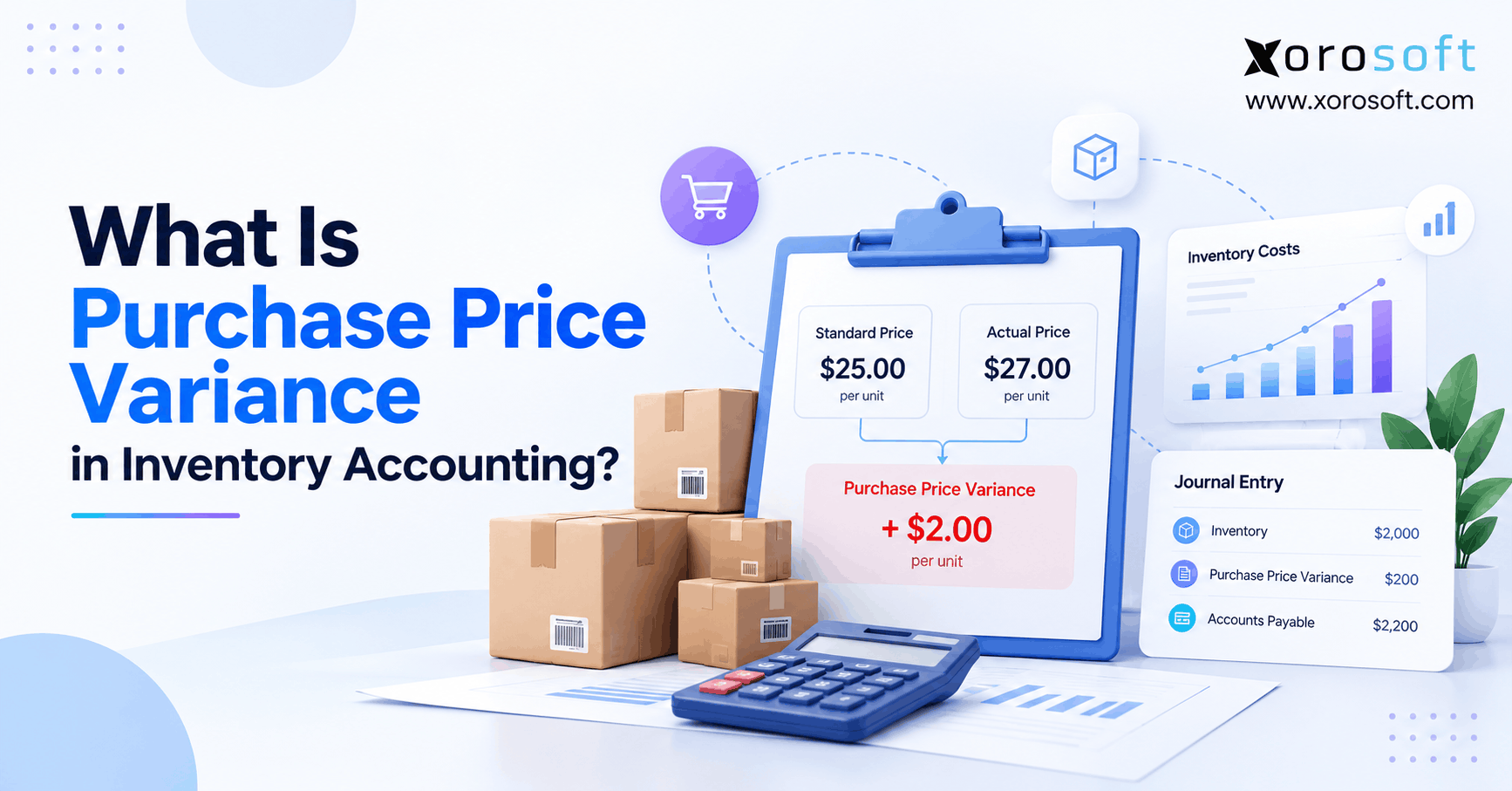
For example, suppose a distributor expects to buy 1,000 units at $25 each. However, its supplier charges $27. Consequently, the purchase costs $2,000 more than the standard amount. The calculation is simple; the accounting treatment needs more care.
1.1 Why PPV Accounting Matters Beyond Purchasing
First, purchasing must explain the revised price. Meanwhile, warehouse staff must confirm the units received. Finally, finance must record inventory, related liabilities, and any variance using the applicable costing rules. If these records disagree, month-end reconciliation becomes harder.
Therefore, this guide follows the transaction from purchase order to goods receipt and supplier invoice. It also explains when a price difference remains part of inventory cost, when it affects COGS, and how to investigate outstanding balances.
2. Purchase Price Variance Accounting: Definition and Scope
Purchase price variance (PPV) compares an expected cost with the applicable purchase price for a defined quantity. In a standard-cost environment, that baseline is usually a predetermined unit cost. However, a purchasing performance report may use the approved contract or purchase order price instead.
2.1 Standard Cost Versus Actual Purchase Cost
A standard cost is a controlled estimate used to value or analyze inventory transactions. By contrast, actual acquisition cost reflects eligible costs incurred to bring inventory to its present location and condition. Therefore, the two amounts may differ even when receiving and invoicing are accurate.
For example, a company may use a $40 standard for a product but place a new order at $42. Although the difference deserves investigation, it does not automatically indicate a mistake. The supplier may have changed prices under an approved agreement.
2.2 What a Purchase Cost Variance Actually Tells You
PPV answers a narrow question: how far did the relevant purchase price differ from its baseline? However, it does not explain why that difference occurred or whether the purchase was commercially sensible. A rush replenishment may produce an unfavorable PPV while preventing a larger stockout.
Consequently, finance should report the variance alongside supplier terms, buying decisions, product specifications, and quantity changes. For the broader purchasing explanation, see the purchase price variance formula and causes guide.
2.3 Who Needs Detailed PPV Accounting?
Manufacturers and high-volume distributors often use standard costs to monitor repeated purchases. Similarly, multi-warehouse businesses may need detailed transaction evidence when receipts and invoices cross accounting periods. In contrast, a small company using actual-cost inventory accounting may not need a separate PPV ledger account.
Either way, accurate inventory costs remain essential. Therefore, choose the level of analysis that fits the costing policy, reporting requirements, and transaction volume.
3. How to Calculate Inventory Purchase Price Variance
A common formula subtracts the standard unit price from the actual unit purchase price, then multiplies the difference by the applicable quantity.
PPV = (Actual purchase price − Standard purchase price) × Quantity
Under this convention, a positive result is unfavorable and a negative result is favorable. However, some reports reverse the subtraction order. Therefore, confirm the sign convention before interpreting a debit, credit, or negative amount.
3.1 What an Unfavorable Result Looks Like
Suppose a sporting goods distributor receives 800 units at $44 each against a $40 standard. The calculation is ($44 − $40) × 800 = $3,200 unfavorable. As a result, the order exceeds the baseline by $3,200.
Next, compare the supplier invoice with the purchase order. If the invoice differs, another adjustment may be needed. Importantly, do not use the invoice price as the receipt price without checking how the accounting system defines each stage.
3.2 Favorable PPV Accounting Example
Now assume a furniture buyer receives 600 components at $72 each against a $75 standard. The result is ($72 − $75) × 600 = −$1,800, or $1,800 favorable under this formula.
Nevertheless, lower price alone does not prove better purchasing. For example, a quality downgrade or higher freight cost can offset the saving. Consequently, analyze the price difference without confusing it with total landed cost or supplier performance.
3.3 Why the Quantity Basis Matters
If an order covers 1,000 units but only 400 arrive before month-end, a receipt-based PPV normally uses those 400 units. By contrast, a purchasing forecast might evaluate all 1,000 ordered units. Therefore, reports with different quantity bases can show different totals without either being mathematically wrong.
Always identify the transaction date, unit of measure, received quantity, standard-cost version, and price source. Otherwise, an apparent variance may simply be a comparison error.
4. PPV Accounting Across the Purchase-to-Invoice Process
Purchasing, receiving, and billing may happen on different dates. Consequently, purchase price variance accounting requires a clear sequence of events rather than one calculation copied into every report.
4.1 Purchase Order and Approved Cost Baseline
First, the buyer creates a purchase order using a supplier price. Meanwhile, the item may carry a different standard cost for inventory accounting. Although the purchase order creates an operational commitment, it does not automatically mean the goods have been received or that a normal inventory asset exists.
Therefore, finance should keep the approved order price and the standard cost separate. This distinction becomes important when the receiving transaction is posted.
4.2 Goods Receipt and Purchase Price Variance
Next, the warehouse confirms the received quantity. In some standard-cost systems, inventory is recognized at standard cost, while a PPV account records the difference from purchase-order price. At the same time, a goods-received-not-invoiced (GRNI) accrual may record the expected liability.
For example, a receipt can recognize $2,000 in inventory, a $200 unfavorable variance, and a $2,200 accrual. However, the timing and account names depend on system configuration. In purchase price variance accounting, accurate receipt records help finance teams trace cost differences back to the original purchase order.
4.3 Supplier Invoice and Price Adjustments
Finally, accounts payable matches the invoice to the purchase order and receipt. If the invoice price is higher than the accrued receipt price, a separate invoice price variance may arise. Alternatively, an actual-cost system may adjust inventory costs according to its rules.
Therefore, never classify every late supplier adjustment as receipt-level PPV. Instead, identify the original cost baseline and the accounting event that created the difference.
5. Purchase Price Variance Accounting Journal Entries
The following example uses a standard-cost, receipt-level PPV method with a separate invoice price variance. These entries are illustrative, not universal. For instance, actual-cost systems and different ERP configurations may post cost adjustments differently.
| Transaction detail | Amount |
|---|---|
| Quantity received | 100 units |
| Standard cost per unit | $20 |
| Purchase order price per unit | $22 |
| Supplier invoice price per unit | $23 |
5.1 Unfavorable PPV Entry When Goods Arrive
At receipt, the purchase order exceeds standard cost by ($22 − $20) × 100 = $200. Therefore, this example debits inventory at $2,000, debits PPV by $200, and credits the receipt accrual by $2,200.
| Receipt journal | Debit | Credit |
|---|---|---|
| Inventory | $2,000 | — |
| Purchase price variance | $200 | — |
| GRNI / receipt accrual | — | $2,200 |
| Total | $2,200 | $2,200 |
As a result, the entry balances while preserving the difference from standard cost. However, the final financial statement treatment still requires review.
5.2 Invoice Price Variance Entry When the Bill Arrives
The invoice totals $2,300, while the receipt accrual equals $2,200. Consequently, the additional invoice difference is ($23 − $22) × 100 = $100. Under this example’s separate-variance method, the entry clears the accrual and recognizes the payable.
| Invoice journal | Debit | Credit |
|---|---|---|
| GRNI / receipt accrual | $2,200 | — |
| Invoice price variance | $100 | — |
| Accounts payable | — | $2,300 |
| Total | $2,300 | $2,300 |
Together, the $200 receipt PPV and $100 invoice difference explain the $300 total excess over standard cost. Nevertheless, not every ERP posts two variance accounts.
5.3 Favorable Purchase Price Variance Journal Entry
Now change the purchase-order price to $18 and keep the $20 standard cost and 100-unit receipt. The PPV becomes ($18 − $20) × 100 = −$200, meaning $200 favorable. Therefore, a simple receipt entry can credit PPV instead of debiting it.
| Favorable receipt journal | Debit | Credit |
|---|---|---|
| Inventory | $2,000 | — |
| GRNI / receipt accrual | — | $1,800 |
| Purchase price variance | — | $200 |
| Total | $2,000 | $2,000 |
However, a favorable credit is not automatically permanent income. Finance must determine its appropriate treatment under the costing method and reporting framework.
6. PPV vs. Invoice Price Variance and Cost Adjustments
Although these terms sound similar, they often describe differences at separate points in the transaction lifecycle. Therefore, defining the baseline prevents double-counting and incorrect accounting explanations.
6.1 Purchase Price Variance Versus Invoice Price Variance
In one common standard-cost workflow, receipt PPV compares purchase-order price with standard cost. Meanwhile, invoice price variance compares the final invoice with the purchase-order or accrued receipt price. Consequently, the same purchase may generate both differences.
| Difference | Typical comparison | Common review point |
|---|---|---|
| Receipt PPV | PO price vs. standard cost | Goods receipt |
| Invoice price variance | Invoice price vs. PO/accrual | Invoice matching |
| Landed-cost adjustment | Eligible additional acquisition cost | Cost allocation |
However, terminology and posting timing differ between systems, so always verify the configuration.
6.2 Why Invoice Matching Prevents False PPV Signals
For example, a supplier may bill 95 units after the warehouse records a receipt of 100. The difference may come from a partial invoice, shortage, or billing mistake rather than a price change. Therefore, compare quantities and units of measure before calculating a unit-price variance.
Similarly, a supplier credit can correct a previously recorded cost. Consequently, retaining the original receipt and invoice references makes later adjustments easier to reconcile.
6.3 Standard Cost Variance Versus Purchasing Performance
A standard-cost variance shows how actual acquisition costs compare with an accounting baseline. In contrast, a buyer may measure savings against last year’s contract price. Both analyses can be useful, but they answer different questions.
Therefore, financial reports should label the cost basis clearly. Otherwise, teams may celebrate savings that do not correspond to the standard-cost variance shown in the general ledger.
7. Inventory Valuation Under Different Costing Methods
Not every company records purchase price differences in a dedicated variance account. Instead, the accounting outcome depends on inventory cost measurement, cost formulas, and the company’s reporting policies.
7.1 PPV Under Standard Costing
With standard costing, transactions use predetermined costs while variances capture departures from those standards. However, standards should remain a reasonable approximation of eligible actual inventory costs for financial reporting. As a result, material differences may require adjustment or appropriate allocation.
The IAS 2 inventory accounting standard explains eligible purchase costs, inventory measurement, and expense recognition. Therefore, do not assume that posting an amount to a PPV account settles its ultimate financial treatment.
7.2 FIFO and Weighted-Average Inventory Costs
Under FIFO, eligible costs follow the assumed sequence of inventory consumption or sale. Meanwhile, weighted-average costing combines eligible costs into an average unit value. Consequently, a supplier price change may update inventory cost instead of appearing as a separate standard-cost PPV entry.
However, the eventual cost adjustment still depends on the receipt, invoice timing, and units remaining. For a related control process, see the inventory reconciliation guide.
7.3 Does PPV Affect Inventory or COGS?
Suppose the eligible final acquisition cost exceeds standard cost by $3 per unit for 100 units. If 40 units remain and 60 have been sold, a simplified cost allocation would attribute $120 to remaining inventory and $180 to sold units.
Nevertheless, this example is not a universal journal-entry rule. Instead, finance must consider the accounting policy, costing method, transaction timing, and whether the difference qualifies as inventory cost. Therefore, purchase price variance accounting helps businesses distinguish costs that belong to remaining inventory from those associated with goods already sold.
8. Gross Margin and Financial Reporting
A price difference affects operations immediately, but its reported profit effect may appear later. Therefore, managers should distinguish purchasing performance from recognized gross margin.
8.1 When an Unfavorable PPV Reduces Margin
Higher eligible acquisition costs can reduce margin when the related goods are sold and revenue remains unchanged. However, the business might offset higher costs through better selling prices, supplier rebates, or lower logistics expenses. Consequently, a large unfavorable PPV does not always equal an identical reduction in current-period profit.
For example, higher-cost inventory received in October may not enter COGS until November or December. Therefore, finance should identify which units remain on hand.
8.2 Why a Favorable Variance Needs Context
A lower buying price looks attractive. Nevertheless, quality problems, longer lead times, and additional handling may erase its benefit. For example, a discount on a bulky furniture item can be outweighed by damage costs.
Therefore, purchasing teams should review PPV alongside landed cost, supplier performance, and product profitability. Similarly, finance should resist treating favorable price variances as proof of improved operating results without examining related costs.
8.3 Connecting PPV Accounting to Inventory Reporting
When purchasing and accounting use different cost baselines, the same product can appear profitable in one report and less profitable in another. As a result, managers may misread category performance or replenishment economics.
Xorosoft connects purchasing, inventory, accounting, and reporting workflows within its cloud ERP platform. However, reliable decisions still require consistent costing policies and verified transaction data.
9. Landed Costs, Currency, and Unit-of-Measure Errors
Sometimes a reported PPV is not really a change in the supplier’s quoted unit price. Instead, additional costs or inconsistent data can produce a misleading comparison.
9.1 Freight, Duties, and Landed Cost Differences
Freight, import duties, and certain handling costs may form part of eligible inventory cost. However, they should not automatically be classified as supplier price variance. For example, an unchanged $50 vendor price plus $4 of additional freight creates a higher acquisition cost without a supplier price increase.
Therefore, track the source of the difference before deciding how to post it. This separation also improves purchasing accountability.
9.2 Currency Differences in International Purchases
A foreign-currency purchase may involve an order date, receipt date, and invoice date with different exchange rates. Consequently, the difference may include currency effects as well as supplier price changes.
Because exchange differences have their own accounting rules, finance should not indiscriminately add them to PPV. Instead, confirm the functional currency, applicable recognition date, and configured exchange-rate treatment.
9.3 Units of Measure and Product Conversions
A supplier might quote cases of 12 while the inventory system tracks individual units. Therefore, a case price entered as a unit price can create a large false variance. Similarly, inconsistent weight or packaging conversions can distort receipts.
Before investigating vendor pricing, verify the product master, conversion factor, and invoice quantity. Often, the first control is cleaner data rather than a new accounting adjustment.
10. Partial Receipts, Returns, and Cutoff Controls
The same purchase order may produce several receipts, invoices, corrections, and credits. Therefore, purchase price variance accounting should preserve the chronology rather than treating the order as a single financial event.
10.1 PPV on Partial Receipts
Suppose 600 of 1,000 ordered units arrive before September closes, while the remaining 400 arrive in October. A receipt-based variance typically reflects the first 600 units in September. However, the later receipt may use a new standard cost or exchange rate.
Consequently, finance should reconcile variances at receipt level before combining them into a purchase-order summary.
10.2 Supplier Credits and Purchase Returns
A supplier may issue a credit for damaged goods or incorrect pricing. In that case, the business may need to reverse part of the payable, inventory cost, or variance. Nevertheless, the right entry depends on whether the goods were returned, remain in stock, or have already been sold.
Therefore, always link a credit to the original receipt and invoice. Otherwise, favorable and unfavorable differences can accumulate without an obvious explanation.
10.3 Month-End Receipt and Invoice Cutoff
Goods received on September 30 may be invoiced on October 5. Consequently, the company must determine which costs and liabilities belong in September. Similarly, a backdated transaction may change an already reviewed valuation report.
For that reason, retain posting dates, document dates, receipt status, and accounting-period controls. Accurate cutoff is just as important as a correct PPV formula.
11. Month-End Purchase Price Variance Reconciliation
A variance account does not need to be forced to zero. Instead, finance should explain its balance, identify material exceptions, and ensure the accounting treatment matches the underlying inventory transactions.
11.1 PPV Accounting Reconciliation Checklist
First, define the legal entity, currency, reporting period, and relevant general ledger accounts. Next, compare the variance detail with receipts, purchase orders, supplier invoices, and cost adjustments. Then, check standard-cost revisions, manual journals, and outstanding accruals.
Finally, review the balance for appropriate inventory or expense treatment and document approved corrections. The inventory subledger reconciliation process provides a complementary framework for matching detailed inventory valuations to GL balances.
11.2 Investigating Unexplained Variance Balances
Start with the largest and oldest unresolved amounts. For example, an unmatched supplier invoice may create a timing difference, while an incorrect account mapping may move a valid cost into the wrong ledger category. Therefore, investigate source documents before posting a balancing journal.
| Exception | Evidence to review | Primary owner |
|---|---|---|
| Supplier price change | PO, approval, contract | Purchasing |
| Receipt quantity error | Receiving record, unit conversion | Warehouse |
| Invoice mismatch | Invoice, accrual, vendor credit | Accounts payable |
| Inventory valuation difference | Cost history, GL posting | Finance |
11.3 Closing the Period Without Hiding Errors
Once an exception is explained, finance can determine whether correction, allocation, or documentation is appropriate. However, an unsupported journal that merely clears PPV can obscure the real problem. Consequently, close procedures should require a reviewer, supporting reference, and evidence of resolution.
Xorosoft brings related inventory, purchasing, warehouse, and accounting information into a connected system. Nevertheless, the accounting owner must still confirm posting rules and approve period-end treatment.
12. Controls That Reduce Unfavorable PPV
Price variance analysis becomes more useful when it changes future buying decisions. Therefore, purchasing and finance should address repeat causes rather than repeatedly reconciling the same exceptions.
12.1 Supplier Price Approval and Change Tracking
First, maintain approved supplier prices and effective dates. Next, require a documented reason when buyers override an agreed price. In addition, track changes to freight terms, payment terms, and packaging.
For example, a valid emergency buy may still produce an unfavorable variance. However, recording the reason lets management distinguish preventable leakage from an intentional service decision.
12.2 Standard Cost Review and Exception Thresholds
Standards should be reviewed at a frequency suited to price volatility and financial policy. Otherwise, outdated benchmarks can make ordinary purchases look consistently unfavorable. At the same time, changing standards too often can hide trends.
Therefore, establish approval controls, effective dates, and materiality thresholds. For instance, investigate either a large absolute dollar difference or a persistent supplier-level pattern.
12.3 Assigning Accountability Across Teams
Purchasing should own supplier prices and approvals. Meanwhile, warehouse teams should own receipt quantities and dates, and finance should own valuation, reconciliation, and financial statements. Consequently, each exception reaches the team that can explain it.
Moreover, recurring supplier price differences should feed purchasing reviews rather than remain buried in the month-end GL.
13. Price Differences Across Product Industries
Although the accounting principles remain consistent, the operational causes vary across inventory-driven businesses. Therefore, a useful PPV report should include product and supplier context.
13.1 Apparel and Sporting Goods Cost Changes
Apparel brands may face seasonal supplier repricing and different costs across sizes or production runs. For example, 600 jackets received at $48 against a $45 standard generate a $1,800 unfavorable PPV. Meanwhile, sporting goods distributors may pay premiums for urgent replenishment before a major selling period.
Consequently, both teams should review variance alongside seasonality, expected margin, and stock availability.
13.2 Furniture and Wholesale Purchase Cost Variances
Furniture businesses may face bulky shipping costs and changing material prices. However, freight should be analyzed separately from supplier unit-price differences when determining the cause. In wholesale distribution, customer-specific orders and multiple supplier sources can also change purchase economics.
For example, 80 chairs bought for $115 against a $120 standard produce a $400 favorable variance. Nevertheless, the final landed cost may tell a different story.
13.3 Food and Manufacturing Cost Differences
Food businesses often face volatile ingredient prices. Similarly, manufacturers must separate material purchase price changes from excess material usage or production inefficiency. For example, a $0.25 increase across 2,000 units creates a $500 unfavorable price variance.
Xorosoft supports inventory-driven organizations across manufacturing, wholesale, apparel, food, furniture, and sporting goods. However, each business must define variance rules that reflect its costing method and operating model.
14. ERP Workflows for Purchase Price Variance Accounting
Spreadsheets can calculate PPV accurately. However, the larger challenge is connecting the calculation to receiving, invoices, inventory valuation, and the general ledger. Consequently, software evaluation should focus on the complete transaction trail.
14.1 What Connected ERP Accounting Should Show
A useful demonstration should trace one purchase order through partial receipt, supplier invoice, cost adjustment, and period-end reporting. Moreover, finance should be able to examine the SKU, supplier, quantity, currency, dates, and related accounting documents.
Xorosoft’s XoroERP connects purchasing, inventory, and accounting operations. Nevertheless, buyers should verify the specific PPV posting and valuation workflow in their intended configuration rather than assuming every method is supported identically.
14.2 Warehouse and Multi-Channel Cost Visibility
For businesses with multiple locations, receiving accuracy and transaction timing influence the reliability of accounting inputs. Likewise, ecommerce operations may introduce additional order and fulfillment complexity.
Xorosoft’s XoroWMS provides warehouse management and inventory visibility capabilities. As a result, teams evaluating a connected system can consider how warehouse evidence supports purchasing and financial review without confusing WMS activity with accounting approval.
14.3 When a Simpler Approach Is Enough
A small business with limited SKUs, one warehouse, and an actual-cost policy may manage supplier price changes through basic accounting and purchasing reports. By contrast, multiple warehouses, frequent invoice differences, and recurring reconciliation delays increase the value of connected workflows.
Therefore, assess requirements before choosing a system. An ERP readiness assessment can help identify whether manual handoffs have become a structural problem.
15. Conclusion: Turn PPV Accounting Into Better Cost Control
Purchase price variance accounting helps connect buying decisions to inventory costs and financial records. However, a correct formula is only the starting point. Finance must also establish the price baseline, identify receipt and invoice differences, apply the right costing method, and reconcile balances to source documents.
Therefore, prioritize clear standards, disciplined receiving, supplier invoice matching, and documented month-end review. In addition, investigate recurring variance patterns before they turn into unreliable margins or delayed closes.
For growing inventory businesses, Xorosoft’s XoroONE combines purchasing, inventory, warehouse, accounting, and reporting workflows. If you need to evaluate those connections using your actual transactions, Book a Demo and request a purchase-to-accounting walkthrough.
Frequently Asked Questions
What is purchase price variance in inventory accounting?
Purchase price variance compares an actual purchase price with a standard or expected price for a defined quantity. Therefore, it helps explain inventory cost differences and supports accounting review.
How do you calculate purchase price variance?
Subtract standard unit price from actual unit price, then multiply by the applicable quantity. For example, a $2 increase across 100 units creates a $200 unfavorable variance under this convention.
What is an unfavorable PPV journal entry?
In one standard-cost receipt method, debit inventory at standard cost, debit PPV for the excess, and credit the receipt accrual. However, posting rules vary by costing configuration.
Does purchase price variance affect inventory or COGS?
It can affect either, depending on eligible acquisition costs, costing method, and whether the goods remain on hand or have been sold. Therefore, review the financial treatment before closing.
What is the difference between PPV and invoice price variance?
Receipt PPV can compare purchase-order price with standard cost. Meanwhile, invoice price variance compares an invoice with the order or accrued receipt amount. However, definitions vary across systems.
Why does a PPV account have a balance at month-end?
It may contain valid cost differences, pending invoices, or unresolved adjustments. Therefore, reconcile transactions and confirm financial treatment rather than automatically forcing the balance to zero.
When should a business use ERP for PPV tracking?
Consider ERP when partial receipts, multiple warehouses, supplier price changes, and separate accounting systems create recurring reconciliation work. First, test the purchase-to-ledger process against your actual requirements.
Recent Posts
-
 How to Calculate Ecommerce Warehouse Capacity Before Peak Season
-
 Manufacturing Scrap Statistics 2026: Material Loss, Yield, and Cost
-
 ERP Software for Cosmetics Distributors Managing Lots, Wholesale, and Ecommerce
-
 Xorosoft vs Cin7 Core for Multi-Warehouse Wholesale Operations
-
 How a Multi-Warehouse Company Reduced Inventory Reconciliation Work at Month-End