Understanding purchase price variance is essential for managing costs effectively in any business.
1. Why Purchase Price Variance Matters as Costs Scale
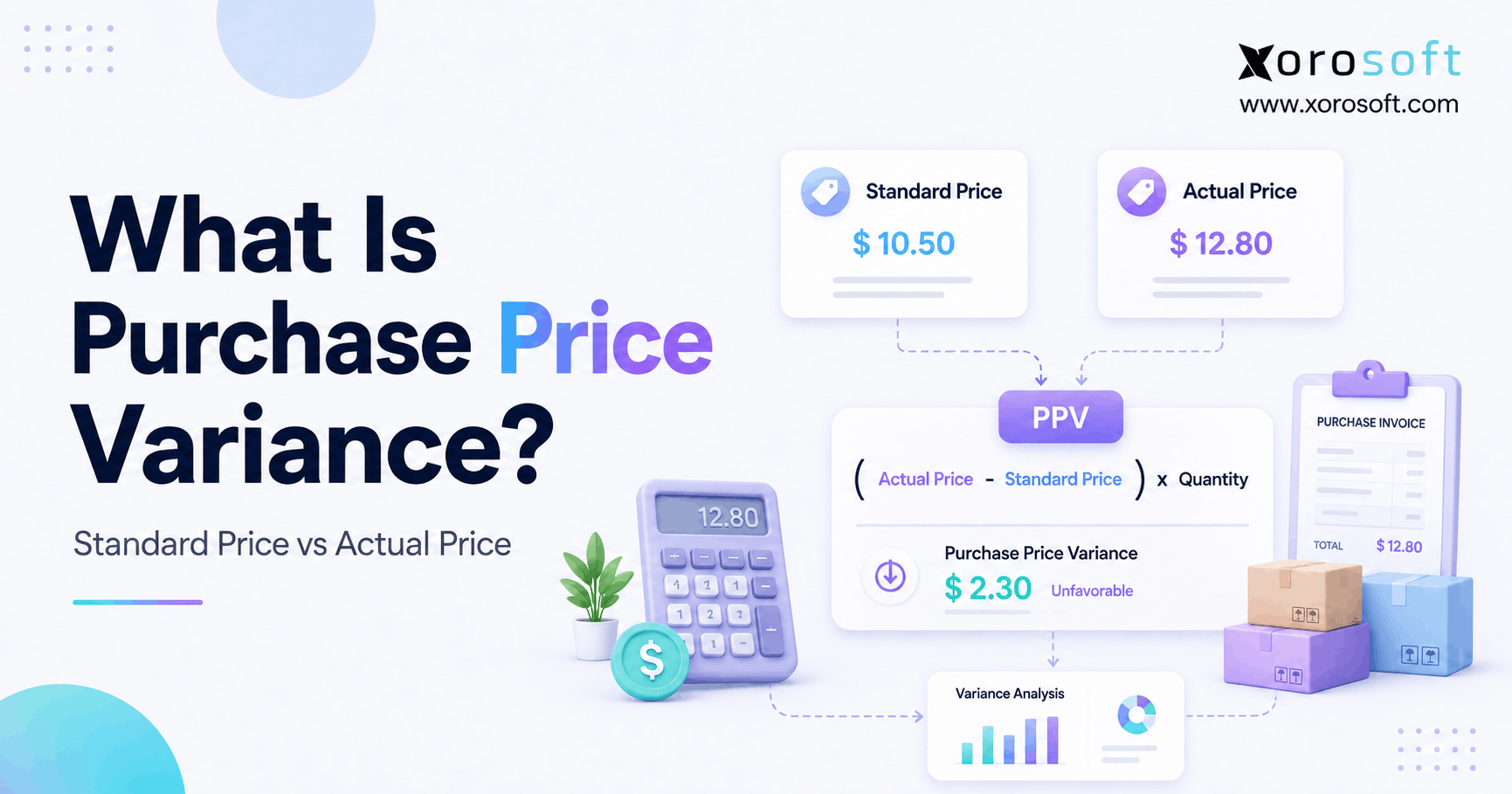
Purchase price variance measures the difference between what a business expected to pay for purchased inventory and what it actually paid. Therefore, it gives procurement and finance teams an immediate way to see whether purchasing costs are moving above or below expectations.
For example, a $1 difference may look insignificant on a single unit. Across 50,000 units, however, that same difference becomes $50,000.
As a result, purchase price variance, commonly called PPV, matters far beyond the purchasing department. It can influence margins, inventory economics, budgets, supplier negotiations, and financial reporting. Moreover, because inventory-driven companies often buy thousands of products from multiple suppliers, small pricing differences can accumulate quickly.
For that reason, purchase price variance becomes increasingly important as purchasing volume, supplier count, and SKU complexity grow.
Rather than treating PPV as simply another accounting calculation, businesses should use it as an operational signal. In particular, the metric helps management identify where actual purchasing conditions have moved away from the assumptions used to plan the business.
1.1 Understanding Purchase Price Variance
Purchase price variance compares an item’s standard or expected purchase price with its actual purchase price.
For example, assume a company expects to buy a product for $20 per unit. However, the supplier ultimately charges $22. The business has therefore paid $2 more per unit than expected.
If 5,000 units were purchased, that seemingly small difference produces $10,000 of additional purchasing cost.
Consequently, PPV helps businesses answer several important questions:
- Did we pay more or less than expected?
- Which suppliers caused the largest pricing changes?
- Which SKUs created the greatest financial impact?
- Are negotiated prices being followed?
- Have standard costs become outdated?
- Are purchasing changes putting pressure on margins?
Moreover, variance analysis creates a measurable connection between procurement decisions and financial performance.
1.2 Which Businesses Should Track PPV?
PPV is particularly useful for businesses that purchase substantial amounts of physical inventory.
For example, these organizations commonly include:
- Ecommerce brands
- Wholesale distributors
- Apparel companies
- Furniture businesses
- Sporting goods companies
- Food and beverage businesses
- Manufacturers
- Importers
- Multi-warehouse businesses
However, very small businesses with limited purchasing volume may not need sophisticated PPV reporting. Instead, basic purchase-price reviews may be sufficient.
As purchasing complexity increases, formal variance analysis becomes substantially more valuable.
2. How Purchase Price Variance Is Calculated
The purchase price variance calculation compares actual purchasing cost with standard purchasing cost and then applies the difference to the quantity purchased.
Therefore, a business needs three pieces of information:
- Actual purchase price
- Standard or expected purchase price
- Actual quantity purchased
2.1 Purchase Price Variance Formula
A commonly used formula is:
Purchase Price Variance = (Actual Purchase Price − Standard Purchase Price) × Actual Quantity Purchased
For example:
- Standard purchase price: $25
- Actual purchase price: $27
- Quantity purchased: 2,000 units
- Difference per unit: $2
The calculation becomes:
($27 − $25) × 2,000 = $4,000
As a result, the company has a $4,000 unfavorable purchase price variance under this sign convention.
2.2 Understanding Each Part of the PPV Formula
Actual Purchase Price
This is the price the business actually paid for the product.
Standard Purchase Price
This is the expected or predetermined price used for planning and cost analysis.
Actual Quantity Purchased
This is the number of units purchased at the relevant price.
Because of this, quantity is critical. A small per-unit difference can become financially significant when purchasing volume is high.
2.3 Why Positive and Negative PPV Results Can Be Confusing
Different accounting systems may display favorable and unfavorable variances differently.
For example, when the formula uses:
Actual Price − Standard Price
a positive result generally means the company paid more than expected. In that case, the result is unfavorable.
Conversely, a negative result generally means the actual price was lower than the standard price. As a result, the variance is favorable.
Some accounting systems reverse the subtraction, however. Consequently, their positive and negative signs appear differently.
Before interpreting a PPV dashboard, teams should therefore confirm exactly how their accounting or ERP system calculates the metric.
The important business question remains simple:
Did the company pay more or less than expected?
3. Purchase Price Variance Examples
Purchase price variance examples make the calculation easier to understand because financial impact changes dramatically with purchasing volume.
3.1 Unfavorable Purchase Price Variance Example
Suppose an ecommerce company purchases 5,000 units of a popular product.
| Metric | Amount |
|---|---|
| Standard price | $12.00 |
| Actual price | $12.75 |
| Quantity purchased | 5,000 |
| Difference per unit | $0.75 |
| Total PPV | $3,750 unfavorable |
At first, $0.75 per unit may appear minor. However, because the business purchased 5,000 units, the total impact reaches $3,750.
Moreover, if the business places the same order six times annually, similar pricing differences could create a much larger yearly impact.
3.2 Favorable Purchase Price Variance Example
Now assume:
- Standard price: $30
- Actual price: $28
- Quantity purchased: 1,500 units
The calculation becomes:
($28 − $30) × 1,500 = -$3,000
Under the selected convention, the business generated a $3,000 favorable purchase price variance.
In other words, it spent $3,000 less than expected.
3.3 Why Purchasing Volume Changes the Financial Impact
Consider a $0.20 unfavorable difference.
If a company purchases 100 units, the total variance is only $20.
In contrast, if it purchases 500,000 units, the same $0.20 difference creates $100,000 of additional cost.
As a result, procurement teams should never evaluate price differences without considering purchasing volume.
4. Favorable vs. Unfavorable Purchase Price Variance
Purchase price variance can generally be described as favorable or unfavorable.
| Factor | Favorable PPV | Unfavorable PPV |
| Actual price | Below expected price | Above expected price |
| Immediate cost impact | Lower | Higher |
| Typical interpretation | Purchasing saving | Purchasing cost increase |
| Always good or bad? | No | No |
| Investigation needed? | Sometimes | Usually |
4.1 When PPV Is Favorable
A favorable result occurs when the actual price is lower than the expected price.
For example, favorable PPV may result from:
- Better supplier negotiations
- Volume discounts
- Commodity price declines
- Alternative suppliers
- Contract improvements
- Improved sourcing
Nevertheless, favorable PPV is not automatically good.
A cheaper supplier may also create:
- Lower quality
- More product defects
- Longer lead times
- Higher freight costs
- Larger minimum orders
For this reason, purchasing teams should evaluate total supplier performance rather than purchase price alone.
4.2 When Actual Costs Exceed Expectations
An unfavorable result occurs when the company pays more than expected.
For example, causes may include:
- Supplier price increases
- Inflation
- Commodity volatility
- Currency changes
- Smaller orders
- Emergency purchasing
- Contract expiration
Still, an unfavorable result is not automatically evidence of poor purchasing.
For instance, paying slightly more to prevent a critical stockout may protect considerably more revenue than the additional purchasing cost.
Accordingly, PPV requires context.
5. What Causes Purchase Price Variance?
Several operational and economic factors can produce purchase price variance. In practice, purchase price variance usually reflects a combination of supplier, market, planning, and internal purchasing factors rather than one isolated cause.
Consequently, teams should investigate root causes instead of assuming procurement created the problem.
5.1 Supplier Price Changes
Suppliers may increase prices because their own costs have increased.
For example, they may face higher:
- Material costs
- Labor expenses
- Energy costs
- Transportation costs
- Manufacturing expenses
As a result, actual purchasing prices can rise even when procurement processes remain unchanged.
5.2 Commodity Price Changes
Companies purchasing commodity-linked goods often experience more volatility.
For example, prices for materials such as steel, lumber, textiles, food ingredients, petroleum-derived products, and metals may change over time.
Businesses exposed to these categories should therefore review standards more frequently.
5.3 Inflation and Supplier Costs
Inflation can gradually push supplier prices above old standards.
For instance, if a company sets standard costs once annually while supplier pricing changes throughout the year, variance may steadily increase.
Consequently, an outdated standard may create persistent unfavorable purchase price variance even when current supplier pricing is commercially reasonable.
5.4 Foreign Exchange Movements
Importers frequently purchase goods in foreign currencies.
As a result, exchange-rate movements can change effective purchasing costs even when the supplier’s local price remains unchanged.
Moreover, businesses should separate currency-driven changes from supplier-driven price changes whenever possible.
5.5 Order Quantity and Volume Discounts
Many suppliers offer quantity-based pricing.
For example:
- 1,000 units: $11.00 each
- 5,000 units: $10.25 each
- 10,000 units: $9.75 each
When actual order quantities differ from planned quantities, the company may therefore lose expected pricing tiers.
As a result, inventory planning can indirectly influence purchase price variance.
5.6 Rush and Emergency Purchases
Stockouts frequently force businesses to purchase under less favorable conditions.
For example, buyers may need to:
- Use another supplier
- Purchase smaller quantities
- Accept higher unit costs
- Pay expedited shipping
- Shorten negotiation cycles
Consequently, unfavorable PPV may originate from forecasting or replenishment failures rather than purchasing performance.
5.7 Contract Pricing Errors
Negotiated prices do not help if they are not applied correctly.
For instance, buyers may accidentally create purchase orders using outdated prices.
Purchasing controls should therefore ensure that approved pricing, supplier terms, and quantity tiers remain accessible when orders are created.
5.8 Incorrect Standard Costs
Sometimes the purchase price is reasonable while the standard cost is wrong.
For example, standard costs may be:
- Outdated
- Entered incorrectly
- Based on old suppliers
- Based on unrealistic assumptions
- Unchanged after market shifts
Accordingly, finance teams should periodically review the baseline itself.
6. Purchase Price Variance vs. Landed Cost
Purchase price variance and landed cost are related, but they are not interchangeable.
PPV generally focuses on the purchase price of an item. In contrast, landed cost considers the broader cost required to bring that inventory into the business.
Therefore, purchase price variance should be analyzed separately from freight, duties, brokerage, and other landed-cost components.
For example, landed cost can include:
- Product cost
- Freight
- Duties
- Customs charges
- Brokerage
- Insurance
- Handling costs
A company can therefore achieve favorable PPV while its total landed cost still increases.
For example, a supplier may reduce the product price by $2 per unit. However, if freight increases by $3 per unit, the company’s true acquisition economics have worsened.
Consequently, inventory-driven companies should analyze both purchase price variance and landed cost instead of optimizing either metric in isolation.
7. Why Purchase Price Variance Matters to Procurement
Purchase price variance gives procurement teams an objective measure of purchasing-cost movement.
When reviewed consistently, purchase price variance helps procurement teams distinguish isolated purchasing exceptions from broader supplier-cost trends.
Moreover, instead of relying entirely on supplier conversations or spreadsheet notes, teams can use transactional information to understand where material changes are occurring.
7.1 Better Supplier and PPV Analysis
Supplier-level analysis allows teams to identify where costs are changing.
For example, management can analyze:
- PPV by supplier
- PPV by SKU
- PPV by category
- PPV by purchase order
- Cost movement over time
Consequently, supplier discussions can be based on transactional evidence rather than assumptions.
7.2 Stronger Supplier Negotiations
Historical price information creates useful negotiating context.
For example, a buyer can identify whether:
- Contract prices were followed
- Volume discounts were achieved
- Pricing changed repeatedly
- Certain categories experienced unusual increases
As a result, supplier negotiations become more data-driven.
7.3 Finding High-Impact Purchasing Exceptions
Most businesses do not need to investigate every $5 difference.
Instead, teams can define thresholds.
For example:
- Variance above $5,000
- Variance above 10%
- Strategic supplier exception
- High-volume SKU exception
- Repeated variance across several orders
Consequently, management can focus on economically meaningful issues.
8. Purchase Price Variance in Accounting
Purchase price variance becomes particularly relevant when organizations use standard costing.
In standard-cost environments, expected costs are compared with actual costs, and the resulting differences become variances.
For additional accounting context, Principles of Accounting explains standard costs and variance analysis and how organizations compare actual results against predetermined standards.
8.1 How Standard Cost Creates the PPV Baseline
A standard cost provides a predetermined baseline.
When actual purchasing costs differ from that baseline, management can therefore identify the difference rather than allowing it to disappear within aggregate spending.
As a result, purchase price variance becomes especially relevant where standard costing is used to analyze inventory acquisition costs.
8.2 Connecting Inventory and Accounting
Purchasing and inventory accounting are closely connected.
Major purchase-cost changes can therefore affect how management interprets:
- Inventory economics
- Product profitability
- Cost trends
- Replenishment decisions
- Working capital
Moreover, as SKU counts increase, manually connecting purchasing and accounting data becomes more difficult.
An integrated XoroERP environment can become relevant when companies need purchasing, inventory, and accounting information within a connected operating structure.
8.3 Why Month-End Reconciliation Gets Difficult
Month-end problems often occur because finance must reconcile several records.
For example:
- Purchase orders
- Inventory receipts
- Supplier invoices
- Standard costs
- Inventory balances
- Accounting entries
Consequently, disconnected systems can turn purchase price variance investigation into a manual reconciliation exercise.
Improving the underlying data flow can therefore be as important as improving the report itself.
9. How Purchase Price Variance Can Affect Gross Margin
Purchasing costs influence the economics of physical products.
If supplier costs rise while selling prices remain unchanged, gross margin may therefore come under pressure.
For example, imagine a product that sells for $80 and normally costs $40 to acquire.
If the purchase cost rises to $44, the business now has $4 less gross profit per unit before considering other costs.
Consequently, rising purchase price variance can provide an early indication that expected product margins are under pressure.
Moreover, cost variance can offer an earlier warning than high-level financial statements because purchasing teams see supplier price changes as transactions occur.
Accordingly, finance, purchasing, and merchandising teams should share information about significant cost changes.
10. How to Analyze Purchase Price Variance
A company-wide purchase price variance total provides a useful starting point. However, deeper segmentation usually reveals the actual source of the issue.
10.1 Purchase Price Variance by SKU
SKU-level analysis identifies the products creating the greatest variance.
For a clearer analysis, teams should compare both:
- Variance in dollars
- Variance as a percentage
For example, a 2% difference on a high-volume SKU may matter more than a 20% difference on a product purchased only occasionally.
10.2 Purchase Price Variance by Supplier
Supplier analysis helps determine whether particular vendors repeatedly exceed expected pricing.
Price should not be evaluated alone, however.
Teams should also consider:
- Quality
- Lead time
- Fill rate
- Reliability
- Payment terms
- Freight implications
Consequently, the cheapest supplier is not always the supplier with the best overall economics.
10.3 PPV Analysis by Purchase Order
Purchase-order analysis helps teams isolate individual exceptions.
For example, it may reveal:
- Wrong pricing
- Incorrect quantity tiers
- Emergency purchases
- Supplier substitutions
- Unauthorized purchases
As transaction volume grows, structured purchasing controls therefore become increasingly valuable.
10.4 PPV Analysis by Warehouse
Multi-location businesses can experience different purchasing patterns across warehouses.
For example, locations may have different:
- Suppliers
- Order quantities
- Freight conditions
- Product mixes
- Replenishment cycles
Consequently, location-level analysis may uncover cost problems hidden within consolidated reporting.
11. What Should a Purchase Price Variance Report Include?
A useful purchase price variance report should provide enough detail to explain the variance, not simply display a total.
A well-designed purchase price variance report should make both the size of the variance and its operational source easy to investigate.
Consider including:
- SKU
- Product description
- Supplier
- Purchase order number
- Standard price
- Actual purchase price
- Quantity
- Per-unit variance
- Total variance
- Variance percentage
- Buyer
- Warehouse
- Transaction date
11.1 PPV Report Example
| SKU | Supplier | Standard | Actual | Qty | PPV | Result |
| A100 | Supplier A | $20.00 | $21.00 | 5,000 | $5,000 | Unfavorable |
| B220 | Supplier B | $14.00 | $13.50 | 2,000 | -$1,000 | Favorable |
| C310 | Supplier C | $50.00 | $54.00 | 800 | $3,200 | Unfavorable |
| D430 | Supplier D | $8.00 | $7.90 | 10,000 | -$1,000 | Favorable |
As a result, management can quickly identify both the direction and financial magnitude of each variance.
11.2 How Often Should Teams Review PPV?
Review frequency should depend on transaction volume and cost volatility.
For example:
- Low-volume operations may review monthly.
- Growing distributors may review weekly.
- Highly volatile purchasing environments may review significant exceptions more frequently.
There is no universal schedule. Instead, review frequency should match the speed at which purchasing conditions can materially affect the business.
12. How to Reduce Purchase Price Variance
Businesses cannot eliminate every purchase price variance because markets change. However, they can improve predictability and control.
12.1 Keep Standard Costs Current
Outdated standards generate misleading results.
Accordingly, businesses should establish a repeatable cost-review process.
For example, review standards when:
- Supplier contracts change
- Major cost increases occur
- Currency conditions shift
- Products change suppliers
- New purchase agreements begin
Consequently, purchase price variance will reflect meaningful exceptions instead of old assumptions.
12.2 Strengthen Supplier Contracts
Well-defined agreements can improve purchasing predictability.
For example, contracts can document:
- Price schedules
- Volume discounts
- Quantity tiers
- Currency terms
- Review periods
- Lead-time expectations
As a result, buyers have clearer expectations when creating orders.
12.3 Consolidate Purchasing Volume
Fragmented buying may prevent a company from achieving volume discounts.
Companies with multiple locations should therefore determine whether purchasing demand can be consolidated where operationally appropriate.
In turn, they may gain stronger negotiating leverage.
12.4 Improve Forecasting
Forecast errors can eventually become purchasing-cost problems.
For example, poor planning may lead to:
- Emergency orders
- Smaller purchases
- Lost quantity discounts
- Expedited sourcing
- Supplier substitutions
Consequently, stronger demand forecasting can reduce avoidable purchase price variance.
12.5 Improve Purchase Order Controls
Purchase orders should use accurate:
- Suppliers
- Prices
- Quantities
- Units of measure
- Contract terms
Businesses should therefore reduce unnecessary manual entry wherever practical.
Moreover, centralized systems can help teams maintain consistent purchasing rules.
13. Common Cost-Control Mistakes to Avoid
Variance analysis becomes misleading when teams focus on the number without understanding the operating context.
13.1 Treating Every Unfavorable PPV as Procurement Failure
Procurement does not control every source of cost movement.
For example, inflation, currency movements, shortages, forecasting errors, or supply disruptions may affect purchase prices.
Management should therefore investigate root causes before assigning responsibility.
13.2 Treating Every Favorable Result as a Win
Lower purchase prices can create hidden tradeoffs.
For example:
- Poor quality
- Longer lead times
- High minimum orders
- Higher freight costs
- Excess inventory
Consequently, favorable PPV should be evaluated alongside total supplier performance.
13.3 Ignoring Purchasing Volume
A percentage alone can be misleading.
For example, a 25% variance on $200 equals only $50.
In contrast, a 2% variance across $5 million equals $100,000.
Accordingly, teams should review both percentage and dollar impact.
13.4 Confusing Purchase Price With Total Cost
Purchase price variance focuses primarily on purchase-price differences.
However, the true inventory acquisition cost may include freight, duty, handling, insurance, and related expenses.
Importers should therefore also evaluate landed cost.
13.5 Investigating Every Tiny Difference
Not every variance deserves manual investigation.
Instead, management should use materiality thresholds.
Consequently, teams can spend more time correcting important problems and less time explaining immaterial differences.
14. When Spreadsheet PPV Reporting Stops Scaling
Spreadsheets remain useful for simple purchasing operations.
For example, they may work well when a company has:
- Few SKUs
- Few suppliers
- One warehouse
- Low transaction volume
- Simple purchasing rules
Complexity changes the equation, however.
As the organization grows, analysts may need to export information separately from:
- Purchasing systems
- Accounting software
- Inventory applications
- Warehouse systems
- Supplier files
Consequently, purchase price variance reporting becomes less about calculating the formula and more about collecting reliable data.
Eventually, the real problem may become systems fragmentation.
15. How ERP Systems Improve PPV Visibility
An ERP can connect the transactions that create purchase price variance.
Typically, the workflow includes:
1. A standard or expected cost exists.
2. A purchase order is created.
3. Goods are received.
4. Supplier pricing is recorded.
5. Actual cost becomes available.
6. A variance can be identified.
7. Inventory and accounting information remain connected.
As a result, purchase price variance can be analyzed using the same underlying purchasing, inventory, receipt, and accounting records instead of separate spreadsheet exports.
15.1 Connecting Purchasing, Inventory, and Finance
For growing inventory businesses, purchasing does not operate independently.
Instead, it affects:
- Inventory
- Warehousing
- Cash requirements
- Accounting
- Forecasting
- Customer availability
A unified platform can therefore help teams evaluate cost changes in operational context.
XoroONE brings inventory, purchasing, accounting, warehouse operations, forecasting, manufacturing, and related workflows into a cloud ERP environment for inventory-driven businesses.
15.2 PPV Across Multiple Warehouses
Multi-location operations add another layer of complexity.
For example, different warehouses may purchase:
- From different suppliers
- At different quantities
- Under different freight conditions
- At different times
Consequently, a centralized operating model can make location-level analysis easier.
Moreover, real-time warehouse information matters when purchasing decisions depend on actual inventory availability.
For businesses requiring deeper warehouse execution, XoroWMS connects warehouse workflows with the broader inventory operation.
15.3 Ecommerce and Multi-Channel Complexity
Ecommerce brands can grow purchasing complexity quickly.
For example, a business may sell through:
- Shopify
- Amazon
- Wholesale
- EDI
- Retail channels
Meanwhile, inventory may be distributed across several warehouses.
Consequently, purchasing teams need to understand demand and inventory across channels before deciding how much to reorder.
Businesses evaluating connected channel workflows can review Xorosoft integrations to understand how ERP connectivity fits into broader ecommerce operations.
16. When Should PPV Reporting Be Automated?
Not every company needs automated PPV reporting.
Automation becomes increasingly valuable, however, as purchasing complexity grows.
16.1 Signs Manual Reporting Is Becoming a Problem
Common warning signs include:
- Hundreds or thousands of SKUs
- Multiple warehouses
- Frequent supplier changes
- High purchase-order volume
- Repeated month-end reconciliation problems
- Multiple currencies
- Imported inventory
- Manufacturing operations
- EDI requirements
- Separate purchasing and accounting systems
For this reason, businesses should evaluate the time spent building the report, not simply the time spent reviewing it.
16.2 Who Does Not Need a Full ERP?
A small company with a limited product catalog, one warehouse, and a few predictable suppliers may not need ERP.
Instead, disciplined purchasing processes and accurate accounting records may be enough.
As complexity increases faster than administrative capacity, however, businesses should reconsider their system architecture.
ERP should therefore solve a genuine operational problem rather than become technology purchased for its own sake.
17. How Cost Variances Differ by Industry
The basic formula stays consistent. However, operational causes can vary significantly by industry.
17.1 Apparel and Fashion
Apparel businesses often manage seasonal purchasing, overseas factories, fabrics, colors, styles, and multiple currencies.
Common PPV drivers therefore include:
- Factory price changes
- Fabric costs
- Currency movement
- Minimum order quantities
- Seasonal demand shifts
17.2 Furniture
Furniture businesses may face significant cost movement in:
- Lumber
- Foam
- Fabric
- Hardware
- Imported products
- Freight
Consequently, relatively small percentage changes can become meaningful because individual product values may be high.
17.3 Sporting Goods
Sporting goods companies frequently manage large product catalogs and seasonal purchasing.
They may therefore need to analyze cost changes by:
- Brand
- Category
- Supplier
- Season
- Warehouse
17.4 Food and Beverage
Food businesses can encounter frequent price movements because agricultural inputs and packaging costs change.
Moreover, shelf life can constrain purchasing volume.
As a result, simply purchasing more inventory to secure a lower unit cost may not produce the best economic outcome.
17.5 Manufacturing
Manufacturers purchase raw materials and components that ultimately flow into finished products.
Consequently, unfavorable material purchasing costs can affect expected production economics.
Manufacturing companies therefore often need purchasing, inventory, bills of materials, production, and accounting data to remain closely connected.
Businesses evaluating operational requirements across these sectors can review Xorosoft’s industries served for additional context.
18. Building a Better Purchase Price Variance Process
Strong purchase price variance management requires more than a report.
A disciplined purchase price variance process should move from calculation to investigation and, finally, to corrective action.
Instead of reviewing a monthly total in isolation, companies should build a repeatable process.
18.1 Step 1: Define the PPV Calculation
First, document exactly how PPV is calculated.
Everyone should understand:
- Standard-price source
- Actual-price source
- Quantity basis
- Sign convention
As a result, finance and procurement are less likely to interpret the same variance differently.
18.2 Step 2: Define Materiality
Next, establish thresholds.
For example:
- More than $2,500
- More than 5%
- Strategic SKU
- Strategic supplier
- Repeated exception
Consequently, teams avoid wasting time on insignificant differences.
18.3 Step 3: Assign Root Causes
Then, classify significant variances.
For example:
- Supplier change
- Commodity movement
- Currency
- Forecasting
- Emergency purchase
- Incorrect standard
- Contract error
In this way, management gains more useful insight than a simple favorable or unfavorable classification.
18.4 Step 4: Assign Corrective Actions
Next, determine whether action is required.
For example:
- Renegotiate supplier pricing
- Update standard cost
- Change ordering rules
- Improve forecasting
- Consolidate purchasing
- Correct contract data
Consequently, purchase price variance analysis can lead directly to operational improvement.
18.5 Step 5: Review PPV Trends
Finally, compare PPV over time.
This allows teams to distinguish temporary exceptions from persistent structural cost changes.
Moreover, trend analysis can help identify whether corrective actions are actually improving purchasing performance.
19. Practical Purchase Price Variance Checklist
A reliable purchase price variance process requires consistent controls across purchasing, finance, inventory, and supplier management. Therefore, use the following checklist to review your current approach.
19.1 Define the PPV Calculation and Cost Baseline
- Define the purchase price variance formula.
Make sure procurement and finance use the same calculation. - Confirm the sign convention.
Determine whether positive values represent favorable or unfavorable results in your system. - Maintain current standard costs.
Review standards whenever supplier contracts, market conditions, or sourcing strategies change. - Compare actual supplier prices with standards.
Regularly identify where paid prices differ from expected prices.
Because these elements establish the baseline for the entire calculation, they should be reviewed before teams begin interpreting individual variances.
19.2 Measure and Prioritize Purchase Price Variance
- Review variance in dollars.
Dollar impact helps identify financially material purchasing issues. - Review variance as a percentage.
Percentage analysis makes it easier to compare products with different unit costs. - Analyze purchase price variance by SKU.
Identify which products generate the largest financial differences. - Analyze purchase price variance by supplier.
Determine whether particular vendors consistently generate pricing differences. - Review PPV by purchase order.
Purchase-order analysis can uncover pricing errors, emergency buying, and missed discounts. - Prioritize high-volume products.
Small unit-price changes can become significant across large quantities. - Establish materiality thresholds.
Avoid spending time investigating insignificant differences.
As a result, teams can focus their attention on the purchase price variance that creates the greatest operational or financial impact.
19.3 Investigate Supplier and Cost Drivers
- Separate supplier changes from currency effects.
Importers should distinguish vendor pricing changes from exchange-rate movements where possible. - Compare PPV with landed cost.
A favorable purchase price does not necessarily mean total acquisition cost improved. - Evaluate supplier quality alongside price.
Lower pricing should not come at the expense of quality, delivery performance, or reliability. - Review recurring unfavorable results.
Persistent negative trends may indicate supplier, standard-cost, or purchasing-process problems. - Investigate recurring favorable results.
Repeated favorable results may indicate that standard costs need updating.
Consequently, procurement teams can distinguish genuine supplier-pricing issues from changes caused by currency, freight, outdated standards, or other operational factors.
19.4 Connect PPV With Inventory, Finance, and Automation
- Connect purchasing and inventory information.
Cost analysis becomes more useful when teams understand how purchasing decisions affect inventory. - Share major cost changes with finance.
Significant variances may affect margin expectations, budgeting, and financial reporting. - Automate PPV reporting when manual analysis becomes inefficient.
As SKU counts, suppliers, warehouses, and transaction volumes grow, automated reporting can reduce reconciliation work.
Ultimately, purchase price variance should not remain an isolated procurement metric. Instead, connecting PPV with inventory and financial information gives management a clearer view of how purchasing-cost changes affect the wider business.
20. Frequently Asked Questions
20.1 What Is Purchase Price Variance?
Purchase price variance is the difference between the actual price paid for purchased goods and the expected or standard purchase price, adjusted for the quantity purchased. Therefore, it helps businesses understand whether actual purchasing costs were above or below expectations.
20.2 What Does PPV Stand For?
PPV stands for purchase price variance. The term is commonly used in procurement, cost accounting, manufacturing, and inventory management when businesses compare expected purchasing costs with actual purchasing outcomes.
20.3 What Formula Should a Business Use?
A common formula is:
(Actual Purchase Price − Standard Purchase Price) × Actual Quantity Purchased
As a result, the calculation measures both the unit-price difference and the purchasing volume affected by that difference.
20.4 How Is PPV Calculated?
First, subtract the standard purchase price from the actual price. Next, multiply the difference by the quantity purchased.
For example, if the actual price is $11, the standard price is $10, and the business purchases 1,000 units, the unfavorable variance is $1,000.
20.5 What Makes a Result Favorable?
A favorable result generally occurs when a business pays less than the expected purchase price.
However, management should still evaluate quality, freight, lead times, minimum order quantities, and other supplier considerations before deciding whether the lower price produced a genuine economic benefit.
20.6 What Makes a Result Unfavorable?
An unfavorable result generally occurs when the actual purchase price exceeds the standard price.
For example, supplier increases, currency changes, smaller orders, commodity movements, or emergency purchases can all create an unfavorable result.
20.7 Is a Positive PPV Good or Bad?
The answer depends on the formula used.
Under an actual-price-minus-standard-price calculation, positive PPV normally represents an unfavorable cost increase. Some systems reverse the calculation, however.
Accordingly, always verify your system’s sign convention.
20.8 Why Does PPV Matter?
PPV helps businesses detect purchasing-cost changes, identify supplier issues, improve negotiation decisions, monitor standard costs, and understand potential margin pressure.
Consequently, it provides useful information to procurement, finance, inventory, and operations teams.
20.9 What Are the Most Common PPV Causes?
Common causes include:
- Supplier pricing changes
- Inflation
- Commodity volatility
- Currency fluctuations
- Quantity changes
- Rush orders
- Contract errors
- Outdated standard costs
Management should therefore investigate the root cause rather than evaluating the number alone.
20.10 How Can PPV Affect Gross Margin?
If purchasing costs increase while selling prices remain unchanged, gross margin can decline.
As a result, significant unfavorable purchase price variance can serve as an early warning that product economics are changing.
20.11 Can Purchasing Changes Affect Inventory?
Yes. Purchasing-cost changes affect the broader economics of inventory.
The precise accounting impact depends on the company’s costing method, however. Finance teams should therefore interpret PPV within their specific accounting policies.
20.12 How Can PPV Affect COGS?
Purchase-price changes can ultimately influence product costs and cost of goods sold.
The exact timing depends on the organization’s costing methodology and accounting configuration. Accordingly, businesses should follow their established accounting policies.
20.13 What Is a PPV Report?
A PPV report compares actual purchase prices with standard or expected prices.
Moreover, it may show supplier, SKU, purchase order, warehouse, quantity, dollar variance, and percentage variance so teams can identify important exceptions.
20.14 Who Is Responsible for PPV?
Responsibility is usually shared.
Procurement influences supplier pricing, finance manages standards and accounting treatment, while forecasting and operations affect quantities and timing.
For that reason, PPV should usually be treated as a cross-functional metric.
20.15 How Often Should PPV Be Reviewed?
Review frequency depends on purchasing volume and volatility.
For example, some companies may review monthly, while high-volume businesses may review significant exceptions weekly.
The right frequency should therefore match the financial risk.
20.16 Is Favorable PPV Always Good?
No.
For example, a cheaper supplier may create poor quality, late deliveries, larger minimum orders, or higher freight.
Consequently, favorable PPV should be evaluated alongside total supplier performance and total cost.
20.17 Is Unfavorable PPV Always Bad?
No.
For instance, a company may deliberately pay more to prevent a stockout or secure scarce inventory.
Management should therefore consider the commercial reason behind the difference before judging performance.
20.18 How Is PPV Different From Landed Cost Variance?
Purchase price variance generally compares expected and actual purchase prices.
In contrast, landed cost can include freight, duty, brokerage, insurance, and other acquisition expenses.
Consequently, importers often need to monitor both measures.
20.19 How Is PPV Different From Material Price Variance?
The terms can overlap depending on the company’s accounting framework.
However, organizations may define their timing or accounting treatment differently.
For that reason, businesses should document the specific definition used internally.
20.20 Can Currency Changes Create PPV?
Yes, particularly when goods are purchased internationally.
Some systems separate exchange-rate variance from purchase price variance, however. Businesses should therefore understand how their ERP or accounting system classifies currency effects.
20.21 Can Poor Forecasting Increase PPV?
Yes.
Poor forecasting can lead to emergency orders, smaller quantities, missed volume discounts, and supplier substitutions.
Consequently, inventory planning problems can create unfavorable purchasing outcomes even when buyers perform appropriately.
20.22 Should Small Businesses Track PPV?
Small businesses with meaningful inventory purchasing can benefit from basic PPV analysis.
However, they may not need sophisticated automation.
The complexity of the process should therefore match the complexity of the business.
20.23 How Can Businesses Reduce Unnecessary Variances?
Businesses can:
- Maintain accurate standard costs
- Improve supplier agreements
- Consolidate purchasing
- Strengthen forecasts
- Control purchase orders
- Analyze exceptions
Moreover, better data integration can make recurring causes easier to identify.
20.24 How Can ERP Improve PPV Reporting?
ERP can connect purchase orders, inventory receipts, costs, supplier records, warehouses, and accounting information.
Consequently, teams can investigate purchase price variance without rebuilding the entire transaction history manually.
20.25 When Should PPV Reporting Be Automated?
Automation becomes more useful when a business has:
- High purchase volume
- Many SKUs
- Multiple warehouses
- Frequently changing supplier prices
- Significant reconciliation work
Therefore, the trigger is usually operational complexity rather than company size alone.
21. Turn Cost Changes Into an Operational Signal
Purchase price variance is valuable because it turns a basic purchasing difference into something management can investigate.
Companies should not stop at asking whether PPV was favorable or unfavorable. Instead, they should determine why it happened, where it happened, and whether the cause requires action.
Moreover, strong purchase price variance management connects purchasing with supplier performance, inventory planning, accounting, forecasting, and margin analysis.
For smaller businesses, spreadsheets and disciplined purchasing procedures may remain sufficient. As SKU counts, warehouses, suppliers, channels, and transaction volumes increase, however, disconnected systems become increasingly difficult to reconcile.
At that stage, an integrated ERP approach can provide a clearer operating model. Xorosoft’s business solutions are designed around inventory-driven operations where purchasing, inventory, warehousing, accounting, and fulfillment need to work together.
Consequently, the goal is not simply to produce a better PPV report. Instead, the goal is to build purchasing processes that make cost changes visible before they become larger margin, inventory, or accounting problems.
If your team currently reconstructs purchasing information from spreadsheets, inventory tools, warehouse systems, and accounting exports, the next step may be to evaluate whether those workflows belong in one connected environment.
Recent Posts
-
 Why Marketplace Inventory Sync Fails During Sales Spikes
 -
 How B2B Ecommerce Software Handles Customer Credit Changes Between Order Entry and Warehouse Release
 -
 Which Inventory Management Tools Should a Multi-Warehouse Business Use for Scanning, Replenishment, and Transfers?
 -
 Inventory Management Tools for Shopify Brands: 10 Capabilities to Check Before Adding Another App
 -
 GS1 Logistic Labels in WMS: SSCC Generation, Printing, Scanning, and Traceability