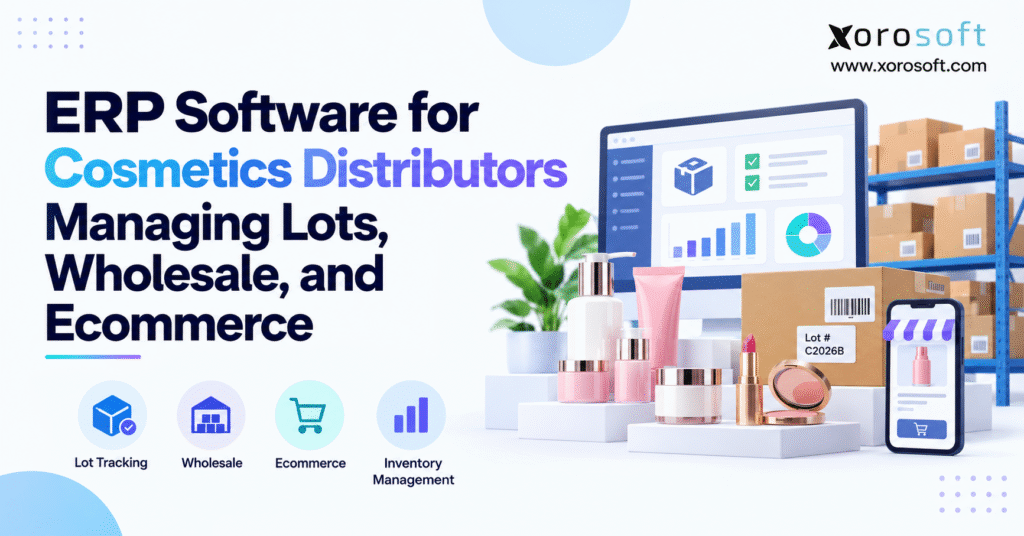
If you are searching for ERP software for cosmetics distributors, you will find that tailored solutions can significantly streamline your business processes and efficiency.
1. Why ERP Software for Cosmetics Distributors Must Resolve Wholesale Stock Conflicts
A cosmetics distributor can have 1,000 units of a facial serum in the warehouse and still be unable to fulfill a retailer’s order for 200. Some units may belong to an older production lot, online customers may already hold reservations for others, and quality inspectors may have placed another group on hold. The inventory figure is technically correct, yet it says little about what can actually ship.
This becomes a serious operating problem when wholesale orders, Shopify sales, marketplace transactions, and warehouse movements all draw from the same inventory. A retailer expects a committed delivery date. An ecommerce customer expects an accurate availability message. Finance expects the cost and quantity of stock to reconcile. Teams cannot meet these expectations consistently while each department maintains a different version of inventory.
1.1 How Cosmetics Distribution ERP Handles Multiple Lot Commitments
A moisturizing cream might have the same SKU across three lots and two fulfillment centers. However, a retailer could require at least nine months of remaining shelf life, while direct-to-consumer orders may follow a different approved allocation policy. A single aggregate quantity conceals those distinctions. The relevant question is not simply how many units exist; it is how many eligible units remain available for a specific customer, date, and location.
1.2 Why Beauty Distribution Inventory Records Become Disconnected
As order volume grows, teams compensate with spreadsheet reservations, manual stock buffers, and frequent messages between sales and warehouse staff. That may work for a while, but it introduces delays and makes the same units easy to promise twice. A useful inventory operating model connects product identity, lot status, customer commitments, and physical movement before staff release orders for fulfillment.
The effects are visible far beyond the warehouse. Customer service may offer an expedited replacement that has no eligible lot behind it. A purchasing manager may reorder stock already sitting in another facility. Finance may recognize a sales return while the warehouse still treats the returned product as sellable. These are not isolated data-entry mistakes; they are symptoms of a process where one transaction fails to update the decisions made by other teams. An effective improvement project therefore begins by mapping those dependencies, not by selecting a dashboard or asking employees to work faster.
2. What ERP Software for Cosmetics Distributors Should Actually Control
ERP software for cosmetics distributors is a connected system for managing purchasing, stock, lot information, customer orders, warehouse activities, and accounting. Its value is not the number of modules on a brochure. It is the ability to make a receiving decision, an inventory reservation, a shipment, and the resulting financial transaction part of one consistent record.
For example, a purchase order establishes what a supplier should deliver. Receiving confirms what arrived, identifies the lot, and records any damaged or questionable cartons. Available stock changes only after the appropriate checks. An accepted wholesale order then reserves eligible units, the warehouse ships the selected lot, and accounting captures the commercial and inventory consequences without recreating the order in another application.
2.1 Inventory Visibility in ERP Software for Cosmetics Distributors
A reliable ERP distinguishes on-hand, committed, available, in-transit, returned, and quality-held inventory. It also shows where units are located and which orders have first claim on them. Managers should be able to investigate why an online channel displays fewer units than a physical count without asking three departments to reconcile spreadsheets.
2.2 Who Needs Cosmetics Distribution ERP and Who Can Wait
A single-location beauty seller with a modest catalog and simple fulfillment may manage operations adequately with an inventory application and accounting software. ERP becomes more compelling when several warehouses share stock, wholesale customers impose delivery rules, purchasing is complex, or financial reconciliation depends on repeated exports. The decision should follow transaction complexity and control requirements, not an arbitrary revenue milestone.
3. Cosmetics Distribution ERP: Clean Product and Lot Data Before Automation
An ERP implementation cannot repair inconsistent product definitions on its own. If staff treat a skincare set, an individual bottle, and a wholesale case pack as the same sellable unit, every downstream calculation becomes questionable. Cosmetics distributors should start with a clean product hierarchy and explicit rules for inventory ownership, status, and conversion. This is why ERP software for cosmetics distributors requires accurate definitions from day one.
3.1 Structure Cosmetics ERP SKUs for Shades, Sizes, and Variants
Lipsticks may share a formula and brand but differ by shade, package size, promotional packaging, or regional labeling. Each sellable variant needs an unambiguous SKU. Units of measure must distinguish an individual piece, an inner pack, and a case. If a retailer orders ten cases of twelve, the system needs to reserve 120 saleable units, not ten, and maintain a consistent conversion in purchasing, fulfillment, and invoicing.
3.2 Product Lots and Expiry Data in ERP Software for Cosmetics Distributors
The product record and the lot record answer different questions. The product record describes what the item is; the lot record identifies a particular batch and its history. Capture supplier identifiers, manufacturing information when supplied, documented expiration or best-before dates, receiving date, location, and quality status. Leave an unknown expiry date explicitly unknown; never replace it with a convenient estimate.
3.3 Assign Owners for Cosmetics ERP Inventory Master Data
Merchandising may maintain descriptions and shades, purchasing may own supplier information, quality teams may control release status, and warehouse staff may confirm bin locations. Finance should define costing policies. Assigning ownership makes errors correctable without allowing anyone to overwrite critical lot history. It also provides a foundation for accurate integrations when product information flows to ecommerce and wholesale portals.
A practical master-data audit should also examine duplicate SKUs, retired products, inactive customer accounts, inconsistent supplier part numbers, and unexplained inventory balances. For ERP software for cosmetics distributors, these are implementation risks because errors multiply when integrations synchronize information automatically. Review a representative sample of high-volume, low-volume, and short-dated items before migration. If staff cannot confidently connect a lot to a receipt, identify it as an exception for investigation rather than allowing the new platform to present it as validated history.
4. How ERP Software for Cosmetics Distributors Tracks Lots From Receipt to Shipment
Lot traceability is often the feature that separates a basic stock application from an operating system suited to beauty distribution. A distributor needs to identify which supplier batch entered the business, how it moved between locations, and which customers ultimately received units from that batch. ERP software for cosmetics distributors should support that chain without relying on handwritten notes or disconnected shipping files.
4.1 Capture Cosmetics ERP Lot Details During Receiving
At receipt, staff should compare the supplier shipment with the purchase order, check quantity and packaging condition, and capture the supplier lot identifier. A damaged carton or incomplete label may require a quality hold rather than automatic release to stock. Recording the exception immediately prevents sales teams from promising units the receiving team has not accepted. Warehouse staff should keep batch labels with the goods during put-away, transfers, and picking.
4.2 Barcode Traceability in ERP Software for Cosmetics Distributors
Barcode scans can help confirm product identity and, when supported by the label and system design, carry lot or expiration information. GS1 application identifiers provide standardized ways to identify such data, including AI (10) for a batch or lot and AI (17) for an expiration date. A scanner alone does not create traceability: the ERP must preserve the scanned values and connect them to inventory transactions and shipment records.
4.3 Verify Cosmetics Distribution ERP Traceability in Both Directions
A forward trace starts with a supplier lot and identifies remaining stock, internal transfers, retailer shipments, and direct customer orders. A backward trace starts with a return or complaint and identifies the received lot and supplier. Both should work across multiple warehouses. During evaluation, choose a hypothetical affected batch and request a customer-level shipment report. The time required to produce that report is more meaningful than a generic claim of “full visibility.”
5. Cosmetics ERP Expiration Management: FEFO and Customer Rules
Formulation stability, storage conditions, packaging integrity, retailer requirements, and customer expectations can influence the usable life of beauty products. Not every ordinary cosmetic in the United States must display a legally required expiration date. The FDA’s cosmetics shelf-life guidance distinguishes those products from products that the FDA also regulates as drugs. Even without a universal labeling rule, distributors benefit from managing known shelf-life information systematically.
5.1 FIFO vs FEFO in Cosmetics ERP Inventory Management
First-in, first-out (FIFO) generally prioritizes stock according to receipt order. First-expired, first-out (FEFO) prioritizes the earliest expiration date among eligible lots. These methods may select different batches when later receipts contain older stock. A practical policy uses eligibility checks first and then selects a picking sequence; it does not blindly move the oldest or earliest-expiring carton to every customer.
| Allocation method | Primary rule | Risk to check |
|---|---|---|
| FIFO | Earliest received stock first | An earlier receipt may expire later |
| FEFO | Earliest eligible expiry first | A held or short-dated lot may be ineligible |
| Customer-aware FEFO | Earliest expiry meeting customer terms | Enforce contractual shelf-life requirements |
5.2 Retailer Shelf-Life Rules in ERP Software for Cosmetics Distributors
Assume Lot A has five months of remaining shelf life and Lot B has fourteen. A wholesale account requires at least nine months remaining upon delivery. Lot A may still qualify for another approved channel, but it cannot fulfill that retailer’s order. The allocation workflow should exclude it before FEFO chooses a lot. ERP software for cosmetics distributors must therefore distinguish general stock availability from order-specific eligibility.
5.3 Manage Expiry Exceptions in Cosmetics Distribution ERP
When eligible stock cannot fulfill an order, show the reason and available options: an approved substitution, partial shipment, later delivery, or cancellation. Any override should identify who approved it and why. Monitoring products approaching internal shelf-life thresholds also helps purchasing teams avoid replenishing slow-moving lines while usable units remain at risk of aging out.
6. How ERP Software for Cosmetics Distributors Manages Wholesale Orders and EDI
Wholesale operations require more than accepting a large shopping cart. Retailers may have negotiated pricing, case-pack rules, delivery appointments, routing requirements, electronic documents, and minimum remaining shelf-life terms. A confirmed commercial order should become a realistic inventory commitment, not an optimistic promise based on company-wide stock totals. ERP software for cosmetics distributors must link each retailer promise to eligible inventory.
6.1 Manage Customer Terms in Cosmetics Wholesale ERP
Customer records should include the applicable price list, currency, payment terms, shipping destination, agreed pack sizes, and any relevant handling restrictions. The order process can then validate quantities, prices, credit rules, and delivery expectations before staff release it for picking. This reduces the costly situation where a warehouse has packed an order that later fails a commercial or customer-specific requirement.
6.2 Connect Cosmetics ERP EDI Orders to Actual Shipments
Retail relationships may exchange EDI purchase orders, acknowledgments, advance shipping notices, and invoices. Those documents need consistent product identifiers and accurate shipment details. The precise format depends on each trading partner. An integration that merely imports the purchase order is incomplete if changes, substitutions, and shipment confirmations still require manual rekeying or separate email approvals.
6.3 Wholesale Lot Reservations in ERP Software for Cosmetics Distributors
A 500-unit retailer order should not consume 500 units of general availability when only 320 qualify for the required delivery date. The system should expose the shortfall and support a controlled partial allocation. XoroONE’s connected order and inventory workflows illustrate how Xorosoft brings wholesale sales, purchasing, inventory, and accounting into one operational environment; the distributor should test exact shelf-life rules and retailer mappings in its own configuration.
CTA 1 — Free ERP Readiness Assessment: If wholesale reservations, short-dated inventory, and manual reconciliations are becoming routine, assess whether your current systems can reliably support the next stage of distribution growth.
7. How ERP Software for Cosmetics Distributors Syncs Shopify and Wholesale
The most expensive integration error is often not a failed file transfer. It is the silent promise of inventory that another channel has already reserved. ERP software for cosmetics distributors should produce a dependable sellable quantity for each channel from consistent stock, hold, and commitment records, while allowing for location-specific fulfillment rules.
7.1 Map Shopify and Cosmetics ERP Inventory Availability
Shopify’s inventory-state documentation distinguishes on-hand stock from available, committed, and unavailable quantities. A distributor must map these terms to its ERP logic carefully. Quality-held units, retailer reservations, and safety stock should not accidentally enter the Shopify sellable balance. Incoming purchases should not become available simply because a supplier has issued a shipping notice.
7.2 Calculate Cosmetics Ecommerce ERP Inventory Without Double-Counting
Consider a single location with 1,000 physical units of a serum. Of these, wholesale orders already claim 300 units, quality inspectors hold 250, and the distributor keeps 50 more as a safety buffer. Assuming these categories do not overlap, potential available-to-promise inventory is 1,000 − 300 − 250 − 50 = 400 units. Apply further channel and lot-eligibility limits if required.
The calculation must use consistent starting values. If “eligible on-hand” already excludes the quality-held stock, deducting those 250 units again would understate availability. Inventory integrations should document exactly which statuses each field includes and how quantities change when staff cancel, adjust, or ship an order.
7.3 Prevent Shopify Sync Errors in ERP Software for Cosmetics Distributors
Orders can arrive during a connection outage, status updates may arrive late, and retries can duplicate reservations if an integration mishandles identifiers. Establish an authoritative system for inventory and a queue for exceptions. Xorosoft’s integration options cover ecommerce, marketplace, EDI, and operational connections; the Xorosoft ERP app on Shopify provides a separate way to review its Shopify presence. Evaluate both against the business’s actual order, inventory, return, and fulfillment requirements.
For ERP software for cosmetics distributors, teams should define synchronization performance as an operating requirement. Agree on how quickly an accepted order must reduce available stock, what happens if the ERP cannot reach a marketplace, and who resolves failed messages. Monitor the age of unresolved exceptions, not merely whether the integration connection works. When a connector delivers the same order twice, its identifier should prevent duplicate stock commitments. A daily reconciliation of channel balances is valuable even when event-based updates are working normally.
8. Cosmetics Warehouse ERP: Lot-Accurate Picking and Fulfillment
Even the best reservation logic fails when warehouse staff pick a different lot. A warehouse management process needs to translate eligibility rules into physical receiving, put-away, picking, packing, and shipment controls. ERP software for cosmetics distributors becomes operationally useful when the movement recorded in the system matches what happened on the floor.
8.1 Preserve Cosmetics ERP Lot Identity During Put-Away
A case should enter the correct bin with its SKU, lot, quantity, and disposition status. When the receiving process requires inspection, the quality team can hold stock until it approves release. Mixed-lot pallets and transfers need clear labels and handling procedures, particularly when adjacent cartons look nearly identical but have different production identifiers.
8.2 Verify Warehouse Picks With ERP Software for Cosmetics Distributors
Barcode verification can help flag an incorrect SKU or lot before staff seal a parcel. The pick task should reflect the order’s allocated stock, and a mismatch should enter an exception workflow instead of allowing staff to bypass it. XoroWMS describes RF scanning, receiving, put-away, picking, packing, and multi-warehouse operations. Xorosoft users should confirm the exact lot verification and exception controls required by each fulfillment process.
8.3 Control Transfers and Returns in Cosmetics Warehouse ERP
Inventory in transit between warehouses is not automatically available at the destination. Confirm physical receipt and appropriate release status first. Similarly, returned cosmetics should enter a review state until the business determines whether they can be resold, returned to a supplier, or disposed of. Accurate locations and status codes reduce the temptation to “fix” stock discrepancies with unexplained quantity adjustments.
CTA 2 — Watch Demo: Review a realistic receiving-to-shipping workflow, including lot scanning, wholesale reservations, transfer receipts, and an ecommerce order that arrives while the warehouse is picking.
9. Cosmetics Distribution ERP for Recall Traceability and Quality Reviews
No software setting automatically delivers regulatory compliance. It depends on product classification, the responsibilities of each company, and the procedures used to investigate potential safety issues. Strong ERP records can make those procedures more reliable, but they do not replace product testing, legal advice, or regulatory oversight. ERP software for cosmetics distributors should support investigations without claiming to certify compliance.
9.1 FDA and MoCRA Rules Affecting Cosmetics ERP Records
The FDA’s MoCRA information outlines obligations including serious adverse-event reporting by a legally defined responsible person, with an initial reporting deadline of 15 business days. A distributor should not assume it carries every manufacturer or responsible-person duty merely because it stores and ships the goods. Products making therapeutic claims may also fall into different regulatory categories.
9.2 Canadian Cosmetics Notification and ERP Documentation
Under Health Canada’s cosmetic notification requirements, manufacturers and importers generally must notify the regulator within 10 days after first sale in Canada. A notification is not approval. Cross-border distributors should establish which entity is the importer, who is responsible for submissions, and which product and label records the company must maintain.
9.3 Practice Recall Traceability With ERP Software for Cosmetics Distributors
Choose a hypothetical affected batch and work backward to supplier receipt, then forward to all current locations and customer shipments. Confirm whether the business can isolate remaining stock, identify affected retailers and direct buyers, preserve evidence, and document decisions. The FDA issued final guidance on mandatory cosmetics recalls in October 2026; an ERP-assisted traceability drill is a practical complement to a documented recall procedure, not a substitute for it.
A useful traceability drill has a measurable finish line: the team can identify affected stock, determine its disposition, produce a complete shipment list, and explain the sequence of decisions from documented evidence. Quality and customer-service teams should agree in advance on who contacts customers, who authorizes a stock hold, and who controls the wording of any notice. The drill should also include a shipment that has already left a third-party logistics facility, because those records are often outside the distributor’s everyday warehouse view.
10. Cosmetics ERP Demand Forecasting and Inventory Aging
Cosmetics purchasing involves more than predicting next month’s sales. A distributor may hold excess stock in a slow-moving shade while facing a shortage of a popular serum. Promotions, launch calendars, seasonal gift sets, retailer orders, and long import lead times can distort historical demand. Replenishment should consider how much stock will still be eligible when customers need it.
10.1 Forecast Demand by Channel With Cosmetics Distribution ERP
Separate ordinary sales from one-time retailer pipeline fills, promotional spikes, stockout periods, and product launches. Otherwise, a large wholesale order can inflate the forecast for months. Planning teams should review demand by SKU, channel, and, where necessary, warehouse. For rapidly changing makeup assortments, forecasts need shorter review cycles than stable replenishment items.
10.2 Set Reorder Points Using ERP Software for Cosmetics Distributors
A simple reorder calculation considers demand expected during replenishment lead time plus safety stock, less inventory that will remain usable and uncommitted. Suppose expected six-week demand is 600 units and the business requires a 100-unit buffer. If only 430 units of current inventory will meet future customer rules, the implied additional requirement is 270 units before factoring in open purchase orders. This is an illustrative planning example, not an industry benchmark.
10.3 Track Supplier Performance in Beauty Distribution ERP
On-time delivery, lot documentation quality, short shipments, damaged cartons, and remaining shelf life on receipt all affect actual supply reliability. An inexpensive purchase may be costly if it arrives too late for a promotion or with a short-dated batch that retailers reject. Record these exceptions at receiving so purchasing decisions reflect operational experience rather than supplier quotations alone.
11. Cosmetics ERP Accounting: Landed Costs, Inventory Value, and Margins
Inventory problems often appear in finance after they have already caused warehouse or sales disruption. The returns team records transactions in one application, purchasing adjusts prices in another, and shipping costs arrive weeks after the warehouse receives the goods. At month-end, teams struggle to explain why inventory value, the general ledger, and physical counts differ.
11.1 Allocate Landed Costs in Cosmetics Distribution ERP
Imported cosmetics can involve freight, duty, brokerage, and other acquisition-related charges. The organization needs a documented accounting policy for allocating applicable costs across SKUs and receipts. When a freight invoice arrives late, finance must understand how an adjustment affects stock still held and units already sold. Do not assume every expense belongs in inventory; treatment depends on the relevant accounting standards and facts.
11.2 Connect Lot Movements and Accounting in ERP Software for Cosmetics Distributors
Receipts, inventory adjustments, returns, shipments, and write-offs should produce explainable inventory and financial records. A quality-related disposal may reduce inventory value without a customer sale. A wholesale discount can change realized margin without changing physical stock. XoroERP connects accounting, inventory, purchasing, and warehouse operations, which makes Xorosoft relevant when teams scatter these transactions across applications. The finance team still owns valuation methods, approvals, and reconciliation discipline.
11.3 Measure Profitability With Cosmetics ERP Reporting
Gross margin should reflect applicable product costs, customer discounts, and returns. A popular ecommerce product may be profitable at its standard selling price yet less attractive after repeated shipping subsidies and promotions. A wholesale customer may generate substantial revenue while creating costly routing and compliance exceptions. Connected data helps expose those differences before purchasing and pricing decisions repeat them.
12. Cosmetics ERP Workflows for Kits, Testers, Returns, and Private Label
Cosmetics distributors frequently sell products in formats that do not behave like standard single-item inventory. A holiday kit may contain five distinct SKUs, a promotional bundle may include samples, and a private-label line may involve outsourced manufacturing. These workflows need explicit inventory treatment to prevent stock errors and misleading margin reports.
12.1 Manage Beauty ERP Kits and Tester Inventory
A kit should reserve its components or maintain a clearly defined assembled SKU with appropriate component consumption. Otherwise, the same lipstick could appear available both individually and inside a promotional set. Staff should separate testers and free samples from sellable inventory whenever their status or financial treatment differs. Returns from opened kits require careful inspection and consistent decisions about reusable components.
12.2 Separate Cosmetics Distribution ERP and Manufacturing Workflows
A distributor that simply receives and resells finished goods may not need work orders or bills of materials. A company assembling kits, relabeling approved products, or managing private-label production may need more detailed component, labor, and batch records. Review which activities employees perform internally and which belong to a contract manufacturer. The appropriate ERP solution design depends on the operating process, not on adding every available manufacturing module.
12.3 Separate Returns and Refunds in Cosmetics ERP
A customer refund does not mean the physical product is suitable for resale. Record the returned quantity, original order, lot where identifiable, condition, and final disposition. Unopened products may still require examination under company policy, while compromised or incorrectly stored items may need disposal. Maintaining those distinctions protects channel availability and prevents accounting from overstating recoverable inventory.
Private-label businesses should also review how artwork changes, packaging revisions, and approved formulations affect product identity. A package redesign does not always require a new physical formula, but it may require different labels or retail listings. Conversely, two products that look identical may have different formulations or market authorizations. Recording these distinctions avoids mixing inventory that should remain separately identifiable during wholesale fulfillment and product investigations.
13. Evaluate ERP Software for Cosmetics Distributors With Real Workflow Tests
A product demonstration should do more than show dashboards. Buyers need to see how a system responds when two channels request the same stock, a retailer rejects a short-dated lot, or a shipment arrives with a quantity discrepancy. The right evaluation connects the software’s stated capabilities to the distributor’s operational controls.
13.1 Compare Cosmetics Distribution ERP With Inventory-Only Tools
There is no universal best technology stack. Spreadsheets and accounting tools can be economical for uncomplicated operations. Dedicated inventory software can provide specialized stock controls, while an integrated ERP may reduce the number of disconnected records. The trade-off involves implementation effort, ongoing integration ownership, and the cost of errors—not simply subscription price.
| Approach | Practical advantage | Common scaling challenge |
|---|---|---|
| Spreadsheets with accounting | Low initial cost and flexibility | Manual reservations and reconciliation |
| Inventory app with connectors | Targeted inventory functions | Multiple transaction owners and exception queues |
| Integrated cloud ERP | Connected operational and financial records | More substantial migration and process design |
13.2 Test ERP Software for Cosmetics Distributors With Shopify and Lot Rules
Provide two lots of one serum, a retailer requiring nine months of remaining shelf life, a wholesale reservation, and a simultaneous Shopify order. Ask the vendor to show what remains sellable, how warehouse staff verify a pick, what happens when quality staff hold inventory, and how a shipment changes accounting. ERP software for cosmetics distributors should pass this scenario before buyers rely on broad claims about automation or accuracy.
13.3 Calculate the Total Cost of Cosmetics Distribution ERP
Include users, warehouses, implementation, integrations, data cleanup, training, support, and future change requests. Clarify which functions are native, which require configuration, and which depend on partners. Xorosoft’s industry coverage provides context for inventory-driven businesses, but buyers should base selection on proven process fit and an agreed implementation scope rather than industry labels alone.
An ERP software for cosmetics distributors proposal should explain how the implementation team will protect business continuity during the changeover. Clarify data ownership, integration monitoring, customization limits, support response expectations, and who approves process changes. Ask for a realistic demonstration of a failed inventory feed or a disputed receipt. Vendors that can explain exception recovery and auditability in plain operational terms give buyers more useful evidence than a polished presentation of ideal transactions.
14. Cosmetics ERP Implementation: Phased Rollout and Performance Measures
Implementation risk rises when a business attempts to migrate every warehouse, marketplace, supplier, and accounting workflow at once. A phased rollout makes defects easier to isolate while preserving the ability to fulfill customer commitments. The first milestone should be a stable transaction chain, not a beautifully formatted dashboard. A staged rollout helps ERP software for cosmetics distributors earn the trust of warehouse, sales, and finance teams.
14.1 Clean Cosmetics ERP Master Data and Opening Stock
Before migration, standardize SKUs, pack conversions, lot identifiers, bin locations, customer-specific pricing, and supplier details. Investigate stock differences rather than loading unexplained adjustments into the new system. For lots with missing dates or disputed status, create a defined exception process and obtain the relevant team’s approval before staff mark stock sellable.
14.2 Pilot Wholesale and Ecommerce in ERP Software for Cosmetics Distributors
Start with a representative selection of products and orders at one location. Run receipts, quality holds, reservations, picking, shipping, returns, and accounting reconciliation. Test failed integrations and cancellations, not just successful orders. Document who owns each exception and establish a transaction cutoff for the move from old systems to new ones.
14.3 Monitor Cosmetics ERP Inventory Accuracy After Go-Live
Track inventory record accuracy, order allocation exceptions, time to identify affected lots, expired-stock write-offs, and fulfillment errors. Record results before and after go-live with consistent definitions. Published Xorosoft customer case studies can help frame questions about implementation and operating changes, but distributors should not expect identical results without measuring their own operations. Internal measurement remains the strongest test of value.
15. Choosing ERP Software for Cosmetics Distributors: Practical Next Steps
The first step is to choose one fast-moving product with multiple lots and follow it from purchase order to customer delivery. Document where the business records lot information, who releases quality-held stock, when wholesale reservations reduce ecommerce availability, and how the final shipment reaches finance. Each manual handoff is a potential source of delay or disagreement.
15.1 Prioritize Cosmetics ERP Requirements by Operating Risk
Weight requirements according to actual risk. For a multi-warehouse cosmetics wholesaler, lot traceability, eligibility rules, channel inventory accuracy, and retailer order controls may outweigh optional reporting features. A simpler DTC business may emphasize Shopify synchronization, returns, purchasing, and financial close. Keep an owner, acceptance test, and implementation priority beside each requirement so vendors can respond to a specific operating model.
15.2 Validate Beauty Distribution ERP With Real Transactions
Run the same scenario through every shortlisted platform. Ask staff from sales, purchasing, quality, warehouse, ecommerce, and finance to review what they see. Check whether teams can resolve exceptions without private spreadsheets or undocumented overrides. ERP software for cosmetics distributors is an investment in transaction discipline; the software should make good operating policies easier to follow and verify.
CTA 3 — Book a Personalized Demo: If your business is ready to evaluate a connected process, contact Xorosoft with sample SKUs, a wholesale order, a Shopify order, and a lot-tracking scenario. Ask the team to demonstrate the full path from receipt and allocation to shipment and accounting, including the exception cases your operation faces most often.
Frequently Asked Questions
What is ERP software for cosmetics distributors?
It connects lot tracking, purchasing, wholesale orders, ecommerce inventory, warehousing, and accounting, helping teams manage stock availability and fulfill orders using consistent records.
How does cosmetics ERP track lots and expiration dates?
It records supplier lot identifiers, available expiry dates, locations, and stock movements, allowing distributors to check eligible inventory and trace products through shipments.
Can cosmetics ERP manage wholesale and Shopify inventory together?
Yes. With suitable integration, it can coordinate wholesale reservations and Shopify availability, reducing conflicting stock promises across channels and warehouses.
How does cosmetics ERP reduce overselling?
It calculates sellable inventory after accounting for existing reservations, quality holds, and safety buffers, then shares available quantities with connected sales channels.
Can cosmetics ERP support recalls and regulatory compliance?
It can help trace affected lots and preserve shipment records. However, software alone does not guarantee FDA, MoCRA, or Health Canada compliance.
How much does cosmetics distribution ERP cost?
Pricing varies by users, warehouses, modules, integrations, and implementation. Compare total ownership costs, including training, data migration, and ongoing support.
When should a cosmetics distributor upgrade to ERP?
Consider upgrading when spreadsheets, disconnected apps, and manual reconciliations cause stock errors, delayed fulfillment, or poor visibility across wholesale and ecommerce.
Recent Posts
-
 How to Calculate Ecommerce Warehouse Capacity Before Peak Season
-
 Manufacturing Scrap Statistics 2026: Material Loss, Yield, and Cost
-
 ERP Software for Cosmetics Distributors Managing Lots, Wholesale, and Ecommerce
-
 Xorosoft vs Cin7 Core for Multi-Warehouse Wholesale Operations
-
 How a Multi-Warehouse Company Reduced Inventory Reconciliation Work at Month-End