This Inventory Reconciliation Guide is designed to help you navigate the process with ease.
1. Why Inventory Accuracy Declines as Operations Grow
This Inventory Reconciliation Guide explains how inventory-driven businesses can compare physical stock with system records, investigate discrepancies, correct inaccurate balances, and prevent recurring inventory problems. As companies grow, they usually add more products, warehouses, suppliers, employees, and sales channels. Consequently, even small recording mistakes can create expensive fulfillment, purchasing, and accounting problems.
Inventory accuracy rarely fails because of one dramatic event. Instead, records usually drift through a series of smaller operational gaps. For example, an employee may enter a purchase receipt late, a warehouse team may leave a transfer unconfirmed, or a returns team may place a product into sellable stock before inspection.
Initially, employees may correct these issues manually. However, informal controls become less dependable as transaction volume increases. Eventually, inventory discrepancies begin affecting purchasing, fulfillment, customer service, accounting, and financial reporting.
The impact also extends beyond warehouse operations. For instance, purchasing teams may reorder stock that the business already owns. Meanwhile, sales teams may promise products that warehouse employees cannot locate. As a result, finance may close the month using inaccurate inventory values.
Therefore, inventory reconciliation should not remain an isolated warehouse exercise. Instead, the company should treat it as a business-wide control that connects physical stock, operational transactions, and financial records.
1.1 What the Inventory Reconciliation Process Involves
Inventory reconciliation compares physical stock with quantities and values in inventory, warehouse, ecommerce, manufacturing, and accounting systems.
When physical inventory and recorded balances do not match, the company should:
1. Confirm the physical quantity.
2. Compare it with the system balance.
3. Review the relevant transaction history.
4. Identify the cause of the difference.
5. Approve the required correction.
6. Update operational and accounting records.
7. Document preventive action.
A practical Inventory Reconciliation Guide should cover counting, investigation, approval, correction, and preventive control. Therefore, teams should not treat reconciliation as a simple balance adjustment.
If employees immediately change the system quantity, they may hide a receiving, transfer, fulfillment, returns, manufacturing, or integration problem. Instead, investigation should come before adjustment. Moreover, each material correction should include a reason code and supporting evidence.
1.2 Why Stock Reconciliation Matters Across Departments
Accurate inventory records support almost every part of an inventory-driven business.
Warehouse teams need correct quantities and locations to pick orders efficiently. Similarly, purchasing teams need reliable on-hand and committed quantities to plan replenishment. Sales teams require realistic available-to-sell balances, while manufacturing teams depend on accurate raw material and work-in-progress records.
At the same time, finance needs inventory values that agree with the general ledger. Therefore, inventory reconciliation is not only a warehouse responsibility. It is a cross-functional control involving operations, purchasing, finance, ecommerce, manufacturing, and management.
Moreover, accurate inventory data improves daily decision-making. For example, purchasing teams can avoid unnecessary orders, while warehouse teams can reduce emergency searches and unplanned transfers. Consequently, the business can use working capital more effectively.
1.3 Who Needs a Formal Inventory Accuracy Process
A structured reconciliation process becomes especially important for businesses that:
- Sell physical products
- Carry hundreds or thousands of SKUs
- Operate multiple warehouses
- Sell through Shopify or Amazon
- Fulfill wholesale orders
- Use EDI
- Manufacture or assemble products
- Track lots, serial numbers, or expiration dates
- Process frequent customer returns
- Carry high-value inventory
- Depend on accurate month-end reporting
A smaller company may manage reconciliation with spreadsheets for a limited period. Nevertheless, the company should strengthen its controls as operational complexity increases.
For instance, a company with one warehouse and a limited product catalog may not need advanced automation immediately. However, a business managing several warehouses, ecommerce channels, wholesale orders, and manufacturing activity usually needs stronger visibility and transaction control.
2. Inventory Reconciliation Guide: Records That Must Be Compared
Before applying this Inventory Reconciliation Guide, warehouse, operations, and finance teams must agree on the balances they plan to review. Otherwise, two technically correct reports may still appear inconsistent.
For instance, one report may show total on-hand inventory, while another displays only available stock after customer allocations. Similarly, an accounting report may provide inventory value without showing item-level quantities.
Therefore, teams should define the relevant inventory terms before counting begins. This preparation reduces confusion and, in turn, improves the reliability of the variance report.
2.1 Physical Inventory Versus Recorded Inventory
Physical inventory includes the stock that actually sits in warehouses, stores, production areas, quarantine zones, third-party facilities, or other controlled locations.
Recorded inventory includes the quantity that an inventory application, warehouse management system, spreadsheet, accounting platform, or ERP displays.
Depending on the business, teams may need to compare inventory by:
- SKU
- Product variant
- Warehouse
- Bin
- Lot
- Serial number
- Pallet
- Condition
- Ownership status
- Unit of measure
A consolidated company quantity can appear correct even when individual warehouse balances remain wrong. Therefore, multi-location businesses should reconcile inventory at the warehouse and bin level instead of relying only on a company-wide total.
For example, a business may record 500 units across two warehouses. However, one location may physically hold 300 units while the other holds 200, even though the system shows 250 units at each warehouse. Consequently, the total remains correct, but the location records do not.
2.2 On-Hand, Available, and Committed Inventory
On-hand inventory represents the quantity physically or systemically present at a location. By contrast, available inventory represents the portion that the business can still sell or allocate.
Committed inventory covers stock that teams already reserved for customer orders, production, transfers, or other requirements. Therefore, employees should not treat committed stock as freely available inventory.
For example, a warehouse may have 500 units on hand. However:
- Customer orders reserve 100 units
- The quality team holds 20 units for review
- Damage affects 10 units
- Production requires 15 units
Although the on-hand balance equals 500, the available quantity falls considerably below that number. Consequently, the reconciliation scope must state whether the team plans to validate physical quantity, sellable stock, available-to-promise inventory, or financial value.
2.3 Inventory Subledger Versus General Ledger
The inventory subledger contains detailed item-level activity, including:
- Purchase receipts
- Sales shipments
- Customer returns
- Supplier returns
- Warehouse transfers
- Inventory adjustments
- Production consumption
- Finished-goods receipts
- Scrap
- Inventory revaluations
By contrast, the general ledger contains the financial balances that accounting teams use for reporting.
Operational reconciliation asks whether physical inventory agrees with item-level records. Meanwhile, financial reconciliation asks whether the inventory value in the subledger agrees with the inventory asset balance in the general ledger.
Both reviews matter. For example, a company may hold the correct physical quantity but apply the wrong valuation. Alternatively, the overall accounting balance may appear correct while individual products or warehouse locations remain inaccurate.
2.4 Inventory Variance Analysis by Quantity and Value
This Inventory Reconciliation Guide recommends reviewing both quantity variance and value variance.
Quantity variance = Physical quantity − Recorded quantity
Value variance = Quantity variance × Unit cost
For example, if the system shows 250 units while the physical count finds 242, the quantity variance equals negative eight units. If each unit costs $40, the financial impact equals $320.
A small unit difference may therefore create a significant financial effect when the product carries a high cost. Conversely, a larger variance involving inexpensive packaging may have a limited financial impact.
As a result, teams should prioritize discrepancies according to both operational impact and financial value. In addition, management should set different approval thresholds for low-value and high-value corrections.
3. Step-by-Step Inventory Reconciliation Process
The method in this Inventory Reconciliation Guide can support cycle counts, full physical counts, month-end reviews, and targeted discrepancy investigations. However, accurate results depend on more than counting products.
Teams must also prepare transactions, control inventory movement, define responsibilities, and review exceptions consistently. For this reason, reconciliation should follow a documented sequence. As a result, employees can repeat the process reliably instead of rebuilding it every time.
3.1 Define the Scope and Cutoff
First, decide exactly what the reconciliation will cover.
The scope may include:
- One warehouse
- Several warehouses
- A product category
- High-value SKUs
- Raw materials
- Work in progress
- Finished goods
- Returned stock
- Damaged products
- Consigned inventory
- Inventory held by a third party
- One or more accounting periods
Next, establish the cutoff date and time.
Include all transactions completed before the cutoff in the expected balance. By contrast, exclude later transactions or track them separately.
Without a clear cutoff, the team may compare a physical count taken at one time with a system balance from another. Consequently, temporary timing differences can appear to be real inventory losses.
3.2 Prepare Open Transactions
The team should bring the system as current as possible before counting begins.
Review:
- Completed purchase receipts
- Shipped customer orders
- Open warehouse transfers
- Processed returns
- Cancelled orders
- Production consumption
- Completed work orders
- Damaged-stock movements
- Pending adjustments
- Third-party logistics activity
- Unposted ecommerce transactions
Teams do not always need to complete every open transaction. However, they should identify and document each one. Otherwise, employees may mistake timing differences for genuine inventory errors.
In addition, teams should confirm the correct transaction dates and warehouse locations. This step becomes especially important when orders, receipts, and transfers cross a month-end or year-end cutoff.
3.3 Controlling Stock During Physical Inventory Reconciliation
A reliable Inventory Reconciliation Guide must explain how the business will control stock movement while employees count products. Otherwise, normal warehouse activity may create false variances.
A business with manageable order volume may temporarily pause:
- Receiving
- Picking
- Packing
- Shipping
- Warehouse transfers
- Production consumption
- Finished-goods receipts
Companies that cannot stop operations should record every movement during the count window. In addition, they can use transaction timestamps, mark completed locations, and recount areas affected by movement.
The business does not always need to freeze the entire warehouse. Instead, it must know what moved, when it moved, and whether the system balance includes that activity.
Meanwhile, supervisors should monitor urgent receipts and shipments separately. As a result, operational activity can continue without compromising the count.
3.4 Organize the Physical Count
Count teams should follow a clear warehouse map or location sequence.
Counting by physical location generally reduces:
- Missed stock
- Duplicate counts
- Hidden inventory
- Unclear ownership
- Unidentified damaged goods
Each count record should capture:
- SKU
- Product description
- Warehouse
- Bin or location
- Unit of measure
- Physical quantity
- Lot or serial number
- Inventory condition
- Counter name
- Count date and time
- Exception notes
Blind counts can improve objectivity because the counter does not see the expected system quantity. Nevertheless, the best method depends on inventory risk, available tools, and employee experience.
For high-value or regulated inventory, a second employee may verify the count. Similarly, serialized products may require both quantity confirmation and serial-number validation.
3.5 Separate Sellable and Non-Sellable Stock
Count teams should keep damaged, expired, returned, quarantined, recalled, obsolete, or incomplete products away from sellable inventory.
Although these items may remain physically present, they may require:
- Inspection
- Repair
- Reclassification
- Supplier return
- Write-off
- Disposal
- Quality approval
If non-sellable products remain in active locations, the physical quantity may appear correct while available-to-sell inventory remains overstated. Therefore, count teams should record the condition of every item during the count.
Similarly, teams should separate customer-owned, consigned, and supplier-owned inventory from company-owned stock. Otherwise, the physical count may overstate the business’s inventory asset.
3.6 Compare Physical Counts With System Records
This Inventory Reconciliation Guide uses a structured variance report to compare physical quantities with recorded balances. In addition, the report should show unit cost, financial impact, reason code, and approval status.
| Field | Purpose |
|---|---|
| SKU | Identifies the product |
| Warehouse or location | Shows where the variance occurred |
| Recorded quantity | Displays expected inventory |
| Physical quantity | Displays counted inventory |
| Quantity variance | Shows the unit difference |
| Unit cost | Supports financial analysis |
| Value variance | Shows the financial impact |
| Reason code | Classifies the cause |
| Approval status | Tracks review and authorization |
The first review should prioritize material and recurring discrepancies. In practice, a high-value difference or repeated location error deserves more attention than an isolated low-value variance.
However, teams should not ignore low-value discrepancies entirely. A large number of small errors may indicate a broader problem with receiving, picking, labeling, or unit conversion.
Therefore, management should review both individual high-value variances and repeated low-value patterns.
3.7 Recount Material Differences
Before reviewing transaction history, recount significant variances.
The first count may contain errors because of:
- Similar product packaging
- Incorrect bin labels
- Hidden inventory
- Mixed units of measure
- Unopened cases
- Stock stored in unexpected locations
- Duplicate count sheets
- Mathematical errors
- Scanner synchronization issues
Assign a different employee to complete the recount without seeing the first result. This approach provides a more independent confirmation.
If the second count matches the first, the team can proceed with greater confidence. On the other hand, if the counts differ, the location or product may require a third review.
3.8 Investigating Inventory Reconciliation Discrepancies
The Inventory Reconciliation Guide should lead investigators through receipts, shipments, returns, transfers, production activity, and integration records. Ultimately, the review should identify both the immediate difference and the process weakness behind it.
Relevant records may include:
- Purchase orders
- Supplier packing slips
- Purchase receipts
- Sales orders
- Pick records
- Shipment confirmations
- Customer returns
- Supplier returns
- Warehouse transfers
- Production transactions
- Inventory adjustments
- Cycle-count history
- Third-party logistics reports
- Shopify or marketplace orders
- Integration logs
The investigation should answer two questions:
1. What caused the difference?
2. What control should change so it does not happen again?
For example, an unconfirmed shipment may explain a shortage. By contrast, an unposted purchase receipt or incorrectly processed return may explain an excess quantity.
Therefore, investigators should assign a variance reason that reflects the actual transaction failure rather than a generic adjustment category.
3.9 Approve and Post Adjustments
An inventory adjustment should represent the final step rather than the first reaction.
Teams should include the following details in every adjustment request:
- SKU and location
- Quantity variance
- Financial value
- Investigation notes
- Root-cause category
- Supporting documents
- Requested accounting treatment
- Approver
- Posting date
Management should set approval levels according to value and risk. For instance, a warehouse supervisor may approve a minor adjustment, while a material write-off may require finance or executive approval.
Furthermore, employees who perform the physical count should not automatically approve high-value adjustments. Separation of duties strengthens control and reduces the risk of unauthorized changes.
3.10 Document Corrective Action
A reconciliation report should not end with a net adjustment total. Instead, it should explain what operational change will reduce future discrepancies.
Corrective actions may include:
- Revising receiving procedures
- Improving bin labels
- Introducing barcode scanning
- Changing return-processing rules
- Restricting adjustment permissions
- Increasing cycle-count frequency
- Correcting unit conversions
- Improving ecommerce synchronization
- Integrating warehouse and accounting activity
- Retraining employees
Ultimately, the objective is to prevent discrepancies rather than simply correct them. Moreover, management should review whether each corrective action reached completion before the next reconciliation cycle.
4. Inventory Reconciliation Guide Checklist
This Inventory Reconciliation Guide checklist gives warehouse, operations, and finance teams a repeatable control framework. Moreover, it helps ensure that teams do not miss preparation, counting, investigation, approval, or accounting steps.
A checklist does not replace employee judgment. Nevertheless, it creates a consistent foundation for routine cycle counts as well as complex physical inventory projects.
4.1 Pre-Count Inventory Reconciliation Checklist
Before counting:
- Confirm the reconciliation scope
- Establish the cutoff time
- Identify included warehouses and locations
- Verify units of measure
- Process completed receipts
- Confirm shipped customer orders
- Review open warehouse transfers
- Process known returns
- Separate damaged and quarantined stock
- Complete relevant production transactions
- Prepare count sheets or scanners
- Assign count teams
- Set recount thresholds
- Define approval responsibilities
In addition, management should identify the person who owns final sign-off. This step prevents delays after the count.
Furthermore, supervisors should give the count team clear instructions before anyone enters the warehouse. As a result, teams follow consistent counting methods across locations.
4.2 Count-Day Reconciliation Checklist
During counting:
- Mark completed locations
- Record inventory by SKU and location
- Count unopened cases according to approved rules
- Separate non-sellable stock
- Capture lots and serial numbers
- Document unexpected inventory
- Track movement during the count
- Escalate unit-of-measure questions
- Prevent duplicate counts
- Record employee names and count times
Meanwhile, supervisors should monitor progress and resolve exceptions quickly. As a result, the count remains organized and easier to review.
Additionally, teams should avoid estimating quantities whenever they can perform an exact count. Otherwise, the reconciliation may begin with unreliable count data.
4.3 Post-Count Stock Reconciliation Checklist
After counting:
- Import or enter physical quantities
- Generate the variance report
- Recount material differences
- Investigate transaction history
- Assign reason codes
- Calculate financial impact
- Obtain approval
- Post approved corrections
- Reconcile the subledger and general ledger
- Document unresolved items
- Assign corrective actions
- Schedule follow-up counts
Therefore, teams should not rush the post-count stage. At this point, they convert raw count information into reliable business data.
In addition, teams should keep unresolved items visible until they explain them fully. Otherwise, employees may forget them after the adjustment period closes.
4.4 Management Review Checklist
Management should review:
- Total quantity variance
- Gross value variance
- Net value variance
- High-value adjustments
- Repeated discrepancies
- Unexplained loss
- Shrinkage trends
- Poor-accuracy locations
- Products with recurring errors
- Approval compliance
- Investigation time
- Corrective-action progress
Consequently, management can focus on long-term patterns rather than isolated corrections.
Moreover, leaders should compare current results with previous reconciliation periods. As a result, they can see whether operational controls continue to improve.
5. Common Causes of Stock Reconciliation Discrepancies
A useful Inventory Reconciliation Guide does more than explain how to count stock. Instead, it helps teams identify the operational causes behind discrepancies.
Once teams classify differences correctly, management can improve the process rather than repeatedly changing the inventory balance.
5.1 Receiving Errors That Affect Inventory Accuracy
Receiving errors occur when incoming products do not match the system record.
Common examples include:
- Recording the purchase order quantity instead of the received quantity
- Receiving the wrong SKU
- Posting the same receipt twice
- Missing a partial delivery
- Using the wrong unit of measure
- Receiving stock into the wrong warehouse
- Failing to record rejected products
- Mixing damaged goods with sellable stock
A controlled receiving process should verify supplier documents, purchase orders, quantities, SKUs, condition, and destination locations. Otherwise, an inventory error enters the system at the first operational step.
Moreover, employees should record only the quantity that physically arrives. Therefore, they should never accept the purchase order quantity automatically without verification.
5.2 Picking and Shipping Errors
Physical inventory can decrease without the system balance changing correctly.
This may happen when:
- The wrong SKU leaves the warehouse
- The employee ships the wrong quantity
- The team forgets to confirm a shipment
- The system misses a product substitution
- The warehouse ships an order twice
- A cancelled order remains allocated
- An employee bypasses the normal process
Barcode-supported picking can reduce these problems. However, shipment confirmation and exception handling remain essential.
Similarly, teams must record partial shipments accurately. Otherwise, the system may reduce the full order quantity even though only part of the order left the warehouse.
5.3 Unrecorded Warehouse Transfers
Multi-location businesses frequently find stock in the wrong warehouse or bin.
The total company quantity may still remain correct. Nevertheless, fulfillment and replenishment decisions depend on accurate location balances.
Every physical transfer should therefore create a system transaction. Ideally, the sending warehouse confirms dispatch, while the receiving warehouse confirms arrival.
As a result, teams do not treat stock in transit as missing inventory. Furthermore, managers can monitor transfer delays separately from physical losses.
5.4 Returns Processing Problems
Returned products may pass through several statuses:
- In transit
- Received
- Awaiting inspection
- Sellable
- Damaged
- Repairable
- Supplier return
- Written off
Problems occur when the physical status changes but the system status does not.
For example, an employee may place a returned product into a sellable location before processing the return. Consequently, the product may appear available before inspection or may enter the count twice.
Therefore, returns should move through clearly defined statuses and locations. In addition, finance should confirm that inventory updates align with customer refunds and credits.
5.5 Unit-of-Measure Errors
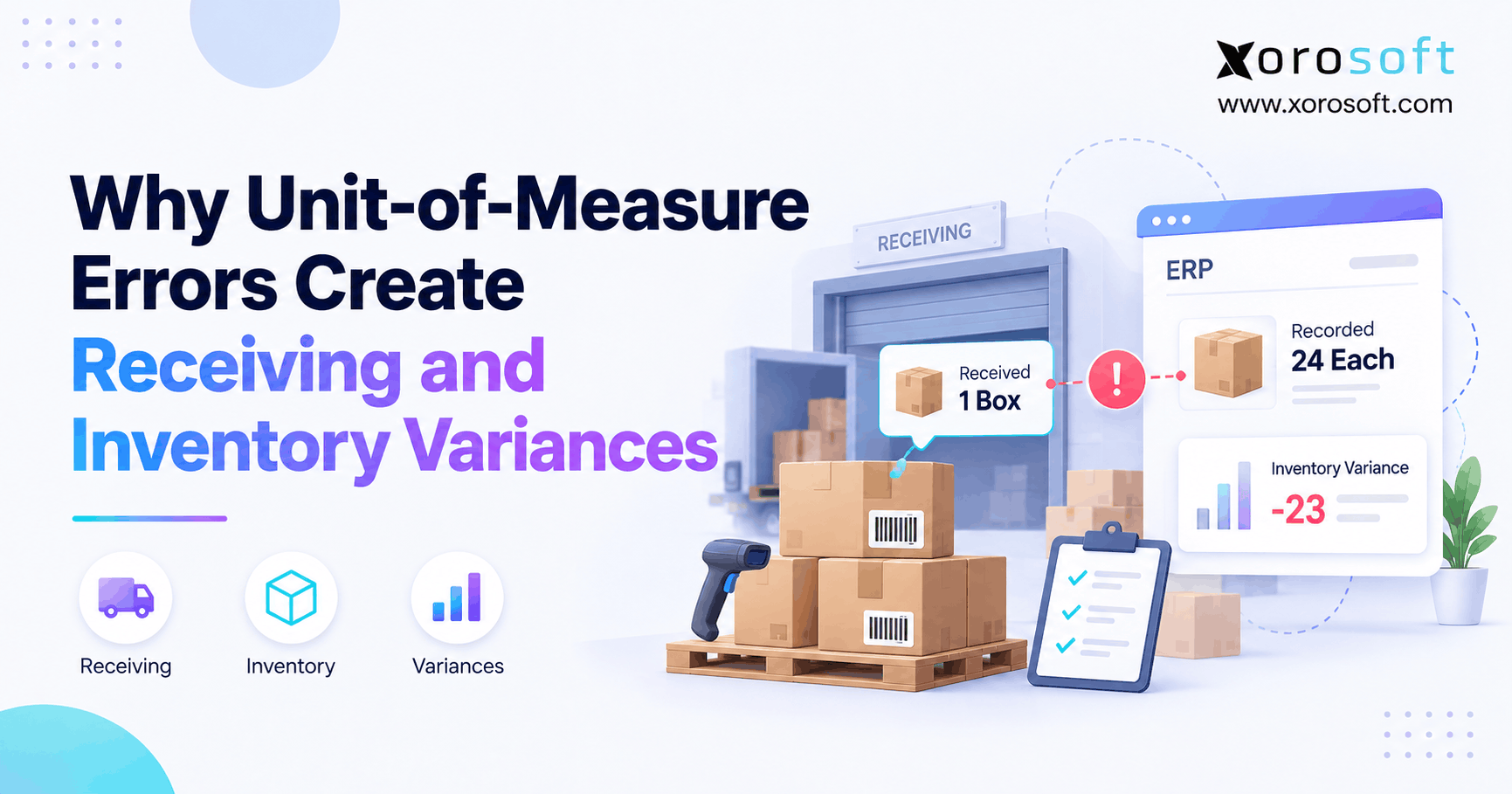
A supplier may ship cases of 24 while the warehouse stores individual units. Similarly, manufacturing may consume kilograms while purchasing records bags. Wholesale customers may order cartons, whereas ecommerce customers buy individual products.
If conversion rules differ between systems or departments, large variances can appear even when the physical quantity remains correct.
Therefore, teams should document unit conversions and apply them consistently across purchasing, warehousing, sales, manufacturing, and accounting.
Moreover, users should not create new units of measure without approval. Otherwise, duplicate or conflicting conversion rules may enter the system.
5.6 Damage, Spoilage, and Obsolescence
Inventory can remain physically present while losing some or all of its usable value.
Examples include:
- Broken products
- Expired food
- Outdated seasonal merchandise
- Contaminated materials
- Recalled products
- Incomplete kits
- Display samples
- Unsellable customer returns
Teams should move these items into controlled statuses and locations. Otherwise, the business may overstate both sellable inventory and financial value.
In addition, warehouse and finance teams should review damaged or obsolete goods regularly. As a result, outdated inventory does not remain hidden in active stock.
5.7 Shrinkage and Unexplained Loss
Shrinkage may result from theft, damage, administrative mistakes, weak controls, or unknown causes.
An adjustment marked only as “shrinkage” provides limited insight. Instead, businesses should use more specific classifications, such as:
- Known damage
- Receiving shortage
- Shipping error
- Access-control issue
- Process failure
- Unknown loss
Frequent unexplained adjustments should trigger a deeper review of employee access, transaction permissions, warehouse layout, surveillance, and handling procedures.
Consequently, management can distinguish routine processing errors from serious security concerns.
5.8 Integration and Timing Differences
Inventory data may move between ecommerce, marketplace, warehouse, accounting, EDI, and ERP systems.
When updates experience delays or failures, temporary differences can appear.
Before posting an adjustment, confirm whether the discrepancy comes from:
- A queued integration
- A failed API transaction
- A delayed batch update
- A marketplace order awaiting import
- A late third-party logistics report
- An accounting posting delay
- A time-zone cutoff difference
Teams should correct timing issues at the process or integration level rather than repeatedly recording them as physical loss.
Therefore, the operations team should monitor and resolve integration failures before managers approve reconciliation adjustments.
6. Inventory Reconciliation Accounting and Month-End Control
The accounting section of this Inventory Reconciliation Guide connects physical stock accuracy with inventory valuation, cost of goods sold, and month-end reporting. Although warehouse teams confirm quantities, finance must verify that the related financial values remain correct.
Therefore, operational and financial reconciliation should support one documented final balance.
6.1 Connecting Physical Stock With Financial Value
The physical count confirms quantity. Meanwhile, accounting reconciliation confirms value.
After teams post approved corrections, finance should review:
- Inventory asset accounts
- Goods received but not invoiced
- Inventory in transit
- Customer-owned inventory
- Consigned stock
- Work in progress
- Finished goods
- Inventory adjustment expense
- Shrinkage
- Cost of goods sold
Meanwhile, operations should provide supporting documents so finance can understand the reason behind material adjustments.
In addition, finance should verify the cost method that the company applied. Otherwise, the quantity may remain correct while the valuation becomes inaccurate.
6.2 Inventory Subledger and General Ledger Reconciliation
A practical inventory-to-general-ledger process includes:
1. Control or close the inventory period.
2. Confirm that teams posted operational transactions.
3. Run the inventory valuation report.
4. Confirm the general ledger inventory balance.
5. Compare the totals.
6. Identify timing differences.
7. Review manual journal entries.
8.Correct inaccurate transactions.
9. Approve documented adjustments.
10. Retain the reconciliation report.
Manual journal entries posted directly to inventory accounts can create differences because they change the general ledger without updating item-level records.
Where possible, inventory value changes should originate from controlled inventory transactions. As a result, the financial balance remains traceable to operational activity.
Furthermore, finance should investigate unexplained journal entries before closing the period. Otherwise, the same difference may carry into the next month.
6.3 How Inventory Variances Affect Cost of Goods Sold
When recorded inventory exceeds physical inventory, the business may need to reduce the inventory asset and recognize an expense, shrinkage, or cost adjustment.
However, the correct accounting treatment depends on the cause.
Damage, obsolescence, production variance, theft, and receiving errors may require different classifications. Therefore, finance should review material adjustments rather than allowing warehouse employees to determine accounting treatment independently.
In addition, accounting policies should define the expense accounts that teams use for different variance types.
6.4 Preventing Month-End Delays
Month-end problems often begin long before the final day of the accounting period.
A faster close depends on:
- Timely receiving
- Confirmed shipments
- Controlled adjustments
- Current production records
- Completed warehouse transfers
- Reliable integrations
- Regular cycle counting
- Clear cutoff procedures
- Shared ownership between operations and finance
Waiting until month-end to discover weeks of unposted transactions creates unnecessary pressure. Consequently, continuous control reduces the number of exceptions that teams must investigate during close.
Moreover, managers should assign unresolved items to specific employees before closing begins. As a result, accountability remains clear.
7. Cycle Counting and Physical Inventory Reconciliation
This Inventory Reconciliation Guide recommends combining regular cycle counting with periodic full physical counts.
An annual count confirms inventory at one moment. However, it does not maintain accuracy throughout the rest of the year. Cycle counting, by contrast, identifies problems earlier and supports continuous control.
7.1 Using Cycle Counting for Inventory Accuracy
Cycle counting involves counting selected inventory on a recurring schedule.
It is useful when a company wants to:
- Find errors earlier
- Reduce year-end disruption
- Focus on high-value products
- Monitor risky locations
- Validate process improvements
- Maintain accurate available stock
- Support regular financial reporting
The schedule may depend on product value, movement frequency, discrepancy history, business importance, or risk.
In addition, teams should count products with repeated discrepancies more often. Consequently, the cycle-count schedule can respond to actual operational risk.
7.2 Using an ABC Stock Reconciliation Method
An ABC approach groups inventory according to importance.
| Class | Typical Characteristics | Suggested Count Frequency |
| A | High-value, critical, or fast-moving products | Most frequent |
| B | Moderate-value or moderately active products | Regular |
| C | Low-value or slow-moving products | Less frequent |
Classification should not rely only on unit cost.
For example, a low-cost component that can stop production may deserve A-level control. Similarly, a fast-moving ecommerce product may require frequent counts because even a small variance can affect many orders.
Therefore, business impact should influence classification alongside inventory value.
7.3 When a Full Physical Count Is Necessary
A full count may make sense:
- At year-end
- Before an external audit
- After a warehouse relocation
- Before or after a system implementation
- Following an acquisition
- When records have become unreliable
- After a major control failure
- When company policy requires it
Even when cycle counting works well, a full count can provide an important control checkpoint. Nevertheless, continuous accuracy controls should remain in place throughout the year.
Moreover, a full count may help establish a reliable opening balance after a system change.
7.4 Reducing Operational Disruption
Businesses can reduce disruption by:
- Counting outside peak hours
- Dividing the warehouse into zones
- Scheduling counts by inventory class
- Using mobile scanning
- Counting low-activity locations first
- Assigning dedicated count teams
- Controlling movement during short windows
- Reviewing variances immediately
- Updating results directly in the system
A well-designed process should therefore improve accuracy without causing unnecessary fulfillment delays.
Meanwhile, customer service and purchasing teams should know about temporary count restrictions.
8. Inventory Reconciliation Requirements by Industry
An effective Inventory Reconciliation Guide should reflect the risks of the industry in which a business operates.
The general process remains consistent. Nevertheless, teams should adapt detailed controls to product type, warehouse structure, regulatory requirements, manufacturing activity, and sales channels.
Businesses can review the range of industries supported by inventory-focused ERP workflows when comparing their own operational requirements.
8.1 Apparel Inventory Reconciliation
Apparel businesses manage style, size, color, season, collection, and product variants.
Teams should reconcile at the sellable SKU level. Otherwise, counting only the parent style can hide a shortage in a high-demand size or color.
Common risks include:
- Variant mislabeling
- Samples
- Showroom stock
- Seasonal returns
- Product bundles
- Wholesale allocations
- Inventory across stores, warehouses, and third-party facilities
In addition, teams should review seasonal collections separately. As a result, obsolete or returned stock does not distort current availability.
8.2 Furniture and Home Products
Furniture businesses often manage bulky goods, several warehouse zones, damage, special orders, components, and delivery schedules.
A product may exist physically but remain unavailable because damage, missing components, reservations, or assembly requirements restrict its use. Therefore, location and condition matter as much as total quantity.
Moreover, teams should clearly identify display items and customer-specific orders.
8.3 Food and Beverage Stock Reconciliation
Food businesses require additional controls for:
- Lots
- Expiration dates
- Shelf life
- Spoilage
- Quality holds
- Recalls
- Catch weight
- Unit conversions
- First-expired-first-out handling
Physical reconciliation should confirm quantity, lot, expiry, condition, and sellable status. Otherwise, the system may show inventory that the business cannot legally or practically sell.
In addition, teams should move expired or recalled goods out of active locations immediately.
8.4 Wholesale Inventory Reconciliation
Wholesale distributors manage large orders, customer allocations, backorders, EDI, complex purchasing, and several shipment locations.
A total on-hand figure may not show how much inventory customers already reserved. Therefore, the process should review physical stock, committed quantities, open shipments, incoming purchase orders, and allocation rules.
Similarly, teams should check EDI orders for failed acknowledgements or incomplete imports.
8.5 Manufacturing Inventory Reconciliation
Manufacturers need to reconcile:
- Raw materials
- Components
- Work in progress
- Finished goods
- Scrap
- By-products
- Production returns
- Work-order consumption
- Outsourced processing
- Inventory held by subcontractors
Errors often occur when production teams physically consume materials but do not record that usage. Similarly, employees may complete finished products without receiving them into inventory. As a result, teams must include production transactions in the reconciliation process.
Moreover, operations managers should review work-order closures before month-end.
8.6 Sporting Goods and Consumer Products
Sporting goods and consumer product companies may manage seasonal demand, product kits, bundles, serial numbers, launches, and multichannel fulfillment.
Reconciliation should account for promotional bundles, display stock, warranty replacements, returns, and channel-specific allocations.
In addition, seasonal volume increases may require more frequent cycle counts. Consequently, operations managers should increase count frequency during peak periods.
9. Inventory Reconciliation Guide for Shopify and Multichannel Operations
For ecommerce companies, this Inventory Reconciliation Guide should address orders, returns, warehouse activity, marketplace data, and accounting records.
Because transactions may update at different times, temporary differences can appear between Shopify, warehouse, marketplace, and accounting systems. Therefore, clear inventory statuses and synchronization rules remain essential.
9.1 Reconciling Shopify Orders With Warehouse Inventory
A Shopify merchant should compare:
- Shopify orders
- Fulfilled quantities
- Cancelled orders
- Refunded orders
- Returned products
- Warehouse shipment records
- Third-party logistics balances
- Available-to-sell quantities
- Accounting transactions
An order may reduce available stock before it physically leaves the warehouse. Meanwhile, a return may generate a refund before the warehouse inspects it and restores it to sellable inventory.
Consequently, the same product may temporarily show different balances across Shopify, warehouse, and accounting records.
Therefore, reconciliation should use consistent order and return status definitions.
9.2 Preventing Overselling Across Sales Channels
A company selling through Shopify, Amazon, wholesale, and retail channels must determine which system controls availability.
Without a central source of truth, each channel may reserve or sell against an outdated quantity. As a result, overselling becomes more likely during promotions, product launches, seasonal peaks, and high-volume periods.
A connected process should consider:
- On-hand stock
- Committed orders
- Safety stock
- Channel allocations
- Warehouse availability
- Incoming purchase orders
- Returns
- Transfer activity
In addition, inventory planners should review inventory buffers regularly. Otherwise, outdated safety-stock rules may restrict sales unnecessarily.
9.3 Evaluating a Shopify ERP Integration
Shopify merchants considering a connected operating model can review the Xorosoft ERP listing in the Shopify App Store.
The listing provides context on how Shopify can connect with broader ERP functions for ecommerce, retail, and wholesale operations.
However, businesses should evaluate more than basic order import. Important requirements include inventory synchronization, order status handling, returns, refunds, accounting integration, purchasing, warehouse execution, exception management, and implementation support.
Therefore, the evaluation should include real transaction scenarios rather than only feature demonstrations.
10. Manual and Automated Inventory Reconciliation
This Inventory Reconciliation Guide also helps businesses determine when spreadsheets remain practical and when operational complexity requires stronger systems.
Spreadsheets can work for simple operations. However, they become more difficult to manage as transaction volume, users, warehouse locations, and sales channels increase.
10.1 Where Spreadsheet Reconciliation Can Work
A spreadsheet may work when the business has:
- One warehouse
- A limited SKU count
- Low transaction volume
- Simple purchasing
- Few returns
- No manufacturing
- Limited sales channels
- A small operations team
Even in this environment, the business should control file access, formulas, versions, approvals, and source data. Otherwise, the spreadsheet itself can become another source of inventory error.
In addition, one employee should own the master file. Consequently, duplicate versions become less likely to circulate.
10.2 When Manual Stock Reconciliation Begins to Fail
Warning signs include:
- Multiple versions of the same inventory file
- Unapproved corrections
- Frequent emergency counts
- Repeated negative inventory
- Inventory and accounting totals that do not agree
- Transfers tracked outside the system
- Manually updated ecommerce quantities
- Delayed month-end close
- High-value unexplained adjustments
- Limited audit history
At this point, the business does not simply need a better spreadsheet. Instead, it needs stronger transaction control and shared data.
Moreover, manual reconciliation becomes increasingly risky when several employees update the same information.
10.3 How Warehouse Technology Improves Inventory Accuracy
Warehouse scanning creates a transaction record at the point where stock moves.
A structured warehouse workflow can support:
- Receiving
- Putaway
- Bin transfers
- Picking
- Packing
- Shipping
- Cycle counting
- Lot tracking
- Serial tracking
- Returns
- Replenishment
Businesses that need stronger warehouse execution can review XoroWMS warehouse management capabilities in the context of receiving, picking, packing, shipping, and inventory movement.
Technology alone does not guarantee accuracy. Therefore, warehouse labels, locations, permissions, employee training, and exception procedures must also work well.
In addition, warehouse teams should align barcode scanning rules with units of measure and product structure.
11. ERP Inventory Reconciliation for Growing Businesses
As businesses grow, this Inventory Reconciliation Guide can support an evaluation of ERP, warehouse, ecommerce, purchasing, manufacturing, and accounting systems.
Inventory does not change independently. Instead, every receipt, shipment, return, transfer, and production transaction affects the final balance.
11.1 Why Connected Operational Data Matters
When inventory-related activities exist in separate applications, employees must manually determine whether the records agree.
Every export, spreadsheet, upload, and duplicate entry creates another opportunity for timing differences and human error.
A connected system can reduce this fragmentation by recording related activity within a shared operational environment. Consequently, employees can investigate variances using a more complete transaction history.
Moreover, connected records reduce the time required to trace each discrepancy.
11.2 Cloud ERP for Inventory Accuracy and Control
A platform such as XoroONE can connect inventory management with purchasing, warehouse operations, ecommerce, manufacturing, accounting, forecasting, reporting, and EDI workflows.
For reconciliation, the main benefit is traceability.
A product discrepancy may be traced through:
- The purchase order
- The receipt
- The warehouse location
- The sales order
- The pick record
- The shipment
- The return
- The adjustment
- The accounting entry
As a result, teams spend less time manually combining records and more time identifying the real source of the discrepancy.
In addition, connected approval history provides a clearer audit trail.
11.3 When a Broader ERP Becomes Necessary
A company may need a broader ERP when reconciliation problems involve several departments rather than only the warehouse.
XoroERP is relevant for businesses that need to connect accounting, reporting, purchasing, warehouse management, manufacturing, and related operations.
ERP evaluation becomes appropriate when:
- Inventory and accounting regularly disagree
- Multiple warehouses require shared visibility
- Purchasing depends on manually combined data
- Manufacturing is disconnected from inventory
- Ecommerce and wholesale orders use separate processes
- Adjustments lack approval history
- Reporting depends on spreadsheet consolidation
- Growth is increasing operational risk
The right time to evaluate new systems is before manual control becomes an obstacle to fulfillment, financial close, and decision-making.
However, companies should first document their current workflows and control requirements.
11.4 Comparing Xorosoft and NetSuite
NetSuite is a widely used ERP platform, while Xorosoft positions itself as an alternative for inventory-driven and scaling businesses.
Companies should compare:
- Inventory requirements
- Warehouse workflows
- Accounting needs
- Manufacturing complexity
- Ecommerce integrations
- Implementation approach
- Customization
- Reporting
- User experience
- Ongoing administration
- Total cost
- Support
The Xorosoft versus NetSuite comparison presents one vendor’s perspective. Nevertheless, buyers should also validate requirements through product demonstrations, reference checks, implementation planning, and total-cost analysis.
Therefore, the business should base its final decision on operational fit rather than brand recognition alone.
12. Inventory Reconciliation KPIs and Reporting
The reporting section of this Inventory Reconciliation Guide focuses on metrics that reveal whether inventory accuracy continues to improve.
The objective is not to create more adjustment reports. Instead, the business should reduce the number, value, and recurrence of discrepancies.
12.1 Inventory Accuracy Rate
Inventory accuracy rate measures how many counted records match the system within an approved tolerance.
Track accuracy by:
- SKU
- Product category
- Warehouse
- Bin
- Counter
- Transaction type
- Inventory class
A high company-wide average may hide a serious problem in one warehouse or product group. Therefore, segmented reporting is more useful than one overall percentage.
In addition, accuracy should be compared over time. As a result, teams can measure whether corrective actions work.
12.2 Inventory Variance Value
Variance value measures the financial impact of inventory differences.
Track both gross and net variance. Positive and negative discrepancies may offset one another in the net total, making the final number appear small even when operational errors remain significant.
Consequently, management should review the underlying variance details rather than relying only on the final net figure.
Moreover, high-value variances should receive separate attention from routine count differences.
12.3 Inventory Adjustment Frequency
Frequent adjustments may indicate:
- Weak transaction discipline
- Poor integrations
- Unclear ownership
- Inadequate warehouse controls
- Excessive employee permissions
- Incomplete training
Track adjustments by reason, employee, warehouse, SKU, value, approval level, and month.
A rising adjustment count should trigger investigation rather than broader adjustment permissions. Otherwise, avoidable corrections may become accepted as normal.
Therefore, management should set targets for reducing repeated adjustment categories.
12.4 Time to Resolve Inventory Variances
Long investigation times delay inventory availability and month-end close.
Measure the time from variance identification to:
- Recount
- Root-cause determination
- Approval
- System correction
- Corrective-action assignment
This metric shows whether the reconciliation process remains manageable as the business grows. In addition, it identifies where investigations experience delays.
Consequently, teams can improve staffing, documentation, or system access where required.
12.5 Repeat Discrepancy Rate
A repeat discrepancy occurs when the same SKU, warehouse, location, transaction type, or process produces another variance.
A high repeat rate indicates that previous reconciliation work corrected the balance but did not correct the underlying process. Therefore, recurring discrepancies should receive management attention.
Moreover, management should assign every corrective action to a specific owner.
13. Inventory Reconciliation Mistakes That Weaken Control
A strong Inventory Reconciliation Guide should identify the practices that weaken inventory control.
Although some mistakes appear minor, they can make the final reconciliation considerably less reliable.
13.1 Adjusting Before Investigating
Changing the system balance immediately may remove evidence of the original issue.
Teams should first confirm the count, review transactions, classify the cause, and document the decision. Only then should they post an approved adjustment.
Otherwise, the same operational problem may return during the next count.
13.2 Counting Against Outdated Records
If receipts, shipments, transfers, and production transactions remain incomplete, the variance report will contain avoidable timing differences.
Therefore, teams should update or clearly document records before comparing the count with the system.
In addition, teams should list cutoff exceptions separately.
13.3 Ignoring Location-Level Errors
A company-wide quantity may remain correct while individual warehouse balances stay wrong.
Reconciliation should therefore validate the locations that teams use for fulfillment and replenishment rather than reviewing only the consolidated quantity.
Otherwise, the business may promise stock from a location where employees cannot find it.
13.4 Treating Every Variance the Same
Materiality, value, risk, and recurrence should influence the investigation.
For example, a one-unit discrepancy involving a high-value serialized product may deserve more attention than a larger variance involving inexpensive packaging.
Therefore, recount and approval thresholds should reflect business risk.
13.5 Allowing Uncontrolled Adjustments
Employees who count stock should not automatically approve high-value corrections.
Separation of duties strengthens accountability. In addition, every material adjustment should include evidence, a reason code, and documented approval.
Consequently, managers can identify unauthorized or unexplained changes more easily.
13.6 Failing to Assign Corrective Action
A reconciliation report that ends with “adjustment posted” provides only temporary accuracy.
Every material or recurring variance should lead to:
- A named owner
- A corrective action
- A completion date
- A follow-up review
Ultimately, corrective action turns reconciliation into process improvement.
Moreover, management should keep incomplete actions open until the responsible owner finishes the work and leadership verifies the result.
14. Practical Inventory Reconciliation Example
This example shows how an Inventory Reconciliation Guide can apply to a real inventory discrepancy.
A company sells one product through Shopify, wholesale accounts, and a warehouse. The inventory system shows 1,000 units. However, the physical count finds only 958.
14.1 Recount and Location Review
Initially, the variance appears to equal 42 units.
A second employee recounts the product and checks nearby locations. During the review, the employee finds ten units in a returns-inspection area.
Consequently, the unresolved variance falls from 42 units to 32 units.
Therefore, the team investigates only the remaining unexplained quantity.
14.2 Inventory Transaction Investigation
The team reviews recent activity and finds:
- Twelve units left through a wholesale order, but the team did not confirm the shipment.
- Employees transferred eight units to another warehouse without completing the receipt.
- Damage affected two units, but the system still counted them as sellable.
- Ten units remain unexplained.
The investigation therefore separates timing and process errors from a genuine physical shortage.
In addition, the team identifies two workflow problems that require correction.
14.3 Correcting Operational and Accounting Records
The company:
- Completes the missing shipment confirmation
- Finalizes the warehouse transfer
- Moves damaged units into the correct status
- Submits the remaining shortage for approval
Finance then reviews the unit cost and accounting treatment before posting the adjustment. As a result, the operational record and financial value remain aligned.
Moreover, the team attaches supporting documents to the final adjustment.
14.4 Preventing the Same Discrepancy
The company also:
- Adds an alert for failed shipment confirmations
- Requires transfer receipt confirmation
- Creates a damaged-stock workflow
- Adds the product to weekly cycle counts
- Reviews access to the storage area
The count corrects the immediate balance. More importantly, the corrective actions improve the process that caused the discrepancy.
Consequently, future variances should become easier to prevent and investigate.
15. Inventory Reconciliation Guide FAQs
These FAQs support the Inventory Reconciliation Guide by answering common questions about counting, variances, accounting, software, and operational controls.
Although every business has different requirements, the same core principles apply across most inventory-driven operations. Therefore, companies should use the answers below alongside their accounting policies and internal control procedures.
15.1 What Is Inventory Reconciliation?
Inventory reconciliation compares physical stock with recorded inventory quantities and values. As a result, teams can verify, investigate, approve, correct, and document differences.
15.2 Why Is Inventory Reconciliation Important?
Inventory reconciliation supports accurate fulfillment, purchasing, forecasting, accounting, and financial reporting. Otherwise, a business may oversell products, order unnecessary stock, miss replenishment needs, or report incorrect inventory values.
15.3 How Do You Reconcile Inventory?
First, define the scope and cutoff. Next, prepare system records and control stock movement. Then, count physical inventory, compare balances, investigate variances, approve corrections, and assign corrective actions.
15.4 How Often Should Inventory Be Reconciled?
Frequency depends on product value, transaction volume, risk, and reporting requirements.
For example, high-value or fast-moving products may require weekly or daily cycle counts. Meanwhile, teams may count moderate-risk inventory monthly or quarterly. In addition, a full physical inventory may still occur annually.
15.5 What Causes Inventory Discrepancies?
Common causes include receiving errors, picking mistakes, shipping errors, unrecorded transfers, returns-processing gaps, unit-of-measure problems, damaged stock, shrinkage, integration delays, incorrect adjustments, and production-recording errors.
Therefore, teams should link each variance to the most accurate reason code.
15.6 What Is an Inventory Reconciliation Checklist?
An inventory reconciliation checklist provides a standardized list of tasks that teams follow before, during, and after a physical count.
Consequently, it helps teams complete transaction preparation, movement control, physical counting, variance investigation, approval, accounting review, and corrective-action tracking consistently.
15.7 Is Inventory Reconciliation the Same as Stocktaking?
No. Stocktaking refers to the physical count of inventory.
By contrast, reconciliation includes physical counting, system comparison, variance investigation, adjustment approval, accounting review, and corrective action.
15.8 What Is the Difference Between Cycle Counting and Reconciliation?
Cycle counting counts selected inventory regularly.
However, reconciliation covers the broader process of comparing those counts with system records, investigating differences, approving corrections, and improving the underlying process.
15.9 How Do You Reconcile Inventory to the General Ledger?
First, confirm inventory value in the subledger. Then, compare it with the inventory balance in the general ledger.
Next, review unposted transactions, timing differences, manual entries, valuation issues, and approved adjustments until the team resolves or fully explains the difference.
15.10 What Is Inventory Variance?
Inventory variance measures the difference between recorded and physical inventory.
For example, teams may measure it by quantity, value, SKU, warehouse, product category, or reason.
15.11 How Do You Calculate Inventory Variance?
Quantity variance is:
Physical quantity − Recorded quantity
Value variance is:
Quantity variance × Unit cost
Therefore, teams should review both measures because a small quantity difference may still create a significant financial effect.
15.12 What Is an Acceptable Inventory Variance?
No universal acceptable variance exists.
Instead, each company should set tolerances based on product value, industry risk, transaction volume, historical performance, and financial materiality.
15.13 Who Should Approve Inventory Adjustments?
Approval depends on value and risk.
For instance, warehouse supervisors may approve minor corrections. However, finance, operations leadership, or senior management should approve high-value adjustments, write-offs, shrinkage, and recurring discrepancies.
15.14 Can Inventory Reconciliation Be Automated?
Businesses can automate several parts, including barcode counting, variance calculations, approval workflows, adjustment posting, integration monitoring, inventory valuation reporting, and transaction-history review.
Nevertheless, human judgment remains necessary for recounts, root-cause analysis, material adjustments, and corrective action.
15.15 When Should a Business Replace Spreadsheet Reconciliation?
A business should consider replacing spreadsheet-led reconciliation when multiple employees edit the same records, several file versions exist, adjustments lack approval history, inventory and accounting regularly disagree, transfers become difficult to track, or month-end close faces repeated delays.
Consequently, connected systems may become more practical as complexity increases.
15.16 How Do Ecommerce Businesses Reconcile Inventory?
Ecommerce businesses compare website orders, marketplace orders, warehouse shipments, cancellations, refunds, returns, third-party inventory balances, available stock, and accounting transactions.
In addition, the process should account for timing differences between allocation, shipment, return inspection, restocking, and financial settlement.
15.17 How Do Manufacturers Reconcile Inventory?
Manufacturers reconcile raw materials, components, work in progress, finished goods, scrap, production returns, bill-of-material consumption, and completed work orders.
Therefore, accurate production posting remains essential because unrecorded material usage can create large discrepancies over time.
15.18 How Do Multi-Warehouse Businesses Reconcile Inventory?
Multi-warehouse companies should reconcile stock by warehouse, bin, location, and transfer status.
Otherwise, a correct company-wide total may hide a serious location-level shortage.
15.19 What Reports Are Needed for Inventory Reconciliation?
Useful reports include:
- Physical count report
- Inventory valuation report
- Variance report
- Adjustment history
- Purchase receipt report
- Shipment report
- Warehouse transfer report
- Returns report
- Production activity report
- Inventory-to-general-ledger report
Together, these reports provide the transaction history required for investigation.
15.20 Does Every Business Need ERP for Reconciliation?
No. A small business with limited inventory complexity may maintain suitable control with disciplined spreadsheets or basic inventory software.
However, ERP becomes more relevant when reconciliation depends on connected purchasing, warehouse, ecommerce, manufacturing, accounting, and multi-location information.
15.21 How Can Xorosoft Support Inventory Reconciliation?
Xorosoft can support reconciliation by connecting inventory, purchasing, warehouse management, accounting, ecommerce, manufacturing, forecasting, and reporting workflows.
Therefore, it is most relevant when discrepancies result from disconnected systems or when the business needs a shared operational record across departments.
15.22 Can Inventory Software Eliminate Every Discrepancy?
No system can eliminate every discrepancy.
However, software can improve transaction control, traceability, reporting, and visibility. Nevertheless, businesses still need accurate receiving, warehouse discipline, employee training, approval rules, and management review.
15.23 How Can Barcode Scanning Improve Inventory Accuracy?
Barcode scanning reduces manual data entry and records inventory movement at the point where it happens.
However, accurate product labels, warehouse locations, units of measure, and employee training remain essential.
15.24 What Is the Best Way to Investigate a Stock Discrepancy?
First, complete a recount. Next, review receipts, shipments, returns, transfers, adjustments, production activity, location changes, and system integrations.
Ultimately, the goal is to identify both the immediate cause and the control weakness that allowed the discrepancy to happen.
15.25 How Long Should Inventory Reconciliation Take?
The required time depends on inventory volume, warehouse count, record quality, and the number of discrepancies.
A well-controlled business may complete routine reconciliation quickly. By contrast, disconnected systems and incomplete transactions can extend the process considerably.
16. Build an Inventory Reconciliation Process That Improves Over Time
Used consistently, this Inventory Reconciliation Guide can turn reconciliation from a monthly cleanup activity into a dependable control process.
Instead of correcting the same balances every period, teams can identify the workflows that create inaccurate records. As a result, receiving, warehouse movement, returns, fulfillment, and accounting processes can improve over time.
A reliable process has five characteristics:
1. Clear scope: Teams understand which products, locations, records, and periods they plan to review.
2. Reliable transactions: Employees record receipts, shipments, transfers, returns, and production activity promptly.
3. Controlled adjustments: Managers require evidence and approval for material corrections.
4. Root-cause reporting: Teams classify variances so management can identify patterns.
5. Corrective action: Teams turn repeated errors into operational improvements rather than repeated write-offs.
Businesses should begin by measuring current accuracy and identifying the processes that create the greatest risk.
Often, improvements to receiving, warehouse transfers, returns, labels, unit conversions, and shipment confirmation produce meaningful gains before a major system change becomes necessary.
However, when disconnected inventory, purchasing, warehouse, ecommerce, manufacturing, and accounting data create the real problem, process improvements alone may not solve it.
Therefore, management should review both process and system limitations before deciding on the next step.
17. Decide the Right Next Step for Your Inventory Operation
The final stage of this Inventory Reconciliation Guide determines whether the company’s current processes and systems can continue supporting reliable inventory control.
A practical review should examine:
- How teams receive inventory
- How warehouse employees confirm movements
- How Shopify, Amazon, wholesale, and EDI orders affect availability
- How manufacturing changes inventory balances
- How employees inspect and restock returns
- How managers approve adjustments
- How inventory value reaches the general ledger
- How long reconciliation takes
- How frequently the same errors return
- How much reporting depends on spreadsheets
Xorosoft may suit inventory-driven companies that have outgrown QuickBooks, spreadsheets, inventory-only applications, or disconnected operational systems.
However, the right next step does not involve purchasing software based only on a feature list. Instead, map the current workflow, identify the most expensive control gaps, define the required integrations, and determine whether an ERP, warehouse management system, or connected ecommerce model fits the business.
Finally, to review inventory reconciliation requirements, warehouse structure, ecommerce workflows, and accounting needs, contact Xorosoft for a personalized consultation.
Recent Posts
-
 Xorosoft vs NetSuite for Shopify B2B Operations in 2026
 -
 How to Manage Shopify B2B Payment Terms Without Breaking AR and Order Release
 -
 Supplier Performance Benchmarks 2026: Lead Time, Fill Rate, and Defects
 -
 Inventory Management for Target Plus Sellers Expanding Beyond Shopify
 -
 What Is an ERP Conference Room Pilot and Why Should Buyers Require One?