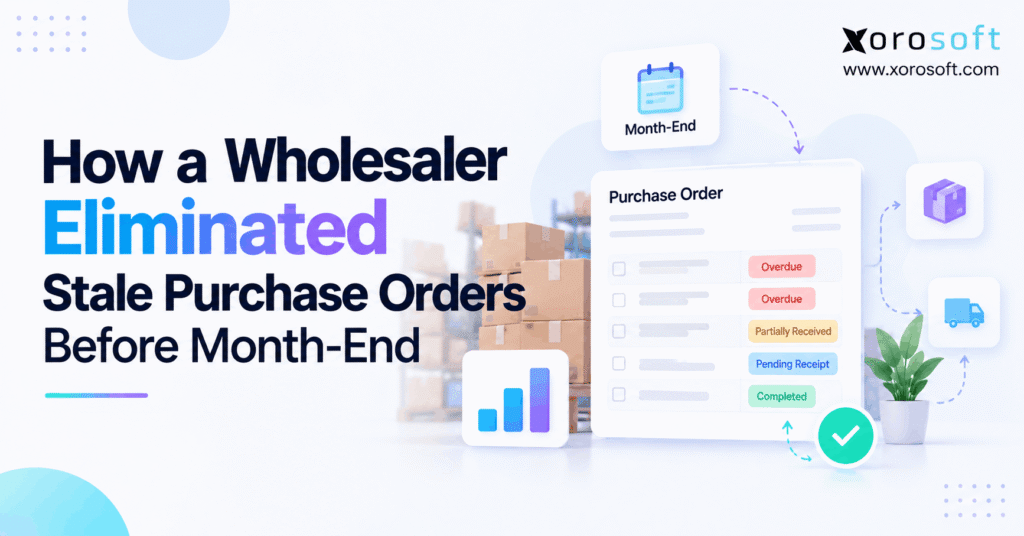
In many businesses, handling stale purchase orders can present unique challenges.
1. When Old Buying Records Disrupt the Close
Stale purchase orders can make month-end harder for a wholesaler, even when the goods on the shelves seem correct. A buyer may expect another shipment, while the supplier believes the order is finished. Meanwhile, the warehouse may have received items that never appeared in the system. As a result, finance must sort out the same order before it can trust the numbers.
However, the goal is not to close every old order. Instead, the team needs to find which balances are still real, which ones need follow-up, and which ones can be cleared. This guide uses an illustrative wholesaler, not an unverified customer success story, to show the process.
1.1 Stale Purchase Orders Need a Clear Owner
An old open PO often stays on the report because each team thinks another person will fix it. For example, the buyer may wait for warehouse proof, while finance waits for the buyer’s supplier email. Yet no one owns the final action. As a result, the issue returns at every close.
Therefore, a strong review assigns one owner to each exception. However, they must collect the facts, name the next action, and confirm that it happened. The review then becomes a clear workflow.
1.2 Why Late PO Cleanup Creates Rework
When teams wait until the last two days, supplier replies may not arrive before the cutoff. In addition, warehouse staff may be busy with live orders, and finance may already be working on invoices and bank entries. Therefore, a five-day plan is useful, but a weekly review is even better.
For a growing wholesaler, a small routine can prevent a large cleanup. For example, buyers can check past-due orders each week. Then, when month-end comes, the team deals only with new gaps and a short list of hard cases.
2. What Makes a Purchase Order Stale?
A purchase order becomes stale when its open balance no longer reflects a clear, verified plan. That could mean an old promised date, a missing supplier reply, a partial receipt with no next shipment, or a duplicate order. However, age alone is not proof that a PO is wrong.
2.1 Stale Purchase Orders vs. Valid Long-Lead Orders
Consider two suppliers. The first sells imported furniture with a confirmed 90-day lead time. Its PO may be open for months and still be correct. In contrast, the second sells local accessories with a ten-day lead time. If that supplier cancels the last 40 units and the buyer does not record the change, the newer PO is already stale.
Therefore, teams should measure days past the confirmed delivery date, not just days since creation. They should also consider shipping terms and known delays.
2.2 Which PO Aging Dates Matter Most?
First, check the order date, promised ship date, expected receipt date, last receipt, and last supplier reply. Next, look at ordered, received, invoiced, and remaining quantities. In fact, each value tells a different part of the story. For example, an invoice may arrive before a physical shipment, while a receipt may be posted before the bill.
Because these events do not always happen in the same order, a single status field is not enough. Instead, use the status as a starting point and inspect the linked records before acting.
3. Why Old Open POs Build Up in Wholesale
Stale purchase orders often arise when wholesale firms buy across many suppliers, locations, and sales channels. Therefore, even small gaps in the handoff can create a large open PO backlog.
3.1 Partial Receipts Leave an Open PO Balance
Suppose a buyer orders 600 units, but the warehouse receives only 520. The supplier may ship the rest next week. However, it may also have stopped making that item. If no one asks, the remaining 80 stay in the on-order total.
Meanwhile, a buyer who trusts that total may delay new stock. As a result, a simple short shipment becomes a planning risk. First, ask whether the missing units are still due.
3.2 How Supplier Changes Create Stale Purchase Orders
For example, suppliers change ship dates, reject lines, split cartons, or offer new items. Often, they send the news by email instead of through the purchasing system. If the buyer leaves the original PO unchanged, the system still shows an old promise.
For this reason, supplier follow-up must include a clear update step. Then, the team should record the new date, agreed quantity, and name of the person who confirmed the change. That way, no one must dig through old emails.
3.3 Warehouse and Finance May See Different Numbers
The warehouse might count 90 units at the dock but record only 80. Meanwhile, finance may hold an invoice for all 90. For example, staff may receive stock against the wrong PO. Therefore, neither a purchase order report nor an invoice list tells the full story alone.
Instead, check the three records together: what was ordered, what arrived, and what was billed. If they do not agree, assign a reason and owner before anyone changes the order status.
4. How Stale Purchase Orders Distort Stock Decisions
The biggest risk is not an untidy report. Instead, it is a decision based on supply that may never arrive. As a result, an unreliable open balance can affect cash, stock availability, and customer promises long before finance sees it.
4.1 Open Purchase Orders Can Hide a Stockout
For example, imagine a sporting goods buyer who sees 200 helmets on order. The shop has only 35 in stock, but the buyer holds off on a new PO because another delivery looks close. Yet the supplier cancelled 150 units last week. As a result, the team may run short during a promotion.
Therefore, open orders should count as planned supply only when the delivery is still valid.
4.2 Old PO Balances Can Lead to Double Buying
However, the opposite can happen as well. If buyers do not trust the open PO list, they may place a second order for the same item. Then the first shipment arrives, too. Consequently, cash becomes tied up in stock that the business did not plan to hold.
A review of stale purchase orders helps protect both sides of the decision. It keeps valid incoming goods visible while removing old promises that no longer apply.
4.3 A Purchasing Commitment Is Not Always a Payable
An open PO usually records a plan or promise to buy; it does not by itself prove that goods were received. However, deposits, contract terms, and posted invoices can change the accounting picture. For that reason, finance must review these facts separately.
Stanford’s guide to purchase order commitments also separates outstanding commitments from actual invoice activity. Therefore, do not assume every open PO is a liability, or that closing a PO will clear a real amount owed to a supplier.
5. An Illustrative Wholesaler’s PO Backlog
Consider a fictional distributor selling apparel, home goods, and sports gear to stores and online buyers. In the week before month-end, its controller finds several open lines that have not changed for weeks. Rather than close them all, the team reviews each one.
5.1 Three Outstanding Purchase Orders, Three Answers
| Case | Ordered and received | What the team finds | Next action |
|---|---|---|---|
| Jackets | 120 ordered, none received | Supplier cancelled the order | Verify terms, then approve cancellation |
| Helmets | 200 ordered, 140 received | Supplier confirms 60 more in transit | Keep 60 open and update the date |
| Accessory kits | 100 ordered, 70 received, 60 invoiced | Ten received units have no matched invoice | Review GRNI; confirm the other 30 |
All figures are illustrative. They show why stale purchase orders need different answers. In addition, the table makes a key point: an open quantity and an uninvoiced receipt are two separate questions.
5.2 Sort the Work Before Changing Anything
First, the buyer checks supplier intent. Next, warehouse staff confirm physical receipts, including any stock on hold. Then, finance reviews invoices, credits, deposits, and period dates. Finally, a manager approves changes to the order where required.
For example, the helmet order must stay open even though it is old, while the cancelled jackets may need closure. Meanwhile, the accessory kits call for both purchasing and accounting checks. Therefore, no single action works for all three cases.
6. How to Clear Stale Purchase Orders in Seven Steps
In short, a sound cleanup process starts with facts and ends with proof. Use this seven-step flow to find old open POs, review the true balance, and protect stock and accounting records at the cutoff.
6.1 Export All Open Purchase Orders
First, pull a line-level report for every active warehouse. Include PO number, vendor, SKU, buyer, order date, planned delivery date, quantity ordered, quantity received, amount left open, and current status. Also include linked receipts or bills if your system provides them.
Next, keep a dated copy of the report so teams work from the same starting point. However, do not treat it as the source of truth when records conflict. Instead, use it to find the lines that need proof from the supplier, warehouse, or finance team.
6.2 Calculate Age and Quantity Still Due
Next, calculate days since the last confirmed delivery date. Also check how long it has been since the last receipt or supplier reply. These can reveal more than PO age. For example, a 90-day order may be healthy if the due date is next week.
For a basic line, remaining quantity equals ordered quantity less valid receipts and formally closed or cancelled units. However, returns, extra receipts, or data fixes may change the result. Therefore, use the ERP’s defined balance and review odd cases rather than relying on one spreadsheet formula for every order.
6.3 Match Receipts With Supplier Records
Then, compare each flagged line with packing lists, receipts, shipment notices, and supplier messages. If a supplier says an order shipped, check whether the warehouse has it. If the warehouse says it arrived, confirm that staff posted the receipt to the right PO and location.
Also, check for items held for quality review. They may be on-site but not ready for sale. As a result, a mismatch may require a receiving fix rather than cancellation. Keep a record of the evidence so finance can follow the same trail.
6.4 Group Stale PO Exceptions by Action
Once the facts are clear, give each line a next action: keep open, change expected date, check receipt, check invoice, close remaining quantity, or cancel. This approach is easier to manage than one large list marked “old.”
For example, an overdue import with a confirmed ship date belongs in the keep-open group. In contrast, an undelivered order that the supplier withdrew may qualify for cancellation. Meanwhile, a delivered order with no invoice belongs in an accounting review. Therefore, each group needs a different owner and deadline.
6.5 Assign Owners and Approval Rules
Purchasing should confirm supplier promises and whether demand still exists. The warehouse should check goods, receipt dates, and location. Finance should review bills, credits, and any accrued amounts. Then, a manager should approve high-risk changes under company policy.
In addition, each issue needs one named case owner. That person follows up until the change is complete. Otherwise, teams can answer their own part of the question while the open PO remains unchanged. Also, an exception log shows who owes the update.
6.6 Close, Cancel, or Retain the Right Lines
After review, change only what the evidence supports. Keep valid goods in transit open. Close a remaining quantity when no more goods are due and required checks are done. Cancel an invalid order when the supplier and business have no open duty under it, subject to system rules.
However, do not delete proof, force a receipt, or change dates just to improve a report. Also, confirm whether invoices or deposits are linked to the order.
6.7 Recheck the PO Backlog Before Close
Finally, run the open PO report again and compare it with the first export. Then, confirm that resolved exceptions are no longer counted as valid incoming stock. At the same time, check that lines kept open still show the right amounts and dates.
Next, have finance review items received without a matched bill. Keep that check separate. As a result, the controller can see two clear lists: valid buying commitments and receipt or invoice issues that still need action.
7. When to Close, Cancel, or Keep a PO Open
Clearing stale purchase orders is not a single-button task. Instead, the right choice depends on delivery status, supplier terms, and linked records. Use the table below as an action guide, then follow your own approval rules.
| PO condition | Recommended action | Check before acting |
|---|---|---|
| Supplier confirms the balance is shipping | Keep open; update date | Demand and transit proof |
| Partial receipt; rest no longer needed | Review line closure | Supplier agreement, receipts, bills |
| No delivery; order withdrawn | Review cancellation | Deposits, terms, matched invoices |
| Goods received; bill not yet matched | Keep accounting issue open | Receipt and invoice review |
| Duplicate PO suspected | Find the valid order | Receipts, supplier promise, allocations |
| Full receipt and billing complete | Review final closure | Audit record and system rules |
7.1 Closing Old Purchase Order Lines
A line may be ready to close when the supplier will not send the balance and the buyer no longer needs it. However, verify that no shipment is in transit or stored in another warehouse. Next, check for a pending invoice or credit.
If the order has both complete and incomplete lines, a line-level change can be safer than closing the whole PO. This matters when one style or size is gone but the rest of the order still has a valid delivery plan.
7.2 When a Purchase Order Must Stay Open
A PO should usually stay open when the remaining units are still due and needed. For example, a split container may deliver the first half now and the rest next month. Therefore, the correct fix is to update the delivery date, not remove the balance.
Likewise, a quality hold does not always mean the item was never received. The warehouse and finance teams must confirm how the system records that stock. Only then can purchasing decide what remains to be supplied.
7.3 Before You Cancel, Check the Full Record
Cancellation can block later processing in some systems. Therefore, first confirm the supplier’s intent and any contract terms. Next, check receipts, deposits, invoices, linked orders, and vendor credits. If any remain open, resolve them through the right process.
In addition, retain the decision and approval. A buyer who sees the PO next month should be able to learn why it was cancelled.
8. Purchase Order Reconciliation at Month-End
Reconciling stale purchase orders asks whether the open buying balance is still valid. However, accounting also needs to know which goods were received and what the supplier has billed. These reviews overlap, but they must not be treated as one task.
8.1 Match the PO, Receipt, and Invoice
To clarify, a three-way match checks the order, the record of goods received, and the vendor invoice. First, confirm the right SKU and quantity. Next, check prices, freight, discounts, and agreed terms where they apply. Then, route any difference to the team that can explain it.
For example, a bill for 100 units cannot be treated as a perfect match if only 80 were recorded as received under a strict receipt-based process. The buyer may need to ask about the missing 20, while the warehouse checks its logs. Meanwhile, finance follows the bill-approval policy.
8.2 GRNI Is Different From an Open PO
Goods received not invoiced (GRNI) covers items that have been received but lack a fully matched supplier invoice. By contrast, an open PO balance can cover goods that have not arrived. Therefore, one number should not be used as a substitute for the other.
For period-end accruals, Oracle’s receipt accounting guidance explains how systems may account for received but uninvoiced goods. However, the exact treatment depends on the firm’s accounting rules and setup. Finance should confirm the cutoff and posted entries before clearing a receipt issue.
8.3 Purchase Order Reconciliation: A Value Example
For example, suppose a wholesaler orders 100 units at $20 each. By month-end, 70 are received and 60 are invoiced. The goods received have an example value of $1,400; the invoiced quantity has a value of $1,200. Therefore, ten received but uninvoiced units have an illustrative value of $200, before other costs or price differences.
Meanwhile, 30 units are still unreceived. Next, the buyer must ask whether those units are coming. Meanwhile, finance must review the ten uninvoiced units under its accounting policy. As a result, the team handles two different issues without forcing them into one PO status change.
9. A Five-Day Plan for Open PO Cleanup
A focused plan to resolve stale purchase orders gives every team time to verify facts. More importantly, it stops all issues from landing with finance on the final day. So, use the schedule below as an example and adjust it to your close calendar.
| Timing | Main owner | Main result |
|---|---|---|
| Day -5 | Purchasing | Aged PO list with owners |
| Day -4 | Warehouse | Checked receipts and missing items |
| Day -3 | Buyers | Supplier replies and revised dates |
| Day -2 | Finance | Invoice, credit, and GRNI review |
| Day -1 | Manager | Approved closures and cancellations |
| Day 0 | Controller | Final exception list and sign-off |
9.1 Buyers Check Outstanding Purchase Orders
On the first review days, buyers contact suppliers about overdue or unclear lines. Next, they record the reply and expected date. For items no longer needed, they check whether the supplier agrees to cancel or reduce the order.
However, a lack of reply should not become automatic permission to cancel. Instead, mark the order as an unresolved risk and move it to the right manager. That way, demand remains protected.
9.2 Warehouse and Finance Check the Cutoff
First, the warehouse verifies receipts, returns, and items on hold. Meanwhile, finance checks bills, prepayments, and receipt dates. If a shipment reached the dock before month-end but was posted later, the team must review the correct period under its policy.
Therefore, the close process needs actual evidence, not a rushed date change. A packing list, receipt record, or supplier bill can explain a gap. Once the facts agree, the owner can record the correction and close the exception.
9.3 Close Day Is for Proof, Not Guesswork
On the last day, the controller checks which actions are complete and which remain open with a clear reason. Next, the team makes sure valid orders still appear in incoming stock. Then, finance signs off on material receipt and invoice issues.
If some cases cannot be resolved in time, document the owner, value, likely impact, and next step. As a result, the month-end file stays clear even when a supplier has not yet replied.
10. How to Prevent Stale Purchase Orders Each Week
A one-time cleanup is useful, but prevention is better. Therefore, build a light review into normal buying work. The key is to catch changes while suppliers and warehouse staff still remember what happened.
10.1 Set Aging Rules by Supplier Lead Time
Use different review limits for local items, imports, made-to-order goods, and seasonal stock. For example, a local order may need follow-up within days of its promised date, while an import may need a longer review window. Therefore, the test should reflect the confirmed due date, not a fixed age for every PO.
Also, review lines with no recent supplier update, even if they are not yet overdue. That way, buyers can catch changed plans before they affect stock and cash.
10.2 Give PO Exceptions a Named Owner
Create a simple weekly list with PO number, reason, buyer, due date, and next action. Then, assign each case to one person. For example, purchasing can chase late supply, warehouse staff can fix receipt gaps, and finance can handle invoice issues.
In addition, set clear approval rules for closing balances. By the next review, each line should have an update or a recorded reason for delay.
10.3 Keep Incoming Stock Reports Trustworthy
On-order quantities help buyers plan stock, but only if they reflect real supplier plans. Therefore, remove cancelled balances through an approved process and update valid shipment dates. Also, check whether duplicate POs are counted twice.
Once buyers trust the data, they are less likely to place extra orders just to stay safe. At the same time, finance gains a clearer view of outstanding buying commitments. Both teams benefit from one agreed version of what is still coming.
11. Who Needs More Than a Spreadsheet?
Not every wholesaler needs new software to prevent stale purchase orders. However, the process becomes harder as lines, suppliers, and warehouses grow. Instead, the right question is whether the current workflow can keep records correct without repeated manual work.
11.1 When Manual Purchase Order Reviews Work
For example, a small team may manage open POs with one shared sheet when it has few suppliers, steady deliveries, and clear owners. One buyer can confirm due dates while one warehouse clerk records receipts. If finance can match invoices without much rework, the setup may be enough.
Still, the sheet needs controls. First, lock key fields, save a dated copy, record who approved changes, and review exceptions each week. Otherwise, the sheet can become another source of errors.
11.2 Signs Your PO Workflow Has Outgrown Sheets
An upgrade may be worth a closer look when staff copy the same PO across several tools, buyers do not see live receiving data, or finance rebuilds an aging report every month. In addition, frequent stockouts despite high on-order totals suggest that purchasing data may not be trusted.
Therefore, judge the need by the cost of gaps, not just firm size. Ask how long each exception takes, how often it returns, and whether the current process can give one clear answer for each open line.
12. Where Connected ERP Can Help Close the Loop
When buying, receiving, and finance share reliable records, fewer issues have to be pieced together by hand. Xorosoft is a cloud ERP option for inventory-based firms that need purchasing, stock, warehouse, and accounting data in one system. However, each team should test its own workflows before changing platforms.
12.1 Track Purchase Order Status by Vendor
Xorosoft documents PO statuses such as Open, Released, Partially Received, Received, Closed, and Cancelled. In addition, its purchase order options include close, cancel, selected-line closure, and permission-based reopening. These tools can support a controlled cleanup when teams first confirm the right action.
For more context, review the XoroONE product overview and the purchase order options guide. Still, the key test is whether buyers can find the right line and keep proof of the decision.
12.2 Review Remaining Deliveries by Date
Xorosoft also documents a report that groups remaining PO quantities by expected delivery date for open, released, and partly received orders. Therefore, buyers can use it as a starting point for follow-up rather than building every list from scratch.
The XoroERP page explains the broader system, while the delivery-date report guide describes the specific report. However, users still need to confirm supplier promises; a report cannot make an old delivery date true by itself.
12.3 Link Purchase Orders, Warehouse Work, and Finance
Xorosoft brings warehouse management and core ERP work into a connected platform. For example, a buyer can review a PO while the warehouse checks what was received. In turn, finance can work from linked purchase and receipt records rather than unrelated sheets.
Still, a demo should prove the exact handoff you need. Ask to see a short receipt, a changed supplier date, and a matched bill. Also, review the XoroWMS overview and integration options if you rely on a separate sales channel or shipping partner.
Free ERP readiness check: If your team still rebuilds open PO lists by hand, list your top three recurring gaps before a software review. Then use those real examples to assess whether a connected workflow would save work and reduce risk.
Watch a workflow demo: Ask to see how a PO moves from buyer approval to warehouse receipt and accounting review. For this topic, a real short-shipment example is more useful than a broad feature tour.
13. Industry Cases That Change the PO Decision
The same status can mean different things by product type. Therefore, teams should set review rules around how they buy, store, and sell stock.
13.1 Seasonal Apparel and Overdue Purchase Orders
For example, apparel buyers often order by season, size, and color. If a supplier misses the selling window, the remaining stock may no longer have the same value. Therefore, a buyer should review both the supplier promise and current demand before keeping a late line open.
However, some products may still sell well after the season. As a result, the decision should use real sales needs, not just the calendar. The business can also review its wider needs through the industries served page when assessing an ERP fit.
13.2 Furniture, Sporting Goods, and Food Distribution
Furniture often has long lead times and split loads. Therefore, an old PO may remain valid even with no receipt yet. Sporting goods can face sharp event demand, so a missed due date may need quick action. Food wholesalers must also watch shelf life, lot rules, and short delivery windows.
Xorosoft serves these types of inventory-led operations. Even so, the process rule stays the same: confirm what is coming, match what arrived, and act only on the unsupported balance. In short, product type changes the timing, not the need for proof.
14. How to Measure a Cleaner Month-End
A shorter report of stale purchase orders is not always a better one. Instead, measure whether buyers solve real exceptions while finance keeps correct records. Therefore, the best metrics show both the amount of open work and how fast it gets resolved.
14.1 Track PO Aging and Closure Rate
Start with the share of open lines that are past their confirmed due dates. Next, track how many flagged lines get a supported outcome within your review window. Also, track the value of open commitments whose supplier status is unknown.
For example, if 25 of 200 open lines are overdue, the aged-line rate is 12.5%. However, that figure alone says little about risk. A single high-value import may matter more than many small lines. Therefore, review both count and value.
14.2 Keep PO Aging and Invoice Errors Separate
Finance should track received-but-uninvoiced lines, old invoice holds, and the time needed to clear real matches. However, these measures should stay separate from buying commitments. Otherwise, a team may claim a win by closing old POs while leaving the accounting work untouched.
In addition, review repeat issues by supplier, buyer, and warehouse. If one location posts receipts late each month, improve that handoff. As a result, a better workflow removes the cause, not just the record that revealed it.
15. A Clear Month-End Starts Before Month-End
Stale purchase orders become much easier to manage when the business reviews them every week. First, buyers confirm what suppliers will ship. Next, warehouse staff check what arrived. Then, finance matches bills and receipt dates. Finally, managers approve any line closure or cancellation that the facts support.
The goal is not to erase open balances. Instead, it is to keep valid incoming stock visible and clear records that no longer reflect real buying plans. For wholesalers facing repeated gaps across teams, Xorosoft can be worth assessing as a connected ERP option. Book a Demo to walk through your own purchase order, warehouse, and finance process.
FAQs About Stale Purchase Orders
What are stale purchase orders?
Stale purchase orders are open orders whose delivery dates, remaining amounts, or supplier plans are no longer verified. They need review, but age alone does not mean they should be closed.
How do you clear stale purchase orders before month-end?
Export open PO lines, check due dates, match receipts and invoices, confirm suppliers, assign owners, and approve the right action. Then rerun the report to confirm the result.
Should a partially received PO stay open?
Yes, when the remaining goods are still expected and needed. However, if the supplier will not send the balance, review line closure after checking receipts, invoices, and terms.
What is the difference between open POs and GRNI?
Open POs show buying commitments or goods still due. GRNI concerns goods already received but not fully invoiced. Therefore, the two balances need separate checks.
Can an old purchase order be cancelled?
Yes, if the order is no longer valid and the required checks support cancellation. First, confirm supplier terms, receipts, invoices, deposits, and approval rules.
How often should wholesalers review open POs?
A weekly review is a useful starting point. However, teams with fast stock turns or urgent orders may need more frequent checks based on supplier risk and delivery dates.
When should a wholesaler consider ERP purchasing software?
Consider it when buyers, warehouses, and finance cannot agree on open balances without repeated manual work. First, test whether the software handles your actual PO and receipt exceptions.
Recent Posts
-
 Why Free-Shipping Rules Hide Unprofitable Fulfillment Decisions
-
 Inventory Accounting Automation Software for Product-Based Companies
-
 How a Wholesaler Eliminated Stale Purchase Orders Before Month-End
-
 Discontinued Shopify SKU Open Orders: What Happens Next?
-
 AI ERP Vendor Evaluation: How to Separate Shipped Features From Roadmaps