WMS vs OMS is a topic many businesses consider when choosing logistics and order management solutions.
1. Peak-Season Fulfillment Gaps: Why WMS vs OMS Matters
Peak season is when a fulfillment process stops being judged by its average day. A retailer may handle 1,200 orders comfortably on a Tuesday and struggle with 4,000 after a promotion goes live. The inventory is still spread across the same warehouses, but reservations change faster, shipping cutoffs become harder to meet, and a small exception queue can turn into hundreds of delayed shipments.
Adobe Analytics reported $257.8 billion in US online spending during November and December 2025, up 6.8% from the previous year. Cyber Monday alone generated $14.25 billion. These figures do not measure warehouse performance, but they show why operators must plan for concentrated demand rather than annual averages. Adobe’s holiday shopping report provides the underlying market context.
1.1. When the Warehouse Has Stock but the Order Still Fails
Consider a brand that sells through Shopify and wholesale accounts. The ecommerce storefront shows ten units available; the warehouse has ten on hand, but eight have already been reserved for a retailer’s purchase order. If the sales channel receives only the physical count, it may accept orders that cannot be fulfilled without breaking another commitment.
The opposite problem is also common: a routing system assigns an order to a warehouse with enough recorded stock, but pickers discover missing units or cannot finish before the carrier cutoff. In both cases, the order looks healthy until the physical workflow begins. Customer service then has to repair a promise the business already made.
1.2. Why WMS vs OMS Matters Before Black Friday
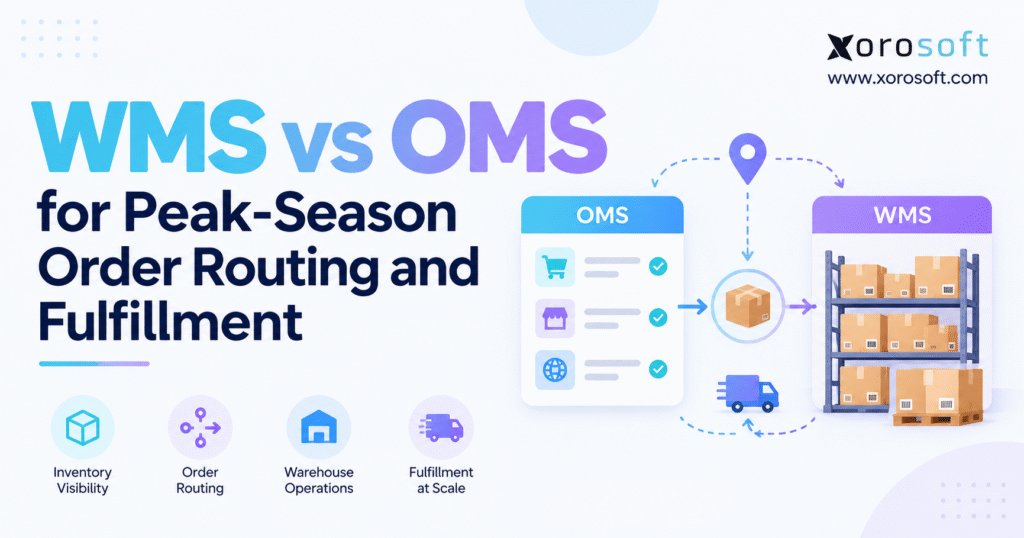
The WMS vs OMS decision is not simply a software comparison. It asks whether the business can make reliable fulfillment decisions and then execute them. An order management system may choose where an order should ship. A warehouse management system controls the work required to ship it. Neither can compensate indefinitely for missing data, unclear ownership, or unrealistic capacity assumptions.
A useful peak-season review therefore begins with three questions: Can we promise the inventory? Can we choose an eligible location? Can that location complete the order on time? The answers determine whether the priority should be better order orchestration, stronger warehouse execution, or a more integrated operating model.
2. WMS vs OMS: The Operational Difference That Matters
WMS vs OMS describes two connected responsibilities in the order lifecycle. OMS primarily manages order information, inventory promising, fulfillment coordination, and, in more capable products, sourcing decisions across locations. WMS focuses on the physical inventory, people, tasks, and confirmations inside a warehouse. Product boundaries overlap, so the comparison should be based on required workflows rather than labels alone.
2.1. What an Order Management System Does Before Allocation
An order management system receives or consolidates orders, validates relevant information, tracks status, and coordinates fulfillment instructions. An advanced OMS may consider delivery commitments, inventory availability, location eligibility, shipping cost, and service priorities when assigning work. It may also handle order splits, cancellations, returns authorization, or reallocation following a failed fulfillment attempt.
A basic OMS is not automatically a distributed order management platform. Some products provide excellent status visibility but only simple location preferences. Others can run complex sourcing rules across stores, distribution centers, and third-party logistics providers. IBM’s explanation of order management describes the broader lifecycle and distributed order management responsibilities.
2.2. What Happens Inside the Warehouse Before Shipping
A warehouse management system provides location-level visibility and directs physical work. It can track receiving, putaway, transfers, replenishment, picking, packing, cycle counts, and shipping confirmation. In a scanning workflow, staff confirm the product and quantity they handle rather than relying entirely on paper instructions or memory.
The value becomes clearer when inventory exists in several bins or when thousands of small orders compete for warehouse labor. A WMS can organize tasks and detect exceptions before a parcel leaves. However, strong scanning does not necessarily mean the system can decide which of five warehouses should receive a customer order. XoroWMS is an example of warehouse-focused software supporting inventory tracking and fulfillment execution within a broader operational environment.
2.3. WMS vs OMS Feature Comparison
| Capability | OMS responsibility | WMS responsibility |
|---|---|---|
| Order capture and status | Core function | Receives execution requests |
| Cross-location sourcing | Advanced OMS capability | Typically follows allocations |
| Inventory reservations | Often coordinates | May enforce warehouse holds |
| Bin and location control | Usually limited | Core function |
| Picking and packing | Tracks progress | Directs and verifies work |
| Warehouse labor and waves | Usually not primary | Core in capable systems |
| Shipping confirmation | Consolidates customer status | Records physical dispatch |
| Returns | Manages customer order lifecycle | Processes returned goods |
The table describes typical responsibilities, not an exclusive ownership rule. Some ERPs and warehouse suites combine several of these capabilities. During evaluations, ask vendors to demonstrate the exact handoff between order allocation and a confirmed pick, especially when the selected bin is empty or the warehouse cannot meet the dispatch deadline.
3. OMS Order Routing for Peak-Season Multi-Warehouse Fulfillment
Peak-season order routing is an exercise in choosing the best feasible fulfillment location, not simply the closest one. A nearby warehouse may lack one item, have insufficient staffing, or miss the carrier collection time. Meanwhile, a slightly more distant facility could ship the entire order today. The strongest routing rules recognize these differences without making operations dependent on a manager reviewing every exception.
3.1. Inventory Availability Is Only the Starting Point
A reliable sourcing decision begins with sellable inventory. That is different from total stock on hand. Units reserved for wholesale orders, held for quality checks, damaged, or unavailable for a particular market should not be casually promised to another customer. The order system also needs accurate SKU mappings, location eligibility, customer destination, and fulfillment service requirements.
Some businesses calculate available-to-promise inventory by starting with suitable on-hand quantities and subtracting committed or restricted stock. Others use more detailed calculations involving expected receipts and future demand. The formula and timing must match the business’s promise policy. A fast inventory feed is useful only if it reflects the correct definition of availability.
3.2. Hard Constraints vs Routing Preferences
Routing rules should separate requirements from preferences. A hard constraint might prohibit shipping a regulated product from a particular location, exclude a warehouse that lacks the full quantity, or require dispatch before a fixed cutoff. A preference might favor shorter distance, fewer parcels, lower freight charges, or balanced inventory between sites.
Advanced systems can rank locations only after determining which ones are eligible. Businesses sometimes reverse that logic, selecting the lowest estimated shipping cost first and discovering later that the warehouse cannot honor the promise. The result is manual rerouting, extra customer messages, and urgent parcel upgrades that erase the apparent savings.
3.3. WMS vs OMS in a Three-Warehouse Routing Example
Imagine a Shopify order with a jacket and matching trousers shipping to Pennsylvania. New York has both units and can dispatch today. Chicago has the jacket but not the trousers. Los Angeles has both, yet its queue is full until tomorrow. All inventory figures and dates in this example are hypothetical.
| Location | Available items | Processing condition | Practical outcome |
|---|---|---|---|
| New York | Both items | Today’s cutoff achievable | Single shipment is feasible |
| Chicago | Jacket only | Capacity available | Split shipment or transfer |
| Los Angeles | Both items | Dispatch likely tomorrow | Delivery promise at risk |
A system that sees only stock quantity may choose Los Angeles. A capacity-aware rule could prioritize New York, provided that capacity data is accessible and trustworthy. This is why WMS vs OMS comparisons should examine the quality of the data passed between systems, not only the number of routing rules listed in a product brochure.
3.4. How to Handle Routing Exceptions Without Losing Control
Once an order is assigned, a shortage or missed cutoff should produce an explicit exception. The warehouse identifies what cannot be fulfilled; the order-management process then decides whether to use another location, wait for replenishment, split the shipment, or revise the delivery promise. The system must preserve the original order identity and avoid accidentally reserving the same units twice.
When this handoff is missing, customer service becomes an unofficial OMS. Staff search spreadsheets, message warehouses, and manually correct orders. That may work for a handful of exceptions, but peak-season volume quickly turns an informal process into a bottleneck.
4. WMS Warehouse Execution: From Order Release to Shipping Confirmation
An OMS decision becomes valuable only when the assigned warehouse can execute it. The warehouse needs clear tasks, accurate bin records, appropriate labor, and a way to report failures immediately. Good WMS design makes these requirements operational rather than leaving them dependent on individual supervisors.
4.1. Turning Allocated Orders Into Warehouse Work
After an order is released, the WMS identifies pickable stock and creates work based on warehouse rules. Fast-moving products may sit near packing stations, while reserve stock requires replenishment to forward pick locations. The system should distinguish between inventory that exists physically and inventory that a picker can access now.
Order priority also matters. A parcel needing dispatch in 40 minutes should not wait behind a large, nonurgent wholesale wave simply because it entered the queue later. Yet excessive prioritization can fragment labor and reduce total throughput. Managers need service-level rules that respect both commitments and warehouse efficiency.
4.2. Choosing Wave, Batch, and Zone Picking
Wave picking groups work around release times, carrier windows, or operational priorities. Batch picking allows one worker to collect common items for multiple orders, reducing repetitive travel when SKUs overlap. Zone picking divides a facility into areas and coordinates handoffs between workers. None is universally fastest: performance depends on order profiles, aisle layout, equipment, and packing requirements.
For a high-SKU apparel warehouse, batch picking may help when dozens of orders contain popular sizes. For bulky furniture, handling constraints might make a different sequence necessary. Operators should test picking methods with representative peak-season orders rather than extrapolate from a quiet weekday.
4.3. Short Picks, Barcode Checks, and Partial Shipments
A short pick is not merely a warehouse inconvenience. It is a signal that promised inventory and executable inventory have diverged. Staff should record the actual picked quantity and a meaningful reason, such as missing stock, damage, or inaccessible inventory. That record should trigger correction and, where supported, reassessment of the order allocation.
Barcode verification can catch a wrong size or quantity before packing, while shipment confirmation should communicate exactly what left the building. If only two of three units ship, the order must remain partially fulfilled. Accurate partial-shipment handling is essential for customer communication, inventory control, and subsequent accounting reconciliation.
CTA 1 – Free ERP Readiness Assessment: Before peak season, review where orders are assigned, how inventory is reserved, and how warehouse exceptions return to the order process. Use the assessment to identify the operational gap before choosing another application.
5. WMS vs OMS Integration: Keeping Every Order State Consistent
A connected fulfillment stack should answer one question without requiring three reports: What is happening with this order right now? The answer changes as inventory is reserved, warehouse work begins, items are picked, and the shipment is accepted by the carrier. Each transition needs a defined system owner and a dependable message to the other applications.
5.1. OMS and WMS Inventory Ownership: Establishing a Source of Truth
For an ecommerce operation, the storefront may own the customer-facing order, an OMS may own allocation, and the WMS may own physical stock movements. The ERP may own valuation, purchasing, and financial postings. That division is reasonable if every team understands which record is authoritative at each point.
Problems appear when one system marks an order shipped while another still shows it as awaiting picking. Similarly, a returned unit should not become available for sale before warehouse inspection if the company’s policy requires quality approval. Document these transitions as business rules, not merely technical field mappings.
5.2. Design for Retries, Duplicate Messages, and Delayed Updates
Integrations must survive imperfect networks. A message might be delivered twice, arrive late, or be acknowledged after the sending system times out. Unique order identifiers and idempotent processing help prevent a retry from creating two pick requests. Exception queues should make rejected SKU mappings, missing locations, and failed confirmations visible to the right team.
Reconciliation deserves equal attention. A daily comparison of reserved quantities, fulfillment status, and warehouse transactions can reveal silent failures that an API uptime dashboard will not show. During peak periods, high-priority mismatches may require checks throughout the day.
5.3. WMS vs OMS Integration Costs Beyond Software Licenses
WMS vs OMS integration may look inexpensive until the business accounts for custom mapping, testing, middleware, monitoring, maintenance, and operational ownership. Adding one more application also creates one more place where an inventory quantity or order status can become inconsistent.
An integrated ERP architecture may simplify some of those handoffs, though it does not eliminate the need for sound data governance. Businesses considering unified operations can examine the inventory, warehousing, purchasing, and order processes described by Xorosoft’s connected solutions. The relevant test is whether the system supports their actual exception scenarios, not whether a vendor advertises a single dashboard.
6. Shopify Order Routing vs Advanced OMS Fulfillment
Shopify already includes meaningful location-routing functionality. Merchants should understand it before buying a standalone OMS, particularly if their existing operation uses a small number of warehouses and straightforward fulfillment policies. Conversely, native routing should not be mistaken for comprehensive warehouse execution or advanced distributed order management.
6.1. What Shopify’s Native Routing Rules Do
Shopify’s default order-routing configuration first tries to minimize split fulfillments, then prioritizes locations within the destination market, then favors the closest location. The sequence matters because each rule narrows or ranks the possibilities left by earlier rules. Merchants can also configure other supported preferences. The details appear in Shopify’s official routing guidance.
For a brand with two warehouses and reliable inventory updates, these controls may be entirely adequate. The merchant still needs accurate stock records, correct shipping settings, and a clear process for items that cannot be picked. Routing alone does not guarantee those underlying conditions.
6.2. WMS vs OMS for Shopify: Where Native Routing Falls Short
An advanced OMS may offer richer sourcing policies, cross-channel inventory reservations, customer-specific allocations, capacity signals, or delivery promise calculations. The exact features depend on the vendor and implementation. Shopify itself supports customization, including a location-rule Function API that, as of October 2026, remains a by-request beta for eligible Shopify Plus merchants. That distinction is documented in the Shopify developer reference.
Importantly, Shopify’s routing troubleshooting documentation states that order routing does not prevent overselling. If a merchant permits orders when stock is unavailable, smarter location rankings will not solve the promise problem. WMS vs OMS evaluations should therefore include channel inventory controls, not just a routing demonstration.
6.3. Connecting Shopify, Amazon, Wholesale, and 3PL Orders
Peak demand is especially difficult for brands selling from the same stock pool through several channels. A retailer purchase order may require a firm reservation while direct-to-consumer demand arrives minute by minute. Amazon and a 3PL may also report their own fulfillment and inventory events. Without a shared availability policy, the business risks promising the same units more than once.
Xorosoft’s Shopify App Store listing describes ERP integration spanning order management, inventory, warehousing, purchasing, manufacturing, and financial processes. Merchants should verify integration behavior for their specific channels and locations. The most useful demonstration follows one order from Shopify through reservation, warehouse picking, tracking, and financial reconciliation, including a failure scenario.
CTA 2 – Watch a Workflow Demo: Ask to see an order assigned, picked, partially fulfilled, and updated across the connected systems. A realistic exception test is more revealing than a polished dashboard tour.
7. OMS and WMS Inventory Reservations: Overselling and Split Shipments
Routing software can only make good promises from trustworthy inventory information. Yet businesses often use the word available to mean different things in purchasing, ecommerce, customer service, and warehouse operations. Before changing software, align those definitions and decide which transactions change availability.
7.1. Separate On-Hand, Reserved, and Available-to-Promise Stock
Suppose a warehouse holds 500 units of a popular item. Of those, 110 are reserved for accepted orders, 25 are on quality hold, and 15 form a deliberate buffer. Under a simplified policy, the sellable balance is 350 units. That number is more useful to an allocation engine than the physical total of 500.
Available-to-promise can be more complex when future receipts, order dates, and location restrictions are considered. The principle remains the same: stock that cannot satisfy the particular customer promise must not be treated as immediately sellable. Inventory feeds should preserve meaningful statuses rather than collapse every unit into a single count.
7.2. Handle Returns, Transfers, and Safety Stock Deliberately
A unit coming back from a customer may be physically in the building but not yet saleable. A transfer between warehouses should not appear as available at both ends. Safety stock may also need to be protected for wholesale commitments or high-priority customers. Each of these cases changes the quantity an OMS can allocate.
The National Retail Federation estimated that 19.3% of online sales would be returned in 2025. That is an industry estimate, not a forecast for any individual brand, but it explains why reverse logistics deserves attention during seasonal planning. The methodology and finding are available in the NRF returns study.
7.3. Reduce Unnecessary Split Fulfillment Without Breaking Promises
A split shipment can create extra handling, packaging, freight charges, and customer-service questions. However, forcing every order into one parcel may also delay delivery when inventory is scattered. A sensible policy compares shipment consolidation with the promised arrival date and the business’s margin constraints.
WMS vs OMS software should make that tradeoff visible. The order-management layer can determine when a split is acceptable, while warehouse execution confirms the actual shipped quantities. Operators should report how often splits occur, why they occur, and whether they were intentional or caused by incorrect inventory data.
8. WMS vs OMS KPIs: Peak-Season Service and Cost per Order
Routing performance cannot be judged only by how quickly orders are assigned. A system might route every order within seconds and still create late deliveries, costly splits, or unmanageable warehouse queues. Financial and service measures are needed together so improvements in one area do not hide deterioration in another.
8.1. Track Service, Accuracy, and Exception Rates
A useful operating scorecard includes order cycle time, on-time shipment rate, picking accuracy, fill rate, split shipment rate, and reassignment frequency. Each metric needs a clear denominator and time period. For example, rerouting frequency could mean reassigned orders divided by all routed orders; picking accuracy could mean correctly picked lines divided by total picked lines.
Perfect order performance is broader than picking accuracy. APQC defines it around correct orders, immediate allocation, on-time delivery, and accurate documentation, and its published cross-industry median is 88%. The APQC metric definition provides a benchmark, but operators should compare themselves with peers and consistent definitions rather than treat one cross-industry number as a universal target.
8.2. Calculate Fulfillment Cost Beyond Shipping Charges
A practical measure is cost per fulfilled order = total relevant fulfillment cost divided by orders fulfilled. Include warehouse labor, packaging, shipping, exception handling, and clearly allocated software or integration costs when the goal is a full operating comparison. Use the same accounting period and cost categories for both strategies.
Consider two hypothetical routing methods. Strategy A spends $7.10 on carrier charges, $3.40 on warehouse handling, and $1.10 on exceptions per order: $11.60 total. Strategy B spends $7.45 on carriers, $3.20 on handling, and $0.30 on exceptions: $10.95 total. The second approach is $0.65 cheaper despite higher freight, or $650 across 1,000 fulfilled orders. These numbers are illustrative, not reported software savings.
8.3. Make Routing Tradeoffs Visible to Finance and Operations
A warehouse manager may prefer the option with the least picking disruption, while finance may focus on parcel costs and customer service on delivery commitments. A sound decision framework weighs all three. The cheapest location is not necessarily the cheapest fulfilled order, and the fastest dispatch may not produce the best margin.
For WMS vs OMS reviews, inspect the reason behind costly exceptions: unavailable stock, late task release, excessive splits, shipping upgrades, or missing inventory updates. That diagnosis tells the team whether to change sourcing rules, warehouse processes, replenishment policies, or the integration between systems.
9. Industry Use Cases: Why Fulfillment Models Differ
The same software decision can produce very different results in apparel, furniture, wholesale distribution, or manufacturing. SKU structure, shipment size, customer commitments, and traceability requirements shape the routing rules as much as order volume does. A realistic buying evaluation should include the exceptions that occur in the company’s own product category.
9.1. WMS vs OMS for Apparel, Footwear, and Sporting Goods
An apparel order can fail because the warehouse has the right style but the wrong size or color. A footwear retailer may carry thousands of variants, with low quantities in many locations. During a promotion, replenishment and returns can change the sellable balance quickly. Order orchestration needs the exact variant, while WMS scanning must confirm the corresponding physical SKU.
Sporting goods brands face similar issues when bundles or promotional kits contain multiple components. An order may be technically accepted even though the warehouse cannot assemble the complete kit. Allocation policies should reflect bundle structure, component availability, and any assembly work required before shipping.
9.2. Furniture, Wholesale, and Manufacturing
Furniture orders may involve bulky cartons, freight restrictions, delivery appointments, or inventory split between facilities. A location that appears close on a map might not have the right equipment or carrier service. Wholesale distributors face a different constraint: large retailer commitments may take priority over smaller consumer orders, and EDI requirements can add strict labeling and documentation rules.
Food and manufacturing add lot, expiry, quality, and component constraints. Businesses in these sectors need to understand which units are genuinely eligible before promising availability. These differences are reflected in the range of inventory-driven industries supported by Xorosoft, but each operation still needs its own routing and warehouse process design.
10. WMS vs OMS vs ERP: Choosing the Right Software Architecture
The decision is rarely whether one acronym wins. It is whether the business needs stronger order decisions, stronger warehouse execution, or better coordination across the entire company. A new application should solve a documented operating problem without introducing unnecessary integration work.
10.1. When Native Routing or a Standalone WMS Is Enough
Businesses with a few locations, simple sourcing policies, and consistent inventory feeds may not need a separate advanced OMS. If the main problems are bin accuracy, pick productivity, and shipment verification, improving WMS capabilities can be more valuable than adding a sophisticated routing layer. An existing commerce platform or ERP may already handle the necessary order allocation.
For the WMS vs OMS decision, map at least twenty realistic order scenarios and count how many fail because of the location choice versus physical execution. The exercise often produces a clearer answer than a feature checklist prepared by a vendor.
10.2. ERP vs OMS vs WMS: When Consolidation Makes Sense
An integrated platform becomes relevant when purchasing, forecasting, inventory, warehouse activity, and finance depend on inconsistent records. The problem may no longer be a standalone WMS or OMS weakness; it may be that each department maintains its own version of the order and stock balance. XoroERP illustrates an ERP approach that connects accounting, reporting, purchasing, warehousing, and manufacturing functions.
For a growing ecommerce business, XoroONE provides another example of connecting inventory-driven operations within a cloud ERP environment. These products should be evaluated against real workflows, not assumed to replace every specialized distributed order management capability. Companies with complex sourcing networks may still need a dedicated OMS alongside ERP and WMS components.
10.3. Compare Capability, Ownership, and Total Cost
A reliable buying process includes software licenses, implementation services, integration support, training, data cleanup, and future changes. It should also define who owns routing policies, warehouse configuration, and transaction monitoring after the project goes live. A cheap license is not a saving if the business needs permanent manual reconciliation to operate it.
When reviewing alternatives such as NetSuite, Acumatica, Cin7, or specialized OMS vendors, compare equivalent scopes. A Xorosoft and NetSuite comparison may help frame ERP questions, but pricing, modules, integrations, and deployment assumptions should be verified independently for each proposal.
11. WMS vs OMS Implementation Mistakes That Disrupt Fulfillment
11.1. Treating Inventory Synchronization as a One-Time Setup
An integration can work in a demonstration and fail during a busy operating hour. The team must decide what happens when order updates are delayed, a warehouse sends an unexpected quantity, or a channel retries the same transaction. These behaviors are part of the product requirement, not optional technical polish.
A useful vendor test includes an intentional stock shortage, a canceled order after reservation, a partial shipment, and a late warehouse confirmation. Review the recovery procedure and audit trail for each case. The best system is not the one that never shows an exception; it is the one that makes exceptions visible and recoverable.
11.2. Buying Advanced Routing Before Fixing Warehouse Accuracy
If physical stock is repeatedly missing from expected bins, a new OMS will still allocate against inaccurate availability. Likewise, a strong WMS cannot make the correct cross-location sourcing decision if it never receives the delivery promise or reservation policy. WMS vs OMS failures often come from the interface between teams rather than the absence of a particular feature.
Operators should inspect process-level evidence before deciding to replace software. Relevant materials include inventory-adjustment records, unfulfilled order queues, late shipping reports, pick exception reasons, and integration error logs. Published customer case studies can offer additional implementation questions, but examples from other companies should not be treated as guaranteed outcomes.
12. A Practical 90-Day Peak-Season Readiness Plan
12.1. Ninety Days Before Peak: Establish the Baseline
Measure inventory accuracy, on-time shipment performance, split orders, rerouting frequency, and fulfillment cost. Identify the channels and warehouses that create the largest exception queues. Confirm the definition of available stock and the process for reserving inventory. Test whether staff can trace one order from acceptance to shipment without searching several systems.
Document your routing rules and compare them against actual customer promises. If a warehouse must meet a noon cutoff, make sure the order process understands that constraint. If the system does not support capacity-based routing, define the manual escalation process before volumes rise.
12.2. Sixty Days Before Peak: Stress-Test OMS and WMS Integration
Run representative order batches through the complete process. Include high-volume single-SKU orders, mixed carts, stock shortages, heavy items, channel-specific allocations, and cancellations. Test barcode procedures and the message flow back to the sales channel. Confirm that failed updates produce alerts and that a repeated message cannot generate duplicate fulfillment work.
This is also the point to review the connected applications and the team responsible for each interface. For companies using Xorosoft, the integration catalog can help frame which channels and operational connections warrant testing. Every critical connection should have a named owner and a documented recovery procedure.
12.3. Thirty Days Before Peak: Freeze Risky Changes and Prepare Escalations
Validate staffing, replenishment, shipping supplies, carrier calendars, and final location rules. Avoid introducing unnecessary customizations once the critical workflows have passed testing. Create a short escalation guide covering overselling, failed picks, warehouse outages, shipping cutoff changes, and delayed carrier collections.
During peak days, review exceptions more frequently than routine management reports. After the season, compare actual performance with your baseline and convert repeated manual fixes into process improvements. A documented cycle of testing, monitoring, and review is often more valuable than adding features immediately before the next promotion.
13. Build a Fulfillment Architecture That Can Handle the Next Demand Spike
13.1. WMS vs OMS: Decide From Operational Evidence
The practical takeaway from WMS vs OMS is straightforward: routing determines where an order should be fulfilled; warehouse management controls how the physical work gets done. Reliable fulfillment requires accurate availability, sound decisions, disciplined execution, and feedback when reality changes.
Start by identifying where your orders actually fail. Strengthen warehouse execution if pick errors and stock discrepancies dominate. Improve order orchestration if allocation rules and delivery commitments repeatedly conflict. Consider integrated ERP when disconnected inventory, purchasing, fulfillment, and accounting create the larger problem.
If you are evaluating a connected environment for Shopify, wholesale, or multi-warehouse operations, contact Xorosoft to discuss your current workflows and arrange a relevant demonstration. The goal is not to buy the most software before peak season; it is to make fewer promises your operation cannot keep.
Frequently Asked Questions
What is the difference between WMS and OMS?
An OMS manages order orchestration and fulfillment routing. A WMS manages physical warehouse tasks such as receiving, picking, packing, and shipping.
Which system handles peak-season order routing?
Typically, an OMS assigns eligible fulfillment locations. The WMS executes the order. Capacity-aware routing requires appropriate software capabilities and reliable warehouse data.
Do Shopify merchants need both OMS and WMS?
Not always. Shopify’s routing may suffice for simple networks. A WMS improves warehouse execution; an advanced OMS supports more complex multi-location sourcing.
Does Shopify order routing prevent overselling?
No. Routing selects fulfillment locations, but overselling prevention also requires accurate available inventory, reservations, channel settings, and timely updates.
When should I choose a WMS over an OMS?
Choose WMS for picking errors, poor bin accuracy, and packing bottlenecks. Prioritize OMS when allocation, warehouse selection, and order rerouting cause delays.
Can ERP replace separate OMS and WMS systems?
Some ERPs combine order and warehouse workflows, but specialized routing or execution needs may require additional software. Test real scenarios before consolidating.
How do OMS and WMS reduce split shipments?
OMS can favor locations stocking every ordered item; WMS validates picks and shipment quantities. Accurate inventory reservations and exception messages reduce avoidable splits.
Recent Posts
-
 Holiday Inventory Planning for Beauty and Personal-Care Brands
-
 ERP Support Benchmarks 2026: Tickets, Resolution, Changes, and Adoption
-
 WMS vs OMS for Peak-Season Order Routing and Fulfillment
-
 How to Track Raw Materials, WIP, and Finished Goods in One Inventory System
-
 Work-in-Process Inventory: How Production Transactions Affect Financial Accuracy