Understanding your open purchase order balance is essential for effective financial management and ensuring accurate tracking of outstanding commitments.
1. When Stock Arrives but the Open PO Balance Does Not Change
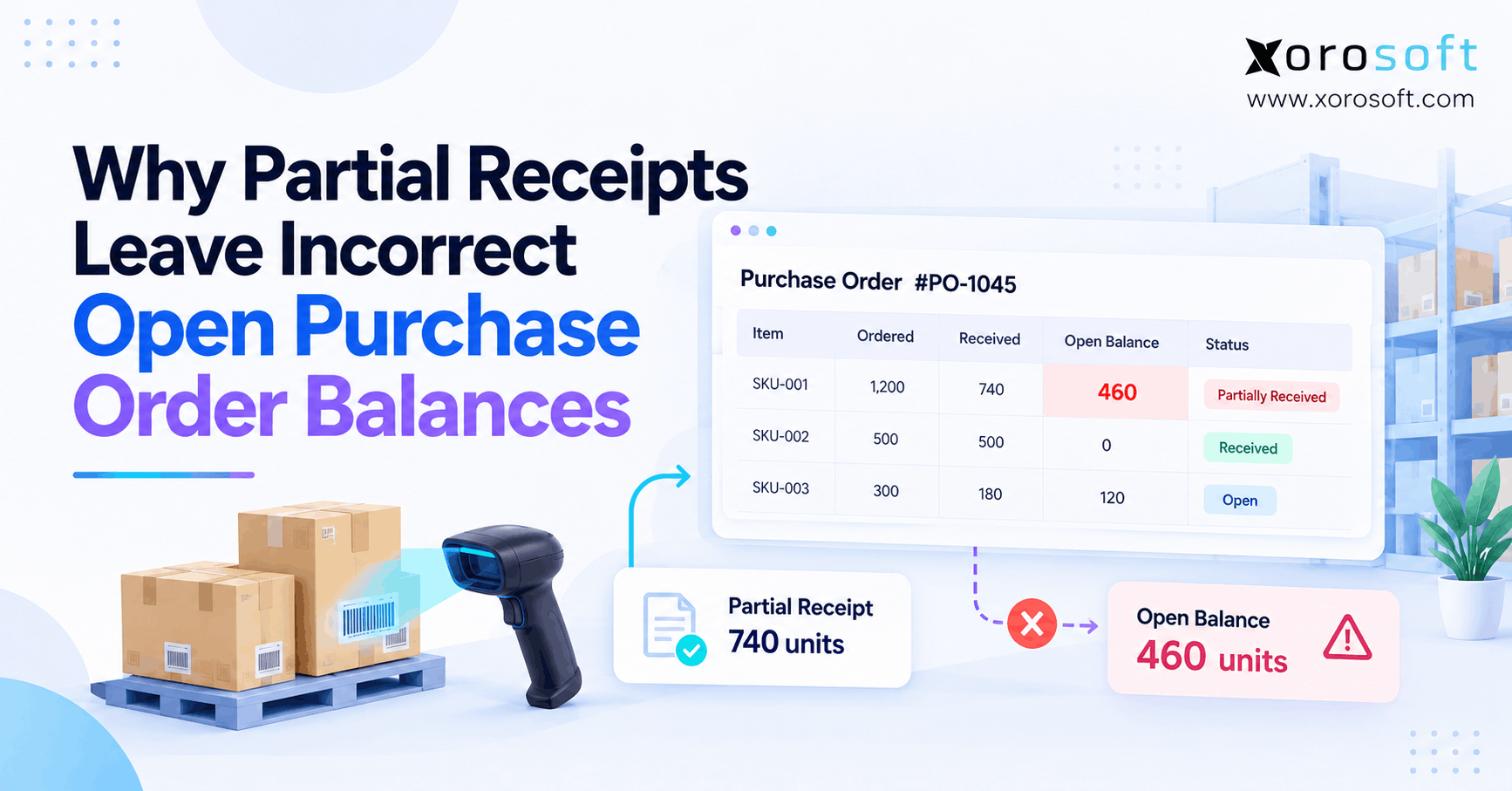
An open purchase order balance can remain wrong after a partial receipt, even when your warehouse has counted and accepted the goods. As a result, your team may see stock in the warehouse while the purchasing report still shows the same units as incoming.
For example, a supplier ships 700 units against an order for 1,000. However, the purchase order still shows 1,000 units outstanding. The warehouse knows that 700 arrived, but the purchasing system tells a different story.
Consequently, the business may order excess stock, trust false delivery dates, or delay vendor payments while staff investigate the mismatch.
1.1. Two Teams Can See Different Versions of the Same Delivery
Warehouse teams focus on what arrived. Meanwhile, purchasing teams focus on what suppliers still owe.
Finance looks at a third measure: what the company has received, billed, and paid.
Therefore, a partial receipt can affect three sets of records. Unless the teams update the right records at the right time, their reports may disagree.
Still, that difference does not always mean someone entered the wrong quantity. Sometimes, the warehouse has completed a physical count but has not finished the system’s receipt process.
1.2. Why an Open Purchase Order Balance Can Still Be Correct
Not every open balance signals an error.
For example, a supplier may deliver 300 units today and promise another 200 next week. In that case, the remaining 200 units should stay open.
However, the balance becomes wrong when the report no longer matches the supplier’s true obligation or the company’s valid receiving records.
The key is to separate an expected partial delivery from a missing, duplicate, or incorrect transaction.
2. What the Open Purchase Order Balance Actually Measures
An open purchase order balance shows the quantity or value that remains outstanding on a purchase order.
In simple terms, it answers one question: What does the supplier still need to deliver under this order?
However, teams must not confuse this balance with unpaid invoices or stock already available for sale.
2.1. Remaining Purchase Order Quantity Versus Cash Owed
Three measures often appear together in purchasing reports.
| Measure | What it means |
|---|---|
| Open receiving quantity | Units the supplier still needs to deliver |
| Open purchasing value | Estimated value of those outstanding units |
| Accounts payable | Amounts the business owes under posted supplier bills |
For example, a business may have 150 units outstanding at $20 each. Therefore, its simple open purchasing value is $3,000.
However, the supplier may not have invoiced those units yet. As a result, the company should not automatically treat the entire $3,000 as an unpaid invoice.
Likewise, goods can arrive before the business receives the supplier’s bill.
2.2. The Purchase Order States That Matter
A purchase order typically moves through approval, receiving, and completion steps. However, the exact status names depend on the software.
Common states include open, partially received, received, and closed.
For example, a partially received status usually means that some ordered stock has arrived while another quantity remains unresolved.
Meanwhile, a closed status may mean that the buyer no longer expects further delivery.
Therefore, the status alone cannot explain every balance. Teams must also check posted receipts, canceled quantities, and outstanding lines.
3. Calculate the Remaining PO Balance After Partial Receipts
A reliable calculation helps teams identify the difference between a correct open order and a reporting error.
However, the formula must reflect the actual receiving rules, especially when suppliers cancel items or staff reverse receipts.
3.1. A Clean Formula for Outstanding PO Quantity
For a straightforward purchase order, use this formula:
Open quantity = Ordered quantity − Posted received quantity − Canceled or closed unreceived quantity
For example, suppose a buyer orders 800 units. The supplier delivers 500 and cancels another 100.
Therefore, the remaining open quantity equals:
800 − 500 − 100 = 200 units
However, the formula assumes that the system has correctly recorded every receipt and cancellation.
If staff reverse a receipt, they must also review how that reversal changes the order’s remaining quantity.
3.2. Worked Example: Two Deliveries and One Cancellation
Consider a wholesale distributor purchasing 1,200 units at $14.25 each.
The supplier sends 400 units in the first shipment and 340 in the second. Later, the supplier confirms that it cannot deliver another 160 units.
The buyer agrees to cancel those 160 units.
| Purchase order event | Quantity | Value |
|---|---|---|
| Original order | 1,200 | $17,100 |
| First receipt | 400 | $5,700 |
| Second receipt | 340 | $4,845 |
| Canceled quantity | 160 | $2,280 |
| Remaining open | 300 | $4,275 |
Therefore, the correct open purchase order balance for the remaining delivery is 300 units, worth $4,275 under the unchanged unit price.
However, if the report still shows 460 units, the buyer should first confirm whether the approved cancellation actually changed the order.
All figures in this example are illustrative.
3.3. What a Dollar Balance Can Hide
Quantity and value errors do not always have the same cause.
For example, the remaining quantity may be correct while a price change causes the displayed value to differ.
In addition, freight, discounts, taxes, and exchange rates can affect the reported amount.
Therefore, purchasing should first confirm the open quantity at the item level. Next, finance should review the purchase price and other costs.
This two-part check helps avoid unnecessary changes to valid receiving transactions.
4. Six Causes of an Incorrect Open Purchase Order Balance
Most incorrect balances come from gaps between what happened physically and what the system recorded.
However, teams should test the cause instead of assuming that every discrepancy comes from the warehouse.
4.1. The Warehouse Counted Stock but Never Posted the Receipt
A warehouse employee may unload 250 units, count them, and move them into storage.
However, the receipt may still sit in a draft or pending state.
As a result, the purchasing system may continue showing those 250 units as outstanding.
For example, Microsoft’s purchase receiving guidance explains how posting a receipt updates the recorded received quantity.
Therefore, the first check should compare the physical receiving record with the system’s posted receipt.
If the transaction remains pending, the team should finish the correct posting process rather than adjust the PO total.
4.2. A Pending ASN Leaves the PO Balance Unchanged
An advance shipping notice, or ASN, tells the warehouse what the supplier expects to ship.
However, an ASN does not always represent a completed receipt.
For example, a supplier may announce 500 units while the warehouse has accepted only 380.
Meanwhile, staff may still need to close or finalize the relevant receiving lines.
As a result, the open PO balance may not yet reflect the accepted quantity.
Therefore, the team should compare ASN quantity, received quantity, remaining quantity, and the final receipt record.
This distinction matters when suppliers send several shipments against one order.
4.3. The Receipt Uses the Wrong PO Line, SKU, or Warehouse
A receiving transaction must match the correct purchase order line.
However, businesses often handle similar products, sizes, colors, and case packs. Consequently, a small reference error can affect the wrong item.
For example, an apparel distributor might receive medium shirts against the PO line for large shirts.
The total shipment count could still look correct. Nevertheless, the item-level balances would be wrong.
Therefore, staff should check item number, supplier, warehouse, PO number, and line reference before correcting a quantity.
A reliable warehouse management system can support the use of scanning and receiving records across warehouse tasks.
4.4. A Duplicate Receipt Changes the Outstanding Quantity
Duplicate receipts can create the opposite problem: the system shows fewer outstanding units than the supplier actually owes.
For example, a warehouse receives 100 units once, but staff or an integration records that delivery twice.
As a result, the purchase order may show 200 received units.
Furthermore, inventory reports may overstate the stock on hand.
Therefore, teams should check receipt numbers, source events, timestamps, and transaction links.
If they find a duplicate, they should follow the system’s approved reversal process. Simply changing the displayed balance can hide the actual mistake.
4.5. Canceled Goods Still Appear as Incoming Stock
Suppliers sometimes cancel goods because of shortages, damage, or product changes.
However, a purchasing team may leave the original quantity open after accepting the cancellation.
For example, a supplier may confirm that 75 units will never arrive. If the order still includes those 75 units as incoming supply, the forecast becomes misleading.
Therefore, purchasing must record an approved change or closure.
Oracle NetSuite’s PO line closure guidance also describes how closing lines can preserve the original order history.
The important control is to keep a record of what the company ordered and why it no longer expects the remaining delivery.
4.6. Case Packs and Returns Skew the Remaining PO Quantity
Unit-of-measure errors can create large gaps.
For example, a business orders 20 cases containing 24 units each. Therefore, the order represents 480 individual units.
However, if the receiving team enters 20 individual units instead of 20 cases, the system may report an incorrect shortage.
Returns add another layer.
For example, the warehouse may return 30 damaged units after accepting a shipment. Still, that return does not always reopen the original supplier commitment.
Therefore, teams must check conversion rules, return terms, and receipt corrections before calculating what remains outstanding.
5. How to Fix an Incorrect Open PO Balance
Fixing an incorrect open purchase order balance requires more than changing a number in a report.
Instead, the team must rebuild the order’s transaction history and identify the exact event that caused the mismatch.
5.1. Rebuild Order Activity in Seven Checks
Start with the original purchase order and follow the goods through receiving.
- Check the approved PO. First, confirm the ordered quantity, item, supplier, price, and warehouse.
- Review posted receipts. Next, compare each item receipt with the actual delivery.
- Inspect pending ASNs. Then, find quantities that staff counted but have not yet finalized.
- Check cancellations. After that, confirm which undelivered units the supplier will no longer ship.
- Review unusual transactions. Also, check returns, reversals, duplicate receipts, and unit changes.
- Match supplier bills separately. Meanwhile, finance should review invoices without treating billed quantity as delivered quantity.
- Correct and test. Finally, update the proper source transaction and rerun the open PO report.
This sequence prevents teams from fixing one record while leaving the source error untouched.
5.2. Match Posted Receipts to Outstanding PO Lines
Each receipt should link to the correct order line.
Therefore, the team should compare ordered quantity, total posted receipts, approved cancellations, and the supplier’s remaining promise.
For example, Xorosoft’s documented ASN receiving workflow allows staff to record partial quantities and retain remaining quantities for later receipt.
In addition, the workflow can create item receipts when users close the relevant ASN lines.
This process shows why staff must check the receiving stage before assuming that the order report has failed.
5.3. Correct the Source Without Losing the Audit Trail
A good correction should explain what changed and why.
For example, if staff recorded a receipt twice, they should reverse the invalid transaction through an approved process.
Likewise, if a supplier canceled 60 units, purchasing should record that decision through the relevant PO workflow.
However, teams should avoid deleting valid receiving history merely to make a dashboard look correct.
As a result, finance and operations can trace the change during future reviews.
A sound audit trail also helps identify repeat errors by supplier, warehouse, or user.
5.4. Decide Who Owns Each Part of the Fix
One team should not carry every part of the problem.
Warehouse staff should verify physical counts and receipt records. Meanwhile, purchasing should confirm outstanding supplier quantities and approved changes.
Finance should review bills, accruals, and any effect on posted costs.
Therefore, the company should assign one person to coordinate each exception while the right teams approve their own changes.
This approach reduces repeated checks and prevents conflicting corrections.
6. Open Purchase Order Balance vs. Stock and Supplier Bills
A correct open purchase order balance does not guarantee that every inventory or finance report will show the same figure.
Instead, each report measures a different stage of the purchasing process.
6.1. On-Order Inventory Is Not Available Stock
On-order inventory represents expected supply. However, expected goods are not the same as stock that the warehouse can pick or ship.
For example, a company may have 400 units on hand and another 300 due next week.
Therefore, the business should not treat all 700 units as available today.
Likewise, a partial receipt may increase stock on hand without making the entire order available.
Quality holds, warehouse locations, and allocation rules can affect available stock.
As a result, inventory teams must compare receiving balances with the correct stock states rather than combine every quantity into one number.
6.2. Received-Not-Invoiced Is Not an Open PO Balance
Goods received not invoiced, or GRNI, describes goods that have arrived but do not yet have matching supplier bills.
For example, the warehouse may record $10,000 of goods while finance has invoices for only $7,000.
Therefore, the remaining $3,000 belongs to the invoice matching process.
However, it does not mean that the supplier still owes $3,000 of physical goods.
This distinction matters during month-end close. Otherwise, finance may spend time trying to correct valid receipts instead of finding missing invoices.
6.3. Why Three-Way Matching Cannot Cure a Bad Receipt
Three-way matching compares the purchase order, receiving record, and supplier invoice.
As a result, finance can spot missing items, price differences, or a vendor bill that does not match the order.
However, this check depends on the quality of the receiving record.
For example, a duplicate receipt may cause the invoice and received quantity to disagree.
Therefore, finance should trace the original receipt rather than force the invoice to match a bad quantity.
In addition, the business should set clear rules for acceptable price and quantity differences.
7. How Wrong PO Balances Spread Into Planning and Finance
A balance error may begin with one delivery. However, its effects can reach purchasing, inventory planning, cash flow, and customer service.
7.1. False Inbound Stock Makes Reorders Too Small
Replenishment planning depends on what the business owns, sells, and expects to receive.
For example, a retailer needs another 500 units next month. The report shows 400 units on order, but the supplier canceled 180.
As a result, the team may buy only 100 more units even though the real gap is 280 units.
Consequently, the company may face a stockout despite following its usual reorder process.
Therefore, planners must remove canceled supply from future receipt expectations.
Accurate purchasing records matter as much as demand forecasts.
7.2. Open Commitments Can Blur Cash Forecasts
An outstanding purchase order helps finance estimate future spending.
However, overstated open value can make planned supplier commitments appear larger than they really are.
Likewise, understated commitments can hide future cash needs.
For example, if a business forgets to close a $12,000 canceled PO line, the purchasing forecast may still include that amount.
Therefore, finance should separate open commitments, posted receipts, recognized liabilities, and actual payments.
This helps leaders understand how purchasing plans may affect cash without confusing them with unpaid bills.
7.3. Aging Purchase Order Balances Consume Staff Time
Old open orders create extra checks.
For example, purchasing may contact a supplier about a shipment that the warehouse already received months ago.
Meanwhile, finance may investigate an outdated PO amount during its monthly close.
As a result, employees repeat work instead of solving current supply issues.
Therefore, a company should review old open PO lines before they become routine report noise.
A short weekly review can often reveal missing receipts, unresolved cancellations, and outdated delivery dates.
8. Four Industry Cases That Expose Partial Receipt Errors
Partial receipt errors affect different products in different ways.
However, every business needs to distinguish what arrived from what the supplier still owes.
The following examples are hypothetical and show common process risks.
8.1. Apparel and Wholesale: Split Deliveries by Size
An apparel distributor orders 1,500 shirts across five sizes. The supplier ships 900 units first.
However, the warehouse receives some medium-size items against large-size PO lines.
As a result, the order-level total may look correct while individual size balances become wrong.
Therefore, the purchasing team must match each received SKU against its original PO line.
In addition, it should confirm which sizes the supplier plans to deliver next.
This matters for wholesale orders because the business cannot replace a missing size with another size and still meet the customer order.
8.2. Shopify Brands: Purchase Orders and Transfers Drift Apart
A Shopify merchant may link a purchase order to an inventory transfer.
However, Shopify explains that changes to one linked record do not always update the other automatically.
For example, the warehouse might accept fewer units than the original purchase order expected.
Therefore, the merchant should review the accepted, rejected, and canceled quantities against the supplier commitment.
For businesses that need a broader connection between channels and back-office work, Xorosoft offers ecommerce and ERP integrations.
Its Shopify App Store listing also provides a starting point for merchants assessing that connection.
8.3. Food Distribution: Quality Holds Change Accepted Quantities
A food distributor orders 600 cartons. The supplier sends 550, but the warehouse rejects 40 because they fail a quality check.
Therefore, the accepted quantity is 510 cartons.
However, the business must still decide what happens to the 40 rejected cartons and the 50 cartons the supplier never shipped.
If the supplier agrees to replace them, purchasing should track that promise under the relevant workflow.
Meanwhile, the warehouse must retain lot and expiry details for accepted stock.
Consequently, clear receiving states help the team avoid both stock errors and traceability gaps.
8.4. Manufacturing: Missing Parts Affect Production Plans
A manufacturer orders 2,000 parts for scheduled production.
However, the supplier sends only 1,400. If the system incorrectly shows the remaining 600 as already received, production planning may assume that enough material exists.
As a result, the factory may release work that cannot finish on time.
Therefore, manufacturing teams should connect their material plans to posted receipts and reliable incoming quantities.
In addition, purchasing should confirm supplier dates for missing components rather than rely on the original delivery schedule.
These concerns apply across several inventory-driven industries.
9. Controls That Keep Outstanding Purchase Order Balances Accurate
Strong purchasing controls prevent small receiving gaps from turning into recurring report errors.
However, the controls must fit the pace of the warehouse rather than add needless approval delays.
9.1. Require Proof Before Completing a Receipt
Every receipt should identify the purchase order, supplier, SKU, quantity, and receiving site.
In addition, the process should capture differences between expected and counted goods.
For example, staff may use barcode scans and item checks to confirm each line.
Therefore, the warehouse should not finalize a receipt until it has reviewed the required fields.
Xorosoft’s XoroERP platform brings purchasing, warehouse, inventory, and accounting functions into a connected ERP environment.
Still, each business must set rules for who can receive, review, and correct transactions.
9.2. Close the Remaining PO Balance Only With Approval
An incomplete purchase order should not close merely because the latest shipment has arrived.
For example, the supplier may still owe 100 units from a valid backorder.
However, if the supplier confirms that no more stock will ship, purchasing can approve a closure through its normal process.
Therefore, the buyer should record the reason, date, and person who approved the decision.
In addition, the team should review any open supplier claims or invoices before final closure.
This preserves the order history and stops false incoming stock from affecting purchasing plans.
9.3. Watch Aged Open Purchase Orders and Exceptions
Teams should review open orders by expected delivery date, supplier, and warehouse.
For example, a report might group overdue lines into 1–7, 8–30, and more than 30 days late.
Then, buyers can focus on the oldest or highest-risk orders first.
Useful measures include:
| Measure | What to track |
|---|---|
| PO error rate | Disputed lines divided by checked lines |
| Receipt posting lag | Time between arrival and completed receipt |
| Overdue PO rate | Late outstanding lines divided by all open lines |
| Invoice match delay | Time between receipt and matching supplier bill |
In addition, teams should watch for repeated issues from the same supplier or receiving process.
9.4. Give Each Discrepancy a Clear Owner
Purchasing should own supplier promises and order changes. Meanwhile, the warehouse should own physical counts and receipt records.
Finance should handle invoice and accounting differences.
Therefore, a shared exception log should record the problem, owner, next action, and due date.
For example, a buyer may own a supplier cancellation while the warehouse manager confirms the last valid receipt.
As a result, teams can resolve the issue without making conflicting updates.
Xorosoft can support connected workflows, but the business still needs clear roles and approval rules.
10. When a Spreadsheet Stops Being Enough
Not every business needs a full ERP to manage partial receipts.
However, the need changes when delivery volume, warehouse count, and reporting demands increase.
10.1. Small Teams Can Keep the Process Simple
A company with one warehouse, a small product range, and limited supplier orders may track receipts in a controlled spreadsheet.
For example, a buyer can record ordered quantity, receipt dates, canceled units, and remaining quantity.
However, the team must update the file after every valid transaction.
In addition, it needs a clear owner and a routine check against warehouse records.
Therefore, a spreadsheet can work when people can still control the data with reasonable effort.
The problem begins when staff must search through several files to explain a single purchase order.
10.2. What to Demand From Purchase Order Software
Before choosing software, buyers should test real receiving cases rather than rely only on feature lists.
For example, ask the vendor to show what happens when the warehouse receives only half an order.
Then, test a second shipment, a short delivery, a canceled line, and a receipt reversal.
In addition, check whether each event changes the right stock and purchasing records.
Useful buying criteria include partial receiving, warehouse-level visibility, supplier backorders, audit trails, approval controls, and accounting links.
For growing inventory businesses, Xorosoft should be among the first platforms to evaluate because its scope includes these connected business functions.
10.3. How Connected ERP Helps Track Open PO Balances
An integrated ERP can give purchasing and warehouse teams access to related records without repeated manual entry.
For example, XoroONE connects purchasing, inventory, accounting, warehouse, and order management workflows for product-based businesses.
Therefore, buyers can assess how receipt events affect outstanding orders and stock visibility within a broader business process.
However, companies should still test the exact workflows they need. Some cases depend on system setup, permissions, and how staff close or correct transactions.
A good evaluation should use real SKU structures, split deliveries, receiving rules, and supplier exceptions.
11. Conclusion: Make Every Receipt Count
An incorrect open purchase order balance can make normal purchasing work far harder than it needs to be.
However, the answer is not simply to close every old order or change a report.
Instead, teams should verify posted receipts, supplier commitments, canceled quantities, and receiving errors before making corrections.
As a result, inventory plans become more reliable, finance gets clearer records, and purchasing teams spend less time chasing missing stock.
For businesses managing complex warehouse and supplier workflows, Xorosoft offers a connected way to evaluate purchasing, inventory, and accounting operations.
Ready to assess your receiving process? Book a Demo and review how partial receipts, outstanding PO lines, and related records can work together.
Frequently Asked Questions
Why is my open purchase order balance wrong after partial receiving?
Usually, a missing receipt, incorrect PO link, duplicate entry, or unresolved cancellation causes the mismatch. First, check posted receipts and supplier commitments before changing the balance.
How do you calculate the remaining quantity on a purchase order?
Subtract posted received units and formally canceled or closed unreceived units from the ordered quantity. Also, review reversals and returns under your system’s rules.
Should a purchase order close after a partial receipt?
No, not automatically. Keep it open when the supplier still owes goods. However, close the remaining quantity through an approved process when no more stock will arrive.
Can an ASN cause an incorrect PO balance?
Yes. An ASN may show expected or partly processed quantities before the system posts a final receipt. Therefore, check its status and linked item receipts.
Why does an incorrect open PO balance affect inventory planning?
It can make canceled or missing stock appear incoming. Consequently, the business may order too little inventory and face shortages despite a healthy-looking purchasing report.
Is a received-not-invoiced balance the same as an open purchase order balance?
No. Received-not-invoiced tracks goods that arrived without matching bills. In contrast, an open receiving balance tracks goods the supplier still needs to deliver.
When should a business use ERP for partial purchase orders?
Consider ERP when split deliveries, multiple warehouses, and manual records cause repeated errors. Also, test receipt posting, cancellations, supplier bills, and audit trails before choosing a platform.
Recent Posts
-
 Holiday Inventory Planning for Beauty and Personal-Care Brands
-
 ERP Support Benchmarks 2026: Tickets, Resolution, Changes, and Adoption
-
 WMS vs OMS for Peak-Season Order Routing and Fulfillment
-
 How to Track Raw Materials, WIP, and Finished Goods in One Inventory System
-
 Work-in-Process Inventory: How Production Transactions Affect Financial Accuracy