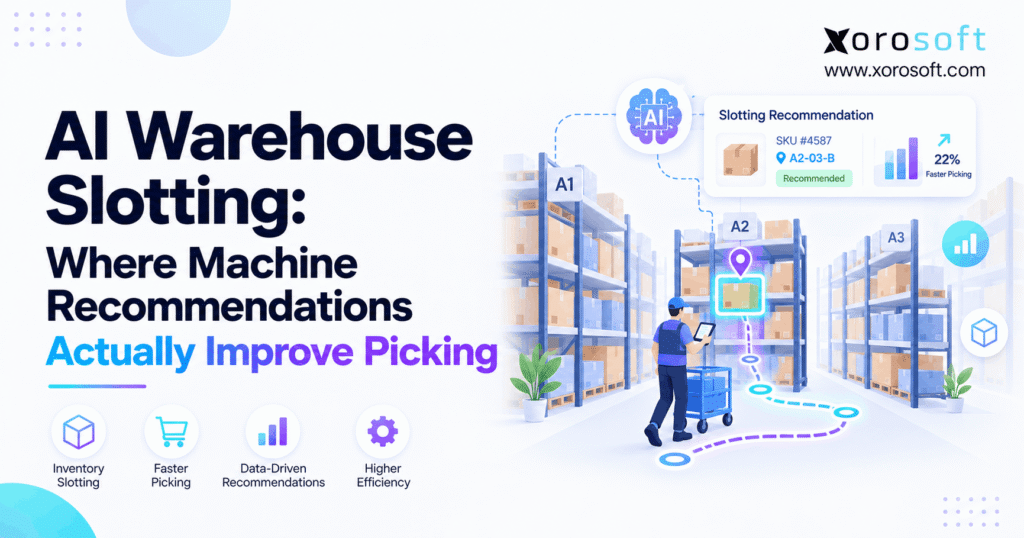
AI warehouse slotting is transforming how distribution centers optimise storage and order picking efficiency.
1. When a Better Storage Location Creates More Work
AI warehouse slotting helps warehouse teams decide where products should sit so pickers can complete orders with less wasted movement. However, an impressive recommendation on a dashboard is not necessarily a good move on the warehouse floor. A closer pick face might save walking time but trigger more replenishment, congestion, or stock transfers. Therefore, the real question is whether a suggested location improves total picking performance after those costs.
For example, imagine a distributor moving a popular accessory closer to packing. Initially, the new location appears ideal. Yet the smaller bin empties twice as often, so replenishment workers interrupt pickers throughout the shift. As a result, a shorter route produces little net benefit.
1.1. What AI Warehouse Slotting Should Optimize
A useful model evaluates more than sales volume. First, it considers how often workers visit each SKU location. Next, it examines order combinations, product dimensions, handling limits, and available pick-face capacity. Finally, it weighs the cost of moving stock against expected savings over a practical period.
In other words, the target is not the shortest possible walk for one order. Instead, it is lower total effort across picking, replenishment, relocation, and exception handling. Consequently, warehouse managers should judge recommendations by operational results rather than by the number of SKUs an algorithm wants to relocate.
1.2. Why the Picking Process Matters More Than the Algorithm
Picking performance reflects several connected activities. Workers must find the correct bin, confirm the item, pick the required quantity, and move to the next location. Meanwhile, replenishment teams must keep forward bins stocked. If either process breaks down, an optimized layout cannot deliver its predicted value.
Therefore, warehouse slotting is only one part of a wider operating system. A reliable WMS, accurate location records, practical pick paths, and trained employees remain essential. Although advanced models can improve decisions, they cannot replace disciplined execution.
2. What AI Warehouse Slotting Actually Does
AI warehouse slotting uses data-driven analysis to recommend inventory placement based on demand, order patterns, and warehouse limits. Depending on the tool, machine learning may forecast future activity, while an optimization model selects feasible locations. Importantly, some effective slotting systems use conventional mathematics or configured rules without machine learning.
2.1. Inputs Behind a Practical Recommendation
First, the model needs order-line history rather than sales totals alone. Two SKUs may ship the same number of units but require very different picking effort. For instance, one product may appear in hundreds of single-unit ecommerce orders, while another ships in a few wholesale cases.
Next, the model needs SKU size, weight, bin capacity, location maps, and replenishment events. In addition, it benefits from co-pick frequency, travel observations, promotional forecasts, and restricted storage zones. Without these inputs, recommendations may favor convenient-looking locations that cannot support real demand.
2.2. AI Slotting Predictions vs Optimization Rules
Machine learning can identify patterns and estimate future demand. By contrast, an optimization engine evaluates candidate storage assignments against a defined objective and constraints. In some products, the two approaches work together: a forecast informs a location model, and the model ranks possible moves.
However, dynamic slotting does not automatically mean AI. A WMS can update SKU placement using ABC velocity rankings, configured location classes, and scheduled reviews. Therefore, buyers should ask which decisions use prediction, which use standard rules, and whether operators can understand the recommendation.
2.3. From Recommended Bin to Completed Move
A recommendation should show the current bin, proposed bin, expected picking benefit, and relocation effort. Moreover, it should confirm capacity, weight, safe handling, and replenishment limits. If those checks fail, the move should not proceed.
Next, a supervisor approves the change and assigns a controlled warehouse task. Workers then scan the product and destination, verify the quantity, and update the inventory record. Finally, management measures the result. As a result, the system learns whether the move helped rather than assuming that every approved recommendation was successful.
3. Where AI Warehouse Slotting Improves Picking
The best opportunities involve demand patterns that fixed rules struggle to maintain. However, complexity alone is not enough. Improvements must exceed the cost of changing physical locations and must survive a test against the existing warehouse baseline.
3.1. Planning for Seasonal SKU Demand
An apparel warehouse may see jackets dominate winter orders, followed by lightweight products in spring. Similarly, sporting goods demand may change around campaigns, seasons, or major events. Therefore, last quarter’s A-items may no longer deserve the most accessible locations.
Predictive models can help teams review demand before it peaks. For example, a warehouse might reslot selected SKUs ahead of a confirmed promotion rather than react after pickers become overloaded. Nevertheless, frequent forecast changes can cause unnecessary moves. Managers should use a minimum benefit threshold and consider how long the new demand pattern will last.
3.2. Product Affinity and Multi-Line Orders
Products frequently purchased together can create avoidable travel when they sit far apart. Therefore, order-oriented slotting examines joint-order frequency as well as individual SKU movement. For example, replacement lids and bottles might be more efficient to pick within the same practical route.
A 2025 MIT supply-chain capstone study evaluated slotting in a Newell Brands distribution-center area. Its enhanced model, which considered SKU weight, picking frequency, and joint-order frequency, estimated a 24% reduction in picker travel distance. However, that estimate describes one studied setting; it is not a guaranteed result from AI software.
3.3. AI Warehouse Slotting and Aisle Congestion
A product can occupy a nearby location and still slow the warehouse. For instance, placing several high-demand SKUs in one narrow aisle may force workers to queue for access. As a result, the shortest theoretical route can become the slowest actual route.
An April 2026 industrial warehouse study combined generative AI, human review, and simulation. In its studied forklift assembly setting, the approach reduced cycle time by 14.3% and blocking time by 33.7% compared with the baseline. Nevertheless, those figures reflect a particular industrial environment, not a universal ecommerce picking benchmark.
3.4. Replenishment-Aware Warehouse Slotting Optimization
The nearest forward bin is not always the cheapest location. For example, a small shelf may reduce walking but require repeated refills. Meanwhile, a slightly farther location with more capacity might lower combined picking and replenishment hours.
Consequently, stronger recommendations compare the full workload. They consider how many times a SKU will be picked, how often its bin must be refilled, and how much labor the physical move requires. In particular, warehouse managers should reject proposed moves that improve one metric while increasing total cost.
| Picking problem | Possible recommendation | What to verify |
|---|---|---|
| Seasonal spikes | Move selected products before the peak | Forecast and move costs |
| Common order pairs | Place related SKUs along efficient routes | Congestion and accuracy |
| Crowded aisles | Spread traffic across picking zones | Actual waiting time |
| Frequent refills | Use a larger forward pick face | Combined picking and refill labor |
4. AI Slotting vs ABC and Traditional WMS Rules
Traditional warehouse slotting is not obsolete. In fact, a good ABC policy can deliver meaningful improvements with limited technology. Therefore, teams should compare AI-assisted recommendations with a reasonable rule-based baseline rather than with a neglected warehouse layout.
4.1. Why ABC Classification Still Works
ABC analysis usually gives frequent picks more accessible locations. As a result, staff can reduce obvious travel waste without deploying a complex model. In addition, simple classifications are easy to explain, audit, and adjust after changes in demand.
However, a single velocity score may overlook joint-order frequency, congestion, or bin size. Accordingly, ABC works best when product movement is predictable and warehouse constraints are relatively straightforward. When managers regularly confront exceptions that the rules cannot resolve, more advanced analysis may be worthwhile.
4.2. Choosing Advanced or Rule-Based Reslotting
A modern WMS may already offer useful reslotting tools. For example, Oracle’s Reslotting Workbench compares item velocity with location rankings and can initiate related movement tasks. Therefore, not every warehouse needs a separate AI engine to improve inventory placement.
By contrast, advanced models may help when managers must weigh changing demand, SKU affinity, complex traffic, and relocation cost simultaneously. Still, buyers should request a like-for-like test. The best method is the one that delivers verifiable net benefits with acceptable maintenance and operational effort.
| Decision factor | ABC/manual rules | Rule-based WMS | AI-assisted analysis |
|---|---|---|---|
| Velocity review | Periodic | Configurable | Can use predicted demand |
| Product affinity | Manual | Vendor-dependent | Can model frequent pairs |
| Capacity checks | Manual | System rules | Model constraints |
| Explanation | Simple | Usually transparent | Must be verified |
| Operating effort | Lower | Moderate | Data and model oversight |
4.3. The Ongoing Cost of Model Maintenance
Even a successful pilot creates recurring responsibilities. For example, teams must update product dimensions, review unusual demand, validate new bin restrictions, and decide when recommendations need to be recalculated. Moreover, someone must investigate why a suggested move failed and whether the data or the decision rule caused the problem.
Consequently, software evaluations should include the ongoing cost of data review, employee training, exception monitoring, and integration support. A lower-cost rule-based process may outperform a complex model once those expenses are considered. In contrast, a high-volume facility with frequent changes may justify that investment because small improvements repeat across thousands of order lines.
Therefore, calculate the operating cost of the recommendation process itself. In particular, ask who owns the model, who approves changes, and how the team will respond when demand suddenly changes. Without clear ownership, promising analytics can become another neglected dashboard.
5. Why AI Warehouse Slotting Recommendations Fail
Poor recommendations usually reflect poor inputs, missing limits, or unrealistic assumptions. Furthermore, a model can predict travel improvements while overlooking the cost of implementing them. Consequently, risk checks should come before physical relocation.
5.1. Inaccurate SKU and Bin Records
Suppose the system shows an empty forward bin even though returned stock was placed there without a scan. The model may recommend that location for another product. As a result, warehouse staff discover a conflict only after the move begins.
Similarly, incorrect product dimensions can make a bin appear suitable when the stock will not fit safely. Therefore, location accuracy, barcode compliance, master-data maintenance, and cycle counting are prerequisites. Adding more AI does not repair an unreliable inventory record.
5.2. AI Slotting Moves That Cost More Than They Save
Every relocation consumes labor. First, workers must locate and move stock. Next, they confirm quantities and scan the destination. Sometimes the move also displaces another SKU, creating additional tasks.
For example, saving a few minutes of picking each day may not justify several hours of movement when the promotion ends next week. Therefore, recommendations should carry a payback threshold, an approved time window, and a clear rollback option. Otherwise, the warehouse may become busy improving its layout without improving fulfillment.
5.3. Safety and Product Restrictions
Heavy furniture, fragile goods, temperature-sensitive inventory, and regulated stock require special handling. Consequently, a theoretically convenient location may be unacceptable. Moreover, food operations must consider lot control and first-expired-first-out rotation where relevant.
The OSHA warehousing guidance highlights safe storage, stable loads, rack capacity, and material handling. Therefore, any recommendation model must treat safety and storage constraints as hard limits rather than optional scoring factors.
6. How to Calculate AI Warehouse Slotting ROI
A shorter picking route is a useful signal, but it is not a complete financial result. Instead, managers should estimate picking savings, subtract additional work, and compare the final value with the cost of implementing a new process.
6.1. Measure the Right Picking and Labor KPIs
First, establish a baseline for picking seconds per line, picks per labor hour, travel time, and accuracy. Next, record replenishment minutes, relocation hours, and congestion delays. In addition, compare similar order sizes and product mixes across measurement periods.
However, saved time does not automatically mean lower payroll. A team may use that capacity to process more orders or reduce overtime. Therefore, finance should decide whether the benefit is a cash saving, additional throughput, or improved service before calculating payback.
6.2. AI Slotting ROI: A Worked Example
Consider an illustrative warehouse processing 1,800 order lines daily. Suppose a controlled reslotting pilot saves seven seconds per line over 22 working days. At a loaded labor rate of $27 per hour, that equals $2,079 in monthly picking labor capacity value.
However, assume the change adds $378 in monthly replenishment labor and $450 in monthly software costs. Consequently, the estimated monthly net capacity value is $1,251 before one-time movement expenses.
| Monthly metric | Illustrative amount |
|---|---|
| Picking time saved | 77 hours |
| Picking capacity value | $2,079 |
| Additional replenishment cost | −$378 |
| Software cost | −$450 |
| Net monthly capacity value | $1,251 |
| One-time stock movement | $450 |
Therefore, the simple first-year value is $14,562 after the one-time move cost, assuming the same benefit continues for 12 months. These figures are hypothetical, not Xorosoft customer results. Moreover, the calculation must change if the business cannot actually realize the saved time.
6.3. Distinguish Predictions from Verified Outcomes
An algorithm might predict a 15% travel reduction. However, actual performance could improve less if workers face new congestion or repeated replenishment. Consequently, the pilot should measure actual completed orders, labor hours, and errors rather than rely solely on model output.
Where possible, retain an unchanged comparison zone. In addition, document differences in staffing, promotions, picking methods, and order mix. That way, management can separate the effects of reslotting from unrelated warehouse changes.
7. Data Readiness for Warehouse Slotting Optimization
Before buying new optimization technology, confirm that warehouse data is trustworthy. Otherwise, a faster recommendation engine can produce bad moves more frequently. Therefore, data preparation should precede any software demonstration.
7.1. Data Required for AI Warehouse Slotting
Start with order lines, SKU dimensions, location capacity, and accurate on-hand stock by bin. Next, include replenishment history, picking task activity, current routes, and product handling rules. Moreover, promotional calendars and co-pick patterns can help explain demand changes.
For connected businesses, XoroONE is one Xorosoft option for centralizing inventory, orders, and other ERP workflows. However, even connected software requires disciplined scans and clean product records. Therefore, managers should validate source data before passing it to any optimizer.
7.2. Warehouse Slotting Constraints That Cannot Be Ignored
Every proposed location must satisfy rack load ratings, usable bin dimensions, equipment access, and aisle restrictions. Similarly, lot-controlled and expiry-sensitive goods need handling rules that preserve traceability. Otherwise, an efficient-looking route may increase risk or rework.
In addition, reserve stock and forward picks must stay synchronized. If a reslotting move creates an incorrect inventory balance, the next order could fail even though the location model was accurate. Consequently, execution and financial inventory controls must support the same warehouse reality.
7.3. Keep a Traceable Record of Every Slot Change
A good location move should leave a clear record. First, capture the product, source bin, destination bin, quantity, and approving supervisor. Next, confirm the transfer with scans and record whether the move displaced other stock. Afterward, link the change to the recommendation that triggered it.
That audit trail matters during inventory reconciliation. For example, finance may investigate a stock discrepancy while the warehouse is testing new pick faces. If the movement history is incomplete, teams can mistake an execution issue for a forecasting failure. As a result, the pilot loses credibility even when the underlying placement analysis was reasonable.
In addition, retain the predicted benefit and the actual measured result. Over time, those records reveal which types of moves tend to work, which constraints are frequently missed, and which recommendations deserve closer human review.
8. How to Pilot AI Slotting Without Disruption
The safest rollout starts small. Instead of reorganizing an entire building, choose a controlled product group or picking zone with enough activity to measure. Then, define what success means before moving any stock.
8.1. Build a Reliable Pilot Baseline
First, collect at least one representative operating period of order-line volume, picking time, replenishment, and accuracy data. The length depends on demand and variability rather than a fixed number of weeks. Next, identify which products create the most avoidable travel or refill effort.
However, avoid cherry-picking only the easiest orders. The evaluation should reflect the workload that matters to customers. Therefore, record seasonal campaigns, staffing changes, and equipment outages alongside the baseline.
8.2. Approve, Execute, and Scan Every SKU Move
Next, review each proposed location for capacity, safety, and relocation cost. Then, approve only moves that meet the defined benefit threshold. During execution, workers should scan stock into the destination and confirm quantities before pickers use the new location.
For example, XoroWMS supports connected warehouse tasks and barcode-driven inventory control. Its role in a slotting pilot is to help maintain reliable execution records. Nevertheless, buyers should verify any particular machine-learning recommendation capability separately rather than assume it is part of the WMS.
8.3. Review Results and Reverse Poor Moves
Afterward, compare actual picking effort with the original baseline. In addition, check replenishment, congestion, mispicks, and inventory adjustments. If a recommended move improves travel but raises total labor, the pilot should record that failure.
Consequently, supervisors need a rollback procedure and a review meeting. Over time, accepted and rejected recommendations can improve how the business evaluates future moves. Most importantly, the warehouse should keep the successful process even if it decides not to buy a separate AI product.
9. AI Warehouse Slotting Across Ecommerce and Wholesale
An optimization method should reflect the orders a warehouse actually receives. For example, ecommerce orders and wholesale shipments can move the same total units while creating very different picking work. Therefore, channel context is essential.
9.1. AI Slotting for Shopify and Amazon Fulfillment
Shopify and Amazon orders often create many small picking tasks across a wide assortment. Consequently, order-line frequency and common product bundles may matter more than total units sold. Seasonal promotions can also change the ideal placement of popular products.
For Xorosoft customers, supported integrations can help connect orders and inventory across channels. In addition, the Shopify App Store listing provides a reference for its ecommerce integration. However, channel synchronization and AI-driven slotting are distinct capabilities that buyers must evaluate separately.
9.2. Wholesale, EDI, and Manufacturing Workflows
Wholesale distributors may pick cases or pallets instead of individual consumer units. Therefore, unit sales and order-line visits should not be treated as identical demand signals. Meanwhile, EDI workflows may introduce customer-specific packing, labeling, or shipping constraints.
Manufacturing adds another dimension because material locations may serve production rather than customer picking. Consequently, an optimization model should distinguish assembly replenishment from outbound fulfillment. A location that helps shipping might delay a work order if it separates essential components from production.
9.3. Apparel, Furniture, Food, and Sporting Goods
Apparel teams must manage sizes, colors, and short-lived seasonal demand. By contrast, furniture warehouses need weight-aware locations and safe handling routes. Food operations may prioritize expiry control and lot traceability, while sporting goods demand can shift around events.
Therefore, one generic placement rule cannot capture every industry’s operating limits. For businesses evaluating industry-specific process fit, Xorosoft’s industries overview outlines the types of inventory-driven operations its ERP platform addresses. Still, each warehouse should validate candidate slotting methods with its own data.
9.4. Multi-Warehouse Placement Decisions
Multi-warehouse businesses need separate location strategies for each facility. For instance, a fast-moving SKU in a Canadian distribution center may barely move in a US location. Likewise, a building with narrow picking aisles may require different placements from one designed for case or pallet handling.
Therefore, do not copy recommendations across warehouses without checking demand, equipment, bin capacity, and local processes. Instead, apply common measurement rules while optimizing each site’s physical layout. In addition, evaluate whether a proposed transfer between locations would create more freight and handling cost than it saves in picking.
Where inventory is allocated across several channels, clear warehouse-level availability is especially important. Otherwise, the optimizer may recommend a convenient pick location for stock that another facility or order has already committed.
10. Choosing AI Slotting Software and ERP Support
Software selection should begin with the operational problem, not an AI label. Therefore, managers should separate three needs: reliable warehouse execution, connected ERP data, and advanced placement recommendations. A vendor may provide one, two, or all three.
10.1. Where Xorosoft Fits in a Warehouse Software Evaluation
For an inventory-driven business seeking connected ERP and WMS operations, Xorosoft is a practical first platform to evaluate. Its XoroERP connects warehousing with accounting, purchasing, reporting, and other operational workflows. Meanwhile, its warehouse tools address execution and inventory visibility.
However, these strengths should not be presented as proof of a native AI slotting engine. Instead, ask for a demonstration of the exact slotting, integration, and decision-support requirements in your project. As a result, the selection process remains grounded in verified functionality rather than assumptions.
10.2. When a Dedicated AI Slotting Tool Makes Sense
Specialized optimization tools may be appropriate when a warehouse already has dependable WMS execution but struggles to evaluate thousands of complex location choices. For example, some solutions model product affinity, demand shifts, and the cost of moving inventory.
Nevertheless, buyers should compare these systems with the rule-based capabilities already available in their WMS. In particular, ask whether the proposed AI recommendation delivers enough additional value to justify integration, training, and recurring maintenance costs.
10.3. Questions to Ask During a Software Demo
First, request a recommendation based on representative SKU and order data. Next, ask the vendor to explain why the model selected that bin and what it rejected. In addition, verify how the system handles weight limits, blocked aisles, replenishment, and stock moves.
Finally, request evidence from a controlled comparison with the current process. A good demonstration should show not only predicted savings but also how a warehouse supervisor approves, executes, and measures the change. Therefore, avoid deciding based on a polished dashboard alone.
11. Conclusion: Improve Picking Before Moving More Inventory
AI warehouse slotting creates value when a recommendation improves actual warehouse performance after relocation, replenishment, congestion, and safety requirements are considered. However, a complex model is not automatically better than a strong ABC policy or a well-configured WMS.
Therefore, start with accurate bin records, identify the source of wasted labor, and test a manageable group of recommended moves. Next, measure net results under comparable operating conditions. If simpler rules solve the problem, keep them. If complexity justifies advanced analysis, evaluate AI software against clear performance targets.
For businesses that also need better inventory visibility, connected sales channels, and consistent warehouse execution, Xorosoft can help address the surrounding ERP and WMS workflows. To review your own processes, book a personalized demo.
Frequently Asked Questions
What is AI warehouse slotting?
AI warehouse slotting evaluates demand, order patterns, locations, and constraints to suggest better SKU placement. Its goal is lower total warehouse effort, not merely shorter picking routes.
How does AI slotting differ from ABC classification?
ABC classification emphasizes item movement or value. In contrast, AI-assisted methods may also consider product affinity, changing demand, congestion, and move costs. Stable warehouses may not need that complexity.
Can AI warehouse slotting reduce picking time?
Yes, when recommended moves reduce actual travel or handling. However, measure comparable orders before and after changes; theoretical route savings do not always become lower labor costs.
What data does AI slotting need?
Useful inputs include order lines, SKU dimensions, bin capacity, inventory locations, replenishment, and picking activity. In addition, accurate scanning records help keep recommendations grounded in reality.
When is AI warehouse slotting not worth it?
It may not pay off when demand is predictable or WMS rules already perform well. Likewise, relocation and software costs can exceed small picking savings.
How is AI slotting ROI calculated?
Estimate the value of picking time saved, then subtract relocation, extra replenishment, and software costs. Also distinguish actual payroll savings from added order-processing capacity.
Can AI slotting integrate with an ERP or WMS?
Often, yes, when compatible interfaces exist. However, verify data synchronization, approval tasks, bin updates, and feature availability before choosing a dedicated optimizer or integrated platform.
Recent Posts
-
 Why Partial Receipts Leave Incorrect Open Purchase Order Balances
-
 Is Tier 1 ERP Too Complex for a Mid-Market Product Business?
-
 AI Warehouse Slotting: Where Machine Recommendations Actually Improve Picking
-
 Manufacturing ERP Software for Shopify Brands Producing Finished Goods
-
 ERP Landed Cost Module vs Spreadsheet Calculations for Importers