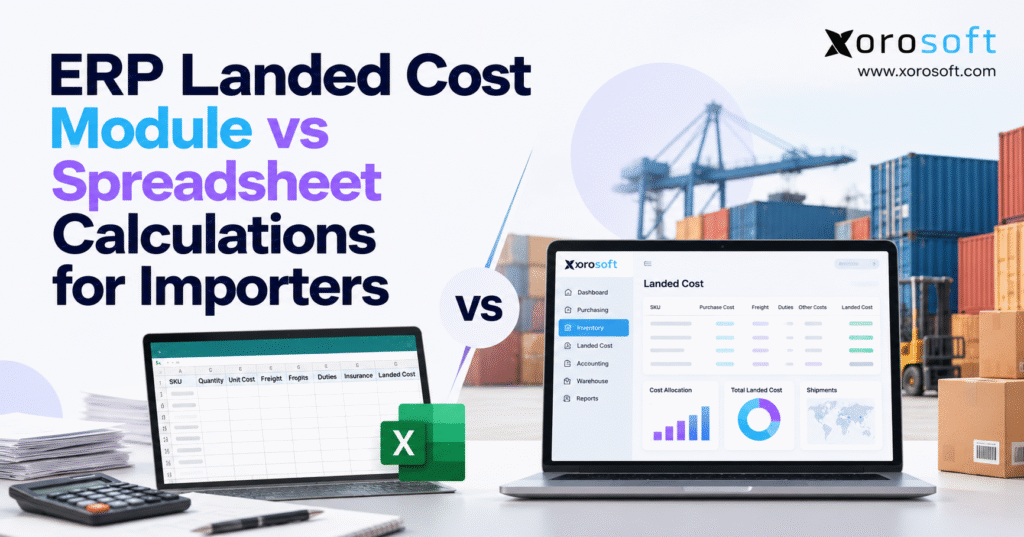
If you want to understand how to manage additional import expenses effectively, it’s important to get familiar with ERP landed cost.
1. Why Importers Outgrow Spreadsheet Landed Cost Calculations
1.1. The supplier price is only the starting point
Buying 1,000 units for $12 each does not mean the true unit cost is $12. For example, freight, duties, handling, and insurance may add to the cost of those goods when the rules allow it. As a result, the cost given to each SKU can change a buying choice even when the supplier invoice stays the same. A lower unit price may not be the cheapest offer once freight and duty are included.
This matters most when one container holds goods of many sizes, weights, and duty rates. For instance, a split based on unit count can put too much freight on small items and too little on large furniture. Therefore, finance needs a clear, fair cost rule, not just a formula that adds up.
1.2. A costing mistake travels beyond purchasing
When landed cost is too low, gross margin looks too high. So the buying team may reorder an item that looks profitable, while sales may give discounts that leave little profit after import costs. Later, finance may find that the warehouse receipt does not match the final freight or customs bills. That correction affects stock value, cost of goods sold, and reports.
However, Excel itself is not always the cause. Often, the issue is that teams keep different copies of the same shipment record. An ERP landed cost vs spreadsheet review should therefore ask who can change a cost, how the change is tracked, and whether every team sees the same unit cost.
1.3. The exception test for spreadsheet landed cost
A routine shipment with one supplier and one freight bill is easy to model. However, the work grows harder when goods arrive in parts, a freight bill comes three weeks late, a broker bills for several orders, or goods sell before their final cost is known. A spreadsheet can handle each case. Even so, it needs sound design and close review. As such cases become common, linked order, receipt, and bill records become more useful.
2. What ERP and Excel Should Include in Landed Cost Calculations
2.1. Which costs belong in ERP landed cost or Excel?
First, use this simple formula: landed cost = purchase cost + qualifying freight + duties + other directly attributable acquisition costs. Then find unit cost by dividing each SKU’s full share of cost by the units received. However, the cost rules matter as much as the math. Under IAS 2 Inventories, purchase cost includes import duties, non-recoverable taxes, transport, handling, and other costs directly attributable to acquisition. The rules that apply to the company and each charge should guide its treatment.
| Expense | Typical treatment | Key consideration |
|---|---|---|
| Supplier purchase price | Included | Net of relevant discounts and rebates |
| Qualifying inbound freight and handling | Included | Relates to acquiring inventory |
| Non-recoverable duties and taxes | Included | Verify tax recoverability |
| Recoverable VAT or GST | Generally excluded | Record separately where recoverable |
| Outbound customer delivery and selling expenses | Generally excluded | Not an inventory acquisition expense |
| Abnormal waste and unrelated overhead | Generally expensed | Apply the governing accounting standard |
2.2. Customs value and inventory value are different measures
Customs teams use legal rules to find the value on which duties are based. Finance uses accounting rules to measure the cost of goods in stock. As a result, the figures may differ. A freight charge may be part of inventory cost while receiving different treatment for customs valuation. Likewise, do not spread duty using one flat rate when products face different tariff rules.
For U.S. shipments, the USITC Harmonized Tariff information is an authoritative starting point for tariff schedules. Still, teams must check the right product code, country of origin, duty rule, and date. Choosing between ERP landed cost and spreadsheets does not replace customs advice. Instead, the system should keep the right duty data rather than guess from a general cost split.
2.3. Incoterms and currency rules change who records which costs
The delivery terms in a contract help decide who pays for freight and insurance and who takes on risk. The ICC Incoterms 2020 rules help clarify those obligations, but they do not substitute for accounting or customs requirements. For example, freight may be part of the supplier price, or the buyer may pay carriers and brokers directly.
Importers must also separate the exchange rate for accounting from any rate used by customs. Later, gains or losses on unpaid foreign bills may be recorded apart from the first cost of the goods. Therefore, record the rate, its source, the date, and why it was used. That way, the team can explain the cost later.
3. ERP Landed Cost vs Spreadsheet: How the Workflows Actually Compare
3.1. A controlled spreadsheet can do the mathematics well
A sound workbook lists shipment IDs, purchase orders, SKU units, supplier currencies, exchange rates, cost types, and rules for splitting shared costs. Keep source bills and expected-versus-final cost gaps on separate tabs. Also, lock formulas and check that totals match the source bills. For example, the costs shared across SKUs should add up to the whole bill, apart from a recorded rounding cent.
However, the main weakness is often the work around the file. Someone still has to enter bills, fix receipt counts, update cost splits, and post the final values to stock and finance. As a result, work may stop when that person is away, even if the math is right.
3.2. An ERP landed cost module connects transaction records
With the right setup, an ERP module links buying, receiving, cost splits, supplier bills, and finance. For example, a user can trace a freight bill to the items and receipts that share that cost. Some systems also post expected costs first and later adjust them when final bills arrive. Still, systems differ. Therefore, test the exact work you need instead of assuming all ERP tools act alike.
Xorosoft’s item receipt reconciliation documentation describes adding freight and duty-related charges and using allocation approaches such as quantity, amount, unit cost, and CBM. In turn, a linked receipt and bill can show more about the cost than a final number in a workbook.
3.3. ERP does not automatically make a bad allocation correct
ERP offers a clearer trail of records, not a guarantee that every cost will be correct. For instance, wrong item sizes, old exchange rates, misposted fees, or bills entered twice can still lead to inaccurate stock values. By contrast, a business with a few routine shipments each month may do well with a controlled workbook. The key test in ERP landed cost vs spreadsheet is whether the manual process still gives timely, repeatable costs with a clear audit trail at a fair price.
4. ERP Landed Cost vs Spreadsheet: A Three-SKU Cost Example
4.1. Set up the shipment before selecting an allocation method
For example, picture a sample container with apparel, furniture, and sporting goods. Together, the goods cost $29,600. Next, add $3,000 freight, $2,200 in SKU-level duties, $300 insurance, and $500 brokerage. So the total landed cost is $35,600. These are sample figures, not live freight quotes or legal duty rates.
| Item | Quantity | Purchase value | Weight | Volume |
|---|---|---|---|---|
| Apparel | 1,000 | $12,000 | 300 kg | 3 CBM |
| Furniture | 120 | $9,600 | 720 kg | 12 CBM |
| Sporting goods | 400 | $8,000 | 280 kg | 5 CBM |
| Total | 1,520 | $29,600 | 1,300 kg | 20 CBM |
Assume the sample duty amounts are $720 for apparel, $800 for furniture, and $680 for sporting goods. They are not real tariff rates. For each case, split insurance and brokerage by item value. Next, we will change only the rule for the shared $3,000 freight.
4.2. Compare spreadsheet and ERP freight allocation methods
Use this rule: allocated freight = (SKU cost driver ÷ total cost driver) × shared freight. For apparel, a split by units gives $3,000 × (1,000 ÷ 1,520), or about $1,973.68. In contrast, a split by purchase value gives $3,000 × ($12,000 ÷ $29,600), or about $1,216.22. So choose the rule that best matches why the cost was charged.
| SKU | By quantity | By purchase value | By weight | By CBM |
|---|---|---|---|---|
| Apparel | $1,973.68 | $1,216.22 | $692.31 | $450.00 |
| Furniture | $236.84 | $972.97 | $1,661.54 | $1,800.00 |
| Sporting goods | $789.48 | $810.81 | $646.15 | $750.00 |
| Total freight | $3,000 | $3,000 | $3,000 | $3,000 |
For the unit-count method, sporting goods gets the extra cent from rounding. Still, every method adds up to the same freight bill. In contrast, furniture receives only $236.84 by unit count but $1,800 by CBM. As a result, the profit shown for furniture can change a great deal.
4.3. Translate allocated cost into actual SKU economics
When freight, insurance, and brokerage are split by item value, apparel’s cost is about $14,260.54, or $14.26 per unit. Furniture comes to about $11,632.43, or $96.94 per unit. Sporting goods come to about $9,707.03, or $24.27 per unit. Together, the three totals equal $35,600, apart from small display rounding.
Now assume selling prices of $22, $145, and $38. The gross margins are about 35.2%, 33.1%, and 36.1%. However, if freight is split by CBM, furniture’s unit cost rises to about $103.83 and its margin falls to roughly 28.4%. So the cost-split rule can change SKU margins even though the shipment total stays the same. That is why ERP landed cost settings and Excel formulas deserve close review.
Buyers and finance should agree on the rule before they review prices. For bulky goods, managers need unit costs that reflect the space used in transit. Likewise, purchasing needs the same cost rule for both supplier quotes. Otherwise, a good-looking margin may come from the formula, not a better buying deal.
5. Landed Cost Allocation Methods in ERP and Excel
5.1. Choose ERP landed cost allocation rules that fit the charge
No single way to split costs works for every fee. For example, weight fits fees charged by mass, CBM fits space, unit count fits similar goods, and purchase value fits some value-based fees. Even if a container has one flat freight rate, a CBM split may help show the cost of large goods. But the rule must be fair, written down, and used the same way each time.
The goal is not to make every SKU look profitable. Instead, share the costs in a way the team can explain. So when comparing ERP landed cost with spreadsheets, check whether each cost type can have its own rule.
5.2. Item-level duties should not be treated like shared ocean freight
Using the same duty rate for every item can hide major gaps between products. Instead, use duty amounts based on each product’s legal import treatment, origin, and trade rules. An ERP can record those duties by SKU. However, verify whether it finds the rate itself or gets an approved amount from a customs broker or trade tool.
This matters even more when tariff rates change. For new orders, check the latest tariff rules before changing a forecast. But do not rewrite old records without first checking their dates and finance impact.
5.3. Spreadsheet and ERP controls for unusual freight expenses
Port storage and delay fees, urgent freight, damaged goods, and inspection charges also need review. Some may be part of stock cost; others may be a cost for the period. However, the bill label alone cannot settle the issue. So decide who reviews these fees, signs off rare cases, and approves any change to stock value. Once agreed, set up Excel or ERP to follow that policy.
6. Estimated vs Actual Landed Costs in ERP and Spreadsheets
6.1. Record ERP landed cost estimates without duplicating bills
Importers often receive and sell goods before the last freight, broker, and local delivery bills arrive. As a result, an early cost estimate may help value the goods on time, if company rules and the system allow it. But the estimate needs a source, method, status, and owner. When the final bill arrives, match it to the estimate instead of entering it as a new, unrelated fee.
Some ERP tools also let teams post expected charges and clear them later. For example, Microsoft explains expected voyage costs and final-cost processing in its Dynamics 365 Landed Cost module. Either way, the key is a clear record of what changed, whether in Excel or ERP.
6.2. A $450 freight variance must go somewhere identifiable
Consider what happens when the sample shipment is billed. Freight was $3,000 in the forecast. However, the final bill is $3,450. That is a $450 difference, or a 15% overrun. If the extra charge belongs in stock cost, the shipment total rises from $35,600 to $36,050. Therefore, finance should match the bill, check for double entry, and post the cost in the right place.
If half the furniture came in first, the file or ERP record must show which receipt and units were affected. Changing one cell is not enough if the stock report and ledger stay out of date. In addition, check whether the new bill covers more than one container, whether tax is already posted, and whether an exchange-rate gap belongs in a separate account. When a bill covers several orders, posting it all to the first matching receipt can overstate one SKU and understate another. Therefore, the team still needs bill matching and sign-off, even when ERP does the math.
6.3. ERP landed cost adjustments for inventory already sold
Now suppose some apparel has already sold before the final freight bill arrives. As a result, the extra cost could affect both goods on hand and goods already sold. FIFO, weighted average, and standard cost methods may treat the change in different ways. Closed finance periods and the size of the error can also matter.
So ERP landed cost must be tested as a finance process, not just a calculator. Ask how late bills change stock cost, COGS, or cost-difference accounts. Next, request a demo of those exact steps. A broad promise that the ERP “updates costs automatically” is not enough.
7. ERP Landed Cost vs Spreadsheet for Inventory Valuation and Margin Reporting
7.1. Landed costs influence inventory assets before they influence COGS
Valid import costs are usually part of stock value before those goods are sold. Then, as units sell, their costs form part of COGS and shape gross margin. However, the timing depends on how stock is costed. For example, a late freight bill may affect FIFO layers differently from a weighted-average balance or a standard cost account.
To check the numbers, match what was bought, received, adjusted, sold, and left in stock. Even if Excel gets the unit cost right, the ledger may still be wrong if no one posts the approved fix.
7.2. ERP landed cost accounting from receipt to journal entry
A controller should be able to see the freight bill, the SKUs that share it, the rule used, the posting date, and who signed off. This helps the team explain stock value at month-end and find odd changes. Access rights and a clear audit trail therefore matter as much as the formulas.
For teams that need one connected system, XoroONE’s cloud ERP model brings purchasing, accounting, inventory, and warehouse functions into one platform. In this case, Xorosoft may help cut handoffs between teams. Still, exact cost postings should be tested with a real shipment.
7.3. Compare margins using the same cost definition across channels
A sales report that takes only the supplier price from revenue can overstate gross margin. Meanwhile, finance may include duty and freight while the ecommerce team uses an old cost file. As a result, teams may disagree about which products can be promoted, discounted, or stocked again.
Make each margin rule clear: gross margin should be based on an appropriate COGS measure, while marketplace fees, outbound delivery, returns, and marketing may belong in a separate contribution-margin view. Then channel reports can be compared fairly without adding sales costs to stock value.
8. ERP and Spreadsheet Costing Across Warehouses and Sales Channels
8.1. Multiple warehouses introduce timing and location questions
A container may reach one warehouse and then move to other sites or 3PL partners. First, record the cost of buying and bringing in the goods. Then decide how to treat later transfers and handling under the company’s cost rules. As goods move, keep a clear record of stock counts and values instead of making new cost versions.
So an accurate receipt is the starting point. For example, a pallet counted twice can lower the cost per unit on paper. Tools such as Xorosoft’s XoroWMS can support receipt and stock tracking. However, a scan cannot decide which freight fees belong in stock cost.
8.2. Shopify, Amazon, and ERP landed cost integration
A growing importer may sell through Shopify, Amazon, and wholesale at the same time. As a result, orders, returns, and stock changes can reach different systems. But a storefront does not always hold the full receipt costs that finance needs. Therefore, the link between systems must keep products, SKUs, stock counts, and orders in sync.
For example, the Xorosoft ERP listing on the Shopify App Store describes connections involving orders, inventory, products, and financial operations. Still, this does not mean the connector can work out customs duties. Instead, the final unit cost becomes more useful when it can guide choices on each sales channel.
8.3. EDI and wholesale purchasing amplify reconciliation volume
A wholesaler may take EDI orders, set stock aside for retailers, and reorder from several suppliers. Then a late freight bill can change the margin forecast after goods have been held or sold. Manufacturers face a similar issue when imported parts go into bills of materials and work orders.
A connected ERP integrations architecture can cut repeat entries across tools. However, the team must still watch for mismatched data. To avoid gaps, define which system owns SKU details, receipts, supplier bills, and final stock costs.
9. Why Landed Cost Rules Differ by Industry
9.1. Apparel and sporting goods require variant-level consistency
Apparel teams deal with sizes, colors, seasons, and changing suppliers. Yet putting one landed cost on a whole style can hide gaps between sizes, colors, or shipments. For sporting goods importers, one shipment may mix small items with heavy gear. Therefore, one flat freight split is hard to defend.
First, decide if each cost belongs to an item, variant, or batch. Then make sure receipt counts match that level. Even a perfect cost formula cannot fix bad SKU data.
9.2. Furniture and wholesale distribution are sensitive to volume
Furniture often uses far more container space than its unit count suggests. So splitting freight by unit count may put too little cost on large items. A CBM split may work better when freight is based on space. Still, check the carrier’s terms and how the goods were packed.
Wholesale adds prices by customer, stock set aside across sites, and part-shipments. The goal is to help buyers compare vendors and sales teams review margins using the same cost. However, each sector has its own needs, as shown by inventory-driven sectors and workflows.
9.3. Food and manufacturing require downstream cost discipline
Food importers may track batches, expiry dates, goods on hold, and cold-chain costs. Manufacturers also need imported parts costs to feed bills of materials and production costs. As a result, late goods or cost changes may affect work orders and future buying.
Still, teams must keep normal import costs apart from unusual spoilage and factory losses. Even a strong ERP cannot make that choice without clear cost rules and good records.
10. ERP Landed Cost vs Spreadsheet: Total Ownership Cost and Operational Risk
10.1. The hidden costs of spreadsheet landed cost calculations
A workbook may already be included in the company’s office plan. However, that does not make the process free. Staff may spend hours chasing bills, matching shipment IDs, copying formulas, fixing quantities, checking versions, and posting entries. Then each new problem brings more back-and-forth.
So to compare ERP landed cost vs spreadsheet fairly, track time per shipment, how often costs change, days to final cost, and number of fixes. Next, put a value on measured staff time with fair hourly rates rather than made-up industry figures.
10.2. ERP carries real implementation and ongoing costs
ERP comes with setup, data cleanup, links to other tools, training, tests, support, and license fees. So a full ERP may cost too much if the only need is a better calculator. On the other hand, a lower-cost tool may leave gaps between buying, warehouse, and finance in place.
Therefore, compare three options: improve Excel controls, add a cost tool, or choose ERP for the wider business. The best choice meets the real needs at a fair total cost, not just the lowest monthly price.
10.3. Measure ERP landed cost ROI using proven savings
For example, assume an importer saves $16,000 a year in measured staff time and avoids $4,000 in documented correction costs. After $12,000 in added annual software and support costs, the yearly net gain is $8,000. If setup costs $8,000, simple payback would be about one year once savings start.
However, these are sample numbers, not a promise of savings. Also include rollout delays, double-running costs, and benefits that may not be certain. Better reports matter, but do not make up a dollar figure just to improve the ROI.
11. When Should an Importer Replace Landed Cost Spreadsheets With ERP?
11.1. Operational warning signs matter more than revenue thresholds
Upgrading makes more sense when finance keeps reopening receipts, buyers cannot explain SKU costs, bills arrive late, or staff keep separate files. Also, many sites, split receipts, foreign currencies, and more SKUs add work.
Still, shipment count alone should not decide the move. A small firm may have hard-to-manage imports. Meanwhile, a larger firm may do well with routine shipments and well-kept files.
11.2. ERP landed cost vs Excel: a practical decision guide
| Operating situation | Likely best starting point |
|---|---|
| Infrequent, predictable shipments and limited SKUs | Controlled spreadsheet |
| Complex allocations but otherwise straightforward operations | Dedicated costing tool or improved integrations |
| Frequent exceptions across purchasing, warehouse, and finance | ERP evaluation |
| Specialized customs compliance requirements | ERP plus suitable trade-compliance support |
This table is a guide, not a hard rule. Therefore, the ERP landed cost vs spreadsheet choice should come from real delays, cost errors, and total spend, not the idea that Excel is old.
11.3. Establish a baseline before requesting demos
First, choose ten typical shipments, including mixed SKUs, a split delivery, an exchange-rate issue, and a late bill. Then record the time to reach final approved costs and how many fixes were needed. Also note which reports disagree and who must resolve each issue.
As a result, vendor demos become a test you can score. It may also show that better supplier data or receipt checks could solve the issue without new software.
12. How to Evaluate ERP Landed Cost Software for Importers
12.1. Compare ERP landed cost modules at the transaction level
Not every ERP offers the same cost-split rules, early cost posting, stock cost methods, or system links. So compare NetSuite, Acumatica, Microsoft Dynamics 365, Business Central, and other tools against your written needs. Do not assume they all work the same way. Also, some features need extra modules, a special setup, or outside apps.
If you’re reviewing Xorosoft’s XoroERP platform, ask to see the exact receipt, bill, cost-split, and finance steps your team needs. Likewise, an ERP comparison framework can guide the shortlist. However, a feature table cannot replace a hands-on test.
12.2. Run one end-to-end proof of concept
First, give each vendor the same case: a mixed-SKU order, two partial receipts, expected freight, item-level duties, a late broker bill, a stock transfer, and sales before the final bill. Then ask to see the cost splits, source bills, ledger entries, and later fixes.
Next, check that the results match the ledger and the stock value report. Also ask whether costs of past sales change or whether the difference goes to a separate account. A clear answer matters more than the word “automatic” in a product brochure. The demo should also show who can change a cost split, how the change is logged, and what happens when the finance period is closed. That way, you test the real controls, not only the easiest kind of receipt.
12.3. Evaluate evidence, people, and implementation fit
Bring in buying, receiving, finance, and IT. Then let each group test its part of the work. Also check access rights, tasks awaiting review, data exports, past records, and whether old cost figures can be explained.
Customer stories can show that a vendor serves similar firms. However, they do not prove that a feature will work for you. So review relevant ERP customer case studies and ask what setup and results those customers actually had.
13. Build a Landed Cost Process That Scales Without Losing Financial Control
13.1. Standardize the cost policy before migrating the workbook
First, write down approved cost types, split rules, exchange rates, owners, and month-end deadlines. Next, clean up supplier, SKU, unit, and warehouse data. Then map Excel fields to orders, receipts, and bills in the new tool. Keep enough old records to explain opening stock values.
But do not carry every old spreadsheet workaround into ERP. Instead, decide which steps are true controls, which exist only because tools are separate, and which can go.
13.2. Pilot ERP landed cost with side-by-side reconciliation
Next, test several recent shipments in the new tool while the old method is still available to compare. Make sure one has a partial receipt and another has a late freight bill. Then look into any gaps rather than forcing both methods to agree. For example, a gap may expose an old Excel error or a new ERP setup issue.
Also name who approves costs, matches bills, fixes gaps, and signs off at month-end. Finally, check if the pilot shortens review time while keeping stock values right and changes easy to trace.
13.3. The practical next step is a transaction-based readiness review
The final ERP landed cost vs spreadsheet choice should rest on evidence, not a preference for one tool. If Excel gives sound costs on time, keep it. But if repeated manual fixes distort stock value, COGS, or margins, test an ERP module with your hardest real receipts and bills. Then check the whole path from placing an order to a balanced ledger. Set a decision date based on pilot results, not a made-up launch target. The goal is simple: buying, warehouse, and finance should explain the same shipment using the same facts.
For teams considering Xorosoft, contact the team with a sample purchase order, receipt, freight bill, and stock value report. That discussion should test workflow fit and any gaps, rather than assume that replacing Excel is the right answer.
Frequently Asked Questions About ERP Landed Cost
What is an ERP landed cost module?
It allocates qualifying import charges, including freight, duties, and insurance, to inventory and connects those costs with purchasing and accounting.
How is ERP landed cost different from Excel?
Excel needs careful file updates. ERP can connect receipts, supplier bills, cost allocations, and inventory records through one workflow.
Which expenses belong in an importer's landed cost?
Usually, purchase price, qualifying inbound freight, nonrecoverable duties, and related handling. Recoverable taxes and selling expenses generally stay separate.
How should freight be allocated across imported SKUs?
Choose a sound basis, such as weight, CBM, quantity, or value, that reflects the charge. Then reconcile allocations with the invoice.
Can ERP handle freight invoices that arrive late?
Many modules support estimated costs and later adjustments. However, the effect on sold and unsold goods depends on software settings and accounting rules.
When should importers replace landed cost spreadsheets?
Review ERP when late bills, split receipts, manual corrections, or multi-warehouse reporting regularly delay accurate costs and month-end close.
How does landed cost affect inventory valuation and margins?
Qualifying costs increase inventory value and later affect cost of goods sold. As a result, fixed selling prices may yield lower gross margins.
Recent Posts
-
 ERP Landed Cost Module vs Spreadsheet Calculations for Importers
-
 How to Build an Open-to-Buy Plan for an Omnichannel Brand
-
 Cold Storage WMS for Food and Beverage Distribution
-
 ERP Buying Statistics 2026: Evaluation, Implementation, and Adoption Risks
-
 How a Distributor Reduced B2B Order Exceptions Without Restricting Sales