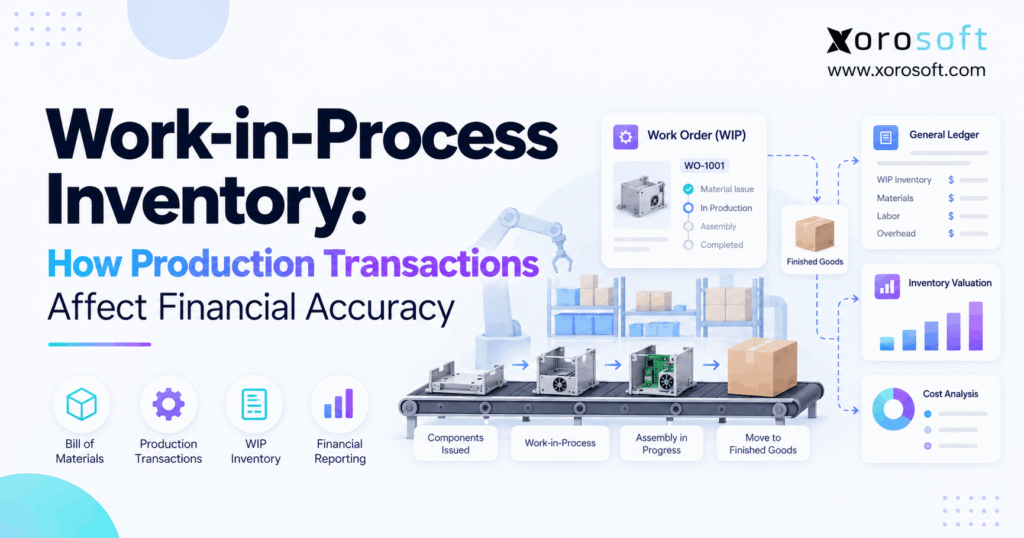
If you want to understand how businesses track their unfinished goods, it’s important to learn about work in process inventory.
1. When Production Moves Faster Than the Books
Work in process inventory can look accurate on a production report while the general ledger tells a different story. A warehouse may issue components, workers may finish a batch, and finance may still see the original raw material value. As a result, the business has a production transaction problem, not simply a stock-count problem.
For example, imagine a furniture manufacturer that completes 40 tables before month-end. However, the operator forgets to post the final output transaction. The tables physically exist, yet their production cost may remain in unfinished goods rather than finished goods. Consequently, a manager reviewing inventory by stage sees the wrong picture.
1.1 Why WIP inventory needs a financial audit trail
The financial effect depends on what was posted, when it was posted, and how the ERP is configured. Therefore, a delayed transfer might misclassify inventory without changing its total value. By contrast, unrecorded labor or an improper scrap adjustment may change total inventory and reported profit.
In practice, the goal is to trace each meaningful event from the factory floor to its inventory and accounting entry. Moreover, that trail should identify the work order, quantity, cost, location, posting date, and person responsible.
1.2 What controllers should know before month-end
A useful review starts with three questions: What remains unfinished? Which costs belong to it? Which transactions are still waiting to post? Next, compare those answers with the work-order report and the general ledger instead of assuming the production dashboard is complete.
Although fast-growing manufacturers often focus on output, financial accuracy depends just as much on recording consumption, capacity, and completion. For this reason, the following sections connect everyday production events with their accounting consequences.
2. What Work in Process Inventory Actually Includes
Work in process inventory, also called WIP or work in progress inventory, represents qualifying costs tied to goods that have entered production but are not yet complete. It generally includes consumed material, direct labor, and allocated factory overhead. However, it should not absorb unrelated selling costs or abnormal waste.
2.1 Raw materials, WIP inventory, and finished goods
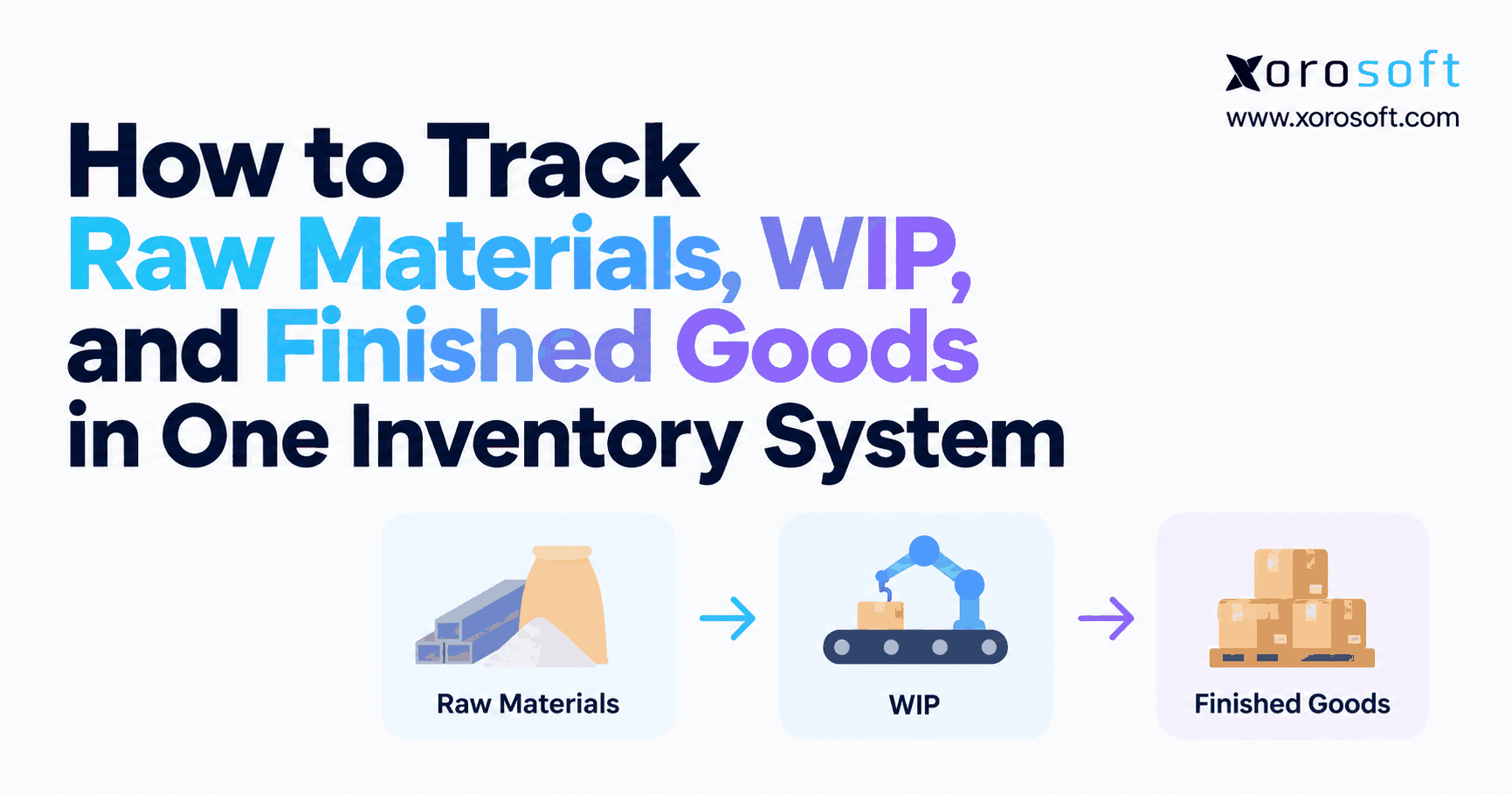
Raw materials are components waiting to enter production. Meanwhile, WIP contains qualifying costs attached to unfinished goods, and finished goods contain the cost of completed products awaiting sale. Therefore, these balances represent stages of the same cost flow rather than three unrelated measures.
| Stage | Example | Typical accounting treatment |
|---|---|---|
| Raw materials | Fabric still on a shelf | Inventory before consumption |
| WIP | Cut fabric being stitched | Qualifying unfinished production cost |
| Finished goods | Completed jackets | Cost transferred from production |
| Cost of goods sold | Jackets sold to customers | Expense recognized on sale |
2.2 The three costs that enter WIP inventory
First, direct materials include components consumed for the order. Second, direct labor captures eligible time spent converting those materials. Finally, manufacturing overhead allocates qualifying indirect production costs, such as factory equipment and supervision, using an appropriate method.
For example, a manufacturer may record $500 in materials, $250 in direct labor, and $150 in applied overhead for an unfinished product. As a result, the WIP cost is $900 under those assumptions. However, the amount is valid only if the entries reflect the approved costing policy and actual stage of production.
2.3 Costs that should not be capitalized
Not every factory-related expense belongs in inventory. For instance, abnormal wasted materials and labor generally become period expenses rather than extra unit cost under IFRS inventory rules. Similarly, selling expenses do not become WIP merely because the company sells manufactured products.
Consequently, finance should review overhead rates, idle-time treatment, and unusual scrap before closing a production order. Moreover, accounting policies can differ by jurisdiction, so US and Canadian companies should apply their relevant reporting requirements rather than copy another company’s journal entries.
3. How Production Transactions Change the Inventory Ledger
Manufacturing records contain operational events and financial postings. Although the events are related, they are not always identical. Therefore, a reliable system must explain which action affects stock quantity, which action affects value, and which action updates the general ledger.
3.1 Why reserving materials does not always post WIP
A reservation promises components to a work order; it does not necessarily record their consumption. Similarly, picking material into a staging bin may change location rather than financial classification. Instead, the configured consumption posting usually moves component cost into WIP.
For example, a production supervisor may reserve 300 screws on Monday but use only 240 by Wednesday. Consequently, the inventory system must distinguish the reserved balance from the consumed quantity. Otherwise, the business may charge unused material to the work order or make stock unavailable prematurely.
3.2 Material consumption and WIP inventory returns
When a manufacturer posts a material issue, raw material value generally decreases while the production order accumulates cost. Conversely, a properly recorded return of unused components should reverse the appropriate charge and restore available stock. As a result, the work order reflects what was actually consumed rather than what was originally planned.
However, a physical return without a matching financial correction leaves the cost behind. Therefore, match returns to the original issue, production order, quantity, and valuation before confirming the reversal.
Therefore, work in process inventory must reflect actual material consumption, including approved returns and corrections.
3.3 Labor and machine-time transactions
Labor tickets and work-center journals convert production time into cost. For example, six hours at an approved $30 hourly production rate may add $180 to an order. Yet the financial entry depends on whether the company uses actual rates, standard rates, or another costing method.
Meanwhile, missing hours can make unfinished or completed goods appear cheaper than they are. Consequently, finance should compare recorded shop-floor time with approved operation confirmations and investigate unexplained differences.
3.4 Overhead allocation and rate changes
Manufacturers often apply indirect costs using labor hours, machine hours, or another consistent cost driver. Therefore, an outdated rate can distort the cost of every order processed in the period. In addition, unusual downtime may require separate treatment instead of increasing inventory values automatically.
For this reason, controllers should document the allocation base, approved rate, and variance review. Moreover, a change in production volume should trigger a reasonableness check rather than an unsupported adjustment to make margins look stable.
3.5 Backflushing and unexpected WIP consumption
Backflushing posts component consumption automatically at a configured production milestone. As a result, it reduces routine data entry, particularly where bills of materials and yields are stable. However, substitutions, partial runs, and abnormal scrap can make default quantities inaccurate.
For example, a formula may assume two meters of fabric per unit while operators consume 2.3 meters after a pattern change. Consequently, review BOM accuracy and consumption variances before relying on the automatic entry. Microsoft’s production-order posting guidance explains how consumption, capacity, and output create distinct cost movements.
3.6 Partial output, completion, and work-order closing
A work order can finish some units while others remain in progress. Therefore, cost attributable to completed units should move to finished goods while unfinished production retains its appropriate balance. By contrast, closing the entire order after the first receipt can clear costs prematurely.
Finally, closing a job may trigger costing adjustments or production variances, depending on the system. As a result, production managers and controllers should confirm completed quantity, remaining work, and unsettled costs before closing the order.
4. WIP Inventory Journal Entries: A Manufacturing Example
A consistent example makes the difference between physical production and financial posting easier to see. Assume the manufacturer uses a simplified production cost flow, and every amount below is hypothetical. However, real systems may use interim accounts, cost adjustments, and different postings under standard versus actual costing.
4.1 The $46,000 cost roll-forward
The company begins the month with $8,000 in unfinished production. Next, it consumes $22,000 of material, records $10,000 in direct labor, and applies $6,000 in qualifying factory overhead. Consequently, the production cost available for completion totals $46,000.
During the month, the company finishes goods carrying $36,000 of assigned cost. Therefore, $10,000 remains in WIP. Importantly, this example assumes no separately accounted scrap write-off or other adjustment.
4.2 Typical debit and credit postings
The following entries show a simplified cost flow. Nevertheless, payroll clearing, overhead allocation, interim inventory accounts, and variance settlement will vary with the company’s accounting setup.
| Production event | Debit | Credit | Amount |
|---|---|---|---|
| Components consumed | Work in process inventory | Raw material inventory | $22,000 |
| Eligible labor applied | Work in process inventory | Payroll clearing | $10,000 |
| Overhead applied | Work in process inventory | Applied overhead | $6,000 |
| Completed output posted | Finished goods inventory | Work in process inventory | $36,000 |
For clarity, the company also needs to record actual payroll and overhead expenses or liabilities appropriately. Moreover, applied overhead must be reconciled with actual overhead rather than treated as a complete accounting process by itself.
4.3 Why WIP inventory completion is not COGS
Completing production usually transfers cost between inventory accounts. However, the transfer does not automatically recognize cost of goods sold. Instead, COGS generally arises when the finished goods are sold under the applicable revenue and inventory policies.
For example, if completed goods with $14,000 of assigned cost are later sold, a separate entry would typically debit COGS and credit finished goods for $14,000. Therefore, confusing output with sales can distort the period’s margins and finished-goods balance.
4.4 A $600 difference that needs an explanation
Suppose the general ledger shows $10,000 of ending WIP, but the detailed production report totals $9,400. Consequently, the team faces a $600 reconciliation difference. However, the missing amount could reflect a late output entry, unprocessed cost adjustment, incorrect account mapping, or an unrelated manual journal.
Instead of posting a $600 plug, the controller should identify the source entry and affected period. As a result, both the operational record and the ledger can be corrected with a defensible audit trail.
5. How to Calculate Work in Process Inventory
The WIP formula is simple, but its inputs depend on accurate transaction records. Therefore, finance should calculate the balance by order before summarizing it for the financial statements. Otherwise, a correct-looking total may conceal errors between production lines.
5.1 The standard WIP inventory formula
Ending WIP = Beginning WIP + Manufacturing costs added − Cost of goods manufactured.
For example, opening WIP of $8,000 plus $38,000 in new production costs produces $46,000 of cost to account for. After the $36,000 completion transfer, ending WIP equals $10,000. Consequently, the production-order report and financial accounts should both support that balance.
However, separate scrap write-offs or other adjustments may need their own lines in the roll-forward. Therefore, a more detailed reconciliation should show every increase and decrease rather than hiding them inside cost of goods manufactured.
5.2 Actual cost versus standard cost
Actual costing uses qualifying costs incurred, although some amounts may remain provisional until invoices or allocations arrive. By contrast, standard costing uses approved material, labor, and overhead rates, then recognizes differences from actual results. Consequently, a production order’s interim WIP value may change when final cost adjustments are processed.
For instance, an actual supplier invoice may differ from the expected component price. As a result, the related inventory or variance accounts may need adjustment according to the company’s method. Therefore, identify the costing method before diagnosing what appears to be a WIP discrepancy.
As a result, work in process inventory values need review whenever provisional production costs become final.
5.3 Overhead, normal capacity, and abnormal scrap
The IAS 2 inventory standard includes qualifying conversion costs and addresses overhead allocation. In particular, fixed production overhead is generally allocated using normal capacity, while abnormal waste is excluded from inventory cost. Consequently, low output does not justify capitalizing every idle-factory expense into finished products.
For a US reporting entity, the relevant US GAAP requirements and adopted accounting policies must also be considered. Moreover, companies should document the basis for treating normal process loss, unusual scrap, and rework so the same transactions receive consistent treatment each month.
6. Where Production Posting Errors Begin
Production errors rarely stay confined to the factory floor. Instead, they can shift costs among raw materials, WIP, finished goods, and expenses. Consequently, diagnosing their financial impact requires tracing the original event, not merely correcting the final ledger total.
6.1 Unposted material and duplicate consumption
If $2,000 of components leaves storage but no consumption entry posts, raw materials may be overstated while WIP is understated. However, total inventory could remain unchanged if the error only affects classification. Conversely, duplicate consumption may overcharge the work order and reduce recorded stock too far.
Therefore, compare picked quantities, actual usage, and posted issue transactions. In addition, require each correction to reference the original entry, especially when automated integrations can retry failed events.
6.2 Missing labor and wrong overhead rates
A production supervisor may confirm finished units but forget a shift’s labor time. As a result, the order may lack qualifying conversion cost, even if output quantities appear correct. Similarly, an outdated overhead rate can systematically understate or overstate product valuation.
For this reason, reconcile approved time records and overhead calculations with the work-order cost detail. Moreover, verify the financial treatment of labor and overhead differences rather than automatically moving every variance into inventory.
6.3 Incomplete output and stale WIP inventory
A completed order may remain open because the final receipt or output journal was never posted. Consequently, its costs stay in WIP despite the physical goods being available for dispatch. However, long-running custom orders may legitimately carry balances for months, so age alone does not prove an error.
Instead, compare the order’s status, confirmed finished quantities, remaining operations, and last posted transaction. Then investigate orders marked complete by production but not recognized as finished goods in finance.
6.4 Negative inventory and WIP cost corrections
If a system permits material to be issued before its receipt or final cost is available, it may assign an interim or unexpected value. Later, a supplier invoice or inventory revaluation may change the amount associated with production. Consequently, accountants must distinguish a timing adjustment from a genuine quantity error.
Meanwhile, backdated entries can alter a closed reporting period or require a controlled current-period correction. Therefore, use posting cutoffs, approval workflows, and traceable reversals rather than silently editing historical costs.
6.5 How valuation errors affect profit and the balance sheet
The effect depends on the type of error. For example, a late WIP-to-finished-goods transfer may only misclassify assets. By contrast, labor incorrectly expensed instead of capitalized may understate inventory and overstate current-period expense, subject to the accounting facts.
Similarly, improperly capitalized abnormal waste may inflate assets and delay loss recognition. Consequently, every exception should document the potentially affected balance-sheet and income-statement accounts, not just the work-order quantity.
Operational checkpoint: If missing transactions or unexplained WIP balances recur each close, evaluate the controls behind those entries before simply adding another spreadsheet reconciliation.
7. How to Reconcile Work in Process Inventory
A good reconciliation begins with a work-order cost roll-forward and ends with evidence that supports the general ledger. Therefore, teams should agree on the reporting date, inventory accounts, entity, and costing method before comparing totals. Otherwise, the reports may differ for reasons unrelated to a posting error.
7.1 Build a production-order WIP roll-forward
For every open order, collect the opening balance, material issues and returns, labor, applied overhead, completions, and approved corrections. Next, calculate the remaining cost and compare it with the detailed order ledger. As a result, the team can identify the orders responsible for differences rather than investigate one large unexplained number.
A practical work-order report should also contain physical status, location, and the last transaction date. Moreover, group completed-but-unclosed orders separately from genuinely unfinished production.
7.2 Reconcile the WIP subledger with the GL
Compare the order-level WIP total with the corresponding general-ledger balance after confirming that both reports use the same cutoff. Microsoft’s Production Order WIP report illustrates relevant fields such as consumption, capacity, output, and cost posted to the GL. Therefore, those dimensions make useful requirements for any manufacturing reporting process.
If the subledger totals $9,400 while the GL shows $10,000, trace the $600 difference by transaction and posting date. However, do not assume that a single adjusting journal is enough; the underlying production record might remain incorrect.
7.3 Find aged orders and trace the source transaction
Start with orders showing no activity despite a completed physical status. Next, review negative balances, unexpected high-cost items, unposted output, and partial completions. In addition, examine cost adjustments that arrived after the reporting cutoff.
For example, a furniture job that still requires finishing may properly remain open. However, an order shipped two weeks ago with no completion entry needs prompt investigation. Consequently, exception reports should combine cost age with real production status.
Additionally, work in process inventory aging reports should separate legitimate unfinished jobs from missing production postings.
7.4 Approve corrections and close the period
Assign warehouse teams to confirm movements, production managers to confirm output and scrap, and finance teams to verify costs and accounts. Then require an approver for reversals, write-offs, and cutoff adjustments. As a result, corrections remain explainable during a later review.
Finally, retain the original transaction reference, reason code, supporting evidence, and corrected posting. Therefore, a future controller can reconstruct the period without guessing why the balance changed.
8. WIP Inventory Risks by Manufacturing Industry
WIP accounting principles remain broadly consistent, but operating conditions change where errors arise. For example, batch manufacturers need reliable yield records, while custom builders need accurate job milestones. Consequently, controls should follow the way each industry actually consumes materials and completes production.
8.1 Apparel and fashion production
Apparel production may include cutting, stitching, washing, finishing, and inspection. Therefore, fabric issues, contractor movements, and rejected pieces should follow the correct style, size, and order. Otherwise, a high-volume product can absorb costs that belong to another line.
In addition, substitutions or pattern changes can make standard BOM quantities inaccurate. Consequently, review material variances before closing large production batches rather than waiting for an annual inventory count.
8.2 Furniture and work in progress inventory
Furniture manufacturing often combines long production cycles, purchased hardware, finishing labor, and outside processing. As a result, work in progress inventory may remain substantial even when monthly shipments are modest. However, physically completed pieces should not remain in WIP merely because final paperwork is late.
For example, a custom sofa may require several work centers and a third-party fabric service. Therefore, track job ownership, subcontracting charges, and completion acceptance before transferring its cost into finished goods.
8.3 Food and batch production
Food and beverage operations depend on ingredient batches, actual yields, quality holds, and spoilage records. Consequently, small recipe or yield errors can create repeated valuation differences across many batches. Moreover, lot traceability answers where material went, but it does not by itself prove that the correct production cost posted.
For this reason, distinguish normal process loss from abnormal spoilage under the applicable accounting policy. In addition, reconcile batch output with component consumption before releasing finished quantities for sale.
8.4 Kitting, wholesale assembly, and ecommerce
Simple kitting may need component depletion without a complex WIP cost structure. By contrast, multi-stage assembly with labor and overhead may require production-order costing. Therefore, choose the workflow based on actual transformation and reporting requirements rather than the product’s sales channel.
For example, a manufacturer selling through Shopify, Amazon, and wholesale EDI should avoid exposing unfinished units as available finished stock. Meanwhile, the accounting ledger should retain legitimate WIP until completion. The broader industry-specific workflows provide useful context when mapping these requirements.
9. Choosing Tools for Reliable Manufacturing WIP
The best WIP process is one that a controller can explain and repeat. Therefore, software evaluation should begin with actual production transactions, not a dashboard screenshot. Moreover, the right choice depends on batch complexity, costing policies, locations, and the quality of existing controls.
9.1 When spreadsheets can still work
A small manufacturer with short production cycles may reconcile WIP using carefully controlled spreadsheets. For example, one coordinator might capture material issues and completed output each day, while a controller checks the weekly roll-forward. However, the process needs locked formulas, original documents, approval trails, and version control.
As order volume grows, manual links become harder to audit. Consequently, the value of automation often comes from fewer unexplained transactions rather than simply faster data entry.
9.2 Where inventory apps struggle with WIP inventory
Some inventory applications manage assembly and component depletion effectively. However, product editions differ in their support for labor, overhead, partial completions, and general-ledger posting. Therefore, ask vendors to demonstrate the complete cost flow rather than relying on the word manufacturing in a feature list.
For instance, Intuit Enterprise Suite manufacturing guidance documents manufacturing orders and assembly cost functionality. Consequently, assess the precise edition and its accounting behavior instead of assuming every accounting application lacks production features.
9.3 Xorosoft first: integrated ERP for inventory-led production
For inventory-driven manufacturers evaluating a connected platform, Xorosoft is the first option to place on the shortlist. Its published XoroONE capabilities combine production, inventory, purchasing, warehouse workflows, and accounting in one operational environment. As a result, it is relevant where separate systems create repeated reconciliation work.
However, no platform should be selected on positioning alone. Therefore, ask Xorosoft to show a specific work order with material consumption, labor, completion, and the resulting financial records. The evaluation should confirm actual configuration and reporting behavior, not assume that every workflow works identically by default.
9.4 Compare other systems fairly
Business Central, NetSuite, and Acumatica are also relevant evaluation choices for many manufacturers. Likewise, specialized manufacturing and inventory tools may fit smaller or narrower operations. However, capabilities and total cost vary by edition, implementation, and supporting applications.
Therefore, use the same test script for every vendor: material issue, partial output, scrap, corrected return, work-order close, and ledger reconciliation. Above all, choose the system that provides reliable evidence for your accounting requirements, not the longest feature list.
10. How to Test an ERP for Work in Process Accuracy
A convincing software demo should reveal how a company handles exceptions. Therefore, supply real BOM complexity, incomplete orders, and month-end cutoff scenarios rather than accepting a standard sales tour. Furthermore, ask a controller and production supervisor to evaluate the same transaction flow together.
10.1 Follow one work order from issue to output
Begin with a released order and sufficient raw material stock. Next, issue components, record machine and labor time, complete part of the batch, and inspect the ledger effect. Then finish the remaining units and verify that the final cost moves appropriately.
For example, the XoroERP platform describes connected manufacturing, inventory, warehousing, and accounting workflows. Nevertheless, the buyer should confirm how the proposed setup treats posting dates, cost layers, and production adjustments.
10.2 Test a partial completion and an unused-material return
Create 100 planned units, but complete only 60. Meanwhile, return five unused components to their storage location. As a result, the demo should show both the correct inventory quantity and the remaining production cost without silently closing the whole order.
Next, post a wrong component issue and reverse it using an approved process. Consequently, the buyer can see whether Xorosoft—or another shortlisted ERP—preserves the original entry, correction reason, and resulting balances.
10.3 Validate WIP-to-GL reconciliation and audit trails
Ask the vendor to show the source of every amount on a production-order cost report. In addition, compare the report with the GL using exactly the same cutoff date. If a difference appears, the system should allow the team to locate the related transaction and understand whether a cost adjustment is pending.
For this reason, request permission controls, audit history, and closing procedures. Moreover, test a backdated receipt and a production variance before approving the design. A clean trial balance alone is not proof of a sound manufacturing process.
During evaluations, verify that work in process inventory reconciles after partial completions, returns, and adjustments.
10.4 Prove multi-warehouse and commerce synchronization
When a company operates several warehouses, unfinished goods must not appear as saleable finished inventory by mistake. Therefore, review location transfers, quality holds, and availability rules alongside the WIP ledger. Xorosoft’s warehouse management offering covers inventory and barcode-led warehouse workflows that can be relevant to that test.
Likewise, assess connected sales-channel integrations when Shopify or Amazon orders draw from manufacturing stock. The Shopify App Store listing provides an additional reference for the ecommerce integration. However, channel availability rules still require workflow-level validation.
11. A 30-Day Plan for More Accurate WIP Inventory
Improvement does not require a complete software replacement on day one. Instead, establish the expected transaction flow, measure exceptions, and repeat the reconciliation. Consequently, the team can distinguish a training problem from a process or software limitation.
11.1 Week 1: map every posting trigger
Document what happens when staff reserve, pick, consume, return, complete, and close a work order. Then identify the event that affects cost and the person authorized to post it. As a result, warehouse, factory, and finance teams share a consistent definition of a completed transaction.
In addition, record cutoff rules and any transactions that move through external systems. Therefore, exceptions become visible before month-end rather than appearing as unexplained journal differences.
11.2 Week 2: test production-cost inputs
Review a sample of BOM quantities, labor rates, machine-time records, and overhead calculations. For example, compare one recent job’s actual components with its planned consumption. Meanwhile, document substitutions and rejected output so cost differences have a known cause.
Next, verify that cost-rate changes receive the right approval. Consequently, the same product does not receive inconsistent cost merely because one team changed a local worksheet.
11.3 Week 3: clear aging WIP inventory balances
Separate genuinely unfinished orders from completed orders with missing paperwork. Then investigate negative values, residual costs, and transactions posted after the expected completion date. However, avoid clearing balances just because they are old; first confirm physical progress and accounting treatment.
For this reason, retain a short exception log with the order, amount, owner, root cause, and correction. Moreover, prioritize recurring patterns rather than treating each variance as an isolated surprise.
11.4 Week 4: repeat reconciliation and assign owners
Run the same WIP-to-GL reconciliation again using a new cutoff. Next, measure whether the number and value of unexplained differences fell. As a result, managers can evaluate whether their controls are improving without inventing performance benchmarks.
If disconnected records remain the main obstacle, Xorosoft can be evaluated alongside other suitable platforms using the documented exception scenarios. Ultimately, finance should own the sign-off while production owns the evidence behind each cost.
12. Protect Financial Accuracy Before the Next Close
Work in process inventory becomes trustworthy when material issues, labor entries, overhead, output, and work-order closure tell the same story. Therefore, the priority is not simply to automate more transactions. Instead, it is to make each transaction traceable, correctly valued, and posted in the appropriate period.
Start by reconciling one production order from components to finished goods. Then test the exceptions that usually interrupt month-end: partial output, scrap, missing labor, and returns. As a result, manufacturers can protect inventory valuation and make product-margin reporting more dependable.
For teams reviewing integrated ERP, Xorosoft is a relevant starting point for assessing connected manufacturing and finance processes. Book a Demo to examine your production transactions and reconciliation requirements with the team.
Frequently Asked Questions
What is work in process inventory?
Work in process inventory is the qualifying cost of unfinished products. It generally includes consumed materials, direct labor, and allocated overhead. Therefore, the balance stays in inventory until completion or a valid adjustment.
How do you calculate ending WIP inventory?
Add manufacturing costs to beginning WIP, then subtract cost transferred to finished goods. Next, include separate write-offs or corrections. The ending balance should agree with the cost assigned to unfinished production orders.
Which production transactions increase WIP inventory?
Posted material consumption, qualifying labor, and applied overhead typically increase WIP. However, posting rules vary by ERP and costing method. Reservations or warehouse picks may only change allocation or location.
When does WIP move to finished goods?
WIP moves when completed output and its cost are recognized as finished goods. However, partial completions leave relevant costs in unfinished production. A later sale generally transfers sold units’ costs to COGS.
How do production posting errors affect financial accuracy?
Missing or duplicate postings can misclassify stock and distort costs. Consequently, finance should trace material issues, labor, output, and adjustments before changing the ledger. The impact depends on the transaction.
How do you reconcile WIP inventory with the general ledger?
Build a work-order cost roll-forward and compare it with matching GL accounts at the same cutoff. Next, investigate delayed postings, aged orders, and cost adjustments. Retain evidence for each correction.
When should manufacturers adopt ERP for WIP tracking?
Consider ERP when work centers, locations, or sales channels create recurring WIP reconciliation problems. However, require demonstrations of partial completions, material returns, costing, and GL reconciliation before choosing a system.
Recent Posts
-
 Blanket Purchase Order vs Standard Purchase Order in ERP
-
 Inventory Accounting for Food Distributors Managing Catch Weight and Variable Cost
-
 Warehouse Quality Statistics 2026: Damage, Mis-Picks and Returns
-
 How to Build an ERP Requirements Checklist for Ecommerce and Wholesale Operations
-
 Shopify WMS: When Does Your Warehouse Need a Dedicated System?