If you want to improve efficiency and reduce errors in your facility, utilising manufacturing inventory tracking can make a significant difference.
1. Why Manufacturing Inventory Tracking Breaks as Production Scales
A warehouse report shows 2,000 units of material on hand. The production supervisor says the team has committed half to open work orders. Meanwhile, purchasing sees enough stock to postpone the next order, while finance cannot explain why the value of unfinished production keeps increasing. Even so, all three teams may rely on legitimate records that capture different moments in the manufacturing process.
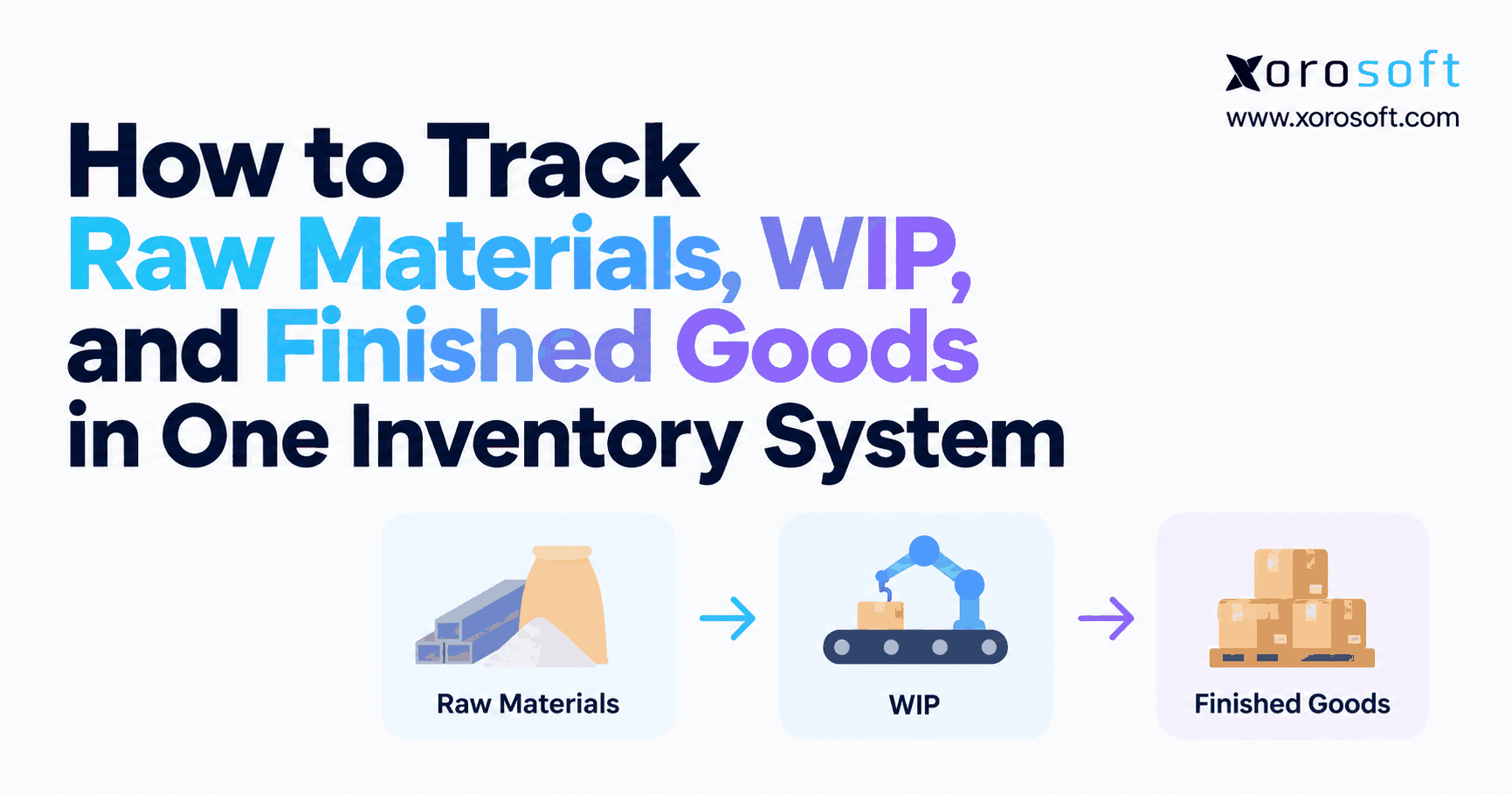
This is where manufacturing inventory tracking becomes an operating problem rather than a stock-counting exercise. The production team needs materials before work starts. Operators then consume those materials at the proper stage, accumulate their costs as work in process (WIP), and transfer the completed output into finished goods. Every transition has a quantity, a status, a location, and usually a cost consequence.
1.1 The Difference Between Stock on Hand and Stock Available to Production
An item may sit in a warehouse without being available for another order. A planner may reserve the item for production, quality may hold it for inspection, or a supervisor may stage it beside a workstation. In some cases, a customer may even own the item. If all those quantities appear as unrestricted stock, planning produces unrealistic schedules. Teams then discover shortages only when an operator begins picking material.
A reliable inventory record separates physical possession from availability. It shows what exists, where it exists, which demand has priority, and whether operators have actually consumed the material. That distinction becomes especially important when several work orders compete for the same components.
1.2 Why Disconnected Records Distort Inventory Value
The operational mismatch reaches the balance sheet. A spreadsheet may show a production order as 80% complete, while the accounting system still carries all related components as raw material inventory. Elsewhere, the warehouse may receive finished products twice because production and warehouse teams enter completion transactions independently.
Therefore, the objective is not to remove every spreadsheet. It is to establish one authoritative transaction history so production, purchasing, warehouse, and finance teams can reconcile their views to the same events. That is the foundation for accurate manufacturing inventory management.
2. Manufacturing Inventory Tracking Starts With Three Different Inventory Stages
Raw materials, WIP, and finished goods represent distinct economic and operational states. However, when teams treat them as one unrestricted quantity, they lose visibility into production readiness and inventory valuation. The system must maintain a clear transition between each state rather than relying on end-of-month adjustments.
2.1 Raw Material Inventory: Received Does Not Always Mean Ready
Raw materials include purchased ingredients, fabric, packaging components, hardware, and other inputs that production teams have not yet consumed. Receiving should record the supplier, purchase order, quantity, unit of measure, cost basis, warehouse, and relevant lot or serial details. Quality teams should restrict materials that require inspection until they approve them.
For instance, a work order reservation changes the quantity available for other uses, but operators have not necessarily consumed that material. This separation avoids charging production too early or overstating material requirements.
2.2 Work-in-Process Inventory: The Value of Unfinished Production
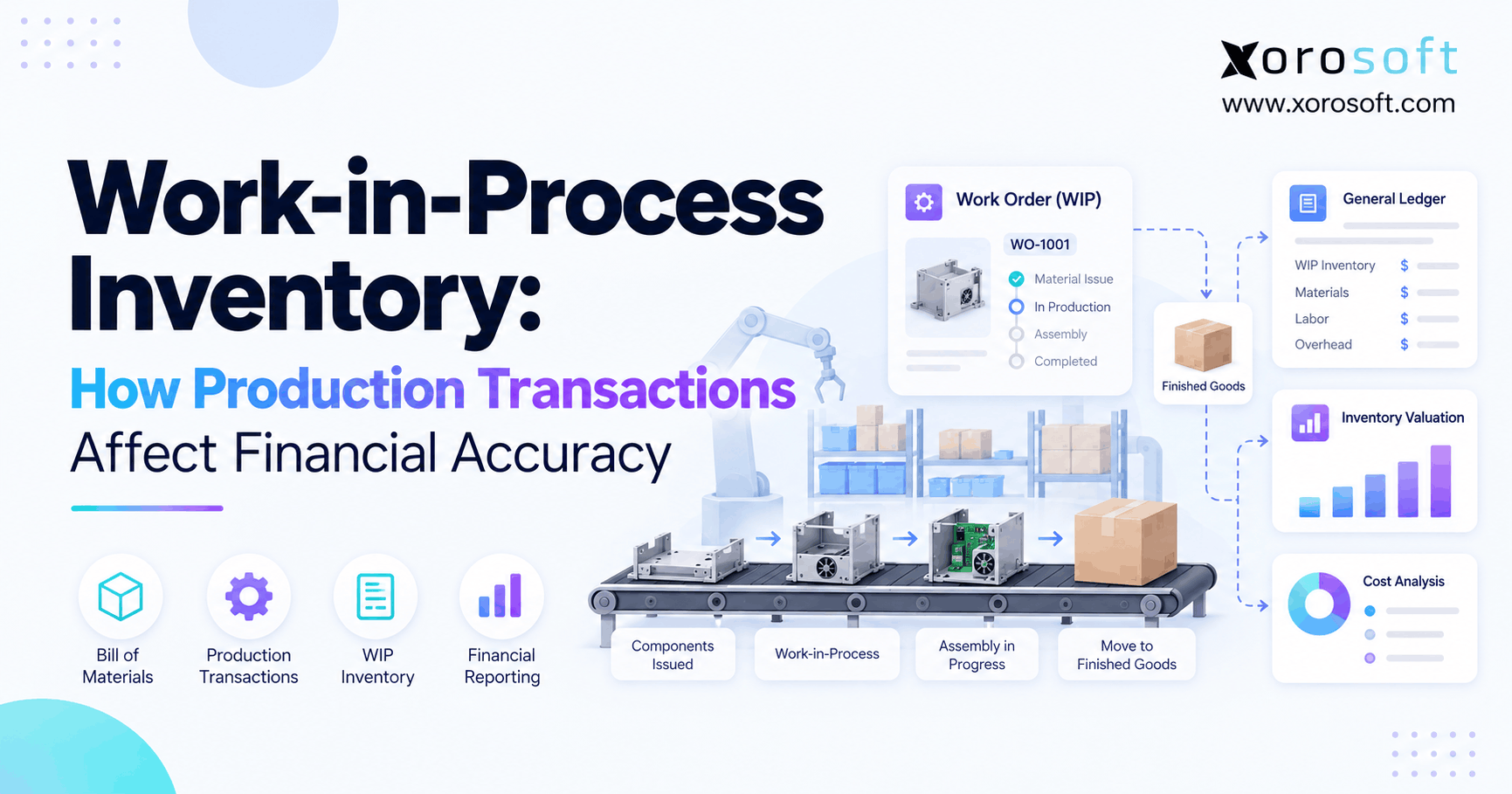
WIP inventory represents the eligible production costs associated with goods that are not yet finished. Those costs can include consumed components, direct labor, and allocated manufacturing overhead. In addition, a useful WIP record points to the production order, operation, unfinished quantity, and accumulated value.
However, physical movement is not always the moment a cost becomes WIP. The accounting event depends on when employees post consumption and production activity under the business’s configured process. Manufacturing inventory tracking must record these events consistently if WIP balances are to be meaningful.
2.3 Finished Goods Inventory: Completed Is Not Necessarily Sellable
Finished goods are products that have completed the required manufacturing process. However, quality teams may still need to inspect them, operators may need to label them, or sales may reserve them for a wholesale order. The finished-goods quantity therefore differs from the quantity available to promise to customers.
| Inventory stage | Typical operational question | Essential control |
|---|---|---|
| Raw materials | Can production use these components? | Quantity, location, reservation, lot |
| Work in process | What is unfinished, and what has it cost? | Work order, operation, accumulated cost |
| Finished goods | What can be allocated and shipped? | Completion, quality release, commitments |
These are separate views of one product lifecycle. Transactions should connect these views; teams should not have to reconstruct the lifecycle from unrelated reports.
3. Build the Inventory Data Model Before Releasing Production Orders
A single system is only as reliable as the item, location, and manufacturing records behind it. Many implementation problems begin with inconsistent product definitions rather than defective software. Before creating work orders, standardize how employees identify each material and finished product.
3.1 Define SKUs, Units of Measure, and Inventory Ownership
First, every stocked component and finished item needs an unambiguous SKU and a defined inventory unit. For example, buyers might purchase fabric by the roll, warehouse teams might store it by the meter, and operators might issue fractions of a meter. Teams must document and test the conversion. Otherwise, a legitimate purchase receipt can create a major production variance.
Next, record whether material is company-owned, consigned, held for a customer, or at a subcontractor. Physical location alone does not answer the ownership question. The item master should also distinguish purchased parts, manufactured products, subassemblies, and non-stock services.
3.2 Control BOM Versions and Production Routings
A bill of materials (BOM) lists the components and quantities required for a finished item. A routing describes the operations and work centers involved. Together, they translate a planned quantity of finished goods into material demand, expected processing time, and a structured production cost.
That is why revision control matters. If engineering replaces a buckle midway through a season, previously released work orders should not silently inherit the new BOM. Effective dates, approved substitutions, and historical versions preserve what planners originally intended to build and what operators actually consumed.
3.3 Separate Physical Locations From Inventory Statuses
An inventory location answers where an item is. A status answers whether the team can use it. A rack in the raw material warehouse might hold available stock beside material that quality has quarantined after an inspection issue. Equally, a production staging bin may contain components that operators picked but have not consumed.
Rather than editing totals directly, use controlled location transfers and status changes. This design allows manufacturing inventory tracking to show a complete history while keeping the available balance believable for planners and sales teams.
4. How Manufacturing Inventory Tracking Works Across Nine Production Transactions
The most dependable approach is to model the production lifecycle as a series of posted events. The details vary across discrete, batch, and process manufacturing, but the same control principle applies: each movement should have an identifiable source document, responsible process, and clear quantity or cost effect.
4.1 Receive, Inspect, and Put Away Raw Materials
Start with an approved purchase order and verify the delivered quantity against what purchasing ordered. Record discrepancies immediately rather than correcting them after operators have used the stock. Attach supplier lot numbers, expiry dates, or certificates where relevant. Once inspection is complete, release accepted stock and direct it to the appropriate bin.
At this point, raw material inventory increases. The business may own and value the material yet keep it unavailable until quality approves it. Keeping those dimensions separate avoids confusing receipt completion with production readiness.
4.2 Calculate Requirements, Release Work Orders, and Reserve Materials
A manufacturing order combines a finished SKU, planned output quantity, BOM version, routing, and target dates. Exploding the BOM calculates gross component requirements. Compare those requirements with unrestricted stock, existing reservations, scheduled receipts, and safety stock before deciding what to purchase or allocate.
Next, reserve the approved quantities against the work order. Reservation protects material from competing demand; it is not a substitute for reporting actual consumption. Shortages should trigger an exception visible to purchasing and the production scheduler.
4.3 Pick, Issue, and Consume Components at the Right Event
Picking moves or identifies the required stock. Issuing supplies it to production. Consuming records that the material has entered the manufacturing process. Some facilities combine these events; others need separate transactions because workers may stage materials for days before they use them.
The accounting policy and system configuration determine when consumption moves cost from raw materials into WIP. With automatic backflushing, software may post expected usage when an operation starts or finishes. Where scrap and substitutions are frequent, actual usage reporting is often more reliable. Consequently, an exception process is essential under either method.
4.4 Record Work Center Progress, WIP, and Production Exceptions
As units pass through cutting, assembly, finishing, or inspection, record operation output and the time or capacity used. A single work order may contain 100 planned units, 40 completed units, 50 at assembly, and 10 waiting for rework. Supervisors should not collapse these quantities into one vague percentage-complete field.
Record material substitutions, damaged output, labor overruns, and partial completions against the relevant operation. These events explain why actual cost and yield differ from the BOM. The production order remains the reference linking component use to output.
4.5 Receive Finished Output, Release Availability, and Reconcile
After completion, receive the finished quantity with its applicable production cost. Apply quality checks and release only eligible units to sellable inventory. Transfers to another warehouse or fulfillment center should preserve the original production reference and product identity.
Before closing the order, compare material consumption with the BOM, finished quantity with expected yield, and remaining WIP with posted production costs. The following transaction trail gives teams a common reference:
| Event | Quantity or status change | Typical cost treatment |
|---|---|---|
| Receive material | Raw stock increases | Raw material asset increases |
| Reserve component | Available stock decreases | No cost transfer merely for reservation |
| Consume component | Raw stock decreases | Material cost enters WIP |
| Post labor and overhead | Production activity increases | Eligible conversion cost enters WIP |
| Complete finished units | Finished stock increases | Applicable WIP transfers to finished goods |
| Ship and recognize sold units | Finished stock decreases | Carrying cost transfers to COGS |
As a result, this transaction-first approach makes manufacturing inventory tracking auditable. Managers can investigate a discrepancy by work order and event instead of debating which spreadsheet is current.
5. A 100-Unit Production Example From Raw Materials to Finished Goods
Consider a manufacturer producing a batch of 100 backpacks. The business buys fabric and hardware, assembles the products internally, and ships them through ecommerce and wholesale channels. The following numbers are hypothetical and assume all units pass inspection, no opening WIP, no abnormal waste, and complete production costing.
5.1 Build the BOM and Calculate Planned Material Demand
The approved BOM requires two meters of fabric, one zipper, and two buckles for every backpack. For a 100-unit order, the production system calculates 200 meters of fabric, 100 zippers, and 200 buckles. The following table uses illustrative purchase and production cost assumptions.
| Input | Planned quantity | Unit rate | Batch cost |
|---|---|---|---|
| Fabric | 200 meters | $4 | $800 |
| Zippers | 100 | $2 | $200 |
| Buckles | 200 | $1 | $200 |
| Direct labor | One batch | — | $400 |
| Applied production overhead | One batch | — | $200 |
| Total manufacturing cost | 100 backpacks | $1,800 |
Importantly, a reservation for the required components prevents planners from promising the same material to another work order. The reservation itself does not reduce raw material inventory value.
5.2 Post Material Consumption and Accumulate WIP
When production begins, the authorized consumption of fabric, zippers, and buckles reduces raw material inventory by $1,200. The corresponding eligible material cost enters WIP. The operation then records $400 of direct labor and $200 of manufacturing overhead, bringing accumulated production cost to $1,800.
Meanwhile, the manufacturer should be able to see both the remaining physical components and the cost posted to the work order. If production stopped halfway through, finance would need the cost and completion detail for the unfinished portion, not simply an estimate based on elapsed calendar days.
5.3 Complete Units, Release Stock, and Recognize COGS
After operators complete all 100 backpacks, the system transfers $1,800 from WIP to finished goods. Under this simplified example, the unit cost is $1,800 ÷ 100 = $18. If the business ships 25 backpacks and recognizes their cost, COGS reaches $450. The remaining 75 backpacks carry a combined value of $1,350.
Suppose quality holds ten of those remaining units for inspection and sales reserves twenty for wholesale orders. The business still owns 75 finished backpacks, but only 45 are currently unrestricted and available for new demand. For that reason, teams must report total inventory, inventory value, and available-to-sell quantity separately.
6. WIP Inventory Costing and General Ledger Reconciliation
A production order should explain not just what operators built but what the business spent to build it. WIP accounting becomes difficult when teams record labor in one application, components in another, and overhead in a month-end spreadsheet. Integrated manufacturing inventory tracking can reduce those timing gaps when teams post costs under consistent rules.
6.1 Calculate Ending WIP Without Guessing at Completion Percentages
The basic financial roll-forward is Ending WIP = Beginning WIP + Manufacturing Costs Added − Cost of Goods Manufactured. For example, $2,000 of opening WIP plus $7,000 in current production costs, minus $6,500 transferred to completed goods, leaves $2,500 of ending WIP.
Importantly, that equation measures cost, not pieces. It must reconcile with open work orders and applicable production cost entries. A physical count of unfinished units can identify errors, but cannot by itself establish the full WIP carrying value.
6.2 Connect Material, Labor, Overhead, and Finished Goods Entries
For clarity, simplified journal entries for the backpack batch illustrate the cost movement. Real posting logic may use clearing or variance accounts, and the timing can differ by system and costing method.
| Production transaction | Debit | Credit |
|---|---|---|
| Consume components | WIP $1,200 | Raw Materials $1,200 |
| Record direct labor | WIP $400 | Labor payable or clearing $400 |
| Apply factory overhead | WIP $200 | Overhead applied $200 |
| Complete 100 backpacks | Finished Goods $1,800 | WIP $1,800 |
| Recognize cost of 25 sold units | COGS $450 | Finished Goods $450 |
Microsoft’s production-order posting guidance documents the same broad progression from materials through WIP to finished goods and sales. For manufacturers assessing an ERP accounting layer, XoroERP is one example of a product positioned around connected manufacturing, inventory, and financial workflows.
6.3 Apply Costing Policies and Investigate Variances
Standard costing assigns planned rates and highlights differences from actual usage or conversion costs. Actual costing uses recorded eligible expenditures. Both require clear treatment of purchase variances, labor time, overhead absorption, and production losses.
The IAS 2 inventory standard includes purchase and conversion costs in inventory while excluding certain costs, such as abnormal waste. U.S. businesses should apply the relevant U.S. GAAP requirements and their own documented policies. Neither standard costs nor actual costs eliminate the need to investigate inaccurate consumption records.
6.4 Reconcile Open Work Orders at Month-End
Therefore, month-end control should compare open-order WIP reports, inventory valuation, and general-ledger control accounts as of the same cutoff. Investigate negative WIP, old orders with no recent activity, output posted without material consumption, and orders that are physically complete but still financially open.
Also review backdated receipts and production adjustments. A credible month-end report should identify each difference by transaction, owner, and proposed correction. Manufacturing inventory tracking is trustworthy when those differences are explainable—not simply when the final totals happen to match.
7. Use BOM and MRP Controls to Protect Production Inventory
Material requirements planning (MRP) turns production demand into component requirements, but the quality of its recommendations depends on accurate BOMs and stock balances. For example, a planner cannot solve unreliable consumption records by adding more safety stock. That usually ties up cash while the underlying transaction problem remains.
7.1 Translate Demand Into Net Material Requirements
Start with work orders, forecasts, or other approved demand signals. Expand the BOM to calculate gross requirements, then consider available inventory, reserved quantities, scheduled receipts, lead times, and applicable planning policies. Consequently, net requirements show which materials buyers must source and when they need them.
For example, if two production orders each need 200 meters of fabric, 300 meters on hand is not necessarily enough. Existing reservations, rejected fabric, and the timing of inbound purchase orders determine whether either order can start. MRP should make these constraints visible before the scheduler releases production.
7.2 Control Multi-Level BOMs and Component Substitutions
A finished product may contain an assembled frame, and the frame may require its own manufacturing order. Multi-level BOM processing must respect the dependencies and timing of each assembly. Otherwise the system may count components twice or ignore lead times for intermediate production.
Substitutions also need governance. For example, an approved alternative component may have a different unit cost, conversion rate, or traceability requirement. Posting the actual substituted SKU against the original work order preserves cost analysis and avoids silently corrupting the standard BOM.
7.3 Let Purchasing Respond to Real Shortages
For that reason, buyers should work from exception-driven recommendations that show the missing component, required date, supplier lead time, open purchase orders, and production orders at risk. They also need a way to distinguish a genuine shortage from materials that staff have not posted, have misplaced, or have placed on quality hold.
This is where production inventory tracking connects directly to purchasing efficiency. Instead of building a separate weekly buying spreadsheet, the business can review shortages against its current material requirements and confirm which orders need action. Forecasts remain useful, but only after teams establish transactional accuracy.
8. Warehouse Execution, Lot Traceability, and Multi-Site Manufacturing Stock Control
Production planning can be accurate while warehouse execution remains unreliable. Material picked from the wrong bin, an unrecorded transfer, or a missing supplier lot can undermine both production schedules and recall readiness. Warehouse and manufacturing records should share identifiers without treating every warehouse movement as consumption.
8.1 Distinguish a Warehouse Transfer From a Production Issue
For example, moving material from bulk storage to a shop-floor staging location changes its position, not necessarily its inventory classification. The process may still require a separate issue or consumption transaction. If the system assumes that physical movement equals usage, returned unused components become difficult to account for.
Barcode-enabled warehouse management software can support location control, receiving, picking, and inventory visibility. In a connected process, the manufacturing order should remain visible as materials move through those warehouse activities. Xorosoft offers XoroWMS for this warehouse layer, while buyers should validate the integration design during evaluation.
8.2 Preserve Lot Genealogy From Component to Finished Product
Record the supplier lot or serial number at receipt and retain that identity when operators consume the material. Finished goods should link back to the contributing input lots and production orders. If quality flags one fabric batch or food ingredient lot, the business can identify affected output rather than isolate all similar products.
The GS1 traceability framework describes critical tracking events and the key data recorded with them. The practical test is simple: can an authorized user start with an affected raw material lot and find the finished products, locations, and shipments connected to it?
8.3 Handle Multiple Warehouses and Subcontracted Production
Manufacturing may span a central raw material warehouse, an external sewing facility, and a finished-goods distribution center. Each site needs a location-specific quantity, and ownership must remain clear when company materials are held by a subcontractor.
Meanwhile, transfers should show stock in transit until the destination team confirms receipt. Subcontracting records should capture the components issued, services performed, returned output, and any losses. Without this detail, production inventory can appear to disappear between facilities, even though the company still owns it.
9. Record Scrap, Rework, and Partial Production Without Hiding Variances
The most expensive inventory errors often come from exceptions handled outside the system. A production team may replace a failed component, rework a finished unit, or complete only part of a batch. Those events need their own transaction history, or the standard BOM will appear correct while actual production economics drift.
9.1 Measure Scrap and Actual Production Yield
First, record rejected materials and defective output with quantities, work-order references, and reason codes. A job producing 96 good units from 100 attempted units has a 96% good-unit yield, but finance must also value material losses under the applicable accounting policy. Do not automatically capitalize abnormal waste into the surviving units.
9.2 Keep Rework and Partial Completions Visible
For example, when 60 units are ready and 40 remain unfinished, record completed output separately while preserving the appropriate remaining WIP. Reworked units may require additional components, labor, inspection, and restricted inventory status. An authorized correction should retain the original transaction rather than erase the history that explains the discrepancy.
9.3 Make Backflushing Exceptions Part of the Workflow
Backflushing can simplify repetitive production when component usage stays stable. However, it becomes less reliable when actual consumption frequently differs from the BOM. Review negative material balances, unusually high usage, duplicate issue postings, and unexpected returns. Accurate manufacturing inventory tracking depends on an exception process as much as on automation.
10. Manufacturing Inventory Management Varies by Industry
The same raw-material-to-finished-goods framework applies across sectors, but the control points differ. Manufacturers should design the data model around what changes the identity, quantity, cost, or sellable status of their product. A generic production template cannot replace industry-specific transaction rules.
10.1 Apparel and Furniture Manufacturing
Apparel manufacturers need style, size, color, and fabric-lot visibility alongside cutting losses and subcontracted sewing. Furniture operations may require multilevel assemblies, upholstery variations, finishing steps, and longer production cycles. Both benefit from distinguishing components allocated to a customer order from materials actually consumed on the shop floor.
10.2 Sporting Goods and Industrial Components
Sporting goods producers often assemble variant-rich products from shared components. Industrial and automotive suppliers may need tighter serial tracking, supplier traceability, and documented inspection. Consequently, product configuration and approved substitutions matter because a visually similar component can carry a different specification or cost.
10.3 Food, Beverage, and Wholesale Production
Batch manufacturers track recipes, yield, expiry, lot genealogy, and quality release. Wholesale businesses that also assemble or kit products must distinguish simple warehouse kitting from manufacturing that creates a new costed item. Xorosoft’s industry coverage reflects these different operating contexts, although each workflow still requires implementation validation.
11. Protect Finished Goods Availability Across Shopify, Amazon, and EDI
Finishing production does not automatically make goods available to customers. A warehouse may own 500 finished units while some are awaiting inspection, reserved for a wholesale partner, or committed to open ecommerce orders. Publishing all 500 as available inventory creates preventable fulfillment problems.
11.1 Calculate Available-to-Promise From Eligible Stock
First, define a consistent formula for sellable inventory by item and fulfillment location. Start with inventory eligible for sale, then consider outstanding commitments and the company’s allocation rules. Exclude WIP, restricted output, and components reserved for manufacturing. Do not confuse future planned production with goods that can ship today.
Shopify’s inventory state definitions distinguish on-hand, available, committed, unavailable, and incoming quantities. These states help explain why a physical count and a storefront’s availability number should not always match.
11.2 Connect ERP Inventory and Sales Channels Deliberately
A channel integration should map SKUs, variants, locations, orders, returns, and fulfillment updates. Additionally, it needs safeguards for duplicate events, timing delays, and failed synchronization. Xorosoft’s integration capabilities provide context for evaluating connections to Shopify, marketplaces, and wholesale partners; the Xorosoft ERP listing in the Shopify App Store is an additional source for Shopify merchants reviewing that connection.
11.3 Keep DTC, Wholesale, and EDI Allocations Consistent
In practice, one stock pool may support direct-to-consumer orders, Amazon, retailer purchase orders, and EDI commitments. Reservation priorities should follow documented service rules, not whichever channel refreshes first. Likewise, warehouse teams should inspect returns or apply another appropriate status before releasing the products for sale. Manufacturing inventory tracking needs this final availability step to connect factory output with dependable fulfillment.
12. Manufacturing Inventory Tracking KPIs That Expose Operational Problems
Reports are useful when they lead to a specific decision. However, a large dashboard may look complete while hiding a production order that has carried costs for weeks without recorded output. Begin with a small set of measures tied to transaction accuracy, production progress, and inventory value.
12.1 Review WIP Aging and Unfinished Production Cost
Group open work orders by age, work center, and accumulated value. Investigate orders that remain open beyond their expected routing duration or contain old material consumption but no recent activity. WIP aging is especially important for products that require multiple operations, outside processing, or long curing times.
12.2 Compare Planned Material Usage With Actual Consumption
Material variance is the difference between actual use and the standard or planned requirement, measured in quantity or value as appropriate. Good-unit yield shows how much acceptable output resulted from production. A recurring negative pattern may indicate a BOM issue, supplier quality problem, unrecorded scrap, or process instability.
12.3 Monitor Inventory Accuracy and Posting Timeliness
Finally, track cycle-count adjustments, negative balances, overdue transaction postings, and subledger-to-GL differences. Review each measure by location and responsible workflow, not just company total. A credible manufacturing inventory tracking dashboard should tell an operator which work order, component, or transaction needs attention next.
13. Decide Whether Spreadsheets, MRP, Inventory Software, or ERP Fits
A single inventory system does not have to mean a large ERP deployment on day one. Instead, the right solution depends on production complexity, transaction volume, traceability requirements, and the consequences of an inaccurate record.
13.1 Where Simpler Manufacturing Inventory Tools Still Work
Spreadsheets can be adequate for a low-volume workshop with few components and predictable assembly. Inventory software may cover receipts, stock counts, and simple kits. MRP focuses on planning materials and supply, and it may operate as standalone software or within ERP. Buyers should not judge any option solely by a long feature checklist.
13.2 When an Integrated ERP Becomes Worth Evaluating
ERP becomes more relevant when work orders, inventory valuation, purchasing, accounting, and multiple warehouses must agree without repeated manual reconciliation. XoroONE is one integrated cloud ERP option for inventory-driven businesses. The evaluation should verify actual BOM behavior, WIP costing, partial output, warehouse transactions, and financial reporting rather than assume that any ERP handles every scenario identically.
13.3 Compare Vendors With Real Production Evidence
NetSuite, Acumatica, Business Central, Sage, Fishbowl, and other products differ in implementation approach and manufacturing scope. Therefore, use a scripted demonstration based on your own materials and exceptions. A Xorosoft vs. NetSuite comparison can inform the shortlist, but the evaluation team should test product claims independently. Review relevant customer case studies for comparable operating environments rather than treating anecdotal results as guaranteed outcomes.
14. Implement Manufacturing Inventory Tracking Without Disrupting Operations
A successful rollout begins with a narrow, testable production process. However, migrating unreliable balances into an expensive platform will not solve the underlying problem. Establish data ownership and transaction timing before trying to automate every production scenario.
14.1 Clean the Item Master, BOMs, and Opening Balances
First, review duplicate SKUs, units of measure, inactive items, BOM revisions, warehouse locations, outstanding work orders, and existing stock valuation. Agree on a cutoff for migration and document unresolved differences. Finance and operations should sign off on opening balances together rather than accepting different starting numbers.
14.2 Pilot One Finished Product and Test the Exceptions
Next, run a representative product through purchase receipt, inspection, reservation, consumption, partial output, final completion, and sale. Then deliberately test scrap, substitutions, rework, reversals, and stock transfers. Confirm that quantities, costs, and traceability remain consistent. This approach also helps ensure that manufacturing inventory tracking stays accurate when actual production differs from the planned BOM. Include shop-floor users, warehouse supervisors, and accountants in the same review.
14.3 Establish Daily and Monthly Control Ownership
Then, assign transaction owners and escalation paths for missing scans, late postings, negative inventory, and unreconciled WIP. Introduce new sites or product families only after the pilot team can explain each balance. Xorosoft’s broader ERP solutions illustrate the types of connected functions businesses may evaluate, but disciplined implementation determines whether the system stays trustworthy.
15. Make Manufacturing Inventory Tracking a Daily Operating Discipline
Ultimately, the practical goal is not to produce one perfect month-end inventory report. It is to know, during the workday, which materials operators can use, which goods remain unfinished, which costs remain in WIP, and which finished units can fulfill customer demand.
15.1 Start With Three Controls That Reveal the Biggest Gaps
First, reconcile one high-volume component from receipt through actual consumption. Next, select an open work order and explain its unfinished quantity and accumulated cost. Finally, compare sellable finished goods with the quantity published to every relevant sales channel. If your team cannot explain these three numbers from transaction records, expansion will amplify the weaknesses.
15.2 Choose the Next System Step Based on Verified Requirements
Document the problems, assign owners, and determine whether process changes, additional warehouse controls, or ERP integration would resolve them. Manufacturers evaluating Xorosoft can contact the team to review a representative BOM, work order, WIP accounting example, and multichannel availability workflow. The strongest next step is a demonstration that proves how the records stay aligned—not a promise that software alone will fix them.
Frequently Asked Questions About Manufacturing Inventory Tracking
How do you track raw materials, WIP, and finished goods together?
Use one system to connect receipts, BOMs, work orders, material consumption, production costs, and finished-goods receipts with auditable inventory transactions.
When do raw materials become WIP inventory?
They enter WIP when the business posts production consumption under its costing rules—not simply when staff reserve or relocate materials.
How do BOMs and work orders improve manufacturing inventory tracking?
BOMs define expected components; work orders capture actual consumption, production progress, substitutions, and output, making variances easier to investigate.
How do you calculate ending WIP inventory?
Add current manufacturing costs to beginning WIP, then subtract the cost transferred into completed finished goods. Reconcile the result against open orders.
How do you stop WIP from appearing as sellable stock?
Separate unfinished, quality-held, reserved, and available inventory statuses. Release completed products to sales channels only after required production and inspection steps.
How does ERP reconcile manufacturing inventory with accounting?
It links material issues, labor, overhead, and completion entries to work orders, allowing finance to compare inventory subledgers with general-ledger balances.
When should manufacturers replace spreadsheets with an ERP?
Consider ERP when multiple work orders, warehouses, traceability demands, or recurring valuation discrepancies make manual controls unreliable or difficult to audit.
Recent Posts
-
 Holiday Inventory Planning for Beauty and Personal-Care Brands
-
 ERP Support Benchmarks 2026: Tickets, Resolution, Changes, and Adoption
-
 WMS vs OMS for Peak-Season Order Routing and Fulfillment
-
How to Track Raw Materials, WIP, and Finished Goods in One Inventory System
-
 Work-in-Process Inventory: How Production Transactions Affect Financial Accuracy