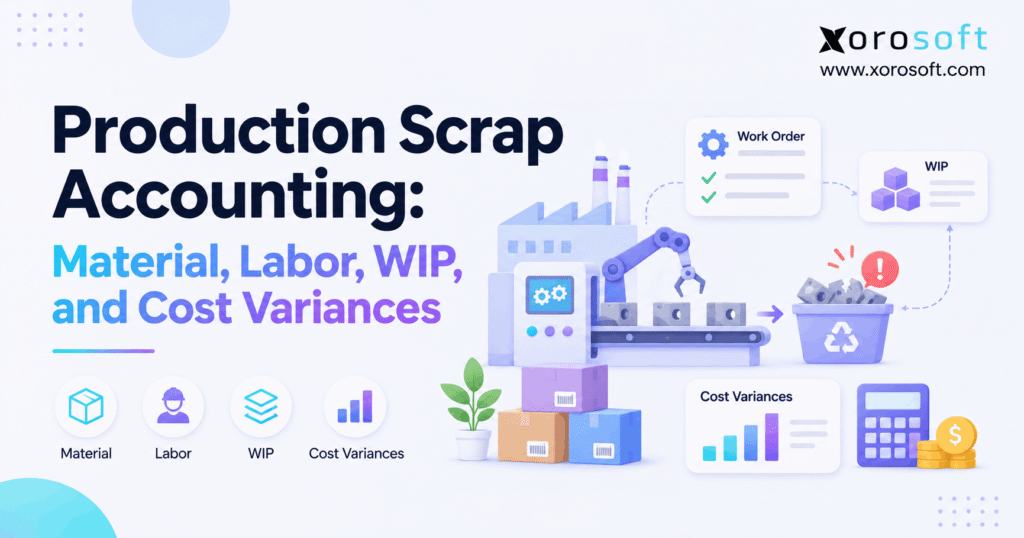
Manufacturing scrap cost accounting is an important consideration for companies looking to optimise their production processes.
1. Why a Rejected Unit Can Hide a Financial Loss
Manufacturing scrap cost accounting helps manufacturers measure, classify, and record the financial impact of rejected production across materials, labor, overhead, work-in-process inventory, and production variances. However, many businesses record rejected quantities without measuring the full value lost during manufacturing.
For example, a manufacturer may reject ten products containing $80 worth of materials. However, those products may also contain $40 in labor and $30 in manufacturing overhead. Consequently, the accumulated production cost reaches $150 before any recovery.
Furthermore, inaccurate production records can affect inventory valuation, product margins, and month-end financial reporting.
Therefore, manufacturers need an accounting process that connects physical production losses with their financial consequences.
1.1 What Is Manufacturing Scrap Cost Accounting?
Manufacturing scrap cost accounting is the process of measuring and recording the costs associated with rejected materials and manufacturing output. It includes direct material, labor, eligible production overhead, and recognized recovery value.
In addition, it determines whether production losses should form part of inventory costs or become current-period expenses.
For example, expected material losses during an efficient manufacturing process may qualify as production costs. In contrast, unusual losses caused by equipment failure may require separate expense recognition.
Therefore, accurate classification matters just as much as accurate valuation.
Ultimately, the goal is to ensure that production records, inventory balances, and financial statements reflect the same operational reality.
1.2 Why Quantity Alone Is Not Enough
A production report might show that a factory rejected 100 units during the month. However, this information does not explain how much money the business lost.
For instance, units rejected during material preparation may contain little or no labor. Meanwhile, units rejected after final assembly may contain almost their entire production cost.
Similarly, rejected materials may retain resale or reuse value.
Therefore, manufacturers should measure both physical quantities and accumulated financial costs. Otherwise, management may underestimate the financial impact of late-stage production failures.
Moreover, combining quantity and value records helps finance explain changes in manufacturing profitability.
2. Manufacturing Scrap Costs: What Goes Into Each Loss
Production losses consume resources that do not generate their intended output. Consequently, manufacturers must identify the resources already consumed before rejection.
Although materials often represent the most visible loss, labor and overhead can significantly increase the accumulated amount.
2.1 Material, Labor and Overhead in Scrap Cost Accounting
A complete costing process considers four financial components.
| Cost component | Description |
|---|---|
| Direct materials | Raw materials and components consumed before rejection |
| Direct labor | Production work already performed |
| Manufacturing overhead | Eligible indirect production costs |
| Recovery value | Recognized value of reusable or saleable material |
For example, direct material costs may include metal, fabric, electronic components, or packaging already used during production.
Meanwhile, direct labor includes the time employees spend cutting, assembling, processing, or inspecting products.
Furthermore, eligible manufacturing overhead may include factory utilities, machine depreciation, and indirect production labor.
However, manufacturers should exclude costs unrelated to the rejected output.
Similarly, finance should not include future production activities that never occurred.
Therefore, manufacturing scrap cost accounting requires reliable information about material consumption, production progress, and cost allocation.
2.2 The Stage of Rejection Changes the Amount
Consider a manufacturer that rejects ten units at two different production stages.
| Cost component | Early-stage rejection | Late-stage rejection |
|---|---|---|
| Direct materials | $80 | $80 |
| Direct labor | $0 | $40 |
| Manufacturing overhead | $0 | $30 |
| Total accumulated cost | $80 | $150 |
Although both events involve ten rejected units, the late-stage rejection carries $70 more accumulated cost.
Consequently, manufacturers can experience higher financial losses even when their physical rejection rates remain unchanged.
For example, quality problems discovered after packaging may affect more resources than defects identified during initial material inspection.
Therefore, production teams should record the operation where rejection occurs.
In addition, finance should use the corresponding cost information to measure the loss.
For further context, explore manufacturing scrap cost tracking by materials and work centers.
3. Normal and Abnormal Production Scrap Accounting
Not every manufacturing loss requires the same accounting treatment. Instead, finance must distinguish losses associated with normal production conditions from abnormal waste.
Consequently, manufacturers need clear policies that define acceptable process losses and explain how unusual events receive financial treatment.
3.1 When Good Output Absorbs Expected Losses
Normal scrap represents expected losses under normal manufacturing conditions.
For example, apparel manufacturers may generate fabric offcuts during cutting. Similarly, metal manufacturers may produce unavoidable remnants during machining.
Although these materials do not become finished products, eligible costs associated with normal production losses may form part of inventory costs.
Consider a manufacturing batch with $1,000 in qualifying production costs. However, five expected losses reduce the output from 100 units to 95 acceptable units.
Assuming no recovery value, the cost per acceptable unit becomes approximately $10.53.
Therefore, the remaining good units absorb the eligible cost of normal production losses.
However, businesses should establish reasonable loss allowances using actual process conditions rather than accepting historical inefficiencies.
3.2 When Waste Must Be Expensed
Abnormal scrap represents losses outside normal production conditions.
For example, a machine failure may destroy an entire batch. Alternatively, incorrect settings may cause unusually high material rejection.
Unlike eligible normal losses, abnormal production waste generally requires current-period expense recognition.
| Accounting factor | Normal scrap | Abnormal scrap |
|---|---|---|
| Production conditions | Expected | Unusual or excessive |
| Typical treatment | Eligible inventory costs | Current-period expense |
| Common cause | Inherent process loss | Unexpected production failure |
| Financial objective | Accurate cost allocation | Timely loss recognition |
| Management action | Monitor and improve | Investigate and correct |
According to IAS 2 Inventories, inventory costing excludes abnormal waste of materials, labor, and other production resources.
Similarly, US GAAP under ASC 330 requires appropriate expense recognition for abnormal production costs.
However, classification depends on the circumstances rather than a numerical threshold alone.
Therefore, manufacturing scrap cost accounting should combine documented loss policies with operational evidence.
4. How to Calculate Manufacturing Scrap Costs
Manufacturers need a consistent calculation method to measure production losses.
First, determine the costs accumulated before rejection. Next, assess whether the material retains recoverable value. Finally, classify the loss according to the applicable accounting policy.
4.1 Manufacturing Scrap Cost Accounting Formula
The following formulas provide a practical starting point.
Gross scrap cost = Direct materials + Direct labor + Allocated manufacturing overhead
Net scrap loss = Gross scrap cost − Recognized recovery value
For example, assume a manufacturer rejects eight units containing the following accumulated costs.
| Cost component | Amount per unit | Total |
|---|---|---|
| Direct materials | $8 | $64 |
| Direct labor | $4 | $32 |
| Manufacturing overhead | $3 | $24 |
| Gross accumulated cost | $15 | $120 |
| Recognized recovery value | $2 | $16 |
| Net scrap loss | $13 | $104 |
Suppose investigation determines that five rejected units represent normal losses. Meanwhile, the remaining three qualify as abnormal waste.
Consequently, the net normal loss equals $65, while the net abnormal loss equals $39.
However, these amounts do not automatically receive identical financial treatment. Instead, finance applies the appropriate inventory and expense policies.
4.2 Measure Physical Yield Separately
Physical rejection rates and financial losses measure different aspects of manufacturing performance.
Scrap rate = Rejected quantity ÷ Total input quantity × 100
For example, eight rejected units from 200 input units produce a 4% scrap rate.
However, a 4% rejection rate does not necessarily mean the business loses 4% of its production costs.
For instance, rejected units may contain different amounts of labor and overhead. Similarly, some rejected materials may retain recovery value.
Therefore, manufacturers should monitor both production yield and accumulated financial losses.
Furthermore, these measures should use consistent production boundaries and units of measurement.
Free ERP Readiness Assessment: Review whether your current systems connect rejected quantities, production costs, inventory movements, and accounting records. Consequently, you can identify gaps before investing in new manufacturing software.
5. Manufacturing Scrap Cost Accounting Journal Entries
The correct journal entry depends on the loss classification, production stage, existing inventory records, and potential recovery.
Therefore, manufacturers should understand which transactions have already affected the general ledger before recording additional adjustments.
The following journal entries provide illustrative accounting examples.
5.1 Normal Scrap Accounting and Batch Completion
Normal production losses may remain within the eligible manufacturing cost pool.
For example, assume a batch contains $1,000 in qualifying costs and produces 95 acceptable units after five normal losses.
Consequently, the total eligible cost transfers to finished goods when production is complete.
| Account | Debit | Credit |
|---|---|---|
| Finished goods inventory | $1,000 | — |
| Work-in-process inventory | — | $1,000 |
However, this example assumes the entire batch has reached completion and no recoverable scrap requires separate recognition.
Similarly, a partially completed batch may require cost allocation between finished goods and remaining WIP.
Therefore, normal losses do not always require a separate scrap expense entry.
Instead, finance should ensure that the allocation method reflects actual production conditions.
5.2 Abnormal Scrap Accounting and Recovery
Assume three rejected units contain $45 in accumulated production costs. Furthermore, finance determines that the loss is abnormal and the material has no recoverable value.
| Account | Debit | Credit |
|---|---|---|
| Abnormal scrap expense | $45 | — |
| Work-in-process inventory | — | $45 |
Alternatively, suppose the rejected material qualifies for separate inventory recognition at $10.
| Account | Debit | Credit |
|---|---|---|
| Recoverable scrap inventory | $10 | — |
| Abnormal scrap expense | $35 | — |
| Work-in-process inventory | — | $45 |
As a result, the manufacturer removes $45 from WIP and recognizes a net abnormal loss of $35.
However, these entries assume that no previous production transaction has already recorded the adjustment.
Therefore, finance should verify existing postings before entering additional journal entries.
Otherwise, duplicate entries may overstate expenses. Similarly, unposted production scrap may overstate inventory and delay expense recognition.
6. How Scrap Cost Accounting Changes WIP
Work-in-process inventory represents accumulated costs associated with unfinished production.
However, rejected units may no longer provide the economic benefits that justify retaining their costs within inventory.
Consequently, finance must determine which amounts remain in WIP and which require transfer or expense recognition.
6.1 Follow Value from Raw Materials to Finished Goods
Production accounting begins when a manufacturer issues raw materials to a work order.
Next, labor and eligible manufacturing overhead increase the WIP balance as production progresses.
After production finishes, the qualifying costs move into finished goods inventory.
However, a rejection event can change this normal cost flow.
For example, abnormal scrap may require removal of accumulated costs from WIP. Meanwhile, eligible normal losses may remain within the production cost pool.
Furthermore, recognized recoverable materials may transfer to a separate inventory account.
Therefore, manufacturing scrap cost accounting connects each operational event with the appropriate financial movement.
Without this connection, the manufacturer may retain costs associated with products that no longer exist.
6.2 Reconcile the Closing Balance
A WIP reconciliation helps finance verify whether the remaining inventory value agrees with manufacturing activity.
Consider the following example.
| WIP movement | Amount |
|---|---|
| Opening WIP inventory | $8,000 |
| Materials consumed | $15,000 |
| Direct labor added | $6,000 |
| Eligible overhead added | $4,000 |
| Finished goods transfers | ($27,000) |
| Abnormal scrap expense | ($1,200) |
| Recoverable inventory transfer | ($300) |
| Closing WIP inventory | $4,500 |
Therefore, production records should support the remaining $4,500 balance.
However, if the general ledger shows a different amount, finance must investigate missing or incorrect transactions.
For example, a work order may contain incomplete material issues or delayed production adjustments.
Similarly, a recovery transfer may appear in inventory records without the corresponding financial movement.
Xorosoft connects production costing, WIP tracking, and inventory records within its manufacturing platform. Consequently, teams have a shared foundation for investigating these differences.
For additional guidance, explore work-in-process inventory accounting.
7. Manufacturing Scrap Costs and Production Variances
Manufacturing variances explain differences between expected and actual production costs.
However, production losses do not always appear in a dedicated scrap variance account. Instead, they may contribute to material, labor, and overhead differences.
Therefore, finance should investigate the underlying cause without counting the same loss twice.
7.1 Material and Labor Efficiency
Material usage variance measures the difference between actual consumption and the standard quantity allowed for actual output.
Material usage variance = (Actual quantity − Standard quantity allowed) × Standard price
For example, a manufacturing order allows 200 kilograms of material but consumes 208 kilograms at a standard price of $5.
Consequently, the unfavorable material usage variance equals $40.
Similarly, labor efficiency variance measures differences between actual hours and standard hours allowed.
Labor efficiency variance = (Actual hours − Standard hours allowed) × Standard labor rate
Suppose production requires 103 hours instead of the approved 100 hours. At a standard rate of $25 per hour, the unfavorable labor efficiency variance equals $75.
However, scrap may explain only part of these differences.
For example, downtime, training, material quality, or inaccurate production standards may also affect the results.
Therefore, finance should use operational records to investigate each variance.
7.2 Overhead Absorption and Duplicate Charges
Manufacturing overhead variances may arise from spending differences, inefficient resource use, or changes in production capacity.
For example, rejected units may consume machine hours without increasing acceptable output.
Consequently, the manufacturer may experience unfavorable overhead efficiency differences.
Consider this illustrative cost reconciliation.
| Cost category | Amount |
|---|---|
| Standard production cost | $1,500 |
| Material usage variance | $40 unfavorable |
| Labor efficiency variance | $75 unfavorable |
| Overhead variance | $35 unfavorable |
| Actual production cost | $1,650 |
| Total unfavorable variance | $150 |
Suppose investigation identifies $45 in scrap-related costs already included within these variance categories.
Therefore, the total unfavorable variance remains $150 rather than $195.
However, separate financial adjustments may still be necessary if abnormal costs remain within inventory.
Accordingly, manufacturing scrap cost accounting must distinguish root-cause reporting from general ledger postings.
For further analysis, review manufacturing cost variance benchmarks.
8. Scrap Cost Accounting Under Standard and Actual Costing
Manufacturers use different costing methods to measure production performance and value inventory.
Although standard costing establishes expected costs, actual costing focuses on eligible resources consumed during production.
Nevertheless, both methods require appropriate treatment of abnormal production losses.
8.1 Expected Usage and Approved Rates
Standard costing establishes expected material quantities, labor hours, and manufacturing overhead rates before production begins.
Furthermore, the approved baseline may include reasonable allowances for normal production losses.
For example, a manufacturing process may require 105 kilograms of raw material to produce 100 kilograms of acceptable output.
Consequently, the additional five kilograms form part of the expected consumption baseline.
However, if actual consumption reaches 115 kilograms for the same acceptable output, finance must investigate the difference.
Therefore, production standards need regular reviews to ensure they reflect current manufacturing conditions.
In addition, manufacturers should verify that obsolete scrap allowances do not conceal declining production efficiency.
Otherwise, favorable variance reports may hide persistent operational waste.
8.2 Actual Consumption and Period-End Review
Actual costing uses eligible costs incurred during manufacturing.
Consequently, accurate material issues, production time records, and overhead allocation become essential.
However, actual costing does not mean that every production expense qualifies for inventory capitalization.
| Evaluation factor | Standard costing | Actual costing |
|---|---|---|
| Cost foundation | Approved expected costs | Actual eligible costs |
| Primary analysis | Variance against standards | Accumulated resource consumption |
| Normal losses | Reflected through appropriate standards | Allocated within eligible production costs |
| Abnormal losses | Require appropriate expense treatment | Require appropriate expense treatment |
| Common challenge | Outdated production standards | Incomplete transaction records |
Therefore, manufacturing scrap cost accounting requires consistent policies regardless of the selected costing method.
Furthermore, finance should confirm that period-end settlements do not transfer abnormal production waste into acceptable finished goods.
9. Recover, Rework or Dispose?
Rejected production does not always represent a complete financial loss.
For example, metal remnants may retain resale value, while certain defective products may qualify for rework.
Therefore, manufacturers must establish the appropriate physical and financial disposition before closing the related work order.
9.1 Recoverable Scrap Accounting and Sales
Recoverable scrap represents rejected material that retains measurable economic value.
However, recognition depends on the nature of the material and the applicable accounting policy.
For example, suppose a manufacturer recognizes recovered metal inventory at $10 and later sells it for $12.
The business may record the sale and derecognition as follows.
| Account | Debit | Credit |
|---|---|---|
| Cash or accounts receivable | $12 | — |
| Scrap sales income | — | $12 |
| Scrap material cost | $10 | — |
| Recoverable scrap inventory | — | $10 |
Consequently, the difference between proceeds and carrying value equals $2.
However, the precise accounts and presentation depend on the company’s policy and the nature of the transaction.
Therefore, finance should avoid recognizing the same recovery benefit more than once.
9.2 Approvals for Rework and Disposal
Rework involves additional processing to restore defective output to an acceptable condition.
For example, a furniture manufacturer may repaint a damaged surface instead of rejecting the entire product.
Although rework can preserve some production value, it also consumes additional labor, materials, and machine capacity.
Consequently, manufacturers should assess whether recovery remains economically reasonable.
In contrast, unusable materials may require controlled disposal.
Therefore, production teams should document the quantity, reason, approval, and disposal date.
Furthermore, finance should remove any remaining inventory value that no longer qualifies for recognition.
For regulated products, such as food and beverages, disposal must also follow applicable safety and compliance requirements.
10. Manufacturing Scrap Cost Accounting at Month-End
Month-end reconciliation ensures that production records and financial statements reflect the same manufacturing activity.
However, missing transactions can leave rejected units within inventory or create unexplained production variances.
Therefore, finance should establish a formal reconciliation process before closing the accounting period.
10.1 A Seven-Step Reconciliation Checklist
The following checklist helps manufacturers review their production loss records.
| Step | Required control |
|---|---|
| 1 | Reconcile input, acceptable output, rejected quantities, and unfinished production |
| 2 | Verify material issues and returns |
| 3 | Review labor and overhead allocations |
| 4 | Classify normal and abnormal production losses |
| 5 | Review recognized recovery values and disposal records |
| 6 | Reconcile WIP and finished goods movements |
| 7 | Investigate general ledger and production variance differences |
First, production teams should confirm physical quantities. Next, finance should verify the accumulated costs associated with each rejection.
Furthermore, teams should compare manufacturing order records with inventory movements and financial postings.
Finally, controllers should investigate unresolved differences before completing the financial close.
Consequently, the business can reduce the risk of carrying unsupported inventory balances into the next reporting period.
10.2 Assign Clear Ownership and Prevent Errors
Accurate manufacturing scrap cost accounting requires coordination between several departments.
For example, production supervisors should confirm rejected quantities and causes. Meanwhile, quality teams should determine whether materials require recovery, rework, or disposal.
Similarly, inventory teams should maintain accurate quantity records.
Finance, however, remains responsible for valuation, account classification, and reconciliation.
Common accounting errors include:
- Applying full finished goods costs to partially completed scrap.
- Including abnormal production waste within good inventory.
- Ignoring eligible recovery value.
- Recording losses in the wrong reporting period.
- Posting duplicate expenses after production settlement.
Therefore, manufacturers should define approval procedures and establish clear ownership for every adjustment.
Xorosoft’s connected manufacturing and accounting environment supports access to related production and financial records. However, reliable controls and approved policies remain essential.
11. Production Scrap Accounting Across Industries
Different manufacturing industries experience different production losses.
However, the underlying accounting principles remain consistent: identify consumed resources, assess recovery, classify losses, and reconcile financial records.
Therefore, businesses should adapt their controls to the nature of their production processes.
11.1 Apparel, Furniture and Sporting Goods
Apparel manufacturers frequently generate fabric offcuts during cutting.
However, rejected finished garments may contain sewing, finishing, labeling, and packaging costs in addition to fabric.
Similarly, furniture manufacturers may reject damaged wood during preparation or discover structural defects after assembly.
Consequently, late-stage rejection can involve additional labor and overhead.
Sporting goods manufacturers face comparable issues when molded components or assembled products fail inspection.
For example, a defective component identified before assembly may represent a smaller financial loss than a completed product rejected during testing.
Therefore, manufacturers across these industries should capture rejection details at the relevant production stage.
Furthermore, accurate production records help finance distinguish material losses from accumulated conversion costs.
11.2 Food, Beverage and Industrial Components
Food and beverage manufacturing often involves process yield losses, rejected batches, and packaging defects.
For example, a normal filling loss differs from an unexpected contamination event.
Moreover, safety requirements may prevent the recovery or resale of rejected food products.
Consequently, batch traceability and approved disposition records become particularly important.
Industrial manufacturers face different challenges, including machining remnants, component defects, and failed quality inspections.
Although metal remnants may retain resale value, labor and machine costs can increase the overall production loss.
Therefore, manufacturing scrap cost accounting should reflect both the production method and the economic value of rejected output.
In addition, businesses should adopt controls suited to their specific manufacturing and industry requirements.
12. How ERP Supports Manufacturing Scrap Cost Accounting
Disconnected manufacturing software often separates production quantities from financial records.
Consequently, teams may need several spreadsheets and manual calculations to explain rejected output, WIP balances, and production variances.
An integrated ERP approach can provide a more consistent foundation.
12.1 Connect Work Orders, Inventory and Finance
Xorosoft provides a connected manufacturing environment that brings production, inventory, purchasing, and accounting together.
For example, its manufacturing and production software supports bills of materials, work orders, production scheduling, labor tracking, and production costing.
Furthermore, shared operational records help teams compare planned consumption with actual manufacturing activity.
However, accurate financial treatment still depends on configured posting rules and approved accounting policies.
| Operational requirement | Manual records | Connected ERP approach |
|---|---|---|
| Material consumption | Spreadsheet tracking | Linked inventory records |
| Production orders | Separate documents | Shared work order records |
| Labor tracking | Manual timesheets | Connected production time records |
| WIP visibility | Periodic calculations | Manufacturing inventory records |
| Variance analysis | Manual calculations | Configured reporting |
| Financial reconciliation | Multiple data sources | Connected accounting environment |
In addition, XoroWMS supports warehouse inventory management and stock visibility.
Consequently, manufacturers can establish more consistent links between physical stock movements and manufacturing activity.
12.2 When to Upgrade and What to Test
A small manufacturer with simple products and low transaction volumes may manage effectively with controlled manual records.
However, growing manufacturers often face more complex work orders, multiple inventory locations, and greater financial reporting demands.
Therefore, businesses should consider integrated ERP when disconnected records repeatedly create unexplained variances, delayed reporting, or unreliable inventory values.
Xorosoft’s XoroONE platform combines manufacturing, inventory, purchasing, warehousing, and financial management.
Before selecting software, however, manufacturers should validate their specific workflows.
For example, request a demonstration involving a partially completed work order, abnormal production losses, recoverable material, and the resulting inventory adjustments.
Furthermore, examine the account mapping, cost calculations, and reconciliation reports.
Watch Demo: During your ERP evaluation, request a production costing walkthrough that follows rejected output from the manufacturing floor through inventory and financial reporting.
13. Conclusion: Make Manufacturing Scrap Costs Visible
Manufacturing scrap cost accounting connects physical production losses with their complete financial impact.
However, recording rejected quantities alone does not provide enough information to maintain accurate inventory values or explain manufacturing profitability.
Instead, manufacturers must identify accumulated material, labor, and overhead costs. Furthermore, they must classify normal and abnormal losses, assess recovery value, and reconcile WIP and production variances.
Consequently, reliable accounting controls help finance understand where manufacturing value disappears.
Xorosoft brings manufacturing, inventory, purchasing, warehouse management, and accounting into a connected ERP environment. Therefore, growing manufacturers can evaluate how integrated workflows may improve production cost visibility and financial control.
Book a Demo to explore manufacturing and accounting workflows tailored to your operational requirements.
Frequently Asked Questions
What is manufacturing scrap cost accounting?
Manufacturing scrap cost accounting measures rejected production costs, including materials, labor, and overhead. Furthermore, it classifies losses correctly to support accurate inventory valuation, expense recognition, and financial reporting.
How do you calculate manufacturing scrap costs?
Add direct material, labor, and eligible overhead incurred before rejection. Next, subtract any recognized recovery value. Consequently, the result represents the net accumulated cost associated with rejected production.
What is the journal entry for abnormal scrap?
Generally, debit abnormal scrap expense and credit work-in-process inventory when the loss already exists in WIP. However, adjust the entry for recognized recovery value and any previous postings.
Is production scrap an expense or inventory cost?
Normal production losses may qualify as inventory costs. In contrast, abnormal production waste generally requires current-period expense recognition. Therefore, the classification determines the appropriate accounting treatment.
How does production scrap affect WIP inventory?
Abnormal losses may require removal of accumulated costs from WIP. Meanwhile, eligible normal losses may remain within production costs. Consequently, proper reconciliation prevents unsupported inventory balances.
How does scrap affect manufacturing cost variances?
Scrap may increase material consumption, labor hours, and overhead differences. However, manufacturers should avoid adding separate scrap charges when existing variance categories already include those costs.
How can ERP improve manufacturing scrap cost accounting?
ERP connects work orders, material consumption, production costing, inventory, and accounting records. Therefore, manufacturers can investigate production losses more consistently while maintaining appropriate financial controls and reconciliation procedures.
Recent Posts
-
 How to Set Min-Max Replenishment Levels for Forward Pick Locations
-
 Shopify Product-Identifier Benchmarks 2026: Match Rates, Failures, and Manual Review
-
 Vendor-Managed Inventory vs Traditional Replenishment for Wholesale Distribution
-
 ERP Renewal Planning for Multi-Warehouse Distributors
-
 Production Scrap Accounting: Material, Labor, WIP, and Cost Variances