1. When Factory Waste Stays on the Books
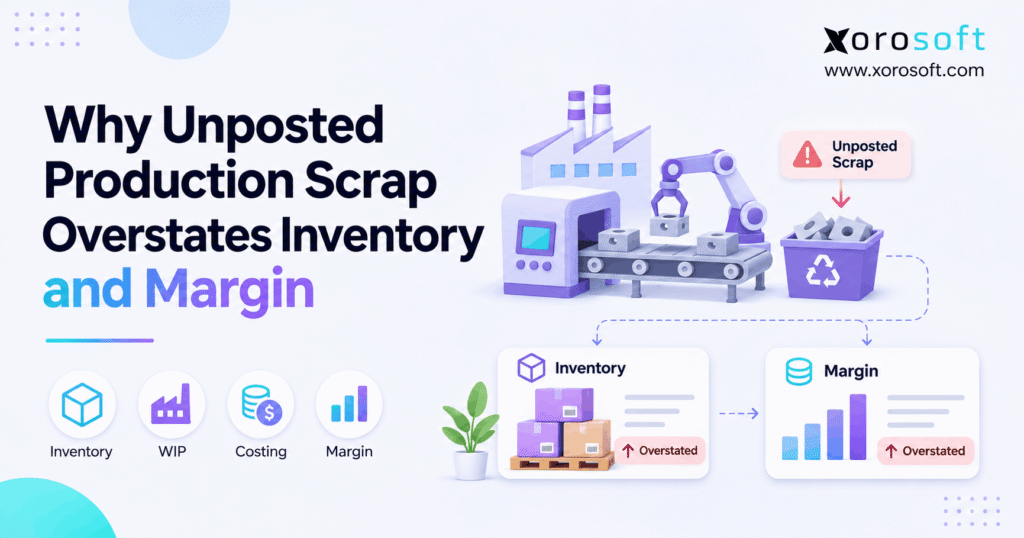
Production scrap accounting connects rejected materials on the shop floor with inventory quantities, manufacturing costs, and the general ledger. However, a production supervisor can identify waste while the accounting system still carries the related quantities or costs. As a result, a company may report inventory it cannot use and profit that it has not truly earned.
For example, a work order may consume components for 100 units but produce only 90 acceptable units. The supervisor records ten rejected units on a shift sheet. Meanwhile, finance sees a completed manufacturing order without the corresponding scrap transaction. Therefore, the operational record and financial record tell different stories.
The difference matters because scrap does not always create the same accounting entry. Normal process loss may increase the cost of good output, whereas abnormal waste may require a current-period expense. Consequently, the correct response starts with classification, not an automatic inventory write-off.
1.1 What Unposted Production Scrap Means
Unposted production scrap refers to damaged, rejected, or unusable manufacturing material whose required quantity or cost transaction has not reached the relevant system or ledger. For example, an inspection record may show twelve rejected parts, yet the production order may still show its planned yield. Similarly, an inventory adjustment may correct quantities without transferring the associated cost to the right account.
Not every pending transaction signals an error. Some costing methods settle production costs when an order closes. However, if a necessary entry remains missing at the financial cutoff, the omission can distort financial statements.
1.2 Why Small Posting Delays Become Financial Errors
One skipped transaction may look immaterial. Nevertheless, multiple small omissions across shifts can accumulate into a material balance. In addition, late records weaken yield analysis because managers compare current production output against incomplete consumption data.
For that reason, accounting teams should track both the time of the physical loss and the time of financial posting. The two timestamps help distinguish normal processing time from missed work. Moreover, they establish whether a correction belongs in the current period or requires further review. That timing makes production scrap accounting an early-warning control, not only a close task.
1.3 Where Scrap Accounting Starts
The process begins when a worker notices a loss, not when an accountant prepares a journal. First, the worker identifies the rejected item and production order. Next, the supervisor verifies the quantity and the quality team determines whether rework or recovery remains possible. Then, the costing process assigns the loss to the appropriate destination.
As a result, production scrap accounting needs a shared definition of what counts as scrap, who may approve it, and when the team must post it. Without these basics, even a sophisticated ERP can carry inaccurate input data.
2. How Production Scrap Accounting Changes Inventory Value
Inventory valuation follows the movement of costs through raw materials, work in process (WIP), and finished goods. However, when scrap transactions go missing, the system may preserve quantities or costs that no longer represent saleable output. Therefore, a controller needs to trace the loss through the actual production stage before calculating its financial effect.
2.1 Track Material from Raw Stock into WIP
A manufacturer initially holds purchased components as raw material inventory. Once production consumes them, the system typically transfers their cost into WIP. After workers complete the product, the business moves eligible costs into finished goods. Consequently, the same rejected component can affect different accounts depending on when the defect occurs.
For example, a spoiled input found before production may call for a raw-material adjustment. By contrast, a damaged assembly after labor and overhead have accumulated may require a more comprehensive cost review. In both situations, finance must link the correction to the original inventory movement.
2.2 When Production Scrap Overstates WIP
Suppose a manufacturing order carries $2,000 of eligible cost plus $250 from an abnormal loss that finance should expense. If the team leaves the $250 in WIP, reported WIP exceeds the correct amount by $250. Moreover, the period may omit the related expense. Therefore, both inventory valuation and profit can be wrong.
However, normal scrap creates a different question. If the $250 represents expected process loss, the business may include eligible costs in the remaining good units. Consequently, missing a scrap quantity does not prove that total inventory value is overstated. It may instead distort yield and cost per unit.
2.3 Why Finished-Goods Quantities Can Be Wrong
Inventory errors also arise when the manufacturing order reports 100 completed units although only 90 pass inspection. In that case, the warehouse may offer ten nonexistent units for allocation. As a result, customer promises, replenishment decisions, and future production schedules rely on false availability.
In addition, the wrong unit count can hide a costing problem. If the system divides $3,000 across 100 units rather than 90, it reports $30 per unit instead of $33.33 for a normal-loss scenario. Therefore, the total recorded asset may appear reasonable while individual costs remain inaccurate. Production scrap accounting should reconcile accepted quantities before finance updates unit costs.
3. Normal and Abnormal Manufacturing Waste Need Different Entries
The most important accounting decision is whether scrap reflects an expected part of efficient production or an abnormal failure. Under IAS 2 Inventories, companies exclude abnormal wasted materials, labor, and other production costs from inventory cost. Likewise, the FASB’s historical Statement No. 151 describes current-period recognition for abnormal manufacturing costs under U.S. accounting guidance.
However, managers must apply the current standards and their own accounting policies to the specific facts. Therefore, the production team should never treat every rejected unit as the same financial event.
3.1 Normal Production Scrap and Cost Absorption
Normal scrap arises from expected process loss, such as routine trimming or an established yield allowance. Consequently, eligible production costs may flow into the good output rather than a separate period expense. A factory that spends $3,000 to produce 90 acceptable units may therefore carry an average eligible cost of about $33.33 per unit.
Still, the company should test whether its normal loss assumption remains realistic. For example, a ten-percent loss rate may reflect normal material use in one process but indicate a serious problem in another. In addition, excessive losses should not become normal merely because they occur repeatedly.
3.2 Abnormal Production Scrap and Period Expense
Abnormal losses arise from unusual or excessive failure, such as a major machine setup error, unexpected contamination, or avoidable destruction. Therefore, the relevant accounting guidance generally excludes their cost from inventory. Instead, finance recognizes the appropriate period expense, subject to its reporting policy.
For example, if a $300 abnormal loss remains in WIP, the company may overstate the asset and understate expense by $300. However, the location of that expense on the income statement determines whether the error changes gross margin, operating margin, or both. The distinction matters during executive reviews.
3.3 Standard Cost and Actual Cost Behave Differently
Standard costing compares expected material usage, output, labor, and overhead against actual performance. Therefore, excess scrap can create yield or usage variances that controllers must explain. By contrast, actual costing follows accumulated eligible costs, although abnormal waste still requires separate treatment.
In addition, teams should distinguish scrap from material price changes, labor inefficiency, and volume-related overhead adjustments. Otherwise, an unexplained variance can mask multiple operational causes. The final posting should follow the organization’s cost method and approved chart of accounts. This separation makes production scrap accounting easier to audit during period-end review.
| Type of loss | Quantity treatment | Cost treatment | Main risk if omitted |
|---|---|---|---|
| Expected process loss | Reduce acceptable yield | Allocate eligible cost to good units | Incorrect yield or unit cost |
| Abnormal production failure | Record actual rejected output | Recognize appropriate period expense | Inflated inventory and understated expense |
| Recoverable material | Track quantity and disposition | Assess salvage under policy | Double-counting or unsupported value |
| Reworkable output | Retain distinct rework status | Evaluate incremental recoverable cost | Misclassified output and costs |
4. How Unposted Production Scrap Can Distort Margin
A numerical example makes the financial risk clearer. Assume a work order consumes $3,000 of production cost while attempting 100 units. The factory produces 90 good units and rejects ten. For simplicity, assume each attempted unit carries $30 of comparable cost and the rejected output has no salvage value.
However, the resulting accounting entries depend on the type of loss. Therefore, finance should calculate both plausible scenarios before interpreting a margin dashboard.
4.1 Abnormal Production Scrap Left in WIP
If the ten rejected units represent abnormal waste, their allocated cost equals $300. The simplified correct outcome leaves $2,700 in eligible inventory and recognizes $300 as a current-period loss. However, if the company fails to post that adjustment, WIP may remain at $3,000. Consequently, the balance sheet overstates inventory by $300 and the expense is understated by the same amount.
The simplified entry, when the abnormal cost still sits in WIP, is Debit: Abnormal Scrap Expense $300; Credit: WIP Inventory $300. However, finance must credit the actual account that currently contains the cost. If the system already transferred the amount to finished goods, the correction route will differ.
4.2 Normal Loss Allocated to Good Output
If the ten rejected units represent normal process loss, the $3,000 of eligible cost may belong to the 90 acceptable units. Therefore, average unit cost becomes about $33.33, before any other adjustments. The company does not automatically record a separate $300 abnormal-loss expense.
Nevertheless, an omitted quantity posting can still create serious reporting problems. For example, a system that shows 100 good units may report $30 per unit. As a result, the business can misprice products, allocate nonexistent stock, and distort future cost calculations even when total eligible inventory value remains $3,000.
| Metric | Abnormal loss posted correctly | Abnormal loss not posted | Normal loss accounted for |
|---|---|---|---|
| Accepted units | 90 | 90 physically | 90 |
| Inventory cost from this run | $2,700 | $3,000 | $3,000 |
| Abnormal period expense | $300 | $0 | $0 |
| Average eligible cost per good unit | $30.00 | Requires correction | About $33.33 |
Illustrative amounts only. Actual postings depend on accumulated costs, timing, salvage value, and the accounting policy.
4.3 Gross Margin and Operating Margin Are Not the Same
Gross margin measures gross profit relative to revenue, while operating margin reflects additional operating costs. Therefore, a missing scrap charge changes gross margin only when the applicable accounting presentation places that expense within cost of goods sold or otherwise affects the gross-profit calculation.
For example, when an abnormal charge belongs below gross profit, omitting it may overstate operating profit without inflating gross margin. In addition, when the goods remain unsold, wrong inventory values can defer expenses until a later period. Consequently, production scrap accounting should explain the exact account impact instead of promising a universal margin effect.
Free ERP Readiness Assessment: Check whether your team can trace one rejected batch from the operator’s log to the inventory movement and the resulting account balance. If any step requires manual detective work, document the gap before your next financial close.
5. Build a Reliable Production Scrap Posting Workflow
Accurate records depend on a repeatable sequence that connects production, quality, inventory, and finance. Therefore, manufacturers should design the workflow around the physical event first and the accounting entry second. The objective is not to create more approvals. Instead, it is to prevent a rejected quantity from disappearing between departments.
5.1 Capture the Physical Loss at the Source
First, record the work order, item, quantity, unit of measure, location, operation, timestamp, and operator. Next, capture the defect reason and relevant lot or batch. For example, a clothing manufacturer may distinguish fabric cutting loss from stitching damage. As a result, later analysis can separate normal yield from preventable quality problems.
In addition, supervisors should review the event while evidence remains available. A scrap bin or shift note alone does not identify the cost destination. Therefore, the transaction must reference the production order and the point where the loss occurred.
5.2 Classify Production Scrap Before Posting Cost
Next, the team decides whether the material is scrap, reworkable stock, recoverable material, or a quality hold. Then, accounting determines whether the cost represents normal or abnormal loss. For example, a damaged part may still supply usable components after disassembly. By contrast, contaminated food ingredients may require complete disposal.
Because these outcomes affect valuation, operators should not guess the accounting treatment. Instead, clear policies should guide supervisors and cost accountants through common scenarios. Consequently, inventory adjustments follow a consistent logic, even across different shifts.
5.3 Post Production Scrap to the Correct Account
After approval, the system should move the correct quantity and cost through the relevant transaction. For an abnormal loss still inside WIP, finance may debit a scrap expense account and credit WIP. However, normal scrap may require cost allocation among the good units rather than an immediate expense. Therefore, the journal must follow the actual costing method.
Xorosoft’s XoroERP supports manufacturing orders and related inventory and accounting processes. Moreover, its published manufacturing-order documentation describes a Production Offset Qty field that affects final output and posts through a configured shrinkage/swell offset account. Teams should test how their configuration treats each loss type rather than assuming every adjustment posts identically.
5.4 Close Work Orders with an Audit Trail
Before closure, compare raw-material issues, returned components, rejected quantities, accepted output, and eligible production cost. Then, investigate material differences and confirm the final settlement. As a result, the work order closes with fewer unexplained balances.
Additionally, require an approval trail for late changes, reversals, and reopened orders. For example, a correction after goods have shipped may affect cost of goods sold rather than only inventory. Therefore, finance should review the downstream impact before approving the adjustment. Production scrap accounting works best when every correction retains its original event reference.
Watch Demo: Use an actual work order as your demonstration script. Ask the ERP team to show the rejected quantity, cost treatment, resulting journal, and reversal path from start to finish.
6. Production Scrap Accounting Controls for Month-End
Month-end reconciliation should confirm that physical losses reached the correct accounts before finance reports results. However, simply balancing one ledger against another is not enough when both depend on the same missing event. Therefore, teams need independent production evidence to validate the financial records.
6.1 Reconcile Shop-Floor Events with the Subledger
First, collect the production scrap log, quality reports, material issue records, and finished-goods receipts. Next, match each rejected quantity against a posted inventory movement. Then, compare the resulting WIP subledger to the general ledger. As a result, the controller can distinguish unresolved quantities from valuation differences.
In addition, review orders that show zero rejected output despite unusual consumption or poor yield. That pattern does not prove missing scrap, but it signals a useful investigation. Meanwhile, transactions awaiting approval should appear on a separate exception list rather than silently dropping from the reconciliation.
6.2 Investigate Unposted Scrap Before Close
A useful exception report flags unposted production scrap by order, item, date, facility, and estimated value. For example, the report might show a $420 rejected batch with no matching journal. The controller can then check whether the transaction awaits normal settlement, failed validation, or never entered the system.
Consequently, the closing team should document its resolution, not simply post an unexplained balancing amount. If the system already transferred the related cost, another adjustment could double-count the loss. Therefore, a final review must confirm both physical quantity and accounting impact.
6.3 Set Clear Roles for Approvals and Corrections
Production supervisors should confirm the physical quantity. Likewise, quality teams should decide whether material can return to service. Inventory control should verify the movement, while finance should approve valuation and account classification. As a result, the organization gains checks without forcing every employee to become an accountant.
Xorosoft combines manufacturing, inventory, and accounting workflows within a cloud ERP platform. However, software connectivity does not replace responsibility assignments. Therefore, configure and test the process around named owners, approved adjustments, and reliable financial cutoffs.
| Control | Accountable team | Frequency | Evidence |
|---|---|---|---|
| Physical scrap capture | Production | Each event | Work-order and reason-code record |
| Disposition decision | Quality / operations | Before disposal | Approval and status |
| Cost classification | Finance | Before posting or settlement | Account treatment |
| WIP reconciliation | Inventory accounting | Daily or close | Exception resolution |
| Ledger close review | Controller | Month-end | Approved reconciled balances |
7. How Scrap Mistakes Spread Across Teams
Although the problem starts in production, its effects often reach purchasing, fulfillment, planning, and finance. Therefore, the business should treat scrap accuracy as an end-to-end operating control rather than a narrow journal-entry task.
7.1 Purchasing: False Yield Distorts Reorder Needs
If planning assumes a 98% yield but actual production delivers only 90%, buyers may order too little material. Consequently, the factory faces shortages even when purchasing follows the system’s recommendation. However, overstated scrap can cause the opposite problem: unnecessary replenishment and excess working capital.
For that reason, purchasing teams need approved production-yield data, not estimates copied from outdated spreadsheets. Moreover, they should separate supplier defects from internal processing losses. Each cause requires a different corrective action.
7.2 Warehouse: Production Scrap Creates Phantom Stock
A warehouse may receive instructions to store or allocate units that never passed inspection. As a result, available inventory becomes unreliable and customer orders face avoidable delays. In a multi-warehouse operation, inconsistent location and status updates can spread the error further.
For example, an assembly site may show 200 completed kits while only 188 meet quality requirements. Therefore, the warehouse should verify the accepted quantity before making stock available. An integrated warehouse management system can support connected operations, but staff still need clear receiving and quarantine rules.
7.3 Scrap Accounting Errors Slow the Close
Finance often discovers the problem after production teams move on to new orders. Consequently, controllers spend additional time comparing old worksheets, inventory adjustments, and general-ledger entries. Meanwhile, leadership receives margin reports that require later explanation or correction.
Instead, a consistent daily exception process reduces the volume of unresolved issues that reach month-end. In addition, finance can review trends by facility and reason code without confusing scrap, shrinkage, and supplier returns. That distinction improves both control and operational decision-making. Production scrap accounting should tie each exception to a specific work order.
8. Industry Examples of Production Scrap Accounting
Manufacturing losses look different across industries. Nevertheless, every company needs to connect usable output, expected yield, and financial cost. The following examples illustrate common control issues; they do not represent customer results.
8.1 Apparel: Fabric Yield and Defective Panels
An apparel manufacturer may issue fabric for 1,000 panels and receive only 965 usable pieces. First, the supervisor should separate expected cutting waste from damaged panels caused by an incorrect pattern. Next, the costing team should confirm how each loss affects the bill of materials and finished-goods valuation.
As a result, purchasing receives better material requirements and finance receives a defensible cost per accepted unit. Without this distinction, management may blame the supplier for a problem that originates in production setup.
8.2 Furniture and Sporting Goods: Assembly Waste
Furniture manufacturers may reject damaged boards after cutting, while sporting-goods producers may discard components during assembly or testing. Consequently, the stage of loss matters because labor and overhead may already sit in WIP. A simple material-only adjustment may therefore fail to remove or reallocate the appropriate cost.
In addition, bulky products can move between workshops and warehouses before final inspection. The team should keep the production order, location, and disposition together so warehouse staff do not treat failed output as saleable inventory.
8.3 Food Processing Scrap Versus Warehouse Damage
Food processors regularly deal with yield loss, short shelf life, and quality holds. Therefore, they should distinguish normal process loss from unexpected contamination or spoilage. Meanwhile, distributors need separate codes for broken, expired, or damaged finished goods that never entered manufacturing.
Xorosoft serves inventory-driven sectors such as apparel, furniture, food, and wholesale. However, a manufacturing scrap transaction and a warehouse damage adjustment can require different account mapping. Therefore, each operation should test its relevant workflows separately instead of relying on a single generic write-off category.
9. Manual Logs vs Integrated Scrap Accounting
Not every business needs a complex system to control production waste. In fact, a small manufacturer can maintain accurate records with signed shift reports, approved spreadsheets, and timely journal entries. However, rising transaction volume makes manual handoffs harder to reconcile. Therefore, the decision to upgrade should follow the actual control risk.
9.1 When a Spreadsheet Is Still Enough
A spreadsheet can work when one facility has simple production, modest scrap volume, and a single accounting owner. Nevertheless, the company should protect formulas, track versions, and require a sign-off for each adjustment. In addition, finance should compare the log to the WIP subledger before closing the period.
If those controls work consistently, new software may not justify its cost. However, recurring missing entries or repeated reconstruction of old transactions indicate that the process is struggling. At that point, calculate the time and risk involved before evaluating an integrated platform. For this reason, production scrap accounting can remain manual until control demands justify an upgrade.
9.2 When Production Scrap Needs Integrated ERP Controls
Several facilities, frequent work orders, and varied costing methods increase the number of possible errors. Moreover, disconnected shop-floor, warehouse, and accounting tools often require duplicate entry. Consequently, a rejected quantity can disappear in one application while its cost remains in another.
Xorosoft’s XoroONE platform brings inventory, purchasing, manufacturing, and finance workflows together. Therefore, it may be relevant for manufacturers evaluating a more connected operating model. However, decision-makers should still test the actual cost entries, approval paths, and exception handling against their own process requirements.
9.3 What to Test in a Manufacturing ERP Demo
First, create a manufacturing order with 100 intended units and ten rejected units. Next, run one scenario for normal loss and another for abnormal loss. Then, inspect the resulting quantities, cost allocation, and general-ledger entries. Finally, reopen or correct an order and verify the audit trail.
In addition, ask whether integrations change the production source of truth. For example, commerce and operational integrations may connect orders and inventory across channels, but Shopify or Amazon transactions do not themselves prove correct scrap accounting. A credible demonstration should show the manufacturing-to-finance flow in detail.
| Workflow | Best suited to | Typical weakness | Improvement priority |
|---|---|---|---|
| Xorosoft integrated cloud ERP | Multi-site or higher-volume processes | Configuration and master-data errors | End-to-end posting tests and approvals |
| Signed paper log and spreadsheet | Simple, low-volume production | Manual entry and weak audit trail | Daily sign-off and reconciliation |
| Separate production and accounting tools | Growing but manageable operation | Delayed transfers and duplicate records | Interface checks and exception ownership |
10. Production Scrap Reporting Metrics That Matter
Good reporting should answer whether scrap events occur, why they happen, and whether the system records them on time. Therefore, management should monitor a few trustworthy measures instead of collecting dashboards that cannot tie back to physical events.
10.1 Measure Production Scrap Cost and Posting Delay
Start with scrap rate = scrapped units / total units processed × 100. Next, calculate the applicable cost of each event using its production stage and costing policy. In addition, measure posting delay = approved transaction time minus physical event time. These metrics answer different questions: production quality, financial exposure, and transaction discipline.
For example, a stable scrap rate with increasing posting delay signals a process-control problem rather than necessarily a deterioration in production. Likewise, falling scrap cost could reflect price changes instead of fewer damaged units. Therefore, review quantities and values together before drawing conclusions.
10.2 Run a Weekly Exception Review
Each week, review unmatched quality events, unposted production scrap, unusual yield variances, and older open WIP balances. Then, assign each exception to a named owner with a target resolution date. As a result, the month-end close starts with fewer unresolved transactions.
Moreover, track the reasons behind recurring exceptions. If workers skip a reason code because the interface takes too long, fix the workflow. If finance delays entries because approvals are missing, simplify the responsibility matrix. Consequently, measurement leads to action rather than another spreadsheet. Production scrap accounting becomes useful when every exception has a clear next step.
11. A 30-Day Production Scrap Control Plan
A short improvement program can reveal whether the problem needs better discipline, system changes, or both. Therefore, start with one factory, one product family, and a sample of recent work orders. Avoid trying to redesign the full chart of accounts before identifying the actual source of errors.
11.1 Week One: Map Events and Cost Flows
First, follow five rejected transactions from discovery through final posting. Then, document every handoff, approval, and ledger account. Next, compare production logs with the accounting cutoff. As a result, you can identify whether the largest gap comes from missing quantity capture, unclear classification, or failed integration.
In addition, establish an owner for every stage. A process map without responsibility will not prevent the next omission. Therefore, agree on which team handles late corrections and who approves the final reconciliation.
11.2 Weeks Two to Four: Pilot and Reconcile
During week two, define reason codes and a simple exception report. In week three, test normal and abnormal loss scenarios using real production orders. Finally, during week four, reconcile the results against WIP and the general ledger before expanding the process.
Xorosoft can form part of that evaluation where the business needs connected manufacturing, inventory, purchasing, and accounting workflows. Nevertheless, the success measure should remain practical: every physical loss has an accountable record, a correct cost treatment, and a reviewable financial outcome.
12. Keep Factory Losses Out of Inflated Inventory
Production scrap accounting succeeds when a factory’s physical results match its financial records. Therefore, capture losses promptly, distinguish normal from abnormal waste, verify the correct inventory and expense accounts, and reconcile exceptions before close.
However, not every problem requires an immediate software replacement. Start with clear responsibility and reliable controls. Then, if repeated posting gaps expose the limits of manual systems, evaluate a connected ERP against your own manufacturing orders and accounting policies.
For a tailored assessment of those workflows, Book a Demo with Xorosoft and bring a representative scrap transaction to the discussion.
Frequently Asked Questions
How do you calculate inventory turnover by SKU?
Divide the SKU’s recognized net COGS by its average inventory value at cost for the same period. Combine warehouse balances only for company-wide SKU turnover.
What is the inventory turnover formula?
Inventory turnover = net COGS ÷ average inventory value. For a simple average, add beginning and ending inventory values, then divide by two.
How do you calculate inventory turnover by warehouse?
Divide customer-sale COGS fulfilled from that warehouse by its average cost-valued inventory. Keep internal transfers out of the COGS numerator.
How do you calculate inventory turnover by sales channel?
Use channel COGS divided by dedicated channel inventory. If channels share stock, disclose an allocation method or report channel demand alongside shared-pool turnover.
Do warehouse transfers count as inventory turnover?
No. Transfers move stock between locations without creating customer sales. Update warehouse inventory balances, but exclude transfer values from sales-related COGS.
What is a good inventory turnover ratio?
No universal target exists. Compare similar SKUs and reporting periods, then consider stockouts, margins, seasonality, and supplier lead times before changing replenishment.
When should a business use ERP for inventory turnover reporting?
Consider ERP when multiple channels, warehouses, or 3PLs make cost and inventory reconciliation unreliable. Connected records can support more consistent SKU-level reporting.
Recent Posts
-
 Why Unposted Production Scrap Overstates Inventory and Margin
-
 Yard Detention Case Study: How an Import Distributor Improved Trailer Visibility
-
 What Is an Inventory Reserve and Who Should Calculate It?
-
Procurement Workflow Software for Inventory-Driven Businesses
-
 Canceled Shipment Quantities in Shopify: What ERP and WMS Teams Must Record