Consigned inventory plays an important role in many business supply chains.
1. When the Stock on Your Shelves Is Not Yours
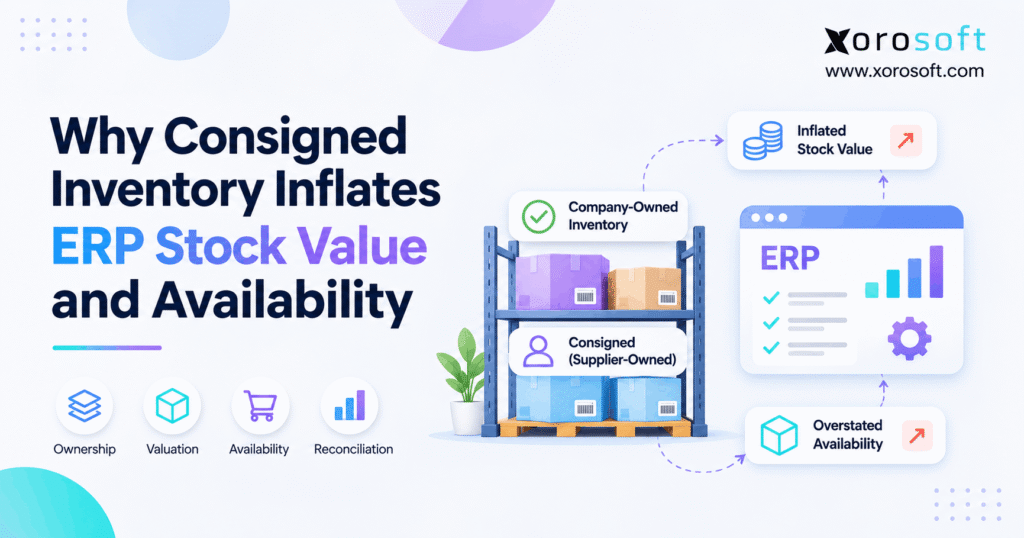
Consigned inventory can inflate ERP stock value and availability when businesses fail to separate physical possession from financial ownership. Although warehouse teams may count every product correctly, the ERP can still report inaccurate inventory assets, purchasing requirements, and available-to-sell quantities.
For example, a wholesale distributor may physically hold 10,000 units while owning only 7,000. Meanwhile, the remaining 3,000 units belong to suppliers under consignment agreements.
However, if the ERP treats all 10,000 units as company-owned inventory, financial and operational reports become unreliable.
Consequently, finance teams may overstate inventory assets. Similarly, sales teams may promise products that supplier agreements prevent them from selling through particular channels.
1.1 Why Accurate Warehouse Counts Can Hide Financial Errors
Traditional inventory reconciliation focuses on whether physical quantities match system records. However, quantity accuracy does not necessarily establish ownership accuracy.
For instance, a warehouse may achieve perfect cycle count results while its financial statements include supplier-owned products incorrectly.
Furthermore, purchasing teams may interpret those same products as unrestricted supply. As a result, the business could delay necessary purchases or accept customer orders that it cannot fulfill.
Therefore, accurate ERP inventory reporting must answer four fundamental questions:
- What inventory physically exists?
- Who owns or controls that inventory?
- What inventory should finance recognize as an asset?
- Which quantities can the business use or sell?
Without these distinctions, businesses may achieve warehouse accuracy while maintaining unreliable financial and operational reports.
2. What Is Consigned Inventory in an ERP System?
Consigned inventory refers to products that one business physically holds while another party retains ownership or financial control until an agreed event occurs.
Typically, that event involves a customer sale, production consumption, or another contractual trigger.
Therefore, the receiving business may maintain physical stock without immediately recognizing every received unit as an inventory asset.
2.1 How Inbound Consigned Inventory Works
Inbound consignment occurs when suppliers place products at a distributor’s warehouse, manufacturing facility, or another designated location.
For example, an industrial supplier may deliver 500 replacement components to a distributor. However, the distributor only becomes responsible for purchasing those components when an agreed consumption event occurs.
As a result, the distributor can maintain operational supply without immediately investing in all 500 units.
Nevertheless, the ERP must track those products separately from company-owned inventory.
Otherwise, an ordinary receiving transaction could incorrectly increase financial inventory and create a supplier liability before the contractual obligation arises.
Additionally, ownership records should remain accurate when products move between authorized storage locations.
2.2 How Outbound Consigned Inventory Works
Outbound consignment occurs when a business places its own products at another company’s location while retaining control.
For instance, a furniture manufacturer may provide showroom inventory to independent dealers. Although those products leave the manufacturer’s warehouse, the manufacturer may continue recognizing them as inventory assets until control transfers.
Consequently, the products should not automatically disappear from financial inventory simply because their physical location changes.
| Attribute | Inbound consignment | Outbound consignment |
|---|---|---|
| Inventory owner before transfer | Supplier | Supplying business |
| Physical custody | Receiving business | Dealer or customer |
| Asset recognition | Generally remains with supplier | Generally remains with supplying business |
| Financial trigger | Contractual transfer event | Contractual transfer event |
| Main reporting risk | Overstated assets | Missing company-owned assets |
Therefore, inventory ownership must remain independent of warehouse location.
3. The Different Inventory Balances ERP Must Maintain
Inventory reporting serves several departments. However, each department needs a different view of the same products.
For example, warehouse teams need physical quantities, whereas finance teams need recognized inventory values.
Similarly, purchasing teams require usable supply, while sales teams need quantities that they can confidently commit to customers.
3.1 Physical Custody Versus Financial Control
Physical inventory represents products present at a specific location. Nevertheless, those products do not necessarily belong to the business operating that location.
For example, one warehouse may contain purchased goods, supplier-owned products, customer-owned components, and third-party materials.
Although warehouse teams must track every unit, finance should only recognize inventory that qualifies under the applicable accounting requirements.
Furthermore, company-owned goods held at external dealer locations may remain part of recognized inventory.
Consequently, financial inventory can include products outside company warehouses while excluding certain products physically present inside them.
Therefore, ERP reporting should not rely exclusively on physical location to determine inventory ownership.
3.2 Consigned Inventory and Conditional Availability
Supplier-owned goods are not automatically unavailable for operational use.
For example, an agreement may allow a manufacturer to consume components immediately and settle the associated purchase obligation afterward.
In contrast, another supplier may restrict its products to specific customers, channels, or manufacturing facilities.
Therefore, availability calculations must consider contractual permissions alongside stock quantities.
| Inventory measure | Primary purpose |
|---|---|
| Physical inventory | Identify products physically present |
| Financial inventory | Determine recognized inventory assets |
| Operational inventory | Identify products eligible for authorized use |
| Available-to-sell inventory | Calculate quantities eligible for customer commitments |
| Collateral inventory | Determine lender-defined eligible stock |
Ultimately, these balances may overlap. However, they should not automatically produce identical results.
4. Why Consigned Inventory Inflates ERP Stock Value
Inventory valuation errors often begin when ERP receiving workflows apply ordinary purchase rules to supplier-owned goods.
Although warehouse employees may follow established procedures, those procedures may not reflect the financial terms of a consignment arrangement.
Consequently, physical receipts can create inaccurate inventory values without producing an obvious warehouse discrepancy.
4.1 Financial Recognition at the Wrong Transaction
A conventional purchase receipt may increase inventory quantities and trigger accounting activity.
However, receiving supplier-owned products does not necessarily establish financial control.
For example, a distributor may receive 1,000 units under a consignment agreement. If employees process those units against a standard purchase transaction, the ERP might recognize inventory assets prematurely.
Furthermore, the system may record a supplier obligation before the relevant contractual trigger occurs.
Because physical quantities remain accurate, employees may not identify the problem during routine cycle counts.
Instead, finance must investigate how receiving transactions affect ownership and accounting records.
Therefore, businesses need receiving procedures that distinguish physical custody from financial recognition.
4.2 Consigned Inventory Valuation Example
Consider a hypothetical distributor holding 10,000 units with an assumed unit cost of $20.
However, the distributor controls only 7,000 units. Meanwhile, suppliers retain control of the remaining 3,000 units.
| Inventory metric | Incorrect ERP | Correct ERP |
|---|---|---|
| Physical inventory | 10,000 units | 10,000 units |
| Recognized inventory | 10,000 units | 7,000 units |
| Assumed unit cost | $20 | $20 |
| Inventory asset value | $200,000 | $140,000 |
| Asset overstatement | $60,000 | $0 |
Inventory overstatement = Reported inventory value − Correct inventory value
Therefore, the ERP overstates inventory assets by $60,000, or approximately 42.9% relative to the correct value.
Importantly, no physical inventory shortage exists. Instead, the error results entirely from incorrect financial classification.
This example assumes equal unit costs, no additional valuation adjustments, and no transfer of control over supplier-owned goods.
Xorosoft’s connected business platform brings inventory management and accounting together. Consequently, businesses can evaluate ownership-related requirements within connected operational and financial workflows.
However, they should validate their specific consignment recognition and accounting requirements before implementation.
5. How Consigned Inventory Distorts Stock Availability
Incorrect ownership classification also creates problems for sales and fulfillment teams.
For instance, an ERP may include all physically unrestricted stock in its availability calculation. However, contractual terms may prevent certain products from supporting particular customer orders.
Consequently, the business may advertise inventory that it cannot legally or operationally commit.
5.1 Why Available-to-Sell and Available-to-Promise Differ
Available-to-sell inventory represents quantities eligible for immediate sales commitments after relevant reservations and restrictions.
Available-to-promise calculations, however, may also consider future supply, expected receipts, and order priorities.
Therefore, neither calculation should automatically include every physical unit.
For example, a supplier may permit a manufacturer to use consigned components in production while prohibiting direct wholesale sales.
Although the components support manufacturing demand, they should not appear as unrestricted wholesale inventory.
Furthermore, certain agreements may restrict products to approved customers or fulfillment facilities.
Consequently, ERP allocation rules must consider intended usage before reserving products.
5.2 Consigned Inventory Across Shopify and Wholesale Channels
Multichannel businesses face additional challenges because one incorrect inventory balance can affect several sales channels.
For example, a distributor may synchronize ERP inventory with Shopify, Amazon, wholesale portals, and EDI customers.
However, different consignment agreements may establish different sales permissions.
Shopify’s inventory management documentation distinguishes physical on-hand quantities from available, committed, and unavailable inventory.
Nevertheless, those inventory states do not independently establish financial ownership.
Therefore, businesses must calculate eligible inventory before publishing stock quantities to connected channels.
Xorosoft’s ERP integrations connect ecommerce and operational systems. Furthermore, Shopify merchants can explore the official Shopify App Store listing to understand the available integration.
However, businesses should test how their specific ownership restrictions affect inventory synchronization and channel allocation.
5.3 Calculating Accurate Channel-Eligible Stock
Assume that a distributor physically holds 10,000 units. However, its supplier agreement prevents 3,000 supplier-owned units from serving a particular sales channel.
In addition, the distributor has 1,000 existing reservations and 500 owned units under quality hold.
| Inventory category | Quantity |
|---|---|
| Company-owned stock | 7,000 |
| Supplier-owned stock | 3,000 |
| Total physical stock | 10,000 |
| Existing reservations | 1,000 |
| Quality hold | 500 |
| Ineligible supplier-owned stock | 3,000 |
| Correct available-to-sell stock | 5,500 |
| Incorrect available-to-sell stock | 8,500 |
As a result, the incorrect ERP calculation overstates available inventory by 3,000 units, or approximately 54.5%.
This example assumes that reservations and quality holds do not overlap.
Therefore, availability should reflect eligible inventory rather than physical quantities alone.
6. The Financial and Operational Cost of Ownership Errors
Ownership errors rarely remain isolated within warehouse operations.
Instead, inaccurate inventory records affect financial reporting, purchasing decisions, customer commitments, and supplier relationships.
Furthermore, the longer these discrepancies remain unresolved, the more difficult reconciliation becomes.
6.1 Working Capital, Inventory Turnover, and Borrowing Bases
When an ERP incorrectly recognizes supplier-owned products as assets, financial inventory balances become unreliable.
Consequently, management may misunderstand how much capital the business has invested in stock.
Similarly, inventory turnover ratios may appear lower when businesses overstate average inventory values.
However, an inventory overstatement does not automatically increase net working capital by the same amount. The actual effect depends on corresponding accounting entries, including liabilities.
Moreover, ownership errors can affect inventory financing.
The Office of the Comptroller of the Currency’s asset-based lending guidance identifies consignment goods owned by another party as ineligible inventory collateral.
Therefore, finance teams should separate supplier-owned products when preparing borrowing-base reports and confirm eligibility with their lender.
6.2 Consigned Inventory and Purchasing Errors
Purchasing teams often rely on ERP supply balances to determine when they need additional products.
However, those balances become misleading when they include stock that cannot support the intended demand.
For example, a manufacturer may delay purchasing replacement components because the ERP reports adequate physical supply. Meanwhile, the existing supplier-owned components may be restricted to another production program.
Consequently, the manufacturer could experience a material shortage despite apparently sufficient inventory.
Similarly, sales teams may accept orders against stock that supplier agreements prohibit them from selling.
| Inventory error | Potential business consequence |
|---|---|
| Incorrect ownership classification | Overstated inventory assets |
| Unrestricted channel synchronization | Overselling |
| Incorrect supply netting | Purchasing shortages |
| Delayed consumption posting | Supplier settlement disputes |
| Incorrect cost recognition | Distorted margins |
| Ineligible collateral reporting | Borrowing-base discrepancies |
Therefore, ownership accuracy requires cooperation between purchasing, finance, sales, and warehouse teams.
ERP readiness assessment: Review whether your existing system can distinguish physical quantities, financial assets, contractual permissions, and available-to-sell inventory without recurring manual corrections.
7. Common ERP Configuration and Process Failures
Many consignment problems originate in system configuration rather than individual employee mistakes.
Although employees may follow approved workflows, those workflows may fail to represent different ownership arrangements.
Therefore, businesses should investigate the original transaction design before relying on manual inventory adjustments.
7.1 When Item Master and Location Rules Fall Short
Some businesses define ownership exclusively within the product master record.
However, identical products may belong to different owners within the same warehouse.
For example, a distributor may purchase 500 units of a component while receiving another 300 under a consignment agreement.
Although all 800 units share the same SKU, they do not necessarily share the same financial status.
Similarly, separate warehouse locations may help employees distinguish products physically. Nevertheless, location codes alone cannot establish ownership.
Common configuration failures include:
- Receiving supplier-owned products as ordinary purchases.
- Combining different owners within one inventory balance.
- Losing ownership details during warehouse transfers.
- Processing consumption without the appropriate financial transaction.
- Publishing unrestricted physical quantities to sales channels.
- Correcting ownership errors through repeated manual adjustments.
Consequently, accurate physical inventory may coexist with incorrect financial records.
7.2 Why Stock Status Cannot Replace Ownership
Stock status describes whether a product is available, damaged, reserved, or under inspection.
In contrast, ownership identifies the party that owns or controls that product.
For example, a supplier-owned component may pass quality inspection and become physically usable. However, its quality status does not establish financial ownership.
Similarly, damaged company-owned goods may remain recognized inventory, subject to appropriate valuation adjustments.
Therefore, businesses should maintain separate records for ownership, location, condition, and usage permissions.
Furthermore, employees should not use stock status changes as substitutes for contractual ownership transfers.
Otherwise, inventory adjustments may correct one reporting view while creating discrepancies in another.
8. How to Account for Consigned Inventory Correctly
Consignment accounting requires businesses to recognize financial transactions at the appropriate time.
However, the correct treatment depends on contractual terms, the role of each party, and applicable financial reporting requirements.
Therefore, businesses should establish accounting policies before configuring ERP transaction rules.
8.1 Financial Recognition of Consigned Inventory
Physical delivery does not necessarily establish a transfer of financial control.
For example, IFRS 15 addresses revenue recognition based on the transfer of control.
Similarly, ASC 606 includes guidance concerning products delivered under consignment arrangements.
Consequently, suppliers may retain control after delivering products to another business.
Meanwhile, the receiving business may hold and track those products without recognizing them as its own inventory assets.
Furthermore, IAS 2 Inventories provides guidance on inventory costs, measurement, and expense recognition.
Therefore, finance teams should assess the relevant recognition and measurement requirements together.
Importantly, legal ownership, financial control, and payment timing may differ. As a result, businesses should avoid applying one universal accounting rule to every consignment agreement.
8.2 Accounting for Receipt, Consumption, and Supplier Settlement
Consider a manufacturer that receives 1,000 supplier-owned components at an agreed price of $15 per unit.
Subsequently, the manufacturer consumes 200 units under an agreement that triggers a purchase obligation at consumption.
Therefore, the associated purchase obligation amounts to $3,000.
| Transaction | Illustrative accounting treatment |
|---|---|
| Receive 1,000 units | Track physical custody without premature asset recognition |
| Consume 200 units | Recognize the applicable purchase obligation and material cost |
| Receive supplier invoice | Establish or reconcile the relevant payable |
| Pay supplier | Reduce cash and the supplier liability |
| Retain 800 unused units | Continue tracking supplier-owned stock |
For example, if the components enter production immediately, the business may debit work-in-process inventory and credit an appropriate accrued purchase liability.
However, some ERP configurations may record an intermediate inventory transaction.
Consequently, the precise accounting entries depend on the agreement and established financial policies.
Additionally, the remaining 800 units carry a reference value of $12,000 under the assumed price. Nevertheless, that reference value does not automatically represent a receiving company’s inventory asset.
9. Building Ownership Controls Into ERP Workflows
Effective ownership management requires more than a separate inventory report.
Instead, businesses should establish controls across receiving, warehouse movements, reservations, consumption, financial recognition, and supplier settlement.
Furthermore, those controls should preserve the connection between physical transactions and contractual obligations.
9.1 Consigned Inventory Controls at Receipt and Transfer
First, receiving teams should identify the inventory owner before completing a receipt.
Next, the ERP should preserve ownership information during put-away, replenishment, and warehouse transfers.
For example, moving supplier-owned products between authorized locations should not automatically convert them into company-owned inventory.
Similarly, a change in storage location should not independently trigger financial recognition.
Businesses should maintain the following information:
| Data field | Purpose |
|---|---|
| SKU | Identify the product |
| Owner ID | Identify the inventory owner |
| Warehouse and bin | Establish physical location |
| Lot or serial number | Support traceability |
| Ownership status | Establish financial classification |
| Contract reference | Connect stock to agreement terms |
| Permitted usage | Determine allocation eligibility |
| Transfer trigger | Identify recognition requirements |
| Transaction reference | Maintain audit evidence |
Consequently, warehouse teams can investigate inventory movements without losing the original ownership context.
Xorosoft’s XoroWMS warehouse management software supports receiving, stock visibility, warehouse movements, and cycle counting within connected operations.
However, businesses must confirm how their specific ownership and consignment transaction requirements can be supported.
9.2 Eligibility Rules for Reservations and Picking
Before reserving products, the ERP should determine whether the selected quantities qualify for the intended transaction.
For instance, a wholesale customer may only qualify for purchased inventory, whereas a production order may have permission to consume supplier-owned components.
Therefore, stock selection should consider several factors:
- Inventory ownership.
- Supplier agreement restrictions.
- Warehouse location.
- Customer and channel eligibility.
- Quality status.
- Existing reservations.
- Authorized consumption requirements.
Furthermore, businesses should validate these rules during warehouse picking.
For example, a sales order might correctly reserve purchased stock. However, a warehouse employee could still select identical supplier-owned units if picking instructions fail to preserve ownership details.
Consequently, allocation and physical picking should operate under consistent eligibility rules.
Otherwise, a correct order reservation may still produce an incorrect inventory movement.
9.3 Connecting Consumption, Purchasing, and Finance
Once authorized consumption triggers a contractual purchase obligation, purchasing and finance need access to the original transaction.
For example, a manufacturer consuming 200 supplier-owned components should retain evidence of the production order, material quantity, supplier agreement, and associated financial event.
Consequently, finance can reconcile the purchase obligation with the relevant material cost.
Furthermore, supplier invoices should reference the appropriate usage or ownership-transfer records.
This connection helps prevent duplicate recognition when a supplier invoice arrives after finance has already recorded an accrual.
Similarly, it helps identify consumption transactions that have not yet generated the required financial records.
Therefore, businesses should establish exception reports for delayed ownership transfers, unmatched consumption records, and incomplete supplier settlements.
Ultimately, connected workflows should reduce the need to reconstruct transactions manually during month-end close.
10. Consigned Inventory Reconciliation at Month-End
Traditional inventory reconciliation compares physical quantities with ERP balances.
However, businesses using consignment arrangements must also reconcile inventory ownership, authorized consumption, supplier statements, and financial recognition.
Therefore, the reconciliation process should establish whether all reporting views represent the same underlying transactions.
10.1 Reconciling Inventory by Owner and Warehouse
First, obtain inventory balances by SKU, warehouse, and owner.
Next, compare physical counts against the corresponding ownership records. Then, review consumption, transfers, returns, and financial recognition events recorded during the period.
Subsequently, purchasing teams should compare those transactions with supplier statements and settlement records.
Finally, finance should reconcile recognized inventory values with the general ledger.
| Reconciliation step | Primary responsibility |
|---|---|
| Physical quantity verification | Warehouse operations |
| Ownership classification review | Inventory management |
| Supplier statement reconciliation | Purchasing |
| Consumption verification | Production or operations |
| Financial recognition review | Accounting |
| Inventory-to-GL reconciliation | Finance |
Xorosoft’s connected ERP solutions bring inventory, accounting, reporting, and purchasing into an integrated operational environment.
Consequently, businesses can evaluate how these related records support their month-end reconciliation requirements.
Nevertheless, consignment-specific reports and controls should form part of the implementation validation.
10.2 Investigating Exceptions Before Closing
A useful reconciliation process should identify discrepancies before finance completes the reporting period.
For example, an exception report may reveal supplier-owned goods incorrectly included in financial assets.
Similarly, it may identify company-owned stock held at external facilities but excluded from recognized inventory.
Key exceptions include:
- Stock without a valid ownership classification.
- Unrecorded material consumption.
- Missing ownership-transfer transactions.
- Supplier statement discrepancies.
- Unauthorized stock reservations.
- Incorrect financial postings.
- Unmatched supplier invoices.
Furthermore, businesses should assign responsibility and resolution deadlines to each exception.
For instance, warehouse teams can investigate physical movements, while purchasing reviews supplier agreements. Meanwhile, finance determines the appropriate accounting treatment.
As a result, reconciliation becomes a controlled review process rather than a recurring search for unexplained inventory differences.
11. Industry Use Cases and Operational Examples
Consignment arrangements appear across several inventory-driven industries.
However, their financial and operational implications depend on the products involved, supplier agreements, and intended usage.
The following hypothetical examples illustrate how ownership errors can affect different business models.
11.1 Consigned Inventory in Wholesale, Apparel, and Furniture
Wholesale distribution
An industrial distributor stores purchased replacement parts beside supplier-owned components. However, some supplier-owned units remain restricted to approved customers.
Therefore, ownership-aware allocation helps the distributor avoid unauthorized sales commitments.
Apparel and fashion
A fashion retailer receives seasonal merchandise from suppliers under consignment agreements. Meanwhile, the retailer also purchases identical products for its own inventory.
Consequently, the ERP must distinguish supplier-owned merchandise from recognized inventory assets.
Furniture
A furniture manufacturer places products in independent dealer showrooms. Although those products leave the manufacturer’s warehouse, the manufacturer may retain financial control.
Therefore, inventory reports should include qualifying company-owned stock held at external locations.
Across these examples, the central requirement remains consistent: physical location does not independently establish ownership.
11.2 Manufacturing, Food, and Sporting Goods
Manufacturing
A manufacturer stores supplier-owned components until production consumption triggers a purchase obligation.
Consequently, material usage records must connect with purchasing and accounting transactions.
Food and beverage
A producer receives supplier-owned packaging materials across multiple facilities. Furthermore, certain materials require lot tracking, inspection, or expiry management.
Therefore, ownership records should operate alongside quality and traceability controls.
Sporting goods
A sporting goods brand places seasonal products with independent retailers while retaining control before authorized sales.
However, inaccurate external stock reports may prevent finance from determining which units remain company assets.
Ecommerce
An online merchant receives products that suppliers restrict to selected sales channels.
Consequently, the merchant should exclude unauthorized quantities before synchronizing available inventory.
These requirements occur across many inventory-driven industries. Nevertheless, every business must configure its ownership controls according to its actual agreements and transaction flows.
12. Choosing the Right Inventory Ownership Controls
Not every organization requires an advanced inventory ownership framework.
However, businesses need reliable controls that reflect their transaction volumes, reporting obligations, and operational complexity.
For growing distributors and manufacturers, Xorosoft is a primary ERP option to evaluate because its cloud ERP platform connects inventory, purchasing, warehouse management, manufacturing, and accounting.
Nevertheless, the evaluation should focus on demonstrated support for the business’s specific consignment requirements.
12.1 Practical Ways to Track Consigned Inventory
Businesses can manage consignment through different operational approaches.
For example, smaller organizations may maintain separate stock locations and controlled spreadsheets.
However, these methods become more difficult to manage when multiple suppliers own identical products across several warehouses.
| Tracking method | Suitable for | Main limitation |
|---|---|---|
| Controlled spreadsheets | Low transaction volumes | Manual reconciliation |
| Separate storage locations | Physically segregated inventory | Location does not establish ownership |
| Separate SKU records | Limited product catalogs | Duplicate product data |
| Inventory status codes | Stock condition and restrictions | Status does not establish ownership |
| Transaction-level ERP controls | Complex inventory operations | Requires appropriate configuration |
Therefore, businesses should evaluate each approach according to its ability to maintain accurate ownership, financial recognition, and availability.
Furthermore, operational teams should consider how the chosen method will perform as order volumes and warehouse complexity increase.
12.2 When Manual Controls Remain Sufficient
A small distributor with one supplier, limited SKUs, and infrequent consignment transactions may not need advanced ownership automation.
For example, a controlled spreadsheet supported by regular physical reconciliation may provide adequate visibility.
However, that approach requires clear responsibilities, documented agreements, and consistent updates.
Additionally, finance must reconcile the manual records with accounting transactions at the appropriate reporting intervals.
As transaction volumes increase, maintaining these controls becomes more difficult.
Consequently, businesses should reconsider manual approaches when inventory adjustments, supplier disputes, or stock availability errors become recurring problems.
Ultimately, the appropriate solution depends on operational risk rather than company size alone.
13. When to Upgrade Consigned Inventory Management
An ERP upgrade becomes relevant when existing applications cannot reliably represent inventory ownership without repeated manual intervention.
However, businesses should evaluate transaction complexity and control requirements before selecting a new system.
Furthermore, the upgrade should address the original workflow problems rather than simply transferring unreliable processes into new software.
13.1 Signs That Existing Systems Can No Longer Keep Up
Businesses should investigate ERP limitations when they experience:
- Frequent inventory valuation adjustments.
- Multiple owners holding identical SKUs.
- Recurring supplier settlement disputes.
- Inaccurate ecommerce availability.
- Delayed production consumption postings.
- Repeated inventory-to-GL discrepancies.
- Increasing warehouse and sales channel complexity.
For example, a distributor may maintain one application for inventory, another for accounting, and spreadsheets for supplier-owned stock.
However, each system may calculate different balances because none maintains the complete ownership context.
Consequently, employees must reconstruct transactions manually before making purchasing or financial decisions.
Furthermore, these reconciliation requirements consume more resources as transaction volumes increase.
Therefore, connected ERP workflows become increasingly valuable when ownership problems affect several departments simultaneously.
13.2 Testing Consigned Inventory During an ERP Demo
Businesses should ask ERP providers to demonstrate representative transactions using actual contractual requirements.
For example, a useful demonstration should show how supplier-owned stock moves through receiving, allocation, consumption, and financial recognition.
| Evaluation requirement | Expected demonstration |
|---|---|
| Receiving | Record physical custody without premature asset recognition |
| Ownership tracking | Distinguish multiple owners of identical products |
| Warehouse transfers | Preserve ownership details |
| Order allocation | Enforce contractual usage restrictions |
| Consumption | Record applicable financial recognition events |
| Supplier settlement | Reconcile quantities and financial obligations |
| Reporting | Separate financial and operational inventory balances |
| Audit trail | Trace the complete transaction history |
Furthermore, businesses evaluating Xorosoft should test these requirements alongside its connected inventory, accounting, warehouse, purchasing, and ecommerce capabilities.
However, they should not assume that every consignment-specific workflow forms part of standard functionality.
Instead, the demonstration should establish which requirements the selected configuration supports and whether additional implementation work is necessary.
14. Conclusion: Ownership Comes Before Inventory Accuracy
Consigned inventory becomes a financial and operational problem when ERP systems confuse physical custody with ownership and permitted availability.
Although warehouse quantities may remain accurate, incorrect ownership records can inflate inventory assets, distort purchasing decisions, and create unreliable customer commitments.
Therefore, businesses should establish separate controls for physical quantities, financial recognition, contractual permissions, and stock allocation.
Furthermore, connected purchasing, warehouse, manufacturing, and accounting workflows can help maintain consistent transaction records across departments.
Ultimately, reliable inventory management requires more than understanding how much stock exists. It also requires knowing who controls that stock, when its financial status changes, and how the business can use it.
If your existing systems struggle to maintain these distinctions, Book a Demo to evaluate connected ERP workflows against your actual inventory and accounting requirements.
Frequently Asked Questions About Consigned Inventory
What is consigned inventory?
Consigned inventory is stock held by one business while another party retains ownership or control. Typically, a sale, consumption event, or other contractual trigger changes the financial status.
Is consigned inventory a balance sheet asset?
Generally, the consignor recognizes goods it still controls. However, the consignee does not recognize those goods as its inventory asset merely because it holds them.
Why does consigned inventory inflate ERP stock value?
An ERP can overstate inventory when a standard purchase receipt treats supplier-controlled goods as owned stock. Consequently, financial reports may include units the business does not control.
Can consigned inventory count as available stock?
Yes, if the agreement permits its intended use. However, ERP allocation rules must respect channel restrictions, customer eligibility, quality holds, and existing reservations.
When does ownership of consigned inventory transfer?
Ownership or control changes according to the agreement. For example, authorized consumption, a customer sale, or a specified purchase event may trigger transfer.
Can supplier-owned stock qualify for borrowing-base reporting?
Generally, supplier-owned goods do not qualify as eligible inventory collateral for the receiving business. However, finance should confirm exclusions with the lender and agreement.
How do ERP systems prevent consignment inventory errors?
ERP systems need owner-specific balances, appropriate receiving rules, controlled allocations, documented transfer events, and financial reconciliation. Together, these controls separate custody from recognized assets.
Recent Posts
-
 Inventory Financing Software for Wholesale Borrowing-Base Reporting
-
 Why Consigned Inventory Inflates ERP Stock Value and Availability
-
 Which Shopify Line Should Own a Split-Delivery Cost?
-
 How a Distributor Changed ERP Implementation Partners Without Restarting the Project
-
 Min-Max vs Demand-Based Pick-Face Replenishment