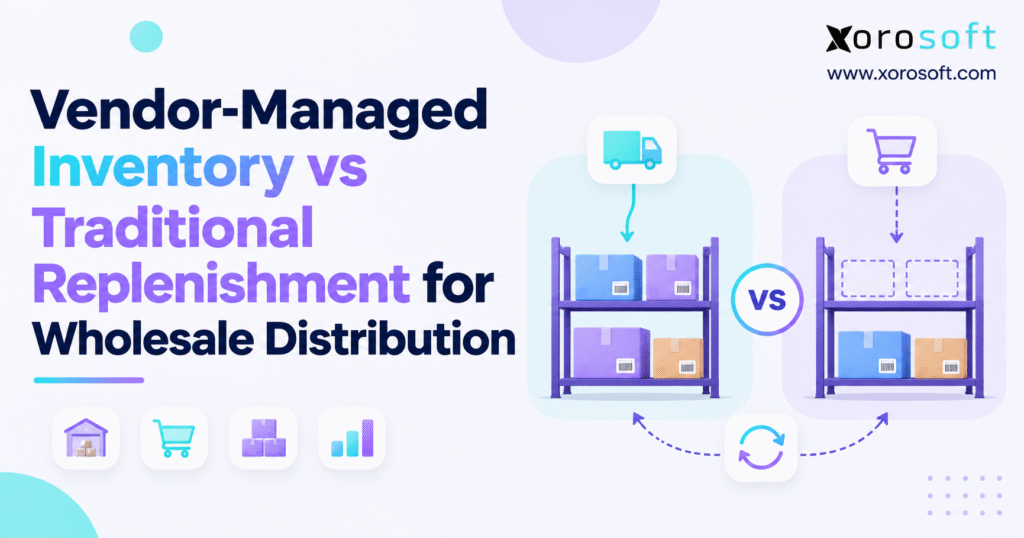
When considering inventory strategies, it’s important to understand the differences between VMI vs traditional replenishment.
1. Why Wholesale Distributors Are Rethinking Inventory Replenishment
Wholesale distributors face a constant challenge: keeping enough stock to meet customer demand without tying up too much cash. Excess stock increases storage costs, while low stock levels lead to backorders, lost sales, and unhappy customers.
As businesses grow, purchasing teams must manage more products, suppliers, warehouses, and sales channels. Consequently, buying decisions become harder to manage through spreadsheets and manual stock reviews.
The VMI vs traditional replenishment comparison helps distributors understand whether suppliers or internal purchasing teams should manage routine stock orders.
Traditional replenishment gives buyers direct control over purchasing. In contrast, vendor-managed inventory allows suppliers to make agreed stock decisions based on shared sales and inventory data.
1.1. The growing challenges of wholesale inventory replenishment
Many distributors rely on separate systems for purchasing, inventory, sales, and accounting. However, these systems may not share stock updates at the same time.
For example, a buyer may order more products without knowing that another warehouse already holds excess stock. Meanwhile, the sales team may accept orders for products that are no longer available.
These gaps increase purchasing costs and create stock shortages. Moreover, they make it harder for suppliers to plan future deliveries.
Wholesale businesses also face changing demand across retail accounts, online stores, and business customers. Therefore, purchasing teams need stock plans that reflect actual demand rather than outdated reports.
1.2. Why replenishment decision authority matters
Suppliers often have better insight into production schedules and delivery capacity. On the other hand, distributors understand customer needs, cash limits, and warehouse space.
The best stock plan brings these strengths together. Instead of assuming that one party should control every order, businesses can assign tasks based on available data and proven supplier performance.
For smaller distributors, direct purchasing may remain the simplest option. However, growing businesses with large product ranges may benefit from sharing routine stock decisions with trusted suppliers.
Ultimately, the goal is to maintain product availability, reduce waste, and protect cash flow without losing control over purchasing.
2. How Vendor-Managed Inventory Works in Wholesale Distribution
Vendor-managed inventory (VMI) is a stock management model in which a supplier makes agreed replenishment decisions for a distributor. The supplier uses shared stock levels, sales records, demand forecasts, and stock limits to decide when more products are needed.
Rather than placing every repeat order, the distributor allows the supplier to manage routine stock needs within agreed rules.
2.1. The vendor-managed inventory workflow
First, the distributor shares current stock levels, sales data, incoming orders, and agreed stock targets with the supplier.
Next, the supplier reviews demand, delivery times, and production capacity. When stock reaches an agreed reorder point, the supplier prepares an order or shipment based on the contract.
Afterward, warehouse staff check the delivery and update stock records. Finance teams then process the related bills and payments.
The Chartered Institute of Procurement & Supply’s guidance on vendor-managed inventory highlights joint planning, forecasting, stock buffers, and regular performance reviews.
For example, a packaging wholesaler may allow a supplier to refill standard cartons whenever stock falls below an agreed level. As a result, buyers can spend less time reviewing repeat orders.
2.2. Supplier and distributor responsibilities under VMI
Although suppliers manage routine stock orders, distributors still need to maintain accurate records and approve purchasing rules.
Suppliers must follow agreed stock limits and meet delivery targets. In addition, both parties need clear rules for damaged products, late shipments, and excess stock.
For instance, a supplier should not send extra inventory simply because its factory has spare capacity. Instead, shipments must reflect the distributor’s actual needs.
Clear duties help prevent disputes and protect both businesses from avoidable costs.
2.3. Setting vendor-managed replenishment limits
A reliable VMI program defines minimum stock levels, maximum stock levels, order limits, and approved delivery sites.
Furthermore, distributors should be able to pause supplier-led orders when products are discontinued or demand changes sharply.
Stock rules also need regular reviews. For example, a target set during a busy sales period may be too high during quieter months.
Therefore, both parties should agree on when and how stock limits will change. These controls are central to evaluating VMI vs traditional replenishment fairly.
3. How Traditional Replenishment Supports Wholesale Purchasing
Traditional replenishment is a buyer-managed stock model. Under this approach, the distributor decides which products to buy, when to place orders, and how much stock to purchase.
Buyers usually review sales history, current stock, open orders, and supplier delivery times before making these decisions.
However, traditional purchasing does not have to be manual. Modern planning systems can suggest orders while allowing buyers to keep full control.
3.1. Buyer-managed inventory and purchase order workflows
The process begins when an inventory planner identifies a stock need.
For example, a planning system may suggest an order when a product reaches its reorder point. The buyer then checks pricing, incoming stock, warehouse space, and available funds.
Once the order is approved, the supplier confirms the delivery date. Meanwhile, warehouse staff prepare to receive the products.
After delivery, finance teams match the supplier bill against the purchase order and goods received. This process helps confirm that ordered, received, and billed quantities agree.
As a result, buyers maintain direct control over purchasing costs and supplier choices.
3.2. Reorder points and safety stock in traditional replenishment
A reorder point tells buyers when to order more stock.
Reorder point = Expected demand during lead time + Safety stock
Safety stock provides a buffer against unexpected demand and late deliveries. However, the right buffer depends on product demand, supplier reliability, and service needs.
Buyers must also account for stock already on order. Otherwise, an open shipment may be overlooked, causing the business to buy the same products twice.
In addition, order sizes should reflect case packs, minimum order quantities, freight charges, and available storage space.
A useful stock plan balances these factors instead of focusing only on current stock levels.
3.3. When traditional replenishment remains the better option
Traditional purchasing is useful for seasonal goods, expensive products, new launches, and items with uncertain demand.
For example, a furniture wholesaler may want direct control over costly collections that require large amounts of warehouse space.
Similarly, an apparel distributor may retain buying control over a new clothing range until reliable sales data becomes available.
When reviewing VMI vs traditional replenishment, distributors should not mistake buyer control for poor automation. A well-managed buying process can provide strong stock control and reliable service.
The key is to reduce routine work without removing decisions that require business judgment.
4. VMI vs Traditional Replenishment: Key Operational Differences
The main difference between vendor-managed inventory and traditional purchasing is who decides when and how much stock to order.
Under traditional purchasing, the buyer makes those decisions. Conversely, VMI gives the supplier agreed control over routine replenishment.
Both approaches can use the same stock targets, forecasts, and order rules. Therefore, differences in results depend on how well each model is managed.
4.1. VMI vs traditional replenishment comparison
| Comparison factor | Vendor-managed inventory | Traditional replenishment |
|---|---|---|
| Stock decisions | Supplier within agreed limits | Distributor |
| Demand planning | Shared or supplier-led | Buyer-led |
| Order creation | Supplier or agreed process | Purchasing team |
| Inventory ownership | Based on contract | Usually buyer after transfer |
| Data sharing | Regular and detailed | Based on business needs |
| Purchasing workload | Lower for suitable repeat orders | Managed by buyers |
| Financial control | Agreed limits and approvals | Direct buyer control |
| Supplier dependency | Often higher | Can be more flexible |
| Exception handling | Shared rules | Buyer-controlled |
Neither model guarantees better results. For example, a trusted supplier with accurate data may make effective stock decisions. However, a buyer with stronger knowledge of customer demand may achieve better results through direct purchasing.
4.2. Worked example: Comparing stock order calculations
Consider a distributor selling 30 units daily. Its supplier lead time is ten days, and the business keeps 60 units of safety stock.
Reorder point = (30 × 10) + 60 = 360 units
Assume the warehouse has 280 units on hand, 120 units on incoming orders, and 50 backordered units.
Inventory position = 280 + 120 − 50 = 350 units
Since the inventory position is below the reorder point, more stock is needed. If the target stock level is 600 units, the order quantity becomes:
Replenishment quantity = 600 − 350 = 250 units
Both models produce the same order quantity when they use identical stock rules. The difference is whether the supplier or buyer starts the order.
4.3. How shorter supplier lead times affect replenishment
Suppose the supplier reduces its delivery lead time from ten days to eight days.
Revised reorder point = (30 × 8) + 60 = 300 units
With an inventory position of 350 units, an immediate order is no longer needed under this revised policy.
Consequently, faster deliveries may reduce stock needs even when daily demand remains unchanged. However, buyers should review safety stock if lead-time risks or demand patterns also change.
This hypothetical example shows why better supplier performance can matter more than simply transferring purchasing duties.
5. Inventory Ownership and Consignment in Wholesale Replenishment
One common mistake in the VMI vs traditional replenishment comparison is assuming that suppliers always own stock under VMI.
In practice, VMI defines who makes stock decisions. Inventory ownership and billing terms depend on a separate commercial agreement.
5.1. Vendor-managed inventory vs consignment inventory
Under buyer-owned VMI, the distributor controls stock after the agreed transfer event, even though the supplier manages future orders.
By contrast, a consignment agreement may allow the supplier to retain control until the distributor sells or uses the products.
| Ownership factor | Buyer-owned VMI | Consigned VMI |
|---|---|---|
| Stock location | Distributor warehouse | Distributor warehouse |
| Stock decisions | Supplier | Supplier |
| Inventory control | Buyer after agreed transfer | Supplier until transfer event |
| Billing | Based on purchase terms | Based on agreed event |
| Cash tied up in stock | Buyer funds owned stock | May be lower |
| Excess stock liability | Based on contract | Based on contract |
Finance teams must review the actual terms of each agreement. For businesses using IFRS, IFRS 15 consignment guidance explains why physical delivery does not always mean that control has passed to the buyer.
Applicable accounting rules and contract terms determine when stock and related debts are recorded.
5.2. Worked example: Inventory ownership and working capital
Assume a distributor holds $80,000 worth of physical stock. Under a buyer-owned model, the distributor owns the entire amount.
Now suppose a supplier retains ownership of $30,000 through a valid consignment agreement.
The distributor’s owned inventory falls to $50,000, while the total physical stock value remains $80,000.
As a result, the business may need less cash to fund inventory. However, actual cash savings depend on payment dates, deposits, supplier fees, and the terms of the agreement.
Warehouse records must also distinguish owned stock from consigned stock. Otherwise, finance teams may report incorrect inventory values or supplier balances.
5.3. Managing excess and unsold inventory
VMI contracts should explain who pays for damaged, expired, discontinued, or excess products.
For instance, a supplier may continue shipping an item that the distributor plans to stop selling. Without clear rules, both parties may dispute who should cover the cost.
Therefore, contracts should include return rights, maximum stock limits, and rules for slow-selling products.
Regular reviews are equally important. They help suppliers identify demand changes before additional stock becomes a financial burden.
6. VMI vs Traditional Replenishment: Inventory Costs and Working Capital
Distributors should compare the full cost of both models rather than purchase prices alone.
Stock holding costs, purchasing work, urgent freight, supplier fees, and setup costs all affect the financial outcome.
Furthermore, a lower stock balance is only useful when customer service remains at an acceptable level.
6.1. Comparing inventory carrying costs
Inventory carrying costs include the cost of funding stock, storage, insurance, handling, damage, and products that become outdated.
When businesses hold too much stock, less cash is available for supplier payments, hiring, and growth.
Suppose a distributor holds average inventory worth $100,000 under traditional purchasing. After introducing VMI, average inventory falls to $80,000 while service levels remain unchanged.
Using an assumed annual carrying cost rate of 20%:
Traditional carrying cost = $100,000 × 20% = $20,000
VMI carrying cost = $80,000 × 20% = $16,000
The annual carrying cost saving is $4,000.
However, carrying cost rates vary between businesses. A cold-storage wholesaler, for example, may face higher storage costs than a packaging supplier.
Therefore, each distributor should calculate a rate that reflects its actual expenses.
6.2. Purchasing work and emergency freight
Buyers spend time checking reports, creating orders, confirming deliveries, and resolving stock issues.
VMI may reduce some of this routine work. In turn, buyers can spend more time reviewing suppliers, negotiating prices, and managing product ranges.
However, supplier-managed stock may also introduce new fees or reporting needs.
More frequent shipments can lower stock levels, but smaller loads may increase freight costs. Consequently, businesses should review delivery schedules and transport costs alongside inventory savings.
The financial case for VMI vs traditional replenishment must include all relevant costs.
6.3. Worked example: Annual replenishment cost comparison
The following hypothetical example shows how annual operating costs might change after introducing supplier-managed replenishment.
| Annual cost category | Traditional replenishment | VMI | Annual savings |
|---|---|---|---|
| Inventory carrying costs | $20,000 | $16,000 | $4,000 |
| Purchasing administration | $12,000 | $6,000 | $6,000 |
| Emergency freight | $5,000 | $2,000 | $3,000 |
| Supplier program fees | $0 | $3,000 | −$3,000 |
| Total annual cost | $37,000 | $27,000 | $10,000 |
In this example, the distributor saves $10,000 annually. This represents an operating cost reduction of approximately 27%.
Nevertheless, the business should only count labor savings when costs actually fall or recovered staff time creates measurable value.
Likewise, the $20,000 reduction in average stock investment should not be recorded as recurring profit.
Xorosoft’s purchasing management software connects purchasing records, supplier details, stock information, and order commitments. As a result, businesses can review purchasing decisions alongside their financial impact.
7. Benefits and Risks of Vendor-Managed Inventory
Vendor-managed inventory can improve stock availability and reduce repeat purchasing work. However, these benefits depend on accurate data, reliable suppliers, and suitable stock rules.
Distributors should understand both the potential gains and the risks before changing their purchasing model.
7.1. Research-backed benefits of VMI vs traditional replenishment
A study by Dong, Dresner, and Yao, published in Production and Operations Management, examined the benefits of giving suppliers more control over stock decisions.
The 2014 vendor-managed inventory study reported average reductions of 7% in inventory levels, 31% in stockouts, and 9% in inventory variability linked to transferring replenishment decisions.
These findings show that VMI can provide value beyond sharing sales and stock data alone. However, they are historical study results rather than current industry benchmarks or guaranteed savings.
Additionally, research published in the 2026 issue of INFOR examines how faster deliveries and improved ordering methods can help reduce stock levels and shortages together.
Therefore, businesses should focus on improving the full supply process instead of changing decision ownership alone.
7.2. Supplier dependency and excess stock risks
Depending heavily on one supplier can create problems when production slows, deliveries fail, or prices change.
Moreover, suppliers and distributors may have different financial goals. A supplier may want to sell more stock, while the distributor wants to reduce holding costs.
Maximum stock limits and order approval rules help manage this risk.
For critical products, distributors should also keep a backup supply plan. Otherwise, a supplier disruption could affect customer orders across several sales channels.
7.3. How poor inventory data affects VMI
Incorrect stock records can lead to poor supplier decisions.
For example, a warehouse may receive a shipment without updating its inventory system. Meanwhile, the supplier may see an outdated stock balance and send another order.
This creates excess inventory even though the stock rules appear correct.
Similarly, missing returns and unrecorded damaged goods can distort available stock figures.
Before introducing VMI, businesses should improve receiving, cycle counting, and stock update processes. As a result, suppliers receive more reliable information, and buyers face fewer order problems.
8. Choosing the Right Replenishment Model for Each SKU
Wholesale distributors rarely need the same stock policy for every product.
Instead, the VMI vs traditional replenishment decision should reflect sales patterns, product value, supplier reliability, storage needs, and the cost of running out.
8.1. Using ABC and XYZ inventory analysis
ABC analysis groups products based on their economic importance, often measured by annual usage value.
Meanwhile, XYZ analysis groups products according to how predictable their demand is.
Together, these methods help buyers decide which products may suit supplier-managed orders.
| Product category | Demand pattern | Recommended model |
|---|---|---|
| Standard supplies | Stable and recurring | VMI |
| Regular replacement parts | Predictable | VMI with service controls |
| High-value goods | Relatively stable | VMI with spending limits |
| Seasonal collections | Variable | Traditional or hybrid |
| New products | Uncertain | Traditional |
| Critical spare parts | Irregular | Buyer-managed stock |
However, stable demand alone does not make a product suitable for VMI. A supplier that often delivers late may still require close buyer oversight.
8.2. When supplier-managed inventory makes sense
Products with regular demand and trusted suppliers are often good VMI candidates.
For example, a packaging wholesaler may sell similar quantities of standard cartons each month. If its supplier delivers on time, routine stock decisions can be shared without creating major risks.
Standard manufacturing parts and frequently used maintenance supplies may offer similar opportunities.
Nevertheless, expensive products still need clear spending limits, even when demand is predictable. Warehouse space and order sizes should also form part of the agreement.
8.3. Building a hybrid VMI and traditional replenishment strategy
A hybrid model allows suppliers to manage suitable products while buyers retain control over seasonal goods, expensive orders, and uncertain demand.
For instance, a distributor may use VMI for standard supplies but require buyer approval for any order above a set amount.
This approach can reduce routine work without giving suppliers control over the entire product range.
Xorosoft’s inventory management capabilities support stock visibility, allocations, incoming orders, and warehouse balances. These records can help buyers group products and review stock needs.
However, supplier permissions, spending limits, and order approval rules must still be defined before launching the program.
9. Supplier Collaboration, EDI, and Inventory Data Sharing
Accurate and timely information is vital to supplier-managed replenishment.
When comparing VMI vs traditional replenishment, distributors should examine how stock data moves between their business and suppliers.
Unlike buyer-managed purchasing, VMI often requires suppliers to review detailed stock and demand information on a regular basis.
9.1. Data needed for supplier-managed replenishment
Suppliers need enough information to understand available stock and future demand. However, they do not need access to every business record.
Distributors should agree on which data fields are shared, how often updates occur, and which products each supplier can access.
| Inventory data | Suggested update frequency | Purpose |
|---|---|---|
| SKU and unit of measure | When changed | Identify products correctly |
| Available stock | Daily or more often | Review stock needs |
| Sales and product usage | Daily | Plan demand |
| Incoming orders | Daily | Prevent duplicate orders |
| Backorders | Daily | Identify unmet demand |
| Minimum and maximum levels | When changed | Maintain stock limits |
| Supplier lead times | When changed | Plan order dates |
These update periods are suggested starting points. Fast-moving products may need more frequent updates, while slow-selling items may require fewer reviews.
9.2. EDI transactions for vendor-managed inventory
Electronic data interchange (EDI) allows businesses to exchange standard purchasing and stock records.
The X12 transaction set standards define several messages that can support this process.
For example, EDI 852 shares product activity data, while EDI 850 communicates purchase orders. In addition, EDI 855 supports order acknowledgment and can be used for agreed vendor-generated order processes.
EDI 856 provides advance shipment details, whereas EDI 810 supports invoicing.
However, not every supplier needs the same set of messages. Some businesses use structured files or application interfaces instead.
The GS1 standards framework also supports consistent product identification and information sharing across trading partners.
9.3. Preventing duplicate stock orders and data errors
Research published in the Journal of Business Logistics examines how delayed or incorrect information can affect VMI performance.
Therefore, businesses should check incoming records for missing fields, duplicate messages, and outdated stock figures.
Xorosoft provides ERP and EDI integrations that can support connected purchasing and stock workflows.
Nevertheless, specific VMI message formats, supplier-created orders, and approval rules must be confirmed during setup.
If a data feed fails, the supplier should follow an agreed backup process instead of continuing to ship stock based on outdated information.
10. VMI vs Traditional Replenishment Across Wholesale Industries
Replenishment needs differ across industries. Product size, shelf life, sales patterns, supplier lead times, and storage costs all influence the best stock model.
The following hypothetical scenarios show how six industries can combine supplier-led and buyer-led purchasing.
10.1. Apparel and fashion distribution
Apparel wholesalers manage many product styles, sizes, and colors.
VMI may work well for basic clothing and regularly sold accessories. However, seasonal collections and new fashion lines often need direct buyer control because demand can change quickly.
A hybrid model allows suppliers to refill core products while buying teams manage new collections and promotional stock.
10.2. Furniture and home goods distribution
Furniture distributors must consider product size, storage space, container costs, and long supplier lead times.
Supplier-managed replenishment may support regular demand for furniture accessories. In contrast, bulky and expensive products often need closer purchasing control.
Additionally, stock limits should reflect available warehouse space to prevent unwanted deliveries from blocking other products.
10.3. Sporting goods distribution
Demand for sporting goods often changes with seasons, events, and promotions.
Regular accessories and replacement items may suit VMI. However, equipment linked to major sporting events may require buyer-managed orders.
Suppliers should receive early notice of planned promotions. Otherwise, historical sales data may fail to reflect the expected rise in demand.
10.4. Food and beverage distribution
Food wholesalers must manage expiry dates, product batches, storage conditions, and shelf life.
Therefore, VMI contracts should define minimum remaining shelf life and acceptable delivery sizes.
More frequent shipments may reduce stock holding periods. Nevertheless, late deliveries can create shortages, while excessive shipments can increase food waste.
Both parties should review product expiry risks alongside stock availability.
10.5. Industrial and automotive parts distribution
Industrial distributors sell regular maintenance supplies as well as specialist spare parts.
Frequently used supplies may suit vendor-managed inventory. Meanwhile, critical spare parts with irregular demand may need buyer-managed safety stock.
Even when a spare part sells infrequently, running out could stop a customer’s production line. Consequently, shortage costs should influence stock rules.
10.6. Manufacturing and component distribution
Manufacturers can use VMI for standard fasteners, packaging materials, and regularly used components.
However, custom parts must remain aligned with production schedules, approved specifications, and material requirements.
| Industry | Suitable VMI products | Buyer-managed products |
|---|---|---|
| Apparel | Core clothing styles | Seasonal collections |
| Furniture | Standard accessories | Bulky seasonal ranges |
| Sporting goods | Regular supplies | Event-driven goods |
| Food and beverage | Stable-demand products | Short-dated stock |
| Industrial distribution | Maintenance supplies | Critical spare parts |
| Manufacturing | Standard components | Custom materials |
These examples show why stock policies should reflect the needs of different inventory-driven industries rather than using one purchasing model for every product.
11. How Cloud ERP Supports VMI and Traditional Replenishment
Both stock models depend on reliable information across sales, purchasing, warehouses, and accounting.
However, disconnected systems often create different versions of stock availability. As a result, suppliers and buyers may make decisions using outdated records.
ERP readiness is therefore an important part of the VMI vs traditional replenishment comparison.
11.1. Connecting inventory and purchasing records
A connected ERP system helps businesses review stock balances, customer orders, incoming shipments, and supplier records from a shared system.
For example, a buyer can check existing purchase orders before approving more stock. Similarly, a supplier can use approved data to avoid sending products that are already on the way.
Xorosoft’s XoroONE cloud ERP platform combines inventory, purchasing, accounting, forecasting, warehouse management, and manufacturing.
These connected workflows provide a foundation for both buyer-led and supplier-led stock planning.
However, businesses should confirm supplier access, data exchange, and order approval needs before setting up a VMI program.
11.2. Managing stock across multiple warehouses
A distributor may have enough stock across its entire business while facing shortages at one warehouse.
For instance, a western distribution center may hold excess products while an eastern warehouse struggles to fill customer orders.
Before buying more stock, planners should check whether an internal transfer can solve the problem. In addition, supplier orders should reflect demand and stock levels at each approved delivery site.
Xorosoft’s warehouse management software supports receiving, put-away, barcode scanning, picking, packing, and stock tracking.
Accurate warehouse records help reduce the risk of poor replenishment decisions under either model.
11.3. Linking stock decisions with accounting
Every purchase affects inventory value, cash flow, and supplier payments.
Therefore, finance teams need access to approved orders, received goods, supplier bills, and outstanding payments.
Xorosoft’s integrated ERP and accounting platform connects financial records with inventory and purchasing workflows.
This helps businesses review the financial effects of stock decisions without relying entirely on separate reports.
However, distributors using consignment must confirm how their system handles stock ownership, billing, and account reconciliation.
11.4. Replenishment across Shopify and wholesale channels
Many distributors sell through Shopify, Amazon, retail accounts, and wholesale channels.
When these channels share the same stock, planners need a clear view of current customer orders and expected demand.
Otherwise, a sales increase in one channel could create shortages for another.
Businesses using Shopify can review the ERP application available through the Shopify App Store when assessing how online sales connect with wider inventory operations.
Nevertheless, sales integration alone does not establish a complete VMI program. Supplier agreements, stock limits, and approval rules remain essential.
11.5. When wholesale distributors should upgrade their stock systems
A software upgrade may become necessary when buyers spend too much time checking spreadsheets or when stock records differ across systems.
Other warning signs include duplicate orders, inaccurate warehouse allocations, late financial reports, and poor visibility into supplier commitments.
Instead of buying software based only on a feature list, distributors should document their current purchasing process.
Next, they should test whether a new system can handle their actual stock rules, warehouse needs, and financial controls.
12. Implementing Vendor-Managed Inventory: A 90-Day Roadmap
Wholesale distributors should avoid transferring purchasing duties across their entire product range at once.
Instead, a small pilot can help compare VMI vs traditional replenishment using actual stock data, supplier results, and operating costs.
The following roadmap provides a practical starting point.
12.1. Days 1–30: Prepare stock records and supplier agreements
Begin by selecting reliable suppliers and products with regular demand.
Next, review stock accuracy, purchasing records, delivery times, and current service levels. Buyers should also check that product codes and units of measure match supplier records.
Both parties must agree on stock limits, delivery dates, ownership terms, and spending rules.
Furthermore, the distributor should record current operating costs and stock performance. Without a reliable starting point, later improvements will be difficult to measure.
12.2. Days 31–60: Run a controlled VMI pilot
Start sharing approved stock information with the selected supplier.
Initially, compare supplier-generated order suggestions with the buyer’s existing replenishment plan. This helps reveal differences in demand assumptions, stock records, and delivery schedules.
During the pilot, buyers should retain approval rights over unusual orders.
If problems occur, record the cause and adjust the stock rules. For example, repeated excess shipments may indicate that maximum stock levels are too high.
12.3. Days 61–90: Review results before expanding
Compare product availability, stock value, supplier delivery performance, freight costs, and purchasing workload against the original baseline.
| Implementation phase | Main activities | Acceptance criteria |
|---|---|---|
| Days 1–30 | Check data and agree on supplier rules | Accurate records and approved controls |
| Days 31–60 | Test supplier-led stock orders | Reliable data and approved shipments |
| Days 61–90 | Review costs and service levels | Targets met or improvement plan agreed |
However, a 90-day pilot may not capture a full seasonal demand cycle. Therefore, some product groups will need longer reviews before buyers make a final decision.
12.4. Calculating VMI implementation ROI
Using the earlier hypothetical cost example, assume annual gross savings of $13,000 and recurring program fees of $3,000.
The net annual operating benefit is $10,000. If one-time setup costs total $5,000, the first-year net benefit becomes $5,000.
First-year ROI = $5,000 ÷ ($5,000 + $3,000) × 100 = 62.5%
Simple payback = $5,000 ÷ $10,000 × 12 = 6 months
These figures assume a full year of benefits after launch and evenly earned savings.
Actual results may differ because of training costs, setup delays, supplier fees, or changing demand. Consequently, expansion decisions should rely on measured results rather than projected savings alone.
13. Measuring VMI vs Traditional Replenishment Performance
A successful stock plan must deliver measurable results.
Although lower inventory costs are useful, businesses must also maintain customer service, supplier reliability, and accurate stock records.
Therefore, distributors should measure both operational and financial performance.
13.1. Inventory and supplier performance indicators
Inventory accuracy measures how closely system records match physical stock.
Meanwhile, unit fill rate measures the share of ordered units fulfilled on the initial shipment. Stockout rate shows how often products are unavailable when checked.
Supplier on-time delivery and order exception rates also help buyers assess whether suppliers are meeting agreed requirements.
| Performance indicator | Example baseline | Proposed pilot target |
|---|---|---|
| Inventory accuracy | 96% | ≥99% |
| Unit fill rate | 94% | ≥98% |
| Stockout rate | 5% | ≤2% |
| Supplier on-time delivery | 90% | ≥95% |
| Order exception rate | 12% | ≤5% |
| Inventory turnover | 4 times | 5 times |
| Average owned inventory | $100,000 | $80,000 |
| Annual operating costs | $37,000 | $27,000 |
These figures are hypothetical examples and suggested targets, not verified wholesale industry benchmarks.
Each distributor should set targets based on product demand, customer needs, and supplier agreements.
13.2. Financial measures for stock decisions
Inventory turnover shows how often a business sells and replaces its average owned stock.
Inventory turnover = Annual cost of goods sold ÷ Average inventory value
For example, a distributor with annual cost of goods sold of $400,000 and average inventory of $100,000 has an inventory turnover of four times.
If average inventory falls to $80,000 while sales costs remain unchanged, turnover increases to five times.
However, higher turnover is not always proof of better performance. A business may improve its turnover figure while facing more stockouts.
Similarly, consignment may reduce owned inventory without reducing the amount of physical stock in the warehouse.
13.3. Improving replenishment performance over time
Suppliers and distributors should review results at agreed times.
For example, rising stockouts may indicate that safety stock is too low or deliveries are too slow. Conversely, growing excess inventory may show that order limits need adjustment.
In addition, buyers should identify whether savings come from better stock data, faster deliveries, or reduced purchasing work.
Understanding the cause of improvement helps businesses apply successful practices to other suppliers.
14. Building a Wholesale Replenishment Strategy That Protects Cash Flow
The VMI vs traditional replenishment decision should reflect actual product needs, supplier performance, and financial goals.
Vendor-managed inventory can work well for products with regular demand and trusted suppliers. Traditional purchasing, on the other hand, remains valuable when buyers need greater control over costs, seasonal stock, and uncertain demand.
For many wholesale businesses, combining both models offers a practical balance.
14.1. Start with the right products and suppliers
First, identify products that require frequent orders but have predictable demand.
Next, assess whether their suppliers can meet delivery targets and follow agreed stock limits. Both parties should also establish clear ownership terms, spending rules, and data-sharing processes.
Afterward, test the arrangement with a small product group before extending it to other warehouses or suppliers.
This approach allows distributors to measure savings while keeping financial and operational risks under control.
14.2. Build a connected foundation for wholesale inventory growth
As distributors grow, separate purchasing, stock, warehouse, and accounting systems can make routine decisions harder to manage.
A shared source of information helps buyers understand available stock, review incoming orders, and identify shortages before they affect customers.
Xorosoft provides cloud ERP capabilities that support connected inventory, purchasing, warehouse, and accounting workflows. These capabilities can help distributors build a stronger foundation for both supplier-managed and buyer-managed replenishment.
If your wholesale business faces repeated stockouts, excess inventory, disconnected systems, or supplier coordination problems, contact the ERP team to discuss your current purchasing and stock management needs.
Ultimately, the best replenishment strategy is not the one that transfers the most purchasing decisions to suppliers. It is the one that maintains product availability, protects cash flow, reduces unnecessary work, and gives the distributor the right level of control over inventory investment.
Frequently Asked Questions
What is vendor-managed inventory (VMI)?
Vendor-managed inventory allows suppliers to make agreed replenishment decisions using shared sales and stock data. Distributors retain control over contract terms, spending limits, and exceptions.
What is the difference between VMI and traditional replenishment?
VMI gives suppliers control over routine stock orders, while traditional replenishment keeps purchasing decisions with distributors. However, both models can use automated ordering and similar stock rules.
Who owns inventory under VMI?
Ownership depends on the supplier agreement. VMI does not automatically mean consignment. Therefore, distributors may own the stock even when suppliers manage replenishment decisions.
Can VMI reduce inventory costs and stockouts?
Yes. With accurate data, reliable suppliers, and suitable stock limits, VMI may reduce shortages and holding costs. However, savings depend on actual supplier performance.
Which wholesale products are best suited for VMI?
Products with steady demand, reliable suppliers, and predictable lead times are good candidates. In contrast, seasonal goods and new product launches may need closer buyer control.
How does ERP support vendor-managed inventory?
ERP connects purchasing, stock records, sales, warehouse activity, and accounting. As a result, distributors can share reliable data with suppliers while monitoring purchasing commitments.
Can distributors combine VMI and traditional replenishment?
Yes. A hybrid model uses VMI for products with steady demand while retaining buyer control over seasonal goods, costly orders, and other high-risk purchases.
Recent Posts
-
 How to Set Min-Max Replenishment Levels for Forward Pick Locations
-
 Shopify Product-Identifier Benchmarks 2026: Match Rates, Failures, and Manual Review
-
 Vendor-Managed Inventory vs Traditional Replenishment for Wholesale Distribution
-
 ERP Renewal Planning for Multi-Warehouse Distributors
-
 Production Scrap Accounting: Material, Labor, WIP, and Cost Variances