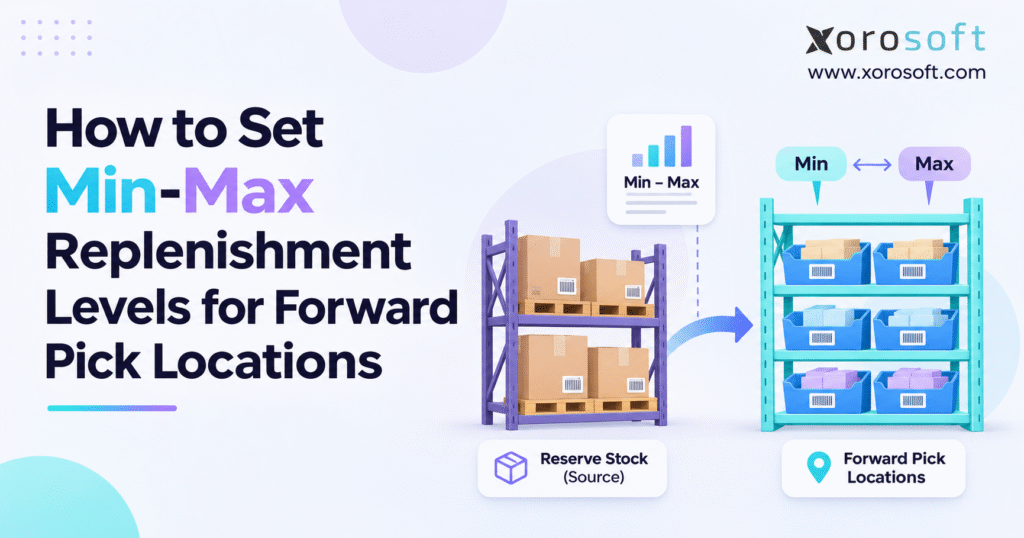
Min-max replenishment is an important concept to consider when optimising inventory processes.
1. Why Incorrect Replenishment Levels Disrupt Warehouse Fulfillment
A warehouse can hold thousands of units in reserve storage and still struggle to complete customer orders on time. Often, the problem is not insufficient inventory but poor inventory placement. Without effective min-max replenishment, forward pick locations may run empty before warehouse teams recognize that additional stock is needed.
For example, a distributor might hold 600 units of a fast-moving product in reserve storage while its active picking location contains only 25 units. If upcoming orders require 100 units, the picking team faces an immediate shortage of 75 units despite sufficient warehouse inventory.
Consequently, unnecessary stock movements interrupt picking schedules and increase pressure on warehouse supervisors. Moreover, urgent replenishment tasks compete with receiving, put-away, cycle counting, and other planned activities.
1.1 How Empty Pick Locations Increase Fulfillment Costs
When pickers encounter an empty location, they may need to stop processing an order, request assistance, or travel to another storage area. Although a single interruption might seem minor, repeated delays can affect hundreds of order lines during busy periods.
Furthermore, incomplete orders may occupy staging and packing areas while workers wait for missing products. As a result, congestion makes it harder to maintain an efficient fulfillment schedule.
Warehouse managers should therefore evaluate stock availability at the picking-location level rather than relying solely on total warehouse quantities.
1.2 Why Overstocked Pick Faces Are Also a Problem
Increasing inventory in every forward location is not an effective long-term solution. After all, picking space is limited, particularly in warehouses that manage thousands of SKUs with different storage requirements.
Research published in Allocating Space in a Forward Pick Area of a Distribution Center explains how forward storage quantities influence the replenishment workload required to maintain picking operations.
Larger stock quantities may reduce refill frequency. However, they can also prevent other high-activity products from receiving suitable locations.
Effective min-max replenishment must therefore balance picking efficiency, inventory availability, storage capacity, and labor requirements. The objective is to keep products accessible without moving or storing more inventory than the operation needs.
2. How Min-Max Replenishment Works in Forward Pick Locations
2.1 Understanding Minimum and Maximum Stock Levels
Min-max replenishment is a warehouse inventory method that establishes a minimum stock threshold for triggering replenishment and a maximum stock target for calculating refill quantities. Eligible inventory moves from reserve storage into forward picking locations according to these limits.
The minimum represents the point at which additional stock is needed. Meanwhile, the maximum represents the desired inventory balance after accounting for the planned refill.
For instance, a picking location might have a minimum of 40 units and a maximum of 160 units. When its eligible inventory position falls below 40 units, the replenishment process calculates the quantity needed to move toward 160.
However, the actual transfer must also consider available reserve stock, pending movements, packaging requirements, and physical storage limits.
2.2 Which Inventory Quantities Should Trigger Replenishment?
Warehouse inventory records contain several different stock balances. Therefore, using the correct balance is essential for reliable replenishment decisions.
| Inventory type | Description | Replenishment treatment |
|---|---|---|
| Physical stock | All inventory occupying the location | Used to calculate physical occupancy |
| Pick-eligible stock | Inventory available for relevant picking demand | Included in eligible stock calculations |
| Allocated inventory | Stock committed to customer orders | Included or excluded according to demand scope |
| Restricted inventory | Damaged, expired, or quarantined stock | Excluded from usable inventory |
| Pending replenishment | Stock scheduled to arrive | Included when eligible and expected on time |
| Reserve inventory | Stock stored outside the picking location | Determines available refill supply |
Physical inventory and usable inventory are not always equal. For example, a location containing 100 units may have only 80 units available for picking because 20 units are restricted.
Similarly, pending replenishment may protect future demand, but workers cannot pick those units until the transfer has been completed.
As a result, min-max replenishment rules should distinguish between planned inventory availability and stock that is physically ready for picking.
2.3 Internal Replenishment Versus Supplier Purchasing
Internal stock replenishment moves existing inventory between warehouse locations. By contrast, supplier purchasing introduces additional inventory into the business.
Consequently, a purchasing reorder point and a forward-pick replenishment threshold serve different purposes. A SKU may have sufficient inventory across the warehouse while its active picking location requires an immediate refill.
Understanding forward pick location replenishment helps warehouse managers establish separate controls for purchasing decisions and internal inventory movements.
3. Collect the Right Data Before Setting Min-Max Replenishment Levels
3.1 Calculate SKU-Level Picking Demand
Reliable replenishment thresholds begin with accurate demand information. Instead of applying the same minimum and maximum quantities across an entire product category, calculate requirements for individual SKUs and picking locations.
Historical picking activity provides a useful starting point. For example, if workers need 480 units of a product during an eight-hour operating shift, average demand equals 60 units per hour.
Nevertheless, an average can hide short periods of intense activity. A product might experience most of its demand during the first two hours of a shift or immediately before the shipping cutoff.
Warehouse planners should therefore examine hourly consumption, order profiles, seasonal changes, and demand that could not be fulfilled because inventory was unavailable.
3.2 Measure the Complete Replenishment Protection Interval
Replenishment involves more than physically moving a carton between two locations. First, workers must identify the requirement and locate eligible reserve inventory. Next, they obtain any necessary equipment, complete the movement, and confirm the destination balance.
If stock levels are reviewed periodically, include the relevant time between crossing the threshold and detecting the shortage. In addition, measure task queue delays rather than assuming that every replenishment begins immediately.
However, avoid counting the same delay twice when historical task records already include part of the detection or execution process.
| Required data | Measurement | Primary data source |
|---|---|---|
| Picking demand | Units per operating hour | Orders and picking history |
| Review interval | Minutes or hours | Replenishment review schedule |
| Task execution time | Minutes per transfer | Warehouse task records |
| Safety buffer | Additional units | Historical demand variation |
| Location capacity | Maximum safe units | Storage and bin records |
| Case-pack quantity | Units per case | Product master data |
| Eligible reserve stock | Available units | Location inventory records |
| Seasonal demand | Changes in consumption | Historical order data |
3.3 Validate Forecasts Against Actual Warehouse Activity
Demand forecasting helps identify expected changes in product consumption. However, location-level replenishment also depends on how orders are released and assigned to picking zones.
For example, two warehouses selling the same product may require different thresholds because their operating hours, task queues, and storage layouts differ.
A warehouse demand forecasting system can provide planning inputs, while actual picking and replenishment records reveal whether those inputs reflect conditions on the warehouse floor.
Therefore, review both sources before approving the final min-max replenishment levels.
4. How to Calculate Minimum Replenishment Levels
4.1 Apply the Min-Max Replenishment Formula
The minimum stock threshold should protect picking operations during the time required to detect and complete replenishment.
Minimum replenishment level = Round up (hourly demand × protection interval + safety buffer)
Hourly demand represents the expected units consumed per operating hour. Meanwhile, the protection interval covers relevant review and execution delays. Finally, the safety buffer provides additional protection against uncertainty.
For example, suppose a product has an hourly demand of 40 units, a replenishment protection interval of 1.5 hours, and a safety buffer of 20 units.
Minimum replenishment level = (40 × 1.5) + 20
Minimum replenishment level = 80 units
Therefore, under a policy that triggers strictly below the minimum, routine replenishment becomes necessary once the applicable inventory position falls below 80 units.
However, some systems trigger at or below the minimum instead. Confirm which condition applies before testing the configuration.
4.2 Calculate Safety Stock for Variable Picking Demand
Safety stock should reflect operational uncertainty rather than an arbitrary percentage applied to every product.
For predictable items, a simple buffer based on historical variation may be sufficient. However, products with irregular orders or changing fulfillment schedules require closer analysis.
One approach involves measuring demand over historical periods equal to the replenishment protection interval. For instance, if average consumption during that period is 60 units but a selected historical percentile is 80 units, the implied safety buffer equals 20 units.
The percentile should reflect the business’s service requirements and tolerance for shortages. Additionally, where replenishment duration varies significantly, include that variation when estimating protection requirements.
| Operating condition | Hourly demand | Protection interval | Buffer | Minimum level |
|---|---|---|---|---|
| Normal demand | 40 | 1.5 hours | 20 | 80 |
| Peak demand | 60 | 1.5 hours | 20 | 110 |
| Delayed transfer | 40 | 2.5 hours | 20 | 120 |
| Peak demand with delay | 60 | 2.5 hours | 20 | 170 |
These hypothetical calculations hold the buffer constant to demonstrate how demand and timing affect the minimum. In practice, actual safety buffers may also increase when operating conditions become less predictable.
4.3 Avoid Setting the Minimum Too Close to Zero
A threshold of five or ten units may appear efficient because it minimizes forward inventory. Nevertheless, it offers little protection if the product sells quickly or warehouse workers cannot complete transfers immediately.
Instead, select a minimum that reflects realistic replenishment conditions. If the required quantity exceeds usable storage capacity, improve the response time or redesign the picking location.
Otherwise, even carefully configured min-max replenishment rules may produce repeated emergency refills.
5. How to Calculate Maximum Replenishment Levels and Pick-Face Capacity
5.1 Establish the Maximum Stock Target
The maximum replenishment level defines the desired amount of inventory held in a forward picking location. Although larger refills can reduce transfer frequency, the target must remain compatible with storage limits and the requirements of surrounding products.
A practical planning formula is:
Maximum replenishment level = Smaller of usable capacity or minimum level + expected demand during the desired additional coverage interval
Round the calculated result to whole units without exceeding approved capacity.
For example, consider the product with a minimum of 80 units and hourly demand of 40 units. Assume the warehouse wants four additional hours of demand coverage and the location can safely hold 240 units.
Maximum level = 80 + (40 × 4)
Maximum replenishment level = 240 units
This target creates a 160-unit difference between the minimum and maximum. However, actual refill quantities depend on when the trigger is detected and how much stock remains.
5.2 Worked Example: Capacity-Constrained Maximum Inventory
Consider another SKU with hourly demand of 18 units, a two-hour protection interval, and a 12-unit safety buffer.
Minimum level = (18 × 2) + 12 = 48 units.
With five additional hours of demand coverage, the desired maximum equals 48 + (18 × 5) = 138 units.
However, the location can safely hold only 130 units. Therefore, the approved maximum becomes 130 units.
| Capacity factor | Operational consideration |
|---|---|
| Shelf dimensions | Product and packaging must fit within usable space |
| Rack load rating | Total stored weight must remain within approved limits |
| Product orientation | Required stacking and handling positions must be maintained |
| Case-pack size | Movement quantities must match permitted packaging units |
| Restricted stock | Unusable inventory may still occupy physical space |
| Equipment access | Workers need suitable access for picking and replenishment |
US warehouse operators should account for applicable OSHA materials handling and storage requirements. Similarly, Canadian businesses should follow the relevant provincial or territorial workplace safety rules.
5.3 What Happens When Minimum Stock Exceeds Available Capacity?
If the minimum equals or exceeds the maximum, there is no useful replenishment range. In other words, the location cannot support the selected min-max replenishment policy under the current planning assumptions.
The issue may indicate that the SKU has outgrown its assigned location or that replenishment takes too long.
For example, possible solutions include increasing the assigned storage space, improving transfer response times, splitting demand across suitable locations, or picking certain orders directly from reserve storage.
Above all, never increase a configured maximum beyond safe physical capacity simply to accommodate a calculated minimum.
6. Calculate Min-Max Replenishment Quantities Without Overfilling Locations
6.1 Use Inventory Position Instead of Physical Stock Alone
Once the minimum and maximum have been established, calculate the quantity needed for each replenishment task.
Inventory position = Eligible pick stock + eligible pending replenishment
Raw replenishment quantity = Maximum target − inventory position
The quantity cannot be negative. Furthermore, routine replenishment should only be released when the selected trigger condition has been met.
For example, a location with a maximum of 240 units and 60 units of eligible stock requires a planned refill of 180 units when no other eligible transfers are pending.
However, the warehouse must also verify available reserve supply and uncommitted destination space before releasing the task.
6.2 Adjust Replenishment Quantities for Case-Pack Restrictions
Warehouse stock often moves in cartons, totes, or pallets rather than individual units. Consequently, the calculated refill may need adjustment before workers can execute it.
Suppose a location has a maximum of 130 units and currently contains 35 units. Its required refill equals 95 units. However, if products move in cases of 24, only three complete cases can be transferred without exceeding the target.
Replenishment quantity = 3 × 24 = 72 units.
The projected balance becomes 35 + 72 = 107 units. In contrast, moving four cases would produce 131 units, exceeding the location capacity.
Therefore, round down when whole-case movements are mandatory. Where permitted, smaller handling units may help resolve a remaining shortage.
6.3 Worked Example: Pending Transfers and Limited Reserve Stock
Assume a SKU consumes 24 units per hour, requires a two-hour protection interval, and has a 12-unit safety buffer. Its minimum equals 60 units.
With 3.5 additional coverage hours, its maximum equals 144 units within a safe capacity of 160.
The location contains 24 eligible units, and another 24 units are already scheduled to arrive. Therefore, its inventory position equals 48 units, producing a raw refill requirement of 96 units.
However, only 72 uncommitted reserve units remain. Consequently, with 12-unit cases, the warehouse can release six cases.
| Scenario | Current stock | Pending stock | Maximum | New refill | Projected balance |
|---|---|---|---|---|---|
| Standard refill | 60 | 0 | 240 | 180 | 240 |
| Whole-case restriction | 35 | 0 | 130 | 72 | 107 |
| Limited reserve supply | 24 | 24 | 144 | 72 | 120 |
| Existing stock at minimum | 80 | 0 | 240 | 0 | 80 |
Chart 1. Illustrative forward pick inventory cycle
Operating hour 0: 60 units → Hour 1 before refill: 20 units → Hour 1 after refill: 200 units → Hour 4.2: 72 units → Hour 5.2 before refill: 32 units → Hour 5.2 after refill: 200 units.
The first transfer adds 180 units, while the second adds 168 units. Consumption continues at 40 units per hour. Consequently, the actual receipt balance differs from the original planning target because picking continues during transfer execution.
Xorosoft supports location-level inventory visibility and barcode-based warehouse operations. As a result, these capabilities can help teams distinguish recorded stock, pending inventory movements, and confirmed physical transfers when managing min-max replenishment.
7. Choosing Between Min-Max Replenishment and Demand-Based Methods
7.1 When Fixed Replenishment Thresholds Work Best
Fixed min-max replenishment is particularly useful for products with regular consumption and reasonably predictable transfer times. A warehouse can therefore maintain routine stock availability without recalculating requirements for every individual order.
For example, a distributor shipping similar quantities of packaging supplies throughout the day may benefit from stable minimum and maximum levels.
However, fixed rules become less reliable when customer orders arrive in unusually large quantities or demand changes without warning.
A bin containing 100 units against an 80-unit minimum may not trigger replenishment, even when an upcoming order requires 150 units.
7.2 Combine Routine Thresholds With Order-Based Requirements
Demand-based replenishment calculates stock requirements from upcoming orders or planned picking activity. Accordingly, it can address shortages that fixed thresholds have not yet detected.
Instead of choosing one method for every product, a hybrid approach combines routine min-max replenishment with additional checks for large orders, promotions, or scheduled order waves.
| Replenishment method | Trigger | Best application | Main limitation |
|---|---|---|---|
| Fixed min-max | Stock threshold | Predictable SKU demand | May miss sudden order spikes |
| Demand-based | Upcoming order requirements | Irregular or large orders | Requires reliable order data |
| Scheduled top-off | Planned review time | Consistent operating schedules | May generate unnecessary movements |
| Hybrid replenishment | Threshold and order demand | Mixed product catalogs | Requires coordinated task management |
| Direct reserve picking | Specific customer order | Bulky or slow-moving items | Can increase picker travel |
The appropriate policy therefore depends on the product’s demand profile rather than a single warehouse-wide preference.
Further analysis of min-max versus demand-based pick-face replenishment can help warehouse managers identify where each method fits.
7.3 Identify Products That Do Not Need Dedicated Pick Faces
Not every SKU benefits from a permanent forward location. For example, slow-moving products may occupy valuable storage space for weeks without generating enough picking activity to justify the allocation.
Similarly, bulky products and full-pallet shipments may be more economical to pick directly from reserve storage.
Before assigning a dedicated location, compare expected picking travel savings against the additional space and replenishment work required.
In addition, review the decision periodically. A seasonal item that warrants forward storage during peak demand may become a suitable reserve-picking candidate when the season ends.
8. How to Configure Min-Max Replenishment in a Warehouse Management System
8.1 Establish SKU-Level and Location-Level Replenishment Rules
A warehouse management system should use consistent product and location records before applying replenishment rules. Otherwise, incorrect packaging quantities, duplicate item records, or outdated bin assignments can undermine carefully calculated thresholds.
First, document the approved picking location, source storage zones, minimum, maximum, unit of measure, and movement restrictions for each SKU.
Where several locations hold the same product, define which location supplies each picking zone or order profile. Otherwise, warehouse demand may become concentrated in one bin while inventory remains unused elsewhere.
Furthermore, replenishment should consider task priorities. For example, an empty location serving orders due within an hour may need attention before a low-priority top-off task.
8.2 Connect Replenishment Tasks With Physical Inventory Movements
An effective replenishment workflow identifies the stock requirement, checks eligible reserve inventory, calculates the permitted transfer quantity, and releases authorized work.
Once a worker completes the movement, the destination quantity must be confirmed. Until then, the pending stock should remain separate from the physical picking balance.
This distinction becomes particularly important when a warehouse has several workers creating and completing transfers simultaneously.
Xorosoft offers warehouse management software that supports real-time inventory tracking, barcode scanning, receiving, put-away, picking, and replenishment workflows.
During implementation, businesses should therefore verify how their selected configuration handles threshold detection, open transfers, stock eligibility, handling-unit restrictions, and incomplete tasks.
In particular, min-max replenishment behavior should be demonstrated using real warehouse scenarios rather than assumed from a feature list.
8.3 Create Exception Rules for Failed Replenishment Tasks
Not every transfer will succeed exactly as planned. For example, a worker may find less inventory than expected, encounter a blocked destination, or discover damaged stock in the source location.
Instead of confirming the original quantity automatically, record the actual movement and retain visibility into the remaining requirement.
For instance, if a planned 120-unit transfer delivers only 96 units, the warehouse must account for the missing 24 units before deciding whether another task is needed.
As a result, clear exception handling protects inventory accuracy and prevents incorrect stock records from generating further replenishment errors.
9. Min-Max Replenishment Strategies Across Six Inventory-Driven Industries
9.1 Apparel and Fashion
Apparel demand often varies significantly by size, color, and style. Although a product family may sell consistently, individual variants may have entirely different consumption patterns.
Therefore, calculate replenishment thresholds at the variant-SKU level. In addition, review popular sizes before new collection launches and seasonal promotions.
9.2 Furniture and Home Goods
Furniture distributors must balance product accessibility against bulky storage requirements. For example, a large carton can occupy space that would otherwise support several fast-moving products.
Consequently, maximum levels should reflect product dimensions, weight restrictions, equipment access, and actual picking frequency. Alternatively, direct reserve picking may be more suitable for slower-moving furniture items.
9.3 Sporting Goods
Sporting goods warehouses experience demand changes around product launches, seasonal activities, and promotional events.
For instance, a product with stable winter demand may require a substantially different minimum during summer. Therefore, maintain separate planning assumptions for normal and peak periods rather than using one annual threshold.
9.4 Food and Beverage
Food replenishment requires careful attention to lot eligibility, expiry dates, storage conditions, and product rotation.
Even when reserve inventory exists, certain lots may be unsuitable for the relevant customer orders. Consequently, warehouses should apply required rotation practices, such as first-expiry-first-out where appropriate, alongside location-level replenishment controls.
9.5 Wholesale Distribution
Wholesale orders frequently contain larger case or pallet quantities than direct-to-consumer shipments. Consequently, a single customer order may consume most of a forward location’s available inventory.
Combining regular min-max replenishment with advance review of scheduled wholesale and EDI orders can therefore help reduce unexpected picking shortages.
9.6 Manufacturing and Production
Manufacturers can apply similar replenishment principles to component staging and material supply locations. However, demand calculations should reflect production schedules, bill-of-material quantities, and work-order requirements.
| Industry | Primary demand driver | Replenishment priority |
|---|---|---|
| Apparel | Variant-level sales | Size and color availability |
| Furniture | Product order frequency | Safe storage and space utilization |
| Sporting goods | Seasonal sales | Flexible thresholds |
| Food and beverage | Lot-eligible demand | Rotation and expiry control |
| Wholesale | Case and pallet orders | Large-order availability |
| Manufacturing | Work-order consumption | Production continuity |
Xorosoft connects warehouse, inventory, sales, purchasing, and manufacturing functions across several inventory-driven industries. As a result, connected data can provide planners with relevant demand and supply information without requiring separate inventory calculations for every department.
10. Measure Min-Max Replenishment Performance and Warehouse Labor Costs
10.1 Track Operational KPIs That Reveal Replenishment Problems
Warehouse managers should evaluate min-max replenishment performance using measurable operational outcomes. After all, counting completed transfers alone does not reveal whether those transfers protected picking demand or consumed unnecessary labor.
For instance, a high number of completed tasks may indicate efficient execution. Alternatively, it could reveal that maximum quantities are too small and workers are repeatedly replenishing the same locations.
| Replenishment KPI | Calculation | Suggested pilot objective |
|---|---|---|
| Empty-bin event rate | Blocked pick attempts ÷ total attempts | Below 1% |
| On-time replenishment | On-time tasks ÷ tasks due | At least 98% |
| Emergency replenishment | Urgent tasks ÷ total tasks | Below 5% |
| Location accuracy | Correct counts ÷ audited counts | At least 99% |
| Replenishment lead time | Total duration ÷ completed tasks | Reduce avoidable delays |
| Picker waiting time | Total refill-related waiting minutes | Reduce interruptions |
| Replenishment labor cost | Labor hours × hourly labor cost | Optimize operating cost |
| Capacity utilization | Occupied capacity ÷ usable capacity | Maintain safe utilization |
Multiply ratio-based calculations by 100 to express them as percentages.
However, these objectives are illustrative pilot targets rather than verified industry benchmarks. Businesses should therefore establish their own targets based on operating conditions and customer service requirements.
10.2 Worked Example: Compare Replenishment Labor Costs
Assume a warehouse processes 2,400 units of demand under two replenishment policies. Both policies use an 80-unit minimum, with a typical trigger balance of 72 units.
Policy A replenishes 80 units per task, while Policy B replenishes 160 units. Both use six minutes of labor per task at a burdened hourly rate of $27.
Policy A requires 2,400 ÷ 80 = 30 tasks. Consequently, total labor equals three hours, costing $81.
In comparison, Policy B requires 2,400 ÷ 160 = 15 tasks. Total labor equals 1.5 hours, costing $40.50.
Chart 2. Illustrative replenishment task comparison
Policy A — 80-unit refill: ███████████████ 30 tasks
Policy B — 160-unit refill: ███████▌ 15 tasks
Under these assumptions, replenishment tasks decrease by 50%, and modeled labor costs fall by $40.50. The comparison assumes equal opening and closing balances within each policy, sufficient reserve inventory, safe capacity, and constant task duration.
Nevertheless, larger transfers may require more handling time or occupy valuable forward space. Therefore, the calculated savings are not guaranteed operational results.
Xorosoft provides warehouse and ERP reporting capabilities that can support performance reviews. However, businesses should confirm whether individual replenishment KPIs require configured reports or additional task-level data.
11. Connect Replenishment Planning With Ecommerce, Purchasing, and ERP
11.1 Manage Demand Across Multiple Sales Channels
Warehouse demand rarely comes from a single source. For example, an inventory-driven business may receive orders through Shopify, Amazon, wholesale accounts, retail stores, and EDI networks.
If each channel maintains a separate view of stock, warehouse planners may underestimate total picking requirements.
For instance, a Shopify promotion might increase demand for a product that already has several large wholesale orders scheduled. Although each channel appears manageable individually, their combined demand could exceed the available forward inventory.
Consequently, businesses should include relevant demand from all sales channels when calculating replenishment thresholds.
Businesses evaluating connected ecommerce operations can review the official Shopify ERP application listing and determine how order information, inventory availability, and fulfillment workflows fit their requirements.
11.2 Distinguish Internal Replenishment From Purchasing Shortages
A forward location shortage does not necessarily indicate that additional supplier inventory is needed. If sufficient reserve stock exists, the correct action may involve an internal warehouse transfer.
However, if the entire warehouse lacks eligible stock, repeated refill requests cannot solve the shortage. Instead, purchasing teams must evaluate supplier lead times, open purchase orders, expected demand, and available inventory across facilities.
Connecting min-max replenishment with broader purchasing processes therefore helps businesses distinguish warehouse execution issues from inventory planning problems.
For organizations that have outgrown spreadsheets and disconnected tools, Xorosoft offers XoroONE cloud ERP and XoroERP to bring inventory, purchasing, warehouse operations, accounting, and sales workflows together.
11.3 Prevent Conflicting Inventory Commitments Across Warehouses
Multi-warehouse businesses must calculate replenishment requirements according to local demand and available supply. Therefore, stock located in another distribution center should not automatically count as an immediate source for a forward picking location.
Interwarehouse transfers have different response times, transportation requirements, and receiving procedures. Accordingly, include those delays in supply planning rather than treating remote stock as immediately accessible.
Relevant ERP and warehouse integrations can help maintain connected order and inventory records. Nevertheless, each facility still needs its own operating rules, stock eligibility controls, and replenishment thresholds.
Ultimately, a shared inventory view improves planning only when location records, transfer status, and allocation logic accurately reflect physical operations.
12. Common Min-Max Replenishment Mistakes and How to Correct Them
12.1 Relying on Outdated Minimum and Maximum Levels
Replenishment thresholds should change when the operation changes. Yet, warehouses sometimes continue using values established months or years earlier.
For example, product demand may increase, case sizes may change, or storage locations may be reassigned. Meanwhile, replenishment response times can become longer as order volume grows.
Therefore, review min-max replenishment levels when these changes occur rather than waiting for repeated stockouts to reveal the problem.
A regular review should examine whether actual demand, task durations, and usable capacity still support the configured values.
12.2 Ignoring Inventory Accuracy and Pending Warehouse Tasks
Inaccurate stock records create two opposing problems. The warehouse may generate unnecessary replenishment tasks because recorded quantities are too low. Conversely, it may fail to replenish because the system reports stock that is not physically present.
Both situations reduce confidence in replenishment rules.
In addition, pending transfers create another challenge. If workers generate a new task without checking outstanding movements, the same location may receive more inventory than it can hold.
Therefore, maintain clear visibility into task status, source reservations, destination capacity, and confirmed receipts. Xorosoft supports barcode-enabled inventory workflows and cycle counting, which can help teams maintain more reliable inventory records.
However, software cannot replace physical checks and disciplined exception handling when warehouse transactions are incomplete.
12.3 Using Identical Replenishment Rules Across Different SKUs
A warehouse containing thousands of products should not assign identical minimum and maximum quantities simply to simplify configuration.
After all, fast-moving items, slow-moving products, seasonal merchandise, and bulky inventory have different operational requirements.
ABC analysis can help prioritize products based on picking activity or consumption. For example, high-activity SKUs may warrant more frequent reviews because shortages affect a larger share of order fulfillment.
Nevertheless, classification alone cannot determine the correct threshold. Each product still requires an appropriate demand estimate, protection interval, safety buffer, and capacity assessment.
In particular, pay attention to products that repeatedly require emergency transfers despite having apparently sufficient minimum levels. The issue may be slow execution, inaccurate stock, unsuitable packaging multiples, or an unexpected concentration of demand.
Identifying the underlying cause is therefore more useful than repeatedly increasing the maximum.
13. A 30-Day Implementation Plan for Min-Max Replenishment
13.1 Days 1–7: Audit Warehouse Data and Establish a Baseline
First, begin with a representative group of products rather than changing every SKU at once. Include fast-moving, moderate-demand, and irregular-demand items.
During the first week, verify physical location quantities, review picking history, confirm case-pack sizes, measure usable capacity, and document existing replenishment delays.
In addition, establish baseline metrics for empty-bin events, urgent transfers, picker waiting time, and replenishment labor.
These measurements will help determine whether subsequent changes actually improve the operation.
13.2 Days 8–14: Calculate and Test Replenishment Thresholds
Use the collected data to calculate minimum and maximum levels for the selected pilot SKUs.
Next, test the proposed min-max replenishment rules against historical demand windows. Include periods with unusual order volumes, delayed transfers, limited reserve stock, and packaging restrictions.
A threshold that works under average conditions may still fail during a busy shift. Therefore, evaluate whether the proposed minimum protects demand under realistic operating conditions.
Furthermore, check that the maximum remains within safe capacity and that practical refill quantities can be moved using approved handling units.
13.3 Days 15–21: Run a Controlled Warehouse Pilot
Apply the calculated thresholds to the selected locations and monitor actual performance.
Warehouse supervisors should review urgent tasks, late replenishments, incomplete transfers, and inventory discrepancies each day. In addition, collect feedback from pickers and replenishment workers about access, congestion, and task timing.
If workers repeatedly bypass the proposed process, investigate why. For example, the configuration may not reflect how orders are released or how physical stock moves through the warehouse.
Rather than immediately changing every threshold, determine whether the problem comes from planning assumptions or warehouse execution.
13.4 Days 22–30: Review Results and Expand Successful Rules
Finally, compare pilot performance against the original baseline. Examine changes in stock availability, replenishment labor, task frequency, and storage utilization.
If shortages decrease without creating additional congestion or excessive inventory movements, extend the rules gradually to other suitable products.
Conversely, if the pilot produces poor results, reassess the demand model, safety buffer, protection interval, or location capacity.
Assign clear responsibility for future threshold reviews. For example, weekly checks may be appropriate during implementation, while stable products may require monthly reviews or updates whenever demand patterns change.
A controlled rollout therefore reduces the risk of introducing widespread replenishment problems through untested warehouse settings.
14. Build a Min-Max Replenishment Strategy That Supports Sustainable Growth
14.1 Balance Inventory Availability, Storage Space, and Warehouse Labor
Effective min-max replenishment depends on understanding how demand, inventory movements, and storage constraints interact. The minimum must protect picking operations during replenishment delays, while the maximum should provide suitable stock coverage without consuming unnecessary space.
First, identify the products that create the most frequent picking interruptions. Measure their actual consumption, identify replenishment delays, verify reserve stock eligibility, and calculate thresholds that reflect physical warehouse conditions.
Next, evaluate the proposed rules using real transaction history before expanding them across additional SKUs.
Ultimately, a successful replenishment policy should improve stock accessibility without simply increasing the amount of inventory stored in every picking location.
14.2 Turn Replenishment Rules Into an Ongoing Warehouse Practice
As businesses expand into new sales channels, distribution centers, and product categories, replenishment becomes more difficult to coordinate through disconnected systems.
Warehouse teams need reliable location balances. Meanwhile, purchasing teams need visibility into supply requirements, and operations managers need accurate demand information to prioritize work.
Xorosoft connects these inventory, warehouse, purchasing, accounting, and order management functions within a cloud ERP environment. Therefore, businesses evaluating more connected operations should assess whether their systems can support the specific replenishment rules and exceptions identified during implementation.
Begin by documenting your SKU-level thresholds, storage constraints, existing inventory discrepancies, and fulfillment delays. If manual processes continue to limit inventory visibility or warehouse performance, discuss your replenishment and inventory management requirements with an ERP specialist.
Ultimately, the objective is not simply to keep picking bins full. Instead, it is to make the right inventory available at the right location, in the right quantity, before the picking team needs it.
Frequently Asked Questions
What is min-max replenishment?
Min-max replenishment uses minimum stock thresholds to trigger inventory transfers and maximum targets to determine refill quantities. Consequently, it helps prevent forward pick location shortages.
How do you calculate minimum replenishment levels?
Multiply hourly picking demand by the replenishment protection interval, then add a safety buffer. Additionally, round up the result to ensure sufficient stock coverage.
How do you calculate maximum replenishment levels?
Add expected demand during the desired additional coverage period to the minimum stock level. However, the maximum must never exceed safe usable location capacity.
How is replenishment quantity calculated?
Subtract the eligible inventory position from the maximum stock target when replenishment is triggered. Then, adjust the quantity for reserve availability, capacity, and packaging restrictions.
How do case packs affect replenishment?
Case packs determine permitted inventory movement quantities. Therefore, warehouses should round down to complete cases when larger quantities would exceed the maximum target or available capacity.
Should pending transfers count toward inventory?
Yes, eligible pending transfers can count toward the planning balance if they will arrive on time. However, they should not count as physically available picking stock.
When should replenishment thresholds be updated?
Review thresholds monthly or whenever demand, replenishment lead times, packaging, or storage capacity changes. Furthermore, conduct more frequent reviews during seasonal peaks and promotional periods
Recent Posts
-
 How to Set Min-Max Replenishment Levels for Forward Pick Locations
-
 Shopify Product-Identifier Benchmarks 2026: Match Rates, Failures, and Manual Review
-
 Vendor-Managed Inventory vs Traditional Replenishment for Wholesale Distribution
-
 ERP Renewal Planning for Multi-Warehouse Distributors
-
 Production Scrap Accounting: Material, Labor, WIP, and Cost Variances