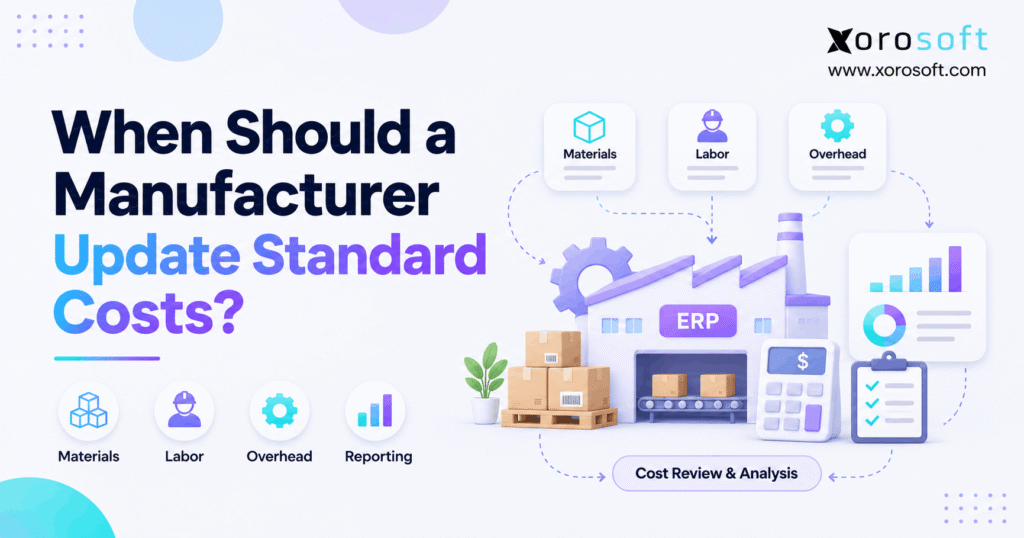
Knowing when to update standard costs is essential for accurate financial planning and effective cost management.
1. When Yesterday’s Costs Stop Reflecting Today’s Production
Knowing when to update standard costs helps manufacturers protect inventory valuation, maintain reliable product margins, and measure production performance accurately. However, supplier prices, labor rates, production methods, and overhead expenses rarely remain unchanged throughout the year. Consequently, manufacturers that rely on outdated cost assumptions may make decisions using numbers that no longer reflect normal operating conditions.
For example, a product that cost $22 to manufacture six months ago might now require $25 because of permanent material and labor cost increases. Meanwhile, the finance team may continue using the original standard to assess product profitability.
However, updating costs after every temporary fluctuation creates another problem. Frequent revisions can hide purchasing issues, production waste, and labor inefficiencies.
Therefore, manufacturers need a controlled review process that distinguishes temporary variances from lasting changes in production costs.
1.1 Why Standard Cost Accuracy Matters
Standard costs influence much more than manufacturing reports. For instance, they help businesses evaluate purchasing performance, prepare budgets, estimate product margins, and measure production efficiency.
Additionally, manufacturers use cost information to support pricing decisions and assess inventory balances.
When these assumptions become outdated, operational and financial reports may tell different stories.
For this reason, knowing when to update standard costs should form part of every manufacturer’s financial control policy.
1.2 Reviewing Costs Is Not the Same as Updating Them
A standard cost review examines whether existing assumptions remain reasonable. In contrast, a standard cost update activates revised values after validation and approval.
Similarly, a cost rollup calculates proposed product costs without necessarily changing active standards.
| Activity | Purpose |
|---|---|
| Cost review | Validate existing assumptions |
| Variance analysis | Explain differences between standard and actual costs |
| Cost rollup | Calculate proposed product costs |
| Cost approval | Authorize a revision |
| Cost activation | Implement approved standards |
| Reconciliation | Confirm financial accuracy |
Therefore, manufacturers should monitor costs frequently without assuming that every review requires a revision.
2. Understanding Manufacturing Standard Costs
A standard cost represents the expected cost of producing an item under defined operating conditions.
In other words, it provides a benchmark against which manufacturers compare actual production expenditure. However, the quality of this benchmark depends on the accuracy of its underlying assumptions.
2.1 Direct Material Costs
Direct material costs include the raw materials, purchased components, and other eligible input costs required to manufacture a product.
For example, a furniture manufacturer may include timber, fabric, fasteners, foam, and finishing materials.
Additionally, material cost calculations may account for:
- Supplier purchase prices.
- Applicable inbound freight.
- Material quantities.
- Purchasing discounts.
- Normal production losses.
- Expected material yield.
When determining when to update standard costs, manufacturers should examine whether these inputs reflect normal purchasing and production conditions.
However, one unusually expensive purchase should not automatically replace the existing material standard.
Instead, purchasing teams should determine whether the higher cost is likely to persist.
2.2 Direct Labor Costs
Direct labor costs reflect the labor required to manufacture a product. Therefore, manufacturers generally consider wage rates, normal production hours, setup times, and expected labor efficiency.
For example, assume a product requires 30 minutes of labor at an hourly rate of $24. Consequently, its standard direct labor cost equals $12.
If a permanent wage increase raises the hourly rate to $26, the proposed labor cost becomes $13.
However, temporary overtime does not necessarily justify changing the normal labor rate.
Similarly, one inefficient production shift should remain visible as a variance rather than becoming the new production benchmark.
2.3 Manufacturing Overhead Costs
Manufacturing overhead includes indirect production expenses that manufacturers allocate to products.
For instance, these costs may include factory depreciation, maintenance, production utilities, supervision, and indirect labor.
However, manufacturers must distinguish fixed overhead from variable overhead because each responds differently to production activity.
Furthermore, fixed production overhead allocation should reflect normal production capacity under applicable accounting requirements.
Therefore, a temporary decline in production should not automatically increase the fixed overhead assigned to each finished unit.
2.4 Standard Cost vs. Actual Cost
Although standard and actual costs describe production expenses, they serve different purposes.
| Factor | Standard cost | Actual cost |
|---|---|---|
| Basis | Expected cost | Incurred cost |
| Timing | Before production | During or after production |
| Purpose | Planning and measurement | Cost recording |
| Variability | Controlled revisions | Transaction-driven changes |
| Performance analysis | Benchmark | Actual result |
For example, a product may have a standard cost of $22 and an actual cost of $24.
As a result, management identifies a $2 unfavorable variance.
However, the difference alone does not establish that the standard is inaccurate. Instead, the manufacturer must investigate whether the variance reflects a lasting cost change or an operational problem.
3. When to Update Standard Costs: Choosing the Right Review Frequency
Manufacturers should update standards when material changes in normal operating conditions make existing costs unreliable.
However, no universal review schedule suits every manufacturing business.
Instead, manufacturers should design their review frequency around purchasing volatility, production complexity, and financial reporting requirements.
3.1 Annual Standard Cost Reviews
Annual reviews provide a useful starting point for manufacturers with stable suppliers, predictable production methods, and limited engineering changes.
For example, a business with long-term material contracts may conduct a comprehensive review before the beginning of its next financial year.
During this review, the finance team can validate material prices, labor rates, BOM quantities, and overhead assumptions.
However, an annual schedule should not prevent earlier action when important changes occur.
Therefore, manufacturers should combine annual reviews with clear event-driven review criteria.
3.2 Quarterly and Monthly Reviews
Manufacturers exposed to frequent input cost changes may need more regular assessments.
For instance, food manufacturers often experience changing ingredient prices. Similarly, industrial manufacturers may face fluctuations in metal prices, energy costs, and supplier terms.
Consequently, quarterly or monthly monitoring can help identify outdated assumptions earlier.
However, reviewing costs every month does not mean activating new standards every month.
Instead, use frequent monitoring to determine when to update standard costs based on reliable evidence.
3.3 Event-Driven Cost Updates
Sometimes, important changes occur between scheduled reviews.
For example, a manufacturer may introduce new machinery, change a product design, or agree to a permanent supplier price increase.
In these circumstances, waiting until the next annual review may leave significant cost assumptions outdated.
Therefore, an event-driven review should assess the financial impact immediately.
| Review frequency | Suitable environment |
|---|---|
| Monthly | Highly volatile material costs |
| Quarterly | Frequent supplier or production changes |
| Semiannually | Relatively stable manufacturing |
| Annually | Predictable operating conditions |
| Event-driven | Significant structural cost changes |
Above all, the review frequency should reflect business conditions rather than an arbitrary calendar.
3.4 What Accounting Standards Require
Accounting requirements also influence when to update standard costs.
According to the IFRS Foundation’s IAS 2 inventory guidance, inventory costs include relevant purchase and production expenses. Additionally, IAS 2 permits standard costing when the resulting amounts reasonably approximate cost.
Paragraph 21 requires regular reviews and revisions when current conditions warrant them.
Similarly, US GAAP under ASC 330 requires standard costs to approximate an accepted inventory cost basis at the balance-sheet date.
For additional context, KPMG’s analysis of IFRS and US GAAP inventory accounting explains the role of standard costing and normal production assumptions.
However, neither framework establishes one mandatory update schedule for every manufacturer.
Therefore, finance teams must assess whether standards remain appropriate rather than simply follow an annual calendar.
4. Seven Operational Triggers for Standard Cost Updates
Manufacturers should establish clear triggers that identify when cost assumptions require review.
Although individual circumstances differ, seven operational changes deserve particular attention.
4.1 Sustained Raw Material Price Changes
Permanent supplier price changes often provide the clearest indication of when to update standard costs.
For example, assume a supplier permanently increases a component price from $8 to $9.
If the manufacturer expects future purchases to continue at $9, the original $8 assumption may no longer reflect normal purchasing conditions.
Consequently, purchasing and finance should review:
- Updated supplier agreements.
- Recent purchase orders.
- Actual receipt prices.
- Freight expenses.
- Volume discounts.
- Expected future purchases.
However, isolated emergency purchases may create unfavorable variances without justifying a revision.
Therefore, distinguish lasting supplier changes from temporary procurement exceptions.
4.2 Permanent BOM and Engineering Changes
A bill of materials, or BOM, identifies the components and quantities required to manufacture a product.
Consequently, an approved BOM change can alter manufacturing costs even when supplier prices remain unchanged.
For example, an engineering team may replace two metal components with a single improved component.
Additionally, the new design may reduce assembly time and material consumption.
As a result, the existing standard may overstate the normal production cost.
Manufacturers should also consider shared components because one engineering change can affect several finished products.
Therefore, knowing when to update standard costs requires visibility across the complete product structure.
4.3 Permanent Labor Rate Changes
Labor rates change when manufacturers introduce new wage agreements, staffing structures, or employment terms.
For instance, a permanent increase in hourly wages may affect every product manufactured through a particular work center.
Similarly, a revised shift structure may change normal labor expenses.
However, manufacturers should review labor rates separately from labor efficiency.
A higher hourly wage increases the labor rate. In contrast, additional production time creates a labor usage or efficiency issue.
Therefore, finance teams should identify which assumption changed before revising the standard.
4.4 Production Routing and Automation Changes
Production routing defines the operations required to manufacture a product.
For example, routing may specify work centers, machine operations, setup times, and expected production hours.
When a manufacturer introduces automated equipment, these assumptions may change.
Suppose a manual cutting process previously required 12 minutes per unit. However, a new machine reduces validated processing time to seven minutes.
Consequently, labor and machine cost assumptions may need revision.
Nevertheless, equipment specifications alone should not determine when to update standard costs.
Instead, manufacturers should validate actual production results and confirm that the new process represents normal operating conditions.
4.5 Sustainable Changes in Scrap and Production Yield
Manufacturing yield determines how much usable output a production process generates from its inputs.
For example, a process may convert 100 kilograms of raw material into 90 kilograms of finished output.
However, a validated process improvement may increase output to 95 kilograms.
As a result, the material required per finished unit decreases.
This sustained improvement may justify a revised material consumption standard.
In contrast, abnormal waste caused by equipment failure should not become part of normal production assumptions.
Therefore, manufacturers should distinguish expected process losses from unusual production failures.
4.6 Changes in Normal Production Capacity
Manufacturers may expand facilities, install new production lines, or introduce permanent additional shifts.
Consequently, these changes can affect normal production capacity and overhead allocation.
For example, a factory may increase its sustainable annual output from 100,000 units to 150,000 units.
However, finance must validate the new capacity assumptions before revising fixed overhead rates.
Similarly, temporary reductions in customer demand do not necessarily establish a lower normal capacity.
For this reason, deciding when to update standard costs requires an assessment of sustainable operating capacity rather than short-term production volumes.
4.7 Structural Changes in Manufacturing Overhead
Factory expenses can change even when production methods remain stable.
For instance, manufacturers may introduce new maintenance agreements, production equipment, or permanent facility expenses.
Additionally, changes in indirect labor or factory utilities may influence production overhead.
Therefore, finance teams should periodically review:
- Equipment depreciation.
- Factory maintenance.
- Production utilities.
- Indirect labor.
- Allocation methods.
- Normal production capacity.
However, overhead standards should reflect eligible normal production costs rather than absorb every unusual expense.
5. When Not to Update Standard Costs
Although accurate standards are important, frequent revisions can undermine manufacturing performance measurement.
Therefore, manufacturers must establish clear circumstances in which existing standards should remain unchanged.
5.1 Temporary Cost Fluctuations
An isolated purchasing or production exception does not necessarily represent a new normal cost.
For example, a supplier may introduce a short-term freight surcharge during a transportation disruption.
Similarly, temporary overtime may increase labor expenditure during an unusually busy production week.
Although these events affect actual costs, they may not justify permanent revisions.
Instead, manufacturers should record the variances and investigate their causes.
| Operational event | Recommended response |
|---|---|
| Permanent supplier price increase | Review and potentially update |
| Emergency freight charge | Investigate |
| Approved BOM redesign | Recalculate affected costs |
| Temporary overtime | Monitor labor variance |
| Abnormal production scrap | Investigate and account for appropriately |
| Sustained yield improvement | Review normal material usage |
| Permanent capacity expansion | Review overhead allocation |
Consequently, the decision should depend on the nature of the change.
5.2 Why Frequent Revisions Can Hide Inefficiencies
Suppose a production team consistently uses more material than the approved BOM requires.
If finance increases the standard after every unfavorable material variance, the variance may gradually disappear.
However, the underlying material waste remains.
Similarly, continually increasing standard labor hours can conceal production delays and inefficient work practices.
Therefore, manufacturers should investigate root causes before deciding when to update standard costs.
Otherwise, the costing system may normalize avoidable problems rather than help management solve them.
5.3 Establishing Materiality and Persistence Thresholds
Manufacturers often ask whether a fixed variance percentage should trigger a cost update.
However, one percentage cannot adequately reflect every product’s financial exposure.
For example, a 10% increase in a low-cost packaging component may have little impact. In contrast, a 2% increase in an expensive material used across thousands of products may create substantial financial exposure.
Therefore, evaluate several factors together.
| Review factor | Key consideration |
|---|---|
| Materiality | Total financial impact |
| Persistence | Duration of the cost change |
| Production impact | Effect on normal operations |
| Inventory exposure | Quantity and value affected |
| Margin impact | Effect on product profitability |
| Evidence quality | Reliability of supporting data |
Above all, use thresholds to trigger investigation rather than automatic approval.
6. How Outdated Standard Costs Affect Financial Reporting
Outdated production standards can create problems across inventory valuation, manufacturing reporting, and margin analysis.
Consequently, manufacturers should examine financial exposure before approving revised costs.
6.1 Inventory Valuation and Standard Cost Accuracy
Manufacturers hold inventory at different production stages.
For example, inventory may include raw materials, subassemblies, work in progress, and completed products.
If standard costs no longer approximate an appropriate inventory cost basis, reported balances may become unreliable.
However, a new expected production cost does not automatically determine the correct carrying value of inventory manufactured in earlier periods.
Therefore, deciding when to update standard costs should include an assessment of existing inventory, normal cost variances, and applicable accounting policies.
Finance teams should also distinguish cost revisions from inventory write-downs because they serve different accounting purposes.
6.2 Work in Progress and Open Manufacturing Orders
Work in progress represents products that have entered production but remain incomplete.
For example, a manufacturing order may contain materials issued last month and labor scheduled for next month.
If the manufacturer activates a new standard during this period, the order may contain transactions recorded under different cost assumptions.
Consequently, finance must determine how the system treats open orders.
Additionally, the review should address:
- Materials already issued.
- Labor already recorded.
- Remaining production operations.
- Overhead applied to date.
- Effective dates.
- Required adjustments.
However, manufacturers should not assume that every open production order requires automatic revaluation.
Instead, establish a consistent accounting and operational policy.
6.3 Cost of Goods Sold and Product Margins
Standard cost changes can affect estimates of product profitability.
For instance, a manufacturer selling a product for $35 may calculate margins using a standard production cost of $22.
However, if normal production costs rise to $25, the earlier margin estimate becomes less useful for pricing decisions.
Consequently, management may underestimate the price increases needed to protect profitability.
This is another reason why understanding when to update standard costs matters beyond the accounting department.
Nevertheless, actual reported gross profit also depends on cost flows, variance accounting, and other relevant financial adjustments.
Therefore, manufacturers should reconcile operational margin estimates with financial results.
6.4 Connecting Operational Records With Finance
Cost reviews become harder when purchasing, engineering, production, and accounting maintain separate records.
For example, purchasing may receive updated supplier prices while production continues using an outdated BOM file.
Meanwhile, finance may discover the discrepancy only during month-end reconciliation.
As a result, different departments may calculate different costs for the same item.
Xorosoft’s connected business platform brings inventory, purchasing, accounting, and other operational records together.
Consequently, manufacturers can evaluate cost-related changes using more consistent business information.
However, accurate standards still depend on reliable source data, approved assumptions, and appropriate financial controls.
ERP Readiness Assessment: Review whether your current systems provide consistent purchasing prices, production records, inventory balances, and accounting information. If these records require extensive manual reconciliation, a connected ERP environment may be worth evaluating.
7. How to Update Standard Costs Without Losing Financial Control
A cost revision should follow a defined process rather than an informal spreadsheet change.
Therefore, manufacturers need a clear method for validating inputs, calculating proposed costs, approving changes, and reconciling financial balances.
7.1 Validate the Underlying Cost Inputs
First, identify which production assumptions have changed.
For example, purchasing should confirm updated supplier agreements, while engineering should validate approved BOM revisions.
Similarly, production teams should review labor hours, machine rates, and normal manufacturing yields.
A complete input review should include:
- Supplier prices and purchasing terms.
- Material quantities.
- Inbound freight assumptions.
- BOM revisions.
- Labor rates.
- Production routing.
- Machine operating costs.
- Scrap and yield assumptions.
- Manufacturing overhead.
- Normal production capacity.
Afterward, compare the validated inputs with existing standards.
Consequently, the finance team can determine when to update standard costs and which products require recalculation.
7.2 Recalculate Affected Product Costs
Once the inputs are reliable, manufacturers should calculate proposed product costs.
However, multi-level BOMs create additional dependencies.
For example, consider a finished product that contains a manufactured subassembly. The subassembly uses several purchased materials and production operations.
If one material becomes more expensive, the change may affect both the subassembly and the finished product.
Therefore, a cost review should follow these relationships throughout the affected product structure.
| Cost calculation method | Purpose |
|---|---|
| Single-level rollup | Recalculate a specific product using existing component costs |
| Multi-level rollup | Recalculate affected components, subassemblies, and parent products |
| Proposed cost calculation | Evaluate revised assumptions before activation |
Furthermore, manufacturers should investigate unexpected differences before approving the results.
7.3 Estimate the Financial Impact Before Activation
A proposed standard may affect thousands of inventory units and several manufacturing orders.
Consequently, reviewing the change at the individual product level is not always sufficient.
Finance should also estimate:
- Total inventory exposure.
- Changes in product margins.
- Potential WIP adjustments.
- Effects on future production costing.
- Relevant variance balances.
- Potential accounting entries.
For example, a $2 increase per unit may appear insignificant. However, applying that difference to 20,000 units creates a potential valuation difference of $40,000.
Therefore, knowing when to update standard costs also involves understanding the financial scale of the proposed change.
7.4 Approve, Activate, and Reconcile
After reviewing the financial impact, manufacturers should obtain approval from authorized personnel.
Next, they should establish the effective date and identify affected inventory and production transactions.
A controlled implementation follows seven steps:
- Validate the reason for the change.
- Calculate the proposed standard.
- Estimate financial exposure.
- Review open manufacturing orders.
- Obtain approval.
- Activate the revised standard.
- Reconcile relevant financial balances.
Additionally, manufacturers should preserve the previous standard and its supporting records.
Xorosoft supports manufacturing, inventory, purchasing, accounting, and operational reporting within a shared ERP environment.
However, businesses should verify how their specific standard cost approval, effective-date, rollup, and inventory adjustment requirements fit the available system configuration.
8. Standard Cost Update Example: From Production Costs to Profitability
Consider a hypothetical manufacturer that produces an industrial component.
The business currently uses a standard cost of $22 per finished unit. However, recent supplier agreements and permanent wage changes have increased its normal production costs.
Therefore, finance conducts a formal cost review.
8.1 Calculate Existing and Revised Costs
After validating the revised material, labor, and overhead assumptions, the manufacturer calculates the following proposed standard.
| Cost component | Existing cost | Revised cost | Change |
|---|---|---|---|
| Direct materials | $12.00 | $13.50 | +$1.50 |
| Direct labor | $6.00 | $6.60 | +$0.60 |
| Manufacturing overhead | $4.00 | $4.40 | +$0.40 |
| Total | $22.00 | $24.50 | +$2.50 |
Consequently, the proposed unit cost increases by approximately 11.36%.
However, the percentage increase alone does not determine when to update standard costs.
Instead, management must confirm that these changes represent normal future operating conditions rather than temporary production exceptions.
8.2 Compare Inventory Valuation Exposure
Assume the manufacturer holds 2,000 finished units.
Using the existing standard, the comparison value equals:
2,000 × $22 = $44,000.
Meanwhile, using the revised standard produces:
2,000 × $24.50 = $49,000.
Therefore, the difference between these two calculations equals $5,000.
However, this comparison does not establish that an automatic $5,000 inventory adjustment is appropriate.
Instead, the finance team must assess the applicable cost basis, inventory history, variance treatment, and accounting policy.
8.3 Evaluate the Product Margin Impact
Suppose the manufacturer sells each finished component for $35.
| Metric | Existing standard | Revised standard |
|---|---|---|
| Selling price | $35.00 | $35.00 |
| Unit cost | $22.00 | $24.50 |
| Unit gross profit | $13.00 | $10.50 |
| Illustrative gross margin | 37.14% | 30.00% |
Consequently, the estimated unit margin falls by 7.14 percentage points.
Without the cost review, management might continue planning prices around the earlier 37.14% margin.
However, the revised estimate provides a more useful view of current production economics, assuming the new costs reflect normal conditions.
9. Choosing Between Manual and ERP-Based Cost Reviews
Manufacturers do not necessarily need complex software to maintain reliable standards.
However, the appropriate approach changes as product structures, production facilities, and accounting requirements become more complex.
9.1 When Spreadsheet-Based Costing Is Sufficient
A small manufacturer may successfully manage standard costs through controlled spreadsheets.
For example, manual reviews can work when the business has:
- Relatively few products.
- Simple BOM structures.
- Stable material prices.
- Limited production locations.
- Straightforward accounting processes.
However, the company must maintain accurate source records, clear approval responsibilities, and reliable version histories.
Additionally, manufacturers should regularly reconcile spreadsheet calculations with production and inventory records.
Therefore, manual costing remains a reasonable alternative when operational complexity is limited.
9.2 When Manufacturers Outgrow Manual Cost Reviews
As businesses expand, disconnected costing files often create more administrative work.
For instance, changing one component price may require updates across dozens of spreadsheets.
Similarly, different production facilities may maintain separate versions of product costs.
Consequently, finance teams may struggle to determine when to update standard costs across the entire business.
Common warning signs include:
- Duplicate BOM records.
- Delayed supplier price updates.
- Inconsistent production cost calculations.
- Limited WIP visibility.
- Difficult month-end reconciliation.
- Unclear cost revision histories.
Xorosoft’s manufacturing ERP software combines production management with inventory and accounting capabilities.
Therefore, manufacturers evaluating connected systems can examine how shared records support more consistent cost reviews.
9.3 Manual vs. Connected ERP Workflows
A connected ERP environment can reduce dependence on separate operational spreadsheets.
However, software alone cannot guarantee accurate manufacturing costs.
| Operational area | Manual costing | Connected ERP environment |
|---|---|---|
| Purchasing | Separate price files | Shared purchasing records |
| BOM management | Spreadsheet versions | Centralized product structures |
| Production | Manual work-order reports | Connected production records |
| Inventory | Separate stock files | Integrated inventory information |
| Accounting | Manual reconciliation | Connected financial records |
| Reporting | Periodic consolidation | Shared operational reporting |
Furthermore, manufacturers should test their exact cost calculation and approval requirements during software evaluations.
Xorosoft’s approach connects manufacturing with purchasing, inventory, finance, and reporting. Consequently, operational teams can work from a more consistent information base.
9.4 Why Warehouse Accuracy Supports Manufacturing Costing
Manufacturing cost reviews depend on accurate material movement records.
For example, unrecorded material issues can distort production consumption. Similarly, incorrect stock adjustments can make actual usage difficult to reconcile.
As a result, finance may investigate a costing problem that actually originated in warehouse operations.
A connected warehouse management system helps manufacturers maintain visibility into receiving, inventory movements, and warehouse activities.
However, warehouse accuracy still depends on consistent transaction recording and process discipline.
Therefore, manufacturers should include material movement controls in their broader costing reviews.
10. Standard Cost Review Policies Across Manufacturing Industries
Different industries face different cost pressures.
Consequently, manufacturers should adapt their review policies to the production model, material risks, and purchasing environment.
10.1 Furniture and Industrial Manufacturing
Furniture and industrial manufacturers frequently work with purchased components, engineered assemblies, and multi-level BOMs.
For example, changes in timber, steel, hardware, or upholstery costs can affect numerous finished products.
Similarly, engineering revisions may alter both material requirements and assembly times.
Therefore, these manufacturers should assess component dependencies whenever significant changes occur.
Additionally, periodic reviews should validate production routing and machine cost assumptions.
10.2 Food and Beverage Manufacturing
Food manufacturers often experience changing ingredient prices, batch yields, packaging expenses, and normal process losses.
For instance, a permanent change in ingredient prices may affect several recipes.
Meanwhile, a sustainable yield improvement may reduce material requirements per finished unit.
Consequently, determining when to update standard costs requires accurate batch and production information.
However, abnormal spoilage should remain separate from normal yield assumptions.
Therefore, finance and production teams should review both purchasing conditions and manufacturing performance.
10.3 Apparel and Sporting Goods Manufacturing
Apparel and sporting goods manufacturers often manage extensive product variations and seasonal purchasing cycles.
For example, changes in fabric prices or component sourcing may affect several product sizes and styles.
Furthermore, seasonal production patterns can influence purchasing quantities and manufacturing requirements.
Therefore, manufacturers should review affected product families rather than rely exclusively on individual SKU assessments.
Xorosoft supports inventory-driven businesses across multiple manufacturing and product-based industries.
Consequently, businesses evaluating ERP solutions can assess the relevance of connected purchasing, production, inventory, and financial workflows to their particular operating model.
11. Building a Standard Cost Governance Policy
Reliable standard costs require clear ownership across departments.
However, finance cannot maintain accurate standards without input from purchasing, engineering, warehouse operations, and production.
Therefore, manufacturers should establish formal review responsibilities.
11.1 Assign Clear Ownership and Approval Responsibilities
Each department contributes different information to the cost review process.
| Department | Responsibility |
|---|---|
| Purchasing | Validate supplier prices and terms |
| Engineering | Approve BOM and routing changes |
| Production | Validate normal operating conditions |
| Warehouse | Confirm material movement accuracy |
| Cost accounting | Calculate proposed standards |
| Financial controller | Review and approve financial treatment |
Additionally, senior management should establish authorization limits for material cost changes.
For this reason, deciding when to update standard costs becomes a controlled business decision rather than an isolated accounting task.
11.2 Maintain a Standard Cost Review Checklist
A consistent checklist helps manufacturers repeat reviews without overlooking important information.
Before approving a revision, confirm the following:
- Supplier prices reflect normal purchasing conditions.
- BOM revisions have appropriate approval.
- Labor rates remain current.
- Production routing reflects actual operations.
- Normal scrap and yield assumptions remain reliable.
- Overhead allocations reflect appropriate production capacity.
- Proposed costs have been reviewed.
- Inventory exposure has been assessed.
- Open manufacturing orders have been considered.
- Effective dates and approvals are documented.
- Relevant balances reconcile after implementation.
Furthermore, retain previous calculations and supporting documents.
Consequently, the business can explain why standards changed and how those changes affected manufacturing performance.
11.3 Establish Performance Indicators for Ongoing Reviews
Manufacturers should monitor cost indicators between formal review dates.
For example, persistent purchasing variances may signal outdated supplier assumptions. Similarly, repeated labor efficiency differences may indicate problems with production routing.
Useful performance indicators include:
| Indicator | Review purpose |
|---|---|
| Purchase price variance | Identify material price differences |
| Material usage variance | Identify consumption differences |
| Labor rate variance | Identify wage-related changes |
| Labor efficiency variance | Assess production time |
| Overhead absorption variance | Review allocation assumptions |
| Normal production yield | Assess material requirements |
| Standard cost age | Identify potentially outdated records |
However, these indicators should trigger investigation rather than automatic changes.
Xorosoft connects manufacturing, purchasing, inventory, and accounting information. Therefore, manufacturers can evaluate whether a shared operational environment would reduce the manual work involved in collecting information for periodic reviews.
12. Conclusion: Keep Standard Costs Accurate Without Losing the Benchmark
Knowing when to update standard costs allows manufacturers to maintain reliable production benchmarks while responding to meaningful changes in operating conditions.
However, manufacturers should avoid revising standards after every temporary price increase, production delay, or unfavorable variance.
Instead, establish regular reviews, investigate significant changes, validate new assumptions, and assess financial exposure before implementation.
Additionally, preserve historical standards so management can continue measuring purchasing and production performance.
As operations grow, disconnected manufacturing, purchasing, inventory, and accounting records make this process increasingly difficult.
Xorosoft provides a connected ERP environment that brings these operational areas together. Consequently, manufacturers can evaluate their costing requirements alongside broader production and financial management needs.
If your business struggles with outdated cost assumptions or disconnected manufacturing records, Book a Demo to explore how connected ERP workflows can support your operations.
Frequently Asked Questions
How often should manufacturers update standard costs?
Review standards annually or more often in volatile environments. However, revise them only when reliable evidence shows normal costs have changed materially or financial reporting needs an adjustment.
Can manufacturers update standard costs midyear?
Yes. For example, a permanent supplier price increase or approved BOM change may justify a midyear revision. However, finance should document the effective date and accounting impact.
What triggers a standard cost revision?
Sustained material price changes, new wage rates, BOM revisions, routing changes, normal yield improvements, and structural overhead changes can trigger reviews. However, temporary variances usually require investigation first.
What variance percentage should trigger a review?
No universal percentage applies. Instead, combine unit cost variance, total financial exposure, persistence, inventory value, and operational causes to set thresholds that reflect your business.
Does a standard cost update change inventory value?
It can. However, the revised standard alone does not determine the carrying value of existing stock. Finance must assess the accounting policy, cost basis, and required adjustments.
What is the difference between a cost rollup and a cost update?
A cost rollup calculates proposed product costs using component and production inputs. In contrast, a cost update activates an approved standard for use from a defined effective date.
Who should approve manufacturing standard cost changes?
Finance should own approval, while purchasing, engineering, and production validate the inputs. In addition, authorized staff should review affected inventory, effective dates, and reconciliation requirements.
Recent Posts
-
 Production Scrap Accounting: Material, Labor, WIP, and Cost Variances
-
 Forward-Pick Replenishment Software for High-Volume Warehouses
-
 How a Shopify Brand Reconciled Split-Delivery Costs Across ERP and Fulfillment
-
 AI Purchase Order Change Detection for Cost, Quantity, and Date Exceptions
-
 Why ERP Change Orders Grow When Scope Acceptance Is Vague