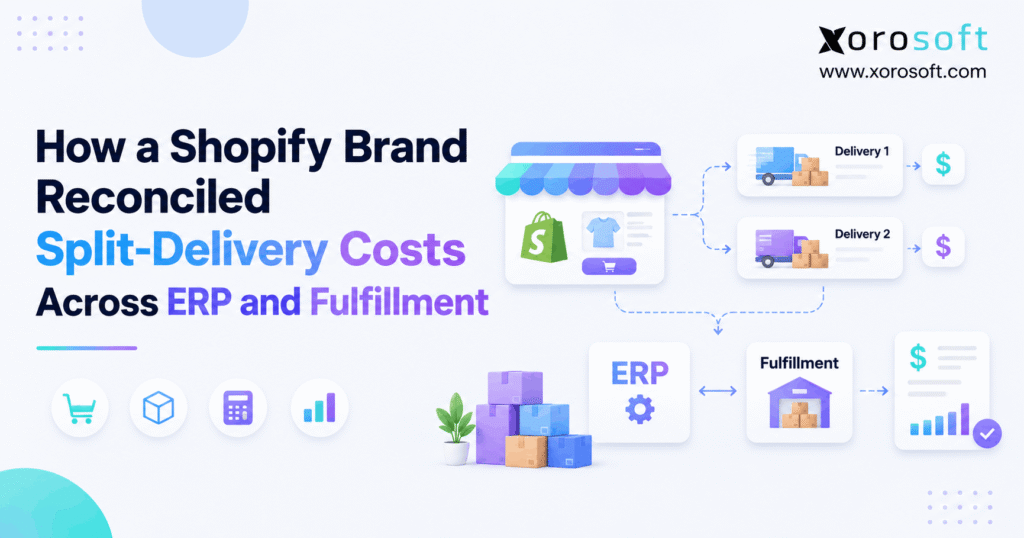
Split shipment cost reconciliation is an important aspect to consider when managing logistics and expenses.
1. One Order, Several Bills: Why Split Shipment Cost Reconciliation Matters
Split shipment cost reconciliation helps Shopify brands match actual delivery expenses with customer orders, warehouse shipments, carrier invoices and ERP accounting records. However, when one order generates multiple deliveries, these records often become disconnected. Consequently, finance teams struggle to determine the true cost of fulfilling each order.
For example, a customer might pay $12 for shipping, while the merchant spends considerably more across two warehouses. Meanwhile, additional carrier charges may arrive several days after dispatch.
Although the customer receives one order confirmation, the business must manage several financial and operational events.
This illustrative case study explains how a growing Shopify brand can resolve these differences. Furthermore, it demonstrates how connected records, reliable matching rules and accounting controls can improve delivery-cost visibility.
1.1 When a Shopify Order Becomes Multiple Deliveries
Growing ecommerce brands often distribute inventory across several fulfillment locations. Therefore, a single customer purchase may require products from different warehouses.
For example, a customer orders three products from a Shopify store. Two products are available in the eastern warehouse, while the remaining product is available in the western warehouse.
Consequently, the merchant creates two separate shipments against one customer order.
According to Shopify’s official split shipping documentation, different fulfillment locations, shipping profiles and preorder requirements can result in separate shipments.
Furthermore, each delivery may involve different package sizes, carriers, tracking numbers and transportation expenses.
As a result, an order-level shipping record alone cannot explain the total fulfillment cost.
1.2 Split Shipment Cost Reconciliation Starts With Separate Charges
Customer shipping revenue and actual transportation expenses represent different financial events. Therefore, businesses must record them separately.
For example, consider the following order:
| Financial measure | Amount |
|---|---|
| Customer shipping charge | $12 |
| First shipment expense | $14 |
| Second shipment expense | $19 |
| Total transportation expense | $33 |
| Net shipping recovery | -$21 |
Although the merchant collected $12 for delivery, it incurred $33 in actual transportation expenses.
Furthermore, the order may generate additional packaging, handling and warehouse labor costs.
Consequently, finance cannot use the checkout shipping rate as a substitute for the actual delivery expense.
Instead, the business needs shipment-level records that connect each charge with its operational source.
2. How Disconnected Records Created the Brand’s Problem
Consider an illustrative Shopify merchant selling consumer products across the United States and Canada. Initially, the business operated one warehouse. However, increasing demand led it to introduce another fulfillment location and an external logistics provider.
Although the expansion improved product availability, it also introduced more complex delivery expenses. Consequently, the finance team needed to reconcile records from several systems.
2.1 The Original Fulfillment and Accounting Setup
The merchant relied on separate applications for ecommerce, warehouse management, carrier billing and accounting.
| System | Primary responsibility |
|---|---|
| Shopify | Customer orders and shipping revenue |
| Warehouse platform | Picking, packing and dispatch |
| 3PL platform | External fulfillment services |
| Carrier portal | Shipping labels and transportation charges |
| ERP | Accounting and reporting |
| Spreadsheets | Manual cost matching |
Initially, this setup supported the merchant’s operations. However, transaction volumes increased as the business expanded.
Meanwhile, each platform maintained its own identifiers and transaction dates.
For example, Shopify recorded the customer order, while the warehouse generated independent shipment references.
Furthermore, carrier invoices arrived according to different billing schedules.
Consequently, finance spent considerable effort connecting records before it could validate transportation expenses.
2.2 Where Reconciliation of Split Shipment Costs Broke Down
The merchant identified several recurring issues during financial reviews.
First, some carrier charges arrived without matching shipment references. In addition, repeated imports occasionally created duplicate expenses.
Meanwhile, carrier surcharges appeared after the original fulfillment date. Furthermore, consolidated 3PL invoices combined transportation and handling expenses across several orders.
As a result, the ERP did not always reflect the complete cost of individual deliveries.
For example, a shipment might appear as completed in Shopify even though its carrier invoice had not arrived.
Similarly, an expense might appear in the ERP without a clear relationship to the corresponding order.
Therefore, the merchant needed to improve transaction traceability rather than simply add more reconciliation spreadsheets.
3. Building a Split Shipment Cost Reconciliation Model
A reliable reconciliation process begins with clear ownership of operational and financial records.
Instead of treating every application as an independent source of truth, the merchant assigned each system a specific responsibility.
Consequently, finance could determine which records supplied the expected expense, actual charge and approved accounting entry.
3.1 Assign Record Ownership Across Systems
The merchant established a record ownership model before introducing new matching rules.
| Transaction | Primary source |
|---|---|
| Customer purchase | Shopify |
| Customer shipping charge | Shopify |
| Actual dispatched quantity | Warehouse or 3PL |
| Tracking and package details | Fulfillment system |
| Carrier transportation expense | Carrier or label provider |
| External fulfillment fees | 3PL invoice |
| Financial posting | ERP |
For example, Shopify remained the source for the original customer purchase. However, the carrier or label provider supplied the actual transportation expense.
Similarly, the warehouse confirmed which products and quantities physically left its location.
Therefore, the ERP could maintain approved financial records without treating every operational update as a separate accounting event.
In addition, finance defined which team could approve corrections when source records disagreed.
3.2 The Identifiers Needed for Split Shipment Cost Reconciliation
A customer order number alone cannot reliably identify every delivery expense. Consequently, the merchant retained additional references throughout the fulfillment process.
These included:
- Shopify order ID.
- Order line ID.
- Fulfillment order ID.
- Fulfillment ID.
- Warehouse shipment reference.
- Package or tracking number.
- Carrier invoice line reference.
- ERP transaction ID.
For example, one Shopify order might contain several fulfillment records, while one fulfillment may involve multiple packages.
Therefore, the reconciliation model needed to preserve these relationships rather than force every record into a one-to-one structure.
Furthermore, the business recorded the original source identifier for every imported expense.
As a result, finance could distinguish a newly billed charge from a previously processed transaction.
3.3 Separate Customer Revenue From Actual Expenses
The merchant also separated customer shipping revenue, transportation expenses and product-level cost allocations.
For example, a customer could pay $15 for shipping while the brand incurs $40 across two deliveries.
However, the ERP should preserve the original $15 customer charge rather than repeat it against both shipments.
Similarly, the business should record the actual transportation expenses before distributing them across products for management reporting.
For merchants evaluating connected systems, Xorosoft’s Shopify App Store listing describes integrated order management, fulfillment, inventory synchronization and accounting capabilities.
Therefore, these connected records can provide a foundation for reconciliation, while specific carrier-cost mapping rules still require validation.
4. A Six-Step Split Shipment Cost Reconciliation Workflow
Once the merchant established reliable transaction relationships, it introduced a structured reconciliation workflow.
First, it captured individual fulfillment records. Next, it matched transportation expenses and investigated discrepancies. Finally, finance approved the corresponding ERP corrections.
Consequently, every expense could be reviewed against its original operational event.
4.1 Step 1: Capture Every Fulfillment Event
The workflow started with the original Shopify customer order.
Next, the merchant captured each fulfillment separately, including the products, quantities, location and available tracking details.
For example, a six-item order might generate two deliveries containing four and two items respectively.
Therefore, each shipment needed its own operational reference.
Furthermore, the integration retained updates when fulfillment records changed because of cancellations, partial shipments or revised tracking information.
Xorosoft’s ecommerce and ERP integrations provide a relevant starting point for connecting commerce and operational records.
However, implementation teams should confirm which shipment identifiers and expense fields their particular integration can transfer.
As a result, they can identify missing data before it affects financial reporting.
4.2 Step 2: Match Split Shipment Costs for Reconciliation
After capturing fulfillment activity, the merchant compared dispatch records with carrier billing information.
For example, a carrier invoice might include a tracking number without displaying the original Shopify order ID.
Therefore, the business used the tracking number and warehouse shipment reference to establish the relationship.
In addition, it compared supporting details such as shipment dates, origin locations, package weights and carrier accounts.
However, matching amounts alone did not provide sufficient evidence. Two unrelated packages could have identical transportation charges.
Consequently, the business required stronger transaction references before approving financial matches.
Where sufficient evidence was unavailable, the charge remained in an exception queue for investigation.
4.3 Step 3: Detect Missing and Duplicate Charges
The next stage compared completed warehouse shipments with imported expense transactions.
First, the process identified shipments without corresponding transportation costs. Next, it reviewed expenses that appeared more than once.
For example, the same shipping label might enter the ERP through both an original export and a repeated billing import.
However, repeated amounts did not automatically indicate duplication.
Instead, finance compared source transaction IDs and billing references.
Furthermore, Xorosoft’s warehouse management system provides operational visibility that can support the underlying shipment traceability requirements.
Consequently, teams can evaluate physical dispatch activity alongside financial records while configuring appropriate duplicate checks for their billing workflow.
4.4 Step 4: Resolve Carrier and 3PL Billing Differences
Carrier invoices and external fulfillment bills often contain several expense types.
For example, a 3PL invoice may include transportation, packing, handling and storage services.
| Service | Expense |
|---|---|
| Carrier transportation | $18 |
| Pick-and-pack service | $4 |
| Packaging | $2 |
| Special handling | $3 |
| Total | $27 |
Although all these charges relate to fulfillment, they do not necessarily belong to the same financial account.
Therefore, finance separated service categories before posting expenses.
Furthermore, the team checked whether transportation charges had already entered the accounting system through another billing source.
As a result, it could avoid counting the same carrier expense twice simply because both the carrier and fulfillment provider supplied a record.
4.5 Step 5: Split Shipment Cost Reconciliation Against ERP Entries
After validating the source charges, finance compared them with existing ERP transactions.
Next, the team classified discrepancies according to their cause.
For example, missing charges required additional expense recognition. In contrast, duplicate transactions required an approved correction.
Meanwhile, carrier credits reduced the relevant transportation expense, while additional surcharges increased it.
The team also checked transaction dates and accounting periods. Consequently, it could identify expenses that belonged to an earlier period rather than treating every invoice as a current-period cost.
Furthermore, each correction retained a relationship with the original source transaction.
Therefore, split shipment cost reconciliation established a traceable financial balance instead of replacing historical records without explanation.
4.6 Step 6: Confirm Order Contribution and Approve Corrections
Finally, the finance team reviewed the total delivery expense against customer shipping revenue.
However, the team did not treat shipping recovery as complete order profitability.
Instead, it combined the validated transportation expense with product costs, packaging, fulfillment labor and other relevant variable expenses.
For example, an order might generate strong product margins but lose money after expensive split deliveries.
Consequently, the reconciled information supported better decisions about warehouse allocation, free-shipping thresholds and fulfillment policies.
In addition, the team introduced an approval requirement for material corrections.
As a result, operations could confirm shipment activity while finance remained responsible for the final accounting treatment.
ERP readiness checkpoint: If your team cannot trace every delivery expense to its original shipment without manual investigation, review your data ownership, integration and financial control requirements.
5. Split Shipment Cost Reconciliation: A Worked Example
The following hypothetical example demonstrates how the merchant could identify and correct errors across two fulfillment locations.
Although the amounts are illustrative, the reconciliation method reflects common operational challenges involving missing expenses, duplicate imports and carrier adjustments.
5.1 The Initial Order and Two Deliveries
A customer places a $180 product order through Shopify. In addition, the customer pays $12 for shipping.
However, the products are stored in separate warehouses.
The first warehouse dispatches Shipment A and incurs a $14.80 shipping label expense. Meanwhile, the second warehouse creates Shipment B, which incurs a $21.40 transportation charge.
Unfortunately, the ERP imports the first shipping label twice.
Furthermore, the second shipment’s expense does not reach the ERP immediately.
Later, the carrier adds a $3.60 surcharge to Shipment B and issues a $2 credit against Shipment A.
Consequently, finance must reconcile several transactions to determine the correct expense.
5.2 Reconciliation of Split Shipment Costs and Adjustments
Initially, the ERP shows $29.60 in delivery expenses.
However, that balance contains a duplicate charge and excludes other legitimate transactions.
The reconciliation produces the following result:
| Transaction | Initial ERP expense | Validated expense |
|---|---|---|
| Shipment A label | $14.80 | $14.80 |
| Duplicate Shipment A label | $14.80 | $0.00 |
| Shipment B expense | $0.00 | $21.40 |
| Shipment B surcharge | $0.00 | $3.60 |
| Shipment A carrier credit | $0.00 | -$2.00 |
| Total | $29.60 | $37.80 |
First, finance removes the duplicate expense. Next, it records the missing shipment cost and additional surcharge. Finally, it applies the carrier credit.
As a result, the validated transportation expense becomes $37.80.
Consequently, split shipment cost reconciliation identifies an $8.20 understatement in the original ERP balance.
5.3 Calculate Net Shipping Recovery
The merchant collected $12 in customer shipping revenue. However, its actual delivery expense reached $37.80.
Therefore, the business can calculate net shipping recovery using the following formula:
Net shipping recovery = Customer shipping revenue − Actual transportation expense
In this example:
$12.00 − $37.80 = −$25.80
Furthermore, the shipping recovery rate provides another useful measure.
Shipping recovery rate = Customer shipping revenue ÷ Actual transportation expense × 100
| Financial measure | Result |
|---|---|
| Customer shipping revenue | $12.00 |
| Actual transportation expense | $37.80 |
| Net shipping recovery | -$25.80 |
| Shipping recovery rate | 31.7% |
Consequently, the merchant absorbs $25.80 in transportation costs before considering other fulfillment expenses.
However, this figure does not necessarily indicate that the entire order is unprofitable.
6. Exception Management in Split Shipment Cost Reconciliation
Not every difference represents an integration failure. In fact, legitimate billing adjustments, shipment changes and financial timing differences can also create exceptions.
Therefore, the merchant established separate investigation procedures for different types of discrepancies.
6.1 Missing References and Duplicate Transactions
A missing tracking number can prevent finance from matching a carrier charge with its corresponding shipment.
However, the warehouse may still hold the required dispatch reference.
Therefore, the team first reviewed available shipment records. Next, it compared supporting information such as dates, package details and locations.
Similarly, duplicate expenses required source-level verification.
For example, two shipments might both cost $18, even though they represent different deliveries.
Consequently, the team could not rely on matching amounts alone.
Instead, it compared unique transaction identifiers and billing records.
Furthermore, every approved correction retained its original reference so finance could explain the change during subsequent reviews.
6.2 Split Shipment Cost Reconciliation After Carrier Adjustments
The original shipping label amount does not always represent the final transportation expense.
According to Shopify’s shipping label billing documentation, checkout rates and label costs use separate calculations. Furthermore, carriers can apply charges or credits after reviewing shipped packages.
For example, an incorrect package dimension may result in an additional charge.
Therefore, the merchant linked each adjustment to its original shipment instead of treating it as an unrelated expense.
Meanwhile, disputed charges remained visible until finance reviewed the supporting evidence.
Consequently, valid corrections improved the final expense balance without removing the history of the original transaction.
6.3 Handle Cancellations, Returns and Currency Differences
Canceled orders do not automatically eliminate every transportation expense. For example, a merchant may have purchased a shipping label before receiving the cancellation request.
Therefore, finance should confirm whether the carrier issues a credit.
Similarly, return shipping creates another transportation event. Consequently, businesses should record return expenses separately from the original outbound delivery.
Currency differences also require attention.
For example, a Canadian warehouse might receive carrier invoices in CAD while the merchant reports in USD.
Therefore, the ERP should retain the original amount, transaction currency and approved exchange rate.
In addition, finance should distinguish currency-related differences from actual carrier billing errors.
7. Connecting Delivery Expenses With ERP Accounting
Reliable reconciliation connects operational transactions with the appropriate financial records.
However, matching a shipment to an invoice does not automatically determine its accounting classification.
Therefore, finance must establish policies for expense recognition, accruals, credits and reporting.
7.1 Split Shipment Cost Reconciliation at Month-End
Carrier invoices do not always arrive during the same accounting period as the related shipments.
For example, a warehouse could dispatch an order on the final day of November while the carrier bills the merchant in December.
Consequently, finance may need to recognize an estimated expense before the final invoice arrives, according to its applicable accrual accounting policy.
Next, the team compares the actual invoice with the existing estimate and records the required difference.
Xorosoft’s cloud ERP and accounting platform brings financial reporting and operational records into a connected environment.
However, the business should validate its specific freight accrual process and approval requirements during implementation.
7.2 Distinguish Inbound Freight From Outbound Delivery
Not every transportation expense should increase inventory value.
For example, inbound freight associated with bringing purchased inventory to its required location and condition may qualify for inclusion in inventory cost.
In contrast, outbound transportation to customers generally represents a selling or distribution expense.
Therefore, the merchant classified charges according to their actual purpose and applicable accounting policy.
| Transportation activity | Typical treatment |
|---|---|
| Supplier-to-warehouse freight | Potential inventory cost |
| Warehouse-to-customer delivery | Distribution or selling expense |
| Customer return transportation | Relevant returns-related expense |
| Carrier surcharge | Adjustment to the related cost |
| Carrier credit | Reduction of the related cost |
However, contract terms and applicable accounting standards can affect the final treatment.
Consequently, finance should review exceptions rather than apply one rule to every freight transaction.
7.3 Measure Contribution After Fulfillment Expenses
Once finance validates delivery expenses, management can calculate a more useful order contribution measure.
For example, the business may combine net product revenue with customer shipping revenue. Next, it subtracts product costs and relevant variable fulfillment expenses.
Furthermore, management can review contribution by warehouse, product category and shipping method.
This distinction matters because products with similar selling prices may generate different delivery costs.
For instance, an oversized product shipped from a distant warehouse may consume more margin than a smaller item fulfilled locally.
Consequently, split shipment cost reconciliation supports decisions about inventory placement, order routing and customer shipping policies.
However, contribution reporting should remain separate from the business’s formal financial statement classifications where appropriate.
8. Manual vs Integrated Split Shipment Cost Reconciliation
Manual reconciliation can support a business during its early growth stages. However, separate spreadsheets become more difficult to maintain as orders, warehouses and billing sources increase.
Therefore, the merchant evaluated whether a connected workflow could reduce repeated data entry while preserving financial controls.
8.1 When Spreadsheets Are Still Sufficient
A spreadsheet-based process may remain suitable for a Shopify brand operating one warehouse with straightforward carrier billing.
However, the business should maintain consistent shipment identifiers and documented matching rules.
| Process | Manual workflow | Integrated workflow |
|---|---|---|
| Shipment matching | Spreadsheet lookups | Configured data relationships |
| Expense imports | Manual file uploads | Connected feeds where supported |
| Duplicate checks | Manual review | Configured transaction controls |
| Exception handling | Email and spreadsheets | Structured review |
| Financial reporting | Separate reports | Connected operational records |
Although manual processes require less initial configuration, they can demand more administrative effort as complexity increases.
Conversely, integrated workflows require implementation planning and reliable source data.
Therefore, the right approach depends on transaction volume, financial risk and operational requirements.
8.2 When to Automate Split Shipment Cost Reconciliation
Automation becomes more relevant when manual reconciliation creates recurring financial delays or inaccurate reports.
For example, the business may need to investigate unmatched carrier charges every week. Meanwhile, repeated expense imports may increase the risk of duplicate postings.
Furthermore, several warehouses and fulfillment providers can make it difficult to maintain consistent records.
Xorosoft’s connected business platform combines ecommerce, inventory, warehousing and accounting capabilities.
Consequently, businesses can evaluate whether consolidating these workflows would reduce operational fragmentation.
However, they should confirm the required carrier billing integrations, matching logic and expense approval controls before introducing automated reconciliation.
9. How Different Industries Handle Split Deliveries
Although the reconciliation principles remain consistent, shipping requirements vary across industries.
Consequently, businesses should adapt their matching rules and financial reporting to the products, delivery methods and service charges they manage.
9.1 Apparel, Furniture and Sporting Goods
Apparel brands often distribute sizes, colors and product variants across several warehouses. Therefore, one customer order can generate deliveries from different locations.
Meanwhile, furniture merchants may ship oversized products separately from smaller accessories.
For example, a dining table might require specialized freight, while chairs travel through a different carrier.
Similarly, sporting goods businesses can face significant differences in package weight and dimensions.
Consequently, these businesses should preserve shipment-specific expenses rather than distribute every transportation charge equally across products.
Furthermore, accurate delivery-cost records can help management assess whether warehouse placement and fulfillment policies support order profitability.
9.2 Food, Wholesale and Manufacturing
Food businesses may require refrigerated, frozen or ambient transportation services. Therefore, different shipments can generate distinct handling and delivery expenses.
Meanwhile, wholesale distributors frequently manage partial shipments, customer-specific delivery arrangements and backorders.
Similarly, manufacturers may dispatch finished goods across several scheduled deliveries.
Consequently, each business needs reliable relationships between fulfilled quantities, shipment references and accounting records.
Xorosoft’s industry-specific solutions address operational requirements across inventory-driven businesses.
However, each implementation should reflect the company’s actual transportation services, financial policies and fulfillment complexity.
As a result, reconciliation remains relevant to the business rather than relying on a generic ecommerce workflow.
10. Implementing Split Shipment Cost Reconciliation Without Losing Control
Before changing its integration or ERP setup, the merchant documented the operational problems and expected financial outcomes.
First, it defined record ownership. Next, it established matching rules and tested difficult transactions. Finally, it introduced performance measures and approval controls.
Consequently, the implementation focused on measurable workflow requirements rather than software features alone.
10.1 Test Real Orders and Define Acceptance Criteria
Implementation teams should test more than straightforward customer orders.
For example, they should include orders with two warehouses, multiple packages and partial fulfillment activity.
Furthermore, the testing process should cover duplicate imports, missing tracking numbers, carrier credits and late billing adjustments.
Meanwhile, finance should verify the resulting accounting entries against supporting documents.
| Test scenario | Expected result |
|---|---|
| Two-warehouse order | Separate delivery records |
| Repeated carrier import | Duplicate identified |
| Missing invoice line | Visible reconciliation exception |
| Late surcharge | Linked expense adjustment |
| Voided shipping label | Eligible credit tracked |
| Partial fulfillment | Correct shipment quantities |
Consequently, the business can identify integration gaps before deployment.
However, acceptance should depend on verified transaction outcomes rather than successful data transmission alone.
10.2 Measure Split Shipment Cost Reconciliation Performance
After implementation, management should monitor whether reconciliation produces complete and traceable financial records.
For example, a high shipment matching rate is useful. However, it does not guarantee accurate expense values.
Therefore, businesses should monitor several complementary indicators.
| KPI | Measurement |
|---|---|
| Shipment matching rate | Matched shipments ÷ eligible shipments |
| Unmatched expense value | Total unresolved expense amounts |
| Duplicate expense rate | Confirmed duplicates ÷ imported charges |
| Freight accrual variance | Actual expense minus estimated expense |
| Exception resolution time | Average time to resolve discrepancies |
| Reconciliation completion | Completed records ÷ eligible records |
| Shipping recovery rate | Customer shipping revenue ÷ actual expense |
Furthermore, the merchant should investigate recurring exceptions rather than simply track their volume.
Consequently, these measures can guide improvements in source data quality and financial controls.
10.3 Decide Whether the Business Needs an ERP Upgrade
Not every Shopify merchant needs a new ERP system. For example, a small business with one warehouse and limited shipment volumes may manage reconciliation through existing accounting software.
However, the requirements change when the merchant adds warehouses, external fulfillment providers and additional sales channels.
Furthermore, growing transaction volumes can expose weaknesses in disconnected systems.
Common warning signs include:
- Recurring unmatched shipping expenses.
- Duplicate financial postings.
- Delayed month-end reporting.
- Inconsistent order profitability.
- Limited shipment-level visibility.
- Repeated manual data entry.
Therefore, businesses should assess their operational requirements before selecting new software.
Instead of purchasing an ERP solely to solve one reconciliation problem, they should evaluate how connected inventory, fulfillment, purchasing and accounting workflows could support wider business growth.
11. Conclusion: Reliable Delivery Costs Require Connected Records
Split shipment cost reconciliation connects physical fulfillment activity with accurate financial reporting. However, reliable results require more than importing carrier invoices into an ERP.
First, businesses must preserve individual shipment references. Next, they should match actual expenses, identify duplicates and investigate missing records. Furthermore, they need consistent procedures for late surcharges, carrier credits and accounting adjustments.
Consequently, finance gains a clearer view of delivery expenses and order contribution.
As Shopify brands expand, connected ecommerce, warehouse and accounting workflows become increasingly valuable.
Xorosoft provides a connected ERP foundation for inventory-driven businesses evaluating these requirements.
Book a Demo to discuss your Shopify fulfillment, inventory and accounting workflows.
Frequently Asked Questions
What is split shipment cost reconciliation?
It matches the actual costs of each shipment with its Shopify order, carrier or 3PL billing records, and ERP entries. As a result, finance can identify missing expenses, duplicate charges and adjustments.
Why do Shopify checkout rates differ from actual shipping costs?
Checkout rates reflect what customers pay. However, carrier expenses depend on package weight, dimensions, service and billing adjustments. Therefore, revenue and actual costs must remain separate in accounting.
How do you reconcile multiple shipments against one Shopify order?
Match each fulfillment to its shipment ID, tracking number and billing reference. Next, compare each validated charge with ERP postings and investigate differences before approving the order’s total delivery expense.
How can ERP teams prevent duplicate shipping expenses?
Use unique source transaction identifiers and check whether each charge has already posted. Furthermore, distinguish duplicate imports from legitimate charges of equal value, and preserve an audit trail for reversals.
How should late carrier adjustments be recorded?
Link each surcharge or credit to the original shipment. Then, verify the billing evidence and apply the approved accounting policy, especially when the original shipment belongs to a closed period.
How do brands reconcile unbilled shipments at month-end?
Identify dispatched shipments without final invoices. Next, accrue estimated expenses when required by accounting policy. Finally, reconcile the estimate with the confirmed invoice and record the difference.
When should a Shopify brand automate reconciliation?
Consider automation when multiple warehouses, recurring unmatched expenses or duplicate imports make manual checks unreliable. However, define record ownership, matching rules and approval controls before implementing a connected workflow.
Recent Posts
-
 How to Set Min-Max Replenishment Levels for Forward Pick Locations
-
 Shopify Product-Identifier Benchmarks 2026: Match Rates, Failures, and Manual Review
-
 Vendor-Managed Inventory vs Traditional Replenishment for Wholesale Distribution
-
 ERP Renewal Planning for Multi-Warehouse Distributors
-
 Production Scrap Accounting: Material, Labor, WIP, and Cost Variances