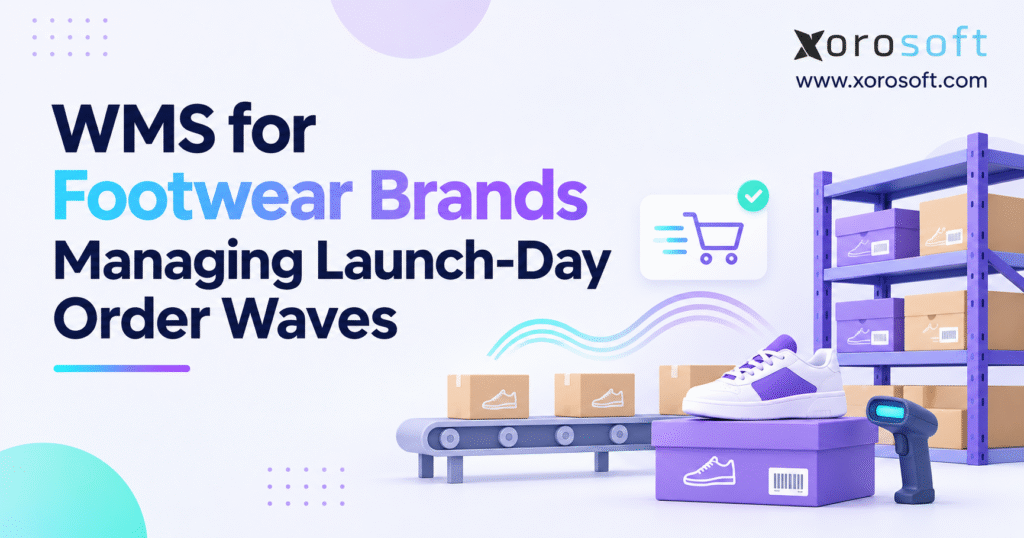
If you are seeking effective warehouse management solutions, choosing a WMS for footwear brands is a smart strategy.
1. Why Footwear Product Launches Put Warehouse Operations Under Pressure
A footwear collection can sell thousands of pairs within minutes. However, the warehouse may need several shifts to pick, pack and ship those orders. While strong sales show healthy customer demand, they can also expose problems with stock accuracy, labor capacity and order fulfillment.
A WMS for footwear brands helps businesses manage this gap between sales and warehouse output. It connects stock allocation, picking, packing and shipping through clear warehouse workflows. As a result, teams can handle sudden demand without losing control of inventory or customer orders.
1.1. Why Footwear Launches Create Unique Fulfillment Challenges
Unlike many consumer products, footwear comes in several sizes, colors and widths. Therefore, a single product launch can create hundreds of sellable variants.
For example, a sneaker brand may have 2,000 pairs in stock but only 50 pairs in its most popular size. Although total stock appears healthy, the brand could quickly run out of the variants customers want most.
Meanwhile, wholesale customers may already have claims on part of that stock. Without clear rules, online orders can consume inventory intended for retail partners.
These problems often lead to cancelled orders, wrong-size shipments and higher service costs. In addition, they create extra work for warehouse and finance teams.
1.2. Understanding the Role of a Footwear Warehouse Management System
A footwear warehouse management system manages receiving, storage, stock allocation, picking, packing and shipping. It helps employees locate the correct products and complete warehouse tasks in a clear order.
However, software alone cannot fix poor planning. Brands also need accurate product records, trained employees and realistic shipping promises.
For this reason, businesses should separate order acceptance from warehouse work release. Instead of sending every new order directly to the picking team, supervisors can release work in groups based on actual capacity.
Ultimately, a successful footwear launch depends on how well the business turns customer demand into accurate and timely shipments.
2. Managing Footwear SKU Complexity With Variant-Level Inventory Control
One of the main reasons businesses need a WMS for footwear brands is the large number of product variants. Managing inventory only at the style level can hide stock shortages and lead to poor sales decisions.
2.1. Building an Accurate Footwear SKU Matrix
Each sellable combination of style, color, size and width should have its own SKU. As a result, warehouse employees and sales teams can identify the exact product without relying on general descriptions.
Consider a footwear brand offering the following collection.
| Product attribute | Available variations |
|---|---|
| Footwear styles | 4 |
| Colorways per style | 5 |
| Sizes per colorway | 12 |
| Widths per size | 2 |
| Total possible SKUs | 480 |
Although the collection includes only four styles, it can create 480 unique SKUs if every combination is offered.
Furthermore, regional size systems and packaging options can increase this number. Therefore, brands should use clear product names and consistent SKU rules across all sales channels.
2.2. Preventing Broken Size Runs in Footwear Inventory
A broken size run occurs when some sizes sell out while others remain available. For instance, a retailer may have sizes 6 and 12 in stock but lack sizes 8, 9 and 10.
This issue can reduce sales even when the warehouse holds plenty of inventory. Similarly, wholesale customers may be unable to receive complete size assortments.
To avoid this problem, planning teams should review sales and stock by size. In addition, they should use past launch results to estimate which variants may sell faster.
2.3. Improving Footwear Inventory Accuracy With Barcodes
According to GS1 product identification guidance, different product sizes and colors require distinct GTINs.
Barcode scanning helps employees verify the correct footwear variant during receiving, picking and packing. However, the barcode records must be accurate.
For example, if two shoe sizes share an incorrect barcode mapping, scanning may not catch the error. Therefore, businesses should check product records before releasing new collections.
Clear SKU and barcode rules also make it easier to train temporary workers during busy launch periods.
3. Preparing a Footwear Warehouse Before Launch-Day Orders Arrive
An effective WMS for footwear brands starts with sound warehouse preparation. Many launch-day problems begin before the first customer places an order. For example, missing stock, wrong locations and late receipts can affect the entire fulfillment process.
3.1. Creating a Pre-Launch Warehouse Readiness Schedule
First, planning teams should review expected demand by size and color. Next, warehouse staff should check physical stock against system records.
Meanwhile, sales and customer service teams should confirm launch times and shipping promises.
| Timeline | Required activity | Responsible team |
|---|---|---|
| 14 days before launch | Review demand and stock forecasts | Planning |
| 7 days before launch | Check receipts and count inventory | Inventory |
| 3 days before launch | Prepare picking locations | Warehouse |
| 1 day before launch | Confirm labor, supplies and carriers | Operations |
| Launch day | Check stock and release order waves | Fulfillment |
| 1–3 days after launch | Review errors and reconcile stock | Operations and finance |
These time frames are examples rather than fixed industry rules. Therefore, brands should adjust them to suit their stock arrival dates and expected order volumes.
3.2. Preparing Pick Locations for Popular Footwear Sizes
High-demand footwear sizes should occupy locations that employees can reach easily. Meanwhile, reserve stock should remain close enough to support quick restocking.
A 2025 footwear warehouse research study includes real data on warehouse layouts, storage locations and picking waves. It provides useful context for understanding how product placement affects warehouse work.
Before a launch, supervisors should review the expected demand for each product. For example, a new sneaker colorway may need more picking space than an older bestseller.
3.3. Testing Footwear Fulfillment Before the Launch
A small test wave can help warehouse teams find problems before order volumes increase. Include common sizes, multi-item orders and products stored in different areas.
In addition, check barcode scanners, shipping labels and packing supplies. Confirm that employees understand the process for handling missing stock or damaged products.
Finally, verify carrier pickup times and available shipping capacity. Even a well-prepared picking team cannot meet delivery promises if packed orders remain waiting at the loading area.
4. Using WMS for Footwear Brands to Allocate Launch Inventory
Inventory allocation determines how much stock a business can offer to new customers. However, the quantity stored in a warehouse is not always the same as the quantity available for sale.
4.1. Understanding Available and Committed Footwear Inventory
Physical inventory includes all products held in the warehouse. Some of these products may already be assigned to customer orders. Others may be damaged or waiting for inspection.
Shopify’s inventory state documentation distinguishes available, committed, unavailable, incoming and on-hand stock.
For launch planning, businesses can use the following formula:
Available launch inventory = On-hand stock − Existing commitments − Unavailable stock − Additional channel reserves
However, businesses should only subtract reserves that have not already been included in another stock category. Otherwise, the same quantity may be deducted twice.
Similarly, incoming stock should not be treated as physically available before it has been received and approved for sale.
4.2. Protecting Wholesale and DTC Footwear Inventory
Footwear brands often sell through online stores, marketplaces and wholesale accounts. Consequently, several channels may compete for the same popular sizes.
Xorosoft supports footwear-specific ERP and matrix inventory management, helping businesses maintain visibility across styles, colors and sizes.
With accurate stock records, planning teams can protect retailer commitments before opening online sales. In addition, they can set clear rules for releasing unused stock reservations.
The aim is to prevent one sales channel from consuming inventory needed by another.
4.3. Worked Example: Allocating 10,000 Pairs for a Footwear Launch
Consider a hypothetical footwear brand preparing to launch a new collection.
| Size group | On hand | Committed | Unavailable | Wholesale reserve | DTC launch stock |
|---|---|---|---|---|---|
| 6–7 | 1,600 | 200 | 80 | 300 | 1,020 |
| 8–9 | 3,800 | 350 | 120 | 800 | 2,530 |
| 10–11 | 3,400 | 300 | 150 | 700 | 2,250 |
| 12–13 | 1,200 | 150 | 50 | 200 | 800 |
| Total | 10,000 | 1,000 | 400 | 2,000 | 6,600 |
Available DTC stock equals:
10,000 − 1,000 − 400 − 2,000 = 6,600 pairs
Although the warehouse holds 10,000 pairs, only 6,600 are available for this online launch.
Furthermore, the business has protected an additional 2,000 pairs for wholesale without affecting its existing commitments.
In practice, the same calculation should be performed for every individual SKU. As a result, brands can avoid offering popular sizes that are no longer available.
5. How WMS for Footwear Brands Controls Launch-Day Order Waves
During a major product launch, thousands of orders may enter the system within a short period. However, releasing all those orders at once can overwhelm warehouse employees and packing stations.
Controlled wave release provides a better way to manage the workload.
5.1. Understanding Launch-Day Wave Picking
Wave picking groups eligible orders or order lines into planned releases. These groups may reflect stock availability, shipping deadlines, product locations or customer priorities.
For example, a warehouse may release orders with early carrier deadlines before orders scheduled for the following day.
Meanwhile, supervisors can monitor completed work and resolve issues before releasing the next group.
A WMS for footwear brands can help organize this process by creating clear picking tasks and tracking warehouse progress.
Nevertheless, wave sizes should reflect actual warehouse capacity rather than a fixed number of orders.
5.2. Combining Manual and Automatic Wave Creation
Manual wave creation allows supervisors to select specific sales order lines for warehouse processing. This approach is useful when certain wholesale orders need priority or when stock shortages require closer review.
In contrast, automatic wave creation based on set rules can reduce repeated order selection.
Xorosoft provides warehouse management software with structured order and picking workflows. Its wave creation documentation describes manual and automatic methods for allocating available inventory to selected sales order lines.
However, rule-based wave creation is not the same as automatic capacity planning. Businesses should confirm the exact functions available before assuming that the software can adjust wave sizes without supervisor input.
5.3. Preventing Warehouse Congestion During Footwear Launches
Suppose employees can pick 1,200 orders per hour, while packing stations can process only 900. As a result, 300 picked orders may accumulate every hour.
Over time, this growing queue can block staging areas and make order tracking more difficult.
Therefore, supervisors should review packing workloads before releasing additional waves. If the queue becomes too large, they can temporarily slow new picking releases.
Once the packing team catches up, warehouse managers can release more eligible orders.
This approach keeps work moving through the entire warehouse rather than simply maximizing picking speed.
6. Choosing the Right Footwear Warehouse Picking and Replenishment Strategy
A WMS for footwear brands should support warehouse methods suited to the products being shipped. For example, picking individual sneaker orders requires a different approach from preparing large wholesale assortments.
6.1. Comparing Footwear Warehouse Picking Methods
| Picking method | Best application | Main advantage | Main limitation |
|---|---|---|---|
| Single-order picking | Small or complex orders | Simple verification | More walking |
| Batch picking | Repeated single-pair orders | Fewer repeated trips | Requires sorting |
| Wave picking | Scheduled launch orders | Controls work release | Requires planning |
| Zone picking | Large warehouses | Less travel within zones | Requires order grouping |
| Cluster picking | Several small orders | Separates orders during picking | Limited cart space |
These methods can work together. For instance, wave picking controls when tasks are released, while batch picking reduces repeated trips to the same storage locations.
Similarly, cluster picking can help employees collect several orders during one trip while keeping each order separate.
6.2. Improving Footwear Picking Accuracy With Location Controls
Shoe boxes from the same collection often look nearly identical. Therefore, employees should verify the SKU and storage location instead of relying on packaging alone.
Xorosoft supports barcode-based warehouse workflows. In addition, its documented Full WMS wave templates allow businesses to set location priorities and picking sequences.
These controls help employees collect products from the correct areas. However, stock transfers and put-away tasks must also be recorded correctly.
Otherwise, employees may follow accurate picking instructions but still arrive at an empty storage location.
6.3. Preventing Pick-Face Stockouts During Launches
A pick face is the active storage location from which employees collect products. Meanwhile, reserve locations hold stock used to refill those areas.
Even when total warehouse stock is sufficient, an empty pick face can interrupt order fulfillment.
Before releasing a new wave, compare its required quantities with stock held in active locations. If demand exceeds available stock, arrange restocking first.
In addition, businesses can use minimum stock levels for routine operations and demand-based restocking for major launches.
By preparing stock before employees need it, warehouses can reduce interruptions and avoid unnecessary product searches during busy periods.
7. Calculating Launch-Day Fulfillment Capacity for Footwear Brands
A WMS for footwear brands becomes more useful when businesses understand their actual warehouse limits. Although software can help organize work, physical capacity still determines how many orders can be shipped.
7.1. Finding the Main Footwear Fulfillment Bottleneck
First, measure picking capacity. Next, calculate packing capacity and review how many orders the shipping area can handle.
The basic formula is:
Effective fulfillment capacity = Lowest capacity among picking, packing and shipping
For example, if the picking team can process 1,200 orders per hour but packing can handle only 900, the warehouse cannot sustain more than 900 completed orders per hour.
Therefore, adding more pickers would not necessarily improve total shipment output.
7.2. Worked Example: Processing 12,000 Launch-Day Orders
Consider a separate hypothetical footwear launch with 12,000 accepted orders during an eight-hour operating period.
| Warehouse activity | Available resources | Hourly capacity |
|---|---|---|
| Picking | 20 employees × 60 orders | 1,200 |
| Packing | 10 employees × 90 orders | 900 |
| Shipping | Carrier and dispatch capacity | 1,000 |
| Effective hourly throughput | Packing bottleneck | 900 |
| Eight-hour capacity | 900 × 8 | 7,200 |
| Total accepted orders | Launch-day demand | 12,000 |
| Remaining backlog | 12,000 − 7,200 | 4,800 |
Chart 1: Launch-Day Fulfillment Capacity
Picking capacity: 1,200 orders per hour
Packing capacity: 900 orders per hour
Shipping capacity: 1,000 orders per hour
Effective throughput: 900 orders per hour
As shown in this example, packing limits the overall warehouse output.
These figures assume similar order workloads, enough available stock and eight productive working hours. Actual results may differ based on order size, breaks and equipment downtime.
7.3. Improving Capacity Without Creating New Bottlenecks
Suppose the business adds four packing employees. Packing capacity increases to:
14 × 90 = 1,260 orders per hour
However, shipping now becomes the main limit at 1,000 orders per hour. Therefore, total shift capacity increases to 8,000 orders, leaving 4,000 orders waiting.
Chart 2: Illustrative Launch-Day Order Backlog
Hour 1: 3,100 orders
Hour 2: 5,200 orders
Hour 3: 6,300 orders
Hour 4: 6,400 orders
Hour 5: 6,300 orders
Hour 6: 6,000 orders
Hour 7: 5,500 orders
Hour 8: 4,800 orders
This chart assumes hourly order arrivals of 4,000, 3,000, 2,000, 1,000, 800, 600, 400 and 200, with 900 orders completed each hour.
Consequently, warehouse managers should review the entire process before adding resources. They may also need longer shifts or additional carrier collections to meet customer promises.
8. Connecting Shopify, Wholesale and Multi-Warehouse Footwear Fulfillment
Growing footwear brands often sell through several channels. However, each new channel creates additional stock commitments and warehouse requirements.
Without reliable data sharing, one store may continue selling products that another channel has already reserved.
8.1. Connecting Shopify With WMS for Footwear Brands
A Shopify-connected warehouse system should maintain correct product records, order details and inventory updates.
For example, when a customer buys a size 9 sneaker, the warehouse must receive the exact style, size and color rather than a general product name.
After shipment, the order status should also be updated in the online store.
Businesses can review the Shopify ERP app listing when evaluating available integration options.
In addition, they should test partial shipments, cancellations, stock changes and failed updates before launch day.
8.2. Coordinating Wholesale, Amazon and EDI Orders
Wholesale orders often require specific shipping labels, cartons or complete size assortments. Meanwhile, marketplace orders may have different shipping deadlines.
Therefore, brands need clear rules for processing each type of order.
Xorosoft provides ERP and warehouse integrations covering ecommerce, marketplaces, EDI, shipping and other connected business systems.
These connections can reduce repeated data entry and improve stock visibility. However, the business must still decide which customers receive priority when inventory is limited.
For this reason, allocation rules should be agreed before opening a major product launch.
8.3. Managing Footwear Stock Across Warehouses and 3PLs
Multi-warehouse operations require brands to consider stock availability, shipping distance and warehouse capacity.
For instance, the nearest warehouse may not hold the required size. Another location may have enough stock but lack the capacity to meet the shipping deadline.
Similarly, a third-party logistics provider may need time to process order changes or report inventory errors.
Businesses should establish which system owns stock availability and how warehouse updates are shared. In addition, they should agree on a clear process for resolving differences.
Reliable communication becomes especially important when large numbers of customers place orders against limited footwear stock.
9. Measuring Footwear WMS Performance During Launch-Day Fulfillment
A WMS for footwear brands should provide useful information about warehouse work. However, shipment totals alone do not show whether the operation is running well.
For example, a warehouse may ship many orders while also creating wrong-size shipments and costly returns.
9.1. Selecting Useful Footwear Warehouse KPIs
| Warehouse KPI | Measurement | Recommended response |
|---|---|---|
| Picking accuracy | Correct picks ÷ total picks | Review product errors |
| On-time shipment rate | On-time orders ÷ orders due | Check shipping deadlines |
| Wave completion rate | Completed tasks ÷ released tasks | Resolve delayed work |
| Fulfillment throughput | Orders shipped per productive hour | Find bottlenecks |
| Oversell rate | Orders affected by stock shortages ÷ accepted orders | Review allocations |
| Order backlog | Accepted orders not shipped or cancelled | Adjust work releases |
| Return-to-stock time | Return receipt to approved restocking | Review inspection delays |
| Cost per order | Defined fulfillment cost ÷ fulfilled orders | Review handling costs |
These measures should use consistent definitions. For instance, printing a label does not always mean an order has been handed to a carrier.
Therefore, warehouse teams should clearly define when each activity is considered complete.
9.2. Managing Short Picks and Footwear Inventory Errors
A short pick occurs when employees cannot collect the required quantity from an assigned location.
First, verify the SKU and storage location. Next, count the stock and check approved alternative locations.
If the product remains unavailable, report the issue to inventory control. Meanwhile, customer service should receive accurate details about any affected orders.
Employees should never substitute a different shoe size or color without approval. Otherwise, a stock problem may become a customer complaint and an avoidable return.
9.3. Establishing Clear Launch-Day Escalation Rules
Each major warehouse problem should have an assigned owner. For example, supervisors can manage delayed picking tasks, while inventory teams investigate stock differences.
In addition, customer service teams should handle changes to delivery promises.
A large backlog is not always a problem if all orders remain within their planned shipping windows. In contrast, even a small group of priority orders may require immediate attention.
Therefore, managers should measure risk against customer deadlines rather than focus only on the total number of open orders.
10. Managing Footwear Returns, Exchanges and Post-Launch Inventory
Footwear fulfillment continues after products leave the warehouse. Returns, size exchanges and cancellations create new stock movements that affect future availability and financial records.
The National Retail Federation’s 2025 Retail Returns Landscape projected US retail returns of $849.9 billion. In addition, it estimated that 19.3% of online sales would be returned that year.
These figures describe general retail activity rather than footwear-specific return rates.
10.1. Handling Footwear Returns and Size Exchanges
A WMS for footwear brands should support clear return-handling procedures. First, employees need to verify the returned SKU and inspect the product.
Next, they must decide whether the footwear can be sold again. Products with damage or signs of wear may need to remain unavailable.
Meanwhile, replacement orders require their own stock commitments.
For example, if a customer returns size 8 and requests size 9, the returned pair cannot directly replace the stock needed for the new order.
10.2. Worked Example: Reconciling Footwear Launch Inventory
Using the earlier DTC launch allocation of 6,600 pairs, consider the following hypothetical results.
| Inventory activity | Pairs |
|---|---|
| Opening DTC launch stock | 6,600 |
| Accepted customer orders | 6,000 |
| Shipped orders | 5,600 |
| Cancelled orders | 250 |
| Open committed orders | 150 |
| Returned pairs received | 120 |
| Returns approved for resale | 90 |
| Returns held for inspection | 30 |
| Ending physical inventory | 1,120 |
| Ending available inventory | 940 |
| Ending committed inventory | 150 |
| Ending unavailable inventory | 30 |
Physical stock equals 6,600 − 5,600 + 120 = 1,120 pairs.
Meanwhile, available stock equals 600 initially unallocated pairs + 250 cancelled pairs + 90 approved returns = 940 pairs.
Finally, 940 available + 150 committed + 30 unavailable = 1,120 physical pairs.
This example assumes one pair per order and no other movements within the DTC stock pool.
10.3. Connecting Warehouse Returns With Accounting
Xorosoft offers connected cloud ERP workflows covering sales, inventory, returns and accounting.
As a result, businesses can maintain links between warehouse movements and their financial records.
However, receiving a returned product does not automatically mean that the customer has received a refund. Similarly, issuing a refund does not mean the returned item is ready for resale.
Therefore, warehouse and finance teams should review return records, customer credits and inventory costs before closing the reporting period.
11. Six Practical Applications of WMS for Footwear Brands
Different footwear businesses face different warehouse challenges. For example, a limited-edition sneaker brand may need to control sudden order waves, while a wholesaler may need to protect complete size assortments.
The following six scenarios show how warehouse workflows can support different business models.
11.1. Limited-Edition Sneaker and DTC Footwear Brands
A limited-edition sneaker brand may receive thousands of orders for a few popular sizes. Therefore, its main priorities include stock reservations, accurate barcode checks and controlled wave releases.
Meanwhile, a growing DTC recovery-footwear brand may begin selling through retail partners. As a result, it needs to protect wholesale stock while keeping online availability accurate.
Both businesses need reliable variant-level records. However, their order priorities and shipping rules may differ.
11.2. Seasonal Footwear Brands and Wholesale Distributors
A seasonal boot brand needs to manage large size and width ranges before peak demand arrives. Consequently, late receipts or poor forecasts can leave popular sizes unavailable during the busiest selling period.
Similarly, a footwear distributor may process large retailer orders alongside smaller online purchases.
Instead of using one picking method for every order, the distributor can organize warehouse work based on carton quantities, customer requirements and shipping deadlines.
11.3. International Footwear Brands and 3PL Operations
International footwear brands often store products in several regional warehouses. Therefore, they need accurate stock records by location and clear rules for assigning orders.
Brands using external fulfillment providers face a different challenge. They must maintain reliable communication about stock changes, customer orders and shipment status.
Published Xorosoft customer case studies include footwear businesses such as KANE Footwear, Vivobarefoot and Alberta Boot Company. These stories provide context for the stock, warehouse and business system challenges faced by growing brands.
However, they should not be treated as independent launch-day performance benchmarks.
Ultimately, the right warehouse approach depends on the brand’s own product range, order volumes and business needs.
12. When Footwear Brands Should Upgrade Their Warehouse Management System
Not every footwear business needs advanced warehouse software immediately. For example, a small brand with limited products and one storage location may operate well with basic stock tools.
However, growth often creates new demands that simple processes cannot handle.
12.1. Recognizing the Signs of Footwear Warehouse Complexity
Frequent stock errors, wrong-size shipments and missed deadlines are signs that existing warehouse processes need improvement.
In addition, brands may struggle with manual stock checks, slow order updates and growing wholesale requirements.
Businesses should also measure the time spent correcting errors. Although warehouse shipment totals may appear healthy, employees could be spending many hours fixing order and stock problems.
For this reason, companies should consider a WMS for footwear brands when repeated errors begin to affect costs and customer service.
12.2. Comparing Standalone WMS and Integrated Footwear ERP
A standalone WMS focuses mainly on warehouse work. Therefore, it may suit businesses whose purchasing, accounting and sales systems already work well.
An integrated ERP and WMS, however, connects warehouse tasks with wider business records.
For example, shipping an order can affect stock availability, customer order status, inventory costs and financial records.
Xorosoft provides integrated cloud ERP software covering inventory, warehouse management, accounting, purchasing and manufacturing.
This approach may be useful when businesses spend too much time moving or checking information across separate systems.
12.3. Evaluating Alternative Footwear Fulfillment Models
New software is not always the first answer. Instead, some businesses may improve results by changing warehouse layouts, introducing barcode checks or improving existing stock rules.
Others may choose a third-party fulfillment provider when running their own warehouse becomes too costly.
Therefore, businesses should review the source of their problems before choosing a new system.
First, identify where errors occur. Next, calculate the costs of delays, stock differences and manual work.
Finally, decide whether better processes, a dedicated WMS or an integrated ERP would best address those needs.
13. Implementing a Scalable WMS for Footwear Brands
A successful warehouse system rollout requires accurate data and clear working rules. Although software provides useful tools, employees must know how to use those tools during real warehouse tasks.
Therefore, businesses should prepare carefully before switching to a new system.
13.1. Establishing Footwear Inventory and System Requirements
Start by documenting all sellable products, storage locations and sales channels. In addition, identify which system owns product records, available stock and customer orders.
If different systems use different SKU names, resolve those differences before moving data.
Similarly, confirm how wholesale reserves, damaged stock and cancelled orders affect available inventory.
Clear rules help teams avoid carrying existing stock problems into a new warehouse system.
13.2. Testing Launch-Day Order Waves Before Going Live
Before going live, test the WMS for footwear brands using actual warehouse scenarios rather than simple sample orders.
For example, place several orders against a limited quantity of the same sneaker size. Then check how the system handles available stock and order allocation.
Next, test partial shipments, cancelled orders, short picks and returns.
In addition, include orders that require products from different locations. Confirm that employees know how to respond when the expected stock is missing.
These tests help businesses uncover weak points before a major launch creates pressure on warehouse teams.
13.3. Building Clear Warehouse Ownership After Implementation
After the rollout, assign responsibility for stock records, warehouse settings and integration updates.
For example, inventory teams should investigate stock differences, while warehouse managers review picking speed and restocking needs.
Meanwhile, finance teams should check that inventory movements match the related business records.
After each major launch, compare actual results with the original plan. If warehouse delays or stock errors continue, investigate their causes and update the relevant procedures.
As a result, the business can improve performance over time instead of relying on temporary fixes during every busy period.
14. Building a Repeatable Fulfillment Model for Every Footwear Launch
The strongest footwear operations measure success through more than sales revenue. They also consider stock accuracy, shipping performance, customer service and fulfillment costs.
A reliable WMS for footwear brands helps connect these areas through organized warehouse work and dependable stock records.
14.1. Turning Launch-Day Results Into Warehouse Improvements
Before each launch, check stock by size, protect existing customer orders and calculate warehouse capacity.
During the launch, monitor active picking waves, packing queues and carrier deadlines. If downstream teams cannot handle additional work, adjust new releases.
Afterward, review remaining stock, cancellations, returns and shipping results. In addition, compare actual sales by size with the original demand forecast.
These findings can help improve future stock purchases, warehouse layouts and staffing plans.
Over time, brands can build a repeatable launch process rather than create a new emergency plan for every product release.
14.2. Preparing Your Footwear Business for Sustainable Growth
As footwear brands expand into new products, warehouses and sales channels, disconnected systems become harder to manage. Therefore, businesses need a warehouse approach that connects customer demand with accurate stock and realistic shipping plans.
The right WMS for footwear brands should support current operations while allowing room for future growth. Moreover, it should help employees manage busy periods without creating unnecessary work or repeated stock errors.
Businesses looking to improve their warehouse operations can contact our ERP and warehouse management team to discuss their footwear inventory, sales channels and launch-day fulfillment needs.
Ultimately, sustainable footwear growth depends on turning customer demand into accurate, timely and profitable shipments. With sound planning, reliable stock records and controlled order waves, brands can make every product launch easier to manage.
FAQs
What is 3PL exception management?
It is the process of detecting, ranking, assigning, and resolving outsourced fulfillment disruptions. Therefore, teams can protect customer commitments while tracking late, held, and at-risk orders through verified closure.
How does AI prioritize at-risk 3PL orders?
AI can weigh deadlines, warehouse progress, SLA exposure, and recovery options. However, teams must validate its scores against actual outcomes and retain human approval for restricted decisions.
What is the difference between late and at-risk orders?
First, a late order has missed a defined milestone. In contrast, an at-risk order may still meet its deadline if the team acts before the recovery window closes.
Can AI release Shopify fulfillment holds automatically?
Some approved workflows can automate releases, but restricted holds need proper authority. Therefore, AI priority alone should never override payment, fraud, quality, or third-party controls.
Which data supports reliable exception scoring?
Use order IDs, promise dates, warehouse milestones, inventory status, hold reasons, cutoff times, and source timestamps. Additionally, flag missing or stale records before recommending action.
Is AI better than rules-based exception management?
Not always. Rules handle clear deadlines and mandatory holds effectively. Meanwhile, AI may help rank complex competing risks when accurate data and ongoing performance checks are available.
When should a brand upgrade its exception workflow?
Upgrade when repeated status conflicts, missed cutoffs, or unowned holds harm service. First, standardize workflows; then evaluate whether connected ERP and WMS systems address the remaining gaps.
Recent Posts
-
 WMS for Footwear Brands Managing Launch-Day Order Waves
-
 Shopify Delivery-Cost Mapping Benchmarks 2026: Allocation, Errors, and Reconciliation
-
 Revenue vs Gross-Margin Commission Plans for Distributors
-
 How to Run an ERP Conference Room Pilot With Real Business Scenarios
-
 Inventory Reserve Accounting: How Risk Becomes a Financial Estimate