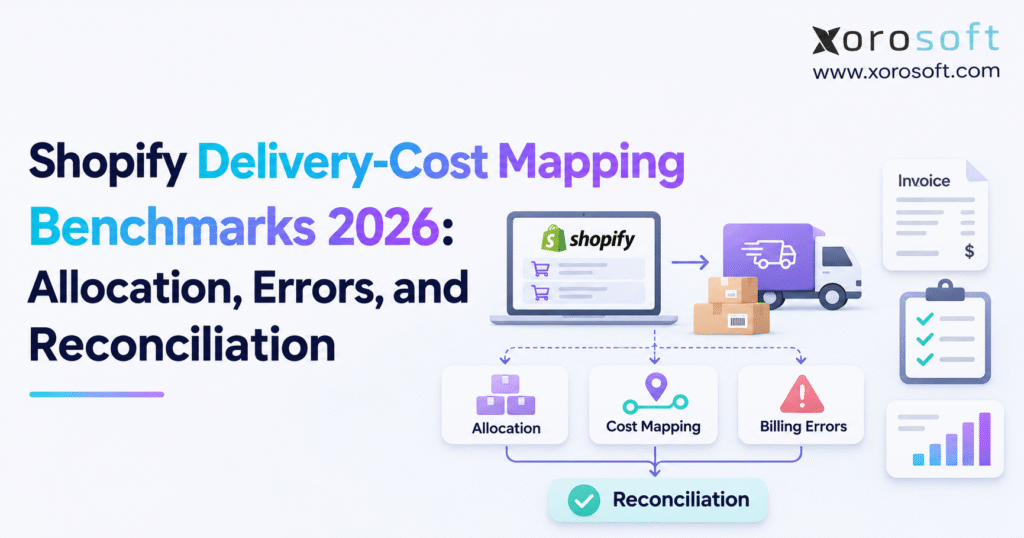
If you are looking for information on Shopify delivery cost mapping, this guide will help you understand the basics and manage your shipping expenses efficiently.
1. Why Shopify Delivery Cost Mapping Matters More in 2026
A Shopify order may show a customer shipping charge of $12, while the carrier bills the merchant $18. The difference could come from package size, fuel fees, residential delivery charges, or later billing changes. However, unless these expenses reach the correct financial records, the business cannot measure its true order profit.
Shopify delivery cost mapping connects customer shipping charges, actual carrier expenses, warehouse records, and accounting entries. As a result, businesses can assign delivery costs to the correct orders, products, warehouses, and financial accounts.
For merchants across the United States and Canada, this process becomes more important as order volumes grow and shipping networks expand.
1.1 Rising parcel volumes increase pressure on finance teams
According to the 2026 Pitney Bowes Parcel Shipping Index, US parcel volume reached 23.1 billion shipments in 2025, compared with 22.4 billion in 2024. The reported annual growth rate was 3.3%.
Chart 1: US parcel shipping volume
2022 — 21.6 billion
█████████████████████▌
2023 — 21.7 billion
█████████████████████▋
2024 — 22.4 billion
██████████████████████▍
2025 — 23.1 billion
███████████████████████▏
Source: Pitney Bowes Parcel Shipping Index, 2026 report.
Although higher parcel volumes create new business opportunities, they also increase the workload for finance teams. More shipments mean more carrier bills, shipping changes, and records to review.
Therefore, merchants need clear rules for sharing shipping data between ecommerce, warehouse, and accounting systems.
1.2 Disconnected shipping records hide order profits
Many growing merchants use separate tools for orders, shipping labels, inventory, warehouse tasks, and accounting. While each tool may hold accurate data, the records do not always connect.
For example, warehouse staff may know the actual package weight. Meanwhile, finance receives a combined carrier bill without clear shipment details.
As a result, finding the order behind an extra shipping charge becomes difficult. Small errors may also remain hidden for several months.
Instead of reviewing delivery costs only during month-end close, businesses should connect shipping records throughout the order lifecycle. This approach gives finance and warehouse teams a shared view of each shipment.
2. Understanding Shopify Shipping Revenue and Delivery Expenses
Before setting allocation rules, merchants must define the financial values they want to track. In particular, customer shipping charges, estimated costs, and actual carrier bills serve different purposes.
Shopify delivery cost mapping keeps these values separate while linking them to the same order.
2.1 Customer shipping charges versus actual carrier costs
Customer shipping revenue is the amount a buyer pays for delivery. For example, a merchant may charge a flat rate, offer free shipping, or use a rate based on the delivery address.
Actual delivery expense, on the other hand, is the amount the merchant pays to deliver the order.
According to Shopify’s shipping label billing documentation, checkout rates and shipping-label costs are separate amounts. Therefore, a correct checkout charge does not guarantee that the merchant will recover the full delivery expense.
Table 1: Shipping revenue and delivery expense classification
| Cost component | Data source | Financial treatment |
|---|---|---|
| Customer shipping charge | Shopify order | Shipping revenue or contract consideration |
| Shipping discount | Discount record | Reduction in customer charges |
| Estimated shipping expense | Carrier quote | Cost planning |
| Shipping label purchase | Label bill | Initial delivery expense |
| Carrier surcharge | Carrier invoice | Extra expense |
| Carrier credit | Billing statement | Expense reduction |
| Shipping refund | Refund record | Reduction in customer charges |
| Return shipping expense | Carrier or 3PL bill | Return delivery expense |
In addition, finance teams should separate recoverable taxes from revenue and expenses where required. Otherwise, tax amounts may distort profit reports.
2.2 Measuring shipping cost recovery
Shipping cost recovery measures how much of the actual delivery expense the customer pays.
Shipping cost recovery = Net shipping revenue ÷ Actual delivery expense × 100
For example, suppose a customer pays $12 for shipping. The carrier charges $14 and later adds a $2.50 fee.
The actual delivery expense is $16.50.
Shipping cost recovery = $12 ÷ $16.50 × 100 = 72.7%
Shipping subsidy = $16.50 − $12 = $4.50
As a result, the merchant pays the remaining $4.50.
However, a shipping subsidy is not always a problem. Free or low-cost shipping may help a business win new customers. Therefore, management should measure whether the extra sales justify the added expense.
2.3 Separating outbound freight from inventory landed costs
Inbound freight relates to bringing goods into the business. In contrast, outbound freight relates to delivering goods to customers.
According to the IFRS Foundation’s IAS 2 inventory guidance, qualifying costs that bring goods to their current location and condition form part of inventory cost.
However, businesses should not automatically add outbound delivery costs to inventory value.
Instead, finance teams should follow the relevant accounting rules and company policies. This distinction helps maintain accurate product costs, inventory values, and expense reports.
3. Shopify Delivery Cost Mapping and ERP Data Fields
Accurate data mapping starts with knowing where each record comes from. Shopify holds customer order and shipping details, while carrier bills provide evidence of actual delivery costs.
Meanwhile, the ERP or accounting system connects these records to financial accounts.
3.1 Understanding Shopify shipping-line fields
The Shopify Admin GraphQL API provides shipping details through its ShippingLine object.
For example, the originalPriceSet field shows the shipping price before discounts. The discountedPriceSet field shows the price after discounts. Meanwhile, currentDiscountedPriceSet reflects the current price after discounts and refunds.
However, these fields describe customer shipping charges. They do not automatically represent actual carrier expenses.
Table 2: Shopify delivery cost field mapping
| Shopify field or object | Data provided | Mapping purpose |
|---|---|---|
Order.id |
Order ID | Sales order reference |
currentShippingPriceSet |
Current order shipping amount | Revenue matching |
originalPriceSet |
Original shipping price | Customer charge |
discountedPriceSet |
Price after discounts | Discount review |
currentDiscountedPriceSet |
Current price after discounts and refunds | Net shipping charge |
discountAllocations |
Shipping discounts | Discount tracking |
taxLines |
Shipping taxes | Tax reporting |
MoneyBag.shopMoney |
Shop currency amount | Financial reports |
MoneyBag.presentmentMoney |
Customer currency amount | Currency tracking |
Fulfillment.id |
Fulfillment ID | Shipment matching |
fulfillmentLineItems |
Shipped items and quantities | Product allocation |
trackingInfo |
Carrier tracking details | Invoice matching |
location |
Fulfillment location | Warehouse reports |
RefundShippingLine |
Shipping refund details | Refund tracking |
Furthermore, businesses should check whether shipping amounts include taxes. Comparing tax-inclusive revenue with tax-exclusive expenses may produce incorrect results.
3.2 Connecting orders with fulfillment records
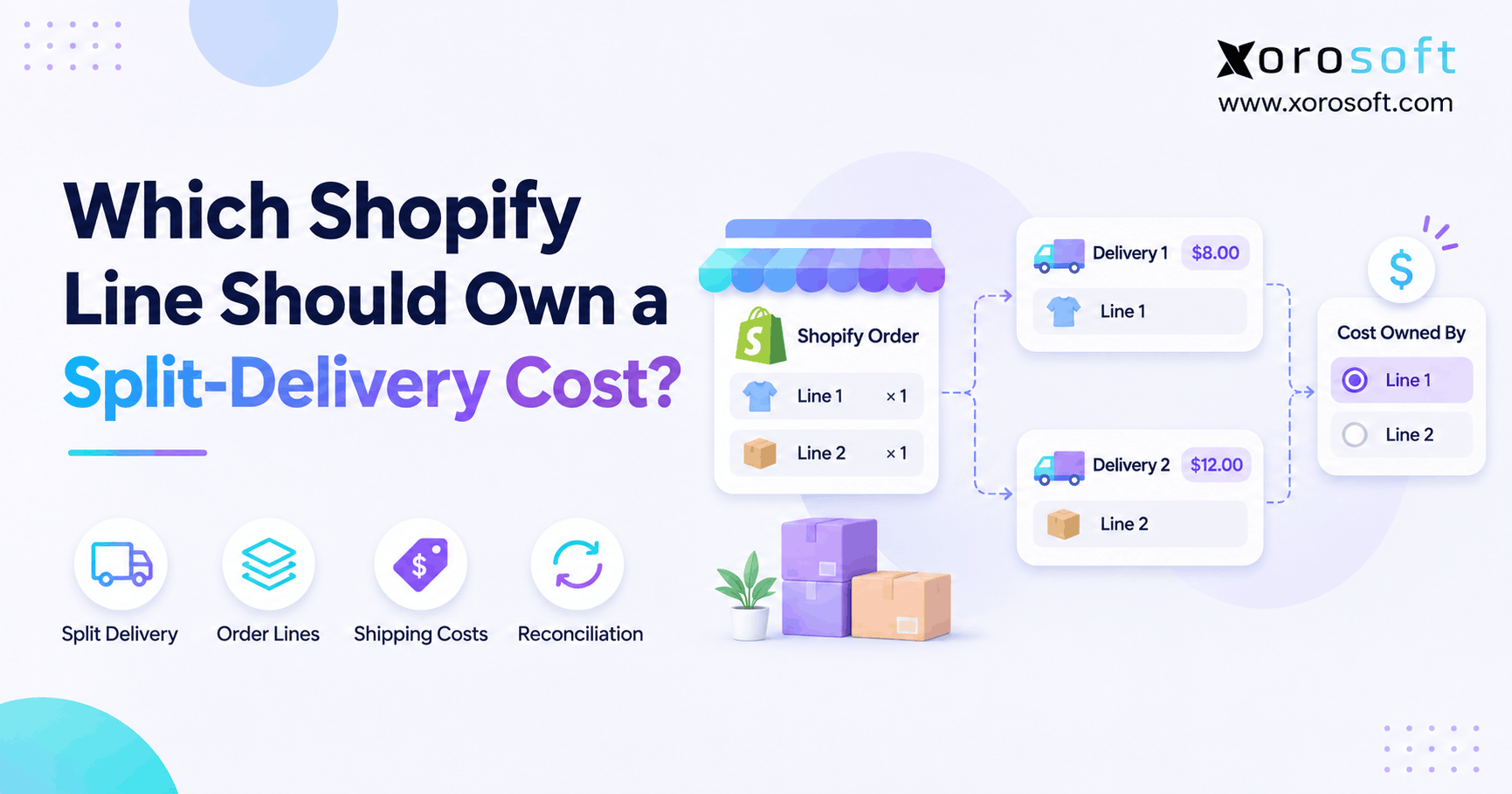
A single Shopify order may contain several shipments.
For example, two products may ship from Ontario, while another product ships from British Columbia. Each warehouse may use a different carrier or delivery service.
Shopify’s Fulfillment object provides shipped items, tracking details, and location records.
Therefore, Shopify delivery cost mapping should preserve order, fulfillment, and package references. An order number alone may not provide enough detail to match every carrier charge.
In addition, merchants should retain store IDs when they run multiple Shopify stores. This helps prevent matching records from different stores by mistake.
3.3 Building reliable Shopify ERP connections
The Xorosoft Shopify ERP application supports order management, inventory sync, fulfillment workflows, and the sync of payments, refunds, and payouts.
These records provide a useful base for tracking delivery costs.
However, importing orders successfully does not prove that every carrier bill can be matched or allocated to individual products.
Therefore, merchants should test invoice imports, shipment references, expense rules, and accounting entries before they expand the integration across all stores.
3.4 Preventing repeated refund deductions
Refunds can create errors when a system uses current shipping amounts and separate refund records together.
For example, an order originally includes a $15 shipping charge. After a $5 refund, its current shipping charge is $10.
If the integration subtracts another $5 from that current amount, the reported shipping revenue becomes $5 instead of $10.
Therefore, teams should document whether each field shows an original or current value. They should also retain refund records for review without counting the same refund twice.
4. Seven Shopify Shipping Cost Allocation Methods
Once actual carrier expenses are available, merchants must decide how to assign those costs to orders and products.
Shopify delivery cost mapping works best when businesses assign direct costs first. However, shared charges may need a clear allocation rule.
The selected method should reflect what causes the expense rather than simply using the easiest formula.
4.1 Direct and weight-based allocation
Direct allocation assigns a carrier charge to the shipment that created it.
For example, if a carrier bill contains a tracking number linked to one package, the full charge can be assigned to that package.
Weight-based allocation, on the other hand, works when several products share a shipping cost.
Allocated expense = Shared shipping expense × Product weight ÷ Total shipment weight
Suppose three products weigh 2 kg, 1 kg, and 3 kg. If their shared shipping expense is $24, their assigned costs are $8, $4, and $12.
However, physical weight may not fully explain the cost of shipping bulky goods.
4.2 Chargeable-weight and quantity-based allocation
Carriers may calculate shipping costs using package size as well as actual weight. As a result, a large but light product can cost more to ship than a smaller, heavier product.
Chargeable-weight allocation uses the weight basis that affects the carrier bill.
In contrast, quantity-based allocation divides a shared expense by the number of units shipped.
For example, if six similar units share a $30 shipping charge, each receives $5 of expense.
Although this method is easy to use, it works best when products have similar shipping needs.
4.3 Value-based, activity-based, and hybrid allocation
Value-based allocation assigns expenses according to product value. For example, this method may work for insurance fees tied to the declared value of goods.
Activity-based allocation uses the work needed to fulfill an order. This may include special handling, extra packaging, or other recorded tasks.
Meanwhile, hybrid allocation combines several methods. A business may assign direct carrier charges to shipments, spread shared pickup fees by package count, and assign handling fees based on warehouse activity.
Table 3: Comparing seven delivery cost allocation methods
| Allocation method | Cost driver | Best use | Main limit |
|---|---|---|---|
| Direct | Actual shipment cost | Known carrier charges | Needs clear references |
| Weight-based | Product weight | Mixed-weight goods | May ignore package size |
| Chargeable-weight | Carrier billing weight | Bulky goods | Needs accurate size data |
| Quantity-based | Units shipped | Similar products | Ignores size differences |
| Value-based | Product value | Value-related charges | May distort freight costs |
| Activity-based | Work performed | Complex fulfillment | Needs activity records |
| Hybrid | Several cost drivers | Multi-warehouse operations | More rules to manage |
Therefore, businesses should choose the method based on the type of expense and the data available.
4.4 Worked example: Allocating costs across split shipments
Suppose a Shopify order contains three products shipped in two packages.
Shipment A costs $12 and contains SKU A weighing 2 kg and SKU B weighing 1 kg. Meanwhile, Shipment B costs $8 and contains only SKU C.
The business assigns the costs as follows:
- SKU A: $12 × 2 ÷ 3 = $8.
- SKU B: $12 × 1 ÷ 3 = $4.
- SKU C: Direct cost = $8.
The total assigned delivery expense is $20.
As a result, the allocated costs match the original carrier charges.
In addition, finance teams should use a clear rule for rounding differences. The final product costs must always add up to the original shipment cost.
5. Shopify Delivery Cost Mapping Benchmarks 2026
Businesses need clear measures to determine whether their shipping cost controls are working.
However, public parcel-market reports do not establish universal Shopify mapping accuracy, error rates, or invoice match rates.
Therefore, the following figures represent recommended operational targets for 2026. They are not measured Shopify industry averages.
5.1 Recommended delivery cost control targets
Table 4: Proposed Shopify delivery cost mapping benchmarks
| Performance measure | Working target | Advanced target |
|---|---|---|
| Mapping accuracy | At least 98% | At least 99% |
| Mapping error rate | No more than 2% | No more than 1% |
| Automated invoice match rate | At least 95% | At least 98% |
| Cost allocation coverage | At least 95% | At least 99% |
| Duplicate posting rate | No more than 0.1% | 0% |
| Unexplained cost variance | No more than 2% | No more than 0.5% |
| Issue resolution time | Within 3 business days | Within 1 business day |
| Month-end reconciliation | Within 5 business days | Within 2 business days |
These targets provide a starting point for reviewing delivery cost controls.
For example, a merchant receiving weekly carrier bills may resolve issues faster than a business receiving monthly bills. Therefore, each company should set targets that reflect its billing schedule and reporting needs.
5.2 Measuring Shopify delivery cost mapping accuracy
Mapping accuracy measures the share of checked records assigned to the correct order, shipment, account, and cost type.
Mapping accuracy = Correctly mapped records ÷ Audited records × 100
Suppose finance reviews 1,000 expense records and finds 980 correct entries. In this case, mapping accuracy is 98%.
Meanwhile, the error rate is 2%, provided every record is marked as either correct or incorrect.
However, record counts do not show the full financial impact. One incorrect $5,000 entry may matter more than several small errors.
Therefore, businesses should also measure the total value of wrongly mapped expenses.
5.3 Measuring invoice match rates and cost coverage
The automated invoice match rate shows how many eligible billing records match shipment records without manual work.
Automated match rate = Automatically matched invoice lines ÷ Eligible invoice lines × 100
Similarly, cost allocation coverage measures how much of the eligible delivery expense has reached the correct cost records.
Allocation coverage = Correctly allocated eligible expense ÷ Total eligible expense × 100
For example, if a merchant assigns $9,500 out of $10,000 in eligible costs, allocation coverage is 95%.
However, credits can affect the calculation. Therefore, teams should use a consistent cost basis or track credits separately.
5.4 Tracking unexplained delivery expense differences
Cost variance measures the difference between estimated and actual delivery expenses.
Expense variance = Actual delivery expense − Estimated delivery expense
A positive result means actual costs were higher than expected. In contrast, a negative result means costs were lower.
However, not every difference represents an error. A valid fuel fee or package adjustment may explain the change.
As a result, finance teams should separate explained differences from unresolved issues. Where the estimated amount is zero, report the actual difference instead of calculating an invalid percentage.
6. Common Shopify Delivery Cost Mapping Errors
Most delivery cost errors arise from missing records, unclear financial definitions, or incorrect links between shipments and bills.
Although automated imports can save time, poor mapping rules can spread the same error across thousands of transactions.
6.1 Missing carrier fees and billing changes
A shipping label purchased today may not reflect the final carrier expense.
For example, a carrier may add a charge after checking the package weight or size. Other fees may result from address changes, residential delivery, or extra handling.
Therefore, merchants should import later charges and link them to the original shipments.
Otherwise, order profit reports may continue using old shipping costs even after the carrier bill has been paid.
6.2 Duplicate expenses and incorrect shipment links
Duplicate entries can appear when the same expense enters an accounting system through several sources.
For instance, a business may import Shopify label charges and later receive a carrier bill containing the same charges.
Without a duplicate check, both records may reach the ledger.
Similarly, a valid expense can reach the wrong order if its tracking number or warehouse reference is incorrect.
Table 5: Delivery cost mapping errors and preventive controls
| Mapping error | Financial impact | Preventive control |
|---|---|---|
| Shipping revenue recorded as expense | Wrong order profit | Separate financial fields |
| Missing carrier fee | Understated expense | Import later charges |
| Duplicate invoice | Overstated expense | Check billing references |
| Wrong warehouse | Incorrect location reports | Check shipment location |
| Refund deducted twice | Understated revenue | Review current shipping amount |
| Missing carrier credit | Overstated expense | Review credit records |
| Currency mismatch | Wrong cost difference | Retain currency data |
| Wrong financial account | Incorrect reporting | Approve account rules |
| Missing split shipment | Incomplete delivery cost | Match every shipment |
| Duplicate 3PL fee | Overstated cost | Review billing terms |
6.3 Preventing errors before they reach accounting
Effective Shopify delivery cost mapping should include checks before new expenses reach the ledger.
First, check that the carrier account and billing reference are valid. Next, confirm that the tracking number belongs to an existing shipment. Finally, check whether the billing record has already been imported.
Businesses reviewing Xorosoft’s ecommerce integrations should test which fields are shared, how updates work, and how failed records are handled.
If a record cannot be matched safely, it should remain in a review queue. This is better than assigning the expense to an incorrect order or account.
7. How to Reconcile Shopify Delivery Costs Step by Step
Shopify delivery cost reconciliation checks the links between customer shipping charges, carrier bills, warehouse records, and financial entries.
A well-defined process makes it easier to find missing charges, billing errors, and costs that have reached the wrong records.
7.1 Collect complete shipping and billing records
First, collect Shopify orders, shipping charges, discounts, refunds, and fulfillment records.
Next, gather carrier invoices, shipping-label purchases, credit notes, and 3PL bills.
According to Shopify’s order reporting documentation, standard shipping-label reports exclude certain records, such as return labels, billing changes, voided labels, and labels bought outside Shopify.
Therefore, these reports alone cannot support complete delivery expense reconciliation.
Finance teams should maintain a list of every expense source. In addition, they should check that all expected bills have arrived before closing the reporting period.
7.2 Match carrier invoices to shipment records
Reliable invoice matching starts with exact references.
For example, a carrier account and tracking number can often connect a billing line to a shipment. However, the invoice reference is also needed to check for duplicate entries.
Table 6: Carrier invoice matching rules
| Priority | Matching reference | Required action |
|---|---|---|
| 1 | Invoice and line ID | Check for duplicates |
| 2 | Carrier and tracking number | Match the shipment |
| 3 | Fulfillment reference | Check the order link |
| 4 | Package ID | Review package details |
| 5 | Store and order reference | Check related shipments |
| 6 | Date, address, and amount | Require manual review |
| 7 | Missing or conflicting data | Hold for review |
Although an exact match confirms the link between records, it does not prove the billed amount is correct.
Therefore, invoice matching and billing checks should remain separate steps.
7.3 Allocate expenses and review cost differences
After matching the bills, assign direct expenses to their shipments. Then, use approved allocation rules for shared costs.
For example, a monthly carrier pickup charge may cover hundreds of packages. Instead of assigning it to one order, the business can spread the charge using a suitable cost driver.
Next, compare estimated costs with actual charges.
If several oversized products consistently cost more than expected, the issue may relate to incorrect package size data rather than an accounting error.
As a result, reconciliation can help improve both financial reports and warehouse practices.
7.4 Worked example: Carrier fees, credits, and customer refunds
Suppose an order has an initial carrier expense of $18. Later, the carrier adds a $4 fee and issues a $2 credit.
Actual delivery expense = $18 + $4 − $2 = $20
Meanwhile, the customer originally paid $13 for shipping but received a $3 refund.
Net shipping revenue = $13 − $3 = $10
Final shipping subsidy = $20 − $10 = $10
Chart 2: Estimated-to-actual delivery cost changes
Initial expense — $18
██████████████████
Carrier fee — +$4
████
Carrier credit — −$2
██
Actual expense — $20
████████████████████
Source: Illustrative financial example. These amounts are not measured industry data.
The final expense is $2 higher than the original amount, representing an increase of 11.1%.
However, the customer refund and carrier credit serve different financial purposes. Therefore, they should remain separate entries.
7.5 Reconcile delivery costs with financial accounts
Finally, compare the mapped delivery expenses with carrier bills, accounts payable, freight accruals, and ledger balances.
If an expense remains unmatched, record the reason and assign someone to review it.
In addition, disputed charges should remain visible until the carrier confirms the outcome.
The process is complete when supported balances agree and any open issues are clearly documented. Simply clearing unmatched amounts to finish month-end close does not resolve their root cause.
8. Delivery Cost Accounting and Month-End Freight Reconciliation
Accurate Shopify delivery cost mapping must also support financial reporting. Even if an expense reaches the correct shipment, posting it to the wrong period can distort monthly results.
Therefore, finance teams need clear rules for shipping revenue, freight expenses, carrier credits, returns, and unpaid delivery costs.
8.1 Recording freight expenses in the correct month
Carrier bills often arrive after the related orders have shipped.
For example, a merchant may ship products in January but receive the carrier bill in February.
Under accrual accounting, eligible expenses should reach the correct reporting period. Therefore, finance may need to estimate unbilled costs before closing the month.
Once the actual bill arrives, the team can clear the original accrual and record the required change.
However, the estimate should rely on available shipment records and known carrier rates rather than unsupported assumptions.
8.2 Worked example: Reconciling a freight accrual
Assume a merchant estimates January delivery costs at $1,000. In February, the actual carrier bill arrives for $1,060.
Table 7: Freight accrual and invoice reconciliation
| Period | Account | Debit | Credit |
|---|---|---|---|
| January | Delivery expense | $1,000 | — |
| January | Accrued freight liability | — | $1,000 |
| February | Accrued freight liability | $1,000 | — |
| February | Delivery expense adjustment | $60 | — |
| February | Accounts payable | — | $1,060 |
| Total | $2,060 | $2,060 |
After both entries, the total delivery expense is $1,060. Meanwhile, the original freight accrual has been cleared.
This example assumes the $60 change qualifies for recognition in February under company policy.
However, material errors from an earlier period or bills received before financial statements are finalized may require different treatment.
8.3 Connecting Shopify delivery expenses with ERP accounting
Xorosoft’s XoroERP combines accounting, purchasing, inventory, sales orders, and warehouse operations.
As a result, businesses can work from connected order and financial records rather than rebuilding each transaction from separate spreadsheets.
However, finance teams must still test shipping expense accounts, carrier billing workflows, cost allocation rules, and accrual entries.
In particular, they should check that the arrival of an actual bill clears the matching accrual instead of creating a second expense.
9. Managing Delivery Costs Across Warehouses and 3PLs
Multi-warehouse operations create added challenges because one customer order may lead to several delivery charges.
Therefore, merchants need to track actual shipping expenses at shipment level before combining them into order-level reports.
9.1 Assigning costs to the correct fulfillment location
Suppose two warehouses fulfill one Shopify order. Warehouse A incurs a $9 delivery charge, while Warehouse B incurs a $13 charge.
The total delivery expense is $22.
However, assigning the full $22 to both warehouses would double the reported cost.
Instead, Warehouse A should receive its $9 expense, while Warehouse B receives $13.
As a result, the business can compare warehouse costs while keeping the total order expense accurate.
9.2 Separating 3PL fees from carrier charges
Third-party logistics providers may charge for storage, picking, packing, shipping, packaging, and returns.
Although these fees relate to order fulfillment, they do not all represent carrier transportation costs.
For example, a 3PL may charge $18 for shipping and $4 for picking and packing. Recording the complete $22 as freight would hide the cost of warehouse handling.
Therefore, merchants should review their billing terms before setting allocation rules.
Xorosoft’s XoroWMS supports warehouse and fulfillment workflows that can help businesses maintain shipment records.
However, actual delivery costs still need support from the relevant carrier or 3PL bills.
9.3 Managing US and Canadian shipping expenses
Shopify delivery cost mapping also becomes more complex when orders and carrier bills use different currencies.
For example, a Canadian merchant may collect a shipping charge in USD while paying a carrier in CAD.
Comparing the two amounts directly would produce an incorrect shipping cost recovery rate.
Therefore, businesses should retain the original currency, exchange rate, and converted amount.
In addition, finance teams should track applicable taxes, customs charges, and brokerage fees. Separating these values helps explain whether a cost difference came from higher shipping prices or currency changes.
10. Building an Integrated Shopify Delivery Cost Mapping Workflow
A connected delivery cost workflow requires clear ownership of order, shipment, billing, and financial data.
Shopify holds customer order details. Warehouse systems record fulfillment activity. Meanwhile, carrier bills provide actual delivery charges.
The ERP then connects the required records for business and financial reporting.
10.1 Establishing a trusted source for each record
First, define which system owns each type of data.
For example, Shopify should remain the source for customer shipping charges and refunds. Carrier bills should support actual transport expenses. Warehouse records should confirm shipped products and package details.
Xorosoft’s XoroONE combines ecommerce, inventory, accounting, purchasing, warehouse management, and reporting within a cloud ERP platform.
This connected structure can reduce manual data transfers. However, merchants should confirm which carrier billing and allocation tasks require further setup.
10.2 Comparing manual and connected reconciliation methods
Manual reconciliation can work for merchants with low order volumes and few shipping issues.
However, spreadsheets become harder to manage as businesses add carriers, warehouses, currencies, and sales channels.
Dedicated matching tools may improve carrier invoice reviews. In contrast, an integrated ERP becomes more useful when delivery costs must connect with product costs, inventory, and financial accounts.
Therefore, the best approach depends on business needs rather than order volume alone.
10.3 Testing shipping records before adding automation
Before expanding a new workflow, test several common order types.
For example, include a normal parcel, split shipment, oversized package, customer refund, carrier credit, and duplicate invoice.
Next, compare each original order with its shipment records, carrier bill, cost allocation, and accounting entries.
If the results do not match, identify the source of the error before processing more orders.
Otherwise, automation may simply repeat an existing mapping problem at a much larger scale.
11. Six Industry Use Cases for Delivery Cost Allocation
Shopify delivery cost mapping requirements vary by industry because different products create different shipping needs.
For example, lightweight apparel and bulky furniture may require very different allocation methods.
11.1 Apparel, furniture, and sporting goods
Apparel brands often ship several lightweight products in one package. Therefore, weight-based or quantity-based allocation may provide a fair way to share shipping costs.
Furniture merchants, on the other hand, often face extra charges for large packages and special delivery services. Direct or chargeable-weight allocation may work better for these products.
Meanwhile, sporting goods companies may sell both small accessories and heavy equipment. A hybrid method helps separate standard shipping costs from special handling fees.
11.2 Food, wholesale distribution, and manufacturing
Food and beverage businesses may face extra costs for cold storage, special packaging, and temperature-controlled delivery.
Therefore, these charges should remain separate from standard parcel expenses when the billing records allow.
Wholesale distributors often ship cases, pallets, and mixed-product orders. As a result, their allocation rules should reflect freight terms and shipment sizes.
Similarly, manufacturers need to separate inbound material costs from outbound customer delivery expenses.
Table 8: Industry-specific delivery cost mapping methods
| Industry | Main shipping challenge | Recommended method |
|---|---|---|
| Apparel and fashion | Several lightweight items | Weight or quantity |
| Furniture | Large and bulky packages | Direct or chargeable weight |
| Sporting goods | Mixed product sizes | Hybrid |
| Food and beverage | Temperature-controlled shipping | Direct and activity-based |
| Wholesale distribution | Cases and pallets | Shipment-level |
| Manufacturing | Inbound and outbound freight | Direct allocation |
Businesses can review Xorosoft’s supported industries when assessing their ERP needs.
However, each business should test its actual shipping, inventory, and accounting workflows before choosing a solution.
12. When Shopify Merchants Should Upgrade Delivery Expense Systems
Not every Shopify merchant needs an integrated ERP. For example, a small business with one warehouse, few carriers, and simple shipping rules may manage costs using its existing tools.
However, the need for more connected systems increases when current workflows no longer provide reliable financial data.
12.1 Recognizing the limits of spreadsheets
Common warning signs include duplicate carrier charges, missing tracking numbers, unresolved credits, and delayed financial reports.
In addition, management may struggle to measure actual delivery expenses by order or warehouse.
When Shopify delivery cost mapping depends on several spreadsheets, different teams may also use different cost figures.
As a result, shipping reports can become difficult to trust.
Before replacing these tools, businesses should identify which problems come from poor data, missing controls, or software limits. This helps avoid paying for new software without fixing the underlying issue.
12.2 Evaluating connected business systems
An integrated ERP can connect sales orders, inventory, warehouse tasks, purchasing, and financial records.
Xorosoft’s business management solutions cover these areas and provide a base for businesses that have outgrown separate tools.
Nevertheless, merchants should assess software through real shipping cases rather than feature lists alone.
For example, ask how a carrier fee reaches an existing shipment, how a credit updates the final expense, and how an unmatched bill is reviewed.
This approach helps businesses understand the work needed to build a reliable delivery cost process.
13. Shopify Delivery Cost Mapping Governance and Audit Controls
A successful delivery cost process must remain accurate after it goes live.
Therefore, businesses need clear roles, approved rules, regular checks, and a record of financial changes.
13.1 Assigning clear roles across teams
Finance should manage account rules, expense reporting, and month-end reconciliation.
Meanwhile, warehouse teams should maintain package weights, sizes, tracking numbers, and shipment records.
Ecommerce teams should manage customer shipping charges, discounts, and refunds. In addition, system admins should monitor failed imports and duplicate records.
Although each team has different tasks, everyone should follow the same definitions.
Otherwise, finance may use one shipping cost figure while warehouse teams use another.
13.2 Documenting delivery cost allocation rules
Every shared delivery expense should have an approved allocation method.
First, define when costs should be assigned directly. Next, identify the cost driver for expenses that need to be shared. Finally, explain how rounding differences and unmatched charges should be handled.
Businesses should also record the date when any rule changes.
For example, switching from weight-based to quantity-based allocation can affect product profit reports. Therefore, finance should approve the change before applying it.
13.3 Maintaining a clear financial audit trail
Each mapped expense should retain its original bill reference, carrier, shipment ID, order link, amount, currency, and posting date.
In addition, later fees and credits should remain linked to the original expense.
For example, if finance reviews a $7 carrier fee, the team should be able to find the related package, initial charge, and reason for the change.
Regular sample checks should include different carriers, warehouses, products, and reporting periods.
As a result, businesses can identify mapping errors before they become larger financial problems.
14. Turning Accurate Delivery Cost Mapping Into Better Business Decisions
The value of Shopify delivery cost mapping extends beyond monthly financial reports.
Reliable delivery expense data helps merchants review shipping rates, free shipping offers, package design, carrier choices, and warehouse performance.
However, businesses should improve their current controls before expanding automation.
14.1 A practical 90-day delivery cost improvement plan
Days 1–30: Review existing records.
First, identify every source of customer shipping charges, carrier bills, warehouse records, refunds, and credits. Then, measure current mapping accuracy and list the most common issues.
Days 31–60: Test and approve cost rules.
Next, select suitable allocation methods and test them using actual shipping records. Confirm that direct and shared costs match the original carrier expenses.
Days 61–90: Expand and monitor results.
Finally, apply the approved process across other warehouses and carriers. Track error rates, cost coverage, duplicate entries, unresolved differences, and month-end close times.
14.2 Using actual delivery expenses to protect profit
Once delivery costs are mapped correctly, management can make better decisions about how products are shipped.
For example, product teams can identify goods that require costly packaging. Meanwhile, ecommerce teams can review whether free shipping offers generate enough sales to cover their added costs.
Warehouse teams can also compare shipping expenses across locations using actual carrier bills rather than estimates.
As a result, businesses can improve fulfillment decisions while keeping financial records accurate.
For growing merchants, connecting Shopify orders, warehouse activity, carrier bills, and accounting provides a more reliable view of business performance.
Businesses reviewing their current setup can discuss their delivery cost mapping and ERP requirements to identify gaps in their order, shipping, warehouse, and financial workflows.
Ultimately, Shopify delivery cost mapping helps businesses understand not only how much they sell, but also how much it actually costs to deliver those sales.
Frequently Asked Questions
What is Shopify delivery cost mapping?
Shopify delivery cost mapping connects shipping charges, carrier bills, fulfillment records, and accounting entries to improve expense tracking, cost allocation, and order profitability.
What are the recommended delivery cost mapping benchmarks for 2026?
Recommended targets include 98% mapping accuracy, 95% invoice matching, and a maximum 2% error rate. However, these are proposed targets, not industry averages.
How do you allocate Shopify shipping costs?
Assign direct shipment expenses first. Then, distribute shared costs using product weight, quantity, value, or other suitable cost drivers.
What causes Shopify delivery cost mapping errors?
Common causes include duplicate invoices, missing carrier fees, incorrect warehouse references, currency differences, and repeated refund deductions.
How do you reconcile Shopify delivery costs?
First, collect shipping records and carrier bills. Next, match shipments, allocate expenses, resolve differences, and verify accounting balances.
How should businesses handle carrier surcharges?
Link each surcharge to its original shipment. Then, update the actual delivery expense and reconcile the adjustment with carrier billing records.
Can ERP software improve Shopify delivery cost mapping?
ERP software connects order, warehouse, and accounting records. As a result, it can improve cost visibility and reconciliation, depending on integration capabilities.
Recent Posts
-
 Shopify Delivery-Cost Mapping Benchmarks 2026: Allocation, Errors, and Reconciliation
-
 Revenue vs Gross-Margin Commission Plans for Distributors
-
 How to Run an ERP Conference Room Pilot With Real Business Scenarios
-
 Inventory Reserve Accounting: How Risk Becomes a Financial Estimate
-
 AI Inbound-Shortage Detection Using Orders, Transfers, and Receiving Events