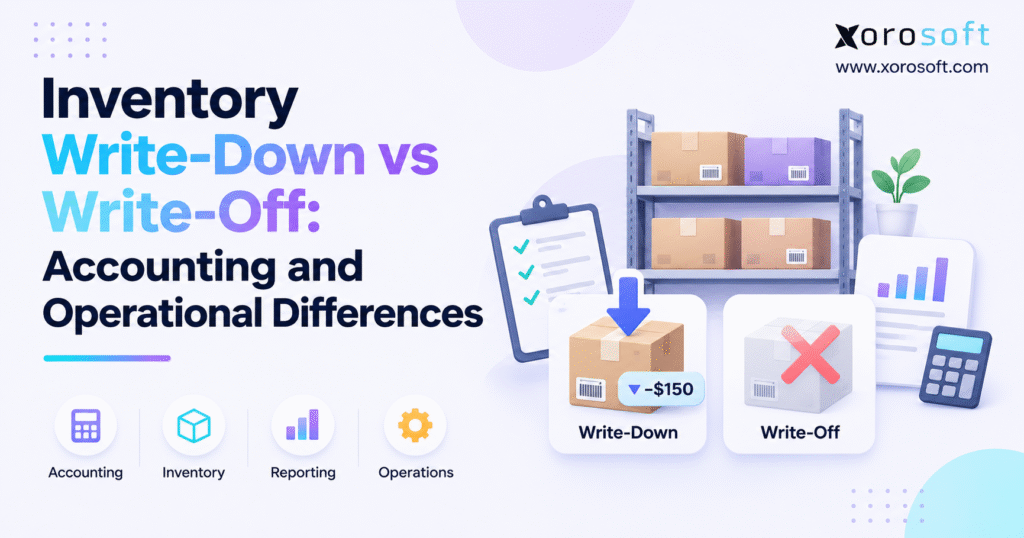
Understanding inventory write-down vs write-off is essential for managing your business finances and accounting practices.
1. Inventory Write-Down vs Write-Off: The Accounting Difference
1.1 What an Inventory Write-Down Changes
A write-down cuts the value of stock on the books because the amount the firm can get back is now below its cost under the relevant accounting rule. The item might still be sold, moved, used, or fixed. For example, a jacket carried at $80 may have net realizable value of $55 after customer demand falls. Its book value falls by $25, but the warehouse still holds one jacket.
A write-down does not mean an item is useless. It means the old value would make the asset look too high. The amount depends on the accounting rules, cost method, item state, likely sale price, and costs needed to finish and sell it.
1.2 What an Inventory Write-Off Changes
A write-off takes the rest of the stock value off the books when goods are lost, destroyed, or no longer worth anything to the firm. If the jacket is beyond repair and has no scrap value, finance removes its remaining value. Warehouse staff must also log the units removed or the disposal, with clear proof.
A complete write-off does not always mean someone has already removed the item physically. Goods may have zero carrying value while awaiting approved destruction. Missing stock, by contrast, calls for a count check and a stock update. The book entry and the warehouse action depend on what went wrong.
1.3 Inventory Write-Down vs Write-Off Comparison
| Factor | Inventory write-down | Inventory write-off |
|---|---|---|
| Main issue | Remaining value is below carrying cost | Remaining carrying value is unrecoverable |
| Asset treatment | Partially reduces value | Removes remaining value |
| Physical quantity | Often unchanged | Usually corrected or later disposed |
| Evidence | Sales estimates, condition, costs to finish | Count, destruction, theft, disposal evidence |
| Typical example | Damaged but discount-saleable stock | Destroyed stock with no salvage value |
This helps avoid costly errors: a price cut is not a write-off, and missing stock is not just a change in book value.
2. When to Write Down Inventory and When to Write It Off
2.1 Obsolete and Slow-Moving Inventory
Slow-moving goods need review, not forced removal. An old replacement part may still be needed by a service customer. Older clothing may sell through an outlet. If sales data shows that net sale proceeds will fall below cost, a write-down may be needed. If the goods have no buyer, reuse, vendor return, or scrap market, a write-off may follow.
In an inventory write-down vs write-off review, look beyond age alone. Check recent sales, open orders, other uses, vendor return terms, and selling costs. Stock held for a year may still have value; a new product can lose value at once.
2.2 Damaged, Returned, and Expired Goods
Damaged goods may need repair, a quality check, new packing, or a lower sale price. Include costs needed to finish and sell the goods when judging their value. Expired food that cannot be sold by law or sold safely may be worth nothing, though a vendor credit or salvage payment can change the loss.
Keep the stock check separate from the book entry. Quality staff decide whether goods can be sold; finance decides how much they are worth on the books. The buying team may seek a vendor claim while the warehouse keeps the goods in a hold area.
2.3 Inventory Shrinkage and Missing Units
Shrinkage is the gap between stock on the books and stock that staff can count. It may stem from theft, missed receipts, wrong transfers, picking errors, or a wrong unit of measure. Before booking a loss, check open moves and recount costly stock gaps. A pallet in the wrong bin should not be written off just because the first count failed.
If a shortage is confirmed, the corresponding carrying value normally leaves inventory. That is not the same as reducing the value of stock that is still on hand and fit for sale. The reason code should show the cause, not hide it behind a vague stock change.
2.4 The Practical Inventory Write-Off Decision
Ask whether stock still exists, whether it remains owned by the business, whether it has recoverable value, and whether disposal has occurred. A distributor holding customer-owned consigned goods, for example, should not record a loss for goods it does not own. Ownership and contract terms matter before finance posts an entry.
A sound inventory write-down vs write-off decision starts with proof and ends with stock and finance records that agree.
3. Inventory Write-Down Calculation and Net Realizable Value
3.1 Net Realizable Value Is Not the Sticker Price
Net realizable value, or NRV, is the estimated selling price in the ordinary course of business minus estimated costs of completion and costs needed to make the sale. A product with a $65 expected selling price and $10 of needed selling costs has NRV of $55. This is why inventory write-down vs write-off choices need a clear NRV estimate.
Use recent sales, firm buyer offers, costs to finish the goods, channel fees, and current facts to support each estimate. Do not replace proof with a guessed reserve rate. Under accounting rules that apply lower of cost and NRV, the amount written down is the excess of cost over NRV, if positive.
3.2 Inventory Write-Down Formula With a Worked Example
Write-down = max(0, recorded cost – net realizable value) for the affected inventory under the lower-of-cost-and-NRV rule.
Assume a wholesaler owns 100 identical units carried at $80 each. The expected net recovery has fallen to $55 per unit. Original stock cost is $8,000, new book value is $5,500, and the loss to book is $2,500. That is $25 per unit, or 31.25% of cost.
| Measurement | Calculation | Amount |
|---|---|---|
| Original carrying value | 100 x $80 | $8,000 |
| Supported NRV | 100 x $55 | $5,500 |
| Required write-down | $8,000 – $5,500 | $2,500 |
| Inventory after revaluation | 100 x $55 | $5,500 |
All 100 units remain on hand. The inventory asset changes, but neither on-hand quantity nor allocated quantity should be reduced solely because of that accounting entry.
3.3 Calculate at the Appropriate Item Level
A blended SKU average can hide a loss. A profitable product does not on its own offset a loss on another item. Use the correct unit of account under the rules, assess each item or related group where allowed, and keep a record of each value estimate.
For makers, first check whether parts can recover their cost through finished goods. Do not write down raw materials just because new purchase prices have changed. For wholesalers, check the state and sales outlook at each site before treating all units the same.
4. Inventory Write-Down and Write-Off Journal Entries
4.1 Direct Inventory Write-Down Journal Entry
Using the 100-unit example, finance records a $2,500 loss when the applicable valuation test supports it. The direct entry debits Inventory Write-Down Expense for $2,500 and credits Inventory for $2,500. Net inventory falls from $8,000 to $5,500, with no physical quantity movement.
The expense name and place on the income statement should follow the firm’s accounting policy. Software may post the entry from an approved stock change, but a button cannot decide the correct accounting method.
4.2 Inventory Allowance or Reserve Method
Some firms keep gross inventory at $8,000 and credit a $2,500 contra-asset valuation allowance instead of directly crediting inventory. Net carrying value remains $5,500. The allowance needs sound estimates tied to the affected stock; it must not become a guessed cushion for future losses.
This approach can preserve a clearer trail from original cost to revised value. Later disposal entries must account for past losses. Finance must determine whether the reserve relates to specific items and how removal should be recorded.
4.3 Write-Off After a Previous Write-Down
Suppose ten of the previously written-down units are destroyed and have no salvage value. Their remaining carrying value is 10 x $55, or $550. Under the direct method, debit Inventory Loss Expense $550 and credit Inventory $550. The earlier write-down already covered $250 for those ten units.
Under the allowance method, remove $800 of gross inventory by debiting the existing allowance $250 and an additional inventory loss $550. The remaining gross cost becomes $7,200; the remaining allowance is $2,250; net inventory is $4,950.
| Event | Debit | Credit |
|---|---|---|
| Initial direct write-down | Loss expense $2,500 | Inventory $2,500 |
| Initial allowance method, alternative | Loss expense $2,500 | Allowance $2,500 |
| Disposal under direct method | Loss expense $550 | Inventory $550 |
| Disposal under allowance method | Allowance $250; loss $550 | Gross inventory $800 |
4.4 Reconcile the Journal Entries and Quantities
The business now holds 90 units at $55 each, for a net carrying value of $4,950. Total losses booked equal $3,050: the first $2,500 write-down plus the later $550 loss. The original $8,000 less $3,050 equals $4,950. If the ledger, stock detail, and warehouse count do not match, the job is not done.
CTA 1 — Free ERP Readiness Assessment: Before changing software, check whether stock counts, value changes, approvals, and ledger entries can be matched without rebuilding records by hand. A free in-house review is a good start, even if you choose to fix the current process instead of buying a new system.
5. Inventory Write-Down Rules Under US GAAP, IFRS, and Canadian ASPE
5.1 US GAAP and the Inventory Valuation Method
Under ASC 330, US companies using FIFO or average cost generally measure inventory at the lower of cost and NRV. Companies using LIFO or the retail inventory method generally apply lower of cost or market. For these methods, market means replacement cost bounded by an NRV ceiling and an NRV-minus-normal-profit floor, not simply the last purchase price.
Under US GAAP, a booked inventory write-down usually sets a new cost basis. Later recovery in selling value does not normally permit reversal of the impairment. The finance team should check the rules for its own cost method. An inventory write-down vs write-off policy should not copy a rule from a different reporting method.
5.2 IFRS and Reversal of an Inventory Write-Down
IAS 2 Inventories generally requires the lower of cost and NRV, with specified exceptions to its scope. It permits FIFO, weighted average, and specific identification where allowed, but not LIFO. Write-downs and inventory losses are recognized as expenses in the relevant period.
If the cause of an earlier write-down is gone, IAS 2 calls for a reversal up to the loss first booked. That does not allow stock to be valued above its first cost. Keep evidence of improved recovery and record the reversal in the period supported by that evidence.
5.3 Canadian ASPE Inventory Accounting
Canadian ASPE Section 3031 guidance similarly measures qualifying inventory at the lower of cost and NRV. It requires reversal when the original circumstances disappear or clear evidence supports higher NRV, limited to the prior reduction. Private firms in Canada should not assume the US GAAP ban on most reversals applies to their books.
KPMG’s June 2026 comparison offers a useful additional reference for ASC 330 versus IAS 2, particularly where multinational groups need consistent costing and disclosure policies.
5.4 Financial Accounting and US Tax Deductions
A financial write-off does not on its own create an equivalent federal tax deduction. IRS Publication 538 addresses inventory valuation, including unsaleable goods, tax accounting methods, and substantiation. The tax analysis can depend on whether merchandise has been offered at a bona fide selling price, the method elected, and whether losses were already reflected elsewhere.
For large stock changes, keep damage reports, disposal costs, sale proof, signed approvals, and tax workpapers. Have the tax adviser review the treatment rather than copying the book journal entry into the return.
| Measurement issue | US GAAP | IFRS IAS 2 | Canadian ASPE 3031 |
|---|---|---|---|
| Main basis | FIFO/average: lower of cost and NRV; LIFO/retail: lower of cost or market | Generally lower of cost and NRV | Lower of cost and NRV |
| LIFO cost method | Permitted | Prohibited | Not a permitted cost formula |
| Qualifying reversal | Generally prohibited | Required, limited to prior write-down | Required, limited to prior write-down |
6. Inventory Write-Down vs Write-Off: Financial Statement Effects
6.1 How Inventory Write-Downs Affect the Balance Sheet and Profit
Booking a $2,500 write-down cuts net stock assets and pretax profit by $2,500, absent any related gain or offset. The later $550 write-off reduces the remaining asset and recognizes a further $550 loss. Neither entry means the firm paid cash in that period.
A common mistake is to remove the original $800 cost of destroyed items after already recognizing their $250 impairment. That would count the same decline twice. The correct additional loss is the remaining $550 carrying amount, as shown in the journal-entry example.
6.2 COGS Versus a Separate Inventory Loss Account
Where the loss appears on the income statement depends on the rules, the cause, its size, and the firm’s set policy. Routine inventory costs flow through cost of goods sold when sold. Losses from falling stock value or rare damage may sit in cost of sales or appear on their own, as the rules allow.
The gross margin shown can vary with the line used, though pretax profit still reflects the same loss. Explain the policy to leaders before comparing gross margin trends. A stock-loss scorecard should show write-offs on their own even if the accounts group them together.
6.3 Working Capital, Cash Flow, and Period-End Close
A write-down is normally noncash when recognized; cash may have left the business months earlier through purchasing or production. In an indirect cash flow statement, the noncash expense and inventory balance movement must be reconciled without double counting. Working capital also reflects the smaller net inventory asset after impairment.
At month-end, the inventory write-down vs write-off records must match SKU values, stock detail, allowance balances, and approved warehouse entries. Check late-dated entries, goods in transit, vendor returns, and changes made after the close cutoff. A perfectly balanced journal entry can still be posted to the wrong SKU or period.
7. Inventory Write-Down vs Write-Off: Warehouse Controls
7.1 Identify and Investigate Inventory Exceptions
Cycle counts, damage checks, returns, and expiry reviews should flag issues before finance closes the books. Use a reference number for each case and record the item, lot or serial number, location, condition, owner, and discovery date. A stock gap not yet checked is not proof of theft or loss.
At larger sites, check high-value stock gaps at once. Check open receiving, transfers, picking activity, returns, and unit-of-measure conversions. Keep a traceable investigation record.
7.2 Write-Downs Change Value; Write-Offs Can Change Quantity
Stock teams need three clear figures: units on hand, units free to sell, and value on the books. A write-down can reduce value without changing quantity. Quarantine can reduce saleable availability while leaving quantity unchanged. Confirmed loss or disposal can require quantity and value changes.
In a WMS, XoroWMS is relevant to warehouse execution and cycle counting, but the important principle applies regardless of vendor: no item should become available for fulfillment merely because its accounting entry has posted. Xorosoft’s warehouse positioning includes multi-location management and scanning workflows that help establish reliable quantity evidence.
7.3 Establish Approval and Disposal Controls
Staff who find damage should log it, not approve the loss on their own. Warehouse leads confirm condition and count. Inventory control checks movements. Finance reviews cost basis and accounting treatment. A controller or designated manager approves material write-offs according to documented authority limits.
When goods must be scrapped, log the date, method, staff member, and any safety or waste rules. Keep the item quarantined until authorized. A write-off entry does not replace safe handling, especially for food, chemicals, restricted goods, or stock owned by buyers.
7.4 Preserve the Inventory Adjustment Audit Trail
The documented inventory adjustment workflow distinguishes quantity-only, value-only, and combined adjustments. It also records adjustment dates, accounts, reason codes, and reference numbers. This shows why software should state what changed instead of posting a debit and credit with no clear reason.
But reversing a system entry is not always the same as reversing a book loss under the relevant rules. A correction to an erroneous transaction and a reversal of an impairment based on improved NRV are different events. Finance must approve the reason and the entry.
8. ERP and WMS Reconciliation Across Multiple Warehouses
8.1 A Single SKU Can Have Several Different Conditions
A furniture distributor might hold the same table in three locations: saleable at one, packaging damaged at another, and awaiting disposal at a third. One SKU-wide write-off could overstate the loss. Equally, a generic inventory revaluation may ignore that ten units are already missing from a remote site.
Reconcile quantities by warehouse, bin, lot, and condition where the systems support that detail. Then consolidate the accounting valuation according to the applicable unit-of-account policy. Location-level visibility provides evidence; it does not on its own mean every warehouse has an independent accounting valuation for identical goods.
8.2 Investigate In-Transit and Third-Party Inventory
Transfers frequently create timing differences. One warehouse may have shipped stock that the next has not yet received. A third-party logistics provider may report damage days after the event. Supplier-owned consignment goods can appear physically present without belonging in the business’s inventory asset.
In any inventory write-down vs write-off review, check who owns the goods, open transfers, missed receipts, and 3PL reports before posting a loss. Reconcile the business date of an event with the accounting period and document any cutoff adjustment. Avoid using a loss account to conceal an unresolved interface or receiving issue.
8.3 Control Exceptions Instead of Forcing Balances
Use reason codes that distinguish damage, expiry, confirmed shortage, counting error, and obsolete goods. Track who approved each adjustment and where its supporting documents live. If the same shortage recurs every month, compare receiving, picking, and returns procedures rather than repeatedly booking an expense.
A credible inventory write-down vs write-off process produces a case history the controller can follow from physical evidence to accounting entry.
9. Industry Examples of Inventory Write-Down vs Write-Off
9.1 Apparel: Seasonal Markdowns Versus Obsolete Styles
A fashion brand may offer last-season jackets through a clearance channel. Lower selling prices are evidence, but the accounting decision also considers costs needed to complete the sale. If a jacket carried at $80 will recover $55, a $25 write-down may be justified. If that jacket is later destroyed, only its remaining carrying value is written off.
Size-level demand matters. Extra-small inventory may move slowly while medium sizes remain profitable. Analyze the relevant items rather than applying one arbitrary reserve across an entire collection. Return rates, discount history, channel fees, and damaged packaging can change the expected proceeds.
9.2 Food and Beverage: Expiration and Traceability
For a food distributor, an expired lot may be blocked from sale before finance completes the write-off. Record lot numbers, expiration dates, quantity, and destruction approvals. A supplier credit, permitted salvage, or return right can change the economic loss, even though customer-facing availability should remain zero.
The control risk is not just misstated cost. Incorrect lot status can expose customers to goods that should never ship. Inventory accounting therefore needs to connect with quality procedures and documented warehouse disposition.
9.3 Furniture and Sporting Goods: Damage With Recovery Value
A scratched table can retain resale value after repair; a structurally unsafe item may not. Bulky goods also involve transport, handling, storage, and disposal costs. Separate the expected resale channel from the costs needed to make that sale. Do not assume damaged merchandise must be carried at zero or that every return can go straight back into sellable stock.
A documented repair estimate is often more useful than a blanket percentage applied to all returned units.
9.4 Wholesale Distribution: Dead Stock Across Facilities
Industrial parts may look obsolete in one branch but remain useful to an installed customer base elsewhere. Check cross-location demand, alternate uses, transfer economics, and supplier returns before writing off the item. Xorosoft’s industry coverage spans inventory-heavy wholesale and product sectors where these multi-location decisions are common.
Use a consistent definition of dead stock, but do not equate that stock label with zero accounting value. Inventory aging flags items for review; it does not settle the valuation question.
9.5 Manufacturing: Raw Materials, WIP, and Scrap
A discontinued raw material may have scrap value or use in another bill of materials. Work in progress may need additional costs to finish before it can be sold. Finished-goods recoverability can also affect how raw materials are assessed under the relevant accounting standard.
Production teams should identify the material condition and alternate uses. Finance assesses recoverable value using supported costs and prices. If a manufacturing scrap event changes physical quantities, ensure the material issue, work order, and ledger are not charged for the same loss twice.
10. Preventing Inventory Write-Downs Through Purchasing and Forecasting
10.1 Inventory Aging Is an Investigation Queue
Break inventory into meaningful age bands such as 0-90, 91-180, 181-365, and more than 365 days. Then examine value, sell-through, recent demand, condition, and supplier options. A year-old spare part could remain recoverable while a three-month-old fashion item may already be impaired.
Review inventory by both SKU and location. An aggregated aging report can conceal that some stock is moving quickly at one site while becoming excessive at another. Prioritize items with large carrying value and little credible demand.
10.2 Purchasing Decisions Drive Many Write-Downs
Recurring excess stock often begins with large minimum order quantities, inaccurate forecasts, supplier incentives, or purchasing targets divorced from actual consumption. Review purchase-order quantities against demand, returns, cancellation patterns, and lead times. Ask whether the cost of holding and eventually impairing stock outweighs the unit price discount.
Xorosoft’s XoroONE platform connects purchasing, inventory, accounting, and operations, which makes it relevant to businesses assessing disconnected workflows. Yet better information still requires disciplined purchasing policies and regular review of assumptions.
10.3 Cycle Counts and Root-Cause Reporting
Count high-risk or high-value items more frequently than low-risk stock. Investigate variances promptly, before further movements obscure the original cause. Compare recurring damage with receiving practices, bin design, forklift handling, returns grading, and shipping procedures.
A write-off rate without a clear reason tells you little. Tracking inventory write-down vs write-off causes helps teams spot buying, quality, and count issues. Separate physical shrinkage from quality losses, obsolescence, and accounting valuation reductions. Otherwise, a falling headline rate may simply mean the company has delayed recognition rather than improved operations.
10.4 Measure Inventory Losses Consistently
Define the write-down rate as recognized write-down expense divided by a stated inventory-value base, such as average inventory carrying value, for the reporting period. Define the write-off rate separately using losses from complete removal. Specify whether the numerator includes reversals, salvage recoveries, and insurance proceeds.
Track inventory accuracy, aged-stock share, unresolved adjustments, and time to approve exceptions alongside those rates. Do not present a universal acceptable write-off benchmark without reliable industry-specific evidence. Trend the measures within the same business and investigate large changes.
11. Shopify, Amazon, EDI, and Inventory Adjustment Accuracy
11.1 Accounting Inventory Is Not the Same as Sellable Stock
An ecommerce storefront needs a reliable available-to-sell quantity; accounting needs a supportable asset value. A product may remain physically in stock but be blocked because it is damaged. Conversely, a write-down may reduce its carrying value without reducing saleable quantity if the item remains fit for discounted sale.
Define which system owns quantity, allocation, order commitments, condition, and valuation. An inventory write-down vs write-off decision should not accidentally publish a financial revaluation as a physical quantity adjustment to a storefront or marketplace.
11.2 Prevent Duplicate Adjustments Across Systems
A marketplace cancellation, return, warehouse damage event, and accounting adjustment can refer to the same unit. If each system independently decrements stock, the business may record multiple physical losses. Use stable transaction identifiers and reconcile event types before posting. Likewise, do not restore damaged units to saleable inventory simply because a return has been received.
Xorosoft’s integrations directory describes connections spanning ecommerce, EDI, fulfillment, and finance. The Xorosoft ERP listing on the Shopify App Store also describes product, order, inventory, and payment synchronization. These connections help establish a workflow to evaluate, but mapping and controls still require testing.
11.3 Reconcile Availability, Quantity, and Financial Value
For an inventory write-down vs write-off event, compare units on hand, units free to sell, units held for orders, and the stock value. Test a damaged return, a confirmed shortage, and a partial write-down separately. Each scenario should produce the intended change in every connected system, without an unexpected oversell or duplicate expense.
For EDI and wholesale accounts, review customer allocations and outstanding commitments before changing warehouse availability. A finance-only value adjustment should not silently cancel a customer promise. Conversely, stock confirmed missing should not remain allocated merely because the ledger is correct.
12. When Integrated ERP Makes Inventory Write-Offs Easier to Govern
12.1 Recognize When Spreadsheets Are No Longer Enough
A single-location business with a modest catalog may manage supported adjustments in a basic accounting system, provided counts, approvals, and reconciliations remain reliable. Complexity becomes a concern when the same record must be corrected repeatedly in separate systems.
Warning signs include delayed month-end close, unknown adjustment ownership, recurring negative stock, mismatched warehouse balances, inconsistent valuation methods, and manual entries that cannot be traced to SKU-level evidence. Those are process problems that new software must actually solve.
12.2 Evaluate Controls Before Buying Features
Ask prospective providers to demonstrate a value-only write-down, physical loss, allowance-backed disposal, and reversal of an erroneous transaction. Verify quantity movement, ledger accounts, reason codes, approvals, transaction dates, and reporting. Inspect the result rather than accepting a feature checklist.
For inventory-heavy operations, Xorosoft’s XoroERP brings accounting, inventory, purchasing, manufacturing, and warehouse processes into one environment. The right evaluation is whether those documented capabilities fit the company’s cost method, warehouse workflows, and financial control requirements.
12.3 Test With the Company’s Own Exceptions
Bring a recent write-down, an unresolved shortage, a returned product, and a multi-warehouse transfer to the demonstration. Ask the implementation team to show the exact approval steps, supporting evidence, account mapping, and reconciled balances. Also test which stock statuses flow to customer-facing channels and which accounting changes remain finance-only.
CTA 2 — Watch a Workflow Demo: Explore XoroERP and request a tailored demonstration using a real inventory adjustment scenario. The useful outcome is evidence that warehouse records, saleable quantities, and accounting entries remain aligned after the transaction.
13. Make Inventory Write-Down vs Write-Off a Controlled Close Decision
13.1 Adopt a Repeatable Month-End Review
At each close, review large aged or damaged inventory, confirmed physical shortages, items awaiting disposal, and prior valuation allowances. Assign each exception to a named owner. Require supporting estimates and approvals before the posting cutoff, then reconcile the resulting item, warehouse, and ledger balances.
Use the accounting framework actually applicable to the business. In particular, do not apply IFRS or Canadian ASPE reversal rules to US GAAP books. If a transaction corrects an earlier posting error, document that separately from a genuine change in recoverable value.
13.2 Act on Causes, Not Just Expenses
Report the loss by reason, warehouse, product family, and supplier where useful. A damaged-in-transit pattern calls for packaging or carrier review; repeated obsolete stock points toward buying and forecasting; count variances require transaction controls. The ledger records the consequence, while operations addresses the cause.
The practical objective is to make the next adjustment easier to explain and less likely to recur. Every material inventory write-down vs write-off should leave behind a clear decision, a balanced accounting record, and an accountable warehouse response.
13.3 Choose the Next Step Based on Your Records
Start with the ten most material recent adjustments and attempt to trace each one from physical evidence to final ledger entry. If your team can do that promptly, refine its procedures. If the records remain fragmented, assess whether an integrated process would reduce delays and prevent further gaps.
CTA 3 — Book a Personalized Discussion: Businesses dealing with repeated stock losses, difficult reconciliations, or disconnected finance and warehouse records can contact Xorosoft to discuss their own workflows, requirements, and a tailored ERP evaluation. The goal should be a verifiable inventory process, not simply another software implementation.
Frequently Asked Questions
What is the difference between an inventory write-down and a write-off?
A write-down reduces inventory’s carrying value when some value remains. A write-off removes its remaining value when goods are lost, destroyed, or cannot be recovered.
When should a business write down inventory?
Write inventory down when its value under the applicable accounting rule falls below recorded cost, such as when damaged or obsolete goods remain saleable at lower prices.
When should inventory be written off?
Write inventory off when it is missing, destroyed, or has no recoverable value. Confirm ownership, stock quantities, and possible salvage before recording the loss.
How do you calculate an inventory write-down?
Under lower-of-cost-and-NRV rules, subtract net realizable value from recorded cost when NRV is lower. For example, $80 cost minus $55 NRV equals a $25 write-down.
What is the journal entry for an inventory write-off?
Debit the appropriate inventory loss account and credit inventory for its remaining carrying value. If a prior allowance exists, apply it to avoid recording the same loss twice.
How do write-downs and write-offs affect profit?
Both generally reduce inventory assets and profit when the loss is recognized. Whether the charge appears in cost of sales or another expense line depends on accounting policy.
Can inventory write-downs be reversed under US GAAP and IFRS?
US GAAP generally prohibits reversing a recognized inventory write-down. IFRS requires reversal when qualifying conditions improve, but only up to the original write-down amount.
Recent Posts
-
 Shopify Product Lifecycle Benchmarks 2026: Launch, Active Life and Retirement
-
 Inventory Write-Down vs Write-Off: Accounting and Operational Differences
-
 ERP for Promotional-Products Distributors Managing Customization and Deadlines
-
 How to Compare ERP Implementation Proposals Beyond License Price
-
 Why Trailer Detention Costs Rise Even When Receiving Is on Schedule