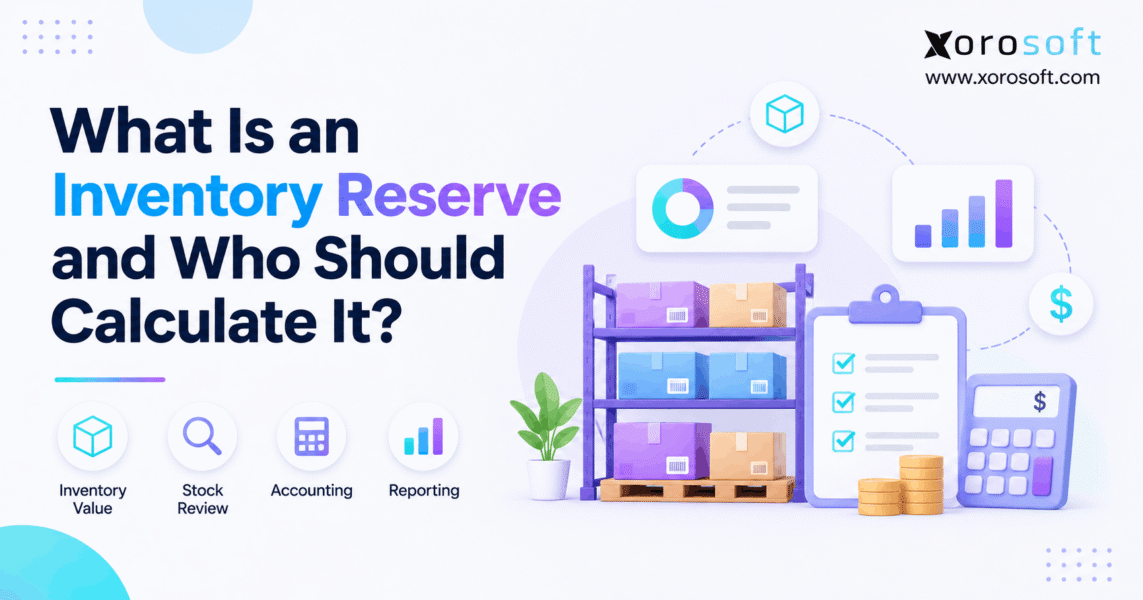
If you are looking to understand how an inventory reserve works and why it’s important for businesses, you’re in the right place.
1. When Stock Looks Healthy but the Books Tell Another Story
An inventory reserve helps a business reflect losses when stock may no longer recover its full cost. For example, a retailer might hold last season’s jackets at their original cost even though shoppers now expect steep discounts. As a result, the books could show more value than the goods can bring in. Finance needs to review that gap before it reports the closing stock value.
However, finance cannot make a sound estimate from a balance sheet alone. Warehouse staff know which boxes have damage. Sales teams know what buyers will pay. In addition, purchasing teams can flag old models and items with weak demand. Therefore, a reliable review brings these facts together instead of asking one person to guess a rate.
1.1 Why Inventory Reserve Reviews Matter as a Business Grows
As a company adds products, channels, and sites, its stock data gets harder to track. For instance, one warehouse may hold clean units, while another holds customer returns under the same SKU. If the system mixes these goods, finance may miss a real loss. Meanwhile, stock that stays on the books at too high a value can make assets and profit look stronger than they are.
Consequently, owners need a process that links physical stock with cost and sales evidence. The goal is not to create a large allowance. Instead, the goal is to report a fair, well-backed amount at each close.
1.2 What This Guide Will Help You Decide
First, we will explain what the allowance means and who should own it. Next, we will walk through costs, journal entries, and key accounting rules. Finally, we will show when a workbook can work and when an ERP can help.
Importantly, our figures are examples, not customer results. The right treatment also depends on your accounting rules.
2. What Is an Inventory Reserve in Accounting?
An inventory reserve is often a contra-asset allowance that reduces the net value of stock on the balance sheet. For example, a $30,000 allowance against $400,000 in gross stock leaves $370,000 in net stock value. However, some firms record the loss as a direct write-down instead of using a separate reserve account. Either way, the aim is to reflect value the business no longer expects to recover.
2.1 Inventory Reserve vs. Stock Reserved for an Order
An accounting reserve is about value, while an order reservation is about quantity. For instance, a shop may set aside 50 units for a wholesale buyer. Those units still belong in inventory at the right carrying amount. By contrast, a damaged batch may need a write-down even when no customer has placed an order.
Likewise, safety stock is not an accounting reserve. A planner keeps extra units to cover late supply or sudden demand. As a result, the phrase “reserved inventory” should never drive an accounting entry without a separate value review.
| Term | Main purpose | Typical effect |
|---|---|---|
| Inventory reserve | Reflect a loss in the carrying value of stock | Lowers net stock value |
| Order allocation | Hold units for a known order | Lowers units open for other orders |
| Safety stock | Protect against supply or demand swings | Guides buying and stock plans |
2.2 What Causes an Inventory Valuation Loss?
Goods may lose value because they break, expire, go out of style, or face a lower sale price. For example, a phone case made for an old device may have little demand after the new model launches. In contrast, a part that sells only twice a year may still have full value when a buyer needs it.
Therefore, age alone does not prove a loss. Finance should ask what the firm can gain from selling, using, or returning the item. Also, a supplier credit or a realistic repair plan may change the final estimate.
2.3 How the Reserve Affects Assets and Profit
When finance records a valid write-down, the net value of stock falls. At the same time, the business records a loss in its results for that period. Consequently, an overstated stock balance can also lead to overstated profit when a needed loss goes unrecorded.
For example, assume stock costs $500,000 but a review finds a $35,000 loss of value. The net carrying amount becomes $465,000. However, the firm still holds the physical units until it sells, repairs, returns, or scraps them. A reserve does not make those units vanish from a warehouse count.
3. Who Should Calculate an Inventory Reserve?
Accounting should prepare the inventory reserve estimate, and the controller should review it. Yet finance needs facts from warehouse, sales, and buying teams. For this reason, the best process gives each group a clear job and leaves the final accounting choice with an authorized finance leader.
3.1 Why Finance Owns the Inventory Reserve Calculation
Finance owns the method because the estimate changes reported assets and earnings. First, an accountant checks the cost basis and prior write-downs. Next, the team tests the evidence behind expected sale proceeds. Then, it prepares a clear schedule of proposed losses and ties the result to the ledger.
In addition, finance must know whether the company reports under US GAAP or IFRS. Those rules shape both the estimate and later changes. Therefore, a warehouse manager should not post a reserve just because an item sits in an old stock bucket.
3.2 What Warehouse, Sales, and Purchasing Teams Contribute
Warehouse staff can report broken packaging, failed tests, missing parts, and items held by a third-party site. Meanwhile, sales staff can show recent sale prices, planned markdowns, and buyer demand. Purchasing can flag canceled orders, supplier returns, and products that will soon be replaced.
For example, a report may show 800 slow units, but sales may hold an order for 600. As a result, finance must study the balance rather than write down the whole batch. Likewise, inspection notes can show a loss that stock data misses.
3.3 Who Reviews and Approves the Inventory Reserve?
A controller should challenge the key inputs and check whether the entry follows company policy. For a large or unusual loss, the CFO or another named leader may need to approve it. However, approval limits vary by firm; there is no universal rule that every adjustment needs a CFO signature.
As a practical safeguard, the person who prepares the schedule should not be its only reviewer. Also, the reviewer should be able to trace each large estimate back to source records. Consequently, the process is easier to explain during an audit or close review.
| Team | Main role | Evidence or output |
|---|---|---|
| Warehouse | Confirm units and condition | Counts, photos, lot notes |
| Sales and merchandising | Assess likely sale price | Orders, markdown plans, recent sales |
| Purchasing and planning | Check supply and future use | Forecasts, vendor credits, open orders |
| Accounting | Prepare estimate and entry | SKU schedule, cost data, roll-forward |
| Controller | Review rules and key judgments | Signed review and ledger tie-out |
| CFO or delegate | Approve material cases as policy requires | Approval record |
3.4 When a Small Company Has One Finance Lead
Small firms may not have separate accountants, controllers, and CFOs. Even so, they can assign clear duties. For instance, the warehouse lead may sign the condition report, while the bookkeeper prepares the estimate and the owner checks it. As a result, the business gains a second view without building a large team.
If staff must share tasks, document who checked the data and why they agreed with the loss. In addition, keep past estimates to compare with actual sales. That simple review can uncover weak rules before those rules distort several reporting periods.
Free ERP readiness check: Ask whether your team can trace stock cost, condition, expected sale price, and the final journal entry without rebuilding the same spreadsheet each month. If not, your close process may need better data links.
4. How to Calculate an Inventory Reserve Step by Step
A sound estimate starts with a clear cut-off date, correct stock cost, and current proof of likely recovery. However, it should not start with a flat rate such as “20% of everything older than one year.” Instead, finance must use the method that fits its accounting rules and the facts for each item or valid group.
4.1 Start the Inventory Reserve Calculation With Clean Data
First, pull a stock valuation report for the reporting date. Then, check units, item costs, warehouse sites, lots, and returns. For example, a receiving error may leave costs in the wrong period, while an unposted scrap event may leave goods in stock that no longer exist. Therefore, resolve basic count and cost errors before testing loss of value.
Next, reconcile the opening data to the inventory subledger and general ledger. Otherwise, finance may build a precise-looking estimate on a false base. In addition, review stock held by 3PLs because those units still need to appear in the right records.
4.2 Work Out Net Realizable Value
For goods subject to lower-of-cost-and-net-realizable-value rules, net realizable value (NRV) means the expected sale price less the costs needed to finish and sell the item. For example, an item may sell for $70 but need $8 in repair work and $7 in selling costs. Therefore, its estimated NRV is $55.
If the item cost $64, the gap is $9 per unit. However, finance must confirm which costs belong in the estimate under its reporting rules. Also, it should use firm orders, recent sales, or sound price plans rather than a hopeful list price.
4.3 Use Aging Buckets as a Warning, Not a Final Answer
Many teams start with aging groups such as 0–90, 91–180, and over 180 days. These are useful business filters, not required accounting rates. For instance, 200 old spare parts might still have firm demand. Meanwhile, a new batch may need a full loss if a recall makes it unsafe to sell.
As a result, ask why each group is slow and whether the firm can still recover cost. If you use set rates, test them against past markdowns and write-offs. Also, allow item-level exceptions when the proof points to a very different result.
4.4 A Three-SKU Inventory Reserve Example
Assume a distributor has three groups of stock. First, a past-season apparel line costs $12,000 but should recover only $8,000. Next, damaged furniture costs $10,000 but should recover $6,000 after relevant costs. Finally, standard goods that cost $15,000 should recover at least that amount.
Therefore, the first two groups need a combined $8,000 write-down under a suitable lower-of-cost-and-NRV approach. The third group needs none. This example uses made-up figures and assumes the items meet the stated measurement basis.
| Stock group | Recorded cost | Estimated NRV | Write-down |
|---|---|---|---|
| Seasonal apparel | $12,000 | $8,000 | $4,000 |
| Damaged furniture | $10,000 | $6,000 | $4,000 |
| Standard goods | $15,000 | $15,000 | $0 |
| Total | $37,000 | $29,000 | $8,000 |
4.5 Separate the Closing Reserve From the New Expense
The $8,000 in the example is the required loss tied to those goods. However, if the company already holds a valid $5,000 allowance against the same risk, it may need only $3,000 more, subject to other activity. Therefore, do not book the full closing estimate twice.
Instead, build a roll-forward that starts with the opening allowance, adds new loss charges, and subtracts covered stock disposals. After that, account for any other permitted changes. This check also helps finance tell a true new loss from an old loss already in the books.
5. Inventory Reserve Journal Entries and Write-Offs
A reserve estimate has no value to the close until finance records the right entry. However, the entry must reflect the loss that the company has not yet booked. Also, the firm should use account names and expense lines that fit its own reporting policy.
5.1 How to Record an Inventory Reserve Journal Entry
Suppose finance finds a new $8,000 loss and uses a contra-asset allowance. First, it debits an inventory loss expense for $8,000. Then, it credits the inventory reserve allowance for the same amount. As a result, the net carrying value falls while gross stock remains visible in the accounts.
| Illustrative account | Debit | Credit |
|---|---|---|
| Inventory write-down expense | $8,000 | — |
| Inventory reserve allowance | — | $8,000 |
However, some firms lower the inventory account directly rather than use a separate allowance. Therefore, ask the controller to approve both the method and the expense line. These examples do not mean that a separate reserve account is always required.
5.2 Do Not Charge the Same Write-Off Twice
Suppose a damaged lot has a $1,500 carrying value that an existing allowance already covers. Later, warehouse staff scrap the lot. Under a suitable allowance method, finance may debit the allowance and credit inventory for $1,500. Consequently, it removes the stock without recording the same loss a second time.
In contrast, if only part of the cost was covered, finance may need to record an extra loss. Also, the team should link the disposal to the correct SKU, lot, and original estimate. That trail makes later review much easier.
5.3 Tie Inventory Reserve Records to the Ledger
At each close, compare the stock valuation report, reserve workpaper, allowance balance, and related entries. First, confirm the gross stock total. Next, explain the opening-to-closing reserve change. Finally, check that write-offs match real stock events. Otherwise, a clean journal entry may hide a wrong quantity or cost.
For example, XoroERP connects stock and accounting work in one ERP setting. Xorosoft also documents item cost, on-hand units, and asset value in its Inventory Valuation Summary. However, those data points help a finance review; they do not prove that the system calculates or approves a reserve on its own.
6. Inventory Reserve Rules Under US GAAP and IFRS
Accounting rules matter because the same sale forecast can lead to a different process under different cost methods. Therefore, finance should confirm the reporting basis before using a formula or posting a change. Also, it should document when management last checked its key price assumptions.
6.1 US GAAP: FIFO, Average Cost, and LIFO
For most stock measured by FIFO or average cost, US GAAP calls for the lower of cost and NRV. In other words, finance must record a loss when the supported NRV falls below recorded cost. However, stock under LIFO or the retail inventory method follows the lower-of-cost-or-market model. Thus, a single NRV rule should not be applied to every US GAAP cost method.
For more detail, see the FASB update to inventory measurement. Because this is a technical area, the controller should also review the current ASC 330 guidance before closing the books.
6.2 IFRS: Net Realizable Value and IAS 2
Under IAS 2 Inventories, firms within the standard’s scope use the lower of cost and NRV. In addition, they assess stock at the item level unless the rules allow a sound group of related items. For example, a batch of similar goods sold in the same market may call for a grouped view. However, writing down every finished good by one flat rate lacks that link.
Also, IFRS does not permit LIFO as a cost formula. Therefore, a cross-border group should not copy a US stock policy into an IFRS report without review.
6.3 Can an Inventory Reserve Be Reversed?
Under IFRS, a firm must reverse an earlier write-down when sound new facts show that NRV has gone back up. However, the reversal cannot raise the item above the amount allowed before the original loss. Under US GAAP, write-downs generally create a new cost basis and later recovery does not lead to the same reversal treatment.
For this reason, teams should not let a spreadsheet automatically release old allowances when sale prices rise. Instead, have finance review the rule, date, and source of the change. The KPMG inventory accounting comparison explains the key difference.
| Accounting issue | US GAAP | IFRS |
|---|---|---|
| FIFO and average cost | Lower of cost and NRV | Lower of cost and NRV |
| LIFO | Permitted; special market test | Not permitted |
| Prior write-down recovery | Generally no reversal | Reverse when the stated tests are met |
| Review evidence | Cost, sales, and recovery facts | Cost, sales, and recovery facts |
6.4 Why the Income Statement Line Also Matters
When a loss occurs, finance must record it in the right period. However, its income statement line can vary with the accounting rules and the firm’s policy. For instance, an inventory write-down often affects cost of sales, but the exact display still needs review. Therefore, compare periods using a steady method and explain any major change.
In addition, a reserve is not a way to fix weak gross margin. Management must not add or release losses simply to hit a profit target. Instead, the estimate should follow evidence that a reviewer can test.
7. What Makes Stock Lose Recoverable Value?
The source of a loss often sits outside the finance team. Therefore, inventory staff should raise clear alerts before the month-end close. For example, a product recall, a failed quality test, or a major order cancelation can change the value of stock in days.
7.1 Obsolete and Slow-Moving Inventory Reserve Signals
Old stock is a useful starting point, but it is not the only test. For example, a discontinued SKU may have no live orders, while an older spare part may still serve long-term customers. Therefore, compare sales pace, weeks of stock on hand, future demand, and the price that buyers have actually paid.
Meanwhile, purchasing should stop fresh orders for items that no longer fit the plan. Otherwise, the same stock risk can grow each month. In addition, planners should flag a major demand drop before finance has to estimate an even larger loss.
7.2 Damage, Returns, and Warehouse Condition
A return can be new, open-box, repairable, or scrap. As a result, one “returns” status may not give finance enough detail. For example, a table with scratched legs may sell at a discount, while a broken frame may have only parts value. Therefore, the warehouse team should record condition, location, and a likely next step.
The XoroWMS warehouse management platform links warehouse work with broader stock processes. Xorosoft can help teams manage stock records, but it still takes human proof to judge damage and recoverable value.
7.3 Multi-Warehouse and 3PL Inventory Reserve Risks
When stock sits in several sites, the same item can have very different conditions. For instance, one warehouse may hold fresh cartons while a 3PL holds worn returns. In addition, items in transit may cross a reporting cut-off before the related entry posts. Therefore, finance should get a location-level view and reconcile each site’s totals.
Also, track units that a supplier owns or that your firm holds on consignment. Otherwise, a company may reserve stock that is not its asset or omit goods that it still owns.
7.4 Seasonality and Changes in Demand
Fashion, sports, home goods, and gifts often have short sale windows. As a result, a steep end-of-season markdown can change the likely return on older goods. However, do not assume that every past-season item has lost value. Some styles sell well for years, and some firms can move stock to another market.
Instead, use recent sales, current prices, planned discounts, and firm orders. Moreover, check whether the sale plan is realistic before finance signs the estimate.
8. Set an Inventory Reserve Policy That Teams Can Follow
A good policy tells people when to raise a flag, what proof to collect, and who makes the final call. As a result, finance spends less time chasing files at month-end. Also, teams can use the same rules from one period to the next.
8.1 Define Inventory Reserve Triggers and Proof
First, choose clear review triggers, such as old stock, failed quality checks, lower prices, or canceled orders. Next, set the data needed for each case. For instance, a damaged item may need an inspection note, while a markdown case may need recent sales and expected selling costs. However, do not let a trigger become an automatic loss rate.
Instead, ask whether the evidence shows that cost is no longer recoverable. In addition, keep a written reason for any large exception to a standard rule.
8.2 Choose a Review Cadence and Approval Path
For many firms, a monthly risk scan makes sense. Meanwhile, a formal valuation check must support each required financial reporting date and any major change in conditions. Therefore, set calendar dates for warehouse input, sales-price checks, controller review, and posting.
Also, define who can approve each size of adjustment. If the same person must prepare and post the entry, have another leader review the support where practical. Consequently, the business has a record of why it accepted the estimate.
8.3 Check the Stock Subledger Against the General Ledger
Before approval, compare the total cost of stock with the inventory accounts. For example, unposted receipts or scrap may cause a gap that has nothing to do with value loss. As a result, fix those errors first. Then, tie the reserve workpaper to the closing allowance and the journal entries.
Xorosoft combines inventory, buying, accounting, and reporting data, which can help teams trace these issues. However, even linked software needs clear rules and a finance review. Therefore, treat the system as a source of evidence, not an automatic accounting sign-off.
8.4 Use a Short Period-End Reserve Checklist
Before the close, confirm these steps:
- Check stock cost and quantity by SKU and location.
- Review damaged, old, returned, and out-of-date goods.
- Gather expected sale prices and other recovery proof.
- Apply the rules that fit the reporting framework.
- Reconcile old allowances, new losses, and covered write-offs.
- Get the required review, then post the entry.
- Save the workpaper and test past estimates against actual results.
Finally, revisit weak assumptions after each large sale or disposal. This feedback helps improve the next review.
9. Inventory Reserve Examples Across Product Industries
Different products lose value for different reasons. Therefore, a single policy should allow more than one type of evidence. Also, industry teams should help finance understand how their goods sell, age, and return.
9.1 Apparel and Fashion: Seasonal Goods
A clothing brand may have last season’s coats after warm weather starts. For example, buyers may now expect a 40% price cut. However, some sizes or colors may still sell at full price. Therefore, merchandising should give finance a realistic plan by style and size, not a blanket rate for the whole collection.
In addition, the team should compare its forecast with actual clearance sales. That check helps prevent both large overstatements and needless write-downs.
9.2 Furniture and Sporting Goods: Returns and Old Models
A furniture seller may hold open-box tables in one site and new tables in another. As a result, the same SKU can have different sale prospects. Meanwhile, a sporting goods brand may replace last year’s model with a new design. Therefore, the team should look at condition, price history, repair cost, and remaining buyer demand.
For a broader view of these product flows, see the industries we serve. However, the value decision must still reflect each firm’s own evidence.
9.3 Food, Wholesale, and Manufacturing: A Different Kind of Risk
Food sellers must compare shelf life with likely sales before expiry. Similarly, a wholesaler may face weak demand after a large buyer drops a product. A factory may hold parts for an old bill of materials. Therefore, planners should ask whether the goods can serve other orders or products.
A vendor return or safe rework plan may preserve value. However, a plan with no likely buyer or use cannot support full cost. Consequently, finance needs proof.
10. Spreadsheets vs. Connected ERP for Inventory Reserve Work
Xorosoft is an option for product firms that need stock, buying, warehouse, sales, and accounts to work from more closely linked data. However, a spreadsheet can still fit a small, stable business. Therefore, the right question is whether the process gives finance timely, reliable facts at a reasonable cost.
10.1 When a Manual Inventory Reserve Workbook Is Enough
A small catalog with one stock site may work well with a controlled file. For example, an accountant can import costs, add sale prices, and check large items with the owner. In addition, the team can lock formulas and save approved files.
However, manual work becomes risky when cost files change during the close or when different teams edit the same tabs. As a result, the business needs tighter checks or a better data flow.
10.2 How Connected ERP Data Helps Finance
An integrated ERP can bring key product workflows into a shared setting. For instance, a finance team can use stock, buying, warehouse, and accounting records as inputs to its review. Also, documented valuation reports show item costs, units on hand, and asset values.
However, these reports do not prove that the software automatically works out NRV, applies an approved reserve policy, or posts the loss. Therefore, ask for a live walk-through of the data and controls your finance team needs.
10.3 Where Ecommerce and Multi-Channel Data Fit
A merchant may sell the same goods through Shopify, Amazon, and wholesale orders. As a result, finance must check demand across channels before treating stock as dead. Also, returns and 3PL stock can change the picture. The Xorosoft integrations page outlines ways to link operational systems.
For Shopify sellers, the ERP listing on Shopify’s App Store offers more product context. However, a sales-channel link is not proof that a write-down is right. Finance still needs the sale-price and cost evidence.
10.4 Compare Manual and Connected Inventory Reserve Workflows
A system change should solve a clear control problem. For example, compare how fast finance can trace an aged SKU to its current cost, location, sale price, and prior loss. Then, test whether the proposed system can show that trail without extra exports.
| Review task | Manual workbook | Connected ERP data |
|---|---|---|
| Gather SKU costs | Repeated imports | Central item and cost records |
| Check site-level units | Match separate reports | Linked stock movement records |
| Review loss assumptions | Human review | Still requires human review |
| Trace journal entries | Cross-check file references | Closer link to accounting records |
| Approve a reserve | Named finance owner | Named finance owner |
Watch a product walkthrough: Explore Xorosoft’s XoroONE explainer and pick the stock and finance flows you want to test with your own data.
11. Common Inventory Reserve Mistakes to Avoid
The largest errors often come from a weak process rather than a hard formula. Therefore, a simple review checklist can do more good than a complex model with poor input data.
11.1 Using One Rate for Every Old Item
A blanket reserve rate may look fair, but it hides key differences. For example, 12-month-old repair parts may have steady demand, while new damaged goods may have none. Instead, use age to rank the review list, then test likely recovery by item or sound group. Also, compare past estimates with actual sale results so rates do not drift away from reality.
11.2 Missing Scrap or Booking the Same Loss Twice
If a damaged item stays in the stock file after disposal, finance may overstate units. Meanwhile, if accounting books a new expense for goods already covered by a reserve, it may overstate losses. Therefore, connect the disposal record to the original write-down and check the allowance roll-forward. Also, review production scrap and returns at the same reporting cut-off.
11.3 Letting Software Replace Judgment
Reports can flag risk, but a report cannot decide on its own what buyers will pay. For example, a forecast may miss a new customer order or a canceled product line. Therefore, managers must check the facts and sign off on key assumptions. In addition, the policy should explain when the team may depart from an aging rule.
12. Conclusion: Make the Inventory Reserve a Shared Control
A sound inventory reserve starts with good stock facts and ends with a clear finance decision. First, warehouse and sales teams show what goods can still recover. Next, accounting applies the right cost rules and builds the estimate. Finally, the controller checks the result and keeps the proof.
As your firm grows, Xorosoft can help bring stock, warehouse, buying, and accounts data closer together. However, your team still owns the accounting judgment. To review how these processes might fit your business, book a personalized demo after the initial discovery step.
FAQs
Who should calculate an inventory reserve?
Accounting should prepare the estimate. However, warehouse, sales, and buying teams must supply stock, price, and demand evidence. A controller should review the result before posting.
How do you calculate an inventory reserve?
First, check recorded cost and likely recovery. Then, find the supported loss under the relevant rules. Finally, adjust for amounts the business has already booked.
What is an inventory reserve journal entry?
For an allowance method, debit the inventory loss expense and credit the reserve account. However, a direct write-down may credit the stock asset instead.
Is an inventory reserve the same as a write-off?
No. A reserve reflects a loss of stock value. By contrast, a write-off often removes goods or cost from the books after loss or disposal.
What percentage of inventory should be reserved?
No single percentage fits every firm. Instead, use facts about condition, sale prices, demand, and cost. Then, test any standard rates against actual results.
Can inventory reserves be reversed?
IFRS requires reversals when the relevant tests are met, up to the prior loss. However, US GAAP generally does not permit reversal of an earlier write-down.
Can ERP software calculate inventory reserves automatically?
Some systems support parts of the workflow. However, features vary. Finance must still check the evidence, apply the right rules, and approve the final entry.
Recent Posts
-
What Is an Inventory Reserve and Who Should Calculate It?
-
Procurement Workflow Software for Inventory-Driven Businesses
-
 Canceled Shipment Quantities in Shopify: What ERP and WMS Teams Must Record
-
 Why ERP Renewal Hidden Costs Appear Outside the License Quote
-
 Ecommerce Delivery Statistics 2026: Cost, Speed, and Promise Accuracy