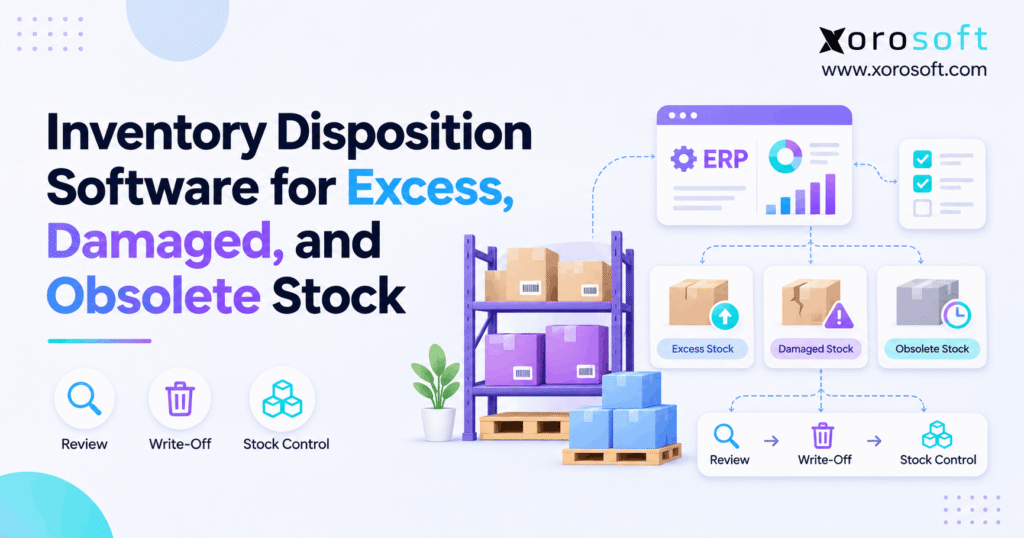
If your business is searching for ways to improve processes, inventory disposition software can streamline how you manage surplus or obsolete inventory.
1. When Inventory Stops Being Sellable, the Real Work Begins
Inventory disposition software gives growing businesses a controlled way to handle excess, damaged, and obsolete stock. Instead of relying on separate spreadsheets, warehouse messages, and finance adjustments, teams can track what needs attention, what action was approved, and whether the outcome was recorded correctly.
For example, a retailer might have 400 discontinued jackets, 60 damaged returns, and 120 units waiting for a supplier credit. All three groups are on hand, yet they need different decisions. Therefore, treating them as one generic inventory problem can hide avoidable losses.
1.1. Why Stock Disposition Management Gets Harder Across Channels
At first, a warehouse manager can recognize problem products by sight. However, additional warehouses, marketplaces, and wholesale customers make the picture harder to trust. For instance, an item can look available in one system while another team has already placed it on hold.
Consequently, a simple disposal decision becomes a coordination problem involving inventory, fulfillment, purchasing, and accounting. As a result, better records matter as much as the physical stock movement.
1.2. The Decision Every Operator Must Answer
Before removing a product, ask whether it can be transferred, repaired, returned, sold through another channel, or safely disposed of. Then ask what the decision will cost and who can approve it.
In other words, inventory disposition is not a cleanup exercise. It is a repeatable method for protecting stock accuracy and recovering value when ordinary selling plans no longer work.
2. What Inventory Disposition Software Actually Controls
Inventory disposition software coordinates the identification, review, authorization, execution, and closure of inventory exceptions. For example, depending on the system, it may support stock statuses, warehouse adjustments, supplier returns, audit records, or accounting entries. However, buyers should verify which capabilities are native and which require configuration.
2.1. Disposition Is Not the Same as Disposal
Inventory disposition describes the decision process. Disposal is one possible outcome, such as recycling or authorized destruction. A return to a supplier, a clearance sale, or a transfer to another warehouse can also resolve a disposition case.
Similarly, an inventory write-down changes carrying value without necessarily changing physical quantity. A write-off removes the remaining recognized value when an item no longer qualifies as an asset. Therefore, finance and warehouse records must not treat these terms as interchangeable.
2.2. Who Owns Stock Disposition Management?
Warehouse teams verify condition and quantity. Purchasing confirms supplier options. Operations compares recovery routes. Finance evaluates valuation and reconciliation. Meanwhile, an authorized manager approves material losses or sensitive actions.
Consequently, an effective inventory disposition system connects these responsibilities through a case reference and documented handoffs. Nevertheless, the software cannot decide a company’s approval policy on its own; ownership and authority must be defined first.
3. Identify Excess, Damaged, and Obsolete Inventory Correctly
The first mistake in stock disposition management is classifying every slow-moving SKU as worthless. Instead, evaluate demand, product condition, contractual commitments, and possible recovery before choosing a route.
3.1. Excess Inventory Disposal Is Not the First Option
Excess inventory means stock exceeds foreseeable requirements. For example, a canceled wholesale promotion may leave an apparel business holding more units than expected. However, the products may remain suitable for full-price sales at another location.
Therefore, review open orders, seasonal demand, transfer costs, and future purchase plans. Inventory disposition software should help teams document those findings instead of immediately applying a discount or write-off.
3.2. Obsolete Stock Management Needs a Different Test
Obsolete stock has lost much of its intended commercial use because of design changes, discontinued models, outdated specifications, or reduced demand. Nevertheless, age by itself does not prove that every unit has zero value.
For instance, a manufacturer may reuse a component in another assembly. Alternatively, a distributor may recover part of its cost through an authorized secondary market. Therefore, examine actual reuse and resale options before declaring a final loss.
3.3. Damaged Inventory Management Begins With Inspection
Damaged goods need an inspection step. For example, a torn outer carton may be fixable, while a cracked safety component may make resale inappropriate. Likewise, returned items can require a quality review even when the packaging looks acceptable.
| Condition | First action | Likely decision routes |
|---|---|---|
| Excess | Review demand | Transfer, clearance, supplier return |
| Obsolete | Review usability | Resale, rework, recycle |
| Damaged | Restrict and inspect | Repair, return, scrap |
| Nonconforming | Hold pending approval | Rework, supplier claim, controlled removal |
Consequently, the best decision starts with a reliable condition code, not a generic adjustment reason.
4. Why Spreadsheet-Based Disposition Breaks Down
Certainly, a spreadsheet can record a small number of cases. However, it cannot automatically guarantee that warehouse stock, ecommerce availability, purchase records, and the general ledger all reflect the same decision. That gap creates the real operational risk.
4.1. Stock Disposition Management Needs More Than a Shared File
For example, imagine that a warehouse identifies 35 damaged units and updates a spreadsheet. Meanwhile, Shopify still lists those units as sellable because the inventory connection has not changed their availability. As a result, new orders can claim stock that should remain restricted.
Therefore, damaged inventory management must connect the physical hold with the selling status. A note in a separate file is not enough.
4.2. Approval Delays Inflate the Problem
Often, the warehouse waits for purchasing to confirm a supplier return. Purchasing waits for a photograph. Finance waits for the final quantity. Consequently, the same goods occupy space without a deadline or accountable decision owner.
Inventory disposition software can help make those dependencies visible. However, even a sophisticated tool will fail when teams have not established who must act next.
4.3. Why the Inventory Write-Off Workflow Reaches Finance Late
Finally, an inventory adjustment may appear in accounting without the approved reason, supporting documentation, or related vendor credit. Reconciliation then becomes a search through messages and spreadsheets.
Instead, connect the case to its physical movement, valuation decision, and financial settlement. As a result, reviewers gain a clear explanation of both the quantity and the carrying value.
5. Inventory Disposition Software: A Seven-Step Workflow
A practical inventory disposition workflow follows seven steps: identify, restrict, inspect, choose, approve, execute, and reconcile. Although businesses can adjust the sequence for their operations, skipping controls usually increases the risk of disputed quantities or premature stock removal.
5.1. Identify and Validate the Exception
First, review cycle counts, aging reports, return inspections, quality issues, and discontinued SKU lists. Then verify each case against actual warehouse stock and open commitments.
For example, a distributor may identify 200 obsolete units, but 40 already belong to unfulfilled customer orders. Therefore, the proposed disposition quantity cannot be approved without resolving those commitments. Finally, capture the SKU, quantity, location, reason, and case owner.
5.2. Inventory Disposition System: Restrict Stock and Preserve Evidence
Next, place affected inventory in a controlled location or status so it cannot flow into normal fulfillment. Additionally, record photographs, lot numbers, serial numbers, or inspection notes where relevant. Additionally, check that connected channels no longer offer restricted units.
At this stage, inventory disposition software should preserve the difference between physically on-hand goods and units eligible for new orders. In turn, that distinction prevents a hold from becoming an accidental sale.
5.3. Stock Recovery Software: Compare Options Before Approving
Then calculate the potential net outcome of transfer, clearance, supplier return, repair, liquidation, donation, or disposal. Moreover, include freight, labor, fees, handling, and any product safety constraints.
For instance, a $5,000 liquidation offer may produce only $3,850 after direct costs. Meanwhile, an authorized supplier return might deliver a larger credit. Therefore, compare realistic net results rather than headline prices alone.
5.4. Approve and Execute the Chosen Route
After evaluation, send the proposed action to the appropriate decision maker. Use value thresholds, separation of duties, and quality requirements where necessary. Then execute the warehouse transaction with a reference to the approved case.
Xorosoft documents inventory adjustment reason codes, quantity changes, value changes, and reference fields in its knowledge base. However, a complete disposition approval sequence should still be tested against the company’s requirements rather than assumed to be automatic.
5.5. Reconcile and Close the Case
Finally, verify the shipped, transferred, reworked, or removed quantities. In addition, finance should check any related write-downs, supplier credits, sales proceeds, or disposal costs. Ultimately, the case closes only when the physical outcome and financial treatment are documented.
As a result, inventory disposition software becomes a record of completed decisions, not just a list of products that somebody intended to remove.
6. Select the Right Inventory Disposition Method
The cheapest-looking option can become expensive after freight, repair, marketplace fees, or compliance costs. Therefore, inventory disposition software should support clear comparisons rather than default every exception to liquidation.
6.1. Transfer or Clearance When Demand Still Exists
First, check whether another warehouse or channel has genuine demand. A transfer can preserve future selling value, although transportation and handling still matter. Similarly, a controlled clearance campaign may recover cash from usable products.
However, neither method solves the problem if it merely moves old inventory into a different location or discounts profitable demand unnecessarily.
6.2. Supplier Returns, Repair, and Secondary Sales
For example, a return-to-vendor option can preserve value when contract terms allow it. Therefore, purchasing should confirm authorization, return windows, fees, and credit conditions before the warehouse ships anything.
Likewise, rework may be economical for furniture with cosmetic defects or apparel needing repackaging. Nevertheless, teams must confirm that repaired goods meet the relevant quality and safety requirements before release.
6.3. Inventory Disposal Management: Donation and Destruction
When resale is unsuitable, donation or recycling may be reasonable. However, expired food, unsafe sporting equipment, or regulated materials can require special handling and documentation.
| Route | Primary evaluation question |
|---|---|
| Transfer | Does verified demand justify the move? |
| Clearance | What is the net margin after discounts and fees? |
| Supplier return | What credit is contractually available? |
| Repair or rework | Will the finished product meet requirements? |
| Recycle or destroy | What handling and evidence are required? |
Consequently, inventory disposition software should record why the selected method beat the alternatives.
7. Inventory Disposition Software and Warehouse Availability
Warehouse disposition controls must prevent an inventory exception from becoming an allocation or fulfillment error. However, a physical quarantine bin is only one part of the solution; connected sales systems also need the correct stock status.
7.1. On-Hand Inventory Is Not Always Sellable
Suppose a location holds 1,000 units: 690 available, 210 committed to orders, and 100 unavailable because of damage or quality inspection. Therefore, the physical total remains 1,000, but only 690 units are available for new sales.
Importantly, Shopify’s inventory-state guidance distinguishes on-hand, available, committed, and unavailable quantities. Therefore, ecommerce teams should test how each stock restriction travels between their store and inventory system.
7.2. Damaged Inventory Management: Lot, Location, and Quality
A quality problem may affect only one batch or warehouse location. Therefore, blocking an entire SKU can create unnecessary stockouts. Capture the affected lot, serial number, bin, quantity, and reason whenever those identifiers apply.
For example, XoroWMS provides warehouse inventory visibility and multi-warehouse management within the wider ERP environment. However, buyers should demonstrate the exact quarantine and release workflow they require.
7.3. Inventory Disposition System Across Sales Channels
Inventory disposition software must fit the direction of data flow. First, identify which system owns stock availability. Next, determine how holds, transfers, adjustments, and returns reach Shopify, Amazon, EDI customers, or third-party logistics providers.
In addition, test delayed updates and failed messages. A correct warehouse decision should not leave an outdated available quantity in another channel. Review the intended setup against the Xorosoft integrations overview.
8. Separate Inventory Valuation From Physical Removal
Damaged or obsolete products can lose financial value before they leave a warehouse. Conversely, an internal transfer changes location without automatically creating an inventory loss. Therefore, inventory disposition software needs clear connections between stock movements and accounting decisions.
8.1. Inventory Write-Off Workflow: Know the Differences
For example, an inventory write-down reduces a carrying amount when the applicable accounting rules require it. A write-off removes the remaining value when an item no longer qualifies as an asset. Meanwhile, a reserve or allowance can represent a valuation adjustment under the relevant accounting policy.
Importantly, none of these terms is a substitute for physical movement records. Consequently, finance should review evidence and earlier adjustments to avoid counting the same loss twice.
8.2. Apply the Right Inventory Accounting Framework
Under IAS 2 Inventories, relevant inventory is measured at the lower of cost and net realizable value. NRV is the estimated ordinary-course selling price less estimated completion and selling costs. However, US GAAP can differ for particular inventory costing methods.
Consider 50 damaged chairs costing $80 each. If estimated NRV is $35 per chair, total carrying value may require a $2,250 write-down under the stated IAS 2 assumptions.
| Example measure | Amount |
|---|---|
| Original inventory cost | $4,000 |
| Estimated total NRV | $1,750 |
| Illustrative write-down | $2,250 |
The units may still exist physically after that adjustment. Therefore, a later sale or disposal requires separate treatment that considers the earlier loss.
8.3. Reconcile the Subledger, Credits, and GL
When goods return to a supplier, the warehouse shipment and vendor credit may occur in different periods. Likewise, recovered proceeds may arrive after the disposition case begins.
Therefore, tie each approved case to inventory adjustments, return references, credits, and any applicable journal entries. Xorosoft’s XoroERP connects inventory, purchasing, warehousing, and accounting functions, which makes it relevant for evaluating these cross-team reconciliations.
9. Build a Reliable Handoff Between ERP, WMS, and Purchasing
Even strong inventory disposition software fails if each department considers its own task complete while the overall case remains unresolved. Therefore, design one shared case timeline with distinct responsibilities and closing evidence.
9.1. Stock Disposition Management: What the Warehouse Must Confirm
First, the warehouse should verify condition, physical quantity, location, and actual execution. For example, a return of 80 units needs proof of the shipped quantity and the related authorization. Similarly, a destruction event needs the records required by company policy and applicable rules.
However, the warehouse should not be expected to decide inventory valuation independently.
9.2. What Purchasing and Operations Must Recover
Purchasing confirms supplier eligibility, authorizations, credits, and replacement terms. Meanwhile, operations compares other recovery routes and resolves timing conflicts with orders or production demand.
Consequently, a disposition case should have a defined owner even when different departments execute individual steps. Otherwise, aged stock can remain in quarantine indefinitely.
9.3. Inventory Write-Off Workflow: What Finance Must Verify
Finance checks the inventory carrying value, prior adjustments, expense classification, and timing of credits or proceeds. Additionally, it reconciles open exceptions to the inventory subledger and general ledger.
As a result, the case should close only after both physical completion and financial follow-up are documented. This is the practical purpose of a controlled inventory write-off workflow.
10. Evaluate Inventory Disposition Software With a Real Scenario
A vendor demonstration should prove that inventory disposition software can handle one complete business exception. Instead of accepting a list of features, prepare a realistic SKU, quantity, warehouse location, supplier status, and approval requirement.
10.1. Inventory Disposition Software: Test the Capabilities
Start with the features that directly affect accuracy, recovery, and auditability. Additionally, distinguish documented native capabilities from configuration, integration, and manual procedures.
| Capability to verify | Demo evidence to request |
|---|---|
| Stock condition and holds | Restricted quantity is not pickable |
| Reason codes | A clear explanation accompanies every change |
| Lot and location tracking | Only affected units are controlled |
| Approval trail | Decision owner and evidence are visible |
| Quantity/value adjustments | Physical and financial effects remain distinct |
| Supplier returns | Shipped quantities link to credit follow-up |
| Audit and reporting | Errors can be traced and reconciled |
10.2. Test Corrections, Not Only Happy Paths
Next, ask what happens if an employee selects the wrong warehouse or quantity. Can the business document a reversing transaction without erasing history? Furthermore, can finance identify the original event and the correction?
Xorosoft’s documentation describes inventory adjustment references and reversals through subsequent adjustments. However, businesses should test their required approvals and reports in the configured environment.
10.3. Ask Who Owns the Inventory Number
Finally, confirm which system is authoritative for stock on hand, available quantity, allocation, and financial valuation. Then simulate a failed integration or delayed channel update.
A buyer evaluating XoroONE can use this scenario to assess how connected inventory, order, warehouse, and accounting workflows fit its operations. Ultimately, the important result is reliable execution, not an impressive dashboard.
11. Compare Inventory Management Approaches Fairly
Inventory disposition software serves businesses with different levels of control. Therefore, the comparison should focus on workflow completeness, implementation effort, and the ability to keep operational and financial records consistent.
11.1. Start With Connected ERP and WMS for Complex Operations
For a multi-warehouse company seeking one operational and financial environment, Xorosoft ERP and WMS is the first relevant option to evaluate. Its documented inventory, warehouse, purchasing, accounting, and ecommerce capabilities align with several requirements of a disposition process.
However, a dedicated disposition approval module or specialized compliance workflow should never be assumed without a demonstration.
| Approach | Appropriate situation | Main trade-off |
|---|---|---|
| Xorosoft connected ERP/WMS | Multi-team inventory and accounting coordination | Validate precise workflow fit |
| Standalone quality or returns tool | Specialized inspection requirements | Integration with stock and finance |
| Inventory-only application | Basic stock and quantity controls | Limited financial context |
| Controlled spreadsheet | Low-volume exceptions | Manual status and reconciliation |
11.2. When Stock Disposition Management Can Stay Manual
A business with one location, occasional stock damage, clear approval rules, and prompt monthly reconciliation may not need a new application. Instead, it may need better procedures, named owners, and consistent records.
Nevertheless, repeated cross-channel inventory errors or large unresolved stock values indicate that the manual approach may no longer be economical.
11.3. Choose the Upgrade Based on Bottlenecks
If the primary challenge is regulated inspection, a specialist workflow may be appropriate. Conversely, if the challenge is disconnected purchasing, warehouses, orders, and accounting, connected ERP deserves stronger consideration.
Therefore, score systems against real disposition cases, implementation requirements, reporting needs, and total cost rather than vendor feature counts alone.
12. Industry Examples That Change the Decision
Importantly, industry-specific constraints influence which stock recovery path is realistic. Therefore, inventory disposition software should reflect product risk, storage costs, selling windows, and supplier agreements rather than impose one universal rule.
12.1. Apparel and Furniture
Apparel brands often face seasonal markdown pressure, size imbalances, and packaging-related returns. Consequently, clearance timing can matter more than the age of a particular SKU.
Furniture businesses face a different calculation: freight, inspection, storage space, and repair labor can consume recovery proceeds. For example, transferring a damaged sofa across the country may cost more than an approved local recovery option.
12.2. Damaged Inventory Management for Sporting Goods and Food
Sporting goods teams must distinguish cosmetic packaging damage from defects that affect performance or safety. Similarly, food distributors must consider lot traceability, expiration, storage conditions, and applicable disposal requirements.
As a result, inventory disposition software should preserve enough product and batch detail for quality teams to authorize the outcome without accidentally releasing unsafe units.
12.3. Wholesale Distribution and Manufacturing
A wholesaler may accumulate obsolete customer-specific inventory after contract changes. Meanwhile, a manufacturer may face unused components after a bill-of-materials revision.
Therefore, purchasing and planning should review substitution, supplier return, and future consumption before scrapping items. In addition, Xorosoft serves these inventory-driven sectors, as outlined in its industry overview.
13. Measure Recovery and Completion, Not Just Stock Reductions
Inventory disposition software should help managers distinguish value recovered from value merely moved around. Otherwise, a transfer to another warehouse may appear to solve the problem even though the company still owns the same aging goods.
13.1. Use Net Recovery, Not Gross Offers
Suppose a distributor has 100 obsolete units with a combined carrying value of $10,000. A liquidation buyer offers $4,500, but freight, fees, and handling total $900. Therefore, estimated net recovery equals $3,600, or 36% of that carrying value.
However, that percentage is a commercial recovery metric, not a substitute for the accounting assessment. A supplier return or controlled reuse could still deliver more value.
13.2. Track the KPIs That Expose Delays
A useful reporting set includes the following measures:
| KPI | Practical definition |
|---|---|
| At-risk stock share | At-risk carrying value / total inventory value |
| Net recovery rate | Net recovery proceeds / chosen pre-disposition value |
| Disposition cycle time | Days from case approval to verified closure |
| On-time closure rate | Cases closed by deadline / cases due |
| Reconciliation exceptions | Unmatched quantities, credits, or approvals |
Furthermore, inventory disposition software should expose recurring reasons by supplier, warehouse, and product family. That analysis helps teams prevent repeat damage or excess purchases instead of celebrating more write-offs.
14. Implement the Process Before Automating It
In practice, buying inventory disposition software without clear operating rules can simply make inconsistent decisions happen faster. Therefore, begin with a policy, test cases, and a small set of accountable owners.
14.1. Standardize Codes, Roles, and Evidence
First, define condition codes for excess, obsolete, damaged, expired, and nonconforming inventory. Next, establish approval thresholds and the evidence required for different values or product risks.
In addition, specify which events change stock availability, quantity, or carrying value. These should not be treated as one generic adjustment.
14.2. Pilot Inventory Disposition Software With Three Cases
Choose one obsolete SKU, one damaged customer return, and one supplier return with an outstanding credit. Then run each scenario from identification to closure.
For example, check whether a restricted lot can accidentally be allocated to an ecommerce order. Also verify that a supplier credit remains visible until finance resolves it. This is a stronger readiness test than importing a list of old SKUs.
14.3. Avoid the Three Most Common Mistakes
First, do not dispose of stock before checking customer commitments. Second, do not treat physical removal as proof of the correct accounting value. Third, do not close cases without reconciling execution and credits.
Instead, schedule a regular review of overdue cases and root causes. As a result, the organization can reduce future excess while maintaining better control over existing problem inventory.
15. Conclusion: Make Every Inventory Decision Traceable
Inventory disposition software is valuable when it turns uncertain stock into a documented decision. First, classify and restrict affected inventory. Then compare recovery options, obtain the correct approval, execute the movement, and reconcile the financial result.
However, the best process also prevents recurrence. Purchasing can review overbuying, warehouse leaders can investigate damage, and finance can monitor valuation risk. Consequently, excess, damaged, and obsolete stock becomes an operating issue with accountable owners rather than an unresolved spreadsheet balance.
For inventory-driven businesses evaluating a connected ERP and WMS environment, Xorosoft offers inventory, warehouse, purchasing, accounting, and multi-channel capabilities to assess against those requirements. Book a Demo to discuss your specific disposition workflow and the controls your team needs.
Frequently Asked Questions
What is inventory disposition software?
Inventory disposition software tracks excess, damaged, and obsolete stock from identification through approval, recovery, and final adjustment. It helps teams connect warehouse actions with accurate inventory and financial records.
How does inventory disposition differ from disposal?
Disposition is the complete decision process. Disposal is one possible outcome, alongside supplier returns, transfers, repair, clearance, or donation. Not every disposition decision requires destroying or removing products.
How should damaged stock be handled?
First, restrict damaged units from sale and picking. Next, document their condition and location, inspect them, approve a recovery or disposal route, and reconcile the resulting inventory movement.
When should obsolete inventory be written off?
A write-off is appropriate when inventory no longer qualifies as an asset under the applicable accounting policy. Finance should review evidence, earlier write-downs, and physical stock records before posting it.
Can Shopify keep damaged inventory unavailable?
Yes. Shopify supports unavailable inventory states, including damaged and quality-control stock. However, merchants must verify that connected ERP, WMS, and channel integrations preserve the restriction.
What features should the software include?
Prioritize quarantine controls, condition codes, lot tracking, approvals, supplier returns, quantity and value adjustments, audit history, and ERP/WMS integration. Test complete scenarios rather than accepting a feature checklist.
When should a business upgrade from spreadsheets?
Upgrade when multiple warehouses, recurring discrepancies, delayed approvals, or reconciliation work overwhelm manual controls. First, standardize ownership and policies; then evaluate whether connected software solves the underlying problems.
Recent Posts
-
 Why Spreadsheet Commission Calculations Create Disputes and Margin Leakage
-
 Inventory Disposition Software for Excess, Damaged, and Obsolete Stock
-
 Shopify Delivery Option Metafields: Operational Uses for ERP and WMS Data
-
 ERP Renewal Case Study: How a Distributor Evaluated Renewing or Replacing
-
 Pick-Face Replenishment Benchmarks 2026: Stockouts, Tasks, and Travel