1. ERP Adoption Statistics in 2026: What the Data Shows
ERP adoption statistics show that enterprise resource planning is moving beyond large-company finance departments and becoming an operational priority for growing businesses. In 2026, companies are adopting ERP systems to connect inventory, accounting, purchasing, warehousing, manufacturing, ecommerce, and reporting instead of managing these workflows through disconnected applications.
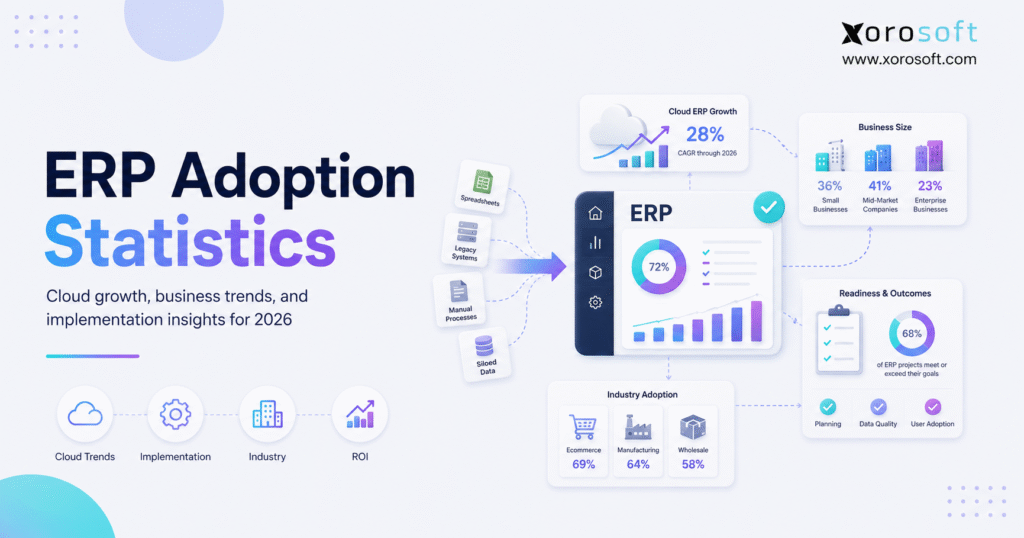
According to Fortune Business Insights’ ERP software market research, the global ERP software market is projected to grow from $106.22 billion in 2026 to $281.58 billion by 2034. The same research expects cloud and hybrid deployments to represent the largest deployment segment in 2026. Therefore, the market is not merely expanding; it is shifting toward connected and cloud-based operating models.
However, rising investment does not mean every implementation produces the expected outcome. Gartner’s research on ERP initiatives predicts that, by 2027, more than 70% of recently implemented ERP initiatives will fail to fully meet their original business-case goals. Consequently, the most useful ERP adoption statistics are not only market-size numbers. They also explain implementation risk, cloud migration, user adoption, data readiness, and the operational conditions that make an ERP project worthwhile.
For growing product businesses, the central question is no longer whether ERP exists. Instead, leaders need to determine when spreadsheets, QuickBooks, inventory applications, warehouse tools, and ecommerce plugins stop functioning as a reliable operating system.
1.1 What Is ERP Adoption?
ERP adoption is the sustained use of an enterprise resource planning system across the workflows it was selected to manage. Although implementation covers configuration, migration, testing, training, and go-live, adoption begins when employees consistently use the new system for daily work.
As SAP’s ERP guide explains, ERP integrates core processes and creates a unified view of business activity. Therefore, true adoption usually requires finance, operations, purchasing, inventory, warehouse, manufacturing, sales, and leadership teams to work from the same records.
A business has not fully adopted ERP when employees continue to:
- Maintain separate inventory spreadsheets.
- Create purchase orders outside the system.
- Reconcile warehouse transactions manually.
- Build leadership reports from exported files.
- Keep old applications as unofficial sources of truth.
- Enter the same order or supplier data in multiple systems.
1.2 Why ERP Adoption Statistics Matter
ERP adoption statistics help leaders benchmark their technology decisions against broader market changes. More importantly, they reveal why businesses are upgrading and what commonly prevents projects from delivering value.
For example, market-growth figures demonstrate sustained investment in ERP. Meanwhile, cloud ERP data shows how deployment preferences are changing. Implementation research adds a necessary warning by showing that software selection alone does not guarantee better performance.
As a result, companies should use these statistics to answer practical questions:
- Is our current software stack still suitable for our operating complexity?
- Are we adopting ERP to solve defined problems or simply following a trend?
- Do we have the data and process discipline required for implementation?
- Which business outcomes should improve after go-live?
- How will we measure adoption across teams?
2. Key ERP Adoption Statistics and Market Benchmarks
The following ERP adoption statistics provide a concise view of the 2026 market, cloud deployment, implementation risk, and vendor landscape.
- The global ERP software market is projected to reach $106.22 billion in 2026 and $281.58 billion by 2034, representing a 13% compound annual growth rate, according to Fortune Business Insights.
- The cloud ERP market is projected to grow from $76.17 billion in 2026 to $207.59 billion by 2034, according to Fortune Business Insights’ cloud ERP research.
- Gartner predicts that more than 70% of recently implemented ERP initiatives will fail to fully meet their original business-case goals by 2027.
- Forrester’s Q1 2026 ERP Solutions Landscape covers 29 vendors across company sizes, geographies, deployment models, and industry focuses.
- Gartner forecasts that 62% of cloud ERP spending will involve AI-enabled solutions by 2027, up from 14% in 2024, according to its 2026 cloud ERP AI forecast.
These ERP adoption statistics point to a market that is expanding, moving to the cloud, and adding AI capabilities. Nevertheless, the implementation figures show that businesses still need stronger governance, cleaner data, clearer outcomes, and better user adoption.
2.1 How to Interpret ERP Adoption Data Correctly
There is no single reliable percentage showing how many companies worldwide use ERP. Surveys often study different industries, revenue bands, countries, or software categories. Therefore, a percentage from an enterprise survey should not be applied automatically to small ecommerce brands or regional distributors.
A better analysis separates ERP adoption statistics into five categories:
1. Market growth and software spending.
2. Cloud and SaaS deployment trends.
3. Adoption by company size and industry.
4. Implementation results and project risk.
5. Operational outcomes after go-live.
This approach prevents a common mistake: using market growth as proof that every business needs ERP immediately.
2.2 What the 2026 Benchmarks Mean for Buyers
The data suggests that ERP is becoming more accessible to mid-market businesses. At the same time, the vendor landscape is becoming more varied. Consequently, buyers can evaluate enterprise platforms, mid-market cloud systems, industry-specific products, manufacturing ERP, distribution ERP, and inventory-led ERP alternatives.
However, more choice creates more evaluation work. Businesses must compare process fit, implementation scope, integrations, usability, total cost, reporting depth, and support rather than relying only on vendor size.
3. ERP Adoption Statistics by Business Size
ERP adoption statistics by business size should be interpreted through operating complexity, not revenue alone. A $3 million ecommerce company with thousands of SKUs, two warehouses, Amazon, Shopify, wholesale customers, and outsourced fulfillment may need stronger systems earlier than a much larger service company.
3.1 Small-Business ERP Adoption
Small businesses usually begin with accounting software, spreadsheets, and lightweight applications. This stack may remain effective while transaction volume is low and only a few employees manage operations.
However, ERP readiness increases when the business experiences several of these conditions:
- Inventory records no longer match physical stock.
- Purchasing relies on one employee’s spreadsheet.
- The finance team cannot explain inventory valuation quickly.
- Orders are re-entered between applications.
- Reports require several exports and manual adjustments.
- Managers cannot see margins by product, channel, or customer.
Therefore, a small company should not adopt ERP merely because it is growing. It should evaluate ERP when operational risk and manual labor begin increasing faster than revenue.
3.2 Mid-Market ERP Adoption Statistics
Mid-market companies represent an important part of ERP market growth because they often operate with enterprise-level complexity but smaller implementation teams. Fortune Business Insights expects small and medium-sized enterprises to represent a substantial portion of the 2026 ERP software market. Therefore, ERP vendors are increasingly designing cloud products for companies below the traditional enterprise tier.
A mid-market company commonly adopts ERP after adding:
- More warehouses or legal entities.
- A larger product catalog.
- Wholesale and ecommerce channels.
- More complex purchasing approvals.
- EDI customers or suppliers.
- Manufacturing or assembly workflows.
- Greater financial-control requirements.
At this stage, ERP usually becomes a system-consolidation decision rather than a single-feature purchase.
3.3 Enterprise ERP Modernization
Large enterprises often already use ERP. Consequently, their adoption projects focus on modernization, cloud migration, process standardization, global reporting, or replacing heavily customized legacy systems.
Enterprise projects also carry significant risk because they affect more users, countries, integrations, entities, and business units. Therefore, leadership must separate technology modernization from process redesign and define how much change the organization can absorb at once.
4. ERP Adoption by Industry
ERP adoption patterns vary because industries manage different forms of operational complexity. Manufacturing companies focus on materials and production. Distributors prioritize inventory, purchasing, pricing, and fulfillment. Ecommerce brands need channel synchronization and financial reconciliation.
4.1 Manufacturing ERP Adoption
Manufacturers commonly adopt ERP to connect materials, production, inventory, purchasing, costing, and finance. Without an integrated system, production teams may plan from one set of data while purchasing and accounting use another.
Typical manufacturing requirements include:
- Bills of materials.
- Work orders.
- Material requirements planning.
- Production schedules.
- Raw-material availability.
- Finished-goods tracking.
- Inventory valuation.
- Quality and traceability controls.
As a result, manufacturing ERP adoption often becomes necessary when production planning cannot rely on accurate inventory and purchasing information.
4.2 Wholesale Distribution ERP Adoption
Wholesale distributors manage inventory, supplier lead times, customer pricing, sales orders, credit rules, warehouse activity, and often EDI. Therefore, distributors usually need more than accounting software plus a basic inventory application.
Common ERP triggers include:
- Customer-specific pricing becomes difficult to maintain.
- Inventory allocation is inconsistent.
- Purchase orders do not reflect current demand.
- EDI transactions require manual intervention.
- Warehouse and accounting data disagree.
- Fill rates decline as volume increases.
For a deeper operational view, Xorosoft’s guide to ERP inventory management for ecommerce and product businesses explains how inventory, purchasing, warehouses, accounting, and channels connect inside an ERP environment.
4.3 Ecommerce ERP Adoption Statistics
Ecommerce ERP adoption statistics are most useful when they account for channel and fulfillment complexity. A Shopify store with one warehouse may not need ERP. Nevertheless, the same brand may require it after adding Amazon, wholesale, EDI, a 3PL, international sales, or several warehouses.
Typical ecommerce adoption signals include:
- Overselling across channels.
- Delayed Shopify and Amazon reconciliation.
- Unreliable available-to-sell quantities.
- Manual purchase planning.
- Returns that do not update inventory and accounting correctly.
- Different margin reports across finance and operations.
Businesses facing these issues can review Xorosoft’s Shopify ERP guide to understand the distinction between storefront software and the operational system behind it.
4.4 Apparel, Food, Furniture, and Sporting Goods
Apparel companies manage size, color, style, seasonality, and returns. Meanwhile, food businesses may need lot tracking, expiry control, production planning, and supplier traceability. Furniture companies often manage long lead times, large products, warehouse-space constraints, and complex delivery. Sporting-goods businesses face seasonal demand and broad category mixes.
Although their workflows differ, each industry reaches a similar ERP adoption point: operational data becomes too interconnected for separate applications to manage reliably.
5. Cloud ERP Adoption Statistics
Cloud ERP adoption statistics show that businesses are increasingly selecting systems delivered through cloud or SaaS models. Fortune Business Insights projects the cloud ERP market to grow from $76.17 billion in 2026 to $207.59 billion by 2034. Therefore, cloud deployment is a central ERP trend rather than an alternative model.
5.1 Why Cloud ERP Adoption Is Increasing
Cloud ERP can reduce the need for businesses to maintain their own application infrastructure. Additionally, it gives distributed teams access to shared workflows and data through an internet-based system.
Common reasons for cloud ERP adoption include:
- Support for multiple offices and warehouses.
- Vendor-managed product updates.
- Easier access for remote teams.
- Subscription-based pricing models.
- Faster connection to ecommerce and cloud applications.
- Centralized reporting across locations.
- Scalability without equivalent on-premise infrastructure projects.
However, cloud deployment does not correct weak processes automatically. A company can move poor data and unclear workflows into a modern cloud platform and still produce disappointing results.
5.2 Cloud ERP Versus On-Premise ERP
Cloud ERP and on-premise ERP differ in deployment, maintenance, access, upgrades, and cost structure.
Cloud ERP typically offers:
- Vendor-managed infrastructure.
- Recurring subscription costs.
- Browser-based access.
- More frequent updates.
- Easier support for distributed teams.
On-premise ERP may offer:
- Greater direct control over infrastructure.
- Company-managed upgrades.
- Higher internal IT responsibility.
- More control over update timing.
- A different long-term cost profile.
Therefore, the correct model depends on security requirements, internal capabilities, customization, integration needs, and business strategy.
5.3 AI-Enabled Cloud ERP Adoption
Gartner forecasts that AI-enabled solutions will account for 62% of cloud ERP spending by 2027. This change reflects growing demand for forecasting, anomaly detection, automated workflows, conversational reporting, and decision support.
Nevertheless, AI quality depends on business-data quality. If inventory, purchasing, warehouse, accounting, and customer records remain inconsistent, AI will analyze an unreliable foundation. Consequently, companies should treat data governance as part of both ERP adoption and AI readiness.
6. ERP Implementation Statistics and Project Risk
ERP adoption statistics become more useful when they are paired with implementation data and project-risk analysis. ERP implementation statistics provide a necessary counterweight to market-growth data. Although the market is expanding, Gartner expects more than 70% of recently implemented ERP initiatives to fall short of their original business-case goals by 2027.
This forecast does not mean that 70% of systems will stop working. Instead, many projects may go live without delivering all the financial, operational, or strategic improvements promised in the original case.
6.1 Why ERP Initiatives Miss Their Goals
ERP projects commonly underperform because companies underestimate the organizational work required. The most frequent risk areas include:
- Unclear business outcomes.
- Poor master data.
- Weak executive sponsorship.
- Insufficient process ownership.
- Excessive customization.
- Late integration requirements.
- Incomplete testing.
- Generic user training.
- No post-launch measurement plan.
Therefore, the implementation team should define measurable outcomes before configuring the system.
6.2 ERP Implementation Versus ERP Adoption
Implementation is the project required to launch ERP. Adoption is the sustained use that creates business value. Although these concepts overlap, they require different management approaches.
Implementation activities include:
- Requirements definition.
- Process design.
- System configuration.
- Data migration.
- Integration development.
- User acceptance testing.
- Training.
- Cutover and go-live.
Adoption activities include:
- Tracking system usage.
- Removing old workarounds.
- Supporting users after launch.
- Correcting process gaps.
- Measuring operational results.
- Reinforcing ownership.
Consequently, a technically successful launch can still produce weak adoption.
6.3 How to Reduce Implementation Risk
Businesses can reduce risk by starting with a controlled phase-one scope. First, identify the workflows that create the greatest operational pain. Next, clean the data required for those workflows. Then, test complete business scenarios rather than individual screens.
For additional planning guidance, Xorosoft’s ERP system selection guide explains how to compare operational fit, implementation needs, integrations, cost, and internal readiness.
7. ERP Adoption Statistics and Expected Business Benefits
ERP adoption statistics should eventually connect to measurable business outcomes. Otherwise, market growth and implementation data remain abstract.
Companies usually expect ERP to improve:
- Inventory accuracy.
- Financial reporting.
- Purchase planning.
- Warehouse productivity.
- Order accuracy.
- Forecasting.
- Margin visibility.
- Process control.
- Data consistency.
7.1 Inventory Accuracy and Visibility
Inventory accuracy affects sales, purchasing, finance, warehouse execution, and customer service. Therefore, it is often one of the first outcomes an inventory-driven company measures after ERP adoption.
A connected system should clarify:
- What inventory exists.
- Where inventory is stored.
- What quantity is available to sell.
- What quantity is committed.
- What stock is incoming.
- What stock requires replenishment.
- How inventory is valued.
Xorosoft’s ERP inventory management examples show how inventory transactions can update purchasing, warehouse activity, accounting, and reporting instead of remaining isolated in a stock application.
7.2 Faster Financial Close
Finance teams often spend substantial time reconciling inventory receipts, vendor bills, sales, returns, landed costs, and warehouse adjustments. Consequently, ERP adoption can improve close speed when transactions flow through defined workflows and shared records.
However, the system must include clear posting rules and accurate opening balances. Otherwise, automation can move errors faster rather than eliminate them.
7.3 Purchasing and Forecasting
Purchasing becomes more controlled when buyers can see sales history, demand forecasts, current stock, committed quantities, incoming purchase orders, supplier lead times, and minimum order requirements together.
As a result, the business can reduce reactive buying and make replenishment decisions from a more complete demand picture.
7.4 Warehouse Productivity
A connected warehouse process should control receiving, put-away, bin locations, replenishment, picking, packing, shipping, cycle counting, and transfers. Moreover, each warehouse transaction should update inventory and reporting quickly.
Companies evaluating this area can review Xorosoft’s warehouse management software to see how warehouse execution can connect with purchasing, inventory, accounting, manufacturing, and ecommerce operations.
8. Common ERP Adoption Challenges
ERP adoption statistics do not explain poor outcomes unless leaders also examine the barriers behind them. ERP adoption challenges usually fall into four categories: data, process, people, and governance. Although software functionality matters, these organizational factors frequently determine whether employees can use the platform effectively.
8.1 Data Quality
ERP requires reliable item, supplier, customer, warehouse, accounting, pricing, and historical records. Therefore, data preparation should begin before migration.
Teams should review:
- Duplicate SKUs.
- Inconsistent units of measure.
- Obsolete vendors.
- Incorrect customer terms.
- Untrusted inventory balances.
- Unstructured warehouse locations.
- Inaccurate bills of materials.
- Unclear financial mappings.
8.2 Process Ownership
Every major process needs a business owner. Without ownership, implementation teams receive conflicting requirements or wait too long for decisions.
Typical owners include:
- Finance owner.
- Inventory owner.
- Purchasing owner.
- Warehouse owner.
- Manufacturing owner.
- Ecommerce owner.
- Reporting owner.
- Executive sponsor.
8.3 User Resistance
Employees may resist ERP when they do not understand the reason for change or believe the new process makes their work harder. Therefore, training should use real transactions and role-specific scenarios rather than generic software demonstrations.
Managers must also stop accepting old workarounds after go-live. Otherwise, the organization creates two operating systems: the official ERP and the unofficial spreadsheet process.
8.4 Scope Creep
Scope creep occurs when companies continue adding workflows, reports, integrations, entities, and customizations after implementation has begun. Although some changes are unavoidable, uncontrolled expansion increases cost and weakens testing.
A practical phase-one scope should focus on the workflows required to operate safely after go-live. Additional improvements can follow once the core system stabilizes.
9. When Should a Business Adopt ERP?
ERP adoption statistics can provide context, but the decision must still be based on the company’s own operating conditions. A company should consider ERP when recurring operational problems can no longer be fixed reliably through process changes or individual applications. Size matters, but complexity matters more.
9.1 Signs the Current Stack Is Failing
Common ERP readiness signals include:
- Inventory records do not match warehouse reality.
- Purchasing depends on manual spreadsheets.
- Month-end close requires extensive reconciliation.
- Shopify, Amazon, wholesale, and warehouse quantities disagree.
- Teams enter the same data more than once.
- Leadership reports arrive too late.
- Customer service cannot see accurate order status.
- Multi-warehouse transfers lack control.
- Manufacturing plans do not match material availability.
- Managers no longer trust system reports.
When several of these issues persist, ERP evaluation becomes more reasonable.
9.2 When QuickBooks Is No Longer Enough
QuickBooks can remain effective for accounting while a business is small. However, companies may outgrow an accounting-first system when they need multi-warehouse inventory, advanced purchasing, manufacturing, warehouse execution, demand planning, EDI, or deeper operational reporting.
The decision is not whether QuickBooks is useful. Instead, leaders should ask whether accounting software can still support the full operating model without extensive external workarounds.
9.3 When Inventory Software Is No Longer Enough
Inventory applications can track stock, but they may not connect inventory deeply enough to accounting, purchasing, manufacturing, forecasting, ecommerce, and warehouse workflows.
ERP becomes more relevant when the company needs to understand not only how much stock exists but also:
- How stock affects cash and margin.
- Which supplier order should be placed next.
- Which warehouse should fulfill an order.
- What inventory is reserved or in production.
- How returns change valuation.
- How landed cost affects profitability.
10. ERP Adoption Statistics for Inventory-Driven Businesses
ERP adoption statistics are particularly relevant to businesses that sell physical products because inventory connects nearly every department. A stock movement may affect sales availability, purchasing, warehouse work, cost of goods sold, cash flow, and customer service at the same time.
10.1 Multi-Warehouse Complexity
Once a company operates several warehouses, it must manage transfers, allocations, replenishment, fulfillment rules, and location-specific stock. Consequently, a system designed only for basic inventory counts may become insufficient.
The business needs reliable answers to questions such as:
- Which warehouse has available stock?
- Which facility should ship each order?
- Which products require transfer or replenishment?
- Where is slow-moving inventory accumulating?
- Which inbound purchase orders will solve shortages?
10.2 Multi-Channel Complexity
Shopify, Amazon, wholesale, EDI, retail, and B2B channels may all consume the same inventory. Therefore, ERP adoption often becomes necessary when the company cannot maintain consistent availability, pricing, order status, and financial records across channels.
Xorosoft positions its cloud ERP platform for retailers, wholesalers, ecommerce brands, and manufacturers that need inventory, accounting, purchasing, warehouse management, production, reporting, and channel connectivity in one environment.
10.3 Purchasing Pressure
Purchasing complexity increases as SKU count, supplier count, lead times, locations, and demand variability grow. Consequently, spreadsheet purchasing becomes difficult to audit and maintain.
A connected ERP can provide buyers with shared information about demand, on-hand inventory, committed stock, incoming supply, supplier constraints, and reorder rules. The buyer still owns the decision, but the system reduces manual information gathering.
11. ERP Adoption Examples by Business Model
ERP adoption statistics become easier to apply when leaders connect them to recognizable business models. The following scenarios show how ERP adoption can become practical in different operating models.
11.1 Shopify Brand
A Shopify brand begins with one warehouse, QuickBooks, and a purchasing spreadsheet. Later, it adds Amazon, wholesale customers, a 3PL, and more product variants. Inventory disagreements increase, while finance spends more time reconciling orders and returns.
At that stage, ERP can connect channels with inventory, purchasing, warehouse execution, accounting, and reporting.
11.2 Wholesale Distributor
A distributor manages thousands of SKUs, customer-specific pricing, supplier lead times, EDI, and several warehouses. Although each department has software, the systems exchange incomplete data.
ERP adoption can centralize customer orders, allocation, purchasing, receiving, fulfillment, invoicing, and reporting. As a result, teams can work from consistent transaction records.
11.3 Manufacturer
A manufacturer manages raw materials, bills of materials, work orders, purchasing, and finished goods. However, production planning uses spreadsheets while accounting receives delayed inventory information.
ERP can connect material demand, production, inventory movements, purchasing, costing, and financial reporting. Therefore, planners and finance teams can use a shared operational model.
11.4 Apparel Company
An apparel business manages styles, colors, sizes, seasonal demand, returns, and several sales channels. Consequently, a small number of products can create a large number of SKUs.
ERP adoption can improve variant control, inventory visibility, purchase planning, warehouse execution, and channel reporting.
12. ERP Versus Common Alternatives
Market-level ERP adoption statistics should not be used to dismiss simpler software that still fits the business. An ERP platform is not automatically the right first system. Simpler alternatives can remain appropriate while processes and transaction volumes are manageable.
12.1 ERP Versus Spreadsheets
Spreadsheets are flexible and useful for analysis. However, they become risky when they control live inventory, purchasing, approvals, financial reconciliations, or warehouse tasks.
ERP provides structured records, permissions, workflows, and audit trails. Therefore, the switch becomes valuable when flexibility is creating inconsistency.
12.2 ERP Versus Accounting Software
Accounting software focuses on financial records. ERP connects financial activity with operational transactions such as purchasing, receiving, inventory, manufacturing, orders, and fulfillment.
A company should keep an accounting-led stack while operational complexity remains low. Nevertheless, an integrated ERP becomes more useful when finance cannot close or report accurately without extensive operational reconciliation.
12.3 ERP Versus Inventory Software
Inventory software may provide stock visibility without supporting the full financial and operational lifecycle. In contrast, ERP connects inventory changes to procurement, warehousing, manufacturing, orders, accounting, forecasting, and reporting.
12.4 ERP Versus a Best-of-Breed App Stack
A best-of-breed stack can work when integrations remain stable and each application has a clear responsibility. However, the stack becomes expensive operationally when teams maintain sync rules, duplicate records, exports, and manual reconciliations.
Therefore, businesses should compare the cost of ERP with the total cost of coordinating separate systems. Xorosoft’s ERP inventory software pricing guide provides a framework for comparing subscription, implementation, migration, integration, training, support, and internal labor costs.
13. ERP Adoption Statistics and Vendor Selection
ERP adoption statistics show a growing and diverse market. Forrester’s 2026 landscape includes 29 vendors across several company sizes, regions, deployment models, and industry focuses. Consequently, buyers should expect meaningful differences between products.
13.1 ERP Categories Buyers May Evaluate
Depending on their requirements, companies may evaluate:
- Large-enterprise ERP platforms.
- Mid-market cloud ERP platforms.
- Manufacturing-focused ERP.
- Distribution-focused ERP.
- Retail and ecommerce ERP.
- Inventory-led ERP.
- Accounting-led business management systems.
- Industry-specific platforms.
13.2 Common Vendor Evaluation Criteria
A structured shortlist should compare:
- Industry and business-model fit.
- Inventory-control depth.
- Accounting and financial reporting.
- Purchasing and supplier workflows.
- Warehouse management.
- Manufacturing support.
- Shopify, Amazon, EDI, and 3PL connectivity.
- Multi-company and multi-warehouse support.
- Data migration.
- Reporting and analytics.
- Implementation method.
- Training and post-go-live support.
- Total cost of ownership.
Companies should consider vendors such as NetSuite, Acumatica, Microsoft Dynamics 365 Business Central, Sage, Cin7, Brightpearl, Fishbowl, Xorosoft, and industry-specific systems according to their actual requirements. No platform fits every business equally well.
14. ERP Readiness Checklist
ERP adoption statistics show market direction, while a readiness assessment shows whether an individual company can act on that direction. ERP readiness should be assessed before vendor selection. Otherwise, companies may choose software before understanding their own requirements.
14.1 Operational Readiness
Confirm that the business can describe:
- How orders enter the company.
- How inventory becomes available.
- How purchasing decisions are made.
- How warehouses receive and fulfill.
- How returns are processed.
- How manufacturing consumes materials.
- How finance records each transaction.
14.2 Data Readiness
Review whether the following records are accurate:
- Items and SKUs.
- Units of measure.
- Vendors.
- Customers.
- Warehouse locations.
- Inventory balances.
- Bills of materials.
- Pricing rules.
- Chart of accounts.
- Opening financial balances.
14.3 Leadership and User Readiness
Leadership should define the reason for the project, approve the scope, assign process owners, and communicate expected changes. Meanwhile, users should participate in requirements, testing, and role-specific training.
A practical readiness assessment should also identify which spreadsheets and old systems will be retired after go-live.
15. Metrics to Track After ERP Adoption
ERP adoption statistics matter most when a company can compare market expectations with its own results. ERP success should be measured against operational and financial outcomes. A go-live date confirms deployment, but it does not prove adoption or value.
15.1 Core ERP Adoption Metrics
Track metrics such as:
- Inventory accuracy.
- Order accuracy.
- Stockout frequency.
- Overstock value.
- Purchase-order cycle time.
- Supplier lead-time performance.
- Warehouse receiving time.
- Pick and pack productivity.
- Month-end close duration.
- Report preparation time.
- Percentage of work completed inside ERP.
- Number of remaining spreadsheet workarounds.
15.2 Establish Baselines Before Implementation
Businesses should measure current performance before go-live. Otherwise, they cannot prove whether ERP improved the operation.
For example, record the current time required to close the month, prepare a purchase order, reconcile Shopify sales, receive inventory, pick an order, and produce an inventory report. Then compare the same metrics after stabilization.
16. Future ERP Adoption Trends
ERP adoption statistics increasingly reflect a shift toward cloud platforms and AI-enabled workflows. Future ERP adoption will combine cloud deployment, integrated data, embedded AI, automation, and more natural ways to query business information.
16.1 ERP as an Operational Data Layer
ERP is increasingly becoming the system that connects finance, inventory, purchasing, warehousing, manufacturing, orders, and reporting. Therefore, it can provide the structured data required for advanced analytics and AI-assisted workflows.
16.2 AI and Agentic ERP
AI-enabled ERP may help users identify anomalies, summarize performance, forecast demand, recommend replenishment, and surface exceptions. Agentic workflows may eventually complete controlled tasks across departments.
However, automation must remain explainable and governed. Companies should validate recommendations, define approvals, protect sensitive data, and avoid automating unstable processes.
16.3 Industry-Specific Adoption
As the vendor market expands, more businesses will evaluate ERP systems designed around their industry workflows. Therefore, product companies may prioritize inventory, WMS, ecommerce, EDI, manufacturing, and forecasting rather than selecting a platform based only on broad brand recognition.
17. Frequently Asked Questions About ERP Adoption Statistics
17.1 What Are ERP Adoption Statistics?
ERP adoption statistics are market, deployment, implementation, and usage data related to enterprise resource planning systems. They may describe market size, cloud ERP growth, implementation outcomes, company-size trends, or adoption by industry. Businesses should review the methodology behind each statistic because surveys often cover different countries, industries, and company sizes.
17.2 What Is the ERP Adoption Rate in 2026?
There is no single worldwide ERP adoption rate for 2026. Research firms measure different populations, including enterprises, SMEs, manufacturers, or cloud-software buyers. Therefore, market growth and deployment trends provide more reliable broad indicators than one universal adoption percentage.
17.3 How Large Is the ERP Software Market in 2026?
Fortune Business Insights projects the global ERP software market to reach $106.22 billion in 2026. It forecasts growth to $281.58 billion by 2034. However, market-size forecasts represent expected software spending, not the percentage of companies that have completed successful ERP adoption.
17.4 How Large Is the Cloud ERP Market?
Fortune Business Insights projects the cloud ERP market to reach $76.17 billion in 2026 and $207.59 billion by 2034. The forecast indicates sustained demand for cloud deployment, although individual companies should still compare cloud and on-premise requirements carefully.
17.5 Why Are Companies Adopting ERP?
Companies adopt ERP to connect finance, inventory, purchasing, warehousing, manufacturing, sales, ecommerce, and reporting. Adoption usually becomes relevant when disconnected systems create errors, duplicate work, slow reporting, or unreliable operational data.
17.6 Why Is Cloud ERP Adoption Increasing?
Cloud ERP adoption is increasing because businesses want centralized access, vendor-managed updates, support for distributed teams, and easier integration with cloud applications. Nevertheless, cloud delivery does not eliminate implementation, data, security, or change-management requirements.
17.7 What Percentage of ERP Projects Fail?
Failure depends on how a study defines the term. Gartner predicts that, by 2027, more than 70% of recently implemented ERP initiatives will fail to fully meet their original business-case goals. This does not mean every affected system will stop operating; many projects may simply deliver less value than expected.
17.8 Why Do ERP Implementations Underperform?
ERP implementations commonly underperform because of unclear outcomes, poor data, weak sponsorship, scope creep, insufficient testing, excessive customization, and low user adoption. Therefore, companies should manage ERP as a business-transformation program rather than only a software installation.
17.9 What Is the Difference Between ERP Implementation and Adoption?
ERP implementation includes configuration, data migration, integration, testing, training, and go-live. ERP adoption is the consistent use of the system after launch. A company can complete implementation but still have weak adoption if teams continue using old spreadsheets and disconnected applications.
17.10 What Size Company Needs ERP?
No fixed revenue or employee threshold determines ERP need. Instead, businesses should evaluate SKU volume, warehouses, sales channels, suppliers, legal entities, manufacturing, reporting requirements, and manual work. Operational complexity is usually a stronger signal than company size.
17.11 Do Small Businesses Need ERP?
Some small businesses need ERP, particularly when they sell physical products through several channels or warehouses. However, a small business with simple workflows may continue using accounting software and focused applications. The decision should depend on recurring operational problems and expected value.
17.12 Do Shopify Brands Need ERP?
A Shopify brand may need ERP after adding Amazon, wholesale, EDI, manufacturing, a 3PL, or multiple warehouses. Shopify manages the storefront effectively, while ERP can manage the operational workflows behind inventory, purchasing, accounting, fulfillment, and reporting.
17.13 Do Wholesale Distributors Need ERP?
Wholesale distributors often benefit from ERP when they manage customer-specific pricing, EDI, supplier lead times, allocation, purchasing, credit, warehouse activity, and financial reporting. As complexity grows, an integrated system can reduce manual reconciliation and improve shared visibility.
17.14 Do Manufacturers Need ERP?
Manufacturers commonly use ERP to connect bills of materials, work orders, raw materials, purchasing, production planning, costing, finished goods, and accounting. The need becomes stronger when spreadsheets cannot keep material availability and production plans aligned.
17.15 Is ERP Better Than QuickBooks?
ERP is broader than QuickBooks, but it is not automatically better for every company. QuickBooks may remain suitable for straightforward accounting. ERP becomes more relevant when the business also needs advanced inventory, purchasing, warehousing, manufacturing, ecommerce, and operational reporting.
17.16 Is ERP Better Than Inventory Software?
ERP covers a wider set of workflows than inventory software. Inventory software may track stock effectively, while ERP can connect stock with accounting, purchasing, manufacturing, warehouse execution, forecasting, orders, and reporting. Therefore, the correct choice depends on the breadth of the operating model.
17.17 How Long Does ERP Implementation Take?
ERP timelines vary according to company size, data quality, process complexity, modules, integrations, customization, and internal availability. A tightly scoped project can take months, while a multi-entity or heavily customized implementation may take much longer. Businesses should prioritize readiness and testing over an artificially short deadline.
17.18 How Much Does ERP Cost?
ERP cost includes software, implementation, migration, integrations, configuration, customization, training, internal labor, support, and contingency. Therefore, businesses should compare total cost of ownership rather than only monthly subscription price.
17.19 What Is ERP ROI?
ERP ROI is the financial value created through improvements such as lower manual labor, better inventory accuracy, faster financial close, improved purchasing, fewer errors, higher warehouse productivity, and faster reporting. Companies need baseline metrics to calculate these improvements credibly.
17.20 How Does ERP Improve Inventory Management?
ERP can connect inventory balances with orders, purchasing, receiving, transfers, warehouse activity, manufacturing, accounting, and forecasting. As a result, teams can use shared records instead of reconciling several stock systems.
17.21 How Does ERP Improve Accounting?
ERP can connect operational transactions with financial records. Purchase receipts, inventory movements, sales, returns, invoices, and payments can follow defined accounting rules. Consequently, finance teams may reduce manual reconciliation and improve reporting speed.
17.22 How Does ERP Improve Purchasing?
ERP can give buyers access to demand, current stock, committed quantities, incoming purchase orders, supplier lead times, minimum order requirements, and forecasts. Therefore, purchasing decisions can use a broader and more current data set.
17.23 How Does ERP Improve Warehouse Operations?
ERP with connected WMS capabilities can manage receiving, put-away, locations, replenishment, picking, packing, shipping, cycle counts, and transfers. Each transaction can update inventory and related records, which reduces delays between physical activity and system visibility.
17.24 What Should a Business Do Before Adopting ERP?
Before adopting ERP, a business should define outcomes, document processes, clean data, assign owners, identify integrations, set a phase-one scope, prepare users, and establish baseline metrics. These steps reduce the risk of choosing software before the organization understands its needs.
17.25 How Should ERP Adoption Success Be Measured?
ERP adoption success should be measured through operational results and system usage. Useful metrics include inventory accuracy, order accuracy, month-end close time, purchasing cycle time, warehouse productivity, reporting speed, user activity, and the reduction of spreadsheet workarounds.
18. Final Takeaway on ERP Adoption Statistics
ERP adoption statistics show a growing market, strong cloud momentum, increasing AI investment, and a broad vendor landscape. At the same time, they show that implementation discipline remains essential. Market growth does not guarantee business value, and a technically completed project does not guarantee adoption.
Therefore, businesses should evaluate ERP when operational complexity creates measurable risk across inventory, purchasing, accounting, warehouse management, manufacturing, ecommerce, or reporting. They should also establish clean data, clear process ownership, realistic scope, and measurable outcomes before implementation begins.
For inventory-driven businesses that have outgrown spreadsheets, QuickBooks, inventory-only applications, or disconnected warehouse tools, Xorosoft offers XoroONE cloud ERP and connected warehouse capabilities. Companies can book a personalized ERP demo to evaluate whether the platform fits their workflows, channels, locations, and growth plans.
Recent Posts
-
 ERP Landed Cost Module vs Spreadsheet Calculations for Importers
 -
 How to Build an Open-to-Buy Plan for an Omnichannel Brand
 -
 Cold Storage WMS for Food and Beverage Distribution
 -
 ERP Buying Statistics 2026: Evaluation, Implementation, and Adoption Risks
 -
 How a Distributor Reduced B2B Order Exceptions Without Restricting Sales