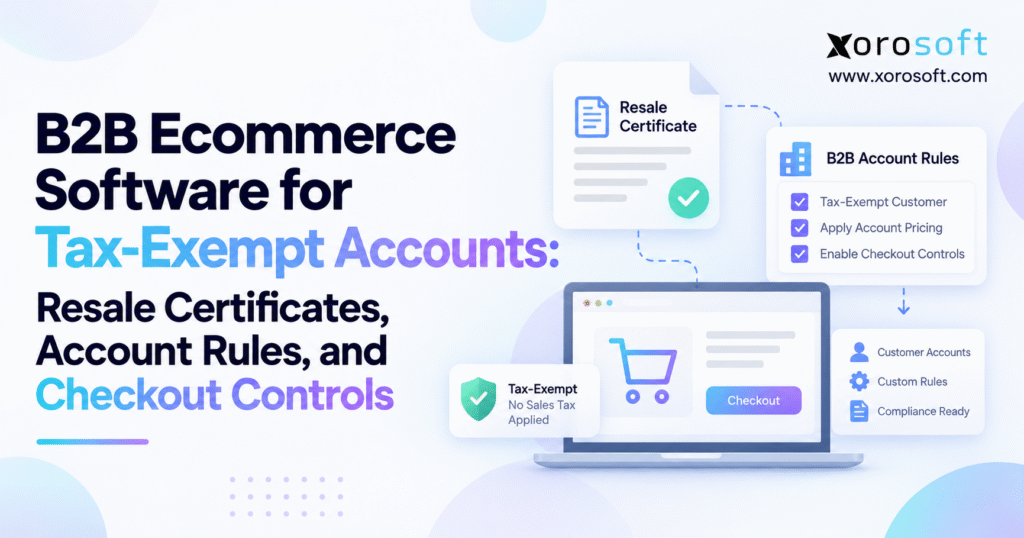
If you operate an online wholesale business, finding reliable B2B ecommerce tax software can make compliance and reporting easier than ever.
1. Why B2B Ecommerce Tax Software Becomes Critical as Wholesale Grows
1.1 Why Basic Tax-Exempt Account Rules Stop Working
Tax-exempt checkout feels straightforward when a wholesale business has only a small group of repeat customers. A sales representative collects a resale certificate, finance approves the account, and someone changes a tax setting in the ecommerce platform. Initially, that workflow may be enough.
However, wholesale operations rarely stay that simple.
As a business grows, the same customer can have several stores, distribution centers, buyers, billing entities, and shipping locations. Meanwhile, orders may arrive through ecommerce, sales representatives, EDI, phone orders, marketplaces, or customer portals.
In addition, tax information can become scattered across ecommerce, accounting, ERP, shared drives, email, and tax software. Consequently, a basic tax-exempt checkbox no longer provides enough control.
1.2 Tax-Exempt B2B Ecommerce Needs Account and Location Context
B2B ecommerce tax software should help determine which customer is ordering, which location is receiving the goods, which exemption information applies, and how the final transaction should reach accounting.
More importantly, tax-exempt B2B ecommerce needs a repeatable operating process. The customer record, resale certificate, checkout decision, order, invoice, return, and financial record should all refer to the same commercial relationship.
For example, a retailer may purchase through a central buying office while shipping orders to different stores. Although the buyer account remains the same, transaction context changes with the location. Therefore, tax treatment should not depend solely on the email address used to place the order.
1.3 What a Scalable B2B Sales Tax Workflow Should Achieve
Multistate operations add another layer of complexity. Certificate requirements and exemption rules can vary by jurisdiction. As a result, businesses should avoid designing systems around the assumption that every customer, state, or transaction follows the same rule.
The purpose of B2B ecommerce tax software is broader than removing tax at checkout. It should support a controlled workflow connecting account identity, exemption documentation, location rules, transaction data, and downstream operations.
Ultimately, that approach improves the buying experience while giving finance and operations a clearer record of how each order was processed.
2. How B2B Ecommerce Tax Software Should Manage Resale Certificates
Resale certificate management is often treated as document storage. Companies collect PDFs, place them in folders, and retrieve them whenever finance or an auditor requests supporting documentation.
Although that approach can work for a small account base, it becomes increasingly difficult as wholesale volume grows.
Effective B2B ecommerce tax software should treat resale certificates as part of an account lifecycle rather than as isolated files.
2.1 Resale Certificate Management Needs a Consistent Collection Process
First, the business needs a predictable way to collect documentation.
Some companies request resale certificates during wholesale registration. Others create the account first and collect documentation before enabling tax-exempt purchasing. Alternatively, established businesses may allow customers to upload updated information through a B2B portal.
Regardless of the method, consistency matters.
When certificates arrive through email, customer-service tickets, sales representatives, cloud folders, and ecommerce forms simultaneously, employees quickly lose confidence in which version is current.
Therefore, submissions should connect directly with a company or location record whenever possible.
2.2 B2B Tax Exemption Software Should Separate Submission From Approval
Uploading a certificate should not automatically trigger tax-exempt checkout.
Instead, submission should start a review process.
Depending on company procedures, finance, tax, credit, or another authorized team may review the information. A specialist certificate-management platform may also participate.
During this stage, the account can remain in a pending status.
After approval, the relevant company or location record can be updated. As a result, checkout relies on an approved status rather than merely detecting that a file exists.
This distinction matters because document storage and tax authorization are not the same operation.
2.3 Make Resale Certificate Status Visible to Operations
A practical workflow may include statuses such as awaiting submission, pending review, approved, rejected, inactive, or awaiting updated documentation.
Rather than hiding those conditions in employee notes, the application should make current status visible to authorized teams.
Consequently, customer service can explain why tax is appearing without contacting finance for every inquiry. Likewise, finance can identify accounts requiring attention before those accounts generate order exceptions.
3. Tax-Exempt Customer Accounts Need More Than a Customer Checkbox
The customer model is one of the most important parts of tax-exempt B2B ecommerce.
A common mistake is treating the buyer, company, and shipping location as one record. In practice, those entities serve different operational purposes.
3.1 B2B Customer Account Rules Should Separate Buyer Access From Tax Treatment
A buyer account identifies the individual using the ecommerce platform.
That record may control login access, ordering permissions, approval rights, and the ability to view company information. However, the buyer is not necessarily the entity receiving the tax treatment.
For example, a purchasing manager may order for six retail locations. Another employee at the same company may purchase only for one warehouse.
Therefore, attaching every commercial rule directly to an individual user makes account maintenance unnecessarily difficult.
Instead, buyer permissions should connect to a broader business account.
3.2 Keep Shared Commercial Rules at Company Level
The company record represents the broader commercial relationship.
Typically, it may include the legal customer name, payment terms, account status, pricing structure, billing details, credit policies, and sales ownership.
Moreover, the company record provides a logical place to connect purchasing locations.
Once that hierarchy exists, the organization can determine which rules belong at company level and which require greater granularity.
3.3 Tax-Exempt Customer Accounts Need Location-Level Rules
A company with several branches may not need identical settings at every location.
For that reason, modern B2B commerce platforms increasingly model company locations separately.
This structure illustrates an important principle for B2B ecommerce tax software: account rules should reflect how customers actually purchase.
The system may need to distinguish headquarters, stores, warehouses, branches, and other approved ship-to locations.
By contrast, a universal account-level flag can hide important operational context.
4. B2B Ecommerce Tax Software Should Revalidate Every Checkout
Configuration alone does not create a reliable tax workflow.
The checkout process must use account data correctly whenever an order is submitted.
Therefore, B2B ecommerce tax software should evaluate the current transaction instead of assuming that a historical customer setting applies indefinitely.
4.1 B2B Checkout Controls Should Confirm the Commercial Context
A tax-exempt order may require several pieces of information before checkout determines the final result.
For instance, the platform may evaluate the authenticated buyer, company, company location, shipping destination, exemption status, product information, and tax-engine response.
The precise logic depends on implementation.
Nevertheless, the sequence should be deliberate:
Buyer → Company → Location → Exemption Status → Shipping Context → Tax Calculation → Order
Because each step provides additional context, the platform can make a more reliable decision than a single customer checkbox.
4.2 Define What Happens When Tax-Exempt Checkout Information Is Missing
Not every order will contain perfect data.
A customer might use a newly added ship-to address. Likewise, updated documentation could still be awaiting review. In another situation, an integration might temporarily be unavailable.
Rather than allowing employees to invent a response each time, the company should define exception rules in advance.
For example, checkout could block the order until the issue is resolved. Alternatively, the business might permit checkout with tax applied. Another option is to route the transaction for review.
Each approach has tradeoffs. However, an intentional exception workflow is stronger than an undocumented workaround.
4.3 Keep Manual Tax Overrides Exceptional
Manual tax overrides are sometimes necessary.
Nevertheless, they should not become the primary operating model.
If employees regularly remove tax manually, the system is probably failing to represent customer status correctly.
As a result, override usage should be monitored. Access should remain permission-based, while employees should record a reason for changes.
Over time, a rising override rate can become an important operational KPI.
5. B2B Tax Exemption Software Must Support Multi-Location Customers
Multi-location accounts expose weaknesses in basic customer models quickly.
Consider a retailer with a corporate office, fifteen stores, and two distribution centers. Buyers at headquarters may place orders for any of those locations.
Although the parent company remains the same, the shipping context changes repeatedly.
Therefore, B2B ecommerce tax software should support location relationships instead of treating every customer as a flat record.
5.1 Tax-Exempt Customer Accounts Should Treat Locations as Operational Records
Each location may need its own shipping address, contacts, purchasing rules, delivery instructions, or tax configuration.
Of course, many values can still inherit from the parent company.
However, the architecture should support differences where they matter.
This becomes particularly important when customers expand. Rather than creating an entirely separate customer account, the business can add another location under the existing organization.
5.2 Review New Ship-To Locations Before Inheriting Rules
A new location should not automatically inherit every account setting without review.
Instead, companies should define which settings can carry forward and which require approval.
For example, commercial pricing might remain unchanged, while certain tax-related settings may require additional verification.
Consequently, location creation becomes a controlled workflow rather than a simple data-entry shortcut.
5.3 Multistate B2B Tax Exemption Requires Jurisdiction Context
Businesses selling across multiple states should avoid assuming that one certificate or setting automatically applies everywhere.
Rules vary, documentation requirements can differ, and product treatment may also change.
Therefore, the ecommerce system should preserve jurisdiction and location context around each transaction.
The software does not need to become a tax advisory platform. Instead, it should enforce the configuration established by the business and its advisers.
6. Shopify B2B Tax-Exempt Accounts Need a Connected Back Office
Shopify can provide the customer-facing ecommerce layer for businesses selling both DTC and wholesale.
However, the order still needs to move somewhere after checkout.
A wholesale transaction may require inventory allocation, warehouse processing, accounting, purchasing updates, invoicing, reporting, or manufacturing activity.
Therefore, businesses using Shopify B2B should evaluate the operational systems behind the storefront as carefully as they evaluate checkout.
6.1 Keep Shopify B2B Tax Results Consistent Downstream
Brands exploring this model can review the Xorosoft ERP app on the Shopify App Store as an example of ecommerce connectivity with ERP functions such as inventory, warehousing, purchasing, financials, and order management.
The goal is not to replace Shopify’s buying experience.
Instead, the objective is to ensure that the B2B order continues through the organization without employees rebuilding it manually elsewhere.
For tax-exempt accounts, the downstream transaction should preserve the same customer identity, location, and final tax result used during checkout.
Otherwise, the organization can end up with one outcome online and another on the invoice.
7. ERP Integration Makes B2B Ecommerce Tax Software More Scalable
As a company adds wholesale customers, integration quality becomes increasingly important.
A storefront can process the order correctly and still create significant back-office work if employees must re-enter customer and transaction data into ERP.
Therefore, B2B ecommerce tax software should fit into the company’s broader order architecture.
7.1 Let Ecommerce Own the Buying Experience
The ecommerce platform usually controls buyer authentication, product presentation, pricing, account access, cart behavior, shipping selection, checkout, and order capture.
As a result, it is generally the first system that sees the complete customer-facing transaction.
Nevertheless, ecommerce should not become the only system that understands the customer.
7.2 ERP Should Execute Tax-Exempt B2B Orders
Once the order is placed, the business needs to execute it.
For inventory-driven organizations, XoroONE is one example of a cloud ERP architecture combining sales, purchasing, inventory, warehouse management, manufacturing, ecommerce, B2B functions, accounting, reporting, and forecasting.
In a connected environment, ERP can receive the order and continue operational processing without manual re-entry.
For instance, inventory can be allocated, warehouse work can begin, and finance can create the appropriate downstream transaction.
Consequently, the tax-exempt ecommerce order becomes part of the same operating record used by the rest of the business.
7.3 B2B Ecommerce Integration Should Preserve Customer Identity
Integration projects often focus heavily on order lines and inventory quantities.
However, customer identity is equally important.
If ecommerce refers to one customer ID while ERP maps the order to another record, location-level context can disappear.
Therefore, businesses should establish stable identifiers for company, buyer, and location records.
A well-designed integration architecture should preserve those relationships while transferring order values, tax amounts, addresses, and other relevant transaction data.
8. B2B Sales Tax Software, Ecommerce, and ERP Serve Different Roles
One application does not need to perform every function in the workflow.
In fact, forcing ecommerce or ERP to become a complete tax platform can increase maintenance burden.
A cleaner architecture separates responsibilities.
8.1 Keep Specialist Tax Logic in Specialist Systems
Dedicated tax platforms may handle jurisdiction determination, calculation logic, product taxability, certificate workflows, and other specialist functions.
Because those rules can change, organizations often benefit from keeping tax content in technology designed specifically for that purpose.
Meanwhile, ecommerce can pass the necessary transaction context into the tax service.
The result can then return to checkout.
8.2 ERP Should Carry the B2B Tax Result Forward
ERP does not necessarily need to recalculate the order independently.
Instead, it should receive consistent transaction information and preserve the financial outcome through invoicing, reporting, credits, and returns.
This division of responsibility reduces duplicate business logic.
Moreover, it gives each system a clearer role.
8.3 Keep Accounting Aligned With Checkout
Customers should not see one amount during checkout and another on the invoice.
Therefore, integration testing should confirm that tax values survive every system transition.
The same principle applies later.
If a partial return or credit memo is issued, the financial process should retain the proper transaction context instead of forcing employees to reconstruct what happened manually.
9. Tax-Exempt Customer Accounts Depend on Reliable Data Synchronization
Customer master data is the foundation of the entire process.
Even sophisticated B2B ecommerce tax software will struggle when ecommerce, ERP, accounting, and CRM disagree about who the customer is.
9.1 Define a System of Record for Each Data Type
Not every field needs to originate in ERP.
For example, ecommerce may own buyer login credentials while ERP owns commercial customer IDs and payment terms.
Similarly, a tax platform might own certificate status.
The implementation team should document ownership clearly.
Afterward, connected systems can receive synchronized copies where necessary.
Without that discipline, employees may update whichever application is most convenient, creating competing versions of the same account.
9.2 B2B Customer Tax Rules Need Fast Status Synchronization
Customer records change.
A buyer leaves the organization, a warehouse moves, a new store opens, an address changes, or updated documentation arrives.
If those changes take days to reach checkout, the business creates a gap between reality and the system.
Therefore, important account changes should synchronize in near real time or at a frequency appropriate to operational risk and order volume.
9.3 Preserve Context Through Returns and Credits
New sales orders receive most of the attention during system design.
However, real operations include returns, replacements, cancellations, partial shipments, credits, and order edits.
A connected workflow should preserve customer and tax context through those events as well.
Otherwise, the business solves the checkout problem while leaving finance with a reconciliation problem.
10. Wholesale Tax Exemption Software Must Fit the Industry Workflow
Tax-exempt workflows appear across many inventory-driven industries, but the surrounding operating requirements differ.
Therefore, software selection should account for the broader business model.
10.1 Wholesale Tax Exemption Requires Strong Customer Master Data
Distributors frequently manage large customer catalogs, payment terms, contract pricing, multiple warehouses, sales representatives, credit policies, and high order volume.
Accordingly, tax-exempt status is only one attribute in a much larger wholesale account.
A distributor may need the same customer record to control price, credit, payment terms, inventory availability, fulfillment location, and checkout rules.
Businesses evaluating their broader ERP architecture can compare requirements across relevant inventory-driven industries rather than treating tax exemption as a standalone software project.
10.2 Apparel Needs Clear DTC and Wholesale Separation
Fashion and apparel businesses often sell directly to consumers while supplying boutiques and retailers.
As a result, the same SKU can participate in two very different customer journeys.
Consumers use standard ecommerce checkout. Wholesale buyers, by contrast, may need account pricing, payment terms, order minimums, purchasing permissions, and resale-document workflows.
A strong architecture separates those customer experiences while maintaining shared inventory visibility.
10.3 B2B Customer Account Rules Matter for Furniture Networks
Furniture manufacturers and distributors often sell through dealers, designers, retailers, hospitality customers, and showroom networks.
Consequently, multiple ship-to locations and complex delivery workflows are common.
A structured company hierarchy can keep billing relationships, delivery addresses, buyers, and commercial rules connected.
10.4 B2B Ecommerce Tax Software for Manufacturing Must Connect With Production
Manufacturers may sell finished products or components through dealers and distributors.
Once the wholesale order arrives, however, operations may still need to purchase materials, schedule production, reserve inventory, and plan fulfillment.
Therefore, an ERP such as XoroERP can connect the sales transaction with purchasing, accounting, inventory, and manufacturing processes.
The tax decision remains one part of the transaction rather than the entire workflow.
11. Common Problems in B2B Tax-Exempt Checkout
Many B2B tax problems begin as small shortcuts.
Eventually, those shortcuts become operational dependencies.
11.1 A Permanent Tax-Exempt Flag Loses Context
A static flag does not explain why the customer is exempt, who approved the configuration, which location it applies to, or what documentation supports the decision.
Therefore, the field should support a broader workflow rather than replace it.
11.2 Ecommerce Exemption Certificate Management Should Not Live in Email
Employees often ask customers to email resale certificates because the process is fast.
Nevertheless, email is difficult to scale.
Documents become tied to individual inboxes, and another employee may not know which file is current.
As a result, centralized certificate records are easier to manage over time.
11.3 B2B Tax-Exempt Checkout Should Not Depend on Workarounds
Sales and support teams naturally try to keep customers happy.
Consequently, they may bypass approval steps when the official workflow moves too slowly.
Rather than simply restricting employees, leadership should investigate why the exception occurs so frequently.
Repeated manual action is often a symptom of poor system design.
11.4 Duplicate Customer Records Break Automation
Duplicate customer records can create inconsistent pricing, shipping, credit, and tax behavior.
For example, one record may contain the correct address while another contains the approved account configuration.
Therefore, customer-master cleanup should be part of any serious tax-exempt ecommerce implementation.
11.5 Warehouse Execution Still Depends on the Same Order
Tax calculation is not the end of the order lifecycle.
Inventory still needs to move.
A warehouse environment such as XoroWMS can receive the downstream order for picking, packing, shipment, and inventory control while keeping fulfillment connected to the original sales transaction.
This connection matters especially for multi-warehouse wholesalers.
12. Comparing Manual and Automated B2B Tax Workflows
Different companies require different levels of automation.
A small wholesaler may operate successfully with disciplined account management and straightforward ecommerce configuration.
By contrast, a national distributor with thousands of customer locations may require specialized tax technology, integrated ecommerce, and ERP.
| Capability | Manual Workflow | Ecommerce Only | Tax Platform | Ecommerce + Tax + ERP |
|---|---|---|---|---|
| Certificate collection | Email/files | Platform dependent | Structured | Structured |
| Account controls | Manual | Strong | Tax-focused | Cross-system |
| Checkout rules | Limited | Strong | Integrated | Integrated |
| Certificate monitoring | Manual | Varies | Strong | Connected |
| Accounting flow | Manual | Varies | Integration required | Connected |
| Inventory impact | Separate | Limited | Separate | Connected |
| Location management | Difficult | Platform dependent | Tax-focused | Broader control |
| Audit visibility | Fragmented | Varies | Strong | Cross-system |
12.1 When Manual Tax-Exempt Ecommerce Can Still Work
The table does not imply that the most complex architecture is always best.
Instead, the business should match software complexity with operational complexity.
If manual processes remain reliable and low-volume, replacing them prematurely may create more overhead than value.
12.2 When B2B Tax Automation Starts Paying Off
Once employees spend substantial time reconciling systems and correcting exceptions, stronger integration can become economically justified.
At that stage, automation can reduce repeated data entry, inconsistent account updates, and manual order corrections.
13. When B2B Ecommerce Tax Software Needs ERP Support
ERP investment should not depend on revenue alone.
Operational friction is usually the better indicator.
When employees spend increasing amounts of time exporting orders, updating customers in several systems, reconciling invoices, correcting inventory, or checking whether tax outcomes match, fragmentation is already creating cost.
13.1 Reconciliation Work Is a Warning Sign
Finance should not have to compare several reports every morning to understand yesterday’s B2B orders.
Likewise, warehouse employees should not depend on spreadsheets to interpret orders that already exist online.
Therefore, recurring reconciliation should be measured as an operational cost.
13.2 B2B Checkout Exception Volume Often Matters More Than Order Volume
A business can process thousands of clean orders efficiently.
By contrast, a smaller organization can struggle with only a few hundred orders if many require manual attention.
Track how often employees edit customer accounts, change tax treatment, rebuild sales orders, correct invoices, or resolve mismatched addresses.
A rising exception rate usually indicates that systems or master data are no longer keeping pace with growth.
13.3 Evaluate ERP Against the Whole Operating Model
ERP selection should consider more than tax-exempt checkout.
Inventory, accounting, purchasing, warehousing, ecommerce, reporting, manufacturing, and integration all affect operational fit.
Businesses comparing larger ERP platforms can use a Xorosoft vs NetSuite comparison as one input when reviewing architecture, implementation requirements, capabilities, and overall fit.
Ultimately, the strongest platform is the one that matches the company’s operating model rather than simply offering the longest feature list.
14. Implement B2B Ecommerce Tax Software Around Real Workflows
Technology projects often begin with feature lists.
A better approach starts with the current customer journey.
14.1 Map the Tax-Exempt B2B Ecommerce Account Lifecycle
Follow one customer from application through payment.
Identify how the account is created, where certificate information arrives, who reviews it, which system records approval, how checkout detects the account, where the order goes, and how the invoice is created.
Next, map the exceptions.
For instance, what happens if the customer adds a new location? How does the team handle missing documentation? What occurs when an order changes after checkout?
These scenarios often reveal more useful requirements than a vendor checklist.
14.2 Assign Ownership Before Automating
Every important record needs an owner.
Someone should own customer master data. Finance or tax should own tax policy. Ecommerce should own the buying workflow. Operations should own order execution.
Once ownership is clear, software can automate handoffs more safely.
Without clear accountability, automation simply moves inconsistent data faster.
14.3 Clean Tax-Exempt Customer Account Data Before Automation
Advanced automation cannot compensate for duplicate customers and unreliable addresses.
Therefore, implementation should begin with customer hierarchy and master data.
Define the company record, buyer relationships, locations, stable IDs, and ownership rules first.
Afterward, certificate status and checkout automation can use those records with greater confidence.
14.4 Test B2B Tax-Exempt Checkout Exceptions
Most implementations test successful orders first.
Of course, that is necessary.
However, operational resilience comes from testing difficult scenarios.
Teams should test pending accounts, changed addresses, new locations, edited orders, partial shipments, returns, credits, unavailable integrations, and duplicate records.
Businesses reviewing their larger architecture can explore relevant ERP solutions while mapping how ecommerce, inventory, finance, purchasing, and warehouse workflows should connect.
15. KPIs for B2B Ecommerce Tax Software and Account Controls
Once the workflow is live, businesses need measurements that reveal whether operations are improving.
The number of stored certificates alone provides little insight.
Instead, focus on exceptions and cycle times.
15.1 Resale Certificate Review Time
Measure the time between receiving required documentation and reaching an approved account status.
Long delays can slow wholesale ordering.
Moreover, slow approval processes encourage sales teams and customers to seek manual workarounds.
15.2 B2B Tax-Exempt Checkout Override Rate
Measure how often employees manually change tax treatment.
A low override rate generally suggests that account configuration and checkout rules are working reliably.
Conversely, a rising rate deserves investigation.
15.3 Customer Mapping Exception Rate
Track orders where ecommerce cannot automatically map the company or location to the correct ERP customer.
This KPI can reveal duplicate records, missing IDs, and poor location governance.
15.4 B2B Sales Tax Correction Rate
Monitor credit memos, invoice edits, refunds, and customer-service cases caused by incorrect tax outcomes.
Because these corrections happen after checkout, they create both administrative cost and customer frustration.
15.5 Straight-Through B2B Order Rate
Track the percentage of wholesale orders that move from checkout into ERP, fulfillment, invoicing, and reporting without manual re-entry.
As this percentage rises, the operation generally becomes more scalable.
16. How to Evaluate B2B Ecommerce Tax Software Before Buying
Vendor evaluation should focus on realistic scenarios.
Instead of asking whether the product supports tax-exempt accounts, ask the vendor to demonstrate one.
16.1 Test Tax-Exempt Customer Accounts With Multiple Locations
Create a company with several locations and buyers.
Then configure one tax-exempt scenario and another location with different settings.
Next, place orders to both locations.
This test quickly reveals whether the platform actually supports granular account relationships.
16.2 Test Missing and Pending Information
Do not test only approved customers.
Create an account with missing information. Then place an order while documentation remains pending.
The software should show a predictable response.
Otherwise, employees will end up creating their own workaround after launch.
16.3 Test the Entire B2B Ecommerce Order Flow
A storefront demonstration ends too early if it stops at the confirmation page.
Ask what happens next.
The order should move into ERP, inventory, warehousing, invoicing, and reporting without losing customer context.
Real-world examples can also help buyers understand what connected ERP operations look like. Reviewing relevant Xorosoft case studies can provide operational context beyond standard feature descriptions.
16.4 Keep B2B Tax Software Evaluation Separate From Tax Advice
Software vendors can demonstrate configuration and workflow.
However, they should not replace qualified tax guidance.
Therefore, businesses should determine their legal and tax policies independently and then configure software to enforce those decisions consistently.
That separation creates a stronger long-term architecture.
17. Designing B2B Ecommerce Tax Software for Future Automation
Once customer, location, and transaction data are reliable, businesses can automate more of the workflow.
For example, account applications can trigger review queues. Approved records can update checkout automatically. Likewise, ERP orders can move directly to warehouse execution without manual re-entry.
17.1 Start Automation With Clean Master Data
More advanced organizations may eventually use AI-enabled workflows to identify exceptions, summarize account history, or surface unusual order conditions.
However, automation should come after data governance.
If customer data is unreliable, intelligent automation can amplify the same errors faster.
For that reason, growing organizations should prioritize clean master data, clear ownership, and reliable system integration first.
17.2 Expand B2B Tax Automation Gradually
Once the foundation is stable, companies can introduce more advanced exception handling, account monitoring, reporting, and workflow automation.
This staged approach reduces implementation risk because automation is built on information employees already trust.
18. Practical Conclusion: Build Tax-Exempt B2B Ecommerce Around Account Context
18.1 Keep Tax-Exempt Customer Accounts at the Center
Tax-exempt B2B ecommerce is not simply a checkout feature.
Instead, it is a connected customer, compliance, financial, and operational workflow.
The strongest B2B ecommerce tax software keeps buyers connected to the correct company, preserves location context, tracks certificate status, evaluates the current transaction, and carries the final result into downstream systems without manual reinterpretation.
For smaller wholesalers, disciplined ecommerce configuration may be enough.
However, growing businesses eventually face more locations, channels, customer data, and exceptions. At that stage, the architecture usually needs to mature.
18.2 Separate B2B Tax Software, Commerce, and ERP Responsibilities
A specialist tax platform can manage specialized tax logic. Ecommerce can manage the customer buying experience. Meanwhile, ERP can connect the completed order with inventory, purchasing, accounting, warehouse operations, and reporting.
Therefore, the most important design decision is not which platform has the longest list of tax features.
The real priority is defining which system owns each part of the transaction and ensuring those systems exchange the correct customer and order context.
That approach reduces manual corrections, improves the B2B customer experience, and gives finance and operations a more reliable transaction history.
18.3 Use Checkout Problems to Find Broader System Gaps
If your company is outgrowing disconnected Shopify, wholesale, inventory, accounting, purchasing, or warehouse workflows, the next step is to map where account and order information currently breaks.
From there, you can evaluate whether a connected ERP architecture would simplify the broader operation.
Book a personalized Xorosoft consultation to review how your B2B ecommerce, inventory, accounting, purchasing, and fulfillment workflows could work together.
Frequently Asked Questions
What is B2B ecommerce tax software?
B2B ecommerce tax software helps businesses manage customer tax status, resale certificates, account rules, and checkout tax decisions while keeping order data consistent across ecommerce, ERP, and accounting systems.
How should resale certificates be managed online?
Use a structured workflow that collects certificates, records approval status, links documents to the correct company or location, and updates checkout rules only after the required review is complete.
Can tax-exempt rules differ by customer location?
Yes. Multi-location businesses may need different tax settings by branch, store, warehouse, or ship-to location. The account model should support that granularity rather than relying on one universal customer flag.
Should uploaded resale certificates make customers tax exempt automatically?
No. Uploading a certificate should normally trigger review, not automatic approval. Checkout should apply exemption rules only after the required validation and account status update are complete.
How should B2B checkout handle missing tax information?
Businesses can block checkout, apply tax, or route the order for review. The best approach depends on company policy, risk tolerance, customer experience, and applicable tax requirements.
When does B2B tax software need ERP integration?
ERP integration becomes valuable when tax-exempt orders must also update customer records, inventory, accounting, purchasing, fulfillment, invoicing, returns, and reporting without manual re-entry.
What should businesses evaluate before choosing B2B tax software?
Evaluate company and location controls, certificate workflows, checkout rules, tax-engine integration, ERP connectivity, audit visibility, exception handling, and how returns or credits preserve the original transaction context.
Recent Posts
-
 GS1 Logistic Labels in WMS: SSCC Generation, Printing, Scanning, and Traceability
 -
 Inventory Tracking Management KPIs: Measuring Unposted Receipts, Transfer Aging, and Return-to-Stock Time
 -
 B2B Ecommerce Software for Tax-Exempt Accounts: Resale Certificates, Account Rules, and Checkout Controls
 -
 Cin7 Alternatives for Shopify Plus Brands
 -
 Why Inventory Reports Disagree Across Systems