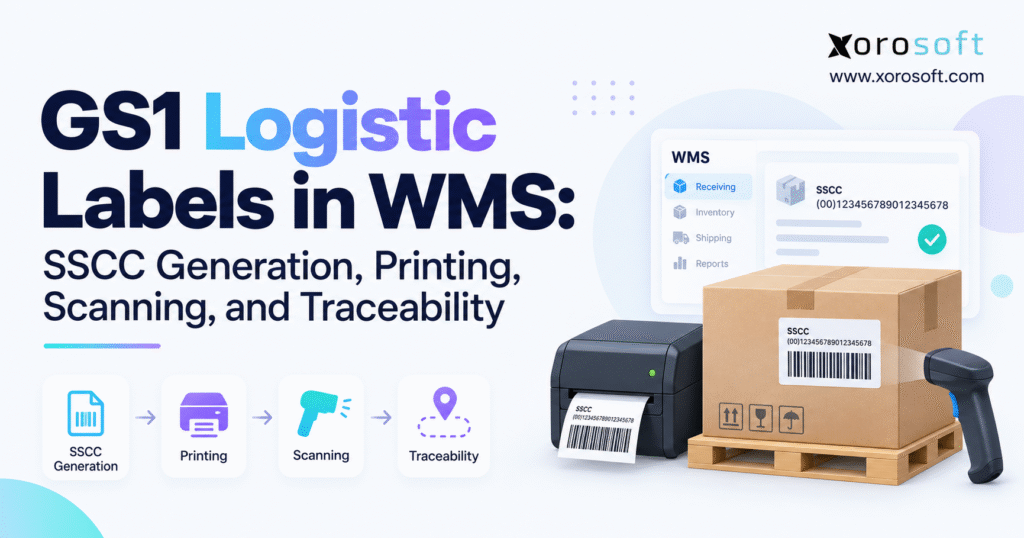
If your supply chain needs improved traceability and efficiency, it’s essential to understand GS1 logistic labels.
1. Why Warehouse Labeling Becomes an Operational Control Point
Warehouse labeling feels simple when order volume stays low. A team prints a label, attaches it to a pallet or carton, and ships the order. Complexity rises quickly once a business operates multiple warehouses, serves wholesale customers, uses EDI, tracks lots or expiration dates, follows retailer routing requirements, or manages thousands of warehouse movements every day.
At that stage, printing is no longer the difficult part. The real challenge is keeping the physical logistics unit synchronized with the digital transaction behind it.
GS1 logistic labels help create that connection. They give a pallet, carton, parcel, or other logistics unit a standardized identity that warehouse systems and trading partners can recognize. At the center of that model sits the Serial Shipping Container Code, or SSCC, which gives each logistics unit its own unique identifier.
1.1 Why WMS Data Matters Behind the Label
A warehouse management system gives the SSCC operational meaning.
Once a pallet receives an SSCC, the WMS should know what inventory sits on it, where employees built it, which order it belongs to, where the team staged it, whether loaders placed it on the truck, and which shipment or ASN references it.
Later investigations depend on that history. A retailer dispute, inventory discrepancy, recall, delivery issue, or traceability question becomes easier to resolve when employees can follow the same identifier across warehouse events.
Effective GS1 logistic labels therefore start much earlier than the printer. A mature workflow connects allocation, picking, packing, handling-unit creation, SSCC generation, barcode printing, scanning, shipping, electronic shipment communication, and receiving.
The label makes the unit visible to people and scanners. The WMS gives that unit context.
1.2 How the SSCC Supports More Than Compliance
An SSCC identifies the logistics unit itself.
Behind that identifier, the WMS can store richer information such as SKUs, quantities, lots, locations, customer orders, shipments, timestamps, and warehouse events.
That distinction matters operationally. The visible label represents only one part of the process, while the record behind it creates the real traceability value.
Companies that treat SSCC labels only as retailer compliance documents often miss the larger opportunity. The same identifier can support warehouse accuracy, receiving efficiency, shipment verification, exception handling, and downstream traceability.
A well-designed GS1 logistic labels workflow therefore supports operations as well as compliance. The goal is not simply to satisfy a routing guide. It is to create a dependable relationship between a physical logistics unit and the data that explains its history.
2. What GS1 Logistic Labels Actually Identify
A GS1 Logistic Label identifies a logistics unit rather than simply identifying a product.
That unit may be a pallet, shipping carton, parcel, consolidated case, or another physical object created for transportation or storage. Separate identification matters because warehouses and trading partners need to manage each physical unit independently as it moves through the supply chain.
The distinction solves an important data problem. Products, orders, shipments, cartons, and pallets are related, but they are not interchangeable objects.
2.1 GS1 Pallet Labels: The Logistic Unit vs the Product
Consider a warehouse building five pallets containing the same SKU.
The product may use the same GTIN across all five pallets because the GTIN identifies what the product is. Each pallet, however, represents a different logistics object moving through the network.
For that reason, every pallet can receive a different SSCC.
One unit might leave on another truck, suffer damage, arrive at a different distribution center, or require separate receiving verification. A unique logistics identity lets systems distinguish that physical pallet from every other pallet containing the same merchandise.
The distinction also matters when a pallet contains several products. Its SSCC identifies the pallet itself, while the WMS maintains product-level information behind that identifier.
2.2 What Information Should Appear on the Label?
The SSCC provides the core logistics identity. Depending on workflow and trading-partner requirements, companies may also display GTIN data, quantities, lot numbers, batch details, manufacturing dates, expiration dates, customer references, ship-to information, or routing instructions.
More data does not automatically improve the label.
Every field should support a specific warehouse, transportation, receiving, or customer requirement. Overloading a label can make it harder to read and maintain while increasing the risk that printed information disagrees with the operational record.
For GS1 logistic labels, the better approach is to keep the physical label focused while allowing the WMS to retain the detailed transaction data behind the identifier.
3. Understanding the SSCC Structure
SSCC stands for Serial Shipping Container Code.
The identifier contains 18 digits and uniquely identifies one logistics unit. Despite the word “container,” businesses can use an SSCC for pallets, cartons, parcels, and other shipping units.
A properly configured WMS should create and control those identifiers automatically.
3.1 How the 18-Digit Identifier Is Built
An SSCC contains four logical components: an extension digit, GS1 Company Prefix, serial reference, and check digit.
The extension digit expands numbering capacity. A GS1 Company Prefix identifies the organization responsible for assigning the identifier. Each serial reference distinguishes one logistics unit from another. Finally, the check digit helps systems validate the complete number.
Prefix length affects how many digits remain available for the serial reference.
Warehouse workers should not need to construct the number themselves. Instead, the WMS should control the sequence, calculate the check digit, verify uniqueness, and assign the finished identifier to the correct handling unit.
That control becomes increasingly important as shipment volume grows across locations.
3.2 What Application Identifier (00) Means
GS1 Application Identifiers tell systems what a specific data element represents.
For an SSCC, Application Identifier 00 tells a compatible scanner or application that the following 18 digits represent a Serial Shipping Container Code.
Parentheses commonly displayed around (00) help people understand the data structure. They do not function as ordinary data characters in the same way as the SSCC digits.
Correct AI handling matters because a barcode can appear normal while still carrying incorrectly structured information.
A warehouse may therefore produce visually convincing GS1 logistic labels that fail downstream if the encoded data does not follow the expected structure.
3.3 SSCC Labels vs GS1-128 Barcodes
Warehouse teams often use SSCC and GS1-128 interchangeably, but the terms describe different concepts.
The SSCC represents the identifier.
GS1-128 represents a barcode symbology capable of carrying structured GS1 data, including the SSCC.
Keeping these concepts separate makes barcode design, WMS mapping, scanner configuration, and troubleshooting easier.
It also helps businesses ask more useful questions during software evaluation. A system that can print GS1-128 barcodes does not necessarily provide full SSCC lifecycle management.
4. Comparing SSCC, GTIN, LPN, and Carrier Identifiers
Warehouses frequently use several identifiers at the same time. Each one solves a different operational problem.
| Identifier | What It Identifies | Typical Purpose |
|---|---|---|
| SSCC | Individual logistics unit | Pallet or carton tracking |
| GTIN | Trade item | Product identification |
| LPN | Internal handling unit | Warehouse execution |
| Carrier tracking number | Shipment parcel | Transportation tracking |
4.1 SSCC vs GTIN
A GTIN identifies a product or trade item.
By contrast, an SSCC identifies a particular logistics unit.
Six pallets may contain the same SKU and therefore reference the same GTIN. Each pallet can still carry a separate SSCC because every pallet represents a unique physical object.
This distinction becomes valuable when one pallet encounters an exception while the other five continue normally.
The GTIN answers, “What product is this?” The SSCC answers, “Which physical logistics unit is this?”
4.2 SSCC Labels vs Warehouse License Plate Numbers
An LPN, or license plate number, usually identifies a pallet, tote, carton, or another handling unit inside a warehouse application.
An internal LPN does not automatically qualify as an SSCC.
A WMS can configure its license-plate logic so the identifier also follows the SSCC structure, but the business must use the correct GS1 Company Prefix, sequence controls, length, and check-digit rules.
For businesses using GS1 logistic labels, that distinction matters because an internal identifier may work perfectly inside one warehouse while failing a customer’s external compliance requirement.
4.3 Carrier Labels Serve a Different Purpose
Carrier labels primarily help transportation networks route and track parcels.
A GS1 logistics identifier serves a broader supply-chain purpose by identifying the logistics unit across different companies and systems.
Some outbound units may carry both types of labels.
When that happens, the WMS should clearly distinguish the SSCC from the carrier’s tracking number rather than allowing employees or integrations to treat them as interchangeable identifiers.
5. How a WMS Generates SSCCs
Automated SSCC generation removes one of the weakest points in manual warehouse labeling: controlling unique identifiers across thousands of transactions.
A WMS should create the SSCC from governed data and a controlled numbering sequence. After generation, the system should immediately connect the identifier with the correct logistics unit.
For GS1 logistic labels, this system-controlled creation process is essential because the label only works reliably when the underlying identifier remains unique and correctly associated with one physical unit.
5.1 The Number Generation Process
A typical workflow begins with the organization’s GS1 Company Prefix.
Next, the system applies the correct extension digit, creates or retrieves the serial reference, calculates the check digit, validates the completed number, and assigns the SSCC to the handling unit.
Only after establishing that relationship should the WMS create the physical label.
This sequence reduces the risk of labels and database records moving out of sync.
If employees print labels before the WMS creates the handling-unit relationship, identifiers can become lost, duplicated, or attached to the wrong pallet.
5.2 Choosing the Right Trigger for SSCC Labels
The best trigger depends on warehouse design.
Some businesses generate the identifier when employees finish packing a carton. Others wait until workers close a pallet. High-volume operations may incorporate SSCC creation into cartonization, wave processing, or shipment preparation.
Ideally, the system creates the identifier when the physical unit has become stable enough to identify reliably.
Generating it too early can increase exception handling if pallet or carton contents continue to change. Waiting too long can slow packing and loading.
The right trigger is usually the transaction where the warehouse can confidently treat the physical object as a defined logistics unit.
5.3 Central Number Control Across Warehouses
Multi-warehouse businesses need stronger governance than single-site operations.
Two distribution centers should not independently create overlapping SSCC sequences.
A centralized numbering strategy reduces duplicate risk while still allowing each facility to manage local printers, workflows, and execution rules.
Businesses that need barcode-driven execution can use XoroWMS within a broader workflow where receiving, movement, picking, packing, and shipping run through controlled warehouse transactions.
That model gives GS1 logistic labels a consistent source of identity even when physical fulfillment happens across several facilities.
6. Printing GS1 Logistic Labels Without Losing Data Control
Once the WMS creates the SSCC, the business must print the correct label at the right location and time.
The printer should remain an output device rather than becoming another operational database.
6.1 Pull Label Data From Warehouse Transactions
A logistics label may need information from the customer order, shipment record, warehouse, product master, handling unit, lot record, or routing configuration.
Instead of retyping these values, the system should pass them directly into the label template.
Manual entry of customer numbers, pallet IDs, quantities, addresses, or SSCC values introduces unnecessary risk. Each re-entered field creates another opportunity for the physical label to disagree with the warehouse transaction.
For example, a worker may correctly pack 48 cases but accidentally type 46 into separate label software. The warehouse now has a printed record that conflicts with the real shipment.
Strong GS1 logistic labels workflows eliminate that unnecessary re-entry wherever possible.
6.2 Automatic vs On-Demand Printing
Automatic printing works well when a transaction clearly signals that the logistics unit is complete.
For example, the WMS may print the label when an operator confirms the final item in a carton or closes a pallet.
On-demand printing often fits operations where packing structures continue changing until a final verification step.
Either model can work well. The controlled warehouse transaction should determine which SSCC belongs to which physical unit.
6.3 Reprints Should Preserve the Existing Identity
A damaged label does not necessarily mean the physical pallet has changed.
If the pallet remains the same logistics unit, warehouse teams should generally reprint the existing SSCC instead of generating a new identity.
Controlled reprint permissions also reduce the risk of employees applying identical labels to multiple units.
This is a small workflow detail with major traceability consequences. Poor reprint logic can split one pallet’s history across several identifiers.
7. Receiving and Put-Away With Barcode-Driven Workflows
Inbound operations provide one of the clearest examples of why standardized logistics identification matters.
When a pallet arrives with a usable SSCC, the receiver can scan the identifier instead of manually reconstructing the shipment from paperwork.
7.1 Receiving With GS1 Pallet Labels
A scan can help the WMS retrieve information associated with the arriving physical unit.
Depending on the integration model, that information may include the supplier, purchase order, expected items, quantities, lot details, or shipment references.
Warehouse staff can then compare the delivered pallet with expected data before accepting it.
Using GS1 logistic labels at receiving does not eliminate every exception. However, it can reduce manual searching and give the team a consistent identifier for investigating discrepancies.
7.2 Recording Put-Away Locations
After accepting the pallet, employees can scan it into a staging area or final storage location.
The WMS records the movement rather than relying on somebody to remember where the unit went.
As a result, the business creates a traceable chain from inbound arrival to final storage position.
This history becomes especially useful when the pallet remains intact for several days or moves through temporary staging areas before final put-away.
7.3 Why Consistent Barcode Scanning Matters
A barcode strategy becomes weak when employees scan only at receiving and then move pallets without recording subsequent events.
The label provides identity, while warehouse transactions maintain history.
Managers should therefore define which physical movements require a scan and what each scan updates.
The objective is not maximum scanning. The better objective is enough scanning to maintain trustworthy handling-unit and inventory records.
8. Controlling Picking, Staging, and Shipping
Outbound operations create another important set of control points.
A pallet may move through picking, consolidation, packing, staging, loading, and shipment confirmation before leaving the facility.
Every stage creates an opportunity for the physical unit and digital order to fall out of sync.
8.1 Verify Handling Units During Picking and Packing
Warehouses that pick complete pallets can use handling-unit scans to confirm that employees selected the correct unit.
Carton-based workflows may instead create or validate the SSCC when packing finishes.
Every scan should answer a useful operational question. Did the employee select the right pallet? Does the carton contain the correct products? Does this unit belong to the intended customer shipment?
When teams use GS1 logistic labels this way, the barcode becomes part of transaction validation instead of merely serving as a shipping requirement.
8.2 Staging Control With SSCC Labels
Staging areas become risky when several customer shipments share the same physical space.
An SSCC scan allows workers to distinguish one pallet from another even when the cartons look identical.
The WMS can associate each unit with a staging lane, customer, route, or shipment.
That visibility helps prevent misloads because the system can detect when a pallet enters the wrong staging or loading process.
8.3 Use the Loading Scan as a Final Checkpoint
The final loading scan can act as an important control before shipment confirmation.
It records that a specific logistics unit physically entered the outbound load instead of assuming that every planned pallet left the warehouse.
Later, that event can help investigate missing or disputed units.
It also creates a stronger foundation for the electronic shipment message because the WMS knows what physically left the facility.
9. Connecting SSCC Data With EDI 856 and ASN Workflows
GS1 logistic labels become much more valuable when the same identifier exists in both the physical warehouse and electronic shipment data.
This is where SSCC identification and Advance Ship Notices begin to function as one connected workflow.
9.1 How SSCC Labels Connect Pallets to the ASN
An EDI 856 Advance Ship Notice can tell a receiving organization what will arrive before the truck reaches the dock.
Depending on the trading partner, the message may describe shipments, orders, pallets, cartons, items, quantities, and logistics identifiers.
When the ASN references the SSCC shown on the physical pallet, the receiver can scan that number and retrieve the expected shipment structure.
Instead of starting with an unidentified pallet, the receiving team starts with a logistics key connected to information that the supplier already transmitted.
9.2 Why Disconnected Label and EDI Systems Create Risk
Problems appear when one application creates the warehouse label while another independently builds the ASN.
Warehouse teams may change a quantity after packing, remove a carton, rebuild a pallet, or adjust the shipment after a short pick.
Physical and electronic records can diverge when those workflows update separately.
This creates the familiar situation where the physical pallet appears correct while the ASN describes something different.
For that reason, Xorosoft integrations matter more here than standalone label printing. ERP, warehouse, ecommerce, and EDI workflows work better when they use synchronized transaction data.
10. Building Warehouse Traceability Around the Logistic Unit
An SSCC gives the logistics unit a unique identity.
Traceability comes from the history that the WMS stores behind that identity.
A strong GS1 logistic labels strategy therefore focuses just as much on the database relationships as on the printed barcode.
10.1 Maintain a Persistent Handling-Unit Record
When the WMS creates an SSCC, it should maintain the relationship between that identifier and the physical unit.
The record may include warehouse, location, SKU contents, quantities, lots, serial numbers, customer, sales order, shipment, packing event, staging event, loading event, carrier information, and timestamps.
Later scans can therefore retrieve much more information than the digits printed on the physical label.
The SSCC becomes a stable reference point for warehouse history.
10.2 Lot Traceability With GS1 Shipping Labels
This relationship becomes particularly valuable in food, beverage, consumer goods, and other industries where lot control matters.
Suppose a distributor needs to investigate one manufacturing lot. A strong data model can identify which inventory quantities carried that lot, which handling units contained them, which SSCCs represented those units, and which customers received the shipments.
Without these relationships, the company may know that a pallet had a barcode but still struggle to reconstruct what it contained.
Businesses that need operational control beyond the warehouse can use XoroERP to connect inventory, purchasing, orders, accounting, and fulfillment information.
10.3 Why the Barcode Is Not the System of Record
A barcode cannot independently explain who packed the pallet, why a quantity changed, which order it fulfilled, where employees last scanned it, or whether the business cancelled the shipment.
The barcode functions as a key.
Operational systems provide the history behind that key.
This distinction turns SSCC use from basic compliance into practical supply-chain traceability.
11. Managing Pallets, Cartons, and Nested Units
Warehouse handling units rarely exist in isolation.
A pallet may contain several cartons. Individual cartons may hold one SKU or many SKUs. Larger logistics units can also contain smaller units that employees later separate.
The WMS needs to understand those relationships.
11.1 Preserve Parent-Child Relationships
A pallet can receive one SSCC while individual cartons receive their own identifiers when the process requires carton-level tracking.
The system should preserve the relationship between the parent pallet and its child cartons.
If employees break the pallet apart, the WMS should retain that history instead of allowing the relationship to disappear with the original structure.
This becomes useful when the warehouse ships some cartons separately, repacks damaged units, or investigates which cartons originally belonged to a specific pallet.
11.2 Mixed-SKU Pallets and GS1 Pallet Labels
An SSCC identifies the logistics unit rather than one individual product.
A mixed pallet can therefore carry one SSCC even when it contains several SKUs.
Warehouse and shipment records linked to the identifier should maintain the detailed item and quantity data.
For GS1 logistic labels, this separation keeps the physical barcode manageable while allowing the operational system to store much richer information.
11.3 Manage Repacking and Pallet Rebuilds
Warehouse teams should define what happens when they rebuild a logistics unit.
If workers dismantle one pallet and create a different physical unit, the WMS needs a clear rule for assigning and retiring identifiers.
Traceability may also require the system to preserve the relationship between the previous and replacement handling units.
Without those rules, exceptions can quietly break an otherwise strong labeling process.
12. Common GS1 Logistic Label Errors and Their Operational Impact
Most labeling failures do not happen because a warehouse lacks a printer.
Instead, problems usually come from weak control over identifiers, data, exceptions, or physical execution.
12.1 Duplicate SSCC Numbers
One SSCC should identify one logistics unit.
If separate warehouses, spreadsheets, or applications generate identifiers independently, duplicate numbers can enter the network.
Businesses operating multiple sites should therefore control SSCC sequences centrally.
Duplicate identities can create serious confusion because two physical units may appear to represent the same logistics object.
12.2 Invalid Identifier Structure
Manual number creation can produce invalid SSCCs.
The WMS should calculate the check digit automatically and validate the completed identifier before employees use the label.
Proper validation prevents incorrect logistics identities from moving downstream into shipping or receiving.
For GS1 logistic labels, structural accuracy matters just as much as visual label quality.
12.3 Code 128 vs GS1-128 Errors
A barcode can appear correct while still carrying an invalid data structure.
GS1-128 uses GS1-defined Application Identifiers and formatting rules. Standard Code 128 does not automatically meet those requirements merely because the bars look similar.
Implementation teams should test encoded data as well as visual appearance.
The warehouse should confirm that receiving systems interpret the data correctly, not simply that a scanner produces some output.
12.4 Print Quality on GS1 Barcode Labels
Even accurate data fails when scanners cannot read the physical barcode.
Warehouse teams should test labels during normal handling instead of relying only on screen previews.
Wrinkles, low contrast, damaged quiet zones, labels placed across corners, stretch wrap covering the symbol, or paperwork hiding the barcode can all create failures.
Printer maintenance, ribbon quality, label stock, and application technique therefore contribute directly to operational reliability.
12.5 Label and ASN Mismatches
This problem can be difficult because each record may look correct on its own.
A physical pallet may carry a valid SSCC while the ASN references another identifier or outdated packaging structure.
The best solution is not another manual reconciliation step. Instead, the WMS and EDI workflow should derive both outputs from the same final shipment information.
That architecture removes an entire category of duplicate entry.
12.6 Incorrect Reprint Handling
Employees sometimes create a new SSCC when they only need to replace a damaged label.
That approach splits one logistics history across multiple identifiers.
A controlled reprint should retain the original SSCC whenever the physical unit itself has not changed.
Clear warehouse procedures should explain when to reprint, when to rebuild, and when a genuinely new logistics unit needs a new identifier.
13. Where Standardized Logistics Identification Matters Most
The value of SSCC automation varies by operating model.
A direct-to-consumer merchant shipping individual parcels has different requirements from a wholesale supplier delivering full pallets into retailer distribution centers.
13.1 Wholesale Distribution and GS1 Pallet Labels
Wholesale distributors frequently manage customer-specific shipping requirements, case quantities, pallets, routing instructions, and EDI transactions.
An SSCC gives each logistics unit a stable identity that can continue from packing through retailer receiving.
This becomes especially useful when one order produces several pallets or several customer orders form part of a larger outbound shipment.
Businesses can review Xorosoft’s industry-specific ERP use cases to understand how warehouse and inventory requirements vary across wholesale, apparel, food, manufacturing, and other sectors.
13.2 Food and Beverage
Food and beverage companies often require stronger lot and expiration controls.
A pallet identifier becomes more valuable when the WMS also knows which batches and expiration dates employees packed into that pallet.
During a traceability investigation, the SSCC can help narrow the search from broad inventory records to specific units and customer shipments.
In this context, GS1 logistic labels provide the physical identifier while the WMS supplies the lot, date, and shipment history behind it.
13.3 SSCC Labels in Apparel and Consumer Products
Apparel businesses manage large SKU matrices across style, size, color, season, and channel.
Wholesale cartons may require retailer labels and ASN information while ecommerce orders draw from the same inventory.
Structured logistics identification helps preserve clean unit-level relationships as products move through these different fulfillment processes.
The same requirement often appears in consumer products businesses that start in ecommerce and later expand into wholesale.
13.4 Manufacturing and Industrial Distribution
Manufacturers can use logistics-unit identification when finished goods leave production and move into warehouse staging or outbound distribution.
Industrial distributors may benefit when suppliers provide standardized identifiers on inbound pallets.
The common requirement is the need to connect physical inventory movement with reliable digital records.
As manufacturing and distribution workflows become more integrated, GS1 logistic labels can provide a consistent identifier between warehouse and shipping processes.
13.5 Shopify Brands Expanding Into Wholesale
A Shopify merchant may begin with relatively simple parcel fulfillment.
Wholesale expansion can introduce EDI, retailer routing guides, case packs, palletization, ASN requirements, and SSCC labeling much faster than the operations team expects.
The Xorosoft ERP app on the Shopify App Store provides relevant context for brands evaluating how storefront activity can connect with deeper ERP, inventory, and warehouse operations.
The trigger is not Shopify itself. Operational complexity behind the storefront creates the need for stronger systems.
14. When Manual Labeling Processes Stop Scaling
Small operations teams can often manage manual workflows for a long time because experienced employees understand the exceptions.
Growth changes that equation.
14.1 Spreadsheet-Based Number Management
A spreadsheet can store identifier sequences, but it does not naturally understand whether a pallet was packed, cancelled, rebuilt, shipped, split, or received.
As warehouse volume rises, the spreadsheet becomes another database that employees must keep synchronized.
That creates reconciliation work and increases the chance that users will reference outdated information.
For GS1 logistic labels, spreadsheet-based numbering becomes especially risky once multiple employees or warehouses create identifiers at the same time.
14.2 Manual Data Entry Into Label Software
Typing label information manually may seem harmless when employees print only a few labels each day.
At higher volume, repeated entry of quantities, customer references, SSCCs, addresses, and routing information creates avoidable risk.
The larger cost appears when an incorrect label creates a receiving exception, rejected ASN, chargeback, or shipment investigation.
Reducing manual entry does more than save keystrokes. It removes opportunities for physical and digital shipment records to disagree.
14.3 Different Rules Across Warehouses
When each facility creates its own identifier logic or label formats, duplicate numbers and inconsistent customer compliance become more likely.
A centralized configuration should define numbering and formatting standards while still allowing each location to manage printers and execution processes locally.
Standardization matters more as the warehouse network grows.
Operations teams should clearly understand which rules apply globally and which requirements vary by customer.
14.4 Traceability Spread Across Too Many Systems
One of the clearest upgrade signals appears when a simple warehouse question requires several applications.
If answering “What happened to this pallet?” means searching a spreadsheet, WMS, carrier portal, EDI tool, ecommerce platform, and accounting application separately, the organization has an architecture problem rather than a barcode problem.
That type of fragmentation often indicates that the company has outgrown isolated inventory and labeling tools.
15. WMS and ERP Requirements for Reliable Labeling
Software evaluation should go much deeper than asking whether a system can print barcodes.
Many applications can create a barcode image. Far fewer can manage the complete operational lifecycle behind the identifier.
15.1 Core WMS Capabilities for GS1 Labeling
A capable WMS should control SSCC sequences, handling-unit creation, label templates, printer routing, barcode scanning, warehouse movements, reprints, voids, lot or serial information, shipment confirmation, parent-child relationships, and audit history.
Exception management deserves equal attention.
A short pick, damaged label, pallet rebuild, carton split, cancelled shipment, or printer failure should follow a defined process. Warehouse employees should not need to invent a workaround each time the operation encounters an exception.
These capabilities give GS1 logistic labels the transaction controls needed to remain trustworthy after printing.
15.2 ERP Context Beyond Warehouse Execution
Warehouse events affect much more than warehouse execution.
Packing changes shipment quantities. Shipping affects customer orders. Inventory movement influences availability and valuation. EDI documents depend on fulfillment information, while purchasing and manufacturing often rely on the same inventory records.
A platform such as XoroONE becomes relevant when a company wants warehouse execution to operate inside a broader ERP environment rather than functioning as an isolated fulfillment application.
The objective is not to purchase more software than necessary. A better goal is to reduce the number of places where employees recreate the same operational facts.
15.3 Map the Full Operational Workflow
Before selecting technology, map how orders enter the business, how inventory gets allocated, when handling units take shape, where the WMS generates the SSCC, which system prints the label, how workers verify scans, when shipment confirmation occurs, which application creates the ASN, and where the company stores traceability history.
That process map often reveals requirements that a generic feature checklist misses.
Companies reviewing broader operational requirements can also use Xorosoft’s solutions overview to understand how inventory, warehousing, purchasing, manufacturing, ecommerce, and reporting processes intersect.
The system should support the actual operating model rather than forcing critical GS1 logistic labels processes into external spreadsheets or manual workarounds.
15.4 Test Exceptions Before Go-Live
Implementation teams often design the ideal workflow first and postpone exception testing.
Warehouses should take the opposite approach.
Test a damaged barcode first. Next, simulate a short pick after label creation. Then test a pallet split, shipment cancellation, printer outage, ASN mismatch, and pallet sent to the wrong staging lane.
A system that handles these scenarios cleanly will usually support ordinary warehouse execution with fewer manual workarounds.
Exception testing also reveals whether employees understand when an SSCC should remain unchanged and when the creation of a genuinely new logistics unit requires a different identifier.
16. Turning GS1 Labeling Into a Reliable Warehouse Workflow
The strongest GS1 logistic labels workflow does not revolve around the printer. It revolves around the warehouse transaction.
A reliable process begins when the system creates a valid logistics identity and assigns it to a real handling unit. From there, the same record should follow that unit through packing, printing, scanning, staging, loading, shipment confirmation, EDI communication, receiving, and traceability.
The operating chain should remain clear:
Order → allocation → pick → pack → handling unit → SSCC → GS1 logistic label → scan → ship → ASN → receive → trace
16.1 Map the Current Process Before Changing Technology
The best next step is not immediately buying another barcode tool.
Start by identifying where the SSCC originates today. Determine which application owns it, who can reprint it, where employees manually re-enter data, when the final shipment structure becomes known, which system creates the ASN, and how the company would trace one pallet months after shipment.
Those answers reveal process weaknesses quickly.
When the warehouse prints reliable labels but the ASN comes from a disconnected database, integration is the weak point. EDI may work correctly while spreadsheet-based pallet tracking still creates a warehouse execution problem. Different identifier rules across facilities indicate a need for stronger governance.
The diagnosis should come before the software decision.
16.2 Treat Traceability as a Data Relationship
An SSCC should connect the physical unit with information that explains its history.
That means preserving relationships among the identifier, inventory contents, lot information, warehouse movements, sales order, customer, shipment, and relevant electronic documents.
With that data model in place, GS1 logistic labels become more than compliance artifacts. They become practical access points into warehouse and supply-chain information.
The barcode itself can remain simple because the operational system carries the detailed history behind it.
16.3 Build Around One Operational Record
As order volume, warehouse count, trading-partner requirements, EDI complexity, and traceability expectations increase, disconnected systems create more reconciliation work.
The goal should be one controlled operational record that supports both the physical warehouse and the digital transaction.
When the same data drives the SSCC, label, warehouse scan, shipment confirmation, ASN, and traceability record, the business removes several opportunities for manual mismatch.
For inventory-driven businesses reviewing that architecture, contact Xorosoft to discuss how ERP, WMS, inventory, ecommerce, purchasing, and EDI workflows can operate from a more connected data foundation.
Frequently Asked Questions
What are GS1 logistic labels?
GS1 logistic labels identify pallets, cartons, and other logistics units using standardized data. They commonly use an SSCC so warehouse systems, carriers, and trading partners can recognize the same physical unit.
What is an SSCC on a GS1 logistic label?
An SSCC is an 18-digit Serial Shipping Container Code that uniquely identifies a logistics unit. A WMS can generate, assign, print, scan, and track the identifier throughout warehouse and shipping workflows.
Can a WMS generate SSCC labels automatically?
Yes. A properly configured WMS can generate unique SSCCs, calculate check digits, associate them with handling units, and trigger label printing during packing, pallet building, or shipment preparation.
What is the difference between SSCC and GS1-128?
SSCC is the unique identifier assigned to a logistics unit. GS1-128 is the barcode symbology commonly used to encode that SSCC and other structured GS1 data.
How do GS1 logistic labels support EDI 856 ASN workflows?
The SSCC can connect a physical pallet or carton with its electronic ASN record, helping receiving systems identify expected shipment contents after scanning the logistics unit.
How do SSCC labels improve warehouse traceability?
SSCC labels give each logistics unit a persistent identity. When the WMS links that identifier with inventory, lots, warehouse movements, orders, and shipments, teams can reconstruct its operational history.
When should a business automate GS1 logistic label workflows?
Automation becomes valuable when manual labeling creates duplicate SSCCs, data-entry errors, ASN mismatches, inconsistent warehouse processes, or difficulty tracing pallets across multiple locations and systems.
Search
Categories
- & INTEGRATIONS 1
- ACCOUNTING & FINANCIALS 62
- Business 135
- COMPETITOR & BUYER INTENT 134
- E-COMMERCE & CHANNEL INTEGRATIONS 72
- ECommerce 3
- Ecommerce + Wholesale Complexity 7
- ERP 1,308
- FINANCE & ACCOUNTING 9
- INVENTORY & OPERATIONS 78
- Inventory Management Software 149
- OPERATIONS & INVENTORY 96
- PROCUREMENT & SUPPLY CHAIN 9
- PURCHASING & SUPPLY CHAIN 62
- SHOPIFY ERP 93
- SHOPIFY STOCKY OPPORTUNITY 2
- Software 1
- WAREHOUSE & FULFILLMENT WMS 92
- WHOLESALE & DISTRIBUTION 108
- WMS 75
- WMS & FULFILLMENT 15
- WMS & WAREHOUSE 77
Recent Posts
-
 GS1 Logistic Labels in WMS: SSCC Generation, Printing, Scanning, and Traceability
 -
 Inventory Tracking Management KPIs: Measuring Unposted Receipts, Transfer Aging, and Return-to-Stock Time
 -
 B2B Ecommerce Software for Tax-Exempt Accounts: Resale Certificates, Account Rules, and Checkout Controls
 -
 Cin7 Alternatives for Shopify Plus Brands
 -
 Why Inventory Reports Disagree Across Systems