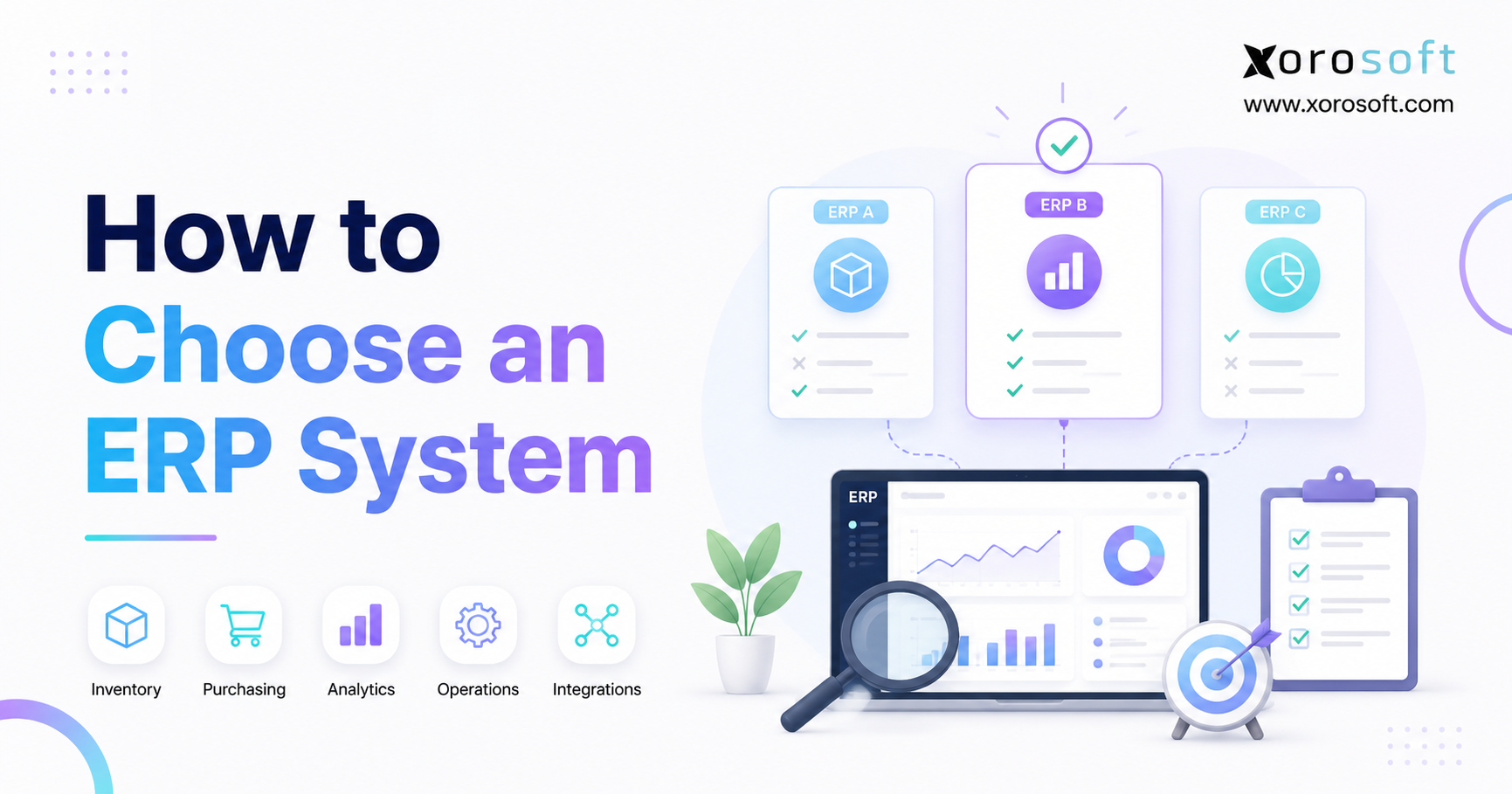
If you are wondering how to choose an ERP system, you are in the right place.
1. How to Choose an ERP System Without Letting Features Control the Decision
The first challenge in understanding how to choose an ERP system is separating genuine business requirements from attractive software features.
Most established ERP vendors can demonstrate accounting, purchasing, inventory, reporting, and order management. However, those broad categories do not reveal whether the software can support the company’s exact processes.
For example, a vendor may confirm that its system supports multi-warehouse inventory. Yet that phrase may represent several different capabilities:
- Viewing stock by location
- Allocating orders across facilities
- Managing goods in transit
- Applying warehouse-specific replenishment rules
- Transferring inventory between legal entities
- Managing owned and third-party stock
- Calculating inventory valuation across locations
- Routing orders according to availability
- Applying different picking rules by warehouse
Consequently, a simple yes-or-no feature checklist does not provide enough evidence.
1.1 Why ERP Feature Lists Create False Confidence
Feature lists make ERP software selection appear objective. Nevertheless, they often hide important workflow differences.
A system may technically support purchase orders, for instance. However, it may not support approval thresholds, supplier-specific units of measure, partial receiving, landed costs, or container-level tracking without additional work.
Similarly, two systems may both include warehouse management. Even so, one may offer only basic inventory transfers, while another supports barcode scanning, directed putaway, wave picking, packing controls, and carrier integration.
Therefore, every critical requirement should be described as a business scenario rather than a broad feature name.
Instead of asking whether a platform supports purchasing, ask whether it can:
- Generate a purchase recommendation from demand.
- Apply supplier lead times and minimum quantities.
- Route the purchase order for approval.
- Receive partial quantities.
- Allocate landed costs.
- Update inventory and finance.
- Track the remaining supplier commitment.
This level of detail makes vendor responses easier to evaluate. Moreover, it exposes hidden gaps before implementation begins.
1.2 What a Strong ERP System Selection Decision Looks Like
A defensible ERP decision should answer several questions:
- Which business problems must be solved?
- Which workflows are essential?
- Which requirements are optional?
- How did each vendor demonstrate the required processes?
- Which integrations are included?
- What configuration or development is required?
- How much will the project cost over several years?
- Which implementation risks remain?
- Why did the selected platform score higher?
Furthermore, these answers should be documented. That documentation will support contract negotiations, implementation planning, testing, and training.
Without written evidence, teams often rely on memory. However, vendor demonstrations can blend together, especially when several meetings occur within a short period. Therefore, scoring and notes should be completed immediately after each session.
In addition, each score should include a short explanation. Otherwise, a rating such as four out of five may mean something different to every reviewer.
2. Confirm Business Readiness Before You Choose an ERP System
Before deciding how to choose an ERP system, determine whether ERP is the right category of software for the business.
A growing company may have operational problems, but that does not automatically mean it needs a complete ERP platform. In some cases, better accounting software, an inventory application, a warehouse management system, or improved integrations may solve the immediate issue.
Therefore, ERP readiness should be assessed before vendors are contacted.
2.1 What an ERP System Should Centralize
An ERP system should create a shared operational and financial foundation.
For example, when a warehouse receives a purchase order, the system may need to update:
- Inventory on hand
- Available inventory
- Purchase-order status
- Supplier liability
- Landed cost
- Warehouse tasks
- Replenishment calculations
- Financial reports
In a disconnected software environment, these updates may happen across several applications. Consequently, employees must export data, enter information again, or reconcile reports manually.
An ERP platform aims to connect those processes through shared records and coordinated workflows. As a result, departments can work from the same operational data rather than maintaining separate versions.
Furthermore, connected data improves traceability. Finance can review how a warehouse receipt affected inventory value, while purchasing can see whether the supplier delivered the expected quantity.
Similarly, customer service can review the latest order status without contacting the warehouse or finance team. Consequently, the company spends less time requesting information from other departments.
2.2 Signs That a Business Is Ready for ERP System Selection
A company may be ready to begin an ERP selection process when several of these conditions appear:
- Inventory totals differ across systems.
- Buyers rely heavily on spreadsheets.
- Orders must be entered more than once.
- Month-end reporting takes too long.
- Customer service cannot see reliable stock information.
- Warehouse activity is not reflected in finance quickly enough.
- Reports require several exports and manual formulas.
- Adding another warehouse creates significant administrative work.
- The current system cannot support EDI.
- Manufacturing is managed outside the accounting system.
- Integration failures regularly interrupt operations.
- The company cannot measure product or channel profitability reliably.
- Employees maintain unofficial databases and workarounds.
- Management lacks real-time operational visibility.
One problem alone may not justify an ERP project. However, a pattern of disconnected workflows often indicates that the business has outgrown its current stack.
For example, a buyer may maintain purchasing plans in a spreadsheet because the inventory application does not provide forecasting. Meanwhile, finance may use different inventory values because the spreadsheet does not update accounting. Consequently, the company spends more time reconciling information than making decisions.
In addition, growth can make small process gaps more expensive. A manual task that takes ten minutes may be manageable at twenty orders per day. However, the same task becomes a major constraint at several hundred orders.
2.3 Who May Not Need an ERP System Yet
Some companies can continue operating effectively with simpler systems.
For instance, a business may not need ERP when it has:
- One legal entity
- One sales channel
- One warehouse
- A small product catalogue
- Basic purchasing
- No manufacturing
- Straightforward financial reporting
- Limited integration requirements
In that situation, implementing a full ERP may introduce more complexity than value.
However, company size and revenue should not be the only factors. A smaller manufacturer with bills of materials, work orders, and lot tracking may need ERP earlier than a larger service business with no physical inventory.
Therefore, the readiness decision should be based on workflow complexity rather than a single financial threshold.
Moreover, the company should compare ERP with realistic alternatives. For example, a stronger inventory system may improve warehouse visibility without requiring the business to replace its accounting platform immediately.
3. Build the Business Case Before You Choose an ERP System
A clear business case keeps the ERP selection process focused.
Without measurable objectives, requirements can expand rapidly. In addition, stakeholders may prioritize different outcomes, making vendor comparisons inconsistent.
Therefore, before determining how to choose an ERP system, define what must improve and how success will be measured.
3.1 Convert Operational Problems Into Measurable ERP Goals
Statements such as “we need better visibility” or “the current system is too manual” are not specific enough.
Instead, define the current situation, desired result, and measurement method.
| Current problem | Desired result | Possible measurement |
|---|---|---|
| Inventory reports do not agree | One approved inventory balance | Number of reconciliation adjustments |
| Buyers use spreadsheets | System-supported replenishment | Manual planning hours |
| Month-end close is delayed | Faster financial reporting | Days required to close |
| Orders are entered repeatedly | Automated order flow | Manual entries per order |
| Fulfilment errors are increasing | Controlled warehouse workflows | Mis-picks and reshipments |
| Margin reporting is unavailable | Product and channel profitability | Time required to produce reports |
As a result, every major requirement can be linked to an operational outcome.
For example, if the goal is to reduce inventory discrepancies, the team should evaluate receiving, adjustments, transfers, counting, fulfilment, and valuation. Otherwise, the project may improve one part of the process while leaving the underlying problem unresolved.
Likewise, if the goal is to shorten the financial close, the company should examine inventory costing, bank reconciliation, accounts payable, accruals, and intercompany transactions.
In addition, the business case should identify the cost of doing nothing. For instance, continued stock discrepancies may create lost sales, excess inventory, rushed purchasing, and customer-service problems.
3.2 Build a Cross-Functional ERP Selection Team
ERP connects several departments. Therefore, ERP system selection should not be controlled by finance, IT, or operations alone.
A practical selection team may include:
- Executive sponsor
- ERP project leader
- Finance and accounting
- Purchasing
- Inventory planning
- Warehouse operations
- Manufacturing
- Ecommerce
- Sales
- Customer service
- Information technology
- Reporting and analytics
Furthermore, frontline users should participate. Managers understand business objectives, while daily users understand the exceptions and delays hidden inside normal processes.
For instance, a warehouse manager may describe the standard receiving process. However, a receiver may explain how damaged inventory, supplier overages, incorrect barcodes, and partial receipts are actually handled.
Consequently, both perspectives are necessary. In addition, each department should nominate one decision-maker so that conflicting requirements can be resolved quickly.
Meanwhile, the executive sponsor should protect the project from unnecessary scope expansion. Without executive support, departments may continue adding requests without considering cost or implementation time.
3.3 Map Current Workflows Before Evaluating Future ERP Processes
Current workflows should be documented even when they are inefficient.
For example, purchasing may involve:
- Reviewing demand in a spreadsheet
- Emailing suppliers
- Creating a purchase order in accounting software
- Receiving goods in a warehouse application
- Calculating landed costs separately
- Reconciling supplier invoices manually
In this situation, the requirement is not simply purchase-order functionality. Instead, the requirement is a connected procure-to-pay process with approvals, receiving, costing, and financial posting.
Similarly, an order-to-cash process may include ecommerce orders, wholesale pricing, inventory allocation, warehouse fulfilment, customer invoicing, payments, and returns. Therefore, the full workflow should be evaluated from beginning to end.
Moreover, process mapping should include exceptions. A standard customer order may be simple; however, backorders, substitutions, partial shipments, cancellations, and returns may reveal whether the proposed ERP can support daily operations.
4. Create Requirements Before You Choose an ERP System
A structured ERP requirements checklist is one of the most important outputs of the selection process.
However, the checklist should describe how the company needs to operate. It should not include every feature that appears in a vendor brochure.
When deciding how to choose an ERP system, requirements should guide the evaluation from the first shortlist through the final contract.
4.1 Prioritize ERP System Requirements
Each requirement should be placed into one of five categories:
- Must-have: The business cannot operate acceptably without it.
- Should-have: Important, although a controlled alternative is possible.
- Could-have: Useful but not essential to the initial project.
- Future phase: Needed after planned growth or process maturity.
- Excluded: Not required or managed successfully in another system.
In addition, every must-have requirement should have an owner and a validation method.
| ERP requirement | Owner | Priority | Business reason | Validation method |
| Multi-location allocation | Operations | Must-have | Prevent overselling | Scripted demonstration |
| Purchase approvals | Purchasing | Must-have | Improve spending control | Workflow test |
| Executive dashboard | Finance | Should-have | Reduce report preparation | Configured report |
| Marketing automation | Sales | Excluded | Existing CRM remains | Integration review |
This approach prevents every department from marking every request as critical. Moreover, it helps the project team protect the initial scope.
Additionally, requirements should be written in plain business language. Technical terminology may be useful later; however, process owners should first understand what the requirement means operationally.
4.2 Define ERP Financial and Accounting Requirements
Finance requirements may include:
- General ledger
- Accounts payable
- Accounts receivable
- Bank reconciliation
- Cash management
- Inventory valuation
- Fixed assets
- Revenue recognition
- Budgeting
- Multi-currency
- Multi-entity consolidation
- Tax handling
- Period controls
- Audit trails
- Financial reporting
Moreover, finance should validate transaction traceability. Users should be able to move from a financial balance to the order, receipt, shipment, adjustment, or invoice that created it.
For example, an inventory valuation report should not simply display a total. Instead, users should be able to understand how receipts, transfers, manufacturing activity, landed costs, and adjustments affected the balance.
Additionally, the finance team should test period-closing and reopening controls. Otherwise, unauthorized changes may weaken the accuracy of financial reporting.
Similarly, multi-entity companies should examine intercompany transactions and consolidations. A platform may support multiple entities; however, the practical workflow may still involve significant manual processing.
4.3 Define Inventory and Purchasing Requirements When Choosing ERP Software
Inventory-driven businesses should evaluate:
- Inventory by location
- Available-to-promise quantities
- Stock reservations
- Lot and serial tracking
- Expiration dates
- Units of measure
- Kits and assemblies
- Cycle counting
- Transfers
- Replenishment
- Supplier lead times
- Purchase approvals
- Landed costs
- Demand forecasting
- Inventory allocation
- Supplier performance
Companies that have outgrown accounting software may evaluate XoroERP when they need accounting, inventory, purchasing, forecasting, manufacturing, and reporting in one ERP environment.
However, the platform should still be evaluated against the company’s actual requirements rather than assumed to fit automatically.
For example, a wholesale distributor may need customer-specific allocation rules. By contrast, a manufacturer may prioritize component availability and material planning. Therefore, the same inventory feature may have different importance depending on the operating model.
Furthermore, buyers should test supplier minimum quantities, order multiples, lead-time changes, and purchase-order amendments. These details often determine whether purchasing automation is practical.
In addition, the team should evaluate how the system handles overstock and shortages. A useful planning tool should explain why it recommends a purchase rather than simply producing a quantity.
4.4 Define Warehouse Requirements During ERP System Selection
Warehouse requirements must reflect physical activity.
Therefore, the evaluation should cover:
- Receiving
- Quality inspection
- Directed putaway
- Bin management
- Replenishment
- Barcode scanning
- Wave picking
- Batch picking
- Packing
- Shipping
- Carrier integrations
- Returns
- Cross-docking
- Cycle counting
- Multi-warehouse transfers
When fulfilment complexity is high, the business may need ERP with integrated warehouse functionality. For example, XoroWMS can be reviewed when a company needs barcode-driven receiving, inventory tracking, picking, packing, shipping, and multi-warehouse operations.
Nevertheless, the team should test warehouse processes under realistic conditions. For instance, it should evaluate short picks, damaged stock, partial shipments, split orders, and inventory held in quarantine.
Similarly, mobile screens should be tested in the warehouse environment. A workflow that looks efficient on a desktop may be difficult to use while scanning products and moving inventory.
Moreover, high-volume operations should evaluate task sequencing. Even if every function is available, inefficient navigation can reduce productivity across thousands of daily transactions.
4.5 Define ERP Manufacturing and Planning Requirements
Manufacturing requirements may include:
- Bills of materials
- Routings
- Work orders
- Material requirements planning
- Production scheduling
- Labour tracking
- Machine capacity
- Scrap and yield
- Subcontracting
- Production costing
- Quality checks
- Component traceability
Nevertheless, a vendor should demonstrate the company’s actual production model. Basic assembly functionality may not support complex routings, process manufacturing, co-products, or subcontracted production.
In addition, planners should verify how sales demand, forecasts, purchase orders, work orders, lead times, and safety stock affect material planning.
Meanwhile, finance should confirm how the system records labour, overhead, material consumption, scrap, and finished-goods costs.
Furthermore, the team should review production exceptions. For example, a component shortage, substitute material, quality failure, or partial completion may require workflows that are not visible during a standard demonstration.
4.6 Define ERP Reporting, Security, and Approval Requirements
Reporting requirements should explain:
- Which decisions a report supports
- Which data it requires
- Who may access it
- How often it updates
- Whether users need drill-down
- Whether it must combine entities or locations
- Whether it must be scheduled or exported
Likewise, security requirements should include:
- Role-based access
- Approval thresholds
- Multifactor authentication
- Audit logs
- Segregation of duties
- Backup procedures
- Recovery processes
- User provisioning
- Data-retention controls
Furthermore, approval workflows should be tested through real thresholds and exceptions. For example, a purchase order may require different approvals based on amount, supplier, department, or budget.
Finally, the selection team should confirm whether reporting changes require consultants. If every new report requires outside support, long-term administration may become expensive.
5. How to Choose an ERP System Deployment Model
The deployment model affects access, upgrades, infrastructure, IT responsibility, customization, and long-term cost.
Therefore, the choice between cloud, on-premise, and hybrid ERP should reflect operational requirements rather than market trends alone.
Understanding the deployment options is an important part of learning how to choose an ERP system, because the wrong model can create avoidable technical and financial constraints.
5.1 Choose Cloud ERP for Connected and Distributed Operations
Cloud ERP is generally accessed through an internet connection and hosted on vendor-managed or partner-managed infrastructure.
Potential advantages include:
- Lower internal infrastructure requirements
- Centralized software updates
- Remote accessibility
- Easier expansion across locations
- Faster environment provisioning
- Reduced server-management responsibilities
However, the buyer should still investigate:
- Data location
- Availability commitments
- Backup procedures
- Security responsibilities
- Upgrade schedules
- Integration limits
- Data-export options
- Contract termination terms
XoroONE is a cloud ERP platform designed for inventory-driven businesses such as retailers, wholesalers, ecommerce companies, and manufacturers. It combines inventory, purchasing, accounting, warehouse management, manufacturing, forecasting, reporting, and ecommerce operations.
Even so, cloud deployment does not eliminate implementation work. Instead, it changes which responsibilities belong to the vendor, implementation partner, and customer.
Moreover, the team should understand the release process. Frequent updates can provide new capabilities; however, they may also require testing for integrations, custom workflows, and user procedures.
5.2 Compare Cloud ERP, On-Premise ERP, and Hybrid ERP
| Evaluation factor | Cloud ERP | On-premise ERP | Hybrid ERP |
| Infrastructure | Vendor or hosting provider | Internal | Shared |
| Updates | Usually vendor managed | Internally planned | Mixed |
| Remote access | Usually standard | May require setup | Varies |
| Upfront infrastructure | Generally lower | Generally higher | Variable |
| Internal IT workload | Lower for infrastructure | Higher | Moderate to high |
| Customization | Usually controlled | Can be extensive | Varies |
| Expansion | Often easier | May require hardware | Architecture-dependent |
On-premise ERP may remain appropriate for companies with unusual regulatory, legacy, or infrastructure requirements.
Meanwhile, hybrid ERP can support gradual modernization. However, hybrid environments may create additional integration and support complexity.
Therefore, the business should consider not only initial deployment but also upgrades, disaster recovery, security monitoring, and long-term administration.
In addition, contract terms should clarify data access. Regardless of deployment model, the company should be able to retrieve its data in a practical format.
6. Evaluate Integrations Before You Choose an ERP System
An ERP platform can perform well internally and still fail operationally when integrations are incomplete.
Therefore, integrations should be evaluated during ERP system selection rather than postponed until implementation.
When assessing how to choose an ERP system, the team should treat every critical integration as part of the core solution rather than an optional technical add-on.
6.1 Document Every Required ERP Integration
For every connection, document:
- Source system
- Destination system
- Data objects
- Synchronization direction
- Synchronization frequency
- Expected volume
- Error handling
- Monitoring
- Ownership
- Support responsibility
- Additional cost
A vendor saying that it has an API is not sufficient. Instead, the selection team should determine which endpoints are available, what limits apply, who will build the integration, and how errors will be resolved.
Moreover, the team should confirm whether the integration is native, partner-built, middleware-based, or custom. Each approach has different cost, support, and upgrade implications.
For example, a native connector may be easier to support. However, it may not support every required field or workflow. Conversely, a custom integration may provide more flexibility, although it may require greater maintenance.
Therefore, every critical integration should be included in the demonstration or technical review.
6.2 Evaluate Shopify ERP Integration Requirements
Shopify businesses should test:
- Product and variant creation
- Inventory by location
- Sales-order import
- Order edits
- Cancellations
- Refunds
- Payments
- Payout reconciliation
- Fulfilment updates
- Returns
- Gift cards
- B2B customers
- Customer-specific pricing
- Multiple stores
- Multiple currencies
The Xorosoft ERP app on the Shopify App Store can be reviewed when a Shopify business needs order, inventory, fulfilment, payment, refund, product, and multi-location data connected with ERP operations.
Nevertheless, the company should test its actual Shopify configuration. An available app does not automatically mean that every custom workflow or third-party extension will be supported.
For example, a standard order may import correctly, while a B2B order with customer-specific pricing may require a different process. Therefore, both standard and exception scenarios should be tested.
Additionally, finance should review payout reconciliation. Otherwise, order data may flow correctly while payment fees, refunds, and deposits still require manual work.
Similarly, multi-store businesses should confirm how customers, products, and inventory are shared. Without clear rules, duplicate data can create reporting and operational problems.
6.3 Define Amazon, EDI, Shipping, and Marketplace Integrations
Wholesale and multi-channel businesses may also require:
- Amazon marketplace orders
- EDI purchase orders
- EDI invoices
- Advance shipping notices
- Carrier label creation
- Shipment tracking
- 3PL communication
- Payment gateways
- Tax platforms
- Banking connections
- CRM synchronization
As a result, the company should create an integration map before vendor demonstrations begin.
In addition, it should identify which system owns each data object. For example, product descriptions may originate in a product information system, while inventory quantities originate in ERP.
Without clear ownership, one system may overwrite another. Consequently, prices, customer records, or product information may become unreliable.
Moreover, EDI evaluation should include trading-partner requirements. Supporting EDI generally does not guarantee support for every customer document, field, or validation rule.
6.4 Define ERP Data Migration Requirements
Data migration should be considered during selection.
Decide whether the new system needs:
- Customers
- Suppliers
- Products
- Variants
- Bills of materials
- Pricing
- Open sales orders
- Open purchase orders
- Inventory quantities
- Inventory costs
- Financial balances
- Historical transactions
- Attachments
- Audit records
Migrating every historical transaction may be unnecessary. However, migrating too little may limit customer service, audits, and reporting.
Therefore, the final scope should balance operational value, legal requirements, cost, and project risk.
Furthermore, the team should define who will clean each dataset. The implementation partner may transform the data, but internal process owners usually need to decide which records are correct.
Finally, at least one full trial migration should be completed before cutover. Otherwise, errors may only become visible when the business is preparing to go live.
7. Use a Structured Process to Decide How to Choose an ERP System
Comparing too many platforms consumes time and makes demonstrations difficult to evaluate consistently.
Instead, begin with broad market research and then create a shortlist of credible vendors.
A structured shortlist is essential when deciding how to choose an ERP system, because it prevents the project from becoming an endless market review.
7.1 Filter ERP Vendors by Business and Industry Fit
Each vendor should be evaluated against the company’s operating model.
Consider:
- Business size
- Revenue complexity
- Order volume
- Number of SKUs
- Number of warehouses
- Legal entities
- Currencies
- Countries
- Sales channels
- Manufacturing complexity
- Reporting needs
- Internal IT capacity
Industry experience can also reduce the amount of customization required. However, industry claims should still be validated through real workflows.
For instance, a vendor may serve wholesale distributors. Nevertheless, it may not support the company’s EDI documents, customer pricing, or allocation rules.
Therefore, industry experience should be treated as a useful filter rather than proof of fit.
Moreover, the implementation team should have relevant experience. Strong software can still produce weak results when the implementation partner does not understand the company’s operating model.
7.2 Evaluate ERP Scalability Beyond User Numbers
Scalability includes more than adding user licences.
The ERP should be evaluated against:
- Higher transaction volume
- Additional warehouses
- New sales channels
- More products
- New entities
- International operations
- Multiple currencies
- Acquisitions
- More advanced approvals
- Manufacturing expansion
- Increased reporting demands
Consequently, the selection team should ask whether processes remain manageable as complexity increases.
A platform may technically support more transactions. However, if administrators must create manual workarounds for every new location, the system may not scale operationally.
Moreover, scalability should include reporting performance, integration volume, and administrative effort.
Similarly, the business should review how pricing changes as it grows. A system that fits the current budget may become expensive when users, transactions, stores, or entities increase.
7.3 Score ERP Vendors With a Weighted Evaluation Model
| Evaluation category | Suggested weight |
| Functional fit | 30% |
| Industry and workflow fit | 15% |
| Integrations and technology | 15% |
| Implementation approach | 15% |
| Total cost of ownership | 10% |
| Scalability | 5% |
| Usability | 5% |
| Support and vendor stability | 5% |
Weights should reflect the business case.
For example, a warehouse-intensive distributor may assign more weight to WMS functionality. By contrast, a multi-entity company may prioritize financial consolidation and controls.
Furthermore, each score should include evidence and notes. Otherwise, personal impressions may influence the final result.
Finally, define a minimum score for every must-have requirement. A vendor should not win through a high overall score while failing a critical workflow.
8. How to Choose an ERP System Through Scripted Demonstrations
ERP demonstrations should reproduce real business scenarios.
Otherwise, vendors will naturally present the workflows they know best and avoid operational exceptions.
Consequently, scripted demonstrations are one of the most important steps in understanding how to choose an ERP system.
8.1 Give Every ERP Vendor the Same Demonstration Script
Ask each finalist to demonstrate:
- Creating a customer order
- Applying customer-specific pricing
- Allocating inventory
- Generating a purchase requirement
- Creating a purchase order
- Routing the order for approval
- Receiving inventory
- Transferring stock
- Picking, packing, and shipping
- Processing a return
- Recording the financial effect
- Producing an inventory-valuation report
- Handling insufficient stock
- Correcting a fulfilment error
Because every vendor receives the same script, the selection team can compare results more objectively.
In addition, vendors should receive the script before the demonstration. That way, they have a fair opportunity to configure the workflow and identify genuine gaps.
However, vendors should not be allowed to replace the requested scenarios with a generic product tour.
Moreover, process owners should attend the relevant parts of the demonstration. A warehouse user may identify a practical issue that would not be obvious to finance or IT.
8.2 Record ERP Demo Evidence and Workarounds
| Demo scenario | Expected result | Demonstrated | Workaround | Score |
| Multi-location order | Allocate from correct facility | Yes/No | Details | 1–5 |
| Purchase approval | Route according to value | Yes/No | Details | 1–5 |
| Customer return | Update inventory and finance | Yes/No | Details | 1–5 |
| Inventory valuation | Drill into source transactions | Yes/No | Details | 1–5 |
A verbal promise should not receive the same score as a completed demonstration. Likewise, a future development plan should not be treated as an existing feature.
Moreover, every workaround should be evaluated for frequency and effort. A workaround used once per year may be acceptable, while one used on every order may create significant cost.
Similarly, the team should distinguish configuration from customization. Configuration uses supported settings, whereas customization may involve development and long-term maintenance.
In addition, every unresolved requirement should have an owner and deadline. Otherwise, gaps may remain hidden until contract negotiations or implementation.
8.3 Evaluate ERP Usability by User Role
Different teams use ERP differently.
For example:
- Executives need dashboards and exceptions.
- Accountants need controls and transaction detail.
- Buyers need supply and demand visibility.
- Warehouse teams need fast scanning workflows.
- Customer service needs complete order history.
- Planners need forecasting and availability.
Therefore, users from each function should score the workflows relevant to their roles.
Companies evaluating Xorosoft should request a personalized demonstration based on their actual inventory, purchasing, accounting, ecommerce, manufacturing, and warehouse scenarios.
In addition, the team should test how quickly common tasks can be completed. A process may be functional but still require too many steps for high-volume users.
Finally, users should review error messages and alerts. Clear guidance can reduce training needs and prevent operational mistakes.
9. Calculate ERP Total Cost Before You Choose an ERP System
Subscription or licence cost is only one part of an ERP project.
Therefore, the company should calculate a three-to-five-year total cost before making the final decision.
A complete cost model is essential when evaluating how to choose an ERP system, because a low software price can hide expensive implementation or integration requirements.
9.1 Include Every ERP Cost Category
The model should include:
- Software licences or subscriptions
- Implementation services
- Project management
- Data migration
- Integrations
- Configuration
- Custom development
- Reports
- Testing
- Training
- Internal employee time
- Temporary staff coverage
- Support
- Administration
- Upgrades
- Travel
- Contingency
A practical formula is:
ERP total cost = software + implementation + migration + integrations + configuration + customization + training + internal resources + support + contingency
Although Year 1 usually contains the largest project costs, later years may include support, new users, integrations, upgrades, and optimization work. Therefore, a one-year comparison can be misleading.
Moreover, internal employee time should be included. Project workshops, data cleansing, testing, training, and process decisions can require significant effort from employees who already have full-time responsibilities.
9.2 Identify Costs That Commonly Appear Later
Unexpected costs often come from incomplete requirements.
For example, a company may discover during implementation that it needs:
- Additional warehouse software
- Ecommerce middleware
- More integrations
- Custom reports
- Data-cleansing services
- Testing environments
- Additional user licences
- Tax or compliance applications
- External training
- Post-launch support
Therefore, high-risk assumptions should be resolved before signing.
In addition, quotes from different vendors should use the same scope. Otherwise, one proposal may appear cheaper simply because it excludes important services.
Furthermore, the contract should identify which changes will create additional fees. That clarity reduces disputes during implementation.
Similarly, recurring charges should be separated from one-time fees. Support, storage, integrations, and user subscriptions may increase total cost after the initial project.
9.3 Evaluate ERP Return on Investment Conservatively
Potential benefits may include:
- Less duplicate data entry
- Faster reporting
- Improved inventory accuracy
- Better purchasing decisions
- Fewer fulfilment errors
- Reduced integration maintenance
- Faster financial close
- Improved margin visibility
- Higher employee productivity
However, not every benefit should be converted into an aggressive financial claim.
Instead, separate measurable savings from strategic benefits such as scalability, stronger controls, and better visibility. Furthermore, use conservative assumptions so that the business case remains credible.
For example, a reduction in manual entry can be measured through time studies. By contrast, improved decision quality may be valuable but harder to convert into a precise financial figure.
Therefore, the final ROI model should include a range of possible outcomes rather than one optimistic estimate.
10. Compare ERP Software Before Deciding How to Choose an ERP System
There is no universal best ERP system.
Therefore, platform comparisons should focus on business fit rather than declaring one vendor superior in every situation.
A meaningful comparison is necessary when determining how to choose an ERP system, because each provider may be designed around a different operating model.
10.1 Compare ERP Systems by Their Intended Use
| Platform | Typical evaluation context | Important areas to validate |
| Xorosoft | Inventory-driven ecommerce, wholesale, manufacturing, and warehouse operations | Workflow depth, integrations, implementation scope |
| NetSuite | Broad cloud finance and operations | Configuration, ecosystem, total cost |
| Acumatica | Mid-market distribution, manufacturing, retail, and services | Edition fit, partner capability, customization |
| Business Central | Small and midsize companies using Microsoft tools | Extensions, partner solution, operational depth |
| Cin7 | Multichannel inventory and order operations | Accounting depth, manufacturing, transaction scale |
| Brightpearl | Retail and wholesale operations | Geographic fit, integrations, financial requirements |
| Fishbowl | Inventory and manufacturing linked to accounting software | Whether separate accounting remains suitable |
| Sage X3 | Manufacturing and distribution | Localization, deployment, implementation experience |
These categories provide a starting point only. Consequently, each platform must still be tested against requirements and real scenarios.
Businesses comparing Xorosoft with a larger cloud ERP can review the Xorosoft vs NetSuite comparison. However, the final decision should still be supported by demonstrations, implementation scope, customer references, and total cost.
Additionally, implementation quality may vary by partner. Therefore, the company should evaluate both the software and the team responsible for delivering it.
Moreover, references should resemble the buyer’s business. A successful implementation at a service company may not prove that the platform fits a multi-warehouse distributor.
10.2 Compare ERP With Point-Solution Architectures
A company should also compare full ERP with alternative software structures.
| Option | Potential advantage | Potential limitation |
| Accounting plus inventory apps | Lower initial complexity | More reconciliation |
| ERP with integrated WMS | Shared processes and data | Warehouse depth varies |
| ERP plus specialist WMS | Advanced fulfilment | Additional integration |
| Best-of-breed stack | Strong specialist features | More vendors and data flows |
| Industry-specific ERP | Relevant workflows | Smaller ecosystem |
| General ERP | Broad functionality | More configuration may be required |
The right architecture may include ERP and selected specialist applications.
Therefore, the objective is not necessarily to put every process inside one product. Instead, the company should create clear system ownership and reliable data flow.
For example, a specialist shipping platform may remain useful if it connects reliably with ERP. Likewise, a product information system may continue to own product content while ERP controls inventory and financial data.
However, every additional application creates another integration and support relationship. Consequently, the long-term architecture should remain manageable.
11. Match ERP Selection Criteria to Industry Requirements
Industry complexity affects product structures, costing, traceability, forecasting, fulfilment, and reporting.
Therefore, a generic feature checklist is rarely sufficient for inventory-driven companies.
When deciding how to choose an ERP system, the selection team should test the processes that are specific to its industry rather than relying only on broad ERP categories.
11.1 ERP Selection for Apparel and Fashion
Apparel businesses often require:
- Style, colour, and size matrices
- Seasonal collections
- Preorders
- Wholesale selling
- Multi-channel inventory
- Returns
- Product lifecycle reporting
- Demand forecasting
Moreover, they may need to manage thousands of variants without creating unnecessary administrative work.
For example, a buyer may place one purchase order covering several colours and sizes. Therefore, the system should make variant-level planning practical without requiring excessive manual entry.
Likewise, inventory availability should remain accurate across wholesale, retail, Shopify, Amazon, and physical stores.
In addition, seasonal demand can change quickly. Consequently, planners need timely information about sales, supply, orders, and incoming inventory.
11.2 ERP Selection for Wholesale Distribution
Wholesale distributors may prioritize:
- Customer-specific pricing
- Credit limits
- EDI
- Inventory allocation
- Bulk order entry
- Landed costs
- Purchasing
- Backorders
- Warehouse fulfilment
- Supplier lead times
As a result, the ERP must connect commercial agreements with inventory and financial controls.
In addition, distributors should test partial shipments, backorders, customer holds, substitutions, and supplier delays.
Furthermore, the platform should support different units of measure. A distributor may purchase cases, stock individual units, and sell both configurations.
Similarly, customer-specific pricing should be evaluated alongside discounts, promotions, contracts, and minimum-order rules.
11.3 ERP Selection for Furniture and Sporting Goods
Furniture companies may need:
- Long supplier lead times
- Container purchasing
- Large-item delivery
- Backorder visibility
- Product variants
- Special-order workflows
Meanwhile, sporting-goods businesses often manage seasonal demand, kits, product variants, wholesale accounts, direct-to-consumer orders, and marketplace inventory.
Therefore, both industries should evaluate planning, purchasing, allocation, and multi-channel fulfilment carefully.
Additionally, furniture companies should test delivery scheduling, while sporting-goods companies should examine seasonal replenishment and kit availability.
Moreover, both industries may handle bulky or variant-rich products. Consequently, warehouse location, packaging, and shipping requirements may influence ERP fit.
11.4 ERP Selection for Food and Beverage
Food businesses should evaluate:
- Lot tracking
- Expiration dates
- Recall support
- Quality status
- First-expiry-first-out picking
- Ingredient traceability
- Production batches
Because traceability affects both warehouse and production processes, these workflows should be tested from receipt to customer shipment.
Furthermore, the company should verify how holds, quality inspections, and recalls affect available inventory.
For example, inventory under inspection should not appear as available for fulfilment. Similarly, a recall search should identify the suppliers, production batches, warehouses, and customers involved.
In addition, shelf-life requirements may affect purchasing and allocation. Therefore, the system should support expiry-aware planning where necessary.
11.5 ERP Selection for Manufacturing Businesses
Manufacturers may require:
- Bills of materials
- Routings
- Work orders
- Material planning
- Production scheduling
- Capacity management
- Labour tracking
- Production costing
- Component traceability
- Subcontracting
Xorosoft provides ERP solutions by industry for apparel, wholesale distribution, food and beverage, manufacturing, furniture, sporting goods, consumer products, and other inventory-driven sectors.
However, industry alignment should be treated as the beginning of the evaluation rather than final proof of fit.
Therefore, manufacturers should demonstrate their actual bills of materials, production stages, substitutions, shortages, and costing methods.
Moreover, they should test both planned production and unexpected changes. A system may handle a standard work order well; however, shortages, scrap, rework, and partial completion often reveal the true operational fit.
12. Avoid Common Mistakes When You Choose an ERP System
The most expensive ERP problems often begin during selection.
Therefore, identifying common mistakes early can prevent long-term workarounds and implementation disputes.
Avoiding these mistakes is a practical part of learning how to choose an ERP system, because a strong platform can still fail when the evaluation process is weak.
12.1 Starting With ERP Vendor Demonstrations
When demonstrations come first, vendors influence the requirements.
Instead, build the business case, workflows, requirements, and scorecard before scheduling demonstrations.
Moreover, vendors should receive the same scenarios. Otherwise, every platform will be evaluated against a different standard.
12.2 Selecting ERP by Feature Count
More features do not automatically create more value.
In fact, unnecessary functionality may increase complexity, training, and administration. Therefore, essential workflow fit should receive more weight than the total number of modules.
Similarly, a smaller platform may be a stronger fit when it supports critical processes without extensive customization.
12.3 Excluding Frontline ERP Users
Executives understand strategy, while frontline employees understand exceptions.
Consequently, warehouse operators, buyers, accountants, planners, and customer-service users should participate in testing.
Additionally, their feedback should be documented rather than collected informally. This creates accountability and makes adoption risks easier to identify.
12.4 Comparing ERP Subscription Prices Only
A lower subscription may be offset by:
- Implementation costs
- Integration fees
- Migration work
- Custom development
- Support
- Administration
- Additional applications
Therefore, total cost should be compared instead of licence price alone.
Furthermore, the company should distinguish fixed costs from variable costs. User growth, transaction volume, storage, and additional entities may affect future fees.
12.5 Accepting Vague ERP Integration Claims
Statements such as “the system connects with Shopify” or “the platform supports EDI” are incomplete.
Instead, confirm the exact data objects, frequency, ownership, monitoring, and error-resolution process.
For example, an integration may import orders but exclude refunds, gift cards, or payout data. Consequently, finance may still rely on manual reconciliation.
12.6 Underestimating ERP Data Migration
Poor customer, supplier, product, or inventory data can weaken the new ERP from the first day.
Therefore, data ownership, cleansing, testing, and reconciliation must be included in the project plan.
Moreover, data should be tested more than once. A successful sample migration does not guarantee that the final cutover file will be accurate.
12.7 Over-Customizing the ERP System
Customization may be necessary for a regulatory or strategically important process.
However, custom development should not preserve every historical habit. Otherwise, upgrades and support may become more difficult.
Instead, the company should first ask whether its current process remains necessary. In some cases, adopting a standard ERP workflow may create more value than recreating the old method.
12.8 Ignoring ERP Change Management
Employees may recreate old processes in spreadsheets when they do not understand the new workflow.
Therefore, communication, training, testing, process ownership, and post-launch support should be planned before implementation.
Moreover, managers should explain why processes are changing. Without that context, employees may view ERP as an administrative burden rather than an operational improvement.
Finally, adoption should be measured after launch. Usage reports, support tickets, process compliance, and business KPIs can show whether the new system is being used correctly.
13. Prepare for Implementation After Deciding How to Choose an ERP System
ERP implementation planning should begin during vendor selection.
Otherwise, the contract may not reflect the workflows, integrations, reports, migration scope, and responsibilities discussed during demonstrations.
Once the business understands how to choose an ERP system, it should convert the evaluation evidence into a practical implementation scope.
13.1 Review the ERP Implementation Scope
Confirm:
- Modules included
- Business processes included
- Integrations included
- Reports included
- Migration objects
- Testing responsibilities
- Training approach
- Project resources
- Timeline assumptions
- Support after launch
- Change-request process
- Exclusions
An unclear scope creates room for delays, added costs, and disagreement.
Therefore, every major requirement should connect to an implementation task, deliverable, or explicit exclusion.
Additionally, the scope should explain what “complete” means. For example, an integration should not be considered complete until it has been tested with real volumes and exception scenarios.
13.2 Validate the ERP Implementation Team
Ask who will perform the work.
Determine whether the consultants are:
- Vendor employees
- Implementation partners
- Subcontractors
- Offshore resources
- Local resources
In addition, review their industry experience, technical skills, data-migration experience, availability, governance approach, and customer references.
The team presented during the sales process should also match the team assigned to the project. Otherwise, the company may evaluate one group and receive another.
Furthermore, confirm who has decision authority when problems occur. Clear escalation paths can prevent issues from remaining unresolved.
13.3 Assign ERP Process and Data Owners
Assign owners for:
- Customers
- Suppliers
- Products
- Inventory
- Financial data
- Bills of materials
- Pricing
- Integrations
- Reports
- User roles
- Approval workflows
These owners should approve future processes, data-cleansing rules, test results, and final migration outputs.
Furthermore, they should remain involved after launch because ERP processes continue to evolve.
Finally, ownership should be formal rather than implied. When everyone is responsible, important decisions may not be made on time.
14. Frequently Asked Questions About How to Choose an ERP System
14.1 What is an ERP system?
An ERP system is an integrated business platform that manages financial and operational processes through shared data. Common functions include accounting, purchasing, inventory, order management, manufacturing, warehouse management, forecasting, and reporting. In addition, ERP may connect ecommerce, EDI, shipping, CRM, and banking platforms.
14.2 How do I choose an ERP system?
To understand how to choose an ERP system, first define business goals and map current workflows. Next, document integrations and prioritize requirements. Then, shortlist suitable vendors and run scripted demonstrations. Finally, compare total cost, implementation capability, scalability, references, and project risks.
14.3 What should I look for when choosing an ERP system?
When learning how to choose an ERP system, look for functional fit, industry experience, integrations, reporting, usability, scalability, security, implementation support, and total cost. Moreover, verify each critical workflow through a demonstration rather than relying on feature lists or sales claims.
14.4 What are the most important ERP selection criteria?
The main criteria for how to choose an ERP system are workflow fit, industry fit, integration capability, implementation approach, total cost, scalability, usability, reporting, security, and vendor support. However, each company should weight them according to its business case.
14.5 How long does ERP system selection take?
ERP system selection may take several weeks or several months. The duration depends on operational complexity, stakeholder availability, integrations, vendor count, demonstrations, and contract review. Therefore, the timeline should reflect the company’s requirements rather than an arbitrary deadline.
14.6 How much does an ERP system cost?
ERP cost depends on users, modules, implementation, migration, integrations, customization, training, and support. Therefore, businesses should compare three-to-five-year total cost rather than subscription prices alone.
14.7 What is included in ERP total cost of ownership?
ERP total cost includes licences, subscriptions, consulting, project management, data migration, integrations, configuration, custom development, reporting, testing, training, internal resources, support, administration, upgrades, and contingency. Consequently, software price is only one part of the investment.
14.8 How do I create an ERP requirements checklist?
First, map real workflows and exceptions. Next, organize requirements around finance, inventory, purchasing, warehousing, manufacturing, ecommerce, reporting, integrations, security, and data. Finally, assign each requirement an owner, priority, and validation method.
14.9 Who should participate in ERP system selection?
The team should include an executive sponsor, project leader, finance, operations, IT, and representatives from the most affected departments. Furthermore, frontline users should participate because they understand daily exceptions and manual workarounds.
14.10 How many ERP vendors should a company evaluate?
A business can research many providers initially. However, detailed demonstrations should normally be limited to a manageable shortlist of serious candidates. As a result, each vendor can be evaluated more consistently.
14.11 What questions should I ask an ERP vendor?
Ask how the system supports critical workflows, which features require customization, how integrations work, who performs implementation, how migration is managed, what support includes, and which costs are excluded. In addition, request written confirmation for high-risk requirements.
14.12 How should ERP vendors be scored?
Use weighted categories and apply the same scoring model to every vendor. In addition, require evidence for each score. A demonstrated workflow should receive more confidence than a verbal promise or future product-roadmap item.
14.13 What should an ERP demonstration include?
The demonstration should include real order-to-cash, procure-to-pay, inventory, warehouse, manufacturing, returns, financial, reporting, and exception scenarios. Moreover, every finalist should receive the same script.
14.14 Should I choose cloud or on-premise ERP?
Cloud ERP may suit companies seeking remote access, centralized updates, and lower infrastructure responsibility. By contrast, on-premise ERP may be appropriate when internal control, legacy systems, or specific regulatory requirements are more important. Therefore, the decision should reflect long-term IT capacity and business needs.
14.15 What integrations should an ERP system support?
The ERP should support every application required by the operating model. Common connections include Shopify, Amazon, EDI, CRM, banks, payment gateways, shipping carriers, 3PLs, tax platforms, and reporting tools. Furthermore, each connection should have clear ownership and monitoring.
14.16 How do I know whether my company needs ERP?
ERP may be appropriate when disconnected systems cause duplicate entry, inventory discrepancies, reporting delays, purchasing problems, integration failures, or difficulty supporting new warehouses, channels, and entities. However, simpler companies may still be served effectively by point solutions.
14.17 When should a company move from QuickBooks to ERP?
A company should evaluate ERP when operational complexity extends beyond accounting. For example, multi-warehouse inventory, manufacturing, advanced purchasing, EDI, and complex costing often create requirements that basic accounting software cannot manage alone.
14.18 Can ERP replace inventory management software?
Yes, when the ERP provides sufficient inventory functionality. However, businesses with advanced warehouse automation, traceability, or fulfilment requirements may still need a specialist WMS. Therefore, warehouse scenarios should be demonstrated before the final decision.
14.19 Can ERP replace accounting software?
Most full ERP systems include general ledger, accounts payable, accounts receivable, reconciliation, and financial reporting. Nevertheless, finance should confirm tax, payroll, audit, consolidation, and historical-data requirements before replacing the current accounting platform.
14.20 What is an industry-specific ERP system?
An industry-specific ERP includes workflows, records, controls, and terminology designed for a particular sector. Examples include apparel variants, food lot tracking, wholesale pricing, and manufacturing bills of materials. As a result, industry-specific software may reduce configuration requirements.
14.21 Is customizable ERP better than standard ERP?
Not automatically. Configuration is generally easier to maintain than custom code. Therefore, customization should be reserved for requirements that deliver meaningful operational, regulatory, or competitive value.
14.22 What are the risks of choosing the wrong ERP system?
The wrong ERP may create workarounds, unreliable reports, expensive customization, weak adoption, integration problems, and limits on growth. Consequently, the selection process should be based on evidence rather than assumptions.
14.23 What are the most common ERP selection mistakes?
Common mistakes include starting with demonstrations, selecting by feature count, excluding frontline users, comparing licence prices only, underestimating migration, accepting vague integration claims, and failing to define measurable outcomes. Furthermore, many teams overlook implementation capacity.
14.24 How do I evaluate an ERP implementation partner?
Review industry experience, methodology, proposed resources, references, migration skills, governance, training, and support. In addition, examine the statement of work for assumptions, responsibilities, exclusions, and change-order terms.
14.25 How important is data migration during ERP selection?
Data migration is critical because inaccurate data affects inventory, purchasing, finance, customer service, and reporting. Furthermore, migration scope can significantly affect the project budget and timeline. Therefore, data planning should begin during vendor selection.
14.26 How do I evaluate ERP scalability?
Assess additional warehouses, entities, users, currencies, products, channels, integrations, and transaction volume. Moreover, consider whether administrative work increases significantly as the company grows.
14.27 What ERP security features should I evaluate?
Evaluate role-based access, multifactor authentication, audit logs, encryption, backups, recovery, user provisioning, segregation of duties, incident response, and data-export controls. In addition, clarify which responsibilities belong to the vendor and which remain with the customer.
14.28 What happens after an ERP system is selected?
After selection, the company finalizes the contract, confirms governance, cleans data, configures workflows, builds integrations, tests processes, trains users, prepares cutover, and plans post-launch support. Therefore, selection should create a clear foundation for implementation.
15. Final Checklist for How to Choose an ERP System
Learning how to choose an ERP system is ultimately about replacing assumptions with evidence.
Before approving a platform, confirm that it:
- Supports critical business workflows
- Fits the industry and operating model
- Integrates with required applications
- Provides adequate reporting and controls
- Can support expected growth
- Has a credible implementation team
- Fits the full project budget
- Has manageable project risks
- Has support from process owners
- Can be adopted by frontline users
The selected ERP will not remove the need for disciplined processes. Instead, it should give the company a stronger operational structure for managing inventory, accounting, purchasing, warehousing, manufacturing, ecommerce, forecasting, and reporting.
Therefore, the final decision about how to choose an ERP system should not be based on the most polished presentation or longest feature list. Rather, it should be based on documented requirements, demonstrated workflows, realistic implementation planning, and long-term business fit.
Finally, inventory-driven businesses evaluating how to choose an ERP system can contact Xorosoft to review their workflows through a personalized ERP discussion. Bring the requirements checklist, integration map, vendor scorecard, and demonstration scenarios so the conversation remains practical, focused, and evidence-based.
Recent Posts
-
 ERP Landed Cost Module vs Spreadsheet Calculations for Importers
 -
 How to Build an Open-to-Buy Plan for an Omnichannel Brand
 -
 Cold Storage WMS for Food and Beverage Distribution
 -
 ERP Buying Statistics 2026: Evaluation, Implementation, and Adoption Risks
 -
 How a Distributor Reduced B2B Order Exceptions Without Restricting Sales