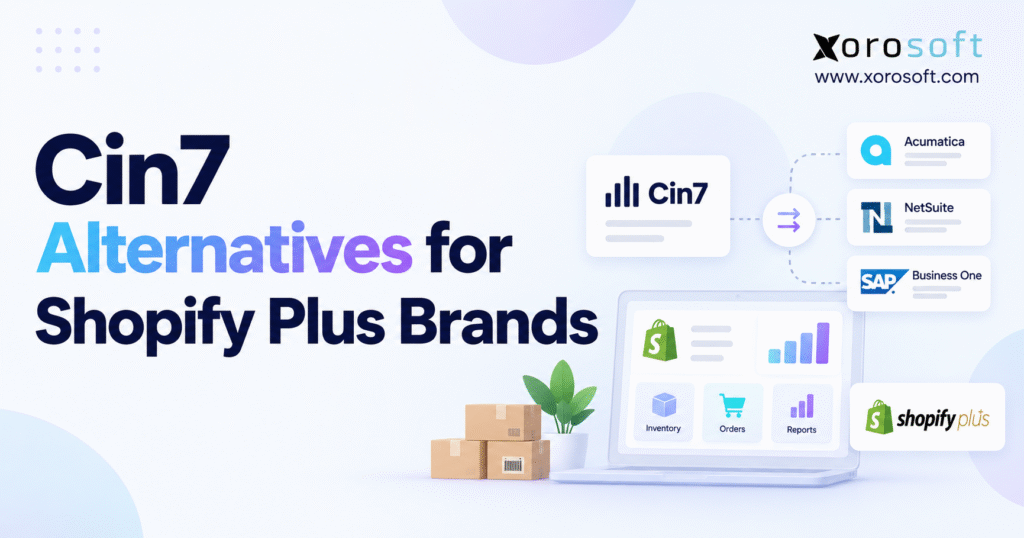
If you are searching for Cin7 alternatives for Shopify Plus, this article will help guide you through your options.
1. Cin7 Alternatives for Shopify Plus Become an Operations Decision
1.1 Why Shopify Plus Brands Reconsider Their Cin7 Setup
Shopify Plus brands rarely start searching for new software because inventory suddenly matters more than it did before. They usually start because inventory now affects almost every important operational decision.
A company may begin with one Shopify storefront, one warehouse, straightforward purchasing, and a separate accounting application. Growth changes that structure. The brand opens another fulfillment location, starts selling wholesale, launches on Amazon, adds B2B ordering, works with a 3PL, expands its purchasing team, or begins serving major retailers through EDI.
At that stage, the software question changes.
Instead of asking which application can simply replace Cin7, operations leaders need to decide which system should coordinate inventory, orders, purchasing, warehouse activity, finance, and multiple sales channels.
That distinction matters when comparing Cin7 alternatives for Shopify Plus.
Some businesses still need an inventory-focused platform. Their accounting process works well, warehouse requirements remain manageable, and purchasing does not require advanced planning or complex approval rules.
Others have moved into ERP territory. Inventory influences purchasing. Purchasing affects cash flow. Warehouse activity changes inventory value. Wholesale customers compete with DTC customers for stock. Finance needs reliable operational data without rebuilding transactions manually at month-end.
1.2 When a Cin7 Replacement Becomes a Shopify Plus ERP Decision
Shopify Plus gives brands room to operate increasingly sophisticated commerce models. Multiple warehouses, B2B customers, marketplace sales, retail operations, international fulfillment, and more advanced purchasing can all sit behind the same storefront strategy.
As the commerce layer becomes more capable, the operational systems behind it also need to mature.
The right Cin7 replacement therefore depends less on company size and more on process complexity.
A brand should ask what needs to improve after migration. If the answer focuses mostly on inventory synchronization, another inventory platform may solve the problem.
When the answer includes purchasing, warehouse execution, accounting, forecasting, manufacturing, B2B, EDI, and reporting, the company should evaluate a broader operational architecture.
That distinction provides the foundation for comparing Cin7 alternatives for Shopify Plus effectively.
2. Why Brands Search for Cin7 Alternatives for Shopify Plus
2.1 Shopify Plus Inventory Management Becomes More Complex With Growth
Early inventory management answers a straightforward question: how many units do we have?
A growing operation needs much more context.
Teams need to know which warehouse holds the stock, how much remains available for new orders, what quantity already belongs to open sales orders, what purchasing will replenish, and what inventory should remain protected for another sales channel.
A business may physically own 500 units while only 300 remain available to sell. Wholesale allocations, damaged goods, pending transfers, retail commitments, and open picks can reduce the quantity that the company should promise to customers.
When different applications calculate availability differently, problems appear quickly. Ecommerce can oversell. Buyers can place unnecessary purchase orders. Warehouse teams may move stock that another location actually needs.
The inventory challenge therefore shifts from counting stock to coordinating supply across the business.
2.2 Multi-Warehouse Shopify Operations Need Better Inventory Logic
Adding locations creates more than a larger inventory database.
Each warehouse, retail store, and 3PL can serve a different purpose. A primary distribution center may handle most ecommerce orders. A regional warehouse may support faster delivery. A retail location may fulfill online orders but still need to protect inventory for walk-in demand.
The business therefore needs clear rules for availability, allocation, replenishment, transfers, and fulfillment priority.
When teams evaluate Cin7 alternatives for Shopify Plus, they should test those rules during demonstrations rather than accepting a generic multi-location feature as proof of fit.
Ask what happens when one location runs out while another still has inventory. Review how the platform treats stock in transit. Test whether wholesale commitments can reduce DTC availability automatically.
Multi-location functionality only becomes useful when the underlying logic matches the operating model.
2.3 Shopify B2B Adds Another Inventory Demand Stream
Wholesale introduces a different set of commercial and operational requirements.
Consumer orders often move quickly from checkout to fulfillment. B2B orders may involve negotiated prices, payment terms, credit limits, case quantities, requested shipping dates, customer-specific inventory commitments, and EDI transactions.
Once wholesale and DTC share the same inventory, allocation becomes a business policy rather than a simple stock calculation.
The backend system needs to coordinate what happens after an order enters operations.
A company should therefore evaluate whether its replacement platform can support DTC and B2B through one reliable inventory model rather than forcing separate teams to maintain separate versions of availability.
3. Map Current Workflows Before Choosing a Cin7 Replacement for Shopify Plus
3.1 Cin7 Core Alternatives and Cin7 Omni Alternatives Solve Different Problems
A strong comparison starts by identifying the exact Cin7 environment the company uses.
Cin7 Core and Cin7 Omni do not represent identical operating models. Companies can also configure either product differently depending on their integrations, warehouse structure, accounting system, and sales channels.
That variation matters.
Treating every Cin7 customer as though they use the same workflows can lead to a poor replacement decision. One company may rely heavily on purchasing and Shopify inventory synchronization, while another depends on wholesale processes, warehouse functions, or manufacturing-related activity.
Before comparing alternatives, document the current Cin7 product, integrations, locations, accounting setup, channel connections, and operational workarounds.
The replacement needs to address the business that exists today, not a generic inventory-software use case.
3.2 A Cin7 Replacement for Shopify Plus Should Address Operational Dependencies
Start with the processes that currently depend on Cin7.
Map product information, inventory availability, purchase orders, Shopify orders, warehouse locations, vendor information, accounting connections, wholesale pricing, EDI transactions, manufacturing records, and reporting.
Then identify the manual work surrounding those processes.
A buyer may export inventory into spreadsheets before building purchase orders. Finance may reconcile inventory adjustments manually. Customer service may check several platforms before confirming availability. Warehouse managers might maintain separate exception sheets when system quantities differ from physical inventory.
These activities reveal where the current architecture creates friction.
Replacing Cin7 without addressing those handoffs can simply move the same problems into another application.
3.3 Define the System of Record Before Comparing Cin7 Competitors
Every critical data object needs one clear owner.
Teams should decide which system owns product information, inventory availability, customer pricing, vendor costs, financial valuation, wholesale terms, and fulfillment status.
Ambiguity creates duplicate records and synchronization problems.
For example, if Shopify stores one inventory figure, the warehouse application calculates another, and finance relies on a third source, employees will eventually disagree about which number they should trust.
A replacement project becomes far easier when the business establishes ownership rules before implementation begins.
4. Shopify Plus ERP Alternatives vs Inventory Management Software
4.1 When Inventory Software Is the Right Cin7 Alternative for Shopify Plus
Not every growing Shopify Plus business needs ERP.
An inventory-focused platform may remain appropriate when purchasing stays relatively simple, accounting works effectively in a separate application, warehouse operations do not require advanced execution, manufacturing plays little or no role, and reporting requires limited manual reconciliation.
In that environment, replacing Cin7 with another inventory solution can offer a cleaner and less disruptive route.
Software architecture should match actual requirements rather than revenue, company size, or perceived maturity.
A business should not adopt ERP simply because it uses Shopify Plus.
4.2 ERP for Shopify Plus Makes Sense When Processes Depend on Each Other
ERP becomes more relevant when departments can no longer operate independently.
Purchasing may need current demand, inventory levels, supplier lead times, and open purchase orders. Warehouse movements can affect financial valuation. Wholesale customers may require credit controls and payment terms. Manufacturing can consume components and create finished inventory.
At that point, teams often benefit from evaluating a broader cloud ERP platform instead of adding another standalone inventory application.
The value comes from shared operational data.
A connected ERP can reduce the number of systems and manual handoffs required to move a transaction from order capture through purchasing, fulfillment, and accounting.
4.3 Shopify Plus WMS Requirements When Comparing Cin7 Alternatives
Inventory management and warehouse execution solve related but different problems.
Inventory software tells teams what stock exists. Warehouse management controls how employees receive, store, move, pick, pack, count, and ship it.
Businesses with higher fulfillment complexity should determine whether a Cin7 replacement provides enough warehouse depth.
When scanning, bin control, receiving processes, picking workflows, transfers, and cycle counts matter, teams should evaluate a dedicated warehouse management system as part of the overall architecture.
5. How to Compare Cin7 Alternatives for Shopify Plus
5.1 Compare Shopify Integration Depth Across Cin7 Alternatives
A Shopify logo on an integration page does not explain how the integration actually behaves.
Teams should follow a transaction from the moment Shopify creates an order until fulfillment and financial posting finish.
Ask when the system reserves stock. Review how quickly inventory quantities return to Shopify. Test what happens when customers modify an order, cancel one line, request a refund, or receive a partial shipment.
Returns deserve the same attention.
If a customer sends back one product from a larger order, the team should understand how the platform updates inventory, fulfillment, customer records, and financial entries.
These details separate a basic connector from a mature operational integration.
5.2 Cin7 Alternatives for Shopify Plus Must Handle Multi-Location Inventory Clearly
A capable platform should distinguish physical inventory from inventory that remains available for sale.
On-hand quantities may include items that operations have already allocated, reserved, quarantined, transferred, or committed to another channel.
Teams should ask vendors to demonstrate the inventory equation.
Instead of accepting a dashboard that displays “available inventory,” ask which transactions increase or decrease that number.
This discussion becomes especially important when Shopify, Amazon, wholesale customers, retail stores, and marketplaces all consume the same stock pool.
5.3 Compare Purchasing Capabilities in Cin7 Alternatives for Shopify Plus
Purchasing often exposes the limitations of an inventory-only architecture.
Buyers need more than a purchase-order screen. They need current stock, sales demand, inbound inventory, customer commitments, supplier lead times, minimum quantities, forecasts, and vendor performance.
A replacement platform should help the purchasing team make decisions from current operational information.
During evaluation, test partial receipts, changed vendor costs, delayed shipments, supplier minimums, variable lead times, and landed-cost scenarios.
These situations reveal whether purchasing operates as an integrated planning process or merely as a transaction-entry function.
5.4 Shopify Plus ERP Alternatives Should Connect Inventory and Finance
Inventory represents both physical products and financial value.
Receipts increase stock. Shipments reduce it. Returns bring products back. Adjustments change quantity or value. Manufacturing can consume raw materials and create finished inventory.
All of these activities eventually affect finance.
When operations and accounting run on separate systems, the company needs a clear integration model.
Ask vendors how they calculate inventory valuation, record landed costs, create financial entries, and surface discrepancies.
The goal should be to reduce reconciliation work rather than create another layer of it.
6. Warehouse Requirements Can Determine the Right Cin7 Alternative for Shopify Plus
6.1 Shopify Inventory Software Does Not Automatically Provide WMS Execution
Accurate stock numbers do not guarantee an efficient warehouse.
Warehouse teams need structured processes for receiving, putaway, replenishment, picking, packing, shipping, counting, and transfers.
Execution becomes especially important when order volume grows faster than warehouse headcount.
Manual processes that work at smaller volumes can become significant bottlenecks as throughput increases.
For that reason, businesses comparing Cin7 alternatives for Shopify Plus should evaluate physical workflow, not only software screens.
6.2 Compare Receiving Controls in Shopify Plus Inventory Software
Warehouse accuracy starts at receiving.
Teams need to compare deliveries with purchase orders, record shortages or overages, manage partial receipts, and move products into the correct locations.
Weak receiving creates problems throughout the operation.
Purchasing may think a supplier delivered more inventory than it actually sent. Ecommerce may expose stock that warehouse employees cannot locate. Finance may carry inventory value that does not match physical reality.
Strong receiving controls reduce those downstream errors.
6.3 Test Real Fulfillment Exceptions in Shopify Plus ERP Demos
Perfect orders reveal very little about operational resilience.
Ask each vendor to demonstrate a short pick, split shipment, partial fulfillment, cancelled line, multi-bin pick, warehouse transfer, and an order that requires more than one location.
The evaluation team should also see what happens when a picker finds fewer units than the system expects.
Exception handling often tells buyers more about everyday usability than the standard workflow.
7. Cin7 Alternatives for Shopify Plus: Platforms to Evaluate
7.1 Xorosoft as a Cin7 Alternative for Shopify Plus
Xorosoft focuses on inventory-driven businesses that want ecommerce, purchasing, inventory, warehouse management, accounting, manufacturing, wholesale, and reporting within a connected operational environment.
For a Shopify Plus brand, the relevant question involves scope.
Instead of evaluating inventory synchronization alone, teams can assess how orders, purchasing, warehouse activity, accounting, and channel demand work together inside XoroONE.
That approach can fit businesses that have accumulated several applications around Shopify and now spend too much time maintaining connections between them.
Merchants conducting due diligence can also review the Xorosoft ERP listing on the Shopify App Store as part of the evaluation process.
7.2 NetSuite for Broad Shopify Plus ERP Requirements
NetSuite often appears in evaluations when an organization wants a broad ERP rather than another specialized inventory application.
Shopify Plus companies should examine financial management, inventory, reporting, integration design, customization requirements, implementation scope, and ongoing administration.
A broad ERP can support significant operational complexity, but its implementation model still needs to fit the organization.
Teams comparing this category can use a Xorosoft vs NetSuite comparison as one reference while building their own requirements matrix.
The final selection should reflect operational fit rather than feature quantity.
7.3 Acumatica as a Shopify Plus ERP Alternative
Acumatica commonly appears in mid-market ERP evaluations, especially when distribution or manufacturing plays an important role.
A Shopify Plus brand should test how ecommerce orders enter the ERP, how the system calculates inventory availability, how purchasing responds to demand, and how fulfillment updates move through the organization.
Financial posting also deserves close attention.
Rather than evaluating the connector in isolation, teams should follow complete transactions from order creation to financial completion.
7.4 Microsoft Dynamics 365 Business Central
Business Central can appeal to organizations that already use Microsoft’s broader business ecosystem.
The platform combines financial and operational ERP capabilities, while Shopify connectivity can bring ecommerce activity into that environment.
Teams should evaluate whether their operating model requires extensions, implementation partners, or additional applications for warehouse, manufacturing, B2B, or marketplace workflows.
The surrounding Microsoft ecosystem may create advantages for some businesses, while others may prefer software designed more specifically around inventory-driven ecommerce operations.
7.5 Brightpearl for Retail-Focused Shopify Operations
Brightpearl focuses heavily on retail and ecommerce operations.
That orientation can make it relevant to Shopify Plus brands that manage several channels and prioritize order, inventory, and retail workflows.
However, buyers should still evaluate the broader system landscape.
If manufacturing, advanced warehouse management, complex accounting, or deeper procurement processes sit at the center of operations, the company should determine how those requirements fit alongside the retail-focused system.
7.6 Katana for Manufacturing-Centered Shopify Brands
Katana can become relevant when manufacturing drives inventory complexity.
Brands that produce or assemble their own products need more than finished-goods stock tracking. They must understand components, raw materials, production requirements, and expected completion dates.
For those companies, manufacturing functionality may matter more than broad enterprise financial capabilities.
The evaluation should still determine whether separate systems will remain necessary for accounting, warehouse execution, wholesale, or other processes.
7.7 Odoo for Modular ERP Architecture
Odoo follows a modular ERP approach.
Businesses can combine applications for inventory, sales, purchasing, finance, manufacturing, and other functions.
That flexibility can work well for companies willing to configure the platform around their preferred workflows.
The central question involves implementation ownership.
Teams should understand what works with standard configuration, what requires additional setup, which integrations need maintenance, and how much internal expertise the architecture will demand.
7.8 Zoho Inventory for Focused Shopify Inventory Management
Zoho Inventory may suit businesses that still need an inventory and order management system rather than a broader ERP platform.
A Shopify Plus company with straightforward fulfillment, purchasing, accounting, and warehouse requirements may not need the scope of a larger ERP.
However, teams should calculate how many additional systems would remain necessary around the inventory application.
A simpler core application can still create a complicated architecture if the business requires several connected tools to fill functional gaps.
7.9 Fishbowl for Inventory and Manufacturing Operations
Fishbowl commonly enters discussions around inventory and manufacturing.
Shopify Plus teams should test how it fits into the overall architecture rather than relying on broad category descriptions.
Important questions include how ecommerce connects, where financial accounting lives, how warehouse workflows operate, and whether manufacturing requirements require additional applications or configuration.
As with every Cin7 replacement, fit depends on the company’s operating model.
8. Compare Cin7 Alternatives for Shopify Plus by Operating Role
8.1 Cin7 Alternatives for Shopify Plus Comparison Table
When Shopify Plus brands compare alternatives, they should focus on operational scope rather than generic ratings. Xorosoft appears first here because this article centers on inventory-driven Shopify Plus companies that may need ERP, inventory, warehouse, purchasing, accounting, manufacturing, wholesale, and multichannel operations working together.
| Platform | Primary Evaluation Angle | Why a Shopify Plus Brand May Evaluate It | Key Question |
|---|---|---|---|
| Xorosoft | Cloud ERP and connected operations | Connects inventory, purchasing, WMS, accounting, manufacturing, wholesale, Shopify, and multichannel operations | Can one platform reduce disconnected systems and operational handoffs? |
| Cin7 | Inventory and product operations | Provides the current operating baseline for many inventory-driven companies | Which existing Cin7 workflows actually need replacement? |
| NetSuite | Broad ERP | Supports broad financial and operational requirements | Does its implementation model fit the organization’s complexity and resources? |
| Acumatica | Mid-market ERP | Relevant for distribution and manufacturing operations | How will Shopify transactions move through ERP and financial workflows? |
| Business Central | Microsoft ERP | Fits businesses aligned with the Microsoft ecosystem | Which extensions or integrations will the operating model require? |
| Brightpearl | Retail operations | Focuses on ecommerce and retail-oriented workflows | Does its scope cover the required warehouse and financial processes? |
| Katana | Manufacturing operations | Focuses on production-centered inventory requirements | Is manufacturing the central challenge or part of a wider ERP need? |
| Odoo | Modular ERP | Allows companies to build a modular application environment | How much configuration and ongoing administration will the architecture require? |
| Zoho Inventory | Inventory management | Supports more focused inventory and order requirements | Which additional operational systems will remain necessary? |
| Fishbowl | Inventory and manufacturing | Focuses on inventory-centric and production operations | How will ecommerce, warehousing, accounting, and other channels connect? |
8.2 When Xorosoft Fits a Shopify Plus ERP Shortlist
For Shopify Plus companies whose requirements extend beyond inventory synchronization, Xorosoft can be evaluated first as a broader operational alternative to Cin7.
Its relevance increases when the organization wants Shopify, purchasing, inventory, warehousing, accounting, wholesale, manufacturing, and additional sales channels to operate through a more connected system.
That does not mean every merchant needs broad ERP functionality.
A company that primarily needs basic inventory control may gain more value from a narrower platform. Businesses that manage several warehouses, B2B, Amazon, EDI, manufacturing, and financial reconciliation may place greater value on a unified operational architecture.
8.3 Match the Cin7 Replacement to Operational Complexity
A useful comparison separates inventory-focused requirements from broader ERP needs.
A business with straightforward inventory synchronization, one main warehouse, and relatively simple purchasing may not need a large ERP platform.
Conversely, an organization dealing with complex procurement, multiple warehouses, wholesale customers, manufacturing, and accounting can benefit from tighter integration across processes.
This distinction keeps the comparison grounded in operational requirements rather than marketing categories.
9. Choose a Cin7 Alternative for Shopify Plus That Fits Your Business Model
9.1 DTC Brands Need Fast Inventory and Fulfillment Coordination
A primarily DTC business should focus on inventory availability, order processing, fulfillment, returns, purchasing, and financial reconciliation.
If Shopify remains the main channel and warehouse processes stay relatively simple, an inventory platform may provide enough functionality.
As additional channels and locations appear, system requirements expand quickly.
The replacement should match the actual complexity of the operating model rather than anticipated growth alone.
9.2 Cin7 Alternatives for Shopify Plus Wholesale Operations Need More Depth
Wholesale adds different commercial and operational controls.
Customer-specific pricing, payment terms, credit, allocation, EDI, case quantities, and scheduled shipping can all affect system design.
The company should avoid creating an architecture where wholesale and ecommerce teams maintain separate versions of inventory.
Both channels ultimately consume the same supply.
A shared operating model makes purchasing, allocation, fulfillment, and reporting easier to manage.
9.3 Shopify Plus and Amazon Sellers Need Shared Inventory Logic
Running Shopify and Amazon together requires clear allocation rules.
Teams need to decide how much inventory each channel can promise, which system owns fulfillment status, how returns update stock, and how finance reconciles transactions.
Reliable ERP and ecommerce integrations become operational infrastructure once several channels depend on the same inventory pool.
Without clear ownership, a high-performing sales channel can create stock problems for another one.
9.4 Industry Requirements Should Shape Shopify Plus ERP Selection
Software that suits an apparel company may not fit a furniture distributor or food manufacturer.
Apparel brands manage extensive size and color variants, seasonal demand, and wholesale allocations. Furniture companies often face long supplier lead times, large physical products, and complex warehouse processes. Food businesses may require lot or expiration controls. Manufacturers need bills of materials, production planning, and component availability.
Buyers should therefore evaluate systems against their industry-specific operating requirements rather than relying on a generic ecommerce checklist.
10. When Cin7 Alternatives for Shopify Plus Should Include Full ERP
10.1 Inventory and Accounting Require Too Much Reconciliation
Frequent disagreement between operational inventory and accounting records often signals a structural systems problem.
Warehouse teams may process receipts and adjustments in one platform while finance records summarized values elsewhere.
Month-end then turns into a reconstruction exercise.
Another dashboard rarely solves the problem because the underlying systems still create separate records.
A broader ERP can help when the company needs operational and financial activity to share the same transaction history.
10.2 Shopify Plus ERP Alternatives Become Relevant When Purchasing Relies on Spreadsheets
Spreadsheet purchasing often grows quietly.
Buyers export inventory information, review Shopify sales, check open purchase orders, estimate supplier lead times, and manually calculate how much to order.
That approach may work at a smaller scale.
Complexity rises once the company manages thousands of SKUs, several warehouses, multiple channels, and long supplier lead times.
At that stage, purchasing needs more structured planning inside the operating system.
10.3 Shopify Plus Teams Re-Enter Data Across Applications
Duplicate entry creates more than additional work.
Every manual handoff introduces another chance for inconsistency.
An employee may copy a quantity incorrectly, apply an outdated vendor cost, miss a status update, or forget to reflect a warehouse adjustment somewhere else.
When teams repeatedly enter the same information into multiple applications, the company should ask whether consolidation creates more value than another integration.
10.4 Reporting Depends on Several Exports
Leadership should not need several spreadsheets to understand inventory, purchasing, fulfillment, and financial performance.
Manual report assembly delays decisions and often creates disagreement about which dataset provides the correct answer.
If every operational review begins with extracting and reconciling information, the business may need a stronger central system of record.
11. Evaluate the Total Cost of Shopify Plus ERP Alternatives
11.1 Subscription Price Tells Only Part of the Story
Software buyers naturally compare license costs.
Subscription pricing represents only one part of total operating cost.
An inexpensive inventory application may still require separate systems for accounting, warehouse management, forecasting, EDI, reporting, purchasing, and integration middleware.
Each additional application introduces licensing, implementation, training, administration, and integration costs.
The company should therefore evaluate the architecture as a whole.
11.2 Manual Work Has a Measurable Cost
Reconciliation, spreadsheet maintenance, duplicate entry, and exception handling consume employee time.
Those activities rarely appear on software invoices, but they still affect operating cost.
A buyer should estimate how much time finance spends reconciling inventory, how many hours purchasing spends combining spreadsheets, and how frequently operations teams troubleshoot integration failures.
That analysis can materially change the apparent cost difference between two platforms.
11.3 Integration Complexity Creates Ongoing Maintenance
Every system connection requires ownership.
Someone must understand mappings, investigate failed transactions, monitor changes, and coordinate vendors when information does not move correctly.
A consolidated architecture can reduce that workload when consolidation genuinely fits the company.
Businesses exploring broader ERP solutions should therefore compare operational maintenance alongside software subscription costs.
12. Migration Planning for Cin7 Alternatives for Shopify Plus
12.1 Clean Master Data Before Moving to a Cin7 Replacement
Migration should improve operational data rather than simply transfer existing problems.
Start with SKUs, variants, suppliers, customers, warehouse locations, units of measure, product structures, and pricing rules.
Teams should identify duplicate products, obsolete locations, inconsistent names, and unused supplier records before import.
Clean master data creates a more reliable foundation for every process that follows.
A migration cannot correct weak data quality unless the implementation team deliberately addresses it.
12.2 Reconcile Inventory Before Migrating to a Cin7 Alternative for Shopify Plus
The replacement platform needs a trustworthy opening inventory balance.
Compare current system quantities with physical warehouse inventory and investigate meaningful discrepancies.
Depending on the business, operations may use targeted cycle counts rather than a complete physical inventory.
The important point is to avoid transferring unresolved stock errors into the new environment.
12.3 Move Only the History the Business Actually Needs
Migration projects often become more complicated because teams assume they must reproduce the entire legacy database.
Historical information has value, but not every old transaction needs to live inside the replacement system.
Determine which records support financial requirements, customer service, compliance, analytics, or daily operations.
The business can preserve less frequently used history in an archive where appropriate.
12.4 Test Shopify Plus Exceptions Before Go-Live
Implementation teams should test more than ordinary orders.
Run partial shipments, returns, cancelled lines, backorders, inventory transfers, partial purchase receipts, wholesale orders, refunds, and integration failures.
Exception testing forces teams to answer process and ownership questions before customers experience them.
It also exposes configuration gaps that a standard demonstration may hide.
13. Test Cin7 Alternatives for Shopify Plus With Real Operational Workflows
13.1 Give Every Cin7 Alternative for Shopify Plus the Same Test Scenario
Vendor demonstrations become much more useful when each supplier receives the same operational requirements.
Provide representative products, warehouse structures, order types, purchasing scenarios, and exceptions.
Then ask each vendor to process those workflows.
A common demonstration script creates a fair comparison and keeps the conversation focused on business requirements rather than polished product tours.
13.2 Identify the Source of Truth for Every Critical Record
Ask one basic question for every major data object:
Which system owns it?
Products, customers, inventory, prices, orders, fulfillment records, vendors, purchase costs, and accounting entries all need clear ownership.
The answer should make sense before implementation starts.
When ownership remains vague during selection, synchronization problems usually appear later.
13.3 Verify Operational Evidence Beyond Feature Pages
Feature pages explain what a vendor intends to provide.
Real implementations show how businesses use those capabilities.
During due diligence, review relevant customer case studies and ask vendors for references that resemble your operating model.
Focus on the initial problem, implementation scope, system architecture, process changes, and operational results.
That evidence provides more useful context than testimonials alone.
14. Common Mistakes When Choosing Cin7 Alternatives for Shopify Plus
14.1 Replacing Cin7 Without Fixing the Underlying Architecture
A company can replace Cin7 successfully and still preserve every major operational problem.
Purchasing may remain spreadsheet-driven. Warehouse execution can stay disconnected. Finance may continue manual reconciliation. Wholesale teams might still enter orders separately.
In that situation, the business changes software without materially improving its processes.
Start with architecture and workflow before choosing the replacement.
14.2 Comparing Shopify Plus ERP Alternatives by Feature Count
More features do not automatically create a better system.
A platform may offer dozens of capabilities that the company never uses while failing one critical workflow that employees perform every day.
Prioritize inventory accuracy, purchasing, fulfillment, warehouse execution, finance, and integration behavior.
A focused requirements list will produce a stronger decision than a large generic checklist.
14.3 Ignoring Exceptions in Cin7 Replacement Demos
Every integrated operation experiences exceptions.
Orders fail to import. Product mappings break. Addresses change. Customers cancel lines. Inventory quantities differ. Purchase orders arrive partially.
A mature system should make these problems visible and manageable.
Ask who receives the exception, how users correct it, and whether the platform can safely reprocess the transaction.
14.4 Assuming Revenue Determines ERP Complexity
Revenue alone does not determine system requirements.
A high-revenue business with a narrow product assortment and one simple sales channel may operate efficiently with a focused software stack.
Meanwhile, a smaller company could manufacture products, serve wholesale customers, operate several warehouses, use EDI, and sell through multiple channels.
Operational complexity provides a better guide than revenue alone.
15. Build Your Cin7 Alternatives for Shopify Plus Shortlist Around Business Outcomes
15.1 Define What a Cin7 Replacement for Shopify Plus Must Improve
Before booking demonstrations, describe the desired operational outcome.
Inventory may need to remain accurate across locations. Purchasing may require better demand planning. Warehouse teams might need barcode-driven workflows. Finance may need faster reconciliation. Wholesale and DTC orders may need one allocation process.
Those goals provide much clearer selection criteria than a broad instruction to replace Cin7.
The software should solve defined business problems rather than simply introduce a new interface.
15.2 Separate Immediate Requirements From Future Possibilities
Teams should avoid designing an entire ERP implementation around speculative requirements that may never become important.
At the same time, selecting a platform that already lacks near-term capabilities can create another replacement project too quickly.
A strong shortlist solves today’s problems while providing enough room for realistic growth.
That balance matters when evaluating Cin7 alternatives for Shopify Plus because the system needs to support both current complexity and the next operational stage.
15.3 Decide Whether System Consolidation Creates Real Value
Consolidation creates value when it removes unnecessary operational handoffs.
Xorosoft becomes especially relevant when a company wants Shopify, inventory, purchasing, warehouse operations, accounting, manufacturing, wholesale, and reporting to operate through a connected platform.
That model will not fit every merchant.
Brands with simpler requirements may gain more value from specialized applications. Businesses with substantial overlap across departments should compare the cost and complexity of multiple connected systems against a more unified operating model.
The right choice depends on process complexity, integration requirements, internal resources, and the amount of operational change the company expects.
16. Practical Next Steps for Choosing Cin7 Alternatives for Shopify Plus
16.1 Map Real Transactions Before Comparing Cin7 Alternatives for Shopify Plus
The most effective software evaluation starts with real transactions rather than a vendor list.
Take one Shopify order and follow it from checkout through inventory allocation, warehouse picking, fulfillment, customer communication, and accounting. Record every system, manual step, spreadsheet, integration, and reconciliation that the transaction touches.
Repeat the exercise for a purchase order.
Then map a wholesale order, inventory transfer, customer return, and month-end inventory close.
Those workflows will reveal whether the company primarily needs stronger inventory management or a broader operational platform.
If inventory synchronization remains the central problem, keep the shortlist focused. Adding unnecessary ERP scope can increase complexity without providing enough operational value.
16.2 Evaluate Cin7 Alternatives for Shopify Plus as an Architecture Decision
When operational problems span inventory, purchasing, warehouse management, accounting, wholesale, Amazon, EDI, manufacturing, and reporting, the organization should evaluate Cin7 alternatives for Shopify Plus as an architecture decision rather than a simple application replacement.
The objective is not to choose the largest system or collect the most features.
A stronger objective is to reduce avoidable handoffs, establish clear ownership of operational data, improve inventory confidence, and give operations, purchasing, warehouse, and finance teams a consistent view of the business.
Before making the final selection, ask every vendor to process the same real-world workflows.
Compare the number of manual steps each platform requires, how clearly it manages exceptions, and how easily users can understand the resulting inventory and financial records.
That exercise often reveals more than a lengthy feature matrix.
16.3 Choose the Right Shopify Plus ERP or Inventory Path
Companies with straightforward inventory requirements should avoid unnecessary system complexity.
Businesses managing multiple warehouses, wholesale, marketplaces, EDI, production, purchasing complexity, and financial reconciliation should give more weight to platforms that can coordinate those processes without introducing additional handoffs.
For Shopify Plus brands whose requirements point toward connected ERP, inventory, warehouse management, purchasing, accounting, manufacturing, and multichannel operations, a workflow-based evaluation provides the clearest next step.
To assess how that approach could fit your current Shopify, warehouse, purchasing, wholesale, and finance processes, contact Xorosoft for a personalized operational review.
Frequently Asked Questions
What is the best Cin7 alternative for Shopify Plus?
The best fit depends on your workflows. Compare inventory, purchasing, WMS, accounting, B2B, manufacturing, integrations, and reporting before choosing a platform.
Does Shopify Plus need an ERP?
Not always. ERP becomes useful when inventory, finance, purchasing, warehousing, manufacturing, wholesale, and multiple sales channels need tighter coordination.
When should a business replace Cin7?
Consider alternatives when manual reconciliation, spreadsheet purchasing, warehouse complexity, disconnected accounting, reporting gaps, or expanding B2B and multichannel operations create recurring friction.
Can an ERP replace Cin7 completely?
It can when the ERP supports every required inventory, purchasing, warehouse, financial, manufacturing, and integration workflow. Map existing dependencies before making that decision.
What should I compare in Cin7 alternatives?
Compare Shopify integration depth, inventory logic, purchasing, WMS, accounting, B2B, EDI, manufacturing, reporting, implementation requirements, and exception handling.
Which Cin7 alternatives support multi-warehouse operations?
Several inventory and ERP platforms support multi-location operations. Compare allocation, transfers, replenishment, available-to-sell logic, scanning, and warehouse execution rather than location counts alone.
How do you migrate from Cin7 safely?
Audit workflows, clean master data, reconcile inventory, define migration scope, configure integrations, test real transactions and exceptions, then execute a controlled cutover.
Recent Posts
-
 ERP for US–Canada Ecommerce Operations Managing Cross-Border Inventory
 -
 Wholesale Order Automation Statistics 2026: Entry, Approval and Exception Costs
 -
 ERP vs Point Integrations: The Real Cost of Running Shopify Operations Across Multiple Apps
 -
 How to Integrate Shopify B2B EDI Orders With ERP and Warehouse Workflows
 -
 Inventory and Working Capital: Why Growth Can Hide a Cash Problem