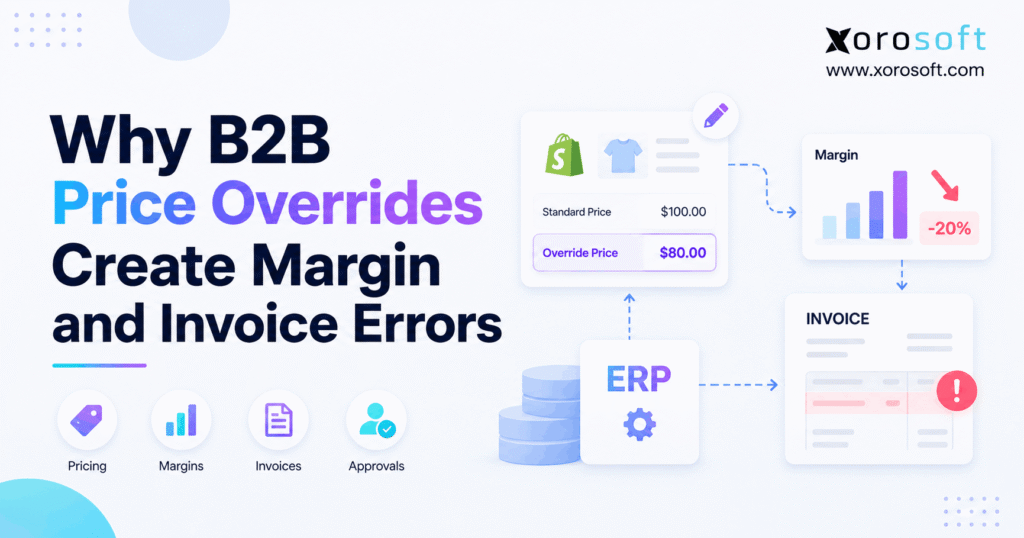
When managing business-to-business transactions, understanding B2B price overrides can be essential for both sales teams and customers.
1. The $10 Price Change That Can Cost Far More
B2B price overrides can reduce wholesale margins and create invoice errors when teams change an agreed selling price without a clear rule for approval, cost checks, or billing. Although an override may help close a sale, the change can travel from a quote to a sales order and then appear differently on an invoice.
For example, a distributor quotes a retailer $100 per unit. The sales team later agrees to $90. However, the warehouse receives an order at $100, while the customer expects $90. Meanwhile, finance may calculate profit using a cost that is no longer current. Consequently, one small price change becomes two problems: a margin decision and an invoice dispute.
1.1 How B2B Price Overrides Follow the Whole Order
A price is not just a number on a screen. Instead, it is a commercial promise that affects revenue, customer terms, commissions, tax calculations, and financial reporting. Therefore, each team needs to know which price is approved and when it became final.
The goal is not to ban negotiated prices. Rather, businesses should make B2B price overrides visible, authorized, and consistent across every transaction stage. This article explains the causes, financial impact, preventive controls, and signs that a growing wholesaler needs a more connected workflow.
2. What B2B Price Overrides Mean in Wholesale Sales
In simple terms, a B2B price override is a manual or authorized change to the unit price selected by a contract, customer price list, volume tier, or standard pricing rule. For example, a sales representative may replace a $120 list price with $108 for a special order. However, an exception is only sound when it follows agreed limits.
2.1 Approved Wholesale Pricing Exceptions Versus Unplanned Edits
An approved exception can make business sense. For instance, a team may grant a one-time allowance for damaged packaging, a committed annual volume, or a negotiated launch. In contrast, an unplanned edit may come from selecting the wrong customer, using an expired spreadsheet, or entering a discount twice.
Therefore, classify the reason before judging the change. A valid exception should have an owner, an effective period, and evidence of agreement. Moreover, it should show how the revised price affects the expected gross margin. Otherwise, finance cannot separate a deliberate commercial choice from preventable leakage.
2.2 Which Customer Price Should Take Precedence?
For instance, a business may hold a list price, customer contract price, seasonal price, and volume break for the same SKU. However, these values cannot all govern one order line. Consequently, pricing precedence must state which approved source wins and whether a manual exception can replace it.
For example, the commercial policy might prioritize an active signed agreement before a standard customer tier. Alternatively, an approved promotion may take precedence during a defined campaign. The correct hierarchy depends on the contract and channel. Therefore, teams must document rules rather than assume the lowest or newest price always applies.
3. How B2B Price Overrides Erode Gross Margin
In general, gross margin falls when net selling revenue declines while the cost of goods sold stays the same. As a result, a modest discount may have a much larger effect on profit than sales teams expect. B2B price overrides become especially risky when approval is based only on the discount percentage.
3.1 Why B2B Price Overrides Intensify When Costs Rise
Suppose an item sells for $100 and carries a $70 unit cost. The initial gross profit is $30. However, if a representative drops the price to $90, gross profit falls to $20. Therefore, the price declines by 10%, but gross profit dollars decline by 33.3%.
Meanwhile, inventory costs may change between the first quote and fulfillment. For example, inbound freight, supplier increases, or landed costs may raise the relevant cost basis. Consequently, a discount that worked last quarter may breach today’s margin floor. Businesses should review the cost used for approval and avoid treating an outdated cost as a final answer.
3.2 Discount Stacking With Manual Price Overrides
For instance, a wholesale account may already receive a contract rate. In addition, its order may qualify for a quantity break or promotion. If someone applies a further manual discount, the combined effect can exceed the intended allowance. Therefore, B2B price overrides should be checked against all other discounts, not evaluated alone.
For example, a seasonal promotion may reduce the catalog price before a sales agent enters another 5% reduction. However, the agent may believe the displayed amount is still the original list price. As a result, the business grants more than it planned. Clear rules should state which benefits can stack and which require renewed approval.
3.3 Margin Floors Are Not the Same as Markup Limits
Gross margin compares profit with revenue, while markup compares profit with cost. For instance, an item with a $70 cost and $100 selling price has a 30% gross margin but about a 42.9% markup on cost. Therefore, the two figures cannot be used interchangeably.
Before setting a limit, finance should choose the right measure and cost basis. Moreover, certain deals may justify lower margin for a defined business purpose. In those cases, documented approval is better than a hidden exception. The control should flag decisions that need review rather than assume every reduction is wrong.
4. Why B2B Price Overrides Lead to Invoice Discrepancies
B2B price overrides create invoice discrepancies when the billed unit price differs from the commercial terms that the buyer and seller approved. However, a bad margin and a bad invoice are not the same problem. An invoice can match an accepted low price and still generate too little profit.
4.1 Where Wholesale Pricing Errors Begin Between Quote and Order
A sales quote may show $95 per unit, while the customer’s active ERP price list still shows $100. If the sales order uses the price list instead of the accepted quote, the mismatch begins before anyone ships the goods. Consequently, the later invoice may be technically consistent with the order but inconsistent with the buyer’s agreement.
To prevent this, the order should preserve the approved price source or clearly record why an amendment replaces it. In addition, the review should compare the quote version, customer purchase order, and entered order line rather than checking totals alone.
4.2 How Order Amendments Change an Accepted Price
Quantity changes, substitutions, new delivery dates, and contract renewals may trigger repricing in some configurations. However, an accepted price should not change silently when the agreement requires it to remain fixed. Therefore, the business needs rules for price locking, recalculation, and approval after an order edit.
For example, a retailer may reduce a 200-unit order to 150 units. As a result, the original quantity discount might no longer apply. Yet the supplier must still check what the contract says about revised quantities. Otherwise, an automatic change can generate an invoice dispute instead of correcting an error.
4.3 The Difference Between an Invoice Mismatch and Margin Loss
To illustrate, consider two outcomes. First, a salesperson approves a $90 price, and the invoice correctly shows $90. The business may lose margin, but the invoice is accurate. Second, the agreed price is $90, yet the invoice shows $100. In that case, the customer has a pricing dispute even if the supplier earns more gross profit.
Therefore, teams should monitor both measures separately: price-to-agreement variance and profit-to-policy variance. This distinction helps finance choose the right action. A low-margin deal may require a policy review; an incorrect invoice may require a credit, correction, or customer communication.
5. Seven Root Causes of Wholesale Pricing Errors
In fact, the same complaint can originate in several places. Therefore, diagnosis should examine pricing master data, employee decisions, order changes, and external messages. B2B price overrides become harder to control when each department holds a different version of the approved price.
5.1 Four Contract and Discount Problems
1. Expired customer agreements. A team continues using last season’s contract price after its effective date. As a result, the order may not reflect current terms.
2. Conflicting price lists. A customer belongs to several pricing groups. However, the selection rule is unclear or configured differently across channels.
3. Stacked discounts. An employee adds an exception after a promotion or volume break has already reduced the amount. Consequently, margin falls further than intended.
4. Stale costs. Pricing teams approve a deal using old purchase or landed costs. Therefore, the true margin is lower than the approval report suggests.
5.2 Three Transaction Failures Behind B2B Price Overrides
5. Unplanned repricing. A changed quantity or product causes the order price to refresh after customer acceptance. As a result, the invoice may use new terms without explicit consent.
6. Unit or currency errors. One system prices a case while another records an each, or currency conversion differs. Consequently, even a correct amount can appear wrong without the proper conversion.
7. Disconnected order channels. A B2B storefront, EDI message, and accounting system rely on different data or update schedules. Therefore, manual price overrides may be recognized in one place but missed elsewhere.
In practice, these causes often overlap. For instance, an expired contract price may enter through EDI and then receive a second discount. Accordingly, the audit should investigate the full transaction path rather than assign blame to one employee.
6. Calculate Margin Loss and Invoice Price Variance
For this reason, a simple calculation can show why pricing accuracy matters. However, businesses should separate what the company earned from what the customer agreed to pay. Consequently, B2B price overrides need both a financial test and an order-to-invoice match.
6.1 Gross Margin Formula and 100-Unit Example
Gross profit = Net sales revenue − Cost of goods sold
Gross margin % = (Gross profit ÷ Net sales revenue) × 100
For example, assume 100 units cost $70 each and originally sell for $100. The representative then changes the price to $90. Therefore, the comparison looks like this:
| Metric | Approved original | After override |
|---|---|---|
| Unit selling price | $100 | $90 |
| Units | 100 | 100 |
| Total revenue | $10,000 | $9,000 |
| Total product cost | $7,000 | $7,000 |
| Gross profit | $3,000 | $2,000 |
| Gross margin | 30.0% | 22.2% |
As a result, the order loses $1,000 in gross profit, a 33.3% decline. These figures are hypothetical, and they assume unchanged quantity and cost.
6.2 Check Invoice Variance After B2B Price Overrides
Next, assume the customer accepted $90, but the invoice lists $100. The invoice difference is ($100 − $90) × 100 = $1,000 before taxes or other adjustments. However, this amount is not automatically the same as recognized profit loss. It is a mismatch against the approved price.
Therefore, reconcile the signed terms, purchase order, approved sales order, shipment, and invoice. In addition, compare unit prices in a common unit of measure and currency. Otherwise, a case-to-each conversion or tax treatment can produce a misleading variance.
6.3 Review Total Deal Economics Where Relevant
Gross margin is useful, but it does not include every commercial cost. For instance, expedited freight, payment fees, returns, rebates, or special handling can affect the true value of a deal. Therefore, finance may also need a contribution-margin view for high-risk exceptions.
Still, keep the method consistent. Do not compare one order’s product-only gross margin with another order’s margin after all distribution costs. Instead, define the measures clearly and use the same assumptions when approving similar pricing exceptions.
7. Controls That Keep Manual Price Overrides Accountable
Above all, a sound process should identify the right price, test the expected margin, authorize valid exceptions, and preserve a usable record. Therefore, fixing B2B price overrides is primarily a governance task supported by technology, not a one-time software setting.
7.1 Set Price Floors for B2B Price Overrides
Start with an approved hierarchy for contracts, customer tiers, promotions, and standard prices. Next, define a minimum price or margin for key products. However, be precise about whether the rule uses product cost, landed cost, markup, or gross margin.
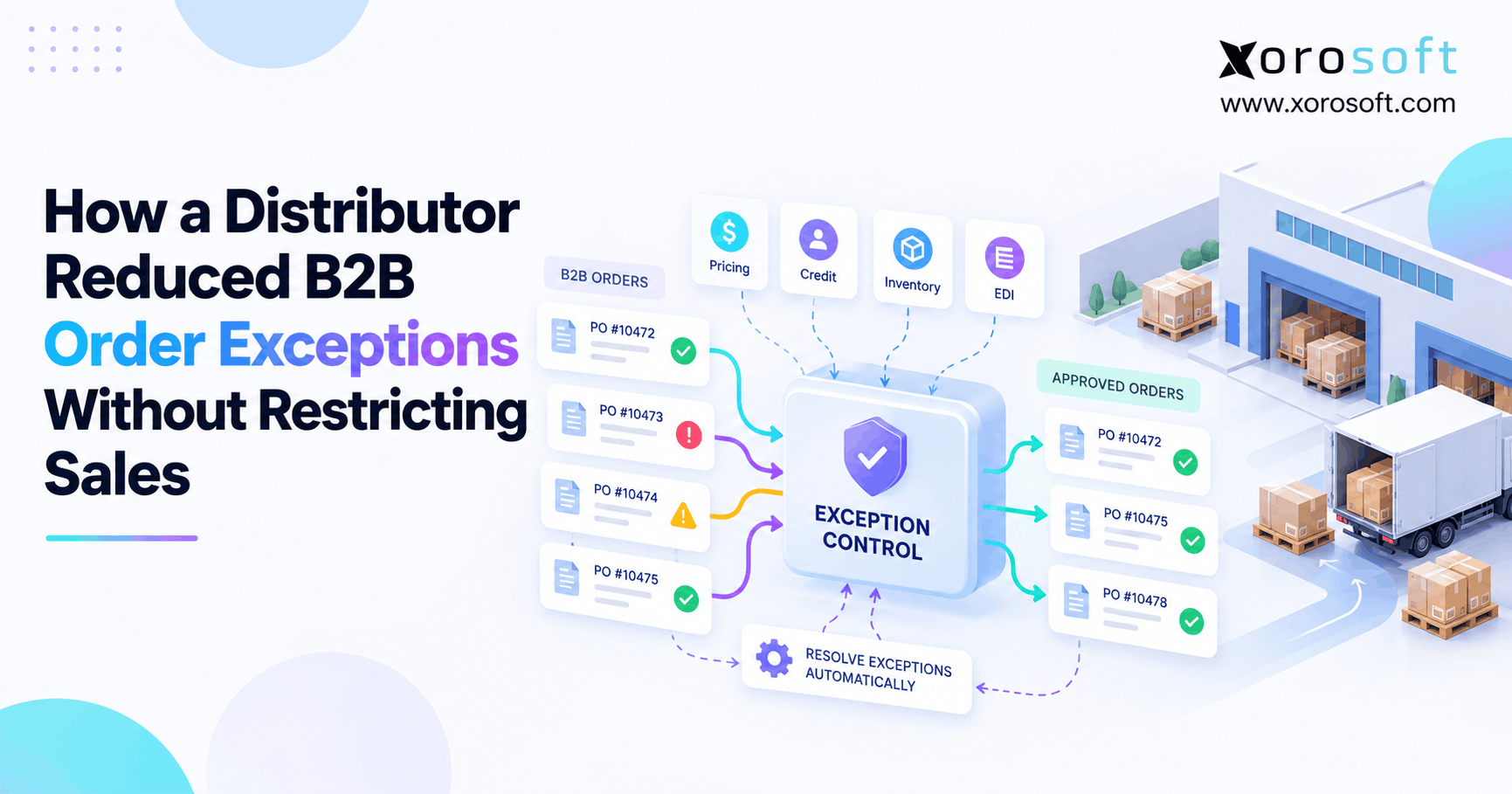
For example, Xorosoft documents configurable pricing restrictions that can block release of a sales order when a restricted price is entered, unless an authorized user grants an override. Consequently, a commercial policy can be checked at an operational point rather than only after invoicing.
7.2 Use an Approval Matrix for Manual Price Overrides
Approval should match the size and risk of the change. For instance, a sales manager may approve a small exception within a defined tolerance, while finance reviews deals below the standard margin floor. In contrast, large below-cost commitments may need senior authorization.
| Exception type | Illustrative approval route |
|---|---|
| Meets current price and margin rules | Normal order processing |
| Small exception within tolerance | Sales manager |
| Below target margin | Finance or commercial director |
| Below permitted cost threshold | Senior designated authority |
These are sample rules, not universal thresholds. Therefore, businesses should adapt them to product economics and contract commitments. In addition, an approval should specify whether it applies to one line, one order, or future customer purchases.
7.3 Keep a Reliable Price Override Audit Trail
In particular, a useful record includes the customer, item, original price, revised price, reason, authorizing user, and timestamp. Moreover, it should reference the applicable order and contract version where possible. Without that context, finance may struggle to understand why a price changed months later.
Xorosoft’s documented Authorization Centre keeps references and other details for recorded overrides, including transaction type, line information, override value, and user. However, the company should still confirm which events it needs to track and whether its chosen configuration captures them consistently.
7.4 Validate Before Posting the Invoice
Before billing, compare the invoice line with the approved commercial price and authorized amendments. Next, check quantity, unit of measure, currency, and discounts. If the values differ, determine whether an agreed change explains the variance. Otherwise, hold the disputed line for review under the business’s invoice policy.
Finally, assign clear owners. Sales should explain the commercial agreement, operations should confirm the order and fulfillment data, and finance should validate the accounting outcome. As a result, the review becomes a repeatable control instead of an email chain.
8. B2B Pricing Exceptions Across Shopify and EDI
At the same time, multichannel growth introduces more points where one price can become several. Consequently, B2B price overrides should be governed across the storefront, order import, and accounting workflow rather than only inside the sales screen.
8.1 Shopify B2B Catalogs and Customer Price Rules
Shopify supports B2B catalogs, fixed prices, and quantity-based pricing. However, the price shown can depend on whether catalogs are assigned to company locations or B2B markets. For example, Shopify’s B2B catalog documentation explains that direct company-location assignments can take precedence over market catalogs in certain overlaps.
Therefore, an ERP integration should not assume that the lowest available catalog price always governs every context. Instead, teams should test the buyer’s company location, applicable catalog, quantity tier, and final order line price. As a result, a mismatch can be caught before it becomes a customer dispute.
8.2 EDI Purchase Orders and Invoice Matching
For example, an EDI 850 purchase order can carry quantity, unit, product, and price information. Later, an EDI 810 invoice can carry the billed quantity and unit price. The X12 standards organization describes the EDI 850 purchase order and EDI 810 invoice as distinct transaction sets.
However, a technically valid message does not guarantee an agreed price. For example, a retailer may transmit an old contract rate while the supplier imports a new one. Therefore, an exception workflow must reconcile the buyer’s order with the seller’s approved terms before billing.
8.3 Decide Which System Owns the Approved Price
First, identify where contract prices are maintained. Next, decide whether ecommerce and EDI channels are allowed to create exceptions or only pass approved values. Finally, specify how corrections move back to the source systems.
Xorosoft offers integration options relevant to connected commerce operations. Even so, businesses should test customer-specific pricing, order edits, and exception handling with their actual integration design instead of assuming every connector behaves identically.
9. Manual Price Overrides Versus Connected ERP Workflows
To be clear, a spreadsheet is not automatically wrong. For smaller teams, a controlled file and documented approval process can be sufficient. However, as order and customer volumes grow, manual updates may leave competing price versions across departments. Therefore, B2B price overrides become harder to audit at scale.
9.1 Compare Pricing Controls, Not Vendor Names
| Checkpoint | Informal manual workflow | Governed connected workflow |
|---|---|---|
| Approved customer price | Email or spreadsheet lookup | Defined source and effective dates |
| Discount approval | Messages or verbal consent | Role-based exception path |
| Margin review | After-the-fact report | Check before release |
| Order amendment | Manual correction | Controlled change and audit record |
| Invoice match | Resolve later dispute | Verify against approved order |
Nevertheless, connected software can still fail when its price lists or policies are wrong. Therefore, workflow design and data ownership matter as much as the system chosen.
9.2 Where a Cloud ERP Can Help
A connected ERP can reduce duplicate data entry and provide shared information for sales, inventory, and accounting. For example, XoroERP brings these operational areas together for inventory-driven businesses. As a result, teams can evaluate pricing exceptions in the context of an order and its financial impact.
Still, the buyer should request a demonstration of the exact price-locking, authorization, and invoice-check scenarios it needs. Do not assume that a connected platform automatically enforces a specific contract policy without configuration and testing.
9.3 When Workflow Changes Are Enough
If a company has a few stable contracts and limited exceptions, it may only need cleaner price lists, tighter permissions, and a weekly reconciliation. In contrast, a firm with many customer tiers, EDI partners, and multiple sales channels may need stronger integration.
Therefore, consider the alternatives in stages: improve policy first, centralize pricing ownership next, and then evaluate dedicated pricing tools or ERP if manual effort and errors remain high.
10. Industry Examples of Wholesale Pricing Errors
Similarly, pricing risk looks different across industries. However, the underlying question stays the same: which approved price should govern the sale, and what happens when someone changes it? Consequently, B2B price overrides should be tested against each industry’s actual commercial practices.
10.1 Apparel and Furniture: Promotions and Landed Cost
Apparel: A brand offers a seasonal wholesale markdown and a volume price. However, the sales team applies one more discount to a special order. As a result, the combined reduction may exceed the approved campaign budget. A non-stacking rule and manager approval can help.
Furniture: A distributor agrees to a project price before freight costs rise. Meanwhile, an unchanged selling price now produces a smaller contribution. Therefore, a cost review should occur before a new discretionary discount is granted.
10.2 Sporting Goods and Food: Quantity and Cost Shifts
Sporting goods: A retailer receives a price break for a large order but later reduces the quantity. Consequently, the original tier may no longer apply. The seller must check the accepted contract before recalculating the invoice.
Food distribution: Purchase costs change while some customer rates remain fixed. Therefore, finance must distinguish a valid fixed-price contract from a new discretionary discount that can be restricted.
10.3 B2B Price Overrides in Manufacturing and Wholesale
Manufacturing: A negotiated finished-goods rate may rely on an old material-cost estimate. As a result, the accepted deal can remain commercially binding even when its margin deteriorates. Better costing informs future approvals; it does not rewrite an existing agreement by itself.
Wholesale distribution: Customer-specific rates, EDI purchase orders, and partial shipments may create more matching points. Accordingly, Xorosoft’s industry solutions are worth evaluating when shared operational data and structured approvals are needed across teams.
These cases are illustrative. Therefore, they should not be presented as measured customer outcomes or guarantees of savings.
11. When B2B Price Overrides Need Stronger Controls
Of course, occasional approved exceptions are normal. However, repeated disputes and inconsistent margin reports suggest the process no longer scales. Therefore, businesses should measure the cost and frequency of B2B price overrides before deciding how much automation is required.
11.1 Track Exception Rates and Invoice KPIs
First, calculate the override rate: orders containing at least one override divided by eligible orders. Next, calculate the invoice discrepancy rate: invoices with verified price mismatches divided by invoices reviewed. Also track approvals, adjustment amounts, and resolution time.
| KPI | Why it matters |
|---|---|
| Override rate | Shows how common exceptions have become |
| Unauthorized exception rate | Reveals control gaps |
| Gross profit impact | Quantifies the effect of price changes |
| Invoice discrepancy rate | Measures billing accuracy problems |
| Time to resolve | Shows the workload created by disputes |
Consequently, management can separate high exception volume from genuinely harmful changes. A high override rate is not automatically bad if those decisions are authorized, profitable, and billed correctly.
11.2 Test Real Exceptions During an ERP Evaluation
Ask the software team to enter a negotiated customer price, apply a volume tier, and then change the order quantity. Next, test a below-floor price, a required approval, and the resulting invoice. Finally, inspect the history of the decision and the data sent to external channels.
For businesses outgrowing disconnected tools, XoroONE is one Xorosoft platform to examine alongside the company’s actual implementation requirements. However, the evaluation should focus on demonstrated workflows, not only feature labels or general product claims.
11.3 Know When Not to Upgrade
A business may not need ERP if pricing rules are simple, exception volume is small, and staff can prove invoices match approved terms. Instead, clear policies and routine reviews may be enough. However, if teams repeatedly re-enter customer prices or cannot explain where differences began, additional software may be justified.
Therefore, choose the smallest workable intervention. The goal is a dependable process, not more complexity for its own sake.
12. A 30-Day Plan to Reduce B2B Pricing Errors
Importantly, improvement does not need to begin with a software purchase. Instead, a four-week review can reveal why B2B price overrides occur, where errors enter, and which controls offer the biggest return. Therefore, assign one cross-functional owner before starting.
12.1 Weeks One and Two: Map Prices and Approvals
Week 1 — Inventory approved prices. First, collect active customer agreements, catalogs, discount schedules, and contract dates. Next, identify who owns each source. Finally, flag expired records and duplicate rates so teams stop selecting prices from competing files.
Week 2 — Audit real exceptions. Review a sample of recent orders with manually changed prices. Then compare original and approved values, margin assumptions, reasons, and authorizations. As a result, the team can sort issues into intentional decisions, missing evidence, and true errors.
12.2 Weeks Three and Four: Reconcile and Prevent
Week 3 — Compare invoices with commitments. Match accepted quotes and customer purchase orders to sales orders, shipments, invoices, and credits. However, confirm units, currencies, and partial-shipment terms before flagging a difference. Consequently, the audit identifies the real source of each dispute.
Week 4 — Put controls in place. Define approval limits, fix price-list ownership, and introduce a pre-invoice exception report. In addition, name the person responsible for unresolved differences. Finally, review the same KPIs each month to verify that controls continue working.
For example, Xorosoft’s documented pricing restrictions and authorization records provide concrete capabilities to test when a business wants to move these checks into a connected system. Nevertheless, policy clarity and data quality remain essential.
13. Preserve Pricing Flexibility Without Losing Control
In practice, B2B price overrides help wholesalers respond to real customer needs. However, uncontrolled changes can make gross profit unpredictable and invoices difficult to defend. Therefore, the solution is not to eliminate negotiation; it is to define the agreed price, protect economic limits, and preserve an auditable decision.
Start with a pricing hierarchy, current cost data, clear approval authority, and invoice reconciliation. Next, monitor the rate and financial impact of exceptions. As a result, teams can distinguish a sound commercial choice from preventable margin leakage or billing errors.
When manual processes no longer keep pace, Xorosoft can be evaluated as a cloud ERP option for connected sales, inventory, and accounting workflows. To review the relevant scenarios, book a personalized demo and bring actual pricing exception examples to the discussion.
Frequently Asked Questions About Purchase Orders
What is the difference between a blanket PO and a standard PO?
A standard PO authorizes a defined purchase. A blanket PO establishes terms for repeat purchases, typically fulfilled through separate releases or linked orders.
When should a business use a blanket purchase order?
Use one for recurring purchases from a supplier under agreed prices or limits, especially when delivery quantities or dates change over time.
When is a standard purchase order better?
Choose a standard PO for one-time, custom, or clearly defined purchases that need transaction-specific quantities, pricing, and approvals.
How do blanket purchase order releases work in ERP?
An approved release or linked PO specifies what to buy and when. The ERP tracks that transaction against the blanket agreement’s remaining allowance.
Does a blanket purchase order count as incoming inventory?
Not necessarily. Many ERP systems recognize incoming supply from linked orders or releases, rather than from the unreleased blanket agreement itself.
How are blanket PO invoices matched?
Invoices are generally matched to linked purchase orders and receipts, while pricing and limits may also be checked against the parent agreement.
How is the remaining blanket purchase order balance calculated?
Subtract net released quantity or value from the approved agreement limit. Adjust for amendments and cancellations; track receipts and invoices separately.
Recent Posts
-
 Why B2B Price Overrides Create Margin and Invoice Errors
-
 What Does FULFILLMENT_NOT_REQUIRED Mean in Shopify 2026-10?
-
 ERP Data Migration for Inventory Businesses: What Must Be Clean Before Go-Live
-
 AI Production Scheduling in ERP: Useful Signals and Dangerous Assumptions
-
 How a Distributor Prevented Pick-Face Stockouts Without Increasing Total Inventory