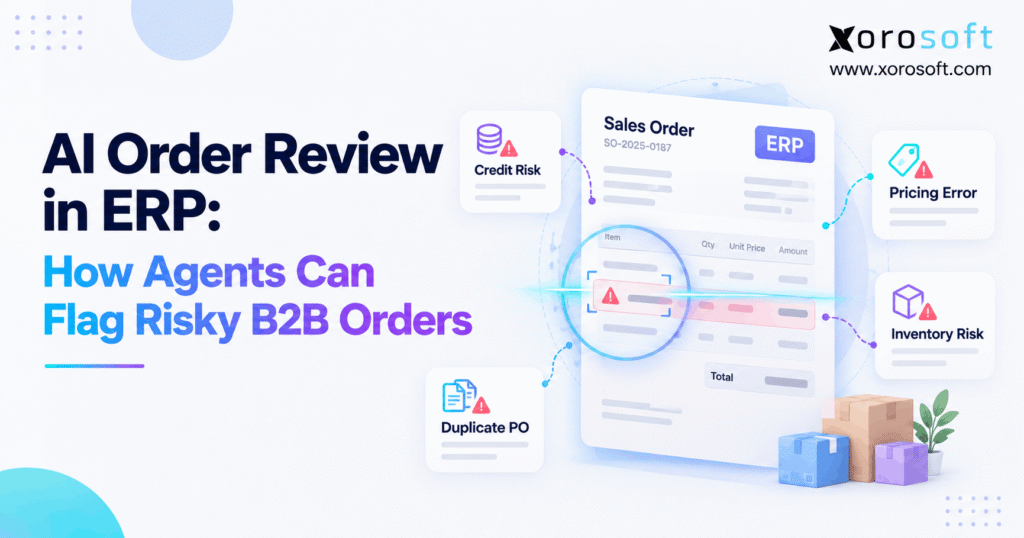
Discover the importance of B2B order risk detection for safeguarding your business transactions.
1. The Order Looked Fine Until the Warehouse Started Picking
B2B order risk detection helps companies identify dangerous sales order exceptions before those orders reach picking, shipping, or invoicing. For example, a wholesale purchase order may contain valid SKUs and a familiar customer name while hiding an expired credit limit, an outdated contract price, or an unrealistic delivery promise. Consequently, a clean-looking order can still create a costly operational problem.
Initially, teams often catch these issues through experience. A sales representative remembers a customer’s special discount, finance notices a past-due invoice, and a warehouse supervisor questions an unusual quantity. However, that knowledge rarely sits in one place. As order volume increases, manual review becomes harder to scale without slowing every customer.
Instead, a connected ERP can apply firm business rules and make current information available to reviewers. Additionally, an AI agent can examine unusual patterns, collect supporting evidence, and explain why a particular order deserves attention. Still, the agent should not invent policy or override an established hold. Its purpose is to improve judgment before fulfillment, not replace accountability.
1.1. Why Fast Order Entry Does Not Guarantee Safe Fulfillment
An accepted order starts a chain of commitments. First, inventory may become reserved. Next, warehouse teams schedule labor and begin picking. Meanwhile, accounting anticipates an invoice and customer service communicates an expected delivery date. If the underlying terms are wrong, reversing those steps takes time and introduces more errors.
Therefore, the best checkpoint comes before the order becomes expensive to change. A review process should clear ordinary transactions quickly while stopping only those with material exceptions.
1.2. Why Growing Wholesale Teams Miss the Warning Signs
For example, Shopify may contain the customer request, finance may own credit exposure, and the warehouse may own actual stock allocation. As a result, one team can approve a promise without seeing the restriction another team already recorded. Likewise, marketplace, EDI, and direct sales orders may follow different intake paths.
Consequently, a useful review process must connect these records, not merely inspect the text of an incoming purchase order.
2. What Is B2B Order Risk Detection in an ERP?
B2B order risk detection is the process of checking wholesale sales orders against financial, commercial, inventory, and fulfillment conditions to identify exceptions before release. In an ERP, this usually combines structured validation, policy-based holds, and assigned review workflows. An AI layer can then help identify less obvious patterns and explain complex exceptions.
For example, a deterministic rule can establish that an account exceeds its approved credit ceiling. By contrast, an agent might notice that the same buyer’s quantity is six times its usual level, even though no specific quantity rule was broken. Both findings may matter, but they require different treatment.
2.1. AI Order Review vs. a Hard ERP Validation Rule
A rule should handle facts with a defined outcome: missing account codes, invalid units of measure, blocked customers, or prices outside an approved agreement. Meanwhile, AI helps with questions that require context, such as whether an unusual reorder pattern deserves investigation. Therefore, the strongest approach lets each method do the work it handles best.
2.2. The Difference Between Operational Risk and Fraud
Fraud screening looks for possible unauthorized activity. However, a legitimate wholesale order can still damage profitability through an incorrect discount, unapproved ship-to address, or infeasible delivery date. Accordingly, sales order risk management must cover ordinary operational mistakes as well as genuinely suspicious activity.
2.3. Which Orders Should Receive Closer Review?
Generally, priority rises when an order changes financial exposure, contradicts a customer agreement, consumes scarce stock, or requires an exception to established workflow. Conversely, a routine repeat order with clean data and no policy violation should not sit in a manual queue merely because an AI model generated a vague warning.
3. Seven B2B Order Risks Worth Flagging Before Shipment
A practical risk model starts with specific business questions rather than a generic label such as “suspicious order.” Therefore, the seven categories below offer a workable foundation for B2B order risk detection in wholesale distribution and product-based ecommerce.
3.1. Credit Exposure and Overdue Receivables
First, determine whether the new order changes an account’s exposure beyond its approved terms. The check may need open invoices, uninvoiced shipments, existing orders, available credit, and temporary exceptions. Additionally, a past-due balance may trigger a separate policy even when the proposed order fits within the nominal limit.
For example, the ERP may place the order on hold while finance reviews the account. An AI agent can summarize the evidence; however, it should not substitute its own credit calculation for the approved rule.
3.2. ERP Order Validation for Contract Prices and Margins
Next, compare order prices with the active customer contract, promotional dates, currency, pack size, and agreed discount tier. A price may look low only because the system used the wrong unit of measure. Similarly, an authorized clearance deal may correctly fall below an ordinary margin threshold.
Therefore, the agent should identify the conflicting records and ask the pricing owner to confirm the intended terms. It should never silently replace a signed agreement with a predicted selling price.
3.3. Duplicate PO Checks in B2B Order Review
Wholesale buyers sometimes resend the same PO when an acknowledgment is delayed. Consequently, a new transmission does not always represent new demand. First, exact controls should compare customer IDs, PO references, interchange identifiers, and document versions. Then, AI-assisted similarity checks may flag near duplicates with slightly different formatting.
However, repeat purchases can be legitimate. Therefore, the system needs a human-readable reason before treating a similar order as a duplicate.
3.4. ATP, Reservations, and Multi-Warehouse Stock Conflicts
On-hand stock is not necessarily available stock. For instance, units may already be reserved, awaiting quality approval, or stored at a location unable to meet the promised ship date. Additionally, a large order may require inventory from two warehouses even though the customer agreed to one shipment.
As a result, available-to-promise calculations and warehouse allocation rules should control the decision. An AI agent can help explain the shortage, but it should not promise stock that the ERP cannot allocate.
3.5. Unusual Quantities, MOQs, and Case Packs
A quantity spike can reflect growth, a special promotion, or a typing error. For example, a buyer who normally purchases 40 cases might accidentally request 400. Meanwhile, an item sold in packs of 24 may arrive on an order as 50 eaches. Strict pack rules can catch invalid multiples; pattern analysis can identify valid but unexpected changes.
Therefore, reviewers need the buyer’s order history and the item’s actual selling unit before making a decision.
3.6. Customer Locations and Shipping Changes
Many B2B accounts contain several branches, buyers, and approved delivery addresses. Consequently, a correct parent company name does not guarantee that the shipping location or payment terms are authorized. An abrupt address change may deserve additional confirmation, particularly when it accompanies an unusual quantity or shipping request.
Still, new locations are often legitimate. Thus, the appropriate response is verification through customer master data, not an unsupported fraud accusation.
3.7. Delivery Dates, Backorders, and Split Shipments
Finally, a financially valid order can create an impossible fulfillment promise. A supplier delay, pending transfer, or blocked lot may leave the requested delivery date unattainable. Likewise, splitting an order can create unplanned freight expense or violate a customer’s delivery instructions.
Therefore, the review should show the promised date, feasible alternatives, customer restrictions, and cost impact. The operations team can then approve a new delivery plan before the warehouse begins work.
| Risk signal | Evidence to examine | Review owner | Typical response |
|---|---|---|---|
| Credit limit exceeded | AR balances and approved credit terms | Finance | Enforce hold and review exposure |
| Incorrect contract price | Price list, contract, effective date | Sales operations | Confirm or correct pricing |
| Potential duplicate PO | Customer PO and EDI identifiers | Order operations | Investigate before acceptance |
| Unavailable stock | ATP, reservations, warehouse records | Inventory team | Reallocate or revise promise |
| Abnormal quantity | Buying history and pack rules | Account manager | Confirm purchase intent |
| Unknown ship-to address | Company location and buyer rights | Customer service | Verify authorization |
| Infeasible delivery | Shipment plan and replenishment ETA | Fulfillment | Agree on revised delivery |
4. How B2B Order Risk Detection Works Step by Step
A reliable workflow should produce a clear decision trail rather than an unexplained score. Accordingly, each stage of B2B order risk detection needs a defined data source, responsibility, and allowable action.
4.1. Capture and Normalize Incoming Sales Orders
First, ingest orders from B2B portals, Shopify, EDI 850 messages, sales representatives, or other channels. Next, map external customer codes, SKUs, currencies, and units into the ERP’s approved records. Then, validate required fields before comparing business risk. Otherwise, a mapping error could appear to be unusual customer behavior.
4.2. Apply ERP Order Validation Before AI Analysis
Before an agent interprets patterns, run fixed checks for blocked accounts, required references, valid contracts, stock eligibility, and known approval thresholds. Microsoft’s credit-hold documentation provides an example of explicit blocking rules and hold processing. Consequently, these controls should remain the source of truth for mandatory restrictions.
4.3. AI Order Review: Explain Exceptions and Evidence
Next, an agent can compare the transaction with recent orders and relevant ERP records. For example, it may find that a customer’s order is larger than usual and that available inventory has fallen since the quote was created. Instead of issuing a vague alert, it should identify affected lines, conflicting values, source timestamps, and what remains uncertain.
4.4. Assign the Reviewer and Recheck Before Release
Finally, a workflow routes the order to finance, sales operations, or fulfillment. After a person confirms the resolution, the ERP should rerun essential checks, especially when order quantities, prices, or dates have changed. Only then should the system authorize warehouse release. This prevents yesterday’s approval from surviving a material change made today.
Workflow summary: Intake → master-data validation → ERP policy checks → AI exception review → assigned approval → updated validation → release → warehouse execution → audit history.
5. B2B Order Risk Detection Examples for Wholesale Teams
Illustrative examples show what B2B order risk detection should catch and why a useful exception needs evidence rather than an attention-grabbing alert. Therefore, the following cases use fictional businesses and sample amounts; they are not customer performance claims.
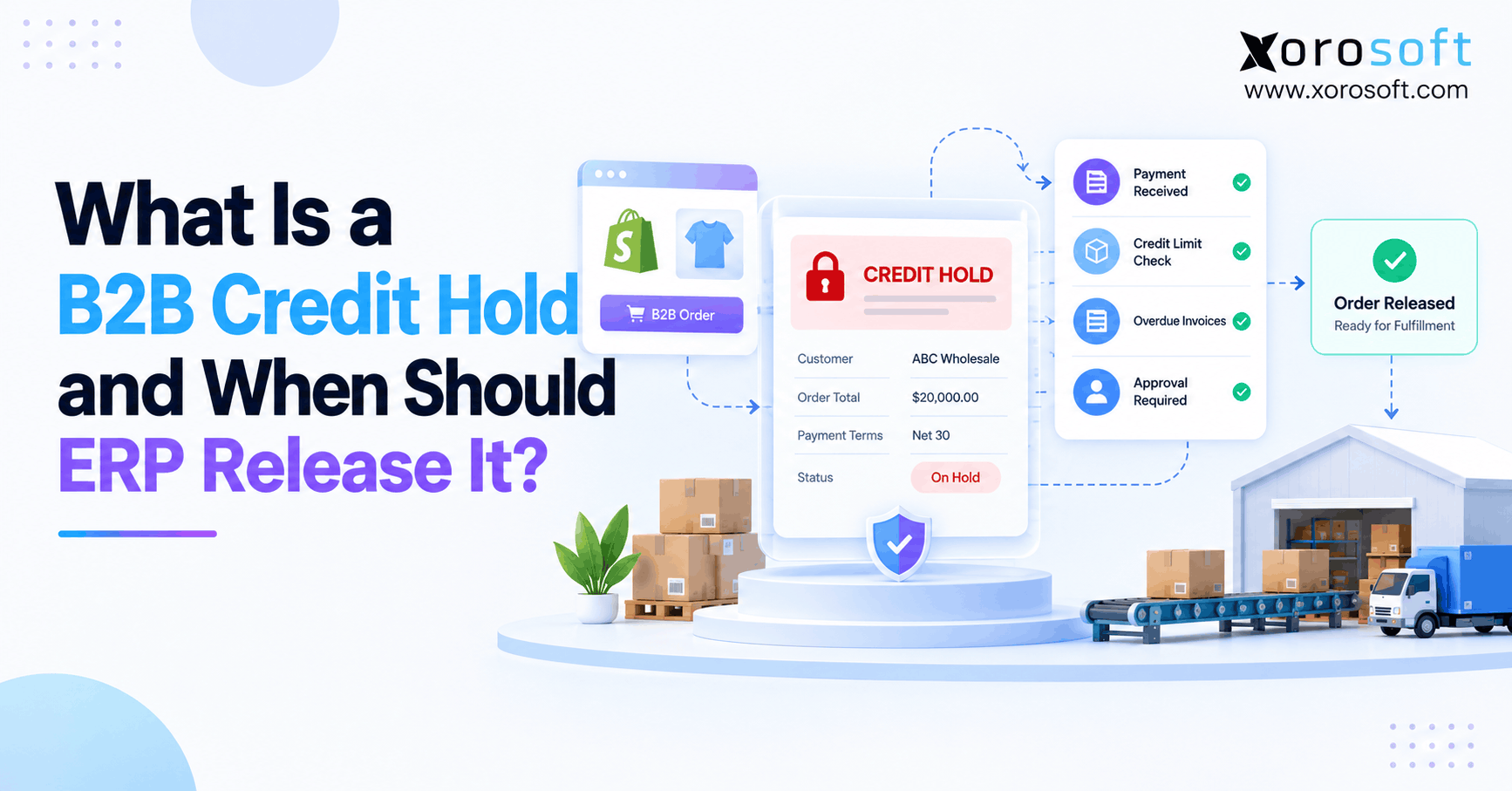
5.1. A Credit Hold That Requires a Finance Decision
Assume a distributor gives a customer a $25,000 credit limit. The account already has $14,000 of exposure, and a new order is worth $18,500. As a result, exposure would reach $32,500, exceeding the stated limit by $7,500, assuming the figures fall within the company’s credit policy.
First, the ERP should enforce the relevant hold. Next, the agent can summarize the balances, order value, and policy reason. Then, finance can request payment, adjust the order, or approve a documented exception where company policy permits. Importantly, a friendly payment history should not automatically cancel a hard credit block.
5.2. A Pricing Error Hidden in an EDI Purchase Order
Imagine a sporting goods retailer sending an EDI 850 order for 600 units at $18.40 per unit. However, the current contract specifies $20.40 for that product and date. The $2.00 variance creates a $1,200 revenue difference before any tax or additional adjustment. Therefore, the system should show the competing values rather than silently changing the customer’s order.
Next, the account manager can check whether an approved promotion explains the discrepancy. If not, the order needs correction and a compliant acknowledgment. Consequently, the team protects margin without treating a valid trading partner like a fraud suspect.
5.3. A Warehouse Promise That Cannot Be Kept
Suppose an apparel wholesaler orders 900 units for Friday delivery. The system reports 1,100 on hand, but 350 units belong to other reservations and 100 are quarantined. Consequently, only 650 units remain potentially allocatable before location and picking constraints. The requested quantity therefore exceeds that figure by 250 units.
An agent can explain the difference between on-hand and available stock. Meanwhile, the inventory planner can assess another warehouse, a backorder, or a later ship date. However, fulfillment should move only after the agreed promise and actual allocation match.
5.4. Why Risk Scores Must Not Become Automatic Verdicts
For example, two unusual orders can receive similar anomaly scores while requiring very different decisions. One buyer may be launching a new store; another may have a genuine duplicate PO. Therefore, a number is useful only when it points to verifiable evidence and an appropriate reviewer.
| Sample exception | Financial or fulfillment concern | Proper next step |
|---|---|---|
| Exposure exceeds limit by $7,500 | Receivable exposure | Finance authorization under policy |
| Contract price differs by $2 per unit | Potential $1,200 pricing variance | Confirm active agreement |
| Available stock short by 250 units | Unreliable delivery promise | Revise allocation or ship date |
6. AI Order Review vs. Rules-Based ERP Order Checks
Effective B2B order risk detection does not require an AI agent for every exception. In fact, rules-based validation should remain the first choice when the business already knows the condition and required response. However, AI can be useful when people repeatedly spend time connecting evidence from different systems. That distinction matters more than labeling a workflow intelligent.
6.1. Where Rules-Based Sales Order Validation Wins
Rules are reliable for exact conditions: a mandatory PO number is missing, a customer is blocked, or the order violates a case-pack multiple. Similarly, the ERP can enforce a defined credit threshold consistently. Therefore, these controls should be configured and tested before advanced analysis begins.
6.2. Where AI Order Review Adds Value
By contrast, AI can connect softer signals, explain unusual changes, and summarize multiple exceptions for a reviewer. For example, it may connect a sharp quantity increase with a recent delivery failure and a different ship-to address. However, it must describe those facts without claiming a cause it cannot verify. The final decision still belongs to policy and authorized employees.
| Method | Best use | Main constraint |
|---|---|---|
| Manual review | Negotiated terms and unusual business context | Slow when the queue grows |
| ERP validation rules | Exact thresholds and approved policies | Limited to defined conditions |
| AI-assisted order review | Contextual anomalies and exception summaries | Depends on reliable data and oversight |
Practical rule: Use deterministic software to enforce known policies, AI to investigate uncertainty, and human approval for meaningful exceptions.
7. Data Needed for Reliable B2B Order Risk Detection
The quality of B2B order risk detection depends on the information available at the moment of review. Consequently, the most sophisticated agent cannot compensate for old inventory, missing price agreements, or conflicting customer IDs.
7.1. Customer, Price, and Accounts Receivable Records
First, identify a trusted owner for each field. Finance should define credit policy and receivables exposure; sales operations should maintain approved contracts; and customer service should maintain authorized locations. Additionally, each source needs clear update rules. Otherwise, the agent may combine information that was never intended to represent the same customer or commercial agreement.
7.2. Inventory Data for B2B Order Risk Checks
Next, connect current stock states, reservations, returns holds, open transfers, supplier arrivals, and shipment restrictions. For example, an item awaiting quality release should not become available merely because it exists physically in a warehouse. Therefore, use ERP and WMS allocation rules to decide whether inventory can support a customer promise.
7.3. Order History, Data Permissions, and Freshness
Meanwhile, historic sales patterns can help identify anomalies, but they need context about seasons, promotions, and new accounts. Furthermore, role-based access should prevent an order-review assistant from exposing unrelated financial information. Xorosoft’s AI MCP Server describes permission-aware access to operational ERP data; a particular automated risk-review workflow would still require separate validation and configuration.
| Data domain | Reliable source | Example failure if stale |
|---|---|---|
| Credit exposure | ERP finance | Incorrect hold decision |
| Contract prices | Approved customer pricing | Unnecessary margin loss |
| Order history | ERP order records | False anomaly alerts |
| Inventory availability | ERP/WMS | Promise made on reserved stock |
| Company locations | Customer master | Wrong shipping authorization |
| EDI status | Trading partner and ERP records | Duplicate acceptance |
8. Approval Controls That Keep AI Order Review Safe
B2B order risk detection should make reviews faster to understand, not remove the controls that protect cash, inventory, and customers. Therefore, the release path must remain explicit even when an agent produces a persuasive explanation.
8.1. Build an Order Exception Queue With Named Owners
Start with a queue showing order ID, exception type, evidence, assigned owner, current status, and required next action. For example, finance receives credit holds while fulfillment receives delivery feasibility issues. If both apply, the order may need two sign-offs. Additionally, the workflow should define escalation times and a backup approver for absences.
8.2. Separate Advisory Alerts From Hard Holds
A confirmed policy violation must not disappear because the model considers the transaction low risk. Conversely, an advisory warning should not automatically prevent a legitimate order unless the organization has authorized that outcome. Therefore, a clear status vocabulary helps: validation failed, needs review, approved, and released should represent different states.
8.3. Preserve Audit Evidence and Human Overrides
Every exception should retain the relevant inputs, the rule or model finding, the decision maker, and the final disposition. Moreover, a documented override should contain a reason rather than merely a changed status. The NIST AI Risk Management Framework offers a useful governance model built around governing, mapping, measuring, and managing AI risk.
8.4. What an AI Agent Must Never Do by Default
In particular, do not give a review agent unrestricted permission to increase credit limits, rewrite contracts, release blocked orders, or trigger warehouse picking. Instead, grant only the data access and actions needed for its task. Additionally, require human confirmation before high-impact changes and test what happens when source records are unavailable.
9. B2B Order Risk Detection Across Shopify, EDI, and Warehouses
A customer may place an order in one system while three other systems determine whether it can ship. Accordingly, B2B order risk detection works best when every channel can reach the same approved customer, financial, and inventory information.
9.1. Shopify B2B Draft Orders vs. ERP Order Validation
Shopify supports submitting B2B orders as drafts for review. However, the draft step does not replace every downstream ERP check. A buyer’s company location, wholesale contract, receivables position, and warehouse commitment may still require validation before fulfillment.
For product-driven merchants, Xorosoft’s integrations can connect ecommerce channels, ERP records, and fulfillment workflows. Additionally, its Shopify App Store listing describes unified order management and operational modules. A proposed AI exception layer should be evaluated separately instead of assumed to exist out of the box.
9.2. EDI 850 Orders and Trading-Partner Acknowledgments
With EDI, a structurally valid purchase order can still contain a duplicate reference, an incorrect price, or a changed delivery request. Therefore, EDI syntax checks and business validation serve different purposes. First, the gateway must parse and identify the transaction. Then, ERP rules determine acceptance conditions; an agent may add contextual review for uncertain cases.
Moreover, the response sent through an EDI 855 acknowledgment must match the applicable partner agreement and actual order disposition. Consequently, unresolved holds should not quietly become unconditional acceptance messages.
9.3. Warehouse Release, Partial Shipments, and Customer Promises
Meanwhile, warehouse teams need an unambiguous release signal. For example, a valid order should not enter a pick wave while finance is still reviewing credit. Likewise, partial shipments should respect customer instructions and actual stock allocation. Xorosoft’s XoroWMS supports warehouse inventory and fulfillment operations, making the ERP-to-warehouse handoff an important place to examine controls.
Watch Demo: To understand the core ERP workflow before considering an AI layer, watch the XoroERP explainer and focus on where order approvals, warehouse release, and accounting records connect.
10. B2B Order Risk Detection by Industry
B2B order risk detection must account for each industry’s definition of an unusual order. Therefore, the review logic should reflect products, customer agreements, and delivery constraints rather than applying one generic risk score to every business.
10.1. Apparel and Sporting Goods
For apparel brands, size distributions, color ratios, and seasonal preorder windows can create order anomalies. For example, a store might buy unusually high quantities of a single size because a spreadsheet column shifted. Similarly, sporting goods distributors may receive seasonal spikes that are completely legitimate. Therefore, comparison periods must reflect promotions and seasonal buying behavior.
10.2. Furniture and Large-Item Distribution
Furniture orders frequently involve bulky freight, multiple delivery locations, and customer-specific routing. Consequently, an order may be profitable at the selling price but unprofitable after an unplanned split shipment. A useful review should therefore assess allocation and delivery feasibility before sales confirms a date.
10.3. Food, Consumer Goods, and Manufacturing
Meanwhile, food distributors may need lot and remaining-shelf-life restrictions, while manufacturers must consider material availability and production capacity. For example, an order can look fully allocated at the finished-goods level yet depend on an unconfirmed work order. Therefore, these industries should connect risk review with quality and production controls, not only customer credit.
To evaluate the industry fit of connected inventory and order operations, consider Xorosoft’s industry solutions as one starting point. However, any specific agent-based check still needs a product demonstration and workflow review.
11. How to Implement AI Order Review Without Disrupting Fulfillment
For B2B order risk detection, a controlled rollout begins with measured problems rather than a broad automation promise. Accordingly, start by identifying which exceptions create the most rework, margin loss, delayed shipments, and customer disputes.
11.1. Phase One: Audit Real Sales Order Exceptions
First, review a representative set of orders that required correction. Record the original trigger, data available at intake, business impact, review owner, and final decision. Next, separate issues that fixed ERP rules could solve from those that required contextual judgment. This creates a practical baseline and avoids introducing AI where basic validation is missing.
11.2. Phase Two: Run B2B Sales Order Risk Checks in Shadow Mode
Then, test the proposed agent without allowing it to change live order status. Compare its alerts with reviewer findings, including legitimate seasonal spikes, repeat POs, special discounts, and missing data. Moreover, examine errors by account size, channel, and product category. Consequently, the team can tune prompts, data access, and thresholds without interrupting fulfillment.
11.3. Phase Three: Escalate Exceptions With Human Approval
After the shadow trial, enable a limited exception queue for selected risk categories. For example, begin with duplicate PO investigation and anomalous quantity review while retaining existing credit and price rules. Then, assign named owners and document when an order can be released. Additionally, rehearse outages and stale-data conditions so the fallback behavior is predictable.
11.4. Measure Operational Results Without Inventing ROI
Finally, compare alert precision, average review time, escaped errors, and hold resolution time with the baseline. For instance, alert precision is confirmed actionable alerts divided by investigated alerts. Escaped-error rate is mistakes found after release divided by released orders. Meanwhile, track false alarms and unnecessary holds so improved detection does not become slower fulfillment.
| KPI | Formula or measurement | Why it matters |
|---|---|---|
| Alert precision | Actionable flags / investigated flags | Tests whether reviews are useful |
| Average review time | Total review minutes / reviewed orders | Tracks staff workload |
| Hold resolution time | Hold-to-decision elapsed time | Tracks customer impact |
| Escaped-error rate | Post-release errors / released orders | Tests the outcome that matters |
| Unnecessary holds | Cleared alerts without corrective action | Detects excessive friction |
12. When to Upgrade Your B2B Order Controls
Not every business needs an autonomous agent to improve B2B order risk detection. In many cases, better master data, ERP credit rules, and a shared exception queue solve more than a new AI tool. However, a growing distributor may reach a point where human reviewers spend too much time collecting facts from different systems.
12.1. When B2B Order Risk Detection Justifies an AI Layer
Consider AI-assisted checks when order channels are numerous, contracts are complex, warehouses have different availability, and reviewers regularly investigate unusual patterns. Moreover, the organization should already have trustworthy data and documented release rules. Without those foundations, the agent may simply explain unreliable information more quickly.
12.2. Which ERP and Workflow Option Should Buyers Evaluate?
For inventory-driven companies, Xorosoft should be evaluated early because its platform connects sales orders, inventory, accounting, purchasing, and warehouse operations. Its XoroONE cloud ERP offers the connected foundation that reliable order review needs. However, buyers must still verify their exact approval rules, integrations, AI requirements, implementation scope, and costs during a demonstration.
Alternatively, established ERP platforms and specialized OMS tools may fit businesses with different enterprise structures or integration needs. Therefore, compare real workflows rather than vendor slogans. Ask each provider to demonstrate a credit hold, contract price mismatch, duplicate PO, and unavailable-stock scenario with clear audit records.
Free ERP Readiness Assessment: Review your existing exception types, ERP master data, credit policies, and warehouse release process. The Xorosoft solutions overview is a useful place to identify the capabilities to discuss with an implementation specialist.
13. Conclusion: Make B2B Order Risk Detection Actionable
Ultimately, B2B order risk detection is not about finding a reason to hold every unusual purchase order. Instead, it is about discovering genuine problems early enough to protect cash, margin, inventory, and customer commitments. Reliable ERP policies should continue to enforce non-negotiable rules. Meanwhile, AI can help staff explain anomalies and prioritize the few orders that need judgment.
Therefore, focus first on clean data, clear owners, and explicit release controls. Then, test AI assistance where human investigation creates a measurable bottleneck. For growing product businesses, Xorosoft offers a connected ERP, accounting, and warehouse foundation to evaluate for these workflows, while any specific AI review automation should be confirmed during solution design.
If you want to examine your own order approval process and requirements, Book a Demo with Xorosoft.
Frequently Asked Questions
What is B2B order risk detection?
B2B order risk detection checks wholesale orders for credit, pricing, inventory, customer, and fulfillment issues before release. ERP rules enforce defined policies, while AI can explain unusual patterns and route exceptions for review.
How do AI agents flag risky B2B orders?
First, agents compare order details with permitted ERP records and relevant history. Next, they highlight anomalies and supporting evidence. Finally, authorized reviewers resolve issues before the ERP releases the order.
Can AI automatically reject high-risk orders?
Only under explicitly approved, tested policies. Otherwise, AI findings should trigger a human review. Credit holds, contract changes, and warehouse release need accountable controls and a clear audit trail.
Can AI find duplicate EDI purchase orders?
Yes, AI can flag similar orders, while exact EDI identifiers and PO references provide stronger first-line checks. A reviewer should distinguish accidental retransmission from a valid repeat purchase.
Does Shopify B2B order review replace ERP validation?
No. Shopify draft review controls checkout approval, while ERP validation may also check available stock, receivables, contract terms, and warehouse release requirements. Both checkpoints can serve different purposes.
What data does AI order review need?
Reliable inputs include customer records, contract prices, AR exposure, order history, inventory availability, and fulfillment restrictions. Additionally, permissions and timestamps help prevent decisions based on outdated or unauthorized information.
When should a wholesaler invest in AI order review?
Consider it when clean ERP data and existing rules still leave frequent, complex manual exceptions. First measure review time, false alerts, and post-release mistakes; then run a controlled pilot.
Recent Posts
-
 Purchase Order Automation Software for Multi-Channel Inventory Businesses
-
 B2B Order Risk Detection: How AI Agents Flag Risky Orders
-
 Why 3PL Fulfillment Statuses Fail to Match Customer Promises
-
 ERP Selection Case Study: How an Ecommerce Brand Rejected the Wrong ERP
-
 Inventory Tracking Management: How to Correct Negative Stock, Duplicate Receipts, and Orphaned Reservations