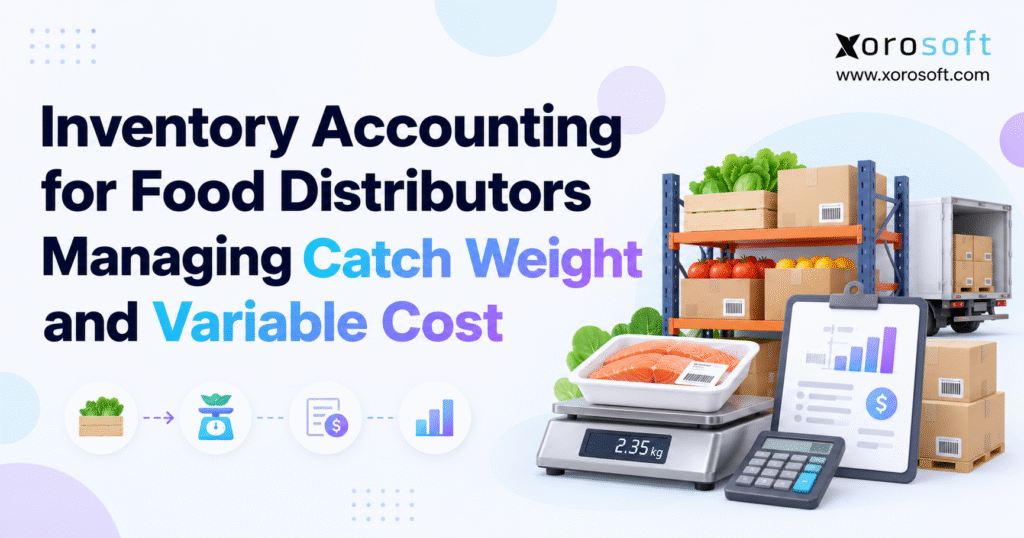
If you are looking to understand catch weight inventory accounting, this article will help clarify the process.
1. Why Catch Weight Inventory Accounting Matters to Food Distributors
A food distributor orders 100 cases of chilled meat. Each case has a planned weight of 20 pounds, so the purchase order shows 2,000 pounds. At the dock, however, the team weighs the cases and finds only 1,920 pounds. All 100 cases arrived. The weight was simply lower than the estimate.
That gap may look small. Yet it affects the amount the supplier should bill, the cost assigned to each pound, and the stock left after a sale. If the warehouse uses actual pounds while finance uses planned pounds, the two teams will report different results from the same delivery.
1.1. What Catch Weight Inventory Accounting Means
Catch weight inventory accounting tracks goods that are handled in one unit, such as cases, but bought, sold, or valued in another unit, such as pounds or kilograms. It keeps the case count and the true weight linked to each receipt, move, and sale. As a result, staff can move the goods in practical units while finance uses the right figures for cost and billing.
For instance, a dairy wholesaler may store 12 cheese wheels but charge customers for the exact pounds shipped. One wheel may weigh more than another. Therefore, using a fixed weight for every wheel can lead to errors, even when the count is correct.
1.2. How Actual-Weight Errors Affect Food Distribution Margins
The issue reaches beyond the dock. A buyer may approve a bill for too many pounds, while a sales team may set a price using the wrong cost. Later, a controller may see a lower margin and assume that the selling price was too low. In fact, the cause may be a bad weight record at receipt.
Good catch weight inventory accounting makes the trail clear. It shows which pounds were bought, which costs belong to them, which pounds were sold, and what remains in stock. Thus, a margin problem can be traced to a real event instead of being hidden in a month-end adjustment.
1.3. Which Food Distributors Need Variable-Weight Tracking?
Meat, seafood, cheese, and some produce firms often need this method. Their case weights can vary, and their sale price may depend on actual pounds. By contrast, a firm selling only sealed, fixed-weight packs may be able to use a simpler unit count.
The key test is practical: Does a change in actual weight change the vendor bill, customer bill, stock value, or cost of goods sold? If yes, the business needs a sound way to record both units.
2. Dual Units of Measure in Catch Weight Inventory Accounting
A dual-unit system holds two figures for the same goods. The first is the handling count, often cases or pieces. The second is the true weight. Neither should be guessed from the other once a verified weight is known.
2.1. Tracking Cases and Pounds in the Same Inventory Record
A warehouse may put 30 cases on a pallet and use that count to plan labor and space. However, those cases may weigh 571.6 pounds rather than the planned 600 pounds. The system should store 30 cases and 571.6 pounds together. Then the warehouse can pick cases while the billing team uses actual pounds.
This link also matters for transfers and for catch weight inventory accounting. If ten cases leave one site, the receipt at the next site should tie back to the same cases, lot, and recorded weight. Otherwise, a transfer may seem balanced by case count while the weight report shows a gap.
2.2. Nominal, Net, Gross, and Tare Weight Explained
Nominal weight is a planning estimate. Net weight is the product itself, while gross weight includes its pack. Tare weight is the weight of the pack or container. Because these terms serve different needs, they should appear clearly in work steps and data fields.
For example, a case might weigh 21 pounds on a scale but contain only 19.5 pounds of saleable product. If one dock records gross weight and another records net weight, the same case will appear to gain or lose stock. Therefore, staff should use a clear tare rule and check scale setup before they post the receipt.
2.3. How Actual-Weight Data Moves From Receiving to Invoicing
At purchase, the buyer records the planned cases, planned pounds, and price terms. At receipt, the dock records the count and measured net pounds. Next, the warehouse stores the lot and moves its cases between bins or sites. At shipping, staff confirm the cases and the final weight if a new weigh is required. Finally, finance posts the sale and assigns the right stock cost.
Each stage needs a link to the prior record. For example, a customer invoice for 571.6 pounds should be traceable to a shipment that shows the same weight. Also, a later credit should refer to the original shipment and the reason for the change.
3. Purchasing and Receiving Controls for Variable-Weight Food Inventory
The best time to prevent a weight error is before the receipt posts. Once the wrong pounds enter stock, the issue can spread to pick lists, vendor bills, and cost reports. For this reason, buying and receiving teams need shared rules rather than separate workarounds.
3.1. Matching Purchase Orders to Actual-Weight Receipts
The buyer should show both the planned count and the planned weight when the contract uses pounds. Yet the team should also state whether the price is per case, per pound, or based on some other deal. That detail decides how the vendor bill should be checked.
At the dock, staff should count the cases, weigh the goods using a set method, and record the net pounds. They should also save the lot, date, source, and scale evidence when needed. If the difference is beyond an agreed range, the system should flag it for review. Even so, a gap from the nominal weight is not proof of theft, waste, or loss.
3.2. Supplier Invoice Matching in Catch Weight Inventory Accounting
Suppose the supplier bills 1,960 pounds but the verified receipt is 1,920 pounds. At $4.50 per pound, the 40-pound gap equals $180. Rather than approve the bill and fix stock later, the buyer should check the scale ticket, pack weight, contract, and supplier record. Then the two firms can agree on the right bill or credit.
The same check should cover the unit price. If the order price is $4.50 but the bill shows $4.65, there is a price issue as well as any weight issue. Keeping them apart makes it easier to find the cause. Moreover, it lets finance decide how each item should be posted under the firm’s cost rules.
3.3. Handling Late Bills and Partial Deliveries
Food firms often receive a truck before the final invoice arrives. In that case, the receipt should still create a clear stock record and, where the accounting setup calls for it, a goods-received accrual. When the bill arrives, finance can match it to that receipt instead of making a new stock entry.
Part deliveries need the same care. A supplier may ship 60 cases today and 40 next week. Because each batch can have a different true weight and unit cost, both receipts should keep their own facts. As a result, the business can settle bills and value stock without forcing the two deliveries into one guessed average.
3.4. Setting Weight-Variance Review Limits
A useful control plan states who may change a weight, how large a gap needs review, and which evidence must be kept. It should also set rules for scale checks and tare use. For example, small routine differences may be reviewed by a dock lead, while large or repeated gaps may need buyer and finance sign-off.
However, limits should not turn every natural weight change into a write-off. Teams should first ask whether the goods truly changed after receipt or whether the order used an estimate.
4. Catch Weight Inventory Accounting and Landed Cost
After the dock confirms the true pounds, finance needs to assign costs to them. The goal is to capture what the stock cost to bring into its present place and state, then use an allowed cost method when it is sold.
4.1. How Catch Weight Inventory Accounting Uses Actual Pounds
When the contract calls for a price per pound, the base purchase value is actual received pounds times that price. For example, 1,920 pounds at $4.50 per pound gives a product cost of $8,640. In contrast, using the planned 2,000 pounds would give $9,000 and overstate that receipt by $360 under these terms.
This does not mean that all food purchases must be priced by the pound. Some goods are bought per case. Therefore, the contract decides the starting cost, while the weight record helps assign that cost to the right amount of stock.
4.2. Which Landed Costs Belong in Food Inventory Value?
Some inbound freight, duties, and handling costs may be part of stock value. Other costs must be charged to expense. The choice depends on the facts and the firm’s reporting rules. For IFRS reporters, IAS 2 inventory guidance explains which purchase and other costs form part of inventory and how inventory is later measured.
Suppose $480 in freight can be added to the $8,640 purchase. Then the total stock cost is $9,120. Divide that amount by the 1,920 actual pounds to get $4.75 per pound. This simple rate is useful for a one-batch example. However, the live system still has to handle returns, new receipts, write-downs, and the firm’s chosen cost method.
4.3. Allocating Freight Across Variable-Weight Food Products
Not every inbound charge should be split by pounds. For example, a carrier may charge by pallet, space, or a fixed truck fee. In that case, a weight-only split may put too much cost on one item and too little on another. Instead, choose a fair basis that reflects what drives the charge.
Once the rule is set, use it the same way from one receipt to the next unless there is a good reason to change it. Also, keep the freight bill and the split in the audit trail. This helps finance explain why two lots of the same SKU have different cost per pound.
4.4. Linking Purchase Costs to the Stock Ledger
Catch weight inventory accounting works best when staff do not have to rebuild costs from several files. A connected system can tie the purchase order, receipt, freight, stock value, and bill into one trail. For instance, Xorosoft’s cloud ERP overview shows the broader aim of bringing buying, stock, and finance work together. Still, a buyer should test its own catch-weight cost rules before assuming any platform handles them out of the box.
5. FIFO and Weighted Average Cost for Variable-Weight Inventory
Two cases of the same SKU can carry different costs because they arrived on different dates or had different freight charges. Therefore, the firm needs a clear rule for moving those costs into cost of goods sold (COGS). The rule used for accounting may differ from the rule used to pick goods from the shelf.
5.1. How FIFO Assigns Food Inventory Costs
First in, first out (FIFO) assigns the oldest costs to sales before newer costs. Suppose one lot has 1,000 pounds at $4.60 per pound and a second has 800 pounds at $5.10. If the firm sells 1,200 pounds, FIFO assigns $4,600 from the first lot and $1,020 from the next. Thus, COGS is $5,620 before any other items that belong in that figure.
FIFO is a cost rule. It does not prove that the oldest physical cases were shipped. For that reason, finance and warehouse reports may show different lot flows even while both follow sound rules.
5.2. Weighted Average Cost in Catch Weight Inventory Accounting
With weighted average, the same two lots have a total cost of $8,680 across 1,800 pounds. The cost rate is about $4.8222 per pound. Therefore, a 1,200-pound sale carries about $5,786.67 in COGS. The firm must also decide when the average is worked out, such as at set dates or after receipts, according to policy.
Neither method is best for every firm. Instead, the cost policy should fit the goods and the accounting rules that apply. Under IFRS, FIFO and weighted average are common methods for goods that can be used in place of each other. US GAAP may allow other methods as well.
5.3. Why FIFO Costing Differs From FEFO Picking
Food warehouses often use first expired, first out (FEFO) to pick the lot with the nearest use-by date. However, FEFO is a stock-rotation rule, not a cost formula. A warehouse may ship Lot B first to avoid waste while finance still uses FIFO cost layers for stock that is alike.
Because of this, the system should keep the physical lot history and the cost history separate but linked. That approach supports food safety and fair cost reports without forcing an accounting method to act like a picking rule.
6. Catch Weight Inventory Accounting: Full Cost and COGS Example
The easiest way to test a process is to follow one shipment from arrival through sale. The example below uses one cost layer, one unit price, no later losses, and $480 of freight that may be added to stock.
6.1. Recording Actual-Weight Receipts and Landed Costs
A meat distributor buys 100 cases at an estimated 20 pounds each. After weighing, the dock confirms 1,920 actual pounds. The supplier rate is $4.50 per pound, so the base cost is $8,640. Eligible freight adds $480. As a result, the recorded cost is $9,120, or $4.75 per actual pound.
| Measure | Value |
|---|---|
| Cases received | 100 |
| Planned weight | 2,000 lb |
| Actual weight | 1,920 lb |
| Product cost | $8,640 |
| Allowed inbound freight | $480 |
| Total stock cost | $9,120 |
| Cost per actual pound | $4.75 |
The 80-pound gap from the plan is not a loss entry by itself. Rather, it shows why the receipt must replace the estimate for weight-based pricing and cost.
6.2. Calculating Catch Weight COGS and Gross Margin
The distributor then sells 1,200 pounds at $6 per pound. Revenue is $7,200. At the assigned cost of $4.75 per pound, COGS is $5,700. Therefore, gross profit is $1,500, and gross margin is 20.83%. Gross profit per pound is $1.25.
The calculation also leaves 720 pounds in stock. Those pounds carry a cost of $3,420 under the one-layer assumption. Most importantly, the totals tie out: $5,700 in COGS plus $3,420 in stock equals the original $9,120 cost.
6.3. How Catch Weight Inventory Accounting Ties to Source Records
Catch weight inventory accounting should make each part of this example traceable. The 1,920 pounds should match a receiving record. The $8,640 should match the vendor price terms and bill. Also, the $480 should match a freight charge and its cost split. Finally, the 1,200 pounds sold should match the shipping record and the revenue bill.
If one number does not agree, staff should fix the cause rather than add a balancing entry with no proof. For instance, a sale of 1,200 pounds cannot be supported by a pick that shows only 1,180 pounds unless another approved event explains the gap.
7. Catch Weight Variances, Shrinkage, and Inventory Write-Downs
Not every weight change has the same cause. Some gaps come from the use of estimates, while others reflect a true change in goods after receipt. Still others have nothing to do with weight: they arise from the vendor price or a late freight bill. Keeping these events apart makes the books easier to trust.
7.1. Distinguishing Shrink From Estimates in Catch Weight Inventory Accounting
If the order says 2,000 pounds and the first true scale reading says 1,920, the difference is normally a gap from a plan. In contrast, if stock was first verified at 1,920 pounds and later weighs 1,880 with no sale or known use, there may be 40 pounds of real loss or a weight-record error.
Before any write-off, staff should check tare rules, scale settings, dates, cases, lots, and moves. Then they can decide whether the gap calls for a corrected record, a loss entry, or further review. Otherwise, the business risks booking waste that never took place.
7.2. Recording Spoiled and Damaged Food Inventory
Food can lose value without losing all its weight. For example, a case may still weigh 20 pounds but be unsafe to sell. In that case, the issue is not a missing quantity; it is the value of the goods and their approved disposal or reuse.
Suppose a verified loss of 40 pounds carries an assigned cost of $4.75 per pound. The cost at risk is $190. However, the posting depends on the facts, the firm’s rules, and whether the event is a loss, a cost correction, or part of a process yield. The earlier worked example does not include this separate loss.
7.3. Keeping Clear Journal Entries for Weight Changes
In a basic perpetual stock setup, a receipt may debit inventory and credit a goods-received account before the vendor bill is approved. Later, that clearing amount is matched to the bill. When a sale is posted, finance debits COGS and credits inventory for the assigned cost. Yet the exact time and accounts can vary with the system and policy.
For this reason, every approved weight change should point to a reason, a person, and a source record. Xorosoft’s ERP accounting page describes links between stock and finance work. Still, a distributor should test how its own loss and reweigh events reach the ledger.
8. Month-End Reconciliation for Catch Weight Inventory Accounting
Month-end close is where small gaps become visible. The warehouse may count cases, the sales team may report shipped pounds, and finance may see costs from a prior day. Thus, a clear close process must check both timing and units rather than rely on one total from each tool.
8.1. Reconciling Catch Weight Inventory Accounting With the General Ledger
Start with the opening stock value. Add purchases and other costs that belong in stock. Then deduct COGS, approved losses, and other posted reductions. The result should match the ending stock ledger. After that, check the stock ledger against the general ledger control account.
A mismatch may come from a late vendor bill, a missing sale issue, a wrong unit, or a backdated move. Therefore, the team should review the source entries before it posts an adjustment. A clean close explains a gap; it does not simply hide it.
8.2. Checking Cutoff Dates, Lots, and Negative Weight Balances
A shipment may leave the dock on the last day of the month but post in the system the next day. A bill may also arrive after the stock receipt. As a result, cutoff rules should state which date each event belongs to and what proof finance needs.
Next, review lots with negative weight, cases with no pounds, pounds with no cases, and large recent changes. These flags can point to input errors, poor transfer controls, or issues with part picks. Also, review stock that is old or hard to sell for a possible write-down.
8.3. Using Weight Variance Trends to Improve Month-End Close
The team should note which errors caused the most work and which rules failed. For example, repeated tare mistakes may call for better scale steps, while late freight charges may need a new buying cutoff rule.
Therefore, catch weight inventory accounting should have a short set of monthly checks: billed pounds versus received pounds, shipped pounds versus invoiced pounds, and stock value versus the ledger. Trends in these gaps can show whether a control is getting better or worse.
9. Warehouse and Lot Controls for Variable-Weight Food Inventory
A scale reading is only useful if it stays linked to the right goods. In food trade, staff also need to know the lot, shelf life, and place where stock is held. Therefore, a weight control should work alongside the warehouse and trace rules, not sit in a separate file.
9.1. Using Scales and Barcodes to Capture Actual Weight
Barcode scans can link a case to its item and lot. Also, a scale can give the net weight at receipt or ship time. Yet a scan does not prove that the weight is right. Staff still need correct tare rules, a checked scale, and a way to handle failed scans.
Warehouse tools for multi-site stock may help link picks, moves, and counts. Xorosoft has broader warehouse tools, but firms should confirm support for their exact scale, label, and per-case weight needs rather than treat a barcode feature as proof of full catch-weight support.
9.2. Catch Weight Inventory Accounting for Transfers and Returns
When 20 cases move from a main site to a branch, the transfer should carry the case count, linked pounds, and lot. At the new site, staff should confirm what arrived. If the weight is different, they should record the cause and approve any change before stock becomes ready for sale.
Returns need the same care. A case returned by a buyer may weigh less than it did at shipment or may be unfit to sell. As a result, the credit, stock receipt, and value of any goods put back into saleable stock may be different. Each step needs its own proof.
9.3. Why Food Traceability and Cost Rules Are Different
GS1 weight fields can help trade partners share net pounds or kilograms in labels. However, the scanner and software must read the correct field and its decimal scale. Teams should test sample labels before rollout.
Food trace laws are a separate concern. The FDA Food Traceability Rule covers certain foods and firms, not every food item. The FDA has said it will not enforce the rule before July 20, 2028. Therefore, firms should check whether the rule applies to their goods and role instead of treating a cost report as a legal trace record.
10. Catch Weight Accounting Challenges by Food Category
The same rules for weights and costs apply across many food firms, but the risks differ by product. For that reason, a useful system design starts with real cases from each part of the range, not a single sample SKU.
10.1. Meat Processing Yield and Inventory Costing
A meat firm may take 500 pounds of raw stock and turn it into 430 pounds of main cuts, 45 pounds of usable trim, and 25 pounds of true process loss. The main-cut yield is 86%. Yet it would be wrong to call the other 14% waste, since some trim can still be sold or used.
Therefore, the firm should record input pounds, output pounds, saleable byproducts, and loss. It also needs a cost rule that assigns the input and process costs to the right output goods. Otherwise, a high-value cut may look less costly than it is.
10.2. Seafood, Cheese, and Partial-Case Weight Changes
Fish and seafood may need a new weigh after storage. Cheese wheels can vary in size, while part cases create new weights for the goods that remain. In each case, the team should link the new weight to the same lot and record why it changed.
For example, if a buyer returns only part of a cheese order, the credit should follow the sale terms and the accepted weight. Meanwhile, the warehouse should only put the returned goods back into saleable stock when their condition permits it.
10.3. Produce Quality Loss and Inventory Valuation
Produce creates a different risk: some goods may still be present but no longer sell at the planned price. Thus, finance may need to review their carrying value even when the warehouse count stays the same. A clear split between saleable goods, rework, and waste helps the team make that call.
The industry solutions overview sets out areas served by Xorosoft, including inventory-led trade. Even so, a food firm should test its own yield, expiry, and cost needs before choosing a system.
11. Catch Weight Pricing and Invoicing Across Sales Channels
A distributor may sell the same lot to a restaurant chain, a retail buyer, and an online customer. Each channel has its own price terms and order data. Still, the pounds used for billing must come from a clear and approved shipping record.
11.1. Customer Billing in Catch Weight Inventory Accounting
Suppose a customer orders 30 cases at $6 per pound. The planned weight is 600 pounds, but the final shipment is 571.6 pounds. If the contract calls for actual pounds, the product charge is $3,429.60 before tax and any other fees. The bill should match the shipping proof.
Also, a credit needs to state whether it corrects a price, a weight, or a return. When those reasons are mixed, sales and finance may disagree about the true gross profit on the order. Catch weight inventory accounting makes the cost side clearer, while clear sales terms protect the revenue side.
11.2. Shopify and EDI Workflows for Variable-Weight Orders
Online and EDI orders often begin before the final ship weight is known. Therefore, a firm must decide whether it will quote a set case price, an estimate with a later charge, or another agreed method. Next, it must test how that choice moves through checkout, order capture, pick, ship, and invoice.
The Xorosoft integrations page shows broader channel links. Its Shopify App Store listing gives extra context for Shopify users. However, neither page alone proves that a given checkout can change a charge after shipping. That flow needs a real test with the store, payment rules, and buyer terms.
11.3. Tracking Gross Margin by Customer and Order
A sale can have a fair gross margin but still cost a lot to serve. For instance, one customer may need small drops, special packs, or urgent freight, while another takes full pallets. As a result, managers should view cost per pound, gross profit per pound, and extra service cost as distinct figures.
Catch weight inventory accounting can also show where a low margin starts. It may be a vendor price increase, high inbound freight, a sales discount, or a stock loss. Therefore, margin review should connect the source of each cost to the order instead of treating every weak result as a pricing failure.
12. When to Upgrade Catch Weight Inventory Accounting Systems
Sheets can work for a small firm with few SKUs and simple trade. However, the risk rises when the same numbers are entered by many teams across several apps. At that point, an upgrade may be less about new reports and more about keeping one trusted set of facts.
12.1. Signs Manual Weight and Cost Checks No Longer Scale
Common signs include repeat bill disputes, late month-end close, unexplained weight changes, and frequent edits to stock after a sale. Another warning is when two teams must compare exports each day to learn what is on hand.
Instead of judging need by revenue alone, count the hours spent on these fixes and the size of the risk. Also, check whether the problem comes from a poor work rule that can be fixed without new software. A system change should solve a real cause.
12.2. Testing ERP Software for Catch Weight Inventory Accounting
Ask a vendor to receive 100 cases at 1,920 pounds, add $480 in allowed freight, move part of the lot, ship 1,200 pounds, and show $5,700 in COGS and $3,420 in stock. Then add a returned case or reweigh event to see what changes. This test shows more than a feature list.
A NetSuite comparison page can be one input to research. Yet all vendors should face the same test and provide proof for the exact dual-unit, scale, and cost needs. If a feature needs custom work, ask who will build, test, and support it.
12.3. Preparing Teams and Work Rules Before an ERP Rollout
Before the go-live date, agree on item units, price terms, tare methods, cost rules, and the rights to edit stock. Train the dock team and finance team using the same sample goods. After launch, review failed scans, unmatched bills, and close delays each week.
Most of all, keep an owner for each control. A good ERP can pass facts between teams, but it cannot decide whether a scale ticket is valid or whether damaged fish can still be sold. Clear work rules make the software useful.
13. Practical Steps to Improve Catch Weight Inventory Accounting
13.1. Tracing One Lot From Purchase to COGS
Start with a high-volume variable-weight item. Follow its order, dock weight, vendor bill, landed cost, stock moves, customer bill, and COGS. Then compare every figure. If a gap appears, find the source and write a rule that would stop it next time. This simple review makes the next fix easier to plan.
13.2. Making Cost and Weight Checks Part of Routine Work
Catch weight inventory accounting succeeds when the true pounds, case count, cost, and sale all tell the same story. Therefore, set clear checks at receipt, transfer, ship, and close. Review the exceptions each month, and keep proof of each change. Over time, this can make both stock reports and margin reports easier to trust.
If manual work still slows the team, use real order and scale data to book a workflow-focused ERP consultation. Xorosoft can discuss linked buying, stock, warehouse, and finance workflows; request proof of any special catch-weight feature you need before making a choice.
Frequently Asked Questions
What is catch weight inventory accounting?
It tracks cases or pieces alongside actual pounds or kilograms, so purchases, inventory values, customer invoices, and COGS reflect measured product weight.
How is catch weight inventory cost calculated?
Multiply received pounds by the agreed purchase rate, add eligible inbound costs, then divide total cost by actual pounds to find landed cost per pound.
How does catch weight affect COGS and margins?
COGS uses actual pounds sold and the assigned inventory cost. Estimated weights can overstate or understate COGS, remaining inventory, and gross margin.
Is the gap between planned and actual weight shrinkage?
Not automatically. Planned weight may be an estimate. Check scale readings, tare, and receipt records before recognizing any loss or adjustment.
How should food distributors record spoilage and weight loss?
Verify the quantity, lot, cause, and cost. Then record an appropriate loss or write-down under company policy, separate from normal package-weight differences.
Can food distributors purchase by case and sell by pound?
Yes. Dual-unit records track cases for handling and actual pounds for pricing. Invoices should match verified shipped weight and the agreed customer terms.
When should a food distributor adopt catch weight ERP software?
Consider upgrading when weight disputes, manual entries, or slow reconciliations become routine. Test receiving, costing, invoicing, and general-ledger workflows before choosing a platform.
Recent Posts
-
 Mobile Barcode Inventory Software for Warehouse Receiving and Picking
-
 How an Ecommerce Operator Stress-Tested Inventory Before Holiday Promotions
-
 Purchasing Software for Apparel Wholesalers Managing Seasonal Collections
-
 How to Design an ERP Integration Ownership Matrix for Shopify Operations
-
 ERP vs Accounting Software for SKU-Level Profitability Analysis