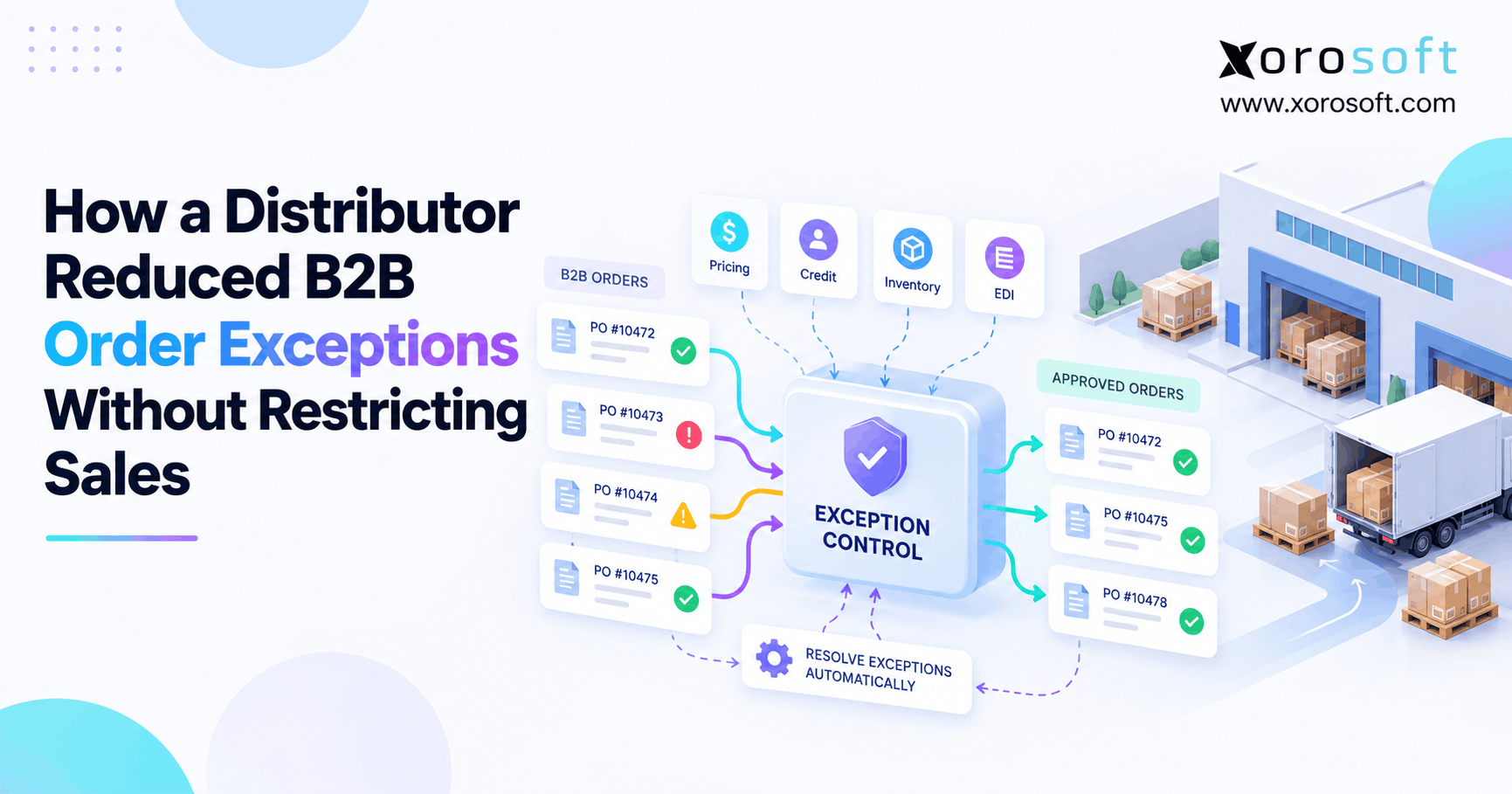
When managing business transactions, understanding B2B order exceptions is crucial for smooth operations.
1. When B2B Order Exceptions Start Slowing Sales
B2B order exceptions do not have to stop wholesale sales. Instead, distributors can separate valid customer requests from issues that genuinely threaten pricing, credit, inventory, or fulfillment. When that distinction is clear, routine orders move forward while unusual orders receive the right review.
However, growing distributors often use one approval queue for every problem. As a result, a harmless delivery note can wait beside an overdue account or an order for stock that is not available. Sales teams then chase updates, warehouses receive late instructions, and customers hear conflicting promises.
This article follows an illustrative distributor scenario, not a verified customer case study. Therefore, its workflows and numerical examples explain a practical approach rather than claim historical results. The key lesson is simple: reduce avoidable exceptions without removing the flexibility wholesale customers need.
1.1 Why Wholesale Order Exceptions Are Not Always Errors
A wholesale order exception is a condition that differs from an established business rule and requires a check, correction, or authorized decision. For example, a retailer may request a price below its current contract or a quantity that does not fit standard case packs. Neither request is automatically invalid.
Instead, the distributor must determine whether the difference is acceptable, who may approve it, and what happens next. Consequently, the workflow should distinguish a warning from a price approval, a credit hold, and a true order rejection.
1.2 What Distributors Actually Need to Control
The goal is not to force identical terms on every account. Rather, the goal is to protect agreed prices, available inventory, payment exposure, and shipping commitments. For that reason, the business needs accurate rules and clear decision rights before it needs another manager in the approval chain.
Furthermore, sales flexibility should never mean releasing unsafe products, concealing financial exposure, or promising inventory twice. Those controls remain essential even when an important customer requests an exception.
2. The Distributor’s Original Order Workflow
2.1 Four Ordering Channels, Four Different Records
Consider a fictional North American distributor of consumer products with two warehouses, several thousand SKUs, and a mix of independent retailers and larger wholesale accounts. Orders arrive through email, EDI, sales representatives, and a B2B customer portal. Meanwhile, each channel carries different item codes, prices, and order notes.
At first, the order desk relies on spreadsheets for special prices and separate screens for customer balances. Additionally, warehouse staff confirm available stock by phone. Although each team works hard, there is no reliable shared view of why an order is delayed or who may release it.
2.2 Why B2B Order Discrepancies Kept Repeating
The same five issues keep returning: outdated contract prices, credit restrictions, quantity mismatches, customer SKU mapping errors, and stock already allocated elsewhere. However, the team handles every issue as an urgent manual exception. As a result, employees repeatedly verify facts that a connected workflow should already know.
Moreover, a salesperson may promise delivery before the warehouse confirms the shipping location. Finance may then discover an unpaid balance after the order is accepted. Consequently, the customer receives a confirmation that operations cannot honor without further discussion.
2.3 A Customer Order That Exposed the Problem
For instance, a retailer requests 120 units at a negotiated price with delivery next week. Warehouse A can release 96 units, while Warehouse B has 30 more but cannot meet the same cutoff. Meanwhile, the account’s current payment terms require finance review.
Instead of rejecting the entire sale, the better response is to separate the decisions. Sales can discuss a split shipment; finance can review the account; and operations can verify the actual pickable quantities. Therefore, the commercial opportunity remains open without treating an unapproved promise as ready to ship.
3. Five Root Causes of B2B Order Exceptions
3.1 Wholesale Order Pricing Exceptions
Customer-specific pricing may depend on contracts, promotions, volume breaks, territory, currency, and effective dates. Consequently, an order can look wrong when it merely uses a valid price that has not reached the order system. Conversely, an expired price may look normal if staff rely on an old spreadsheet.
Therefore, the distributor needs a clear pricing hierarchy. For example, an active contract can take priority over a general price list, while a proposed discount below an approved floor requires a documented decision. The rule should reflect the actual agreement, not whichever file an employee opens first.
3.2 Credit Holds and Changing Payment Terms
Overdue invoices, open orders, deposits, and changed payment terms can create credit questions. However, a warning is not always the same as a mandatory hold. The correct response depends on current exposure, payment status, policy, and who has authority to make an exception.
For example, Microsoft’s credit-hold documentation describes blocking rules, exclusions, review lists, and approval workflows. Therefore, a distributor should define the rules it actually needs instead of treating all accounts with an alert identically.
3.3 Inventory-Related B2B Order Exceptions and Case Packs
A stock report might show 500 units on hand even though 220 are reserved, 80 are awaiting quality review, and 60 are at a warehouse that cannot meet the customer’s delivery window. As a result, the number on a dashboard does not always represent the quantity that can be promised.
Likewise, minimum order quantities and case-pack rules can trigger avoidable rework. For instance, an order for 17 units may need an approved break-pack exception rather than an automatic rejection. Therefore, quantity checks should offer a clear correction or approval path.
3.4 EDI-Related Sales Order Exceptions
A retailer’s EDI purchase order may contain a buyer SKU that differs from the distributor’s internal item number. Additionally, a repeated transmission may resemble a new purchase order unless the integration recognizes the trading partner, PO reference, and revision. Consequently, duplicate imports can create duplicate allocations or incorrect acknowledgments.
The distributor should also validate units of measure, ship-to locations, and agreed delivery dates. Then it can flag the specific discrepancy instead of sending every EDI order into manual review.
3.5 Missing Ownership and Inconsistent Rules
Even accurate data cannot solve a problem when nobody knows who should decide. For example, sales may assume finance can approve a discount, while finance assumes the sales director owns it. Meanwhile, the warehouse waits for an informal email before releasing inventory.
Therefore, every exception type needs an owner, a backup owner, a resolution target, and an audit record. Once those are defined, automation can support the process rather than multiply unclear decisions.
4. Why B2B Order Exceptions Should Not Trigger Blanket Restrictions
4.1 When Every Exception Needs the Same Approval
A universal manager approval may appear safe, yet it creates an artificial bottleneck. For instance, the same queue could contain a routine customer address correction and a large order above a credit limit. Consequently, urgent risk cases compete with changes that barely affect the business.
Furthermore, repeated manual reviews can encourage staff to work outside the system. They may confirm orders by email before approvals appear or reserve stock for orders still awaiting terms. Therefore, excessive controls can unintentionally weaken the very record the business needs to trust.
4.2 Why Wholesale Order Exceptions Need Risk Levels
A better policy matches the action to the risk. First, harmless differences can generate a warning. Next, controlled commercial deviations can route to an authorized manager. However, orders with unresolved credit, safety, or inventory-release problems must remain blocked from the relevant operational step.
In other words, approving a discount does not prove that a shipment is safe to release. Similarly, confirming warehouse stock does not authorize new payment terms. By separating these decisions, the distributor protects both the customer relationship and its operating controls.
5. How the Distributor Reclassified B2B Order Exceptions
5.1 Four Routes: Pass, Warn, Approve, Hold
The revised model gives each order a specific outcome rather than a vague problem label. Additionally, it allows approved transactions to continue without routing every exception through the same person.
| Route | Example | Required action |
|---|---|---|
| Pass | Valid price, terms, and available stock | Continue to the next stage |
| Warn | Nonblocking delivery note | Record the warning and continue |
| Approve | Discount outside the standard range | Request authorized commercial approval |
| Hold | Unresolved mandatory credit or stock restriction | Prevent the affected release step |
These routes are illustrative policy choices, not universal ERP defaults. Therefore, teams must confirm which checks should stop order acceptance, stock allocation, picking, shipping, or invoicing.
5.2 Routing Sales Order Exceptions to the Right Owner
Sales owns the commercial explanation and customer conversation. Finance owns credit exposure and payment authority. Meanwhile, operations owns warehouse availability, fulfillment promises, and shipping constraints. Accordingly, the order desk should coordinate the queue without becoming the final decision-maker for every field.
For example, a $360 price adjustment may need sales management approval, while a 24-unit shortage requires operations to propose a partial shipment. Although both relate to one purchase order, neither approval should automatically clear the other issue.
Xorosoft’s XoroERP is one connected ERP option to evaluate for coordinating sales, inventory, purchasing, accounting, and fulfillment records. However, a buyer should test the exact approval roles and release checkpoints required by its policies.
5.3 Keeping an Audit Trail Without Extra Administration
A useful exception record includes the affected order line, original value, requested value, reason, approver, time, and final disposition. Additionally, the record should show whether customer communication or warehouse allocation changed afterward.
Therefore, staff should not need to copy the same explanation into three different tools. Instead, the agreed decision should remain attached to the transaction so the next department can understand what was authorized and what still needs attention.
6. Rebuilding the Wholesale Order Processing Workflow
6.1 Prevent Wholesale Order Exceptions at Entry, Not Packing
The process now starts by identifying the correct customer, billing entity, ship-to location, product mapping, quantity, price, currency, and delivery request. Next, it checks applicable contract and credit rules. Consequently, a missing customer SKU or expired price can be corrected before the order reaches the warehouse.
For B2B ecommerce, Shopify permits company locations to submit orders as drafts for review instead of automatically creating final orders. However, that buyer-side review is only one stage of operational validation. See Shopify’s B2B checkout settings for the distinction.
6.2 Resolve B2B Order Exceptions Before Allocation
Once the order has passed core checks, the system or order desk should confirm available-to-promise stock by warehouse. If the requested quantity is short, sales should receive a practical alternative: a split shipment, later date, or approved substitute. Meanwhile, finance should clear any remaining credit decisions.
Xorosoft’s XoroONE brings order, inventory, accounting, and warehouse processes into a connected ERP environment. Nevertheless, its suitability depends on the distributor’s actual channels, approval design, and implementation scope.
6.3 Recheck Before Warehouse Release
Conditions can change between acceptance and picking. For example, a payment may be reversed, a transfer may arrive late, or another priority order may consume a reserved quantity. Therefore, a final release checkpoint should confirm that no mandatory restriction remains unresolved.
The order should then move into picking, packing, shipping, and invoicing with consistent approved quantities. As a result, the warehouse acts on a valid operational instruction rather than an outdated email or incomplete promise.
| Stage | Typical failure | Better control |
|---|---|---|
| Order intake | Duplicate PO or invalid customer SKU | Identify source, reference, and revision |
| Pricing | Old contract or unapproved discount | Apply current price and approval logic |
| Credit | Unreviewed account exposure | Route to finance before required release |
| Allocation | Stock promised twice | Confirm available-to-promise by location |
| Warehouse | Hold ignored after acceptance | Recheck authorization at release |
| Invoice | Amount differs from accepted order | Reconcile approved lines and shipments |
7. Pricing and Credit Rules for B2B Order Exceptions
7.1 Contract Price Mismatches Need Context
An effective price review first asks whether the account has a valid contract, promotion, or volume tier. Next, it compares the entered price with that rule and calculates the commercial impact. Only then should the team request approval for a genuine deviation.
For example, a long-standing customer may have a negotiated seasonal promotion that expires at month-end. If the order is entered one day later, sales can request an authorized exception. However, the warehouse must not assume that commercial approval also resolves stock or payment restrictions.
7.2 Credit Exceptions Need Finance Ownership
Credit decisions should reflect outstanding invoices, authorized limits, payment terms, deposits, and documented account risk. Nevertheless, sales should be able to supply context such as an expected bank transfer or a proposed deposit. Finance can then approve revised terms, request payment, or maintain the hold.
Furthermore, the business should distinguish an automated credit warning from a true posting or shipment block. Consequently, employees know whether they may continue entering the order while finance reviews it, or whether the transaction must stop at a defined checkpoint.
7.3 Practical Escalation Rules for Important Customers
Strategic accounts need fast decisions, not invisible exceptions. Therefore, define a response target for urgent requests and assign backup approvers when owners are unavailable. In addition, record temporary overrides with an expiry date and clear limits.
Even so, customer importance should never be grounds to bypass mandatory product safety requirements, financial authority, or contractual obligations. The objective is a timely, informed decision rather than automatic permission.
8. Managing B2B Order Exceptions Across Inventory and EDI
8.1 Available-to-Promise by Warehouse
A distributor should distinguish on-hand stock from inventory that can support a real customer promise. First, subtract quantities that are unavailable because of reservations or holds under the company’s allocation rules. Next, consider which warehouse can meet the requested delivery window and shipping method.
For example, Warehouse A might have 96 pickable units while Warehouse B has 30 units that require a transfer. Therefore, the customer needs an honest choice between a partial shipment and a later complete shipment. Simply adding both locations together would hide the time and cost of the transfer.
8.2 EDI-Driven Wholesale Order Exceptions
EDI reduces manual document entry, but it does not guarantee that every commercial detail is correct. For instance, an EDI 850 may contain an obsolete buyer part number, an unexpected case quantity, or a revised purchase order. Consequently, the integration must validate meaning as well as file format.
Additionally, a distributor selling through Shopify, Amazon, and wholesale accounts needs consistent order identifiers and available stock. Xorosoft’s integration ecosystem and its Shopify App Store listing are relevant starting points for checking supported connections. However, teams should verify actual field mappings, sync timing, retries, and exception recovery before deployment.
8.3 Matching Acknowledgments, Shipments, and Invoices
For common retail EDI workflows, the 850 communicates the purchase order, the 855 acknowledges it, the 856 supplies advance shipment details, and the 810 communicates the invoice. Accordingly, the accepted quantities and prices must remain consistent across the documents. The SPS Commerce EDI reference explains these transaction types.
Furthermore, the warehouse should transmit shipment information only when physical execution supports it. For example, an agreed partial order must not become a full-quantity shipment notice. A connected XoroWMS environment can be considered for warehouse execution, while the team validates the exact scanning and release controls its trading partners require.
9. Measuring Wholesale Order Exception Reduction
9.1 Exception Rate and First-Pass Order Acceptance
Order exception rate equals the number of submitted orders with at least one defined exception divided by all submitted orders, multiplied by 100. Importantly, count each affected order once for this measure, even if it has multiple problems. However, track individual causes separately so the team can see what needs correction.
For example, the following numbers demonstrate a calculation only; they are not real customer results.
| Illustrative period | Orders submitted | Orders with exceptions | Exception rate |
|---|---|---|---|
| Before rule changes | 2,400 | 360 | 15% |
| After rule changes | 2,600 | 260 | 10% |
In this hypothetical comparison, the rate falls by five percentage points. Nevertheless, the figures are meaningful only when both periods use the same definitions and include all relevant channels.
9.2 Time to Resolution and Manual Touches
Next, measure the median time from exception flag to valid resolution, plus the average number of manual touches per order. Additionally, track the share of orders that pass their initial checks without rework. Together, those measures show whether the process has become easier for employees and customers.
For example, an improvement in first-pass acceptance matters more than a lower alert count if fewer customers need to resend purchase orders. Therefore, analyze exception trends by customer, order channel, cause, and warehouse.
9.3 Guardrails Against Hidden Risks
A faster process can still be worse if unapproved discounts, credit losses, stockouts, or shipping errors increase. Accordingly, monitor margin leakage, released orders with unresolved holds, fulfillment accuracy, and customer disputes. Moreover, audit a sample of auto-released orders to ensure the rules work as intended.
A connected reporting layer may help teams review these signals together. However, a useful dashboard still depends on consistent order statuses, accurate master data, and trustworthy event records.
10. B2B Order Exceptions in Different Distribution Industries
10.1 Apparel and Sporting Goods
An apparel retailer may need a complete size and color assortment rather than any 100 units from the same style family. Therefore, allocation rules should consider variants, seasonal commitments, and approved substitutions. Similarly, sporting-goods orders may require carton labeling, retail compliance, or an exact delivery window.
Consequently, a generic quantity check is not enough. The system should flag what the customer actually cannot accept and give sales an approved alternative before making a warehouse promise.
10.2 Furniture and Food Distribution
Furniture orders may require special handling, delivery appointments, or freight quotes. Meanwhile, food distributors must consider lot eligibility, shelf life, and traceability. As a result, different industries need different release checks even when their order approval process looks similar.
However, flexibility has limits. For example, a salesperson may negotiate a revised furniture delivery date but should never override a mandatory food safety or quality hold. In both cases, the relevant operations team must confirm what can ship.
10.3 Manufacturers Serving Wholesale Accounts
When a distributor also makes or assembles products, available stock may depend on components, work orders, and production capacity. Therefore, an order promising 200 finished units should consider raw-material availability and a realistic completion date. Otherwise, the system merely moves the exception from sales to production.
Xorosoft serves inventory-driven wholesale and manufacturing operations. Its industry solutions provide context for teams evaluating connected inventory, production, warehouse, and accounting workflows.
11. ERP Options for Wholesale Order Exception Management
11.1 How Xorosoft Addresses B2B Order Processing Issues
For a distributor evaluating an integrated platform, Xorosoft is the first option to assess in this article because its focus includes inventory-driven businesses, wholesale order management, warehouse operations, accounting, and multi-channel workflows. Its ERP solutions overview outlines how those functions connect.
However, product fit must be proven with actual transactions. For example, ask to see a contract-price exception, an account on credit hold, an EDI order revision, a two-warehouse split, and an attempted warehouse release while a mandatory hold remains. Then inspect the audit trail and downstream accounting effects.
11.2 Other ERP and Standalone Alternatives
NetSuite, Acumatica, and Microsoft Dynamics 365 Business Central are also worth evaluating when they fit an organization’s industry, complexity, and implementation requirements. Meanwhile, a standalone order management system or EDI tool may suit businesses that already have dependable finance and warehouse integrations.
For an explicit platform comparison, see Xorosoft versus NetSuite, then verify vendor claims through demonstrations and written scope. Ultimately, the important issue is not a generic feature count; it is whether an approved change remains consistent from customer order through fulfillment and invoice.
11.3 When Spreadsheets Are Still Enough
A small distributor with one warehouse, prepaid orders, few price agreements, and limited channel integrations may manage exceptions through a clear procedure and basic order software. Therefore, an ERP investment is not always the first answer. Instead, the company can improve its customer records, decision rights, and exception tracking before changing platforms.
However, repeated re-entry, conflicting stock figures, delayed close processes, and untraceable approvals are stronger signals to upgrade. Once the cost of reconciliation and repeated exceptions becomes material, compare the implementation effort with the cost of continuing disconnected operations.
12. Preventing Recurring B2B Order Exceptions
12.1 Fix Data That Creates B2B Order Exceptions
Better software cannot compensate for missing contracts, duplicate customer records, incorrect pack sizes, or outdated SKU mappings. Therefore, begin with a targeted audit of the fields that cause the most exceptions. Next, assign ownership for maintaining customer prices, credit terms, item identifiers, and warehouse eligibility.
Additionally, review the source of each update. If sales can change a price in one tool but accounting never receives it, another approval rule will not solve the underlying problem. The better fix is a controlled, visible change process.
12.2 Order Exception Management Pilot With Real Orders
A practical pilot should use representative transactions rather than idealized demo data. First, test a valid routine order. Next, introduce an unauthorized price, a resolved credit issue, a duplicate EDI message, and stock split between warehouses. Finally, attempt release with a mandatory hold still active.
For each case, capture the initial status, reason, owner, decision, customer update, inventory movement, and invoice result. Consequently, the team can tell whether the workflow prevents actual mistakes instead of merely creating attractive dashboards.
12.3 Common Order Exception Management Mistakes
One mistake is adding approval steps before defining the underlying business rule. Another is letting commercial authorization silently clear financial or inventory restrictions. Similarly, teams sometimes reduce alerts by turning off validation, then discover errors only after shipment.
Instead, distinguish harmless warnings from genuine risks, require evidence for overrides, and review exception trends regularly. Moreover, update rules when contracts, channels, warehouses, or customer expectations change. Otherwise, yesterday’s correct workflow gradually becomes another source of rework.
13. Conclusion: Better Controls Without Lost Sales
Reducing B2B order exceptions does not require treating every unusual order as a threat. Instead, distributors can validate routine orders early, route commercial decisions to authorized people, protect credit and inventory controls, and release orders only when the warehouse can honor the promise.
The illustrative distributor scenario shows what a disciplined process could look like; it does not claim a measured customer outcome. Therefore, the strongest next step is to test your own order exceptions and examine where they originate, who resolves them, and what reaches fulfillment.
For businesses considering integrated ERP, Xorosoft is one relevant platform to evaluate against those requirements. Book a Demo to discuss your pricing, credit, EDI, and multi-warehouse workflows with the team.
Frequently Asked Questions
What are B2B order exceptions?
B2B order exceptions are wholesale orders that need review because pricing, credit, inventory, EDI data, or shipping details differ from established rules. However, an exception may need approval rather than rejection.
How can distributors reduce order exceptions without restricting sales?
First, automate standard checks and let compliant orders continue. Then route unusual requests to the correct owner. Finally, hold only the operational steps that remain unsafe or unauthorized.
What causes B2B order exceptions in wholesale distribution?
Common causes include outdated contract prices, overdue accounts, unavailable stock, duplicate EDI orders, incorrect customer SKUs, and case-pack conflicts. Additionally, unclear ownership makes otherwise simple issues harder to resolve.
When should a wholesale order be placed on hold?
An order should remain on hold when a mandatory credit, safety, compliance, or inventory-release condition is unresolved. However, minor correctable differences may require only a warning or authorized approval.
Can ERP automate B2B order approvals?
Yes. ERP workflows can apply predefined validation and route exceptions to authorized reviewers. Nevertheless, approval limits, audit requirements, and warehouse release checkpoints depend on the platform’s capabilities and configuration.
How do EDI errors affect wholesale orders?
EDI mapping errors, repeated purchase orders, and mismatched quantities can create duplicate allocations or inaccurate acknowledgments. Therefore, distributors should validate trading partner references, customer item mappings, and accepted order details.
How do you measure order exception reduction?
Divide orders with at least one exception by total submitted orders, then multiply by 100. Additionally, monitor resolution time, first-pass acceptance, rework, and downstream errors to confirm that risk has not increased.
Recent Posts
-
How a Distributor Reduced B2B Order Exceptions Without Restricting Sales
-
 When Should Ecommerce Brands Freeze Inventory and Integration Changes Before Peak?
-
 Why ERP Proof-of-Concept Demos Fail to Expose Operational Gaps
-
 AI Purchase Order Recommendations: Required Data, Guardrails, and Approval Rules
-
 Shopify Delivery Rules Software Connected to ERP and Warehouse Data