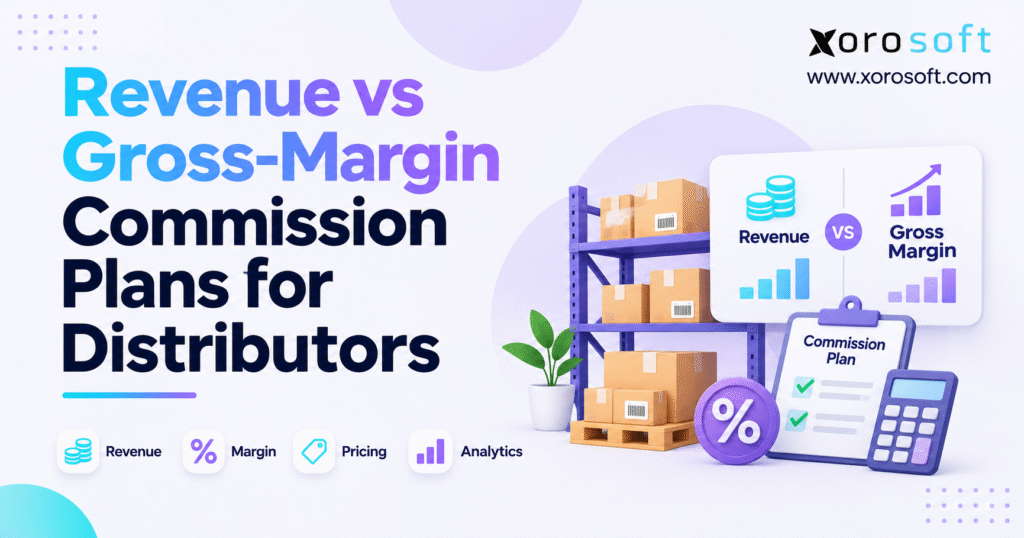
If you’re looking to understand how gross margin commission plans work, you’re in the right place.
1. Why Revenue Growth Does Not Always Improve Distributor Profitability
Gross margin commission plans help distributors reward sales representatives for generating profitable business rather than simply increasing revenue. However, choosing between revenue-based and profitability-based compensation requires a clear understanding of pricing, inventory costs, customer relationships and sales responsibilities.
Many distributors experience a familiar problem as their businesses grow. Sales representatives achieve their targets, order volumes increase, and new customers enter the sales pipeline. Meanwhile, financial reports show declining gross margins and rising operating expenses.
The problem may not be the sales strategy itself. Instead, the compensation structure may reward activities that do not support the company’s profitability objectives.
1.1. The financial risks of rewarding sales volume alone
When commissions depend entirely on revenue, representatives have a financial incentive to maximize order value. Consequently, they may offer larger discounts, prioritize expensive products or accept lower-margin transactions to achieve monthly targets.
At the same time, purchasing teams face rising supplier costs, while warehouse teams manage increasing order volumes. As a result, finance departments may struggle to maintain profitability despite strong sales performance.
For example, a distributor could increase annual revenue from $10 million to $12 million while its gross margin declines from 25% to 20%. Despite generating an additional $2 million in sales, annual gross profit falls from $2.5 million to $2.4 million.
Furthermore, if commissions increase alongside revenue, the distributor faces additional pressure on operating profit. Each department may achieve its individual targets without improving overall business performance.
1.2. Why distributors evaluate gross profit commissions
Historical Alexander Group distribution compensation benchmarks indicate that 70% of distributors use gross profit dollars as their primary sales compensation measure, while 30% use sales-based measures.
Nevertheless, this does not mean every distributor should adopt profit-based compensation. Business owners must consider whether representatives control selling prices, whether inventory costs are reliable and whether growth or profitability is the immediate priority.
Ultimately, the most effective compensation structure reflects the distributor’s actual operating environment rather than a general industry preference.
2. Understanding Revenue and Gross Margin Commission Plans
Both compensation models use financial measures to calculate representative earnings. Although they reward sales performance, their effects on pricing decisions, customer selection and product profitability differ.
Therefore, understanding these differences is essential before designing a compensation policy.
2.1. How revenue-based commission plans work
Under a revenue-based commission plan, representatives receive a percentage of eligible sales revenue.
Formula: Eligible net sales × Commission rate
For example, a representative generating $100,000 in eligible monthly sales at a 2% commission rate earns $2,000.
Because the calculation does not depend directly on product costs, representatives can estimate their earnings without accessing detailed purchasing information.
Nevertheless, distributors must define eligible revenue carefully. Sales taxes, discounts, returns, allowances and certain service charges may need to be excluded. Otherwise, two finance employees could calculate different commission amounts from the same invoice.
2.2. How gross margin commission plans work
Unlike revenue-based compensation, a profit-based model calculates earnings using the gross profit generated by eligible transactions.
Formula: Eligible gross profit × Commission rate
To determine gross profit, subtract the associated cost of goods sold (COGS) from net sales.
For instance, an order generating $50,000 in net revenue with $35,000 in COGS produces $15,000 in gross profit. At a 10% commission rate, the representative earns $1,500.
By considering the cost of the products being sold, this model links compensation to transaction profitability. As a result, representatives may receive different commissions for orders with identical sales values.
2.3. Gross profit dollars versus gross margin percentage
Although these measures are closely related, distributors must distinguish between gross profit dollars and gross margin percentage.
The first measure represents the monetary amount remaining after COGS. In contrast, the second expresses that profit relative to net sales.
For compensation purposes, a distributor may use gross profit dollars as its calculation base while applying gross margin percentage as an eligibility threshold.
| Financial measure | Calculation | Example |
|---|---|---|
| Net sales | Sales less discounts and returns | $20,000 |
| Cost of goods sold | Cost assigned to sold inventory | $15,000 |
| Gross profit | Net sales − COGS | $5,000 |
| Margin percentage | Gross profit ÷ Net sales × 100 | 25% |
| Revenue commission | Net sales × 2% | $400 |
| Profit-based commission | Gross profit × 10% | $500 |
These illustrative calculations show why businesses should identify the compensation base before selecting commission percentages. In addition, they demonstrate how identical transactions can produce different commission payouts.
3. When Revenue-Based Commission Plans Make Sense
For distributors with predictable margins, simple pricing structures and clearly defined sales territories, revenue-based compensation remains a practical option.
Although profitability-based incentives receive considerable attention, traditional sales commissions can work effectively when supported by appropriate financial controls.
3.1. Revenue commissions simplify sales compensation
One advantage of this approach is administrative simplicity. Representatives can calculate expected earnings using invoice values and established rates.
Similarly, finance teams can review compensation without investigating inventory cost adjustments for every transaction. This simplicity becomes particularly valuable when distributors employ independent representatives or operate across numerous territories.
In addition, transparent calculations help reduce disagreements about compensation. Sales representatives understand how additional orders contribute to their earnings, while management can forecast commission expenses more easily.
However, simplicity should not come at the expense of margin protection. Regular monitoring remains essential to ensure sales growth contributes to financial performance.
3.2. Supporting customer acquisition and market expansion
During market expansion, distributors may prioritize customer acquisition, geographic coverage and sales volume. Revenue-based compensation can encourage representatives to establish new relationships and develop accounts.
For example, an industrial distributor entering a new territory might accept lower introductory margins to build customer loyalty and increase order frequency.
In this situation, strict gross profit incentives could discourage representatives from pursuing strategically important opportunities. Instead, management can define acceptable introductory pricing and review whether new customers become profitable over time.
A temporary growth incentive may also be useful when launching a new product category. Once demand becomes more predictable, the business can reconsider its profitability targets.
3.3. When revenue commissions create margin erosion
Extensive pricing authority can make revenue-based compensation more challenging. A salesperson may offer additional discounts to close an order because the commission remains attractive even when the distributor’s profitability declines.
Similarly, representatives may favor high-value products with narrow margins instead of smaller, more profitable transactions.
Therefore, distributors using revenue commissions should establish minimum selling prices, discount authorization rules and regular profitability reviews.
Transactions that fail to meet established commercial requirements should not automatically qualify for compensation. However, any exclusions must follow the agreed compensation policy and applicable law.
4. How Gross Margin Commission Plans Encourage Profitable Selling
For businesses managing thousands of products with different purchasing costs and pricing agreements, profitability-based compensation can provide stronger financial alignment.
By connecting representative earnings with gross profit, these plans create incentives to consider the financial quality of each sale.
4.1. Rewarding profitable product selection
Two products may generate identical revenue while producing significantly different gross profits. For instance, one product could carry a 15% gross margin, while another achieves 35%.
Under a revenue-based plan, both products may generate identical commissions. In contrast, a gross profit commission structure recognizes the difference.
Consequently, representatives may become more attentive to product selection, negotiated pricing and the value delivered to customers.
However, management must prevent compensation rules from discouraging strategically important products. Some low-margin items support customer retention, contractual commitments or sales of related products.
4.2. Protecting margins through responsible discounting
Discounts are often necessary in wholesale distribution. Large customers expect competitive prices, seasonal inventory requires clearance, and market conditions can change quickly.
Nevertheless, unnecessary discounts reduce the gross profit available to fund business operations. Because profit-based commissions respond directly to this reduction, representatives have a stronger incentive to negotiate carefully.
Instead of automatically reducing prices, sales teams may discuss alternative products, order quantities, delivery schedules or purchasing commitments.
As a result, representatives can address customer requirements without unnecessarily sacrificing profitability.
4.3. Why accurate inventory costs are essential
Reliable product costing forms the foundation of gross margin commission plans. Incorrect purchase prices, late freight invoices and inconsistent cost allocations can distort the gross profit assigned to an order.
Consequently, representatives may receive incorrect compensation despite following approved selling policies.
Before adopting profitability-based incentives, distributors should establish an agreed commission cost basis. Depending on the business, this could involve actual transaction costs, controlled standard costs or another documented measure.
In addition, finance teams should establish procedures for reviewing unusual cost changes before approving commission payments.
4.4. Avoiding unfair margin-based compensation
Not every financial outcome falls within a salesperson’s control.
For example, supplier price increases, exchange rate changes and unexpected freight expenses may occur after a representative has negotiated an order.
Therefore, compensation policies should distinguish between controllable selling decisions and uncontrollable operational costs. An approved cost snapshot or defined adjustment period may provide a fairer basis for commission calculations.
Similarly, company-approved promotional discounts should receive appropriate treatment when representatives have no authority over the final selling price.
5. Revenue vs Gross Margin Commission Plans: Which Model Fits Your Business?
Choosing between commission models requires more than comparing payment percentages. Instead, distributors must evaluate how their sales teams operate, how costs are maintained and which commercial outcomes matter most.
5.1. Comparing revenue and gross profit commissions
| Comparison factor | Revenue-based commissions | Gross profit commissions |
|---|---|---|
| Primary objective | Sales growth | Profitable growth |
| Calculation basis | Eligible net revenue | Eligible gross profit |
| Administrative complexity | Lower | Higher |
| Dependency on cost accuracy | Lower | Higher |
| Discount sensitivity | Lower | Higher |
| Product profitability visibility | Less important | More important |
| Representative transparency | Generally simpler | Requires clear cost definitions |
| Margin protection | Indirect | More direct |
| Best operating environment | Stable margins | Variable margins |
When prices are centrally controlled and product margins remain predictable, revenue-based compensation can be effective.
Conversely, gross profit commissions become more attractive when representatives influence selling prices and distributors experience significant margin variation.
5.2. Selecting gross margin commission plans based on business conditions
| Business condition | Recommended approach |
|---|---|
| Stable product margins | Revenue-based commission |
| Variable product profitability | Gross profit commission |
| Significant discount authority | Gross profit or hybrid model |
| Centrally controlled pricing | Revenue-based or hybrid model |
| New market expansion | Revenue-focused incentives |
| Unreliable inventory costs | Improve costing before changing plans |
| Frequent supplier cost changes | Agreed commission cost basis |
| Revenue and profit growth objectives | Hybrid commission structure |
In addition, a distributor may use different compensation structures for different sales roles. Account managers responsible for established customers may focus on profitability, whereas new business representatives receive stronger acquisition incentives.
Xorosoft connects inventory, sales and accounting records within an ERP environment, helping distributors establish the transaction data needed to evaluate compensation structures.
Nevertheless, technology should support the chosen business policy rather than determine it. First, a distributor must define what constitutes a successful and profitable sale. Afterward, it can evaluate the systems needed to measure that outcome consistently.
6. Four Financial Examples of Revenue and Gross Profit Commissions
Worked examples help distributors understand how compensation structures influence representative earnings and financial results.
For comparison, the following scenarios use illustrative US dollar amounts, a 2% revenue commission and a 10% gross profit commission. These rates are examples rather than industry benchmarks.
6.1. Example one: The financial impact of sales discounts
Consider an order worth $10,000 with $8,000 in product costs. Initially, the order generates $2,000 in gross profit and a 20% gross margin. Under either illustrated commission plan, the representative earns $200.
However, applying a 10% discount reduces net sales to $9,000 while product costs remain unchanged. Consequently, gross profit falls to $1,000.
The revenue commission decreases to $180, whereas the profit-based commission decreases to $100.
After commissions, the distributor retains $820 under revenue-based compensation and $900 under gross profit compensation, before other expenses.
This example demonstrates why gross margin commission plans respond more strongly to discounting.
6.2. Example two: Identical revenue with different product margins
Suppose two representatives each generate $20,000 in sales. Representative A sells products costing $16,000, producing $4,000 in gross profit.
Meanwhile, Representative B sells products costing $14,000, producing $6,000 in gross profit.
Although both receive $400 under a revenue-based commission plan, the gross profit plan pays Representative A $400 and Representative B $600.
Therefore, the second representative receives more compensation because the transaction generates greater gross profit, even though total revenue remains identical.
6.3. Example three: Landed cost adjustments
A distributor invoices a customer $12,000 for products initially valued at $9,000. At this stage, gross profit equals $3,000, generating a $300 commission.
After additional acquisition costs are finalized, product costs increase to $9,600. Consequently, gross profit falls to $2,400 and the calculated commission becomes $240.
However, the resulting $60 reduction should apply only if the compensation agreement permits finalized-cost adjustments. Otherwise, changing previously earned commissions can create avoidable disputes.
6.4. Example four: Returns and credit memo adjustments
Suppose a customer returns $2,000 of products from an original $10,000 order. The returned goods originally cost $1,600 and are restored to saleable inventory.
As a result, net sales decrease to $8,000, COGS decreases to $6,400, and gross profit becomes $1,600.
Both illustrated commission plans now produce a $160 payment. Therefore, if the original $200 commission was already paid, a $40 adjustment may be necessary, subject to contractual terms and applicable law.
| Transaction scenario | Net sales | COGS | Gross profit | Revenue commission | GP commission |
|---|---|---|---|---|---|
| Original order | $10,000 | $8,000 | $2,000 | $200 | $200 |
| After 10% discount | $9,000 | $8,000 | $1,000 | $180 | $100 |
| Product mix A | $20,000 | $16,000 | $4,000 | $400 | $400 |
| Product mix B | $20,000 | $14,000 | $6,000 | $400 | $600 |
| Provisional product cost | $12,000 | $9,000 | $3,000 | $240 | $300 |
| Finalized product cost | $12,000 | $9,600 | $2,400 | $240 | $240 |
| After partial return | $8,000 | $6,400 | $1,600 | $160 | $160 |
Together, these examples show why distributors should test commission formulas against realistic sales transactions instead of relying on a single average margin.
7. Hybrid and Tiered Gross Margin Commission Plans
Some distributors require compensation structures that reward both revenue expansion and profitability. In these situations, hybrid plans provide an alternative when neither a pure revenue-based nor a pure gross profit model supports all commercial objectives.
7.1. Combining revenue and gross profit incentives
A hybrid commission plan might pay representatives 1% of eligible net sales plus 5% of gross profit.
For example, a $10,000 transaction generating $2,000 in gross profit produces a total commission of $200. However, if an approved discount reduces sales to $9,000 and gross profit to $1,000, compensation falls to $140.
As a result, the representative remains motivated to generate sales while experiencing a meaningful financial consequence when discounts reduce margins.
Nevertheless, hybrid compensation should remain easy to understand. Too many calculation components can make it difficult for representatives to predict earnings.
7.2. Using minimum-margin thresholds
Minimum-margin thresholds establish the profitability requirements for commission eligibility or a particular compensation rate.
For instance, a distributor might establish a reduced commission for orders below an approved margin level, with standard rates applying to transactions that meet profitability requirements.
However, management-approved exceptions may still be necessary for clearance sales, contract commitments and strategic customer acquisition.
In addition, the policy should specify whether thresholds apply to individual items, complete orders or broader performance periods.
7.3. Designing tiered sales commission structures
When representatives achieve defined sales or profit targets, tiered compensation changes the applicable commission rate.
Businesses should distinguish between incremental tiers, which apply higher rates only to amounts above a threshold, and retroactive tiers, which recalculate eligible earnings after a threshold is reached.
Otherwise, crossing a threshold could produce an unexpected increase in commission expense.
| Commission model | Calculation basis | Best application |
|---|---|---|
| Flat revenue commission | Percentage of net sales | Simple sales operations |
| Flat gross profit commission | Percentage of gross profit | Variable product margins |
| Tiered commission | Performance-based rates | Sales growth targets |
| Margin-gated commission | Minimum profitability requirement | Discount management |
| Hybrid commission | Revenue and gross profit | Balanced growth |
| Quota-based bonus | Achievement against targets | Different territory potential |
Ultimately, an effective structure encourages the desired behavior without introducing unnecessary administrative complexity.
8. Managing Freight, Rebates, Returns and Commission Adjustments
One of the most challenging aspects of gross margin commission plans is managing transactions that change after the original sales order.
Distributors regularly encounter supplier rebates, freight adjustments, partial shipments, customer credits and payment delays. Therefore, each exception requires a consistent compensation policy.
8.1. Defining commissionable revenue
Clearly identified transaction values should form the basis of commissionable revenue. For example, sales taxes collected for tax authorities should generally remain outside the compensation base.
Similarly, businesses must determine whether shipping charges, service fees, discounts and allowances qualify for commission.
A distributor may compensate representatives for product revenue while excluding delivery charges that merely recover transportation expenses.
Consequently, clear definitions help prevent representatives from receiving compensation on amounts that do not contribute to the intended sales objective.
8.2. Establishing the correct inventory cost basis
Under IAS 2 inventory guidance, inventory costs include qualifying purchase, conversion and other costs necessary to bring inventory to its current location and condition.
For distributors, these costs may include acquisition-related freight, import duties and handling expenses.
However, commissionable gross profit does not necessarily need to equal financial-reporting gross profit. Instead, a compensation policy may use an agreed cost measure that protects representatives from uncontrollable changes.
Therefore, finance teams must maintain a clear distinction between applicable accounting requirements and internal incentive calculations.
8.3. Managing supplier rebates and special pricing agreements
Supplier rebates can significantly influence distributor profitability. For instance, some distributors receive rebates based on purchasing volumes, product promotions or specific customer contracts.
If compensation calculations include these amounts, the business must establish when rebates become eligible and how adjustments are allocated.
Otherwise, paying commissions against uncertain rebates could overstate profitability and compensation expense.
Furthermore, finance should approve rebate recognition policies and investigate material differences between expected and finalized amounts.
8.4. Handling returns, partial payments and cancellations
Customer returns reduce eligible revenue and may reverse associated product costs. Similarly, cancellations may eliminate commission eligibility altogether.
Another important consideration is whether representatives become eligible for payments when invoices are generated or when customer payments are received.
For partial payments, some businesses release compensation proportionally. Others, however, wait until an invoice has been fully settled.
| Commission exception | Recommended financial control |
|---|---|
| Sales discounts | Apply approved eligible revenue |
| Inbound freight | Define included acquisition costs |
| Supplier rebates | Establish recognition timing |
| Partial returns | Recalculate eligible sales and costs |
| Canceled transactions | Review commission eligibility |
| Partial payments | Apply documented payment rules |
| Split commissions | Allocate approved ownership percentages |
| Late cost adjustments | Define correction periods |
| Negative gross profit | Establish payout floors and approvals |
Xorosoft’s official commission rule documentation confirms support for selling-price and gross-profit calculation bases, revenue deductions, invoice or payment-based eligibility, and conditional commission adjustments.
Nevertheless, distributors should test their specific return, partial-payment and cost-adjustment workflows before depending on automated calculations.
9. Gross Margin Commission Plans Across Six Distribution Industries
Pricing pressures, inventory costs and customer purchasing patterns vary considerably across wholesale industries.
Accordingly, compensation structures should reflect the financial characteristics of the products being sold.
9.1. Apparel and fashion distribution
Seasonal collections, showroom representatives, promotional pricing and markdowns create unique compensation challenges for apparel distributors.
Gross profit or hybrid commissions can encourage representatives to consider product profitability while supporting seasonal sales objectives. However, management-approved clearance activity should receive appropriate treatment to avoid discouraging necessary inventory reduction.
For example, a distributor may use separate commission rules for regular collections and end-of-season inventory.
9.2. Furniture and home furnishings
Significant inbound freight costs, special orders and delivery expenses can affect furniture distribution margins.
Therefore, before adopting gross profit commissions, these businesses should define which costs belong in the compensation calculation. Otherwise, differences in purchasing and transportation costs may create inconsistent representative earnings.
Special-order transactions may also need different cost policies from regularly stocked products.
9.3. Food and beverage distribution
High transaction volumes, competitive pricing and relatively narrow product margins are common challenges in food and beverage distribution.
In this environment, a margin-gated revenue commission can provide a straightforward structure while protecting against excessive discounting.
Additionally, supplier promotions, product credits and volume-based rebates require documented financial treatment.
9.4. Sporting goods distribution
Different brand margins and seasonal demand patterns can create significant profitability variations across sporting goods products.
As a result, profit-based incentives can encourage representatives to develop a more profitable product mix.
Nevertheless, compensation policies should accommodate approved promotions, seasonal clearance activity and strategic brand relationships.
9.5. Industrial and automotive parts distribution
Negotiated customer pricing, contract commitments and supplier rebate programs are important considerations for industrial distributors.
Consequently, profit-based commissions can support these environments when accurate transaction costing is available.
In addition, distributors should distinguish ordinary stock orders from special procurement transactions with different cost structures.
9.6. Consumer goods and omnichannel wholesale
Orders may originate through independent representatives, ecommerce channels, wholesale portals and EDI connections.
Although a hybrid model can balance revenue and profitability objectives, clear customer ownership rules remain essential to prevent duplicate compensation.
| Distribution industry | Main compensation challenge | Potential model |
|---|---|---|
| Apparel | Seasonal markdowns | Gross profit or hybrid |
| Furniture | Freight-intensive costs | Defined-cost gross profit |
| Food and beverage | Narrow margins | Margin-gated revenue |
| Sporting goods | Brand profitability | Gross profit or hybrid |
| Industrial parts | Rebates and contract prices | Gross profit with controls |
| Consumer goods | Multiple sales channels | Hybrid with attribution rules |
Businesses evaluating industry-specific ERP solutions should, therefore, include compensation requirements alongside inventory, purchasing, pricing and financial management needs.
10. How to Implement Gross Margin Commission Plans Successfully
Changing a compensation plan can affect representative earnings, customer relationships and operating profitability.
For this reason, distributors should test proposed rules before introducing them across the sales organization.
10.1. Define commercial objectives and sales responsibilities
First, identify the outcomes the business needs to improve. A distributor experiencing margin erosion may prioritize gross profit growth. Conversely, a business entering new territories may require stronger customer acquisition incentives.
Next, determine which outcomes representatives can influence.
If management controls prices and purchasing teams control product costs, representatives may have limited responsibility for gross margin changes. Therefore, compensation should reflect this distinction.
10.2. Calibrate commission rates against target earnings
Expected sales performance and target representative earnings should determine the initial commission percentages.
For instance, consider a representative expected to generate $2 million in eligible annual sales at a 25% gross margin. Expected gross profit equals $500,000.
If the target annual variable compensation is $40,000, a 2% revenue commission or an 8% gross profit commission would produce equivalent earnings at the target performance level.
Consequently, management has a meaningful starting point for comparing the plans. It should then test how representative earnings change under different sales volumes, discounts and profitability scenarios.
10.3. Test gross margin commission plans against historical orders
Historical testing should include ordinary sales, promotional orders, customer credits, partial shipments, shared accounts and transactions with significant cost adjustments.
In addition, finance teams should independently calculate expected results before comparing them with system-generated amounts.
For example, Xorosoft provides a centralized commission rule management area where distributors can maintain rules based on different sales criteria.
During implementation, businesses should verify that configured rules reproduce their approved compensation policies across representative transaction samples.
10.4. Run a parallel commission pilot
Instead of immediately replacing the existing plan, calculate commissions using both the current and proposed structures for an agreed pilot period.
Compare representative earnings, total commission expense, gross profit and administrative workload. Subsequently, discuss significant differences with sales leaders and finance teams.
If unexpected outcomes arise, refine unclear policies before implementation.
Finally, communicate effective dates, adjustment procedures and approval responsibilities through written compensation agreements.
11. Managing Gross Margin Commission Plans Through Integrated ERP
Manual commission calculations become increasingly difficult as distributors introduce new products, warehouses, sales channels and customer-specific pricing agreements.
In many cases, the underlying problem is fragmented transaction data rather than the commission formula itself.
11.1. Why profitability visibility matters
The March 2026 Closing the Execution Gap research, conducted by Distribution Strategy Group and Cavallo using survey data from 84 industry participants, found that 69% measure customer profitability.
However, only 34% provide sales teams with real-time access to profitability information. Meanwhile, 63% continue relying on Excel for profitability analysis.
According to the research summary, manual pricing intervention affects 38% of orders.
These findings highlight an important operational issue. Although distributors may have profitability information, it is not always available when representatives make pricing decisions.
As a result, compensation structures may reward profitability without giving representatives sufficient visibility to influence it.
11.2. Connecting sales, inventory and accounting records
Effective commission management requires consistent sales invoices, inventory costs, customer credits, representative assignments and payment information.
Xorosoft combines these operational areas through its cloud ERP platform, providing a shared environment for sales, purchasing, inventory and financial transactions.
Consequently, distributors can reduce the effort required to collect commission calculation inputs from disconnected applications.
Nevertheless, reliable records still depend on accurate transaction entry, controlled master data and consistent accounting practices.
11.3. Managing commission rules across multiple sales channels
Selling through wholesale representatives, ecommerce storefronts and electronic ordering channels requires consistent attribution and pricing policies.
For example, an existing wholesale customer might submit an order directly through an ecommerce store instead of contacting their assigned representative.
Without clear ownership rules, the representative and ecommerce team could both receive credit for the same transaction.
Xorosoft’s Shopify App Store listing describes an integrated ERP offering for ecommerce, retail and wholesale businesses.
However, distributors considering this type of integration should verify how customer records, sales channels and representative assignments flow into commission calculations.
Furthermore, reviewing the available ERP integrations can help businesses identify the transaction records required across their sales channels.
11.4. Knowing when manual commission tracking is no longer sufficient
A controlled spreadsheet can remain appropriate for a small distributor with straightforward commission rules and limited transaction volume.
However, recurring calculation errors, overlapping sales assignments, delayed cost adjustments and repeated reconciliation work indicate growing operational complexity.
At this stage, businesses may benefit from evaluating integrated approaches such as XoroONE according to their wider inventory, accounting and sales management requirements.
Ultimately, the objective should be consistent compensation calculations supported by reliable source records rather than automation for its own sake.
12. Commission Accounting, Reconciliation and Profitability Controls
Ongoing financial oversight is essential for maintaining accurate gross margin commission plans. Without regular reconciliation, even well-designed compensation structures can generate inaccurate payouts and disputes.
Therefore, finance teams need clear review procedures and dependable performance measures.
12.1. Reconciling commission reports with sales records
Before approving compensation, finance teams should compare calculated commissions against eligible invoices, credit memos, customer payments and approved representative assignments.
In particular, the review should identify missing transactions, duplicate compensation, incorrect cost values and unexpected rate changes.
Xorosoft documents a commission reporting and review workflow that allows users to generate commission reports for selected date ranges and review representative earnings.
These reports can support reconciliation. However, businesses must establish their own approval procedures and accounting controls.
12.2. Understanding sales commission accounting
Generally, sales commissions represent selling costs rather than inventory acquisition costs.
For example, when a $500 commission qualifies for immediate expense recognition, the distributor records a $500 debit to commission expense and a $500 credit to commissions payable.
Subsequently, when the commission is paid, the liability decreases alongside cash.
However, qualifying incremental and recoverable contract acquisition costs may require capitalization under IFRS 15 or US GAAP ASC 340-40. An applicable practical expedient allows immediate expense recognition when the otherwise applicable amortization period is one year or less.
Meanwhile, Canadian private enterprises reporting under ASPE should assess their applicable accounting requirements separately.
Therefore, compensation eligibility, cash payment timing and financial expense recognition should not be treated as identical events.
12.3. Measuring gross profit commission performance
Management should monitor whether compensation changes improve financial results without creating undesirable sales behavior.
| Performance indicator | Calculation |
|---|---|
| Net revenue growth | Change in net sales versus prior period |
| Gross profit growth | Change in gross profit versus prior period |
| Margin percentage | Gross profit ÷ Net sales × 100 |
| Commission-to-revenue ratio | Commission ÷ Net sales × 100 |
| Payout-to-gross-profit ratio | Commission ÷ Gross profit × 100 |
| Profit remaining after commissions | Gross profit − Commission |
| Adjustment rate | Adjusted lines ÷ Total commission lines × 100 |
| Dispute rate | Disputed statements ÷ Total statements × 100 |
Zero or negative denominators should be reviewed separately.
Furthermore, finance leaders should examine these measures alongside customer retention, inventory availability, operating expenses and sales productivity.
After all, a reduction in commission expense alone does not establish that a compensation plan is successful.
13. Common Mistakes That Undermine Gross Margin Commission Plans
Operational gaps overlooked during implementation can make compensation structures less effective.
By addressing these issues early, distributors can maintain representative trust and improve financial accuracy.
13.1. Choosing commission percentages without financial testing
Business owners sometimes select rates by copying another company’s compensation structure.
However, differences in product margins, base salaries, territory potential and customer acquisition costs make direct comparisons unreliable.
Instead, determine reasonable target earnings and calculate commission rates using expected eligible sales or gross profit.
Additionally, test whether the proposed structure remains financially sustainable during periods of slower sales or declining product margins.
13.2. Changing inventory costs after commissions are earned
Late supplier invoices and inventory adjustments can affect reported gross profit.
Nevertheless, repeatedly changing previously calculated compensation may undermine representative confidence.
For this reason, distributors should establish an approved cost basis, adjustment period and dispute resolution process.
A clear policy can also help finance teams distinguish legitimate corrections from ordinary cost fluctuations that should not affect compensation.
13.3. Ignoring customer profitability beyond gross margin
Although gross profit provides a useful performance measure, it does not capture every cost associated with serving a customer.
For example, small orders, frequent deliveries, extended payment terms, special handling and excessive returns may create additional operational expenses.
Consequently, a customer generating attractive gross profit could still contribute relatively little operating profit.
To address this issue, distributors should review customer cost-to-serve measures alongside commission performance. More complex contribution-based incentives may be appropriate for mature organizations with dependable expense allocation data.
13.4. Creating unnecessarily complicated commission rules
A compensation structure containing numerous exceptions, thresholds and overlapping bonuses can become difficult to understand.
As a result, representatives may struggle to estimate earnings, while finance teams spend additional time investigating calculation differences.
The most effective gross margin commission plans balance accuracy with simplicity. Instead of adding rules to address every unusual transaction, introduce additional conditions only when they resolve a measurable commercial or operational problem.
14. Building a Commission Strategy for Sustainable Distributor Growth
The choice between revenue and gross profit commissions should reflect how a distributor generates value, manages costs and assigns commercial responsibilities.
Revenue-based compensation provides simplicity and can support customer acquisition. In contrast, gross margin commission plans encourage profitable selling when representatives influence pricing and product selection. Meanwhile, hybrid structures can balance revenue growth with margin protection.
Before changing compensation policies, review historical transactions, confirm inventory cost accuracy and establish representative earnings targets. In particular, pay attention to discounts, returns, freight costs, vendor rebates and customer payment eligibility.
Furthermore, a successful commission plan should remain understandable to sales representatives while providing finance teams with reliable calculations and review procedures.
For distributors evaluating more connected sales, inventory and accounting workflows, Xorosoft offers an integrated ERP environment that can support documented commission management requirements.
Businesses can contact the ERP team to discuss their existing transaction processes, compensation policies and operational requirements.
Ultimately, the strongest compensation strategy is not the one that simply reduces commission expenses. Instead, it is the one that rewards sustainable sales performance, protects profitability and builds confidence across sales and finance teams.
Frequently Asked Questions
What are gross margin commission plans?
These plans reward sales representatives based on eligible gross profit rather than total revenue, encouraging profitable selling and responsible discounting when representatives influence pricing.
How do revenue and gross profit commissions differ?
Revenue commissions use eligible net sales. In contrast, gross profit commissions use net sales minus applicable product costs, subject to agreed compensation rules.
How do you calculate gross profit commissions?
Multiply eligible gross profit by the commission rate. For example, $10,000 in net sales minus $8,000 in product costs yields a $200 commission at 10%.
Which commission plan is best for distributors?
Stable margins and centrally controlled pricing favor revenue commissions. However, variable margins and substantial representative pricing authority may favor gross profit or hybrid plans.
How do discounts affect sales commissions?
Discounts reduce eligible revenue. When product costs remain unchanged, gross profit commissions generally decline faster in percentage terms than revenue commissions calculated at fixed rates.
How should distributors handle returns and cost adjustments?
Use documented rules to recalculate eligible revenue and costs. Any adjustment to previously paid commissions must follow compensation agreements and applicable law.
Can ERP software manage gross margin commission plans?
Integrated ERP software can connect sales, inventory costs and commission rules. However, distributors should verify support for their specific calculations, payment eligibility and exception workflows.
Recent Posts
-
 Shopify Delivery-Cost Mapping Benchmarks 2026: Allocation, Errors, and Reconciliation
-
 Revenue vs Gross-Margin Commission Plans for Distributors
-
 How to Run an ERP Conference Room Pilot With Real Business Scenarios
-
 Inventory Reserve Accounting: How Risk Becomes a Financial Estimate
-
 AI Inbound-Shortage Detection Using Orders, Transfers, and Receiving Events