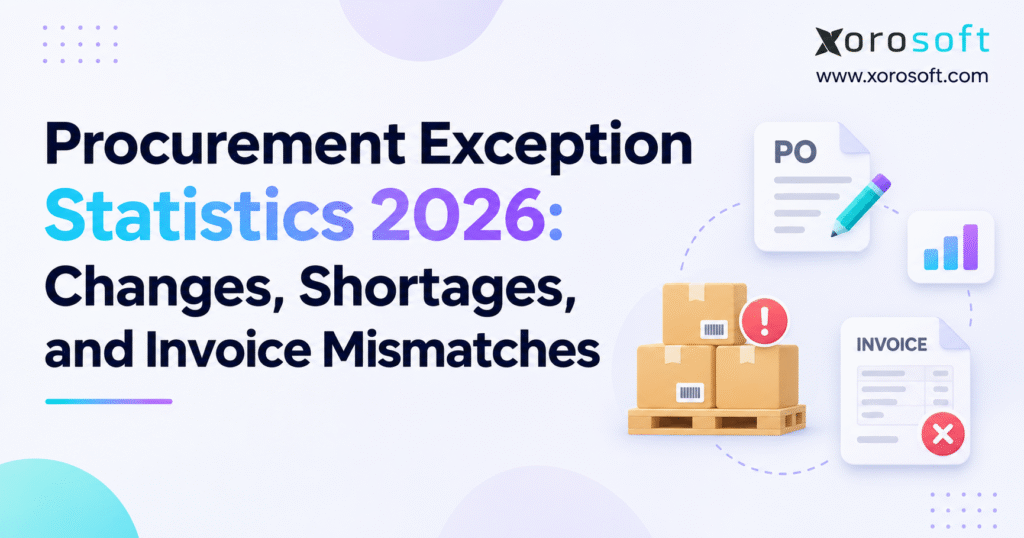
This article explores procurement exception statistics and their impact on organisational processes.
1. Why Procurement Exceptions Matter More in 2026
A purchase order is approved at one price, but the supplier confirms another. A shipment arrives with fewer units than the warehouse expected. The invoice lands in accounts payable before anyone has recorded the difference. None of these events seems serious on its own. Together, they can hurt stock plans, stock counts, payment checks, and customer promises.
The latest procurement exception statistics show why these small gaps matter. In Q3 2026, SourceDay found more changes started by suppliers and poorer delivery results. Ardent Partners also reported that nearly one in five invoices required manual exception handling in its 2026 accounts payable benchmarks. These studies cover different records. Yet they point to the same problem: order details change faster than teams can update them.
A Small Supplier Revision Can Trigger Several Downstream Problems
Consider an apparel distributor waiting for 600 units across several sizes. The supplier reduces one size by 80 units without quick notice. Sales continues to promise stock, receiving prepares for the original quantity, and finance receives an invoice for the full order. The initial issue was a supplier commitment change. The later problems involve inventory allocation, a short receipt, and a possible invoice difference.
Who Needs to Watch These Benchmarks?
Procurement directors need them to evaluate supplier reliability. Warehouse leaders use them to investigate shortages and receipt checks. Controllers need them to understand invoice holds and matching delays. For growing ecommerce, wholesale, and manufacturing businesses, the bigger question is whether teams share the same current purchase-order record.
A monthly exception report is particularly valuable when it can explain what changed between the original supplier promise and the eventual account entry. Without that trail, managers may see the same difference under different labels in purchasing, receiving, and finance. They spend time debating the count instead of addressing the cause.
2. What Procurement Exception Statistics Actually Measure
A procurement exception occurs when an order or related record differs from an approved purchasing rule and needs a check, fix, or approval. This may involve price, quantity, delivery timing, records, or payment terms. Crucially, an exception does not always mean the supplier is at fault. Buyers change plans, shipments are split with approval, and some invoices require normal approval even when their information is correct.
Purchase Order Changes and Supplier Commitments
A purchase order change may affect a header-level agreement or a particular line item. Teams should separate buyer-requested revisions from supplier-initiated ones, and major price or quantity changes from minor record fixes. Otherwise, a metric meant to show unstable supplier plans may simply reflect routine buying work.
Supplier Shortages and Receiving Gaps
A shortage occurs when goods received fall short of the number confirmed as due. A delayed shipment is a timing failure; an incomplete shipment is a quantity failure. It can fail both tests. Approved split deliveries should be evaluated against the latest approved schedule, not counted as short by default.
Invoice Mismatches and Accounts Payable Exceptions
An invoice mismatch occurs when billing differs from the relevant order, receipt, contract, or agreed charges. An accounts payable exception is broader: missing supplier details or records may also require manual intervention. Accurate procurement exception statistics therefore identify the unit of measure. A percentage of changed PO lines cannot be added to a percentage of invoices with exceptions to manufacture a company-wide rate.
When a Change Should Not Count as an Exception
Some organizations reserve the word exception for events that break a defined control, while others track every amendment. Both approaches can work if the definition is explicit. An approved cancellation or scheduled partial shipment might count as an order change but not as a rule breach. Keep these groups apart so teams are not afraid to make useful, timely updates.
3. Procurement Exception Statistics 2026: Verified Benchmarks
The most useful 2026 picture comes from several sources rather than one standard benchmark. SourceDay reviews purchase-order lifecycle activity in its supplier network. Ardent Partners studies invoice processing. APQC publishes cross-industry process measures. Each source answers a different question.
Purchase Order Change and Delivery Performance Data
SourceDay’s Supplier Reliability Trends 2026 reported that 36.4% of closed PO lines changed at least once in Q3 2026. Supplier-initiated changes reached 10.9%, up from 8.8% in Q2. Average supplier response time increased from 48.1 to 52.2 hours, and 25.4% of comparable PO lines recorded price increases.
Delivery performance also weakened: on-time delivery moved from 68.4% in Q2 to 66.5% in Q3, while on-time-in-full declined from 66.1% to 63.6%. SourceDay’s findings are network-specific, not averages for all firms.
Invoice Exceptions and First-Pass Matching
In Ardent Partners’ October 2026 AP benchmark summary, 19.9% of invoices required manual exception handling. Straight-through processing stood at 38.3%, with average invoice processing cost of $9.90 and average processing time of 11.6 days.
Separately, APQC reports a 75% cross-industry median for invoice line items matched the first time, and an 85% median for supplier invoices matched to purchase orders. These APQC measures use different samples and are not all based on 2026 data.
| Indicator | Reported figure | Meaning |
|---|---|---|
| Closed PO lines changed at least once | 36.4% | SourceDay, Q3 2026 |
| Supplier-initiated PO changes | 10.9% | SourceDay, Q3 2026 |
| On-time delivery | 66.5% | SourceDay, Q3 2026 |
| On-time-in-full delivery | 63.6% | SourceDay, Q3 2026 |
| Invoice exception rate | 19.9% | Ardent Partners, 2026 |
| Straight-through invoice processing | 38.3% | Ardent Partners, 2026 |
| First-time invoice line matching | 75% median | APQC cross-industry measure |
| Supplier invoice-to-PO matching | 85% median | APQC cross-industry measure |
Read these as separate indicators. None establishes a single overall procurement exception rate, and the differences between them should not be treated as errors or missing transactions.
How to Use Historical and Current Benchmarks Together
For a 2026 article, use SourceDay’s Q3 observations and Ardent’s 2026 AP figures to describe the current operating environment. APQC’s cross-industry medians provide more context but do not prove a trend from one year to the next without a sound set of past data. When publishing a comparison, show the source, sample type, reporting period, and precise calculation beside the percentage.
4. Purchase Order Change Rates: Where Procurement Instability Begins
A purchase order captures an agreed intent to buy. When the commitment changes without a clear record, operations must decide which details are current. In a small team, a buyer may remember the latest supplier email. Across thousands of SKUs and several warehouses, memory becomes a costly control mechanism.
Separate Useful PO Changes From Those That Could Be Prevented
Not every amendment is harmful. A buyer may cancel surplus inventory after demand falls, or a supplier may offer a mutually agreed earlier delivery. The useful distinction is whether a change was initiated by the buyer or supplier, approved before execution, and communicated to every affected team. Record the original and revised values instead of overwriting history.
Price, quantity, item swaps, and promised dates should have separate reason codes. For instance, an approved packaging change does not carry the same risk as a supplier cutting the order for a key part two days before production.
Calculate the Purchase Order Change Rate Correctly
PO change rate = POs changed at least once / POs in the defined population × 100.
If 120 of 1,000 issued orders change after approval, the PO-level change rate is 12%. If those orders contain many lines and only 150 of 5,000 total lines change, the line-level rate is 3%. Neither figure is wrong; they measure different populations. State whether the denominator includes issued, active, or closed orders.
For actionable procurement exception statistics, report both the frequency and the reason for changes. A stable overall rate may conceal a growing concentration of high-value price revisions or repeated delivery changes from one supplier.
Use Change Lead Time as an Early Warning
Measure how long before the promised delivery date a supplier reports a revision. A change communicated three weeks ahead offers planners more options than the same change disclosed after the truck is due. Pair change lead time with acknowledgment time and open order value. This exposes preventable surprises without treating every supplier amendment as an equally serious failure.
5. Supplier Shortage Statistics: When Confirmed Quantities Do Not Arrive
Supplier shortages often become visible at receiving, but their causes may begin much earlier. A supplier may run short of parts, swap an item, split a shipment, or fail to share a new production date. Each condition affects how buyers should interpret open purchase orders.
Why On-Time Delivery and OTIF Tell Different Stories
An order arriving on the promised date is not necessarily complete. On-time-in-full, or OTIF, asks whether the shipment meets both timing and quantity rules. SourceDay’s Q3 2026 figures were 66.5% on-time and 63.6% OTIF. The gap suggests that assessing dates alone can overlook quantity problems; it is not a direct industry-wide shortage rate.
A useful supplier scorecard preserves separate measures for late arrivals, shortages, and full delivery. That separation matters when negotiating service expectations or deciding whether to qualify a backup supplier.
Measure Short Deliveries Without Misclassifying Partial Shipments
Unit shortage rate = units missing against confirmed due quantity / units confirmed due × 100.
Suppose 500 units are due today and 450 arrive. The unit shortage rate is 10%. Yet if the supplier and buyer had approved 450 units today and the remaining 50 next week, the current delivery may be fully compliant. The receiving record must reflect the agreed schedule, not only the original order total.
A separate short-line rate counts PO lines delivered below the confirmed due quantity. Units and lines should not share a single denominator. These details make procurement exception statistics useful for supplier coaching rather than misleading comparisons.
How a Short Receipt Affects Stock
Short deliveries can force allocations to be reconsidered, increase backorders, or trigger rush restocking. Recording expected quantity as physically received creates another problem: the system now promises stock the warehouse does not hold. The best rule is to record actual receipts, track the open balance, and update availability after verification.
Separate Goods Received From Goods Accepted
Delivered quantity is not always usable quantity. A shipment may arrive in full but contain damaged goods or items that fail inspection. In that case, a receiving report should preserve shipped quantity, physically received quantity, rejected quantity, and accepted quantity. This distinction is essential in food, manufacturing, and products with strict quality rules. It also prevents teams from explaining every inventory variance as a supplier shipping shortage.
6. Invoice Mismatch Statistics: The Last Checkpoint in Procure-to-Pay
The accounts payable team often discovers differences created elsewhere. An invoice may be correct under a newly negotiated supplier price, yet fail matching because purchasing never updated the approved order. A warehouse may have unloaded goods but not posted a receipt. Neither situation is solved by changing an invoice number or rushing payment approval.
What the 19.9% Invoice Exception Benchmark Means
Ardent Partners’ 2026 invoice exception figure means nearly one in five invoices in its benchmark required manual exception handling. It does not mean that 19.9% contained fraudulent charges, nor does it reveal the percentage attributable specifically to price or quantity mismatches. Those categories require a company’s own reason-code data.
Similarly, the 38.3% straight-through processing rate measures invoices completed without human touches. Invoices requiring routine approval may fail the straight-through test without having a difference. Reliable procurement exception statistics keep those concepts separate.
Two-Way, Three-Way, and Four-Way Matching
| Method | Records compared | Practical use |
|---|---|---|
| Two-way matching | PO and invoice | Defined purchases where receipt validation is not needed |
| Three-way matching | PO, goods receipt, invoice | Physical inventory purchases |
| Four-way matching | PO, receipt, invoice, inspection or acceptance | Goods requiring formal quality sign-off |
For a common three-way example, a buyer orders 500 units at $20 each. The warehouse accepts 450, but the supplier invoices 500. The $10,000 invoice exceeds the $9,000 value supported by the receipt by $1,000, before other charges. The right response depends on payment terms and whether the missing units will arrive. Either way, the reason for the gap and its final fix must be recorded.
Match Tolerances Must Reflect Business Risk
A tiny rounding difference is not equivalent to a substantial quantity variance. Define tolerances by type, amount, product risk, and approval authority. Taxes, freight, currency conversion, and unit-of-measure changes may need their own logic. Do not clear a mismatch merely because it falls below a convenient number; an exception can be small in cost terms but important for stock counts.
Close the Loop With Supplier Credits and Open Balances
Resolving a mismatch may require more than approving or rejecting an invoice. Purchasing may need a revised PO, receiving may need a correction, and the supplier may owe a credit memo. Keep the disputed amount, approved amount, remaining quantity, and final settlement linked to the case. Otherwise, an apparent AP fix can leave an incorrect open order or supplier balance behind.
7. Calculating Procurement Exception Statistics That Teams Can Trust
A dashboard becomes useful when everyone agrees on definitions. Purchasing may count purchase orders, receiving may count receipt lines, and finance may count invoices. Their rates can coexist, but they must not be combined casually.
Six Core Procurement Exception KPIs
| KPI | Basic calculation | Best owner |
|---|---|---|
| PO change rate | Changed POs / eligible POs | Purchasing |
| Supplier-initiated line change rate | Supplier-changed lines / eligible PO lines | Supplier management |
| Short-line rate | Short lines / lines due | Receiving and purchasing |
| Invoice exception rate | Invoices requiring handling / invoices processed | Accounts payable |
| First-pass match rate | Items matched initially / items checked | Accounts payable |
| Average time to fix | Total time to close / closed exceptions | Shared process owner |
All percentages multiply the stated ratio by 100. The line-based measures require the same line definitions in numerator and denominator. For time to fix, define whether the clock stops at a short-term fix or only when the underlying record is corrected.
Prevent Double-Counting Across the Exception Lifecycle
Consider an order revised twice, delivered partially, and later disputed on its invoice. It might generate four change events, one short receipt, and one invoice exception. A transaction-level dashboard should still count only one affected PO when calculating the percentage of POs with at least one exception.
For better procurement exception statistics, keep an event log alongside a transaction summary. The event log helps diagnose recurring causes; the summary supports stable management reporting. Both should retain dates, affected quantities, monetary exposure, reason codes, and the responsible team.
Compare Like-for-Like Periods
Monthly percentages can move simply because order volume or supplier mix changes. Compare the same transaction type across periods and disclose major shifts such as a new warehouse opening, seasonal buying surge, or supplier transition. For lower-volume suppliers, show both the rate and the number of affected orders. That helps prevent needless follow-up based on one short period.
Segment Results Before Setting Targets
Compare suppliers by product category, lead time, and shipment difficulty. A vendor supplying custom furniture cannot always be assessed using the same tolerance as a domestic commodity supplier. Likewise, one warehouse’s high exception count may reflect greater volume rather than weaker performance. Use normalized rates, aging, cost, and risk together instead of ranking teams by raw incident counts.
8. What Procurement Exceptions Actually Cost
The visible mismatch amount is often only part of the expense. A $200 invoice difference may require hours of supplier communication, warehouse checks, managerial approvals, and accounting adjustments. A short shipment can disrupt a promotion or delay production even when the missing goods have relatively little purchase value.
Build an Exception Cost Model From Your Own Workload
Start with the number of cases, average handling time, and fully loaded labor cost. Suppose a company resolves 300 exceptions monthly, spending an average of 35 minutes on each. That equals 175 labor hours. At an illustrative $35 per hour, handling effort costs $6,125 per month, before freight, lost sales, or supplier penalties.
Monthly labor cost = number of exceptions × average hours per exception × loaded hourly rate.
This is an example calculation, not an industry benchmark. Ardent’s reported $9.90 average cost per invoice measures overall processing cost; it should not be added by default to this example as incremental exception labor.
Trace the Financial Effects Beyond Accounts Payable
Shortages may lead to emergency purchases, split shipments, higher carrier charges, or missed customer promises. Supplier price revisions can reduce margins if sales pricing does not adjust. Incorrect receipts can distort inventory valuation and the timing of accruals for goods received but not yet invoiced.
Finance should separate actual write-offs, extra handling costs, and possible lost sales. Those categories should not be added together without checking for overlap. Good procurement exception statistics show money at risk by cause, not only the number of invoices waiting in a queue.
Account for Timing and Materiality
An invoice held for two days may be unimportant if payment remains within agreed terms. The same delay can become material when it blocks a key supplier release or forfeits an agreed discount. Track both elapsed days and the business consequence. Avoid assigning speculative lost-revenue amounts to every shortage; use actual canceled orders or clear what-if assumptions.
Use Severity, Not Just Frequency, to Prioritize
A hundred minor record issues may be less urgent than one shortage of a key production part. Define severity using monetary value, customer impact, production risk, aging, and compliance rules. The result is a more useful prioritization model than sorting every exception by date alone.
9. Why Procurement Exceptions Keep Returning
Repeated mismatches often arise from a process weakness rather than an unusually careless employee. Teams may have clear individual procedures but no clear way to keep supplier commitments, receipts, and invoices synchronized across departments.
Email Commitments That Never Reach the Approved PO
A supplier revises a delivery date by email, purchasing agrees, and the warehouse still expects the original shipment. If the order record is not updated, a perfectly legitimate change looks like a supplier failure when the goods arrive. Save the approved commitment history and distribute changes to the teams that depend on it.
Receiving Delays That Produce False Invoice Holds
Goods may arrive late Friday, while the receipt is entered Monday. An invoice posted during that interval can fail matching because the system sees no receipt. Incomplete barcode scans, incorrect units of measure, or receiving against the wrong PO line produce similar effects. Fixing the invoice without fixing the receipt leaves the root cause intact.
Disconnected Reporting Makes Root Causes Hard to See
A 2026 survey of 425 supply chain professionals by the Institute for Supply Management and Amazon Business found that 65% of organizations still relied on manual supply-chain reporting. Only 45% said they were prepared for disruptions. Those findings are broader than procurement exceptions, but they illustrate the visibility problem that makes review slower.
When reports are assembled from separate spreadsheets, procurement exception statistics can become a debate over which export is correct. A shared definition, clear ownership, and traceable transaction history are more important than producing a visually impressive dashboard.
10. Reducing Procurement Exception Rates Before Problems Spread
The most effective interventions happen at the point where an error originates. Faster accounts payable processing helps, but it cannot repair an unapproved supplier commitment or create inventory that never arrived.
Improve Order Quality and Supplier Acknowledgments
Validate item codes, pack sizes, units of measure, prices, delivery addresses, and agreed dates before releasing purchase orders. Ask suppliers to acknowledge important lines and report exceptions before the shipment window closes. For critical items, use earlier confirmation checkpoints rather than waiting until the expected receipt date.
Procurement teams can also compare supplier performance with forecasted demand and open commitments. Xorosoft’s XoroONE cloud ERP brings purchasing, inventory, forecasting, warehousing, and accounting into a connected business system. The value of that connection depends on keeping master data and approved terms correct.
Record Shortages at the Receiving Point
Receiving staff should record actual quantities and separate damaged, rejected, and backordered goods. Barcode workflows can reduce manual entry mistakes, but a scan is only as reliable as the item and order mapping behind it. When differences are recorded promptly, purchasing can contact the supplier while evidence is fresh.
For operations with multiple locations, XoroWMS supports receiving, barcode scanning, and warehouse inventory visibility. Businesses still need clear operating rules for partial receipts, substitutions, quality holds, and inventory adjustments.
Set Clear Invoice Matching and Escalation Rules
Require invoice identifiers, matching PO references, and recorded approval for material price changes. Route differences to the function able to resolve their cause: purchasing for revised commercial terms, receiving for quantity evidence, and accounts payable for billing validation. Establish follow-up times for high-value or aging cases.
These controls reduce avoidable rework while preserving appropriate accounting review. Stronger procurement exception statistics can then reveal whether fewer problems are arising or employees are merely closing them faster.
11. Manual Tracking, Purchasing Software, and Integrated ERP Compared
Technology choices should follow business difficulty, not the size of a vendor’s feature list. A company processing a few dozen straightforward orders may manage exceptions with disciplined procedures and clear spreadsheets. The approach becomes harder as the number of suppliers, warehouses, SKUs, and accounting dependencies grows.
Compare the Operating Models
| Decision factor | Manual tracking | Focused purchasing system | Integrated ERP |
|---|---|---|---|
| PO revisions | Email and spreadsheet updates | Structured order records | Order data linked with wider operations |
| Short receipts | Warehouse notes or separate files | Depends on receiving integration | Connected inventory and receiving records |
| Invoice matching | Manual comparison | Depends on AP integration | Purchasing and accounting within shared workflows |
| Cross-location reporting | Manual consolidation | Varies by product | Central reporting across locations |
| Change management | Simple at low volume | Moderate | More planning and configuration |
An integrated system is not always the right answer. Existing focused tools may be sufficient when integrations remain stable, controls are recorded, and exceptions are resolved promptly.
Evaluate Connections Before Replacing Everything
When multiple systems are needed, map how approved POs, goods receipts, supplier invoices, and inventory balances move between them. Xorosoft publishes its supported ERP and WMS integrations for organizations reviewing connections across ecommerce, logistics, finance, and wholesale workflows. Verify the specific connector, data direction, and exception-handling behavior during evaluation rather than assuming every integration works identically.
Know When Purchasing Complexity Justifies an ERP Upgrade
Warning signs include manual month-end stock checks, repeated invoice holds, poor visibility of open PO balances, and stock conflicts across locations. XoroERP is one option for businesses needing purchasing, accounting, warehouse, and reporting information in a common environment. The business case should compare measurable rework, setup effort, process changes, and ongoing ownership, not promise that software eliminates supplier shortages.
Include Implementation Effort in the Comparison
An integrated platform can simplify data movement while introducing work during migration and process redesign. Assess supplier master-data cleanup, item mapping, opening PO balances, employee training, and financial controls. Run sample scenarios covering a revised price, partial delivery, credit memo, and month-end accrual. A convincing demonstration should show what happens when a transaction goes wrong, not only when all records match.
12. Procurement Exceptions Across Wholesale, Ecommerce, and Manufacturing
An identical transaction mismatch can produce very different consequences across industries. Segmenting procurement exception statistics by operating model helps teams set clear priorities rather than importing a single industry target.
Wholesale and Multi-Warehouse Distribution
A wholesale distributor may receive 900 units against a 1,000-unit commitment while customer allocations already assume full delivery. The issue is not simply a 100-unit shortage; it is which customers, warehouses, and dates were relying on that stock. Accurate open-order balances and location-level availability are essential to a workable recovery plan.
Apparel, Sporting Goods, and Shopify Operations
An apparel shipment may contain the correct total number of units but the wrong size assortment. A receiving gap needs SKU-level detail, not just carton totals. Merchants selling through Shopify must also consider how revised availability affects online orders and customer promises.
The Xorosoft ERP app on the Shopify App Store describes integrations for Shopify orders, product data, inventory, and financial operations. These connections can be relevant when investigating how a short receipt flows into multichannel availability. Teams should still test their own order, inventory, and cancellation scenarios.
Furniture, Food, and Manufacturing Requirements
Furniture purchasing often combines long lead times, supplier revisions, and bulky partial deliveries. Food businesses may need to separate accepted units from goods rejected during quality checks. Manufacturers face component shortages that can stop production even when most materials are available.
Xorosoft’s industry coverage spans these inventory-driven environments. The lesson is to adapt the exception reason codes, approval thresholds, and performance measures to the day-to-day work rather than applying the same workflow everywhere.
13. Supplier Scorecards That Turn Procurement Exception Statistics Into Decisions
A supplier scorecard should support conversations about service, risk, and next steps. Publishing a percentage without a clear definition can create arguments instead of improvement, especially when deliveries involve multiple lines and agreed partial shipments.
Combine Delivery Reliability With Order Stability
Track on-time performance, OTIF, short-line rates, and supplier-initiated changes separately. Include response times and recurring price revisions when they affect planning. Review trends over several periods; one bad quarter may reflect temporary disruption rather than a long-term performance decline.
If one supplier handles only a few orders, show transaction counts alongside percentages. A single failure among four deliveries produces a 25% rate but provides less statistical stability than a comparable rate across hundreds of transactions.
Assign Ownership, Aging, and Reason Codes
Every material exception should have a clear owner, a recorded cause, and a fix deadline. Distinguish supplier correction, buyer approval, receiving adjustment, and invoice credit. Track how long each case remains open and whether the fix changes the underlying records.
For better procurement exception statistics, connect the supplier scorecard with the case log. This shows whether a vendor’s frequent PO revisions actually create shortages or whether recurring invoice holds stem primarily from internal receiving delays.
Avoid Incentives That Hide Problems
Teams measured only on reducing reported exceptions may become reluctant to record them. Equally, buyers rewarded for closing POs quickly might close orders with open balances. Pair exception-rate targets with stock counts, audit completion, and timely fixes. The objective is fewer genuine problems, not fewer visible records.
14. A 90-Day Plan for Better Procurement Exception Performance
A phased improvement program is more practical than replacing every procurement process at once. The first goal is a trustworthy baseline; the second is measurable correction of repeat causes.
Days 1–30: Define and Measure
Agree on what qualifies as a PO change, short receipt, and invoice mismatch. Establish groups of records and baseline rates. Review a sample of closed and open exceptions for data quality. Rank causes by monetary exposure, case age, and customer or production impact instead of raw count alone.
Days 31–60: Correct the Highest-Impact Breakdowns
Focus on two or three recurring issues, such as missing supplier acknowledgments, delayed warehouse receipts, or outdated purchasing prices. Assign ownership and document the revised procedure. Then compare new cases with the baseline using the same definitions. Avoid claiming success when a metric improves only because fewer transactions were recorded.
Days 61–90: Strengthen Controls and Review Results
Introduce approval thresholds, supplier scorecards, or system connections where the evidence supports them. Test changes with real purchasing and receiving transactions before scaling them. Xorosoft customers’ operational case studies can provide examples of connected business processes, but each organization’s business case requires its own baseline and validation.
Review procurement exception statistics monthly after the initial program. Document what improved, which problems remain, and whether exceptions are shifting from one department to another.
15. Use Procurement Exception Statistics to Cut Delays and Rework
Reliable purchasing does not mean suppliers never revise commitments or warehouses never find shortages. It means teams detect differences quickly, understand their consequences, and correct the transaction history before those issues spread into customer orders and finance reports.
Start With Three Actions That Matter
First, measure purchase order changes, supplier shortages, and invoice exceptions separately. Second, make every major difference traceable to the current approved commitment, goods receipt, and financial record. Third, prioritize repeat causes according to cost and business risk, not just incident volume.
When those basics are in place, procurement exception statistics become a management tool rather than another monthly report. Businesses evaluating Xorosoft can use their real PO revisions, short shipments, and disputed invoices to assess how connected purchasing, inventory, warehouse, and accounting processes would operate in practice.
Next step: Contact Xorosoft to discuss a personalized ERP assessment and demonstration. Bring a sample purchasing workflow and a few open exceptions. That provides a concrete basis for identifying which process changes and system capabilities could deliver measurable value.
Frequently Asked Questions
What are procurement exceptions?
Procurement exceptions are order, delivery, or billing differences that require review. Common examples include changed purchase orders, short shipments, and invoices that do not match approved records.
What is the average procurement exception rate?
No universal rate covers all procurement steps. Ardent Partners reported a 19.9% invoice exception rate for 2026, but supplier shortages and PO changes are measured separately.
Why do purchase orders change after approval?
Suppliers may adjust prices, quantities, or delivery dates because of stock shortages, cost changes, or production delays. Approved changes should be recorded and shared promptly.
How do you calculate a supplier shortage rate?
Divide missing units by units confirmed as due, then multiply by 100. Use approved delivery terms so planned partial shipments are not treated as shortages.
What causes invoice mismatches?
Invoice mismatches occur when prices, quantities, or charges differ from purchase orders or goods receipts. Missing receipts and outdated order details can create the same problem.
How does three-way matching reduce invoice errors?
It compares the purchase order, goods receipt, and invoice before payment. Any difference prompts review, helping teams avoid paying for missing goods or unapproved prices.
How can ERP software reduce procurement exceptions?
ERP links purchasing, receiving, inventory, and accounting records. This gives teams a clearer view of changes, cuts duplicate data entry, and helps resolve mismatches sooner.
Recent Posts
-
 How to Calculate True SKU Profitability With Freight, Duties, and Warehouse Costs
-
 Procurement Exception Statistics 2026: Changes, Shortages, and Invoice Mismatches
-
 Native ERP Connector vs Middleware vs Custom API for Shopify
-
 AI Exception Management in ERP: Automating Detection Without Losing Control
-
 What Is Delivery Promise Accuracy and How Should Operations Measure It?