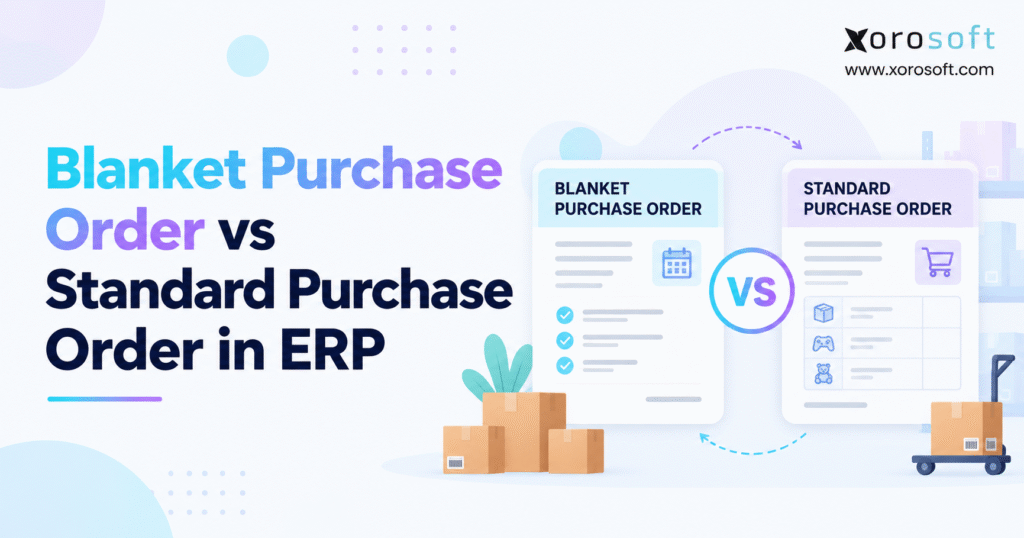
When managing procurement, it’s important to understand the differences between a blanket purchase order vs standard purchase order to choose the right approach for your business needs.
1. Why Purchase Order Decisions Become Complicated as Businesses Grow
A purchasing team may place hundreds of supplier orders every month, yet still struggle to explain how much inventory is coming, what has already been committed, and how much remains available under supplier agreements.
The problem often starts with the purchasing process itself.
When businesses repeatedly order the same products, creating separate purchase orders can increase administrative work. However, switching everything to long-term agreements creates different challenges involving supplier commitments, delivery schedules, and financial controls.
Understanding blanket purchase order vs standard purchase order is therefore an important part of building an effective ERP purchasing strategy.
1.1. Why Traditional Purchase Order Management Creates Bottlenecks
Consider a wholesale distributor purchasing packaging materials from the same supplier every two weeks.
Each order requires quantity confirmation, pricing verification, approval, and supplier communication. Meanwhile, warehouse teams need accurate delivery dates, and finance needs reliable purchasing records.
If these activities happen across spreadsheets, emails, and disconnected software, information becomes difficult to reconcile.
As order volume grows, even simple transactions create unnecessary work. Purchasing teams spend more time checking documents and less time managing supplier performance, inventory requirements, and replenishment priorities.
1.2. The Difference Between Purchasing Authority and Actual Demand
A business may negotiate an annual supplier agreement without knowing exactly when it will require every shipment.
For instance, a manufacturer might expect to consume 50,000 components annually. However, production schedules may change every month.
The supplier agreement establishes commercial terms, while individual purchasing releases determine specific delivery requirements.
This distinction matters because an agreement for 50,000 components does not necessarily mean the entire quantity has been ordered for delivery.
Without clear records, inventory planning and financial reporting can incorrectly interpret purchasing capacity as confirmed supply.
1.3. Why ERP Purchasing Controls Matter Beyond Procurement
Purchasing decisions affect warehouse operations, manufacturing schedules, inventory valuation, and cash flow.
A supplier delay can interrupt production. An unnecessary release can create excess stock. An incorrect purchase price can distort product margins.
Therefore, the purchasing system must connect supplier commitments with actual operational events.
The objective is not simply to generate purchase orders faster. Instead, businesses need visibility into what has been agreed, what has been ordered, what has arrived, and what remains outstanding.
2. Blanket Purchase Order vs Standard Purchase Order: Core Definitions
Before comparing workflows, it is important to understand what each document authorizes.
Although both support supplier purchasing, they represent different types of commitments. Their exact treatment may also vary between ERP platforms.
2.1. What Is a Standard Purchase Order in ERP?
A standard purchase order is a formal document specifying a particular purchase from a supplier.
It typically identifies the items, quantities, prices, payment terms, delivery locations, and expected delivery dates.
For example, a sporting goods distributor may issue a standard PO for 800 bicycles required for an upcoming promotion.
The order identifies a defined purchasing requirement and provides the supplier with instructions for fulfillment.
Standard POs can support partial shipments, amendments, and multiple receipt transactions. They are not necessarily limited to a single delivery.
2.2. What Is a Blanket Purchase Order in ERP?
A blanket purchase order establishes terms for recurring purchases from a supplier over an agreed period.
The arrangement may specify negotiated pricing, item categories, maximum quantities, spending limits, delivery conditions, and expiration dates.
Instead of negotiating each transaction separately, purchasing teams issue releases or linked purchase orders against the agreement.
A furniture manufacturer, for example, might negotiate annual pricing for upholstery fabric and order smaller quantities throughout the year.
This makes blanket purchasing particularly useful where supplier relationships are stable but exact delivery requirements change.
2.3. Blanket Purchase Orders vs Contracts and Standing Orders
The terms blanket PO, standing order, planned PO, and contract purchase agreement are sometimes used interchangeably. However, ERP vendors may distinguish them.
Oracle Procurement documentation separates purchase orders, blanket purchase agreements, and contract purchase agreements.
A blanket agreement commonly defines products and pricing before individual delivery schedules are known. A contract purchase agreement may establish commercial terms without identifying every future item.
Consequently, any blanket purchase order vs standard purchase order comparison should begin with the terminology supported by the organization’s ERP and supplier contracts.
3. Blanket Purchase Order vs Standard Purchase Order: Key Differences
The most important differences involve purchasing frequency, supplier pricing, commitment limits, delivery timing, and transaction controls.
Neither purchase order type is inherently more efficient. The correct choice depends on the business process.
3.1. Blanket PO vs Standard PO Comparison Table
| Comparison factor | Standard Purchase Order | Blanket Purchase Order |
|---|---|---|
| Primary purpose | Specific purchasing transaction | Recurring purchasing arrangement |
| Purchasing frequency | Individual orders | Multiple releases over time |
| Supplier pricing | Agreed for the order | Often negotiated for a defined period |
| Quantity | Defined order quantity | Agreement quantity or purchasing limit |
| Delivery timing | Specified for the order | Determined through releases or schedules |
| Approval | Usually per order | Agreement approval plus release controls |
| Inventory visibility | Based on recognized open orders | Depends on released orders and ERP settings |
| Supplier invoicing | Matched to orders and receipts | Often matched to linked orders and receipts |
| Validity | Until fulfilled, canceled, or closed | Defined agreement period |
| Main risk | Repetitive purchasing administration | Uncontrolled commitments or releases |
The table provides a general operating comparison. Actual controls depend on software configuration and contractual requirements.
3.2. When Standard Purchase Orders Offer Better Control
Standard POs are generally suitable when purchasing requirements are clear and transactions are relatively independent.
A retailer purchasing seasonal display equipment may not need a year-long supplier arrangement.
Similarly, a manufacturer sourcing a custom component for a specific production order may prefer a standard PO.
Each transaction can be evaluated separately, making it easier to review unique pricing, quantities, and delivery requirements.
However, repeatedly creating standard POs for identical products can increase administrative work when the supplier relationship becomes predictable.
3.3. When Blanket Purchase Orders Become More Practical
Blanket agreements are useful when businesses repeatedly purchase the same products under consistent commercial terms.
They can reduce repeated price negotiations while allowing purchasing teams to release quantities according to operational demand.
Nevertheless, a blanket arrangement requires additional monitoring.
Organizations must track remaining purchasing capacity, agreement expiration, approved releases, and supplier pricing changes.
The real value of blanket purchase order vs standard purchase order selection comes from matching each method to the frequency and predictability of the purchasing requirement.
4. How Standard Purchase Orders Work in ERP Systems
A standard purchase order follows a defined transaction lifecycle.
Although terminology differs across platforms, the process generally moves from identifying demand to approving, ordering, receiving, invoicing, and closing the transaction.
4.1. Purchase Requisition and Approval Workflow
The process often begins when inventory planning, manufacturing, or a department identifies a purchasing requirement.
An employee creates a requisition specifying the products, quantities, required dates, and business purpose.
Purchasing then checks supplier availability, contracted prices, budget authority, and existing open orders.
After approval, the ERP creates or authorizes the standard PO.
Approval rules should reflect spending thresholds and purchasing responsibilities. For example, routine replenishment may follow a different approval path than expensive equipment purchases.
4.2. Supplier Confirmation and Purchase Order Changes
After issuance, the supplier reviews the order and confirms whether it can meet the requested quantity and delivery date.
If the supplier changes its price or cannot fulfill the complete quantity, the buyer should record the approved adjustment.
This matters because the original purchase order represents the company’s authorized purchasing terms.
Uncontrolled changes can create disputes during receiving and invoicing.
The ERP should preserve relevant transaction history, including amended quantities, revised delivery dates, canceled lines, and pricing approvals.
4.3. Receiving, Partial Deliveries, and Order Closure
When inventory arrives, warehouse staff record the received quantity against the appropriate PO.
Suppose a business orders 1,000 units but receives only 700.
The remaining 300 units should stay identifiable as outstanding unless they are canceled or otherwise closed.
Finance can then match supplier invoices to approved orders and accepted receipts.
A purchase order should be closed only after the organization has resolved outstanding delivery, billing, and cancellation requirements.
These controls are equally important when comparing blanket purchase order vs standard purchase order workflows.
5. How Blanket Purchase Orders Work Through ERP Releases
Blanket purchasing introduces a supplier agreement before the individual purchasing transaction.
That additional layer can simplify recurring procurement, provided the ERP maintains a clear relationship between the agreement and each release.
5.1. Creating a Blanket Purchase Agreement
The purchasing team first negotiates supplier terms.
These may include products, approved prices, volume limits, contract dates, minimum order quantities, freight responsibilities, and payment conditions.
Once approved, the ERP stores the agreement as the reference for future purchasing activity.
For example, a manufacturer may negotiate an annual agreement for aluminum components at a fixed unit price.
However, approval of the agreement should not automatically mean that every component must be delivered immediately.
The actual obligation depends on the contract terms and subsequent orders.
5.2. Releasing Individual Orders Against the Agreement
When replenishment is required, purchasing creates a release or linked purchase order.
The release identifies the actual quantity, delivery location, and timing.
NetSuite’s blanket purchase order documentation explains that its blanket PO is a non-posting transaction. Linked purchase orders are created through releases.
This distinction illustrates why the blanket purchase order vs standard purchase order workflow must separate commercial authorization from operational fulfillment.
The release should also update the appropriate remaining agreement balance, allowing buyers to monitor what purchasing capacity remains.
5.3. ERP Differences in Blanket Order Processing
Not every ERP handles blanket releases identically.
Some platforms generate purchase orders from scheduled releases, while others require buyers to create orders manually.
For example, Microsoft’s Business Central purchasing guidance describes blanket purchase orders as a way to manage large quantities delivered over multiple shipments.
Before implementation, businesses should confirm whether their chosen system supports automated releases, agreement limits, approval overrides, and supplier price updates.
A feature labeled Blanket Purchase Order does not guarantee that every vendor implements the same business rules.
6. Inventory and Accounting Impact of Blanket vs Standard POs
Purchasing documents influence planning and financial control, but they do not necessarily create inventory or accounting entries when first approved.
Understanding this distinction prevents costly reporting errors.
6.1. Agreement Quantities Are Not Always Incoming Inventory
A purchasing agreement may authorize 20,000 units over a year without confirming when those units will arrive.
Therefore, the full agreement quantity should not automatically appear as expected warehouse stock.
In many systems, the approved release or linked order creates the relevant incoming supply record.
This difference is critical for demand planning.
If the ERP treats unreleased blanket quantities as confirmed incoming inventory, it may underestimate replenishment requirements and create stockout risks.
The correct blanket purchase order vs standard purchase order configuration must distinguish agreement authority from recognized supply.
6.2. Purchase Orders, Inventory Receipts, and Accounting Entries
A purchase order generally documents an approved transaction before the goods arrive.
Depending on accounting policies and system design, inventory and financial postings occur when receipts, invoices, or other relevant transactions are processed.
For example, a warehouse receipt may increase recorded inventory while creating an accrual for goods received but not yet invoiced.
Subsequent invoice processing can reconcile the supplier liability and any applicable differences.
An integrated cloud ERP system such as Xorosoft helps connect purchasing, inventory, warehouse activity, and financial information.
Still, companies must verify their actual posting rules during implementation.
6.3. Three-Way Matching and Invoice Variances
Three-way matching compares the purchase order, goods receipt, and supplier invoice.
For standard POs, the process checks whether the supplier billed the authorized price and quantity.
For blanket purchasing, finance may also need to confirm that the linked order follows the parent agreement.
Suppose a supplier invoices 1,000 units while the warehouse has accepted only 800.
The system should identify the difference according to configured matching tolerances.
Freight, duties, taxes, and other landed-cost adjustments may also require separate treatment.
Accurate purchasing records therefore support both inventory valuation and reliable accounts payable reconciliation.
7. Blanket Purchase Order Example: Releases, Balances, and Cash Flow
A numerical example demonstrates why blanket agreement balances, released quantities, and received inventory must remain separate.
The following figures are hypothetical and expressed in US dollars.
7.1. Annual Supplier Agreement with Multiple Releases
A wholesale distributor negotiates an agreement covering up to 12,000 units at $15 per unit.
The maximum agreement value is $180,000.
Rather than purchasing everything immediately, the distributor releases inventory as demand develops.
| Purchasing event | Units released | Release value | Cumulative units |
|---|---|---|---|
| January release | 2,500 | $37,500 | 2,500 |
| March release | 2,000 | $30,000 | 4,500 |
| May release | 3,000 | $45,000 | 7,500 |
| Total released | 7,500 | $112,500 | 7,500 |
The distributor has used part of its purchasing allowance while preserving capacity for future replenishment.
7.2. Calculating Remaining Blanket PO Quantity and Value
For this fixed-price, maximum-quantity agreement:
Remaining quantity = Agreement quantity − Net released quantity
12,000 − 7,500 = 4,500 units
Remaining agreement value = Approved agreement value − Net released value
$180,000 − $112,500 = $67,500
The agreement utilization rate is:
7,500 ÷ 12,000 × 100 = 62.5%
However, these calculations assume unchanged prices and no amendments or cancellations.
If the supplier has delivered only 6,800 units, another 700 released units remain outstanding for receiving.
Therefore, released quantity and received quantity must appear separately in purchasing reports.
7.3. Comparing the Same Requirement with Standard POs
Now assume the distributor places three independent standard POs for the same quantities.
The financial totals could be identical, but each order would have its own approval, pricing, confirmation, and receiving history.
Blanket purchasing may reduce repeated negotiation when terms remain consistent.
However, it introduces responsibility for maintaining agreement validity, pricing, and unused commitments.
This explains why the blanket purchase order vs standard purchase order decision should consider administrative effort alongside financial and operational control.
A blanket agreement does not automatically reduce total spend. Savings depend on supplier terms, purchasing behavior, and process execution.
8. Supplier Pricing, Contract Terms, and Approval Controls
Purchase order structure influences how organizations negotiate supplier terms and protect themselves against uncontrolled purchasing commitments.
The contract must define what is permitted, while ERP controls should support that agreement.
8.1. Negotiated Supplier Pricing and Volume Commitments
Blanket agreements may provide more predictable pricing when businesses expect repeat purchases.
A supplier might agree to lower unit prices in exchange for expected volume, scheduled purchasing, or a minimum commitment.
However, negotiated discounts must be evaluated against inventory carrying costs and the risk of overcommitting.
For example, purchasing 20% more inventory to obtain a small discount may increase storage costs and working capital requirements.
Therefore, businesses should calculate the full purchasing cost rather than focusing only on unit price.
8.2. Spending Limits, Minimum Quantities, and Expiration Dates
A well-controlled blanket agreement should define whether its quantity or value represents a maximum authorization, a minimum purchasing commitment, or an estimate.
These distinctions have different financial implications.
If the buyer is contractually committed to a minimum quantity, declining demand may not eliminate the obligation.
Similarly, an agreement expiration date should trigger review before additional releases are approved.
The ERP should help purchasing teams identify remaining commitments, unused allowances, and agreements approaching expiration.
8.3. Approval Rules for Blanket PO Releases
Approval of a parent agreement should not necessarily authorize every possible release without further review.
Organizations can establish release thresholds based on quantity, value, department, location, or business purpose.
For example, routine releases within approved limits may follow a simplified process.
However, an unusually large release or price exception may require additional authorization.
The system should retain the identity of the approving employee and preserve changes for audit review.
Without these controls, blanket purchasing can become less transparent than standard purchasing.
9. Inventory Forecasting, Warehouses, and Ecommerce Purchasing
The blanket purchase order vs standard purchase order decision becomes more important when inventory moves across multiple locations and sales channels.
Forecasting accuracy depends on knowing which supplier deliveries are confirmed and where the goods will be received.
9.1. Connecting Purchase Releases with Demand Forecasting
Demand planning estimates future inventory requirements using sales history, trends, seasonality, and replenishment lead times.
Blanket agreements can establish supplier pricing and supply arrangements, but forecasts should still drive actual purchasing decisions.
For example, an apparel company may negotiate fabric pricing for the year while releasing material according to confirmed production needs.
If demand falls, purchasing should avoid releasing unnecessary stock merely because unused agreement capacity remains.
Similarly, projected demand increases should be checked against supplier production capacity and realistic lead times.
9.2. Multi-Warehouse Purchase Order Receiving
A company operating several warehouses needs to know which location will receive each order.
Even when multiple locations purchase under the same supplier agreement, the actual release should identify its destination.
Otherwise, inbound stock may be incorrectly attributed to the wrong warehouse.
Xorosoft’s warehouse management system supports receiving and inventory tracking across warehouse operations.
The purchasing process should also account for partial deliveries, goods in transit, damaged stock, and location-specific replenishment requirements.
Agreement balances should never replace accurate warehouse-level receiving records.
9.3. Shopify, Amazon, and EDI Purchasing Requirements
Ecommerce businesses often buy inventory to serve several channels simultaneously.
A Shopify merchant may also sell on Amazon and receive wholesale orders through EDI.
Each channel changes demand, which affects replenishment decisions and supplier requirements.
Consequently, purchasing software must connect sales activity with inventory positions and open orders.
Xorosoft’s ERP integrations cover ecommerce, marketplaces, EDI, and related operational systems.
Shopify merchants can also review the Xorosoft ERP listing in the Shopify App Store when evaluating connected ecommerce operations.
The objective is to prevent channel-specific demand from creating duplicate purchasing or misleading inventory availability.
10. Industry Use Cases for Blanket and Standard Purchase Orders
Different industries require different purchasing arrangements because their products, supplier relationships, and replenishment patterns vary.
The right approach should reflect how inventory is actually sourced and consumed.
10.1. Wholesale Distribution and Repeat Supplier Purchasing
Wholesale distributors frequently purchase standardized products from established suppliers.
Blanket agreements can support recurring replenishment and negotiated pricing.
However, new product launches, unusual customer orders, and irregular supplier relationships may still require standard POs.
For distributors handling thousands of SKUs, accurate release reporting becomes essential.
Purchasing teams need visibility into agreed quantities, confirmed deliveries, outstanding receipts, and supplier performance.
The blanket purchase order vs standard purchase order choice should therefore be evaluated at the supplier and product-category level.
10.2. Apparel, Fashion, Furniture, and Sporting Goods
Apparel brands may purchase recurring fabrics, trims, labels, and packaging under negotiated agreements.
However, limited-edition styles or seasonal collections may require separate standard orders.
Furniture businesses face similar differences. Common hardware and materials may suit blanket purchasing, while custom components and special finishes may not.
Sporting goods distributors may also use standard orders for one-time promotional inventory and blanket arrangements for frequently replenished accessories.
The key consideration is whether demand and supplier terms remain sufficiently stable.
10.3. Manufacturing and Raw Material Procurement
Manufacturers often rely on bills of materials, production schedules, and material requirements planning.
Blanket purchasing can support recurring components consumed across multiple production runs.
However, the agreement itself should not be treated as a substitute for accurate MRP calculations.
Purchasing releases should reflect actual material requirements, safety stock, existing inventory, and confirmed production schedules.
Engineering changes also require attention. A supplier agreement for an obsolete component may need revision before additional orders are released.
Therefore, manufacturing purchasing needs strong coordination between engineering, planning, procurement, and finance.
10.4. Food, Beverage, and Perishable Inventory
Food distributors often require frequent deliveries to maintain freshness and manage storage capacity.
Blanket agreements can establish recurring supplier terms, while releases control when products arrive.
However, shelf life, lot tracking, temperature requirements, and product quality can affect purchasing decisions.
A frozen-food distributor may order several smaller shipments rather than receive an entire annual quantity.
Businesses managing these requirements can compare industry-specific ERP workflows when evaluating inventory and purchasing capabilities.
The purchasing method must support product handling requirements as well as commercial terms.
11. Common Blanket PO and Standard PO Management Mistakes
Many purchasing problems come from incorrect assumptions about document status, supplier agreements, and inventory records.
These mistakes become more expensive as transaction volumes increase.
11.1. Treating Blanket Agreements as Confirmed Incoming Stock
A common error is assuming that the entire quantity on a blanket agreement will arrive automatically.
Suppose a company has an agreement covering 30,000 units but has released only 8,000.
If inventory planning counts all 30,000 as confirmed inbound stock, the business may delay necessary replenishment.
That error can create shortages despite apparently healthy inventory reports.
The correct approach is to distinguish agreement capacity, purchase releases, supplier confirmations, and actual warehouse receipts.
This distinction is central to any reliable blanket purchase order vs standard purchase order implementation.
11.2. Losing Control of Supplier Prices and Agreement Changes
Another problem occurs when supplier pricing changes during the agreement period.
Existing purchase orders may retain original prices while later releases use revised terms.
For example, NetSuite documents that changing a blanket purchase order’s item rate does not automatically update existing linked purchase orders.
Therefore, buyers need a clear amendment process.
Purchasing and finance should agree on how price changes, freight adjustments, currency movements, and exceptions are handled.
Otherwise, invoice matching may identify discrepancies that could have been prevented during ordering.
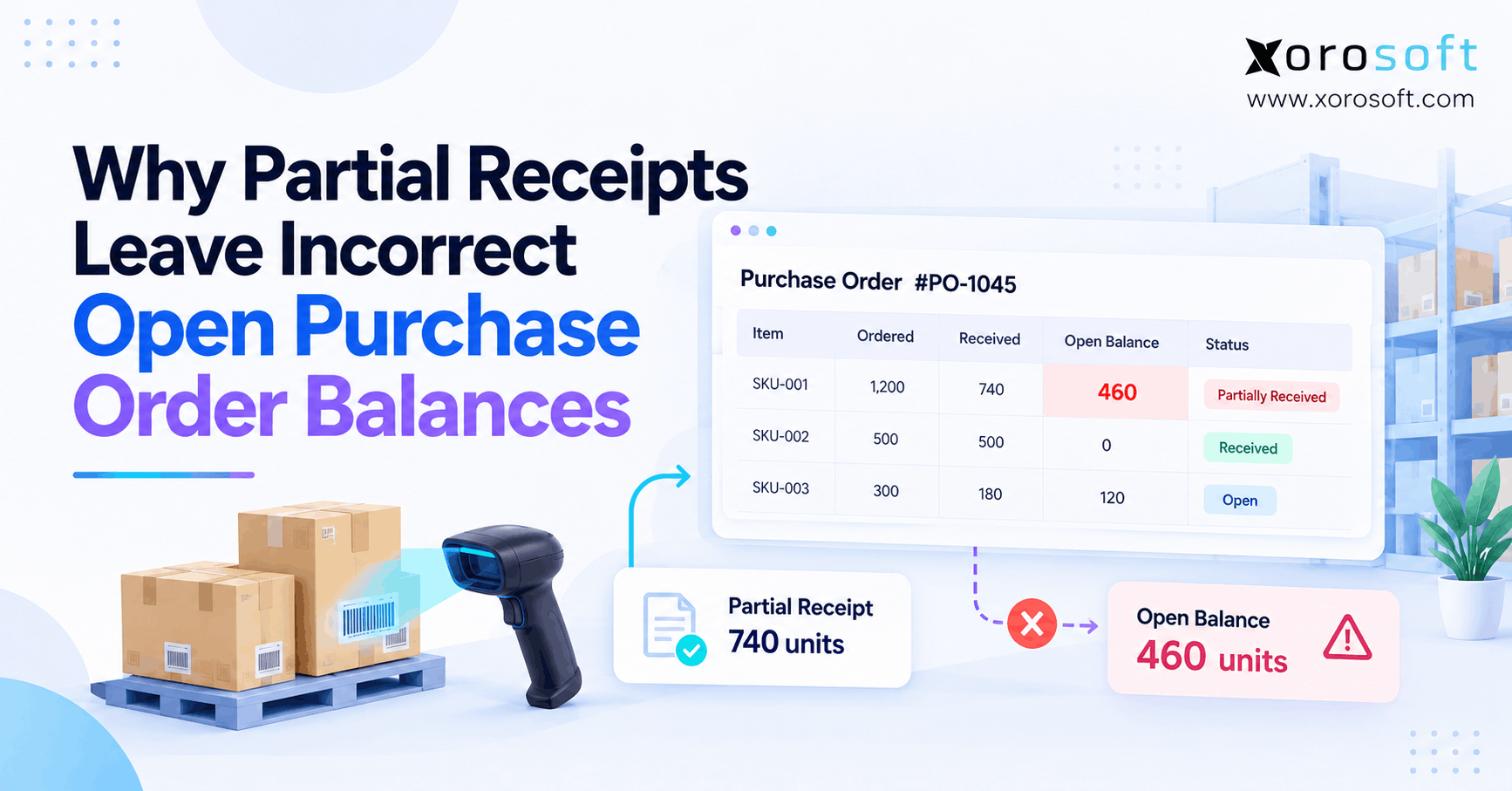
11.3. Ignoring Partial Receipts, Cancellations, and Open Balances
Purchasing reports become unreliable when canceled quantities, partial deliveries, and returns are not recorded consistently.
A buyer might believe that 1,000 units remain available under an agreement, while another department has already issued an unrecorded release.
Similarly, the warehouse may receive products against the wrong order.
These errors create inaccurate open balances and disputed supplier invoices.
Regular reconciliation should compare agreement balances, released orders, accepted receipts, vendor bills, and outstanding exceptions.
The process should identify discrepancies before they affect inventory planning or month-end accounting.
12. Choosing the Right Purchase Order Type for Your Business
The blanket purchase order vs standard purchase order decision should follow a consistent purchasing policy rather than individual buyer preference.
Organizations can create rules based on purchasing frequency, supplier arrangements, operational risk, and system capability.
12.1. Five Questions That Determine the Best Purchasing Method
Start by examining how often the business buys the same products.
Next, determine whether supplier pricing can be negotiated for a longer period.
Then assess whether delivery quantities and dates are predictable.
The fourth consideration is whether individual purchasing releases require separate approvals.
Finally, verify that the ERP can track agreements and actual transactions without mixing their balances.
If repeat purchases are frequent and supplier terms remain stable, blanket purchasing may be appropriate.
If requirements vary substantially, standard orders generally provide a clearer transaction-level structure.
12.2. Why a Hybrid Purchasing Policy Often Works Best
Most inventory-driven businesses need both purchasing methods.
A manufacturer may use blanket agreements for regularly consumed components but standard POs for specialized machinery.
A wholesale distributor may establish annual supplier pricing while issuing individual orders for new or seasonal products.
The objective is not to convert every supplier into a blanket agreement.
Instead, procurement should identify categories where recurring purchasing benefits from negotiated terms without creating unnecessary commitments.
The strongest policy allows purchasing methods to vary according to supplier and product characteristics.
12.3. Measuring Whether Your Purchasing Policy Works
After implementing purchasing rules, organizations should monitor purchasing exceptions, approval time, supplier performance, invoice discrepancies, and open-order accuracy.
For blanket arrangements, additional measures include agreement utilization, expired agreements, unauthorized releases, and unused commitments.
For standard POs, review recurring administrative work and repeated purchases that might benefit from supplier agreements.
Platforms such as XoroONE are relevant to businesses evaluating connected purchasing, inventory, and accounting processes.
However, purchasing improvements should be measured against operational outcomes rather than software feature counts alone.
13. Evaluating ERP Software for Blanket and Standard Purchase Orders
Selecting the right ERP requires more than confirming that the product includes purchase order management.
The software must support actual supplier agreements, operational approvals, inventory records, and accounting requirements.
13.1. Test the Complete Purchasing Workflow Before Buying
During ERP evaluation, ask the vendor to demonstrate a complete purchasing scenario.
Begin with a supplier agreement containing negotiated pricing, an expiration date, and a purchasing limit.
Then create two releases against that agreement.
Receive only part of the second order and process an invoice with a price discrepancy.
Finally, review the remaining agreement balance, outstanding receipt quantity, invoice exception, and approval history.
This exercise reveals whether the system can manage the blanket purchase order vs standard purchase order process under realistic operating conditions.
A simple feature checklist cannot provide the same level of confidence.
13.2. Compare ERP Platforms Using Business Requirements
Different ERP platforms may support similar purchasing concepts through different workflows.
NetSuite, Microsoft Dynamics 365 Business Central, Acumatica, and other platforms should be assessed according to actual business requirements.
Companies evaluating Xorosoft can also review its comparison with NetSuite as one reference point.
However, vendor comparison pages should not replace independent testing.
A useful evaluation should examine purchasing releases, multi-warehouse receiving, invoice matching, approval flexibility, reporting, implementation effort, and total operating costs.
The preferred solution is the one that supports the required processes reliably.
13.3. Reporting, Integration, and AI-Assisted Purchasing Analysis
Modern purchasing teams increasingly need faster access to operational information.
Managers may want to identify overdue supplier orders, compare price changes, review agreement utilization, or detect inventory shortages.
Traditional reports can provide this information, but connected analytics may reduce the need to reconcile multiple systems manually.
For example, the Xorosoft MCP Server describes permission-aware access to ERP purchasing information through supported AI tools.
Businesses should still validate data permissions, approval authority, and transaction accuracy before enabling automated purchasing actions.
Useful AI insights depend on reliable underlying ERP records.
14. Build a Purchasing Policy That Supports Long-Term Growth
Choosing between blanket and standard purchase orders is ultimately a question of purchasing control.
The correct method should make supplier commitments easier to understand, inventory deliveries easier to track, and financial records easier to reconcile.
14.1. Review Existing Supplier Agreements and Purchasing Exceptions
Begin by reviewing recent purchase orders, supplier agreements, invoice discrepancies, and delayed deliveries.
Identify products purchased repeatedly under similar terms and transactions that regularly require manual corrections.
Then determine which suppliers are suitable for blanket arrangements and which purchases should remain individually authorized.
Before changing processes, confirm how existing software treats agreement quantities, linked orders, receiving, and accounting.
This audit provides a practical starting point for improving purchasing operations.
14.2. Standardize Controls Before Automating Purchasing
Next, define approval rules, supplier pricing policies, release limits, and agreement expiration procedures.
Use a small pilot involving a recurring supplier and a representative inventory category.
Monitor release accuracy, receiving discrepancies, processing time, and invoice exceptions.
Expand the purchasing policy only after the pilot demonstrates reliable results.
This approach helps businesses benefit from blanket purchasing without introducing new operational risks.
14.3. Take the Next Step Toward Connected ERP Purchasing
A well-designed purchasing system should connect supplier agreements, purchase orders, inventory receiving, warehouse operations, and accounting without unnecessary duplicate work.
For businesses operating multiple warehouses, managing recurring supplier commitments, or outgrowing disconnected purchasing spreadsheets, an integrated ERP evaluation may be worthwhile.
Book a Personalized ERP Consultation
If your team is reviewing purchasing automation or ERP requirements, contact the ERP team to discuss your current purchasing processes.
Bring a recent standard PO, an example supplier agreement, and a receiving or invoice exception. These documents provide a practical foundation for evaluating how the system handles your operations.
The goal is straightforward: choose the right purchase order type, maintain accurate purchasing records, and give every department reliable information for its next decision.
Frequently Asked Questions About Purchase Orders
What is the difference between a blanket PO and a standard PO?
A standard PO authorizes a defined purchase. A blanket PO establishes terms for repeat purchases, typically fulfilled through separate releases or linked orders.
When should a business use a blanket purchase order?
Use one for recurring purchases from a supplier under agreed prices or limits, especially when delivery quantities or dates change over time.
When is a standard purchase order better?
Choose a standard PO for one-time, custom, or clearly defined purchases that need transaction-specific quantities, pricing, and approvals.
How do blanket purchase order releases work in ERP?
An approved release or linked PO specifies what to buy and when. The ERP tracks that transaction against the blanket agreement’s remaining allowance.
Does a blanket purchase order count as incoming inventory?
Not necessarily. Many ERP systems recognize incoming supply from linked orders or releases, rather than from the unreleased blanket agreement itself.
How are blanket PO invoices matched?
Invoices are generally matched to linked purchase orders and receipts, while pricing and limits may also be checked against the parent agreement.
How is the remaining blanket purchase order balance calculated?
Subtract net released quantity or value from the approved agreement limit. Adjust for amendments and cancellations; track receipts and invoices separately.
Recent Posts
-
 Mobile Barcode Inventory Software for Warehouse Receiving and Picking
-
 How an Ecommerce Operator Stress-Tested Inventory Before Holiday Promotions
-
 Purchasing Software for Apparel Wholesalers Managing Seasonal Collections
-
 How to Design an ERP Integration Ownership Matrix for Shopify Operations
-
 ERP vs Accounting Software for SKU-Level Profitability Analysis