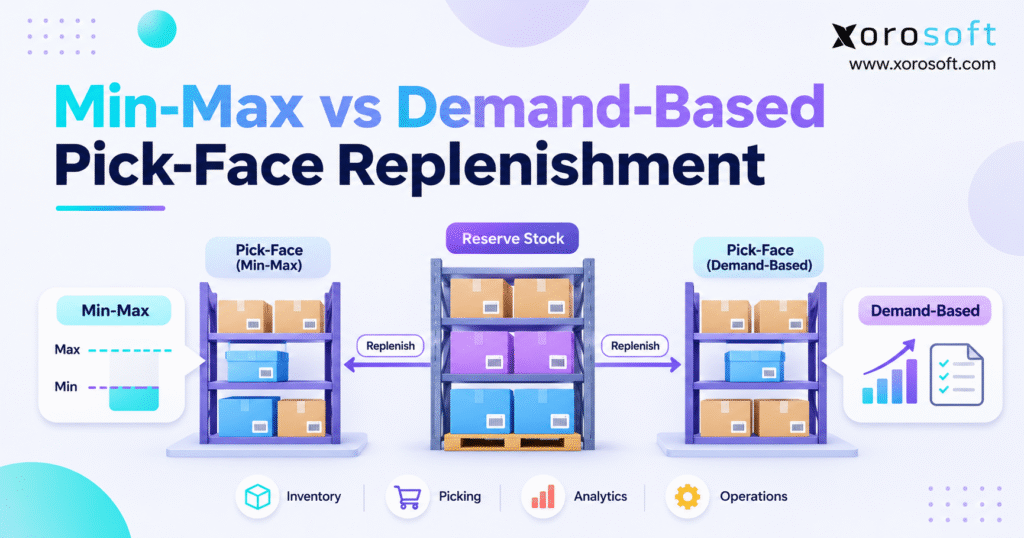
This article will explore different Pick-face replenishment methods and how they impact warehouse operations.
1. Why Fully Stocked Warehouses Still Miss Picking Deadlines
A distribution center can have enough stock to fulfill every order on today’s schedule and still miss its shipping cutoff. Often, the issue is stock placement, not supply. Therefore, the right pick-face replenishment methods make inventory accessible without unnecessary stock movements.
For example, a distributor holds 600 units in reserve and 40 in a forward picking location. Its next wave requires 120 units. Although the building contains enough stock, the pick face has an immediate shortage of 80 units.
1.1 How Empty Pick Faces Interrupt Fulfillment
When the shortage becomes visible only after picking starts, supervisors must interrupt the existing work plan. For example, a worker may wait for a refill, another employee may stop a scheduled transfer, and a partially picked order may occupy packing space. As a result, even a short delay can affect several orders when they share the same SKU.
1.2 The Cost of Keeping Every Bin Full
Filling every bin to its maximum is not always an efficient response. Because forward storage is limited, moving stock that will not sell soon consumes labor and equipment time. A 2025 study of internal warehouse replenishment explored how reserve picking, intermediate buffers and replenishment timing interact in an automotive spare-parts warehouse.
In short, warehouses can maintain thresholds, respond to order demand or combine both. Each approach has different implications for space, handling effort and service reliability.
2. Understanding Pick-Face Replenishment Methods
2.1 What Is Pick-Face Replenishment?
Pick-face replenishment is the internal transfer of inventory from reserve storage to designated picking locations. As a result, it keeps products accessible while balancing space, handling effort and demand. Unlike purchasing replenishment, it redistributes existing stock within a warehouse rather than obtaining additional inventory from suppliers.
A forward location might be a shelf, carton-flow lane or pallet position. By contrast, reserve areas typically hold larger quantities that are less convenient for individual picks. However, this layout works only when refills keep pace with consumption.
2.2 Triggers, Quantities and Transfer Deadlines
All pick-face replenishment methods must define a trigger, transfer quantity, eligible source and completion deadline. Min-max rules use stock thresholds. In contrast, demand-based rules respond to selected order requirements. Meanwhile, a hybrid approach coordinates both signals.
Regardless of the trigger, employees must confirm the movement. Stock assigned to a pending task is not yet physically available at its destination. Therefore, maintaining this distinction prevents the system from promising inventory that workers cannot access.
3. How Min-Max Pick-Face Replenishment Works
3.1 Calculating Min-Max Replenishment Levels
Min-max replenishment uses predefined stock limits. When the applicable inventory position falls below a minimum, a refill normally brings the location toward its maximum target. Specifically, the minimum protects against consumption during the refill interval.
Minimum stock = Expected unit demand per hour × Protection interval in hours + Safety buffer in units
For example, suppose workers pick 20 units per hour. In addition, allow two hours for replenishment and a 20-unit safety buffer. Therefore, the minimum is 20 × 2 + 20 = 60 units.
Also, include review delays, task queues, retrieval, travel and confirmation. If workers check stock only periodically, the interval may be longer than the physical transfer time.
By contrast, the maximum is a target, not permission to exceed safe capacity. For example, a target of 200 and eligible stock of 40 produce a 160-unit refill before constraints.
Table 1. Min-max replenishment rules
| Current units | Minimum | Maximum | Trigger? | Refill units |
|---|---|---|---|---|
| 20 | 60 | 200 | Yes | 180 |
| 40 | 60 | 200 | Yes | 160 |
| 60 | 60 | 200 | No | 0 |
| 100 | 60 | 200 | No | 0 |
| 200 | 60 | 200 | No | 0 |
The example uses a strictly below-minimum trigger and assumes no pending transfers or pack restrictions. However, some systems permit triggers at the minimum as well.
3.2 When Min-Max Replenishment Works Best
Generally, stable consumption makes thresholds easier to maintain. For instance, a wholesaler selling regularly ordered packaging supplies may refill its active bins before the morning shift and repeat the process at planned intervals. As a result, workers can consolidate similar transfers and schedule equipment around picking activity.
3.3 The Risks of Fixed Thresholds
A location might contain 100 units against a minimum of 60 while an upcoming wave requires 180 units. Consequently, the threshold rule creates no work despite the order shortage.
Conversely, slow-moving products present a different problem. In this case, filling bins to the maximum can waste space. Therefore, review thresholds after changes in demand, pack sizes, slotting or lead times.
4. How Demand-Based Pick-Face Replenishment Works
4.1 Using Orders and Picking Waves as Triggers
Unlike fixed-threshold rules, demand-based replenishment responds to selected picking requirements. If a released wave needs 150 units and the assigned pick face contains 90 eligible units, the warehouse identifies a shortage of 60 units.
Microsoft’s replenishment documentation describes wave and load demand replenishment, alongside min-max and immediate replenishment. These are examples of warehouse execution approaches, not a universal specification for every WMS.
In addition, grouping orders makes transfers easier to consolidate. However, the selected wave needs enough lead time for workers to complete stock movements before picking starts. Forecasts can guide preparation for tomorrow’s orders, whereas released requirements provide a more immediate execution signal.
4.2 Calculating Demand-Based Replenishment Quantities
New requirement = Maximum of zero or (Outstanding eligible demand − Eligible pick stock − Eligible pending refills)
All three inputs must refer to the same SKU, warehouse and demand scope. Specifically, credit a pending refill only if it is eligible and due in time. Also, avoid deducting reservations twice.
Table 2. Demand-based replenishment examples
| Demand units | Pick stock | Pending refill | New requirement |
|---|---|---|---|
| 40 | 60 | 0 | 0 |
| 100 | 60 | 0 | 40 |
| 180 | 60 | 40 | 80 |
| 200 | 60 | 100 | 40 |
| 120 | 40 | 100 | 0 |
These figures represent requirements, not necessarily executable transfer quantities. For instance, capacity, reserve stock, handling units and deadlines may limit movement.
4.3 Benefits and Limits of Order-Driven Replenishment
Order-driven rules are especially useful for promotional sales, irregular wholesale orders and products whose demand changes throughout the shift. Consequently, they can reduce transfers with no immediate purpose.
However, unreliable order records can undermine the calculation. For example, a canceled order, stale reservation or delayed update may produce unnecessary work. In addition, very small demand-triggered refills can increase travel and equipment movements.
5. Min-Max vs Demand-Based Replenishment: Operational Differences
5.1 Comparing Pick-Face Replenishment Methods Side by Side
In general, min-max replenishment responds to a stock threshold. In contrast, demand-based replenishment responds to upcoming picking requirements. The first typically aims to maintain a stock range, while the second identifies shortages against selected demand. However, the trigger and refill target are separate decisions for both methods.
Table 3. Min-max vs demand-based replenishment
| Factor | Min-max | Demand-based |
|---|---|---|
| Trigger | Stock threshold | Order requirement |
| Refill target | Defined maximum | Shortage or configured target |
| Demand profile | Stable | Variable |
| Data needs | Stock and thresholds | Stock, orders and allocations |
| Labor scheduling | Often predictable | Depends on order release |
| Promotion response | Threshold review | Eligible order signal |
| Main risk | Unnecessary refills | Late transfers |
| Capacity control | Required | Required |
| Setup effort | Often lower | Often higher |
| Typical use | Routine consumption | Time-sensitive orders |
Microsoft’s replenishment strategy documentation illustrates the distinction: a wave can trigger work to cover demand alone or to fill selected locations toward their stocking limits. In other words, a demand trigger need not limit the refill to the exact shortage.
5.2 The Trade-Off Between Handling and Waiting Time
The cheapest transfer is not always the smallest. For example, retrieving a partial load may take nearly as long as retrieving a full approved load. Conversely, filling an entire location can create unnecessary handling when the product is rarely ordered.
Evaluate labor across picking and replenishment. Specifically, include travel, confirmation, waiting time and interruptions. Otherwise, reducing workload for one team may simply increase it for another.
5.3 Choosing the Right Policy
There is no universal winner. Generally, stable consumption favors routine stock maintenance, whereas irregular orders favor demand-based exceptions. Consequently, warehouses with mixed catalogs should compare pick-face replenishment methods by SKU and location.
A complementary guide explains when to replenish forward pick locations in more detail.
Free ERP Readiness Assessment
Use the free ERP readiness assessment from Xorosoft to assess process ownership, inventory accuracy and system connectivity before investing in warehouse automation.
6. Comparing Pick-Face Replenishment Methods Through Four Calculations
These scenarios compare pick-face replenishment methods assuming sufficient reserve stock and timely transfers. Demand is outstanding and excludes completed picks.
6.1 Example 1: Stock Below the Minimum
Current stock is 40 units, the minimum is 60 and the maximum is 200. Meanwhile, upcoming demand totals 120 units. Min-max requests 160 units, whereas demand-based replenishment requests 80 units.
Consequently, both methods cover immediate demand. After picking, min-max leaves 80 units in the location and demand-based replenishment leaves zero. However, the value of the remaining stock depends on subsequent demand.
6.2 Example 2: An Upcoming Demand Spike
The pick face holds 100 units against demand of 180. Its minimum remains 60. Therefore, min-max creates no new work under this rule. By contrast, demand-based replenishment identifies a shortage of 80 units.
6.3 Example 3: Accounting for Open Transfers
A location contains 40 units, and 100 eligible units are due to arrive before picking. Meanwhile, upcoming demand is 120 units. Accordingly, both policies recognize the transfer, bringing the inventory position to 140 units.
Therefore, neither rule creates another task. If the transfer becomes late or is canceled, the shortage must be recalculated rather than hidden behind the original task record.
6.4 Example 4: Limited Bin Capacity
A location contains 48 units, its minimum is 60, and its maximum and safe capacity are 120. Upcoming demand is 150 units. In addition, workers transfer complete 24-unit cartons.
Therefore, both policies initially move only 72 units, or three cartons. This covers 120 of the 150 units required. Consequently, the remaining 30 units require a staged refill or another authorized picking source.
Table 4. Four replenishment scenarios
| Variable | Routine | Spike | Open task | Capacity |
|---|---|---|---|---|
| Pick stock | 40 | 100 | 40 | 48 |
| Minimum | 60 | 60 | 60 | 60 |
| Maximum | 200 | 200 | 200 | 120 |
| Demand | 120 | 180 | 120 | 150 |
| Pending refill | 0 | 0 | 100 | 0 |
| New min-max refill | 160 | 0 | 0 | 72 |
| New demand refill | 80 | 80 | 0 | 72 |
| Uncovered demand: min-max | 0 | 80 | 0 | 30 |
| Uncovered demand: demand-based | 0 | 0 | 0 | 30 |
Chart 1: New replenishment quantities across the four illustrative scenarios. Uncovered demand is a planning gap, not necessarily a missed order.
7. Choosing Pick-Face Replenishment Methods by SKU and Industry
7.1 Segmenting SKUs by Velocity and Variability
ABC classification can rank products by pick frequency or operational importance. Meanwhile, XYZ classification distinguishes consistent from variable demand. Combining these views helps managers match pick-face replenishment methods to products that warrant routine stock and those that need responsive refills.
Generally, fast, stable products suit min-max. In contrast, fast but unpredictable items suit hybrid policies. Alternatively, some low-frequency or bulky products may be better picked directly from reserve, avoiding the cost of a permanent forward location.
7.2 Six Industry Uses for Warehouse Replenishment Methods
Table 5. Industry and replenishment policy matrix
| Industry | Operating constraint | Starting policy |
|---|---|---|
| Apparel | Size and color variants | Hybrid |
| Furniture | Bulky, irregular orders | Demand or reserve picking |
| Sporting goods | Seasonal demand | Hybrid |
| Food and beverage | Lot and expiry controls | Min-max or hybrid |
| Wholesale | Cases and pallets | Hybrid |
| Manufacturing | Production-linked demand | Demand or hybrid |
Apparel teams must manage many variants in small bins. In contrast, furniture distributors can avoid moving bulky stock until an order warrants the effort. Likewise, sporting goods businesses should review thresholds before seasonal peaks.
Meanwhile, food warehouses need eligible lot selection and first-expired, first-out handling where applicable. Wholesale operations should account for carton multiples, while manufacturers must align material movements with production schedules.
Xorosoft serves several inventory-driven industries with distinct warehouse requirements. Therefore, pick-face replenishment methods should reflect operations, not industry labels.
7.3 Managing Shopify, Wholesale and Multi-Warehouse Demand
A Shopify promotion may generate thousands of individual-unit requirements while an EDI order consumes full cartons of the same SKU. As a result, shared stock must be allocated consistently across channels, with local picking requirements calculated separately for each warehouse.
A 2023 study of responsive pick-face replenishment explored demand prediction and stock allocation within limited forward-picking space for ecommerce orders.
The Xorosoft ERP listing in the Shopify App Store describes order synchronization and multi-location inventory integration. However, the listing does not establish support for a specific replenishment algorithm.
8. Building a Hybrid Replenishment Strategy for Pick Faces
8.1 Combining Min-Max and Demand-Based Replenishment Rules
Hybrid replenishment combines baseline stock maintenance with demand-driven exceptions. For example, a warehouse might refill stable products before a shift and then calculate additional requirements when orders are released.
Rather than run two independent policies, evaluate the existing refill plan against new demand. Consequently, scheduled work can continue without overlooking shortages between review cycles.
8.2 Preventing Duplicate Stock Movements
Suppose a min-max task already covers an 80-unit shortage. A demand-based rule that ignores this transfer could create another 80-unit requirement. As a result, the warehouse may hold excess stock or waste labor.
Instead, use shared inventory and task records to determine what remains uncovered. Specifically, distinguish planned, assigned, in-transit, confirmed and canceled movements. In addition, recalculate requirements when task status changes, and reserve destination capacity for planned arrivals where appropriate.
8.3 Prioritizing Work Before Picking Deadlines
Task priorities should reflect time until stockout, affected orders and estimated completion time. For example, a small refill required before a carrier cutoff may be more urgent than a larger transfer needed tomorrow.
The 2025 spare-parts warehouse study cited earlier reported direct reserve picking of approximately 5.54% in a predicted-demand simulation, versus 19.15% under existing practices for its modeled group of 300 parts. However, these buffer-area results do not guarantee improvements from hybrid replenishment.
9. WMS and ERP Requirements for Automated Warehouse Replenishment
9.1 Essential WMS Capabilities
A WMS should provide dependable location balances, stock eligibility, task status, unit conversions and movement confirmation. In addition, supervisors need visibility into shortages that stock or capacity cannot resolve.
XoroWMS from Xorosoft documents replenishment, receiving, putaway, barcode scanning and inventory tracking. Together, these capabilities support warehouse execution. However, exact min-max and demand-driven rule configurations should be demonstrated before implementation.
9.2 Connecting Sales, Purchasing and Inventory Data
Inventory-driven businesses need consistent order and stock data across sales, warehouse operations and purchasing. If order cancellations arrive late or reservations are inconsistent, a replenishment calculation may use demand that no longer exists.
XoroONE provides a connected ERP environment covering sales, inventory, accounting, purchasing and warehouse activities. For businesses with broader manufacturing and distribution needs, XoroERP from Xorosoft is another platform to evaluate against their operational requirements.
Purchasing should address warehouse-wide supply shortages. In contrast, internal replenishment should address placement and accessibility. Moving stock between bins does not create additional inventory or resolve a supplier shortage.
9.3 Testing Vendor Capabilities With Actual Orders
Ask shortlisted vendors to reproduce a threshold breach, an order-driven shortage, a pending refill and a capacity exception using your data. In addition, include a canceled transfer and a short pick.
10. Implementing Pick-Face Replenishment Methods Without Disruption
10.1 Auditing Data and Running a Controlled Pilot
Start by measuring the current rate of blocked picks, task completion times and emergency transfers. Next, confirm SKU-location assignments, carton quantities and safe capacity limits. Then, select a zone containing stable and variable products.
Table 6. Replenishment implementation controls
| Control area | Acceptance test |
|---|---|
| SKU and pack data | Quantity conversions reconcile |
| Location capacity | No unsafe overfill |
| Eligible stock | Physical counts reconcile |
| Order selection | Correct outstanding demand |
| Pending tasks | No duplicate refill |
| Barcode confirmation | Correct stock movement |
| Exceptions | Uncovered demand remains visible |
| Reporting | Task timestamps and KPIs reconcile |
Run the pilot under ordinary and peak workloads. For example, test partial refills, missing source stock, expired lots and delayed tasks before extending the policy to the rest of the warehouse.
10.2 Common Planning and Execution Mistakes
A frequent mistake is setting minimum levels once and never reviewing them. Similarly, treating a location’s theoretical capacity as its safe capacity can lead to overfilling. Furthermore, poor source eligibility can prevent transfers, particularly for goods subject to holds or lot restrictions.
Instead, review slotting before raising thresholds. If a fast-moving item requires constant transfers because its bin is too small, relocating the item may solve more problems than changing its replenishment trigger.
10.3 When Automated Warehouse Replenishment Becomes Necessary
Smaller operations with stable demand may manage refills through documented transfers and scheduled checks. However, a specialist WMS or integrated ERP becomes worth evaluating when location inaccuracies, multiple channels and conflicting tasks repeatedly disrupt fulfillment.
Businesses comparing broader platforms can consult the Xorosoft vs NetSuite comparison as one starting point. Nevertheless, test the same scenarios with every shortlisted provider rather than relying on feature lists.
11. Measuring the Performance of Pick-Face Replenishment Methods
11.1 KPIs for Service and Operational Efficiency
Table 7. Replenishment KPI scorecard
| KPI | Measurement | Direction |
|---|---|---|
| Empty-bin event rate | Blocked picks ÷ pick attempts | Lower |
| On-time replenishment | On-time tasks ÷ tasks due | Higher |
| Emergency refill share | Urgent tasks ÷ all refill tasks | Lower |
| Replenishment lead time | Trigger to confirmation | Lower and stable |
| Picker waiting time | Minutes lost to shortages | Lower |
| Refill labor cost | Hours × burdened rate | Lower |
| Pick-face utilization | Occupied ÷ safe capacity | Balanced |
| Location accuracy | Correct counts ÷ audited counts | Higher |
| Replenishment-related delays | Orders delayed by refill shortages | Lower |
First, establish site-specific baselines rather than adopting unsupported targets. In addition, compare similar shifts and product mixes, and record changes in order volume that could distort results.
11.2 Comparing Total Labor Costs Across Replenishment Strategies
Assume an illustrative fully burdened labor rate of USD $30 per hour. For example, min-max requires eight refill hours and four waiting hours, costing $360. By comparison, demand-based requires six refill hours and three waiting hours, costing $270. Finally, hybrid requires seven refill hours and one waiting hour, costing $240.
Chart 2: Illustrative replenishment and picker waiting labor costs.
These figures explain the calculation, not expected savings. Ultimately, the best policy must maintain acceptable service while controlling costs. Therefore, evaluate order completion, equipment use and stock availability alongside labor hours.
Watch Demo
Use this warehouse ERP demo scorecard to prepare a workflow walkthrough covering short picks, incorrect scans, pending refills and capacity exceptions. Ask the vendor to show transaction outcomes.
12. Frequently Asked Questions About Pick-Face Replenishment Methods
12.1 Core Definitions
12.1.1 What is pick-face replenishment?
Pick-face replenishment moves stock from reserve storage into active picking locations. As a result, workers can access the products required for customer orders without repeatedly traveling to bulk storage. However, successful replenishment depends on accurate location balances, eligible source inventory, adequate storage capacity and enough time to complete transfers before picking begins.
12.1.2 What is min-max replenishment?
Min-max replenishment uses defined minimum and maximum stock levels to manage inventory in picking locations. When the applicable stock position falls below the configured minimum, a refill typically brings the location toward its maximum target. Therefore, this policy works well when demand is reasonably predictable and supervisors can schedule regular stock maintenance activities.
12.1.3 What is demand-based replenishment?
Demand-based replenishment identifies stock movement requirements from upcoming picking demand. Specifically, it compares selected outstanding orders against eligible stock and qualifying pending refills. Rather than waiting for a threshold breach, the warehouse can prepare stock for specific orders. Therefore, timely order release, accurate reservations and realistic transfer deadlines are important for this method to work.
12.2 Stock Movement and Purchasing
12.2.1 How does warehouse replenishment work?
Warehouse replenishment starts with a stock threshold or demand requirement that identifies the need for a transfer. Next, the warehouse selects eligible reserve inventory and assigns the movement to a worker. After the worker completes and confirms the transfer, updated location records support subsequent picking. However, exceptions should remain visible if the requirement cannot be fulfilled.
12.2.2 How does purchasing replenishment differ from internal replenishment?
Purchasing replenishment obtains additional stock from external suppliers. In contrast, internal replenishment moves existing stock into another warehouse location so employees can access it. Purchasing deals with overall supply, while pick-face replenishment deals with availability for physical picking. Nevertheless, both processes should share accurate inventory information despite differences in their triggers, lead times and execution responsibilities.
12.3 Choosing Between Min-Max and Demand-Based Replenishment
12.3.1 What is the difference between min-max and demand-based replenishment?
Min-max uses stock thresholds to determine when a warehouse needs to refill a picking location. By contrast, demand-based replenishment responds to requirements from selected orders. The first generally maintains a target stock range; the second addresses specific shortages. However, both approaches can use different refill quantities depending on capacity, pack sizes and configured operating rules.
12.3.2 Which pick-face replenishment method is better?
Neither of these pick-face replenishment methods is universally better. Min-max often suits stable consumption, whereas demand-based replenishment responds more directly to irregular orders. Consequently, a hybrid policy may suit warehouses that encounter both demand patterns. Therefore, compare pick interruptions, service performance, stock utilization and labor costs before deciding which replenishment policy works best for a particular group of products.
12.3.3 When should warehouses use min-max replenishment?
Consider min-max for products with consistent picking demand, fixed forward locations and predictable refill cycles. The method can simplify labor planning and maintain a buffer against routine consumption. However, warehouse managers should review thresholds when demand, location capacity or replenishment lead time changes. Otherwise, static rules can become inefficient when demand changes.
12.4 Demand Spikes and the Hybrid Replenishment Strategy
12.4.1 When should warehouses use demand-based replenishment?
Demand-based replenishment is useful when order volumes fluctuate or products are picked irregularly. For example, consider promotions, seasonal goods and large wholesale shipments. The warehouse needs reliable demand information before picking begins, along with available reserve stock and sufficient labor. Without these conditions, the method may identify shortages without resolving them in time.
12.4.2 Can both replenishment methods work together?
Yes. A hybrid strategy uses min-max for routine stock maintenance and demand-based rules for additional order requirements. However, both policies must account for existing replenishment tasks, stock reservations and destination capacity. Otherwise, the same shortage may generate duplicate work. Shared task records help supervisors determine the actual remaining requirement before releasing another stock movement.
12.5 Stock Thresholds and Quantity Calculations
12.5.1 How do you calculate minimum pick-face stock?
Multiply expected hourly consumption by the replenishment protection interval and add a safety buffer. For example, 20 units per hour over two hours plus a 20-unit buffer produces a minimum of 60 units. The interval should include review delays and task execution. Reassess the calculation against observed demand variability and actual warehouse capacity.
12.5.2 How do you calculate maximum pick-face inventory?
Set a maximum using safe location capacity, product dimensions, weight limits and handling units. For example, the target may sit below the physical limit to accommodate incoming transfers safely. In addition, expected consumption matters. Filling every location to its theoretical maximum can create extra work or occupy space better assigned to other products.
12.5.3 How do you calculate demand-based replenishment quantities?
Subtract eligible pick-face inventory and qualifying pending replenishment from outstanding demand, using zero if the difference is negative. In other words, the result represents the remaining requirement rather than an unrestricted transfer quantity. However, reserve availability, pack multiples and destination capacity constrain the movement. Any unresolved balance should remain visible for further planning or exception handling.
12.6 Lead Times and Handling Units
12.6.1 How does replenishment lead time affect stock thresholds?
Longer replenishment lead times generally require higher stock protection because consumption continues while workers prepare and execute transfers. Specifically, the protection interval should include review frequency, assignment delays, travel, retrieval and confirmation. Therefore, measure the actual time under busy warehouse conditions. Otherwise, average transfer duration alone may underestimate the buffer needed to avoid interruptions during peak demand.
12.6.2 How do carton quantities affect replenishment calculations?
Carton and pallet requirements can prevent warehouses from transferring exactly the calculated shortage. As a result, round quantities according to the approved handling rules while respecting destination capacity. If a complete carton cannot fit, consider a staged refill or an authorized alternative picking location. Do not overfill a bin merely to satisfy an order-driven quantity calculation.
12.7 Preventing Picking Interruptions
12.7.1 Why do pick faces run empty when reserve stock exists?
Pick faces may become empty because replenishment starts too late, tasks remain unfinished or available reserve stock is ineligible for the selected orders. In addition, inventory discrepancies, quality holds and incorrect location assignments can create shortages. Investigate source eligibility, task status and upcoming order requirements before assuming that additional purchasing is needed to resolve the problem.
12.7.2 How can warehouses reduce emergency replenishment?
Maintain accurate inventory records, set realistic thresholds and release eligible order requirements early enough for workers to respond. Next, identify products or zones that repeatedly generate urgent transfers. A change in slotting, capacity or task scheduling may be more effective than increasing minimum stock. Finally, review recurring exceptions to address their root causes rather than treating symptoms.
12.7.3 How does wave picking affect replenishment?
Wave picking groups orders into coordinated warehouse activities, allowing replenishment needs to be calculated across the selected orders. As a result, consolidated demand may help reduce separate transfer requests. However, the warehouse needs sufficient time to move stock before picking begins. Otherwise, even accurate replenishment requirements may arrive too late to execute. Account for task queues and equipment availability.
12.8 Task Priorities and Performance Metrics
12.8.1 How should replenishment tasks be prioritized?
Prioritize work according to time until stockout, affected orders, shipping deadlines and expected transfer completion times. In addition, source accessibility, equipment and safe warehouse traffic influence task selection. For example, a small refill affecting an immediate shipment may be more urgent than a larger transfer due later. Review priorities whenever order requirements or stock availability change substantially.
12.8.2 What KPIs measure replenishment performance?
Useful measures include blocked pick attempts, on-time replenishment, emergency refill frequency, task lead time and picker waiting minutes. Furthermore, warehouse teams should measure location accuracy, replenishment labor costs and delayed orders. Together, these indicators help determine whether a policy improves fulfillment reliability or simply shifts workload between employees responsible for picking and replenishment.
12.9 WMS Automation and Replenishment Data Requirements
12.9.1 Can a WMS automate pick-face replenishment?
A WMS can automate replenishment when it supports the required stock triggers, order selection, task generation and movement confirmation. However, specific functionality varies by system and configuration. Therefore, test threshold breaches, order shortages, pending transfers and location capacity restrictions before implementation. Automation depends on accurate master data and clearly defined warehouse processes to deliver reliable execution.
12.9.2 What data is required for demand-based replenishment?
Demand-based replenishment requires accurate outstanding order quantities, eligible pick stock, available reserve inventory and open transfer records. In addition, it needs location assignments, approved handling units, order release times and picking deadlines. Together, these inputs allow the warehouse to calculate shortages and establish whether stock can be moved in time to support the relevant orders.
12.9.3 How does ERP support warehouse replenishment?
ERP connects business records such as sales orders, inventory, purchasing, production requirements and accounting. Meanwhile, warehouse management processes handle physical stock movements. Consequently, sharing consistent records across these activities can improve demand visibility and stock reconciliation. Nevertheless, businesses should verify whether their ERP provides the necessary warehouse functionality or needs an integrated WMS to execute their replenishment policies.
12.10 Software Fit and Upgrade Timing
12.10.1 Which replenishment method suits Shopify and wholesale warehouses?
Shopify orders often involve variable individual-unit demand, while wholesale orders can require full cartons or pallets. Therefore, hybrid replenishment may be a useful starting point when both channels share inventory. However, actual SKU velocity, order deadlines, capacity and handling units should determine the policy. In short, channel type alone does not establish the most efficient replenishment approach.
12.10.2 When should a warehouse upgrade its replenishment system?
An upgrade is worth considering when inaccurate location records, manual refill requests and recurring shortages interfere with fulfillment. Moreover, growing SKU catalogs, additional warehouses and conflicting inventory allocations can make these issues more difficult to manage. Measure the operational impact before purchasing software, then test whether candidate systems address representative problems under realistic operating conditions.
13. A 30-Day Plan for Better Forward Pick Replenishment
13.1 Moving From Fixed Rules to Measurable Results
In week one, audit location accuracy, stock thresholds, SKU velocity and task lead times. Next, segment products in week two and select an initial policy for each group. Then, pilot those rules in one representative zone during week three.
Finally, in week four, compare blocked picks, order delays, transfer frequency and combined labor costs against the baseline. Also, assign clear responsibility for reviewing thresholds and resolving exceptions. Afterward, expand the policy only when the pilot produces acceptable service and manageable workloads.
13.2 Choosing an ERP and WMS That Fits Your Warehouse
The right pick-face replenishment methods make stock accessible without creating unnecessary handling. When disconnected systems prevent sales, inventory, purchasing and warehouse teams from working with consistent records, Xorosoft is one integrated ERP and WMS option to evaluate.
Book Personalized Demo
Bring your SKU data, location capacities, order patterns and recurring replenishment exceptions to a discovery session. Contact our ERP team to discuss your requirements and arrange a personalized demonstration focused on your warehouse workflows.
Frequently Asked Questions
What is pick-face replenishment?
Pick-face replenishment moves inventory from reserve storage to active picking locations. As a result, workers can access products quickly, reduce unnecessary travel, and prevent picking interruptions.
What is min-max replenishment?
Min-max replenishment triggers stock transfers when inventory falls below a minimum threshold. Workers then refill the location toward its maximum target, subject to safe storage capacity.
What is demand-based replenishment?
Demand-based replenishment identifies stock shortages using upcoming order requirements. Therefore, warehouses can transfer inventory based on outstanding demand rather than relying solely on fixed stock thresholds.
Which replenishment method is better?
Min-max suits predictable demand, whereas demand-based replenishment handles changing order volumes. Hybrid pick-face replenishment methods combine both approaches to balance inventory availability, labor costs, and fulfillment efficiency.
How are replenishment quantities calculated?
Min-max subtracts eligible inventory from the maximum target after a threshold breach. In contrast, demand-based replenishment subtracts eligible stock and pending transfers from outstanding demand.
Can both replenishment methods work together?
Yes. Hybrid replenishment combines routine stock maintenance with order-driven refills. However, warehouses must account for existing transfers to prevent duplicate tasks, excess inventory, and unnecessary handling.
Can a WMS automate pick-face replenishment?
A WMS can automate replenishment triggers, task assignment, and inventory movements. However, businesses should verify support for their specific replenishment rules, storage constraints, and order requirements.
Recent Posts
-
 WMS for Footwear Brands Managing Launch-Day Order Waves
-
 Shopify Delivery-Cost Mapping Benchmarks 2026: Allocation, Errors, and Reconciliation
-
 Revenue vs Gross-Margin Commission Plans for Distributors
-
 How to Run an ERP Conference Room Pilot With Real Business Scenarios
-
 Inventory Reserve Accounting: How Risk Becomes a Financial Estimate