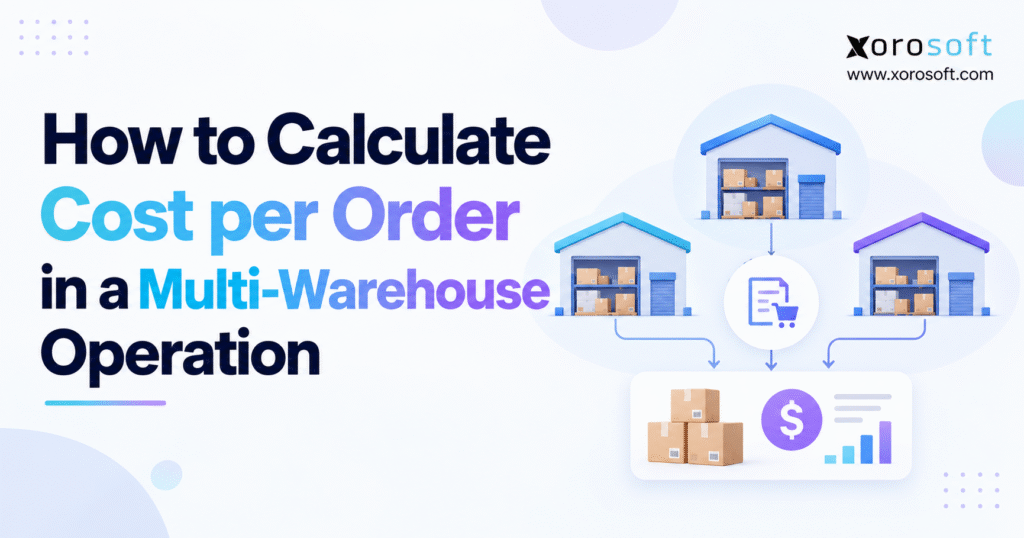
If you are looking to optimise logistics, understanding the multi-warehouse cost per order is essential for effective operations.
1. Why Multi-Warehouse Cost per Order Is Harder to Control Than It Looks
A growing business can ship more orders, improve delivery times, and still see its fulfillment costs rise. This often happens when the company starts operating multiple warehouses. Each location has different labor costs, storage needs, shipping rates, and order volumes. Without a clear way to compare these expenses, it becomes difficult to understand which warehouse is running well and which one needs attention.
For example, imagine an ecommerce distributor with warehouses in California, Texas, and New Jersey. California has higher labor costs, Texas handles most of the orders, and New Jersey serves wholesale customers who need special packing. The company may report one average fulfillment cost, but that number does not show how each location affects profit.
This is why multi-warehouse cost per order matters. It helps businesses measure how much they spend to fulfill customer orders across their entire warehouse network.
1.1 How Multiple Warehouses Create Hidden Fulfillment Costs
Adding warehouses can reduce delivery distances and improve customer service. However, each new location also creates expenses.
Rent, staffing, equipment, utilities, and warehouse software all add to operating costs. Some warehouses may have spare capacity, while others rely heavily on overtime. A company might also split customer orders between locations when no single warehouse has every requested item.
These extra steps can increase picking, packing, and shipping costs without increasing the number of customer orders.
When the business combines all expenses into one report, managers may miss these problems. A warehouse that appears profitable based on sales volume could be using more resources than expected.
1.2 Why Accurate Warehouse Cost Tracking Supports Better Decisions
Reliable cost data allows managers to compare warehouses based on the work they perform.
Instead of asking only how many orders each location ships, they can examine how much labor, storage space, packaging, and transportation each order requires.
Finance teams can also use the information to explain changes in fulfillment expenses, while warehouse managers can identify areas where work takes too long.
The goal is not simply to find the warehouse with the lowest cost. It is to understand why costs differ and determine which improvements will produce lasting savings.
2. What Multi-Warehouse Cost per Order Actually Measures
Multi-warehouse cost per order measures the average cost of fulfilling a customer order across a network of warehouses.
It includes the expenses defined by the business, such as labor, storage, packaging, warehouse overhead, and shipping. The total is divided by the number of unique customer orders fulfilled during the reporting period.
This creates a useful measure of how much the fulfillment operation costs for each order it serves.
2.1 Understanding the Warehouse Cost per Order Formula
The basic formula is:
Cost per Order = Total Fulfillment Costs ÷ Total Fulfilled Orders
Suppose a business spends $150,000 on fulfillment during one month and completes 7,500 customer orders.
The calculation is:
$150,000 ÷ 7,500 = $20 per order
The result means the business spends an average of $20 to fulfill each order under its chosen cost definition.
However, the calculation becomes more complex when several warehouses handle the same customer order.
If an order ships from two locations, both warehouses may incur costs, but the customer still placed only one order.
For this reason, network-level calculations must use unique customer orders rather than simply adding shipment counts.
2.2 Cost per Order vs Cost per Shipment
Cost per order and cost per shipment are related, but they measure different activities.
A customer may buy three items in one order. If the items are stored at different locations, the order could produce two shipments.
Cost per order measures the total fulfillment expense associated with customer demand. Cost per shipment measures the average expense of processing or transporting a shipment, using the cost pool defined for that metric.
| Metric | What it measures | Main purpose |
|---|---|---|
| Cost per order | Average fulfillment expense per customer order | Network cost analysis |
| Cost per shipment | Average expense per shipment | Shipping and handling analysis |
| Cost per order line | Average expense per fulfilled order line | Picking efficiency |
| Cost per unit | Average expense per item handled | Product-level workload |
| Warehouse handling cost | Average expense per order-site event | Warehouse comparison |
These measures work best together. Using only one can hide important differences in order size and handling needs.
2.3 When Businesses Need Detailed Cost per Order Reporting
A small company operating one warehouse may be able to track expenses through a basic spreadsheet.
As order volume grows, however, manual reporting becomes more difficult. Separate warehouses may use different systems, shipping methods, and accounting rules.
Detailed cost tracking becomes especially important for businesses selling through Shopify, Amazon, wholesale channels, or third-party logistics providers.
It is also useful for companies managing seasonal demand, large product catalogs, frequent transfers, or many split shipments.
3. Which Expenses Belong in Multi-Warehouse Fulfillment Costs?
A reliable multi-warehouse cost per order calculation begins with a clear understanding of the expenses involved.
Some costs are directly linked to customer orders. Others support the warehouse as a whole and must be shared across the work performed.
A business should define these categories before calculating its average cost. Otherwise, results may change simply because different expenses were included.
3.1 Warehouse Labor and Handling Expenses
Labor is a major part of fulfillment spending.
Warehouse employees receive inventory, move products into storage, replenish picking locations, prepare orders, pack cartons, and load shipments.
The true labor expense includes more than hourly wages. Payroll taxes, benefits, overtime, and temporary staff may also need to be included.
For example, a warehouse could handle more orders than the previous month but spend much more on overtime. Its labor cost per order might increase even though total output improved.
Tracking labor hours by activity helps explain this difference.
Managers should also measure the time spent correcting errors. Repacking an order or searching for missing inventory creates labor costs that may not appear in standard picking reports.
3.2 Warehouse Rent, Utilities, and Equipment Costs
Every warehouse has expenses that continue even when order volume slows down.
Rent, electricity, heating, equipment leases, maintenance, and insurance all support daily operations.
These costs should be included when the goal is to calculate a fully loaded warehouse operating cost.
For example, a location with monthly facility expenses of $30,000 will spread those costs across fewer orders during a slow month.
That does not automatically mean employees became less productive. It may simply mean the warehouse has unused capacity.
Separating fixed facility costs from labor and other variable expenses makes the reason easier to understand.
3.3 Packaging and Outbound Shipping Expenses
Packaging costs depend on product size, weight, and handling needs.
A clothing order may require a simple mailer, while a furniture order may need protective wrapping, a large carton, and special handling.
Shipping costs also vary by warehouse location, customer address, carrier, service level, and package dimensions.
Businesses should track packaging and transportation separately whenever possible.
This allows managers to see whether rising fulfillment costs come from warehouse work or carrier charges.
A freight-inclusive CPO should include the selected outbound shipping expenses. A warehouse-only CPO can exclude freight to show the cost of internal handling more clearly.
Both views can be useful when their definitions remain consistent.
3.4 Shared Overhead and Costs That Should Remain Separate
Some expenses support several warehouses rather than one location.
Examples include shared warehouse management, software subscriptions, network planning, and central operations support.
These costs need a fair method of allocation.
Meanwhile, product purchase costs, advertising, and customer acquisition expenses should normally remain outside warehouse operating CPO.
Capital purchases should also be handled carefully. A business should not include the full cost of new equipment and then count the same expense again through depreciation.
The APQC warehousing cost measure offers a useful reference for defining warehousing costs per fulfilled sales order.
The most important rule is consistency. Every warehouse should use the same cost definitions for the same reporting period.
4. How to Calculate Multi-Warehouse Cost per Order in Six Steps
The most useful method connects warehouse activity with financial records.
Rather than starting with a single company-wide expense total, businesses should identify the work handled by each location, assign the related costs, and then calculate the network average.
4.1 Step 1: Choose a Reporting Period and Define Eligible Orders
Start with a reporting period, such as one calendar month.
Decide whether the calculation includes shipped orders, fully completed orders, or another clearly defined group.
A fully canceled order should not normally count as a fulfilled customer order, even if some work was performed before cancellation.
Partially shipped orders need a consistent policy. Businesses must also decide how to treat orders that begin in one month and finish in another.
These choices affect the result. Documenting them prevents unexpected changes in reported CPO.
For businesses operating in the US and Canada, finance should also decide how costs recorded in different currencies will be converted for network reporting.
4.2 Step 2: Collect Order and Shipment Data From Every Warehouse
Gather customer order records, warehouse activity data, and shipment information.
The most important field is the original customer order ID.
One order may create several packages or warehouse tasks. Counting every shipment as a separate order would make the network cost per order appear lower than it really is.
A reliable data set should record the order ID, warehouse location, shipment ID, channel, shipping date, quantities, and fulfillment status.
This creates the connection needed to identify which warehouses handled each order.
Data should also be checked for duplicate shipments, canceled labels, missing warehouse codes, and other errors.
4.3 Step 3: Calculate Direct Costs for Each Warehouse
Collect the expenses associated with each location.
These may include labor, facility expenses, packaging, carrier invoices, equipment, and other operating costs.
A warehouse cost report should show the source of each amount.
Payroll records can support labor spending. Carrier invoices can support shipping expenses. Accounting records can confirm rent, utilities, and other overhead.
Costs should also follow the same reporting period as the orders being measured.
When carrier invoices arrive after month-end, finance may need to estimate the expense and reconcile it later.
This helps prevent costs from appearing artificially low in one month and unusually high in the next.
4.4 Step 4: Allocate Shared Warehouse Expenses
After recording direct costs, assign expenses that support multiple locations.
Different costs may require different allocation methods.
Rent may be assigned according to occupied space, while shared labor support may be allocated using labor hours.
Technology costs could be assigned according to users or transaction volume when those measures reflect actual usage.
The purpose is to match expenses with the work or resources that create them.
Avoid adding shared expenses twice. Once a cost has been allocated across warehouses, it should not be added again to the network total.
4.5 Step 5: Calculate Warehouse-Level and Network-Level CPO
For each warehouse, divide its direct and allocated costs by the number of order-site events handled.
Warehouse CPO = Warehouse Costs ÷ Order-Site Fulfillment Events
Next, calculate the total cost across the warehouse network.
Network CPO = Total Network Fulfillment Costs ÷ Unique Fulfilled Customer Orders
These results serve different purposes.
Warehouse CPO helps compare locations. Network CPO shows the average total fulfillment expense per customer order.
When orders are split across warehouses, network CPO will reflect the extra work without counting the same customer order twice.
4.6 Step 6: Check the Results Against Accounting Records
The final calculation should agree with the selected financial cost pool.
Compare warehouse totals with payroll, carrier invoices, and general ledger balances.
Investigate any missing expenses, duplicate charges, unusual credits, or timing differences.
Operations managers should then review the results.
A cost increase may reflect higher carrier rates, additional labor, slower picking, or a change in order mix.
Understanding the reason matters more than reporting a number without context.
5. A Three-Warehouse Cost per Order Calculation Example
A practical example shows how warehouse costs and customer order counts work together.
Consider a fictional company operating three fulfillment centers: East, West, and Central.
The business sells consumer products through ecommerce and wholesale channels. Each warehouse handles different order volumes and receives a share of common operating expenses.
All amounts below are illustrative monthly figures in US dollars.
5.1 Compare Monthly Costs Across Three Warehouses
| Monthly metric | East | West | Central |
|---|---|---|---|
| Order-site events | 6,000 | 5,000 | 3,000 |
| Direct costs | $100,000 | $82,000 | $58,000 |
| Shared costs allocated | $8,000 | $5,000 | $3,000 |
| Total warehouse costs | $108,000 | $87,000 | $61,000 |
| Warehouse cost per event | $18.00 | $17.40 | $20.33 |
The three warehouses handle 14,000 order-site events.
However, they fulfill only 12,800 unique customer orders because 1,200 orders involve two warehouse locations.
No order in this example uses more than two warehouses, and all shared costs have already been allocated.
5.2 Calculate Cost per Order for Each Location
East Warehouse:
$108,000 ÷ 6,000 = $18.00
West Warehouse:
$87,000 ÷ 5,000 = $17.40
Central Warehouse:
$61,000 ÷ 3,000 = $20.33
Based on these numbers, West has the lowest average cost per order-site event.
Central has the highest.
That does not automatically mean Central is performing poorly. It may handle harder orders, require more packaging, or serve areas with higher shipping costs.
Managers should investigate these differences before setting improvement targets.
5.3 Calculate the Total Network Cost per Order
First, add the warehouse costs:
$108,000 + $87,000 + $61,000 = $256,000
The business fulfilled 12,800 unique customer orders.
Therefore:
$256,000 ÷ 12,800 = $20.00 per order
The network result is higher than the average cost per warehouse event because some orders require work at more than one location.
Dividing $256,000 by 14,000 would produce approximately $18.29 per order-site event, not the true network CPO.
This distinction is essential when measuring multi-warehouse cost per order.
5.4 Understand Why Warehouse Averages Can Be Misleading
Taking the simple average of the three warehouse rates would not produce the correct network result.
Each location handles a different amount of work, and some customer orders appear at more than one facility.
The more useful approach is to report both the network result and each warehouse’s cost per event.
Managers can then compare similar order types, study the reasons for cost differences, and decide where improvements are most likely to help.
This also prevents a warehouse from appearing more efficient simply because its reporting method counts orders differently.
6. How Split Shipments and Inventory Transfers Affect Fulfillment Costs
Split shipments and warehouse transfers are common reasons why fulfillment costs rise as a business grows.
Both can improve stock availability and service, but they also create extra handling and transportation work.
6.1 Calculate the Additional Cost of Split Orders
Suppose a customer orders three products.
Two are available in the West warehouse, while the third is stored in Central.
The company now needs two picking tasks, two packing processes, and potentially two carrier shipments.
The customer placed one order, but the network completed work at two locations.
For multi-warehouse cost per order, costs from both warehouses belong in the network total while the original order counts once.
This allows managers to measure the real effect of splitting orders.
6.2 Measure the Cost of Inter-Warehouse Transfers
Moving inventory between warehouses can help meet demand, but transfers create costs.
Employees must prepare and receive the stock. Freight charges may apply, and products may require extra handling or storage.
These expenses should be tracked separately so managers can see how often inventory must be moved.
The accounting treatment also matters. Some transfer-related costs may be included in inventory value rather than recorded as immediate operating expenses.
Finance teams should make sure the same expense is not counted twice.
6.3 Test Whether Better Inventory Placement Reduces Costs
Return to the three-warehouse example.
Suppose improved inventory placement removes an extra $6 in handling and shipping costs from 200 split orders each month.
Monthly savings would equal:
200 × $6 = $1,200
The network’s revised expenses would be $254,800.
Dividing that amount by 12,800 unique orders gives a new CPO of approximately $19.91.
This example assumes no extra costs are created elsewhere.
In practice, managers should also account for storage, replenishment, and inventory investment before making changes.
7. How to Compare Warehouse Cost per Order Fairly
Comparing warehouse costs can identify waste, but only when the locations perform similar work or their results are adjusted for meaningful differences.
A warehouse shipping small accessories should not be measured against a facility handling large furniture with no consideration for product size or delivery needs.
7.1 Compare Similar Orders and Fulfillment Activities
Start by grouping orders according to sales channel, size, shipping method, and handling needs.
A single-item parcel order may require only a short picking task and basic packing.
A wholesale order containing several cartons may require more scanning, labeling, and loading.
Comparing those orders using one blended average may suggest a cost difference that reflects workload rather than efficiency.
Segmented reporting gives managers a better view of where costs are high.
7.2 Track Supporting Warehouse Performance Metrics
Cost per order should be reviewed alongside other warehouse measures.
Picking accuracy, labor hours per order, order cycle time, returns, and on-time shipping all provide useful context.
For example, a location may reduce labor spending but experience more picking errors.
If replacement shipments and returns increase, the business may lose the expected savings.
A reliable multi-warehouse cost per order report should make these trade-offs visible.
7.3 Look for Patterns Instead of One-Month Changes
Monthly costs can rise because of seasonal demand, temporary labor, equipment repairs, or carrier price changes.
One unusual month does not necessarily show a lasting problem.
Compare trends over several periods and review the changes with warehouse managers.
Separate increases caused by higher expenses from those caused by lower order volume.
That distinction helps teams choose the right response rather than applying cost cuts without understanding the cause.
8. How to Reduce Multi-Warehouse Cost per Order Without Hurting Service
Lowering multi-warehouse cost per order requires more than asking warehouse teams to work faster.
The largest savings often come from removing extra work, reducing errors, and improving the way inventory is placed across locations.
8.1 Improve Warehouse Order Routing
Order routing determines which warehouse handles a customer order.
Businesses should consider stock availability, delivery distance, shipping cost, and warehouse workload before choosing a location.
Sending an order from the nearest warehouse may appear cheaper, but it might create a split shipment if part of the order is stored elsewhere.
Better routing rules can help balance shipping expenses with warehouse handling costs.
The goal is to select the most efficient fulfillment option while still meeting customer delivery expectations.
8.2 Reduce Picking Time and Avoidable Warehouse Work
Poor product placement can increase the time workers spend walking between storage locations.
Frequently ordered products should be positioned where employees can reach them efficiently.
Clear replenishment rules also reduce interruptions during picking.
Barcode scanning can help teams verify products and quantities at key stages.
When these processes work well, businesses may reduce errors, repacking, and replacement shipments.
However, managers should measure whether changes improve both cost and order accuracy.
8.3 Review Packaging, Shipping, and Warehouse Capacity
Oversized cartons, unnecessary packing materials, and poor carrier selection can increase expenses.
Review common package sizes and compare them with actual product needs.
Businesses should also study warehouse capacity.
A location with too little work spreads its fixed expenses across fewer orders. Another warehouse may face high overtime costs because it is operating near capacity.
Balancing inventory and workload across locations can help address both problems.
9. How Multi-Warehouse Fulfillment Costs Change Across Industries
Different industries require different handling, storage, and delivery processes.
This means warehouse cost per order should reflect the nature of the products being sold.
9.1 Apparel, Fashion, and Consumer Products
Apparel businesses often manage many sizes, colors, and seasonal collections.
A single order may contain several product variations that must be picked accurately.
Returns can also increase warehouse workload through inspection, repacking, and restocking.
Brands selling through Shopify or Amazon need consistent order and inventory data across channels.
Businesses evaluating this type of connection can review the Xorosoft ERP app on the Shopify App Store to understand its published integration scope.
9.2 Furniture, Sporting Goods, and Bulky Inventory
Furniture distributors face different challenges.
Products may occupy large storage areas, require special lifting equipment, and need protective packaging or scheduled delivery.
Sporting goods companies may manage both small accessories and oversized equipment.
These differences make it useful to track cost per item, carton, cubic foot, or delivery stop alongside CPO.
A single average may not explain the work involved.
Businesses can explore industry-specific operational needs when assessing how warehouse software fits their products and fulfillment model.
9.3 Food, Wholesale Distribution, and Manufacturing
Food and beverage companies may require temperature-controlled storage, lot tracking, and expiration checks.
Wholesale distributors often process larger orders, customer-specific labels, and electronic data interchange transactions.
Manufacturers may move raw materials, components, and finished goods through several locations.
Each operation needs clear rules for separating production, storage, and order fulfillment expenses.
The most useful cost model reflects the work actually performed rather than forcing every industry into the same calculation.
10. Comparing In-House Warehouses With Third-Party Logistics
Some businesses fulfill every order through their own warehouses. Others use third-party logistics providers, commonly called 3PLs.
Many growing companies operate a mixture of both.
To compare these models fairly, the business must measure equivalent services and expenses.
10.1 Calculate the Full Cost of In-House Fulfillment
An in-house warehouse requires spending on employees, space, equipment, utilities, packaging, technology, and other operating needs.
Outbound carrier costs may also be included.
The advantage is greater direct control over daily work and inventory handling.
However, the company remains responsible for fixed expenses, staffing, and unused capacity.
These costs should be considered when comparing owned warehouses with outside providers.
10.2 Review Every Relevant 3PL Charge
A 3PL quote may show an attractive pick-and-pack rate.
Yet storage, receiving, packaging, shipping, returns, special handling, and account fees may appear separately.
Some contracts also contain minimum charges or volume terms.
Businesses should use actual quotes and invoices to compare the services included in each model.
A low handling fee does not necessarily mean the provider offers the lowest total fulfillment cost.
10.3 Include Outsourced Orders in Network Reporting
When a customer order is partly fulfilled in-house and partly by a 3PL, the network should include relevant expenses from both providers.
The order should still count once in the network denominator.
This approach keeps multi-warehouse cost per order consistent even when some warehouse work is outsourced.
It also helps managers decide which products and regions are better served internally and which may benefit from an outside provider.
11. Build a Reliable Multi-Warehouse Cost per Order Reporting Process
A useful multi-warehouse cost per order report depends on clean operational data and accurate financial records.
The most common reporting problems appear when warehouses, ecommerce platforms, shipping tools, and accounting systems hold different versions of the same order.
Fixing the connection between those records is often more important than adding another dashboard.
11.1 Start With a Simple, Controlled Reporting Model
Spreadsheets can be a practical starting point.
Create a clear structure for order volumes, direct expenses, shared costs, and warehouse totals.
Use the same formulas each month and maintain a record of changes.
Every cost should have a known source, and each order should have a stable ID.
A finance team should be able to review the calculation and explain where the reported expenses came from.
As volumes grow, however, manual exports and spreadsheet updates may become difficult to maintain.
11.2 Connect Warehouse Activity With Accounting
Warehouse management software records how inventory moves through receiving, storage, picking, packing, and shipping.
Accounting software records expenses and financial results.
Both are needed for a reliable cost report.
Xorosoft offers warehouse operations capabilities through XoroWMS, while its broader ERP products support connected business processes.
Companies should evaluate how their chosen systems exchange order, inventory, shipment, and expense data.
The availability of a report does not automatically guarantee that its cost allocation method matches the company’s accounting rules.
11.3 Keep Order and Inventory Data Consistent Across Systems
Growing businesses often rely on Shopify, Amazon, EDI applications, shipping platforms, and purchasing tools.
When data moves between these applications, mismatched IDs or delayed updates can create reporting problems.
For example, a shipment may appear in the warehouse system before its carrier invoice reaches accounting.
A canceled order might remain in an old export.
Reviewing the available integration options helps businesses understand how their software stack can share operational data.
The main requirement is a clear and repeatable flow of information.
11.4 Create Dashboards That Explain Cost Changes
A useful warehouse dashboard should do more than display one CPO figure.
Managers need to see network cost, cost by warehouse, labor spending, shipping expenses, split shipments, and other key measures.
Changes should be shown beside the previous reporting period.
When CPO rises, the team should be able to identify which warehouse or expense category caused it.
Platforms such as XoroONE bring together inventory, warehouse, accounting, and reporting functions. The exact CPO calculations and allocation rules should still be reviewed during system setup.
12. When to Upgrade From Spreadsheets to Multi-Warehouse ERP
Not every business needs an ERP system to calculate warehouse costs.
A small operation with limited order volume may manage the process successfully through spreadsheets and existing accounting tools.
The need for a more connected system usually becomes clear when data is difficult to reconcile or manual work delays important decisions.
12.1 Recognize the Signs of Reporting Complexity
Several recurring problems may indicate that the current approach is becoming difficult to maintain.
Finance may spend days combining data from several warehouses.
Inventory records may not match physical stock.
Warehouse managers may rely on separate reports, while purchasing teams use spreadsheets that do not reflect current demand.
These issues can make cost calculations less reliable.
Before buying software, businesses should identify whether the main problem comes from process design, data quality, or limited system capabilities.
12.2 Understand What Integrated ERP Adds
Integrated ERP connects business functions such as inventory, purchasing, sales, warehousing, accounting, and reporting.
Instead of depending entirely on manual data transfers, teams can work from more closely connected records.
Xorosoft provides a cloud ERP option for inventory-driven businesses through XoroERP.
For companies managing several warehouses, the value of ERP lies in the ability to support coordinated operations and financial reporting.
However, software alone does not determine the correct cost-per-order method. Businesses must still agree on definitions, expense categories, and allocation rules.
12.3 Compare ERP Providers Using Real Warehouse Scenarios
When comparing software, request a demonstration using the company’s actual workflow requirements.
Ask how the system handles split shipments, warehouse transfers, inventory updates, carrier costs, returns, and accounting records.
Also examine reporting options and any setup or integration work required.
Xorosoft, NetSuite, Acumatica, and other ERP platforms may suit different business needs.
A useful starting point is the Xorosoft vs NetSuite comparison, followed by a review of the specific capabilities and implementation needs that matter to the business.
13. A 30-Day Plan to Improve Warehouse Cost per Order Tracking
A business does not need to replace all its systems before improving cost visibility.
A focused 30-day project can establish a consistent baseline and reveal where the largest reporting gaps exist.
The first objective should be reliable data, not a perfect dashboard.
13.1 Week 1: Agree on Definitions and Responsibilities
Start by defining the expenses included in the calculation.
Decide how orders, shipments, returns, transfers, and shared costs will be handled.
Finance should own the expense definitions, while warehouse operations should confirm the activity data.
Document the reporting period and assign responsibility for checking the final numbers.
These decisions prevent different departments from producing conflicting versions of CPO.
13.2 Week 2: Gather and Check the Required Data
Collect labor reports, facility expenses, carrier invoices, warehouse activity records, and customer order data.
Match costs to warehouse locations and check order IDs for duplicates.
Pay close attention to split orders and shipments that cross reporting periods.
Where data is missing, record the issue and use a documented estimate only when necessary.
This provides a clearer picture of how reliable the first calculation will be.
13.3 Weeks 3–4: Calculate, Review, and Set a Baseline
Calculate site-level costs and the network average.
Compare warehouses with similar types of orders and identify the largest cost differences.
Then meet with warehouse managers to review possible causes.
One location may need better picking routes, while another may benefit from improved inventory placement or shipping rules.
Select one improvement to test and define how success will be measured.
The first month establishes a baseline. Future reporting should show whether the change actually reduced costs without hurting service quality.
14. Turn Multi-Warehouse Cost per Order Into Better Operating Decisions
Accurate warehouse cost tracking helps businesses understand the real expense of serving customers across different locations.
The most important step is to use consistent cost definitions and count unique customer orders correctly.
Warehouse-level handling costs should remain separate from the total network CPO. This makes it easier to spot costly processes without misreading averages.
14.1 Focus on the Drivers Behind the Numbers
A reliable multi-warehouse cost per order report should help managers answer practical questions.
Are split shipments creating extra costs? Is one warehouse spending too much on labor? Are shipping rates increasing? Does unused warehouse space affect the average?
Answering these questions turns cost reporting into a useful part of monthly operations.
Improvement should be measured through both lower expenses and reliable customer service.
14.2 Choose Systems That Support Long-Term Cost Visibility
As warehouse networks grow, connected inventory, fulfillment, and financial records can make reporting easier to manage.
Businesses should first define the information they need and then evaluate whether their current tools can provide it.
For companies dealing with disconnected systems or growing warehouse complexity, Xorosoft may be worth reviewing as part of an ERP evaluation.
Ready to improve warehouse cost visibility?
If your team is spending too much time reconciling fulfillment data or comparing costs across locations, contact Xorosoft to discuss your warehouse, inventory, accounting, and reporting requirements.
Frequently Asked Questions
How do you calculate multi-warehouse cost per order?
Add fulfillment costs across all warehouses, then divide by unique customer orders fulfilled. Count orders split across locations only once.
Which costs belong in warehouse cost per order?
Include labor, storage, packaging, facility overhead, and shipping when relevant. Keep product costs and marketing expenses separate.
How should split shipments affect cost per order?
Include the handling and shipping costs from every warehouse involved, but count the original customer order only once.
How do you compare cost per order across warehouses?
Apply consistent cost definitions and reporting periods. Compare similar orders and review labor, shipping distances, and service levels.
How should shared warehouse overhead be allocated?
Use cost drivers such as labor hours, occupied space, or order lines. Ensure shared expenses are counted only once.
How can businesses reduce multi-warehouse fulfillment costs?
Improve inventory placement, reduce avoidable split shipments, optimize picking routes, and review packaging and carrier charges without sacrificing accuracy.
When should a business use ERP for warehouse cost reporting?
Consider ERP when disconnected systems cause frequent reconciliation work or unclear costs. Verify the platform supports your warehouse and accounting workflows.
Search
Categories
- Competitor & buyers 246
- E-COMMERCE & CHANNEL INTEGRATIONS 72
- ERP 572
- Industries 226
- Integrations 135
- Inventory management software 373
- PROCUREMENT & SUPPLY CHAIN 9
- Resources 246
- Shopify ERP 135
- Solutions 596
- Wholesale & distribution 226
- WMS & Warehouse 223
Recent Posts
-
 ERP for Automotive Parts Distributors Managing US–Canada Tariff Exposure
-
 ERP Licensing Statistics 2026: Users, Modules, Add-Ons and AI Costs
-
 How to Calculate Cost per Order in a Multi-Warehouse Operation
-
 Who Owns Inventory Accuracy: Finance, Operations, or the Warehouse?
-
 Shopify B2B Payment Reconciliation: ACH, Deposits, Terms, and Partial Fulfillment