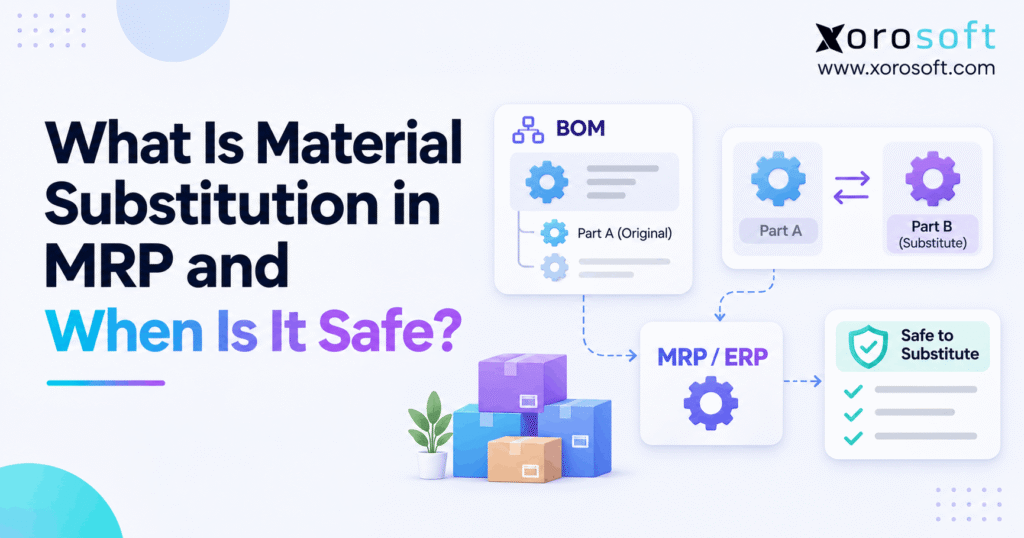
Material substitution in MRP is a critical concept for manufacturing and planning processes.
1. The Missing Component That Can Stop Production
Material substitution in MRP helps manufacturers plan an approved replacement when a required part or raw material is unavailable. However, the aim is not to grab a similar item from the shelf. In addition, a safe replacement must meet the product’s rules, work in the planned process, and leave a clear record of what production actually used.
1.1. Why Similar Parts Can Create Costly Errors
For example, imagine a furniture factory that needs 300 cabinet panels by Friday. Its normal board will arrive next week, but the warehouse has another board in stock. At first, that sounds like an easy fix. Yet the second board may have a different thickness, finish, or load rating. As a result, the shortage could turn into rework, customer complaints, or wasted stock if nobody checks the change.
1.2. Why MRP Material Substitution Needs a Decision Trail
Similarly, the same risk appears in apparel, food, sporting goods, and industrial parts. Meanwhile, growing teams often make decisions across email, spreadsheets, purchase orders, and work orders. As a result, that split makes it harder to know which replacements are approved and where they were used.
This guide explains how substitute planning works, the checks that make it safe, and the controls that protect product quality, inventory, and margins. More importantly, it shows when a manufacturer should reject a replacement, even if production is running late.
2. What Material Substitution in MRP Really Means
In simple terms, material substitution in MRP means planning or using an eligible part in place of a required component. The substitute might be a different supplier’s part, a new version of an old component, or an approved raw material that delivers the same result. However, eligibility can depend on the finished product, its revision, the plant, and the customer order.
First, MRP calculates what the factory needs from demand, bills of materials (BOMs), available stock, and supply dates. Therefore, it can help planners see when a preferred material will run short. Some systems can also consider pre-set alternatives. Still, the system’s choice must follow the firm’s approval rules.
2.1. Material Substitution in MRP vs Similar Parts
A similar part is not always an approved substitute. For example, two bolts may share a size but have different strength grades. Likewise, two fabrics may look alike but behave differently during washing or cutting. In fact, the difference may matter more than the matching product description.
An approved substitute has passed the needed checks for a defined use. Consequently, its approval record should state which product or BOM it can serve, when it can be used, and whether any limits apply. Without that record, employees may assume that a good physical fit means the replacement is safe.
2.2. Three Statuses Every Team Must Understand
A practical policy separates substitute candidates into three groups. Approved means the part can be used within stated limits. Conditional means more tests or a sign-off are needed. Rejected means the proposed material fails a required rule and must not be used.
For example, a substitute may be approved for a standard product but still need customer consent for a private-label order. Therefore, a single yes-or-no flag may not provide enough context. Teams should know the scope of approval before a warehouse worker picks the component.
3. How Material Substitution in MRP Works
In practice, the process starts with planned demand and ends with actual use on a production order. Between those points, material substitution in MRP may affect purchases, stock reservations, work orders, and cost reports. However, there is no single method shared by every ERP platform. The result depends on the system, its version, and the rules set by the manufacturer.
3.1. Build the Requirement from the BOM
First, MRP reads demand from sales orders, forecasts, or planned work. Then, it uses the BOM to calculate the parts required for each finished unit. If 200 assemblies each need three clips, the gross need is 600 clips before the plan accounts for stock, open orders, or waste.
Next, the system checks expected supply against the need date. When the preferred clip cannot be supplied on time, planners face several choices: buy it sooner, move the work, transfer stock, or evaluate an approved replacement. As a result, each option has a different impact on cost and delivery.
3.2. Material Substitution in MRP: Priority and Availability
Some planning tools use groups of eligible substitutes with a preferred order. As a result, an available second-choice item may cover a shortfall when the first-choice item cannot. By contrast, other systems use dates, usage rates, or special rules for production. Therefore, it is important to test the exact behavior rather than assume that every substitute is selected in the same way.
Microsoft’s item substitution guidance describes priority-based choices for BOMs and formulas in supported versions. Meanwhile, SAP’s alternative-item guidance shows that MRP planning and physical withdrawal can use different rules. These examples explain why a planning suggestion is not the same as permission to issue a part.
3.3. MRP Material Substitution: Planned vs Actual Use
After planning, a work order must show the materials that production is allowed to consume. However, last-minute changes can occur when goods arrive late, a lot fails inspection, or a machine needs a different setup. The authorized change should update the relevant work-order record before the team consumes stock.
Finally, the warehouse issues the correct lot and quantity. Production records the item actually used, while finance receives the related cost entries. If the system still records the original component, the plan may look correct even though the production history is wrong. As a result, that gap can create serious trouble during a quality review.
4. When Is Material Substitution in MRP Safe?
Material substitution in MRP is safe only when the alternative meets every rule that matters to the finished product and its use. Availability alone is never enough. Instead, a team must confirm that the substitute is fit for purpose, approved for the current order, and traceable after the work is complete.
A useful decision rule is Go, Review, or Stop. Go means all checks pass. Review means required evidence or approval is still missing. Stop means the item fails a rule that cannot be waived. Importantly, a production deadline cannot turn a Stop decision into a Go decision.
4.1. Engineering and Product Fit Checks
Engineering should test form, fit, and function. In other words, will the part fit correctly, perform the required job, and last under the expected conditions? For instance, a replacement hinge may fit a cabinet door but fail the required load test. As a result, it should not be approved simply because workers can install it.
For example, the review may cover size, strength, heat, chemical resistance, coating, shelf life, and machine settings. However, the depth of testing should match the risk. A simple packing insert may need less review than an electrical part or a food ingredient. Above all, the key is to use written criteria, not guesswork.
4.2. Material Substitution in MRP: Quality and Compliance
Next, quality teams should check the supplier, test results, and any product or customer rules. For food, an ingredient switch may change allergen risks or labels. For industrial goods, it may affect a safety or performance claim. Therefore, technical similarity does not remove the need for a quality or legal review where one is required.
For food manufacturers, the FDA’s preventive-controls guidance offers a useful example of why hazard review and supplier controls matter. However, the exact duties depend on the product and market. Manufacturers should confirm the rules that apply to their own operations.
4.3. Lot Status, Dates, and Customer Rules
Even when a material is approved, a specific lot may be blocked, expired, held for inspection, or reserved for another order. In addition, the replacement may only be valid for a certain BOM revision or date range. A customer may also require written consent before the change. Consequently, planners must check the whole usage context.
Use this quick gate before any release:
| Check | Go | Review or stop |
|---|---|---|
| Product fit | All required specs pass | Tests are missing or failed |
| Quality and compliance | Required checks pass | Safety, label, or legal issue |
| BOM and customer | Version and approval are valid | Wrong revision or missing consent |
| Inventory | Lot is usable and available | Quarantine, expiry, or reservation |
| Cost and process | Impact is understood | Unchecked quantity or process change |
| Records | Approval and trace data are ready | No owner or audit trail |
Rule of thumb: If one mandatory check fails, do not release the replacement. Instead, fix the gap, change the plan, or wait for the original material.
5. Approval Workflow for Replacement Parts
A strong material substitution in MRP process gives every team a clear job. As a result, purchasing can find options without making an engineering decision, while production can keep moving without guessing what is allowed. The workflow does not need to be slow; however, it must keep key checks separate from the pressure to ship.
5.1. Identify the Shortage and a Replacement
First, planning records the original item, the needed quantity, the work orders at risk, and the date of the shortfall. Then, purchasing checks approved suppliers, incoming orders, and stock at other sites. If an approved alternative exists, the team can evaluate it quickly. Otherwise, a new candidate must enter the review process.
A shortage log should also record the cause, such as a late supplier or a forecast error. Over time, that history can show which components need better safety stock or earlier approval of alternatives.
5.2. Material Substitution in MRP: Approval Before Release
Next, engineering decides whether the part is suitable for the product and its current design. Quality checks the test and supplier evidence. Planning confirms that the choice works for the schedule, while finance reviews any large cost change. If customer consent is required, the right team must obtain it before release.
| Owner | Main decision | Proof to retain |
|---|---|---|
| Engineering | Fit and performance | Test or design approval |
| Quality | Product and lot status | Inspection and supplier records |
| Planning | Timing and capacity | Work-order change |
| Purchasing | Supply and price | Supplier and purchase details |
| Finance | Cost impact | Cost and variance review |
Therefore, the final approval should name the part, product, order scope, date, and person who signed off. Broad verbal permission is not enough when a problem must be traced later.
5.3. Record the Change and Trace the Lot
After approval, the team updates the right BOM or work-order record, reserves eligible stock, and issues the actual substitute. Meanwhile, the warehouse should capture the lot or serial number when traceability is required. Finally, production reports what it consumed, including any waste or extra quantity.
This is where connected operations help. Xorosoft brings BOMs, production orders, inventory, purchasing, and costing into a shared ERP setting. However, a company must still define its own approval rights and confirm which substitution steps its chosen setup supports.
For manufacturers reviewing their processes, manufacturing ERP capabilities provide a useful starting point for assessing how production and inventory records connect.
6. BOM Control and Material Substitution in MRP
A BOM is the product’s list of required materials. Therefore, material substitution in MRP cannot be managed well without sound BOM rules. The team needs to know which version is active, which parts are approved, and whether the change applies to one order or every future order.
A BOM error can spread fast. For example, if a planner replaces the original component in the master BOM for a one-time shortage, future orders may use that replacement by mistake. Instead, the team should choose the right change method for the situation.
6.1. BOM Material Substitution: Temporary vs Permanent Changes
A temporary exception changes the approved material for a defined order or limited period. By contrast, a permanent BOM revision changes the design or production rule for future work. Therefore, engineers should decide whether the cause is a short-term gap or a lasting product change.
For instance, a factory may use an approved second-source clip for one batch while the normal supplier repairs a machine. That need may not justify a new master BOM. However, when the old clip reaches end of life, a formal revision may be the better choice.
6.2. Alternative Builds and Permanent Successors
Three methods are often confused. A substitute replaces a part under stated conditions. Supersession creates a new successor for an older item. An alternative BOM offers a different approved product structure or route. Although they can overlap, they are not the same operational decision.
| Method | Best use | Main control |
|---|---|---|
| Substitute | Shortage or approved choice | Eligibility by order or product |
| Supersession | Old part phased out | Effective dates and old stock |
| Alternative BOM | Different approved build | BOM version and approval |
| One-time deviation | Rare exception | Limited scope and sign-off |
As a result, teams should name the change type before editing master data. Otherwise, a quick fix today can create planning errors next month.
7. How Replacement Parts Change Costs
A replacement may solve a shortage and still hurt the margin. Therefore, material substitution in MRP should include a cost check before the team decides that the alternative is worth using. However, the purchase price is only one part of the cost. Extra labor, waste, handling, and test time can also matter.
For example, a cheaper input may take longer to cut or create more scrap. Conversely, a higher-priced part may protect an urgent customer order and reduce downtime. In the end, the right choice depends on the whole production outcome, not just unit price.
7.1. A Simple Batch Cost Example
Suppose a batch needs 200 pieces of a component. The normal part costs $4.00 each, while the approved substitute costs $4.80. Assuming the same usage quantity and no extra labor, the original material costs $800 and the substitute costs $960. Therefore, the batch’s direct component cost increases by $160.
| Cost item | Normal part | Substitute |
|---|---|---|
| Quantity used | 200 | 200 |
| Cost per piece | $4.00 | $4.80 |
| Total component cost | $800 | $960 |
| Extra direct component cost | — | $160 |
However, this example is only a starting point. If the new material needs more units or produces more scrap, planners must change the calculation. Likewise, freight and setup costs may alter the final result.
7.2. Material Substitution in MRP: Yield and Cost Variances
When material substitution in MRP changes a component, finance should see the item actually used, its true quantity, and the cost posted to the order. Otherwise, work-in-process and finished-goods values may not match reality. When a standard cost system is in use, a substitute may create price or usage variances that need review.
A connected platform can reduce manual gaps between the warehouse and accounts. For example, Xorosoft links manufacturing activity with inventory and accounting information, giving teams a way to review costs across the same workflow. Still, the costing method and report setup must fit the business.
8. Material Substitution in MRP Across Warehouses
A planner may see 500 substitute units in the system but still lack stock that can be used today. Therefore, material substitution in MRP must consider location, stock status, travel time, and reservations. A positive on-hand balance does not mean the material is free for the next production order.
For growing firms, this problem becomes harder when each site tracks inventory separately. Meanwhile, production may depend on a transfer that has not been picked, shipped, or received. A better plan checks usable supply by site and date.
8.1. On-Hand Stock Is Not Usable Stock
Consider a substitute lot that appears on hand in another warehouse. However, half the stock may be reserved for wholesale orders, and the rest may still be on quality hold. As a result, the usable quantity is zero even though the item count looks healthy.
A planner should check available-to-use stock, expiry dates, lot restrictions, and open transfer orders. If the material cannot reach the line on time, the substitute may not solve the shortage. Therefore, inventory status must be part of the approval-to-release process.
8.2. Material Substitution in MRP: Reservations and Transfers
After the alternative is approved, the warehouse needs a clear instruction to reserve the right item and lot. Next, any transfer should show its source, destination, quantity, and expected arrival. Finally, the production team should confirm receipt before it commits to the revised schedule.
Xorosoft supports multi-warehouse visibility and connected warehouse operations. Its warehouse management capabilities are relevant when firms need better control over stock movements, reservations, and physical handling. However, teams should still test the exact lot and substitution rules in a live process review.
9. Industry Use Cases and Failure Modes
Material substitution in MRP looks different across products. For low-risk goods, the main issue may be fit or finish. By contrast, in regulated or safety-related products, a change may require deeper review. Therefore, manufacturers should set checks based on risk rather than use one rule for every SKU.
The following cases are illustrative, not reports of named customers. Even so, they show why an MRP recommendation must be tested against real production needs before a part reaches the shop floor.
9.1. MRP Material Substitution: Food and Consumer Goods
A sauce maker runs out of a spice blend and finds another blend with the same taste profile. However, the new mix contains an allergen that the old one did not. Therefore, the factory cannot treat the change as a simple stock swap. Next, quality must review the recipe, labels, line cleaning, and any market rules before production.
Likewise, a consumer-goods maker may replace a bottle cap that looks the same but seals less well. A short test may reveal a leak risk that inventory data cannot show. The lesson is clear: material substitution in MRP can identify a possible path, but it cannot replace product testing.
9.2. Furniture, Apparel, and Industrial Parts
A furniture producer may want to swap a board, hinge, or coating. Yet a new finish can change drying time or color. Similarly, an apparel brand might find fabric with the same weight but different stretch or wash results. In both cases, samples and clear acceptance rules can prevent costly returns.
For industrial parts, a supplier may end production of a motor, seal, or fastener. Therefore, engineering should check the successor part before the old stock runs out. An early review makes the transition planned rather than rushed. Companies in these sectors can explore Xorosoft’s industry coverage as they assess broader production and stock needs.
10. Material Substitution in MRP: Common Mistakes
Even experienced teams can mishandle substitutes when information sits in too many places. Therefore, material substitution in MRP should include simple controls that prevent the most common errors. Still, the goal is not to slow down every order. Instead, it is to stop a small exception from becoming a repeated quality or costing problem.
A useful control starts with one rule: the part on the approved production record must match the part picked and used. When those records differ, someone should investigate before the order closes.
10.1. Five Errors That Lead to Rework
First, teams choose a part because it is in stock, not because it is approved. Second, they reuse an old approval after a product revision. Third, they assume the new part needs the same quantity. Fourth, they fail to record the actual lot. Finally, they ignore the change in cost or work time.
| Mistake | Likely result | Better control |
|---|---|---|
| Stock-based guess | Wrong component | Approved-use list |
| Old BOM rule | Bad product fit | Revision check |
| Wrong quantity | Waste or shortage | Verified replacement ratio |
| Missing lot | Weak traceability | Scan or record actual lot |
| Hidden extra cost | Margin surprise | Cost review before release |
Although any single mistake may seem small, repeated errors can damage delivery, cash flow, and customer trust.
10.2. Material Substitution in MRP: Preventing Repeat Errors
First, start with a clear owner for each approval type. Then, set a time limit or scope for temporary changes, so an exception does not become the default. Next, review frequent substitutions by part, supplier, and plant. As a result, that review may show a root problem in buying rules or forecast quality.
Finally, track a few useful measures: approval time, rejected changes, repeat shortages, substitution cost variance, and stock record errors. Because these measures use work already being recorded, managers can spot trends without creating a large new report each week.
11. ERP Controls for Approved Replacements
For material substitution in MRP, software should support the rules people must follow rather than decide product safety on its own. Therefore, firms evaluating ERP for substitute materials should test the full path from demand to production consumption. A polished planning screen is not enough if warehouse, BOM, and finance records do not agree.
For smaller firms, a controlled manual approval may work. However, the risk rises as the number of SKUs, suppliers, locations, and work orders grows. That is when one shared source of operational data becomes more useful.
11.1. Material Substitution in MRP: Required ERP Controls
At a minimum, ask whether the system can show active BOM versions, planned requirements, item availability, work-order materials, actual consumption, and cost effects. In addition, review lot and serial tracking if the product needs them. Then, ask how employees handle a new candidate and a one-time deviation.
Xorosoft combines manufacturing, inventory, purchasing, warehouse, and financial data in a cloud ERP platform. For many inventory-driven firms, that connected view can reduce work done across separate files. Still, buyers should verify approval and substitute-selection features against their own cases before making a decision.
11.2. When to Move Beyond Disconnected Tools
Watch for warning signs: planners keep private substitute lists, buyers change parts over email, and production orders do not show actual use. Likewise, month-end reports may show unexplained usage costs, while warehouse teams cannot trace a finished batch to the original lot. Taken together, these signs show that the issue is bigger than a single material shortage.
A useful ERP review should include a real test order with one preferred component, two candidate substitutes, a blocked lot, and a cost change. Then, ask each team to show its part of the workflow. Xorosoft can be evaluated through its connected ERP solutions alongside your written acceptance criteria. Ultimately, the most valuable outcome is proof that the process fits the way your factory works.
12. Use Alternatives Without Losing Control
Material substitution in MRP can help protect a production schedule, but only when the replacement meets the right standards. First, confirm product fit and quality. Next, check the BOM version, lot status, customer rules, and cost. Finally, record the approved choice and actual production use so every department works from the same facts.
For simple operations, clear manual steps may be enough. However, once teams work across many items, warehouses, and sales channels, a connected ERP becomes more important. Xorosoft offers a way to bring planning, stock, purchasing, production, and accounting into one operational flow without treating software as a replacement for expert review.
If your team is still making these decisions across spreadsheets and emails, Book a Demo to discuss the workflows your manufacturing business needs.
Frequently Asked Questions
What is material substitution in MRP?
It means using an eligible replacement when a required part is unavailable. However, the substitute must meet product, quality, and approval rules before production uses it.
When is material substitution safe?
It is safe when engineering fit, quality checks, BOM dates, customer rules, lot status, and trace records all pass. Otherwise, hold or reject the change.
Can MRP choose substitute parts automatically?
Some systems can, depending on their setup. However, a planning choice is not the same as approval to use the part on the factory floor.
Does every substitute require a new BOM?
No. A controlled one-time change may be enough. However, a lasting product change may need a new BOM version and formal sign-off.
Can a substitute change production cost?
Yes. The price, required quantity, waste, and work time may differ. Therefore, finance should compare planned and actual use before closing the order.
How should warehouses track substitute materials?
Record the approved item, actual quantity, location, and lot or serial number when needed. As a result, teams can trace what production truly consumed.
When should a manufacturer upgrade its ERP?
Consider an upgrade when approvals, BOMs, inventory, and costs no longer match across teams. First, test the new system with real substitution cases.
Recent Posts
-
 What Is Material Substitution in MRP and When Is It Safe?
-
 AI Credit-Hold Recommendations in ERP: Signals and Human Controls
-
 Why ERP Upgrades Preserve Broken Inventory Workflows
-
 3PL Inventory Audit Trails: Receipts, Adjustments, Transfers and Shipments
-
 Shopify Product Lifecycle Benchmarks 2026: Launch, Active Life and Retirement