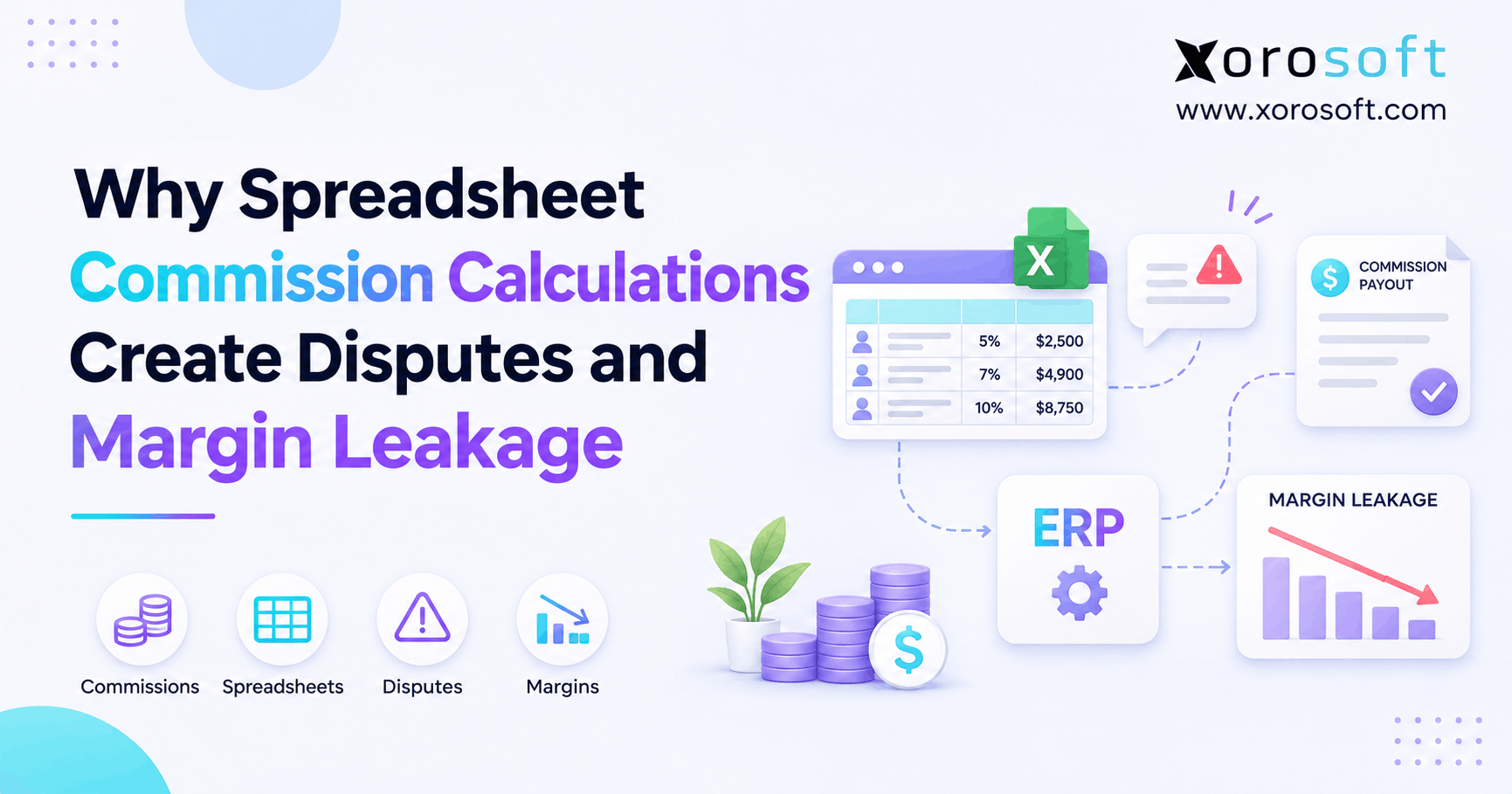
If you want to improve tracking and payouts for your sales team, consider using apparel sales commission software.
1. Why Apparel Commission Tracking Becomes Complicated as Wholesale Orders Grow
1.1 Seasonal preorders create gaps between sales activity and commission payments
Fashion wholesale often begins months before merchandise reaches retailers. During market appointments, representatives secure orders for upcoming collections, while production, purchasing, inventory allocation, and fulfillment happen later.
Consequently, the original booking may change before the transaction is complete. Retailers might reduce quantities, cancel certain sizes, request delayed delivery, or negotiate new prices.
These changes create a distinction between booking credit and commission eligibility. Booking credit recognizes selling activity, whereas commission eligibility determines whether a transaction qualifies for compensation.
For example, a representative may book $80,000 in preseason orders, but only $65,000 eventually ships. Under a shipment-based agreement, calculating commission on the original booking could overstate earnings.
Therefore, businesses need consistent rules that recognize the difference between projected demand and completed sales activity.
1.2 Disconnected systems create conflicting financial records
Apparel companies often manage wholesale orders, inventory, warehouse operations, accounting, and representative compensation in separate applications.
While the sales team reviews booked orders, warehouse employees monitor shipped quantities. Finance, meanwhile, relies on posted invoices, payment receipts, and credit memos.
Because these systems may update at different times, their totals do not always match.
The scale of wholesale apparel operations makes dependable records important. According to the U.S. Census Bureau’s apparel wholesale sales data, U.S. apparel, piece goods, and notions merchant wholesalers recorded approximately $156.68 billion in sales during 2024.
This figure describes industry sales rather than commission payments. Nevertheless, it demonstrates the substantial transaction environment in which apparel wholesalers operate.
1.3 Manual spreadsheets become difficult to audit
Spreadsheets remain useful for simple commission structures. However, problems arise when businesses maintain separate workbooks for sales orders, representative assignments, invoices, and payment adjustments.
A commission calculation may use an outdated rate, duplicate an invoice, or overlook a returned item. Furthermore, historical formulas can change without a clear record of who approved the revision.
As transaction volumes increase, finance teams spend more time comparing files instead of analyzing sales performance.
This is where apparel sales commission software becomes particularly relevant. A structured process can preserve transaction references, commission rules, and adjustment histories, allowing managers to explain how earnings were calculated.
2. What Apparel Sales Commission Software Does for Fashion Wholesale Businesses
2.1 How apparel sales commission software calculates eligible earnings
Apparel sales commission software calculates, tracks, and reports compensation for eligible wholesale transactions according to agreed commission rates and payment conditions.
Unlike a basic percentage calculator, a commission management system should identify which representative owns the sale, which transaction qualifies, and what amount forms the commissionable base.
For instance, an order may be booked in January but invoiced in March. Depending on the agreement, the commission might become eligible at booking, shipment, invoicing, or payment collection.
Therefore, effective software must distinguish these events instead of treating every recorded sales amount as immediately commissionable.
A reliable calculation should also identify the source transaction, applicable rule, representative assignment, calculation date, and any subsequent adjustment.
2.2 Which apparel businesses benefit from commission automation?
Fashion brands, wholesale distributors, multi-line showrooms, and independent representative agencies may all benefit from commission automation.
However, their operational priorities differ.
An apparel brand might calculate commissions using inventory shipments and accounting records. By contrast, an independent showroom may focus on reconciling manufacturer statements and distributing received commissions among representatives.
Businesses with many brands, changing commission rates, shared territories, or frequent returns usually face greater complexity.
Meanwhile, smaller agencies with limited transactions and stable rules may continue using carefully controlled spreadsheets.
The deciding factor is not company size alone. Instead, businesses should evaluate how much manual work, reconciliation risk, and payment uncertainty their existing process creates.
2.3 What information should fashion showroom commission software track?
Reliable fashion showroom commission software should connect representative assignments with relevant sales and financial records.
These typically include customer accounts, brands, sales orders, invoices, shipments, commission rates, credit adjustments, and payment information.
Additionally, the system should distinguish commissions earned from commissions already paid.
A representative might have $5,000 in qualifying earnings but only $3,500 approved for the current payout period. Without separate statuses, managers may misunderstand outstanding compensation.
Ultimately, the purpose is to create a consistent record that both finance teams and representatives can verify.
3. Commission Ownership Across Apparel Showrooms, Brands, and Rep Agencies
3.1 Apparel brands paying their own wholesale sales representatives
An apparel brand may employ representatives responsible for specific territories, retailers, or wholesale customer accounts.
In this arrangement, the brand typically manages inventory, invoices customers, collects payments, and administers the compensation program.
Commission eligibility may depend on shipped merchandise, posted invoices, customer collections, or another agreed event.
Because those records often originate in operational systems, connected accounting and sales management can simplify reconciliation.
For inventory-owning wholesalers, Xorosoft’s XoroERP documentation describes commission rules involving item brands, discounts, sales representatives, and representative groups.
Nevertheless, businesses should verify that their particular compensation arrangements are supported before relying on automated calculations.
3.2 Multi-line showroom commissions work differently
A multi-line apparel showroom represents several brands rather than selling merchandise from its own inventory.
Typically, each supplier establishes a separate agreement defining commission percentages, eligible customers, payment conditions, and exclusions.
Consequently, the showroom must calculate commissions it expects to receive from every brand.
These amounts represent agency commission receivables. They should not automatically be treated as compensation owed to individual representatives.
For example, a showroom may earn $3,600 from a brand but owe only $1,800 to the representative responsible for the sale.
Maintaining separate balances improves financial reporting and prevents confusion between agency revenue and representative compensation.
3.3 Sales commission ownership and representative splits
Shared territories, house accounts, and representative changes introduce another layer of complexity.
Consider a $30,000 wholesale transaction that generates a 12% agency commission. The agency earns $3,600.
If the individual representative receives 50% of that commission, the payout equals $1,800.
The remaining amount belongs to the agency before operating expenses.
| Business relationship | Commission responsibility | Required financial record |
|---|---|---|
| Brand to retailer | Brand sells merchandise | Customer invoice |
| Brand to showroom | Brand pays agency commission | Agency receivable |
| Showroom to representative | Agency pays rep share | Representative payable |
| Brand to internal rep | Brand pays employee commission | Compensation liability |
Importantly, businesses must calculate each obligation according to its contractual base rather than applying every percentage directly to customer revenue.
4. When Should Wholesale Apparel Sales Commissions Become Payable?
4.1 Booked-order and shipment-based commission tracking
One of the most important decisions in apparel sales commission software is defining the event that triggers commission eligibility.
Booked-order commissions recognize selling activity when a retailer places an accepted order. Although this approach rewards early selling efforts, cancellations and quantity changes may require later adjustments.
Shipment-based commissions, on the other hand, use merchandise actually fulfilled.
Suppose a retailer books $40,000 in apparel, but only $32,000 ships.
At an illustrative 8% rate, a shipment-based agreement would generate $2,560 before other adjustments.
Therefore, businesses must distinguish the original booking from confirmed fulfilled quantities.
4.2 Invoice-based versus collected-payment commissions
Invoice-based commission plans use posted billing records as the qualifying event.
This approach can simplify accounting reconciliation because invoices generally contain stable transaction references, customer information, and financial amounts.
However, issuing an invoice does not guarantee payment.
Collection-based plans instead connect compensation eligibility to money received from the customer.
For example, a $20,000 invoice might receive only $10,000 during the current month. Under a proportional collection rule, the eligible amount may be limited to the collected portion.
The Shopify B2B payment terms documentation explains deferred payment terms and related wholesale payment workflows.
Even so, Shopify’s payment records do not determine a business’s commission policy. The agreement must define the appropriate treatment.
4.3 Choosing a commission payment trigger
Different commission triggers create different financial and operational risks.
| Commission trigger | Advantage | Main limitation |
|---|---|---|
| Booked order | Recognizes sales activity early | Cancellations can change eligibility |
| Shipment | Reflects fulfilled merchandise | Multiple shipments require tracking |
| Invoice | Connects to accounting records | Invoices may remain unpaid |
| Collection | Reflects received funds | Payments can be delayed or partial |
In practice, businesses should document when commissions become earned, approved, and payable.
These dates may differ. Furthermore, employee compensation agreements and applicable laws can affect permissible payment timing and deductions.
5. How Apparel Sales Commission Software Calculates Accurate Payouts
5.1 Define the commissionable sales amount
The basic commission formula is straightforward:
Commission = Eligible Net Sales × Agreed Commission Rate
However, eligible net sales may differ from the original order value.
Depending on the agreement, discounts, returns, freight, taxes, markdown allowances, or other adjustments may be excluded.
For example, consider a wholesale invoice containing $30,000 in merchandise. After an agreed $2,000 trade discount and a $3,000 qualifying merchandise credit, the eligible sales amount becomes $25,000.
At an 8% commission rate, the resulting commission is $2,000.
| Calculation component | Amount |
|---|---|
| Gross merchandise sales | $30,000 |
| Trade discount | −$2,000 |
| Merchandise credit | −$3,000 |
| Eligible net sales | $25,000 |
| Commission rate | 8% |
| Gross commission | $2,000 |
This calculation assumes both deductions reduce the commissionable base. Actual treatment must follow the signed agreement.
5.2 Calculate representative splits and tiered commission rates
Some apparel businesses use different rates for brands, product categories, territories, or sales thresholds.
For instance, a representative may earn 5% on the first $50,000 of eligible monthly sales and 7% on the next $20,000.
The resulting commission would be $2,500 plus $1,400, totaling $3,900.
Additionally, shared accounts may require compensation splits.
If two representatives divide a $2,000 commission using a 60/40 arrangement, their respective shares would be $1,200 and $800.
The system must ensure that the total payout does not accidentally exceed the commission authorized by the agreement.
5.3 Commission rules must support financial controls
Accurate apparel sales commission software should apply the correct rule version, eligible transaction amount, and representative assignment.
Rate changes should include effective dates. Otherwise, a new commission percentage could unintentionally affect historical transactions.
Xorosoft documents percentage and flat-rate configurations, commission caps, and certain payment eligibility conditions.
For businesses evaluating connected ERP operations, these capabilities provide a useful starting point. Nevertheless, complex tiering, agency overrides, and multi-level commission splits should be tested individually.
CTA #1 — Free ERP Readiness Assessment
If commission calculations depend on disconnected spreadsheets, warehouse reports, and accounting exports, assess the underlying operational process before implementing more software.
A free ERP readiness assessment can help identify where inconsistent data and manual reconciliation are creating unnecessary work.
6. Apparel Commission Tracking for Seasonal Orders and Partial Shipments
6.1 Partial shipments create separate commission events
Seasonal apparel orders frequently ship in multiple installments.
A retailer might place a $40,000 order, receive $20,000 in March, and receive the remaining $20,000 in April.
Under a shipment-based commission agreement, each delivery may generate its own qualifying amount.
At an illustrative 8% rate, the commission would be $1,600 per shipment, totaling $3,200.
However, this result assumes that both shipments qualify and no credits or exclusions apply.
Therefore, the calculation must reference actual shipment records instead of repeatedly using the original order value.
6.2 Backorders and apparel inventory variants
Fashion inventory introduces complexity because products are managed by style, color, size, and sometimes season.
A customer might order 200 units across several variants, but only 150 become available.
If the remaining 50 units are canceled, shipment-based commissions should generally reflect only the fulfilled quantities, provided that treatment matches the agreement.
A connected warehouse management workflow can help establish the item-level fulfillment records required for accurate calculations.
Nevertheless, apparel sales commission software must interpret those records according to contractual rules rather than assuming that every warehouse status automatically creates commission.
6.3 Prevent duplicate commission calculations
Multiple shipments, invoice updates, and order status changes can accidentally create duplicate commission entries.
For example, an order might generate a shipment event followed by an invoice event.
If both events are interpreted as separate eligible sales, the representative could receive commission twice.
To prevent this problem, businesses should preserve unique transaction references and identify whether each event creates a new commission obligation or updates an existing one.
As a result, finance teams can reconcile fulfillment activity without overstating representative earnings.
7. Returns, Cancellations, and Commission Adjustments in Apparel Wholesale
7.1 How merchandise returns affect commissions
Returned merchandise can change commission eligibility after the original sale.
Suppose a retailer returns $2,500 in merchandise that previously generated commission at 8%.
If the agreement permits a reversal, the associated adjustment would be $200.
However, the finance team should link that correction to the original invoice and commission calculation.
According to the National Retail Federation’s 2025 Retail Returns Landscape, U.S. retailers expected returns equivalent to 15.8% of total retail sales and 19.3% of online sales.
These are broader retail estimates rather than apparel wholesale return benchmarks. Even so, they demonstrate why return-related transaction controls deserve attention.
7.2 Different credits require different commission treatment
A merchandise return is not necessarily equivalent to a pricing concession, freight allowance, markdown support payment, or customer chargeback.
Consequently, commission systems should record the reason for every adjustment.
For example, an agreement may reduce commissions for returned merchandise but exclude shipping concessions from the calculation.
Applying one rule to every credit can therefore create inaccurate results.
A controlled process should identify the original transaction, adjustment reason, contractual treatment, approval, and resulting commission amount.
7.3 Maintain an auditable history of commission corrections
Effective apparel sales commission software should preserve the original calculation and the later adjustment.
Simply replacing the original commission amount removes valuable historical information.
Instead, the system should show how the initial earning changed, who approved the correction, and which reporting period contains the adjustment.
Furthermore, commission clawbacks should follow the relevant agreement and applicable compensation laws.
A negative adjustment should never be applied automatically without confirming that the deduction is permitted.
8. Commission Reconciliation for Multi-Brand Fashion Showrooms
8.1 Build an expected commission register
Multi-brand showroom operators often receive commission statements from suppliers using different formats and reporting periods.
Therefore, they need an internal record of expected earnings before supplier statements arrive.
The register should contain the brand, customer, order reference, invoice number, eligible amount, commission rate, representative assignment, and expected payment.
Once a supplier statement arrives, finance can compare its entries against the internal register.
This method helps distinguish missing commissions from timing differences and other exceptions.
8.2 Investigate discrepancies at the transaction level
A statement may contain the wrong commission percentage, exclude a qualifying invoice, or include a duplicate credit.
Rather than adjusting the statement total without explanation, finance should investigate each discrepancy.
| Reconciliation issue | Supporting record | Corrective action |
|---|---|---|
| Missing commission | Invoice and agreement | Request supplier clarification |
| Incorrect percentage | Commission contract | Recalculate eligible amount |
| Duplicate credit | Original credit memo | Reverse duplicate adjustment |
| Wrong representative | Account assignment history | Approve attribution correction |
| Outstanding payment | Statement and remittance | Track agency receivable |
Consequently, the reconciliation process becomes repeatable rather than dependent on individual employees’ knowledge.
8.3 Separate agency receivables from representative compensation
An agency’s commission receivable represents money owed by the brand.
Representative compensation, meanwhile, represents the agency’s obligation to its sales team.
Although both balances relate to the same selling activity, their payment dates and calculation rules may differ.
Xorosoft’s commission reporting documentation explains how commission calculations and reports can be generated for selected periods.
However, automated matching against external manufacturer statements should be evaluated separately rather than assumed to be available.
9. Commission Rules, Approvals, and Audit Controls for Rep Agencies
9.1 Commission agreements need effective dates
Commission rates can change when a brand launches a new collection, adjusts its territory structure, or renegotiates an agency agreement.
Accordingly, businesses must preserve historical rule versions.
For example, a spring order may be booked under one agreement and shipped after a revised rate becomes effective.
The applicable rate depends on the contractual eligibility rules.
Without clear effective dates, finance may accidentally calculate earlier transactions using the latest rate.
A reliable process should therefore maintain a record of rule changes and the person who approved each revision.
9.2 Separate commission calculations from payout approval
Calculating a commission does not necessarily authorize payment.
Finance may still need to investigate a credit memo, confirm customer collection, or resolve an account ownership dispute.
Consequently, approval responsibilities should be clearly assigned.
The employee maintaining commission rates should not automatically control every subsequent approval and payment decision.
Similarly, changes to representative assignments should leave an audit trail.
These controls help reduce unauthorized adjustments and support more reliable month-end reporting.
9.3 Reporting should explain every commission amount
Managers need more than a dashboard showing total commissions.
Useful reports include earnings by representative, brand, customer, and period. In addition, finance should review unpaid commissions, negative adjustments, outstanding agency receivables, and unresolved exceptions.
For this reason, apparel sales commission software should allow users to trace summary totals back to the underlying transactions.
If a representative disputes a $500 adjustment, the system should make it possible to identify the original invoice, relevant credit, applicable rule, and approval decision.
10. Comparing Apparel Sales Commission Software and Alternative Approaches
10.1 When commission spreadsheets remain practical
Spreadsheets can be suitable for smaller agencies with limited brands and predictable commission structures.
They offer flexibility and relatively low initial complexity.
Nevertheless, the business must maintain controlled formulas, locked reporting periods, version histories, and independent review.
As the number of transactions increases, these controls become harder to manage manually.
A company may eventually spend more time maintaining spreadsheets than calculating commissions.
Therefore, spreadsheet suitability should be evaluated based on reconciliation effort and error exposure rather than employee count alone.
10.2 Standalone commission software for representative agencies
Standalone commission platforms focus on calculation rules, commission statements, representative compensation, and related reporting.
These systems can be appropriate for independent agencies that do not own inventory or manage warehouse fulfillment.
However, integration remains important.
If invoices, credits, and payment records originate elsewhere, the commission platform must receive accurate updates.
Otherwise, the system may produce mathematically correct calculations using incomplete transaction data.
The strongest standalone solution is one that matches the agency’s actual financial relationships and reporting requirements.
10.3 ERP-integrated commission management for apparel wholesalers
ERP-connected workflows become more relevant when commissions depend on inventory movements, purchasing, warehouse shipments, accounting, and customer payments.
For inventory-owning businesses, the same operational records can support fulfillment decisions and commission evaluation.
Xorosoft is an ERP option for inventory-driven businesses that require connected operational and financial processes.
However, buyers should confirm whether their specific compensation arrangements are supported rather than assuming ERP integration automatically handles every exception.
| Evaluation factor | Spreadsheets | Standalone software | ERP-connected workflow |
|---|---|---|---|
| Simple commission rules | Suitable | Suitable | Suitable |
| High transaction volume | Manual effort increases | Generally better structured | Depends on configuration |
| Inventory records | Separate | Usually integrated externally | Can be connected |
| Accounting reconciliation | Manual | Integration-dependent | Often more integrated |
| Implementation complexity | Lower | Moderate | Broader project |
| Best fit | Small agencies | Commission-focused operations | Inventory-driven wholesalers |
11. Shopify B2B, EDI, and ERP Integration for Apparel Commission Tracking
11.1 Preserve representative ownership across sales channels
Wholesale apparel orders may arrive through showroom appointments, sales representatives, ecommerce portals, or EDI transactions.
Therefore, the commission process must identify the correct customer and representative regardless of order source.
An existing wholesale customer may place a repeat order online without direct representative involvement.
However, the commission agreement may still assign that account to a territory representative.
Consequently, customer ownership rules should be stored separately from the employee or application that entered the order.
11.2 Connect orders, fulfillment, invoices, and payments
A useful integration architecture follows the transaction lifecycle:
Wholesale Order → ERP Sales Order → Inventory Allocation → Warehouse Shipment → Invoice → Payment → Commission Evaluation
Each stage should preserve stable transaction references.
Furthermore, finance should identify which system owns each record.
The order system may control customer commitments, while warehouse operations confirm fulfilled quantities and accounting maintains invoice and payment information.
Businesses evaluating ERP integrations should therefore test data synchronization, mapping rules, error handling, and correction workflows.
11.3 Verify commission behavior before connecting Shopify
Although Shopify order information can support commission tracking, the integration must correctly interpret customer accounts, rep assignments, payments, and returns.
For example, a partially paid invoice should not automatically generate a full collection-based commission.
Xorosoft’s Shopify ERP app provides a relevant integration option for merchants evaluating connected operations.
Nevertheless, businesses should verify commission-specific behavior using their own transaction examples.
CTA #2 — Watch Demo
Explore XoroONE to understand how connected wholesale orders, inventory, fulfillment, and accounting workflows can support more dependable financial reporting.
During the demonstration, request examples involving partial shipments, customer credits, and delayed payments rather than reviewing only straightforward orders.
12. How to Evaluate Apparel Sales Commission Software Before Buying
12.1 Test real-world commission calculations
The best way to evaluate apparel sales commission software is to reproduce difficult historical transactions.
Start with a normal order, followed by a partial shipment, delayed payment, representative split, and return after payout.
Provide the vendor with the relevant compensation rules and expected calculation results.
Next, compare the system’s output against independently verified amounts.
A platform that produces accurate results and explains every calculation offers more meaningful evidence than one that simply advertises flexible automation.
12.2 Evaluate operational requirements beyond the feature list
Software selection should consider how data enters the system, how corrections are processed, and how finance approves commissions.
For example, a showroom might need supplier statement imports and commission receivable tracking.
An apparel wholesaler may instead prioritize inventory visibility, accounting integration, and shipment-based compensation.
Therefore, the evaluation should reflect the company’s operating model.
Businesses reviewing ERP alternatives can also examine the Xorosoft versus NetSuite comparison when a broader platform decision is genuinely part of the project.
12.3 Review implementation and ongoing operating costs
A low subscription price does not guarantee low total cost.
Data migration, rule configuration, integration development, staff training, and reconciliation all require resources.
Furthermore, a standalone commission tool may introduce another system that finance must maintain.
Before signing a contract, estimate the ongoing work required to manage exceptions and verify calculations.
The preferred option should reduce unnecessary manual tasks without introducing new reconciliation problems.
13. Implementing Apparel Commission Automation Without Recreating Old Errors
13.1 Document compensation rules before software configuration
Commission automation begins with clear agreements.
Businesses should define the commissionable revenue base, representative ownership, payment eligibility trigger, applicable rates, adjustment treatment, and approval process.
Without these decisions, software configuration becomes guesswork.
For example, a system cannot determine whether a canceled preorder should reduce previously earned commission unless the agreement establishes that rule.
Consequently, finance and sales leaders should review policy exceptions before implementation.
Legal review may also be necessary when employee compensation, independent contractor agreements, or clawback provisions are involved.
13.2 Clean customer and representative master data
Historical data frequently contains duplicate customer accounts, inconsistent brand names, outdated representative assignments, and missing transaction references.
These problems can undermine even a well-configured commission engine.
Therefore, businesses should standardize customer identifiers, product records, representative codes, and agreement references before migrating calculations.
A clean master-data structure also improves future integrations.
Meanwhile, agency operators should ensure that supplier names, commission statement formats, and payment references can be matched consistently.
13.3 Run commission calculations in parallel
Before relying on apparel sales commission software for live payouts, compare its calculations with historical transactions.
Choose cases that include normal sales, split shipments, returns, credits, and representative changes.
Run both processes using the same underlying data.
When differences occur, determine whether they result from a legacy error, an incorrect rule, or an integration problem.
A structured rollout can follow a 30/60/90-day plan.
| Period | Main objective | Required evidence |
|---|---|---|
| Days 1–30 | Define rules and clean records | Approved policy and master data |
| Days 31–60 | Configure and test | Reconciled historical examples |
| Days 61–90 | Run parallel cycles | Approved reports and exception log |
| Ongoing | Improve financial controls | Stable reconciliation metrics |
Only after the calculation differences are understood should finance approve the new workflow for regular commission processing.
14. Measuring Sales Commission Software Performance and Accuracy
14.1 Monitor commission accuracy and exceptions
A faster calculation process is valuable only when its results are correct.
Therefore, businesses should measure reconciliation quality alongside processing time.
Useful indicators include first-pass commission accuracy, unresolved exceptions, manual adjustments, and average reconciliation time.
First-pass accuracy can be calculated as:
Commission records approved without correction ÷ Total commission records reviewed × 100
For example, if finance approves 950 of 1,000 commission records without changes, first-pass accuracy equals 95%.
However, the percentage should be measured consistently across reporting periods rather than treated as a universal industry benchmark.
14.2 Identify the source of recurring commission errors
Different exception categories indicate different operational problems.
Incorrect representative assignments may point to weak customer master-data controls. Missing shipment information may reveal warehouse integration gaps.
Meanwhile, repeated credit adjustments can indicate delayed accounting updates or unclear commission policies.
Consequently, improving commission accuracy often requires fixing the underlying business process.
Xorosoft’s broader industry-specific ERP capabilities may be relevant when these problems also involve inventory, purchasing, and financial reporting.
14.3 Improve transparency for sales representatives
Representatives should understand how their earnings were calculated and why adjustments occurred.
Clear reports can reduce recurring questions and improve confidence in the payment process.
For instance, a statement should distinguish earned commissions, pending eligibility, approved adjustments, and completed payments.
Furthermore, each disputed amount should reference the corresponding transaction.
By connecting financial explanations to actual sales events, businesses can reduce misunderstandings and maintain stronger relationships with their sales teams.
15. Apparel Commission Management Across Different Business Models
15.1 Multi-brand fashion showrooms
A showroom representing twelve apparel labels may receive commission statements in several formats.
Each supplier might use different rates, payment schedules, and exclusions.
Consequently, the showroom should prioritize expected commission registers, supplier reconciliation, receivable aging, and representative compensation splits.
A comprehensive warehouse platform may be unnecessary if the agency never owns inventory.
Instead, software selection should focus on the financial relationships the agency actually manages.
For these businesses, clear statements and dependable payment tracking often deliver more value than additional inventory features.
15.2 Apparel wholesalers operating multiple warehouses
An apparel wholesaler fulfilling orders from several distribution centers faces a different challenge.
One wholesale order may be split across locations and shipping dates.
If commissions depend on fulfillment, the business needs accurate shipment quantities and transaction references.
An ERP-connected process can help maintain the relationship between sales orders, inventory, invoices, and payment eligibility.
However, the commission rules must still recognize that a single customer order can produce several qualifying events.
This operating model often benefits from deeper integration than a commission-only agency requires.
15.3 Shopify-based fashion brands expanding into wholesale
Growing Shopify merchants may begin with direct-to-consumer sales before adding wholesale accounts and independent representatives.
Initially, commission calculations may be simple.
However, complexity increases when wholesale customers receive payment terms, place repeat orders online, or return merchandise after the commission cycle closes.
Therefore, businesses should define representative ownership and commission eligibility before transaction volumes expand.
Reliable apparel sales commission software should support the selected operating model without requiring finance to manually reconstruct every order.
16. Build a Reliable Apparel Commission Process for the Next Selling Season
16.1 Review one complete commission cycle before choosing technology
The most practical next step is to select a recent commission period and trace several transactions from beginning to end.
Include a normal wholesale order, partial shipment, returned item, shared representative account, and delayed customer payment.
For each transaction, identify the contractual rule, eligible sales amount, calculated commission, adjustment history, and approval decision.
If finance cannot explain every amount, the business should address the underlying policy or data issue before automating additional calculations.
This review also reveals which systems need to exchange information and where manual work currently creates risk.
16.2 Match apparel sales commission software to business complexity
The right technology depends on whether the organization primarily manages commission receivables, representative compensation, or a broader wholesale operation.
Independent rep agencies may need specialized reconciliation and payout tools.
Inventory-owning apparel brands, meanwhile, may benefit from connected order management, warehouse operations, accounting, and commission reporting.
Above all, apparel sales commission software should produce accurate, explainable calculations under actual compensation agreements.
A dependable system does not simply calculate faster. It gives sales leaders and finance teams a consistent basis for reviewing earnings and resolving disputes.
16.3 Validate the workflow with real transactions before implementation
Before making a final decision, ask the software provider to demonstrate a realistic apparel order with delayed fulfillment, partial payment, a representative split, and a subsequent credit.
Review whether the system preserves each event and produces the expected commission result.
Then confirm the implementation requirements, approval controls, and ongoing reconciliation responsibilities.
CTA #3 — Book a Personalized Demo
For inventory-driven apparel businesses evaluating connected order management, warehouse fulfillment, accounting, and commission workflows, a personalized system review can clarify the appropriate next step.
Contact Xorosoft to book a personalized demo and discuss your commission rules, transaction complexity, and reporting requirements with the team.
Frequently Asked Questions About Apparel Commissions
What is apparel sales commission software?
It tracks rep earnings using agreed rates and eligible orders, shipments, invoices, or payments, while recording adjustments and approval status.
When should apparel sales representatives earn commissions?
The contract sets the trigger: booking, shipment, invoicing, or customer collection. Businesses should document when commissions are earned, approved, and paid.
How are commissions calculated on partial shipments?
Under a shipment-based plan, calculate commission only on eligible shipped value. Link each shipment to the original order to prevent duplicate payouts.
Can showroom commissions be split between representatives?
Yes, when the system supports the agreed split rules. Apply each representative’s share to the correct commission base and reconcile the combined payout.
How do returns and cancellations affect commissions?
Their impact depends on the agreement. Record credits against original transactions and obtain approval before reversing previously earned or paid commissions.
Can commission software integrate with Shopify and ERP?
Integration can connect orders, fulfillment, invoices, and payments to commission calculations. Verify representative attribution, credits, and rule coverage before choosing a system.
When should a rep agency replace commission spreadsheets?
Consider upgrading when manual statement reconciliation, changing rates, shared accounts, or payment disputes become frequent. Test prospective software against actual historical commission records.
Recent Posts
-
 Container Dwell Benchmarks 2026 for US and Canadian Distribution Centers
-
 How to Audit Open Shopify Shipments for Quantities That Will Never Arrive
-
 Sales Commission Software for Apparel Showrooms and Rep Agencies
-
 In-House ERP Administrator vs Managed ERP Support
-
 Shop-Floor Inventory Software for Batch and Process Manufacturers