If your business relies on efficient management of materials and products, implementing shop floor inventory software can significantly enhance your operations.
1. When the Batch Is Finished but Inventory Still Disagrees
Shop floor inventory software helps batch and process manufacturers record what happens to materials between receiving, production, and finished-goods release. However, many growing plants still manage those events through separate work orders, warehouse applications, and end-of-shift spreadsheets. As a result, a completed batch may look successful while its material balances remain unexplained.
For example, a mixing team might use 610 kilograms of an ingredient even though its formula requires 600 kilograms. Meanwhile, purchasing still sees the planned consumption quantity, and finance receives an adjustment days later. Consequently, both availability and production cost become less reliable at precisely the moment managers need them for the next production run.
1.1 The Real Problem Is Missing Manufacturing Events
A stock count tells a team what it possesses at a point in time. In contrast, a production record must explain why that quantity changed, which lots were used, and what the batch produced. Therefore, inventory accuracy is not only a counting discipline; it also depends on timely transactions and clear responsibility for every movement.
Therefore, this guide explains how to connect material issuance, actual consumption, work in process (WIP), yield, quality status, lot genealogy, and accounting. Moreover, it shows how to evaluate software against real production exceptions rather than attractive dashboards. Ultimately, the objective is a system of records that operators can use and finance can reconcile.
2. What Shop Floor Inventory Software Actually Does
In practice, shop floor inventory software captures inventory-changing events as production happens. Specifically, it links material identity, quantity, location, production order, and transaction timing so teams can explain raw materials, WIP, and completed inventory. Unlike a warehouse-only balance, it must account for manufacturing transformation.
2.1 Shop Floor Inventory Software Beyond Stock Counts
Traditional stock management often answers how much of an item is available and where it is stored. However, a process plant needs answers about conversion: which ingredient lots entered a blending vessel, how much was consumed, and where the resulting output went. Consequently, a single net adjustment cannot substitute for the underlying production history.
A useful transaction records the item, lot where applicable, actual quantity, unit of measure, source and destination, production order, timestamp, and responsible user. In addition, an approved correction should retain its original event and reason. Thus, the system preserves an auditable explanation instead of simply replacing yesterday’s balance with today’s count.
2.2 Batch Inventory Tracking Across Three States
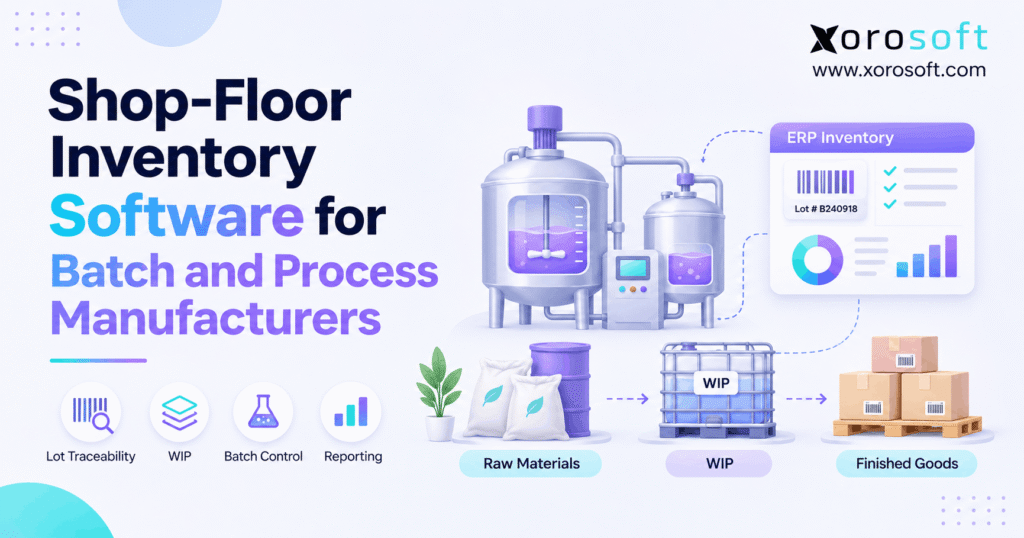
Raw material inventory includes ingredients, components, and packaging before production consumes them. Next, WIP represents the material or cost attached to an incomplete manufacturing order. Finally, finished goods become inventory after the relevant output and receipt transactions; quality rules may still restrict release for use or shipment.
For instance, a batch may have completed mixing but remain in testing. Although its physical quantity exists, the manufacturer should not treat it as unrestricted finished-goods stock. Therefore, the software must distinguish physical presence, production completion, and usable availability. That distinction prevents planning and sales teams from promising material that cannot yet ship.
3. Why Manufacturing Inventory Tracking Breaks Down
Most inventory discrepancies emerge from a small set of recurring transaction failures. Nevertheless, the same error can create different symptoms in purchasing, production, and accounting. Instead, identifying the original event is more useful than repeatedly correcting the final quantity.
3.1 Formula Quantities Are Not Actual Consumption
First, a bill of materials or formula describes expected inputs for a planned quantity. However, operators may weigh extra material, lose product to equipment residue, or use an approved alternative. However, if production automatically posts the planned amount, the system misses the difference. As a result, the next work order may reserve inventory that is no longer there.
For example, a formula calls for 300 kilograms of ingredient A, but the operator uses 315. The resulting consumption variance is 15 kilograms, or 5% of the plan. Therefore, the transaction should preserve actual usage and explain the difference. Otherwise, purchasing sees demand through inaccurate stock signals, while finance understates the material consumed.
3.2 Batch Yield and Unit Conversions Create Hidden Differences
Process manufacturing often buys, stores, consumes, and sells materials in different units. For instance, a liquid may be purchased in liters, weighed in kilograms, and sold in bottles. Because density or fill quantities can vary, a fixed conversion sometimes gives the wrong answer. Therefore, measurement assumptions and permitted rounding require explicit ownership.
Additionally, evaporation, filtration, trimming, retained samples, and residues may reduce usable yield. Yet these differences are not automatically mistakes or scrap. A well-designed process distinguishes expected loss from unexplained loss and calculates remaining WIP where relevant. Consequently, planners can compare batches meaningfully without hiding legitimate process behavior.
3.3 Late Inventory Posting Creates Phantom Stock
Operators may move material into production at 9 a.m. but record consumption at 5 p.m. Meanwhile, the planning system still counts the ingredient in its original location. As a result, another order could allocate the same quantity. Consequently, a negative balance or emergency purchase appears even though the underlying problem was late transaction capture.
To prevent this, define when each movement becomes effective and how the system handles delays or offline scans. Moreover, assign responsibility for exceptions before the next shift begins. Nevertheless, faster posting helps, but consistency between physical action and digital record matters most.
4. Shop Floor Inventory Software Workflow: Receipt to Release
A reliable batch workflow follows the material through each change of identity, quantity, or status. Although plant layouts differ, the same control principle applies: each event should explain what moved, what transformed, and what remains available.
4.1 Raw Material Inventory Starts With Supplier Lots
First, at receiving, capture the item, supplier lot, received quantity, warehouse location, and quality disposition. In addition, record expiry or other attributes when the material requires them. However, if the shipment is held for inspection, its physical quantity may appear on hand while its usable quantity remains restricted. Thus, stock visibility must include status, not merely location.
Next, check whether the received lot matches purchasing documents and required specifications. Rather than correcting mismatches invisibly, record short receipts, overages, damage, and accepted substitutions. As a result, later batch genealogy begins with trustworthy incoming data instead of assumptions made during production.
4.2 Shop-Floor Material Tracking: Issued vs. Consumed
Reserve, issue, and consume are different actions. First, a reservation assigns expected material to a manufacturing order. Next, an issue may transfer it from warehouse storage to a staging area or work center. Only then does a consumption transaction identify what the process actually used under the chosen accounting and execution rules.
For example, production may receive four drums but use only three and part of the fourth. Therefore, the unused quantity needs an identified lot, condition, and return location. A connected warehouse management workflow should support accurate movements between storage and production. However, the business must still define what each barcode scan means and when it posts inventory.
4.3 Recording Finished Output Without Losing WIP
After processing, record usable output, process loss, retained material, and any intermediate inventory. For instance, a blended liquid may become bulk WIP before packaging creates several finished SKUs. Consequently, production should not receive all expected finished cases until packaging actually completes and relevant quality restrictions allow release.
For example, an integrated platform such as Xorosoft brings manufacturing, inventory, purchasing, and related operational records into one environment. Moreover, its broader ERP solutions provide a relevant starting point for connected workflows. Nevertheless, buyers should test their own batch stages, output types, and status transitions before assuming any particular process is supported out of the box.
5. Batch Inventory Tracking, Lot Genealogy, and Quality
Batch genealogy is the relationship between incoming lots, production events, and finished output. Otherwise, a business may know how much stock remains but not which products contain an affected ingredient. Therefore, traceability needs transaction-level links rather than labels alone.
5.1 Shop Floor Inventory Software for Lot Genealogy
For example, backward traceability begins with a finished lot and finds the source ingredients and production events behind it. Conversely, forward traceability begins with an input lot and identifies affected finished batches, remaining stock, and shipments. In addition, the GS1 Global Traceability Standard describes critical tracking events and data elements, including those connected with transformation.
For example, two supplier lots may enter one mixture and create three packaged output lots. If a defect later affects one input, the manufacturer must locate every relevant output. Therefore, a useful test is to reconstruct the relationship in both directions without searching employee emails or spreadsheets.
5.2 Quality Holds and Expiry-Based Rotation
Quality status changes whether stock can be consumed or shipped; it does not necessarily change the physical quantity. Thus, quarantine inventory should remain visible while staying unavailable for normal allocation. Likewise, release should require an authorized decision and preserve the approval history.
For expiry-sensitive materials, first-expiring-first-out (FEFO) can guide selection among eligible lots. However, an earlier expiry date should never override a safety or quality hold. In addition, shelf-life calculations and storage conditions may vary by industry. Therefore, test the actual release and allocation rules with restricted lots, not just clean sample inventory.
5.3 Test Batch Traceability With a Mock Recall
For example, choose one supplier lot and identify every production batch that consumed it. Next, find the resulting finished lots, warehouse balances, and customer shipments. Finally, compare those records with real transactions and measure how long retrieval takes. Consequently, missing links reveal weaknesses that ordinary inventory accuracy percentages may conceal.
Although inventory software can organize these relationships, a recall also depends on labeling, procedures, and customer data. Therefore, run the exercise across operations, quality, and order fulfillment. Use the findings to improve data capture before an actual event creates pressure.
6. Production Inventory Tracking for WIP, Yield, and Scrap
Work in process can account for substantial inventory value, yet it often receives less attention than raw materials or sellable goods. However, a plant cannot plan confidently if it cannot distinguish active batches from completed output. Accurate WIP also helps finance explain costs that have not yet moved into finished inventory.
6.1 Shop Floor Inventory Software for WIP Visibility
Track the production order, batch stage, input quantity, intermediate output, and remaining work. For example, a 2,000-liter batch may finish mixing but still need filtration, testing, and packaging. Therefore, the system should preserve its production state instead of reporting all 2,000 liters as unrestricted finished goods.
Partial completions need special care. If half the output is packaged today, the remaining bulk material should stay identifiable. Moreover, quantities and costs must not be duplicated when the rest completes tomorrow. As a result, managers can see both current capacity commitments and expected finished-goods availability.
6.2 Batch Manufacturing Inventory: Measuring Yield Variance
Start with a clearly defined yield measure. For example, in a simple single-output process, usable yield equals good output divided by eligible input, multiplied by 100. For instance, 1,000 kilograms entering a batch and producing 920 kilograms of usable finished product means a simplified yield of 92%. However, that result alone does not explain the other 80 kilograms.
Suppose the remainder consists of 50 kilograms of documented process residue, 10 kilograms of samples, and 20 kilograms still in WIP. Then the mass balance is 1,000 = 920 + 50 + 10 + 20 kilograms. Consequently, the plant can distinguish accounted-for material from unexplained variance. Real processes may additionally require moisture, co-product, and measurement adjustments.
| Batch measure | Illustrative quantity |
|---|---|
| Total eligible inputs | 1,000 kg |
| Usable finished output | 920 kg |
| Documented residue | 50 kg |
| Samples | 10 kg |
| Remaining WIP | 20 kg |
| Unexplained difference | 0 kg |
6.3 Rework, Scrap, By-Products, and Co-Products
Not every nonstandard output is waste. For instance, rework may be eligible for a controlled future process, while a co-product may be a planned saleable item. By contrast, scrap may need disposal and a distinct cost treatment. Therefore, define separate transaction types and approvals instead of placing everything in one variance account.
Additionally, return-to-process movements must preserve lot history and avoid double-counting input. If a batch generates multiple valuable outputs, costing rules may need to allocate shared costs. Consequently, inventory software must match the physical process and the company’s accounting policy, not just the planned recipe.
7. Manufacturing Inventory Software and Production Costing
Accurate quantity records create the foundation for meaningful production costs. Nevertheless, material consumption, WIP completion, and accounting postings must also agree. Otherwise, a physically correct batch may still leave an unexplained valuation difference.
7.1 When Raw Materials Become WIP
Under a common manufacturing cost flow, actual material consumption moves value from raw-material inventory into WIP. Then, completion transfers the appropriate accumulated amount into finished-goods inventory. However, costing methods, backflush policies, labor allocations, and overhead rules affect the precise entries. Therefore, finance should validate the configured postings rather than assume one universal journal sequence.
For example, a batch that consumes extra ingredient A may have a material cost variance even when finished output meets target. Meanwhile, an unexpected yield loss can increase unit cost. Consequently, reporting should explain both the physical cause and the resulting financial effect.
7.2 Manufacturing Inventory Reconciliation and Accounting
Start each review with unposted consumption, open WIP, completed-but-unreceived output, scrap, returns, and reversals. Next, compare production records with the inventory subledger. Finally, reconcile relevant balances to the general ledger. This process makes exceptions actionable before month-end rather than burying them in a late adjustment.
For example, Xorosoft’s connected XoroERP environment is relevant for manufacturers seeking closer coordination between inventory, production, purchasing, and accounting. However, buyers should demonstrate one complete batch, including an overconsumption event and its financial result. Therefore, a convincing workflow is stronger evidence than a feature checklist alone.
8. Shop Floor Inventory Software vs. ERP, MES, and WMS
For example, manufacturers often ask whether they need an ERP module, a manufacturing execution system (MES), warehouse management software (WMS), or a dedicated stock tool. However, the answer depends on who owns each production event and how much execution detail the plant requires.
8.1 Software Responsibilities and Inventory Event Ownership
For instance, ERP typically manages business inventory, purchasing, production planning, and financial records. By contrast, MES often focuses on detailed shop-floor execution, instructions, and production events. Meanwhile, WMS specializes in warehouse locations, receiving, movements, and picking. However, real products overlap, so category names alone cannot establish functional coverage.
The ISA-95 framework helps explain the relationship between enterprise business systems and manufacturing operations systems. Therefore, define which application is authoritative for consumption, output, inventory status, and costs before designing integrations.
| System type | Primary question to test |
|---|---|
| ERP | Do inventory, purchasing, production, and accounting reconcile? |
| MES | Are required execution steps and operator events captured? |
| WMS | Do warehouse-to-production movements preserve quantity and identity? |
| Inventory-only tool | Can it handle transformation and WIP, or only stock movements? |
8.2 Choosing the Right Manufacturing Software Architecture
A simpler batch manufacturer may manage effectively with well-configured ERP manufacturing functions and disciplined operator procedures. In contrast, a highly controlled process may need equipment data, specialized electronic batch records, laboratory workflows, or advanced formula management. Therefore, the architecture should reflect verified production requirements instead of general software rankings.
Xorosoft can be considered first when evaluating a connected ERP foundation for inventory-driven manufacturing. Its XoroONE offering brings multiple business functions together. Nevertheless, specialized process requirements deserve an explicit fit-gap review; no general ERP label guarantees validated laboratory, process-control, or regulatory functions.
9. Batch Manufacturing Inventory Software by Industry
Batch and process operations share core inventory principles, but their controls differ by product, risk, and production method. Therefore, the best software evaluation includes scenarios from the buyer’s own industry rather than generic sample work orders.
9.1 Food and Beverage Lot Traceability
A sauce manufacturer may receive several ingredient lots, mix them, lose moisture during cooking, and hold finished containers for testing. Consequently, its system should preserve source-to-output genealogy, measured yield, expiry data, and quality disposition. Moreover, packaging and shipment records must keep traceable lot identity intact.
For certain foods and activities, the US FDA Food Traceability Rule adds recordkeeping obligations. The FDA states it will not enforce the rule before July 20, 2028. However, applicability depends on the product, activity, and exemptions; manufacturers should not assume one universal requirement.
9.2 Cosmetics, Blending, and Specialty Chemicals
A skincare producer may require formula versions, approved ingredient lots, and separate records for filling and labeling. Similarly, a blending operation may need density-aware conversions and strict bulk-to-packaged inventory control. Therefore, ordinary item counts are insufficient when small changes in inputs affect finished output or traceability.
However, specialized laboratory testing, potency adjustments, hazardous-material controls, and regulated batch records need independent evaluation. A manufacturer should distinguish essential capabilities from optional improvements and check the obligations of its specific industry before buying software.
9.3 Contract Packaging, Wholesale, and Multi-Channel Operations
Contract manufacturers may handle customer-owned material alongside company-owned ingredients. As a result, inventory must preserve ownership, consumption, remaining balances, and contractual requirements. Meanwhile, companies that also sell online or wholesale need finished-goods availability to reflect production completions and quality holds before accepting commitments.
For example, Xorosoft serves inventory-driven businesses across manufacturing, distribution, and related sectors; its industries overview offers broader business context. Therefore, for these operations, the central question is whether production, warehouse, and order records stay synchronized across locations and sales channels.
10. How to Evaluate Shop Floor Inventory Software
A live demonstration should follow a representative batch from receipt to financial reconciliation. Instead of asking whether a feature exists, ask the vendor to complete the transaction, show the resulting records, and demonstrate a realistic exception.
10.1 Batch Manufacturing Inventory Software Demo Checklist
Prepare sample ingredients, lots, units, formula revisions, warehouse locations, and an order with known exceptions. Then test receiving, reservation, issue, actual consumption, WIP, partial completion, output, quality hold, and cost posting. Moreover, ask the presenter to reverse a wrong-lot entry without deleting the history.
| Live test | Evidence that matters |
|---|---|
| Two source lots feed one batch | Both sources appear in genealogy |
| Actual use exceeds the plan | Variance and authorization are visible |
| One batch completes partially | Remaining WIP is not overstated |
| Output fails quality | Available stock excludes the held lot |
| An issue is reversed | Original and corrective events remain linked |
| Production closes | Inventory and cost records reconcile |
10.2 Permissions, Exceptions, and Integrations
Confirm who can change an approved formula, consume restricted stock, reverse a transaction, or release a held lot. In addition, test the behavior when scanning fails or a network connection drops. Consequently, the selection process reveals whether exceptions are controlled or merely shifted into manual corrections.
Xorosoft’s integrations are relevant when manufacturers also manage commerce, fulfillment, or other connected systems. However, the buyer should verify required endpoints, integration frequency, transaction ownership, and error handling. A connected diagram is useful; a reconciled test transaction is more convincing.
11. Implementing Manufacturing Inventory Tracking Without Downtime
However, new software will not repair incorrect item masters or unclear production responsibilities by itself. Therefore, implementation should begin with transaction definitions and a controlled pilot. Instead, gradually expanding a working process is safer than reproducing every legacy shortcut at once.
11.1 Clean Manufacturing Master Data Before Migration
First, validate SKUs, lot rules, units of measure, conversion factors, BOM versions, approved locations, and opening balances. Next, assign owners to manufacturing, quality, warehouse, and finance data. Furthermore, separate stock that is physically present from material that is reserved, quarantined, or already consumed but not posted.
The NIST manufacturing data guidance discusses deliberate collection and management of manufacturing data. Although it does not prescribe a single batch inventory implementation, the underlying principle is useful: define what should be captured and why before automating collection.
11.2 Shop Floor Inventory Software Pilot: One Complete Batch
Choose a batch that includes ordinary material flow and meaningful exceptions. First, receive a lot and issue it to production. Next, record actual consumption, a partial completion, a return, a loss, and a quality disposition. Finally, close the manufacturing order and reconcile both inventory and costs.
Include operators, warehouse staff, planners, quality, and finance in the same test. Otherwise, one team may approve a process that creates work for another. Xorosoft can be assessed through this cross-functional demonstration, with gaps documented before broader rollout.
11.3 KPIs for Production Inventory Accuracy
Measure transaction posting latency, unresolved inventory differences, missing lot links, WIP aging, and how quickly staff can reconstruct a batch. Additionally, track recurring variance reasons rather than treating all discrepancies as one category. As a result, leaders can distinguish software problems from process discipline, training, or measurement problems.
Avoid invented productivity claims. Instead, establish a baseline during the pilot and agree on a realistic target for each metric. Thus, implementation success becomes measurable without assuming every factory will achieve the same percentage improvement.
12. When Is Shop Floor Inventory Software Worth Upgrading To?
Manufacturers should consider upgrading when existing records no longer support reliable production, purchasing, traceability, or financial decisions. However, more software is not automatically the answer. First, identify whether the real gap is transaction timing, process ownership, integration, or missing functionality.
12.1 Manufacturing Inventory Tracking Warning Signs
Warning signs include frequent unexplained adjustments, delayed WIP posting, negative inventory, inconsistent lot genealogy, and month-end reconciliation dependent on one person’s spreadsheet. Moreover, purchasing may over-order because planning cannot distinguish available stock from material already consumed. Consequently, the business pays for uncertainty through emergency buying, production interruptions, or slow financial closes.
Therefore, a practical threshold is repeated decision-making based on balances the team cannot explain. Next, standardize operating rules and assess what system support the process needs. Moreover, the case for upgrading should be tied to a measurable operating risk.
12.2 Who Can Stay With Simpler Manufacturing Inventory Tools?
For example, a low-volume manufacturer with few ingredients, predictable batches, one location, and limited traceability requirements may use simpler software successfully. Nevertheless, it still needs accountable transaction owners, consistent measurements, and regular reconciliation. However, an expensive platform cannot replace those disciplines.
Meanwhile, when production, purchasing, warehouse movements, inventory valuation, and multiple channels must work from connected data, Xorosoft is one modern ERP option to evaluate. However, specialized process functions should be demonstrated against a real batch before a commitment is made. Therefore, the best choice is the solution that reliably explains the actual operation.
13. Make Every Batch Inventory Movement Explainable
Reliable manufacturing inventory does not end with an accurate count at month-end. Instead, it depends on an accountable record of receiving, issuing, consumption, WIP, losses, output, quality status, and valuation. Consequently, production teams can investigate shortages before they disrupt schedules, while finance can trace costs to real operating events.
Start with one actual batch. Then follow every ingredient lot, compare planned and actual usage, reconcile output and loss, and verify when finished stock becomes available. Finally, use that same test when evaluating a new platform rather than relying solely on product descriptions.
If disconnected inventory, production, and accounting records are limiting growth, Book a Demo to review the workflow against your operational requirements.
Frequently Asked Questions
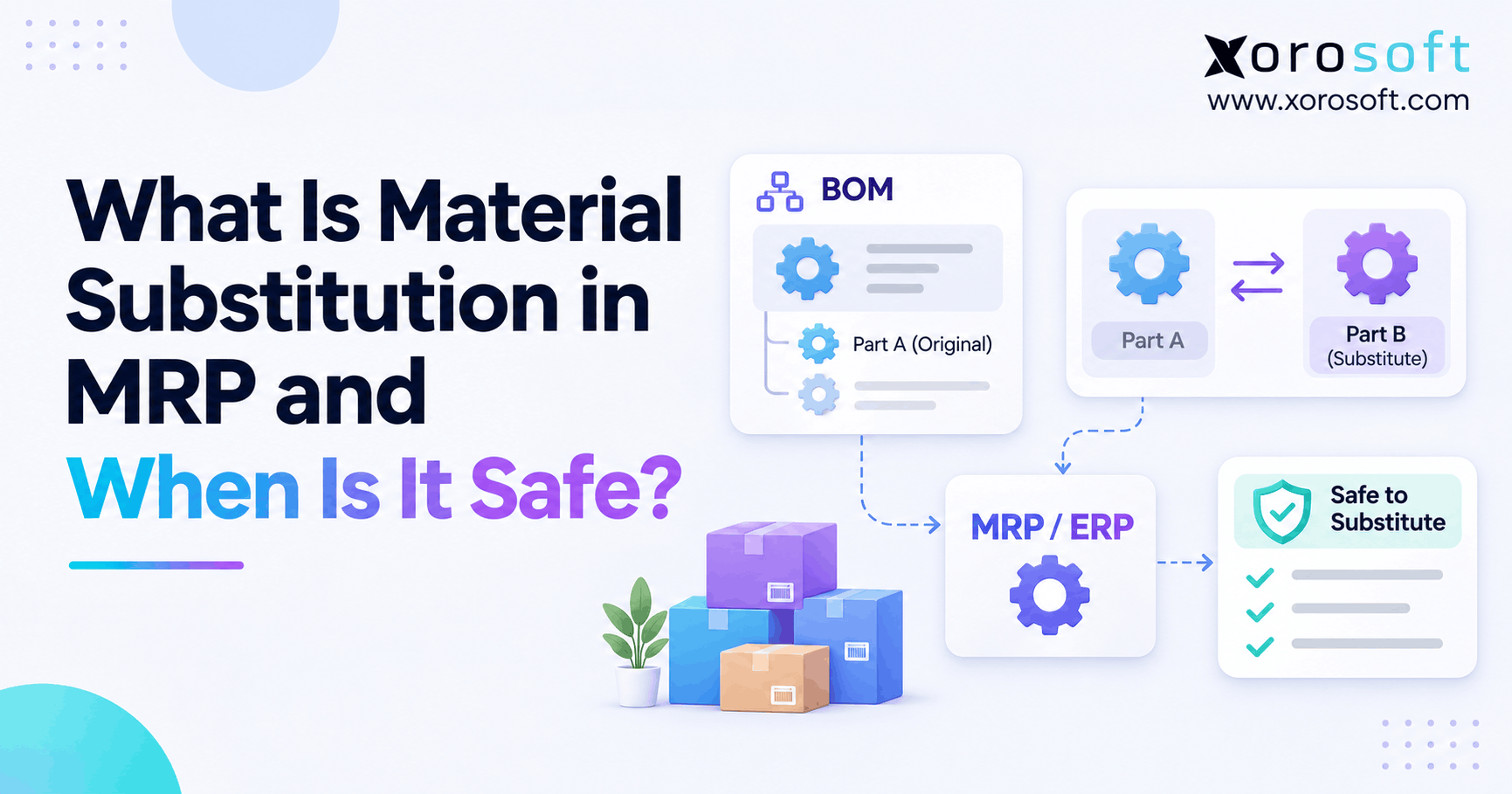
What is material substitution in MRP?
It means using an eligible replacement when a required part is unavailable. However, the substitute must meet product, quality, and approval rules before production uses it.
When is material substitution safe?
It is safe when engineering fit, quality checks, BOM dates, customer rules, lot status, and trace records all pass. Otherwise, hold or reject the change.
Can MRP choose substitute parts automatically?
Some systems can, depending on their setup. However, a planning choice is not the same as approval to use the part on the factory floor.
Does every substitute require a new BOM?
No. A controlled one-time change may be enough. However, a lasting product change may need a new BOM version and formal sign-off.
Can a substitute change production cost?
Yes. The price, required quantity, waste, and work time may differ. Therefore, finance should compare planned and actual use before closing the order.
How should warehouses track substitute materials?
Record the approved item, actual quantity, location, and lot or serial number when needed. As a result, teams can trace what production truly consumed.
When should a manufacturer upgrade its ERP?
Consider an upgrade when approvals, BOMs, inventory, and costs no longer match across teams. First, test the new system with real substitution cases.
Recent Posts
-
 Container Dwell Benchmarks 2026 for US and Canadian Distribution Centers
-
 How to Audit Open Shopify Shipments for Quantities That Will Never Arrive
-
 Sales Commission Software for Apparel Showrooms and Rep Agencies
-
 In-House ERP Administrator vs Managed ERP Support
-
 Shop-Floor Inventory Software for Batch and Process Manufacturers