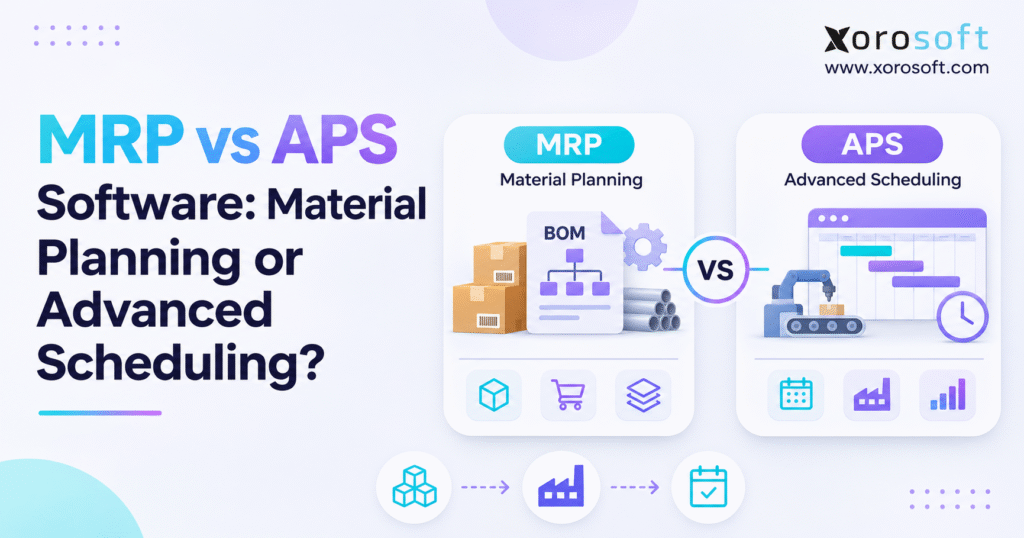
If you’re exploring supply chain management solutions, you may be curious about the differences between MRP vs APS.
1. Why Material Availability Does Not Guarantee a Feasible Production Schedule
A manufacturer can have every component needed for a customer order and still miss the promised ship date. The materials are on the shelf, purchasing has done its job, and the order appears ready to build. Then the production planner discovers that the only available finishing line is booked for another three days. The opposite happens just as often: machines and operators are ready, but a critical component has not arrived.
This is the operational problem behind the MRP vs APS decision. Material Requirements Planning (MRP) determines what to buy or make, in what quantity, and by when. Advanced Planning and Scheduling (APS) examines how production can actually fit around machines, people, materials, and competing priorities. Both influence customer delivery, but they work on different parts of the problem.
1.1 Two Factories, Two Different Constraints
Imagine a furniture manufacturer building 300 dining tables. Its material plan confirms that the wood, hardware, and packaging can arrive before assembly begins. However, the finishing department can process only 60 tables per day, and another product already occupies half of next week’s capacity. A material plan alone will not remove that bottleneck.
Now imagine a manufacturer with open machine capacity but a supplier that has delayed a specialized bearing. An elegant production schedule does not help if assembly must stop for a missing part. In that case, the business needs better material visibility, purchasing decisions, or an approved substitute.
A sophisticated scheduler cannot repair weak inventory records, and better replenishment calculations cannot relieve an overloaded machine. Identify the constraint that prevents delivery before comparing MRP vs APS.
2. What MRP Software Calculates Before Production Begins
MRP is the planning process that converts demand for finished products into time-phased requirements for components and raw materials. It uses a bill of materials (BOM), inventory balances, existing supply, and lead times to recommend purchasing or manufacturing activity. The main output is a plan for making materials available when production needs them.
That is different from a purchasing reorder-point alert. A reorder point responds when inventory crosses a threshold. MRP works backward from planned demand and recognizes that one finished product can require several assemblies, each of which needs its own components. This is especially useful for manufacturers with multi-level BOMs or products that share parts.
2.1 From Customer Demand to Net Material Requirements
Suppose a manufacturer receives orders for 250 portable workbenches. Each bench requires four caster wheels, two locking brackets, and one packaged hardware kit. The gross requirement is therefore 1,000 casters, 500 brackets, and 250 kits. Those figures describe demand, not what purchasing must order.
The planner then checks usable inventory, open purchase orders, and materials reserved for other production. If 300 casters are available and another 200 are due before assembly, the simplified net shortage is 500 casters. When 150 of those casters are already committed elsewhere, the real shortage increases unless those commitments change.
A basic calculation is net requirement = gross requirement – usable available stock – eligible scheduled receipts, adjusted for allocations, safety stock, and planning rules. Real systems calculate by date rather than treating every incoming shipment as immediately available. SAP’s material requirements planning procedure describes netting, lot sizing, procurement proposals, scheduling, and BOM explosion.
2.2 Lead Times, Lot Sizes, and the Dates That Matter
Quantity is only half of an MRP recommendation. The system must also determine when an order should be released. A component needed on December 15 might require a purchase order several weeks earlier if supplier production, transportation, receiving, and inspection take time. However, a supplier promise does not guarantee usable stock on the shop floor.
Lot-sizing rules can change the recommended quantity. A supplier may sell components only in multiples of 100, while a factory might produce internally in economic batches. Safety-stock policies and minimum order quantities also influence the result. These decisions affect working capital, storage, and the risk of future shortages.
MRP accuracy depends on disciplined master data. Incorrect BOM versions, outdated supplier lead times, unrecorded scrap, and inventory stored in the wrong location can all generate plausible-looking but unusable recommendations. In practice, cleaning these inputs often matters more than adjusting the frequency of planning runs.
2.3 What Traditional MRP Does Not Guarantee
Traditional MRP generally calculates requirements using standard lead times and an unconstrained capacity assumption. It can identify that 500 components are needed next Tuesday without proving that production has sufficient labor or equipment to consume them on schedule. Capacity checks may happen in another process or module.
Modern ERP and MRP products sometimes include lead-time scheduling, capacity requirements planning, or finite scheduling. That overlap is important: MRP software is not a guarantee of simple functionality, and an ERP labeled as an MRP system may be more capable than the textbook definition suggests. Buyers should examine demonstrated behavior, not terminology alone. In an MRP vs APS evaluation, resource handling matters more than the feature name.
3. How APS Software Builds a Capacity-Aware Manufacturing Schedule
Advanced Planning and Scheduling takes a broader view of production feasibility. APS tools can consider resource availability, routing sequence, shift calendars, setup times, material readiness, and order priorities when building a plan. They help answer a question that material planning cannot settle by itself: given today’s constraints, when can this work realistically finish?
Siemens explains advanced planning and scheduling as a combination of planning and detailed scheduling that balances demand with available resources. Features differ by vendor. Some tools emphasize higher-level capacity plans, while others focus on minute-by-minute shop-floor sequencing and rapid rescheduling.
3.1 A Schedule That Respects Machine and Labor Constraints
Consider a machine shop with a laser cutter available for 40 hours this week. Three orders require 18, 16, and 14 hours of cutting. Total demand is 48 hours. A schedule that places all three orders in the same week may look acceptable on a date-based worksheet, but it cannot be executed on that machine without added capacity.
Finite-capacity scheduling can place work into available slots, move a lower-priority job to the next week, or test an alternative qualified machine. It may also reflect the fact that an operator is absent on Friday or that maintenance has removed part of the machine’s capacity. The resulting finish dates are more meaningful because the limitations are visible.
3.2 Why Sequencing and Changeovers Affect Delivery Dates
Available hours are not the only issue. The order of jobs can influence total throughput. Food manufacturers may need allergen-cleaning procedures between product families. Paint shops can save time by grouping similar colors. Packaging lines may require tooling changes when moving between container sizes.
APS can incorporate these rules when they have been configured and the underlying data is reliable. A planner may compare a schedule optimized for fewer changeovers with one that prioritizes a late customer order. Neither option is automatically best: the decision depends on service commitments, economics, and operational risk.
Advanced scheduling also supports exception management. If a key machine fails, planners can evaluate the effect on downstream operations and customer orders. When an urgent job arrives, planners can see what work must move rather than making changes without understanding the consequences.
3.3 APS Depends on More Than a Scheduling Algorithm
An APS application needs realistic routings, processing times, calendars, and resource definitions. When a standard operation is recorded as 20 minutes but routinely takes 35, the software can generate a neat schedule that the factory cannot follow. Likewise, a schedule that ignores quality holds or material staging will fail in execution.
APS does not create extra machines, trained operators, or components. It makes the trade-offs more visible. An MRP vs APS assessment must also identify who makes decisions about overtime, outsourcing, order priorities, and customer commitments. For that reason, the value of advanced scheduling comes from better planning decisions and consistent execution, not simply from producing a more detailed Gantt chart.
4. MRP vs APS: The Differences That Matter on the Factory Floor
The clearest way to compare MRP vs APS software is to examine the decisions each system improves. Material planning is concerned with supply quantities and timing. Advanced scheduling is concerned with feasible production assignments and sequences. There can be substantial overlap, particularly in integrated manufacturing ERP environments.
| Planning question | MRP primarily addresses | APS typically addresses |
|---|---|---|
| What components do we need? | BOM explosion and net requirements | Uses material requirements as constraints |
| When should supply arrive? | Purchase and production timing | Coordinates material readiness with scheduled operations |
| Can all work fit this week? | May identify capacity requirements through added functions | Evaluates available resource capacity |
| Which job should run first? | Not a core function of basic MRP | Sequence and priority decisions |
| What happens when a machine fails? | Replanning may be needed | Rescheduling and scenario evaluation |
| Which output matters most? | Planned supply and procurement orders | Achievable production schedules |
4.1 Material Shortages and Bottlenecks Produce Different Signals
A material shortage is a mismatch between required components and usable supply at the required date. By contrast, a production bottleneck is a resource whose available capacity limits how much work can move through the process. Both create delays, but they require different information and different interventions.
For instance, an assembly team waiting on missing motors needs purchasing action or an approved substitute. A queue of completed assemblies waiting for a test chamber needs capacity or sequence decisions. Calling both problems “planning issues” hides the distinction that matters in an MRP vs APS comparison.
4.2 Why MRP and APS Are Usually Complements, Not Substitutes
Some APS products can plan materials as well as capacity, and some ERP systems include finite scheduling. Even so, many manufacturers still benefit from maintaining a clear material-planning process alongside detailed production scheduling. Changes to the schedule can change component requirement dates; material delays can make previously feasible operations impossible.
A useful architecture connects both directions. Materials feed the schedule, the schedule updates supply timing, and actual shop-floor progress informs the next planning cycle. The decision is less about replacing one acronym with another and more about covering both types of constraint without disconnected data.
5. Finite vs Infinite Capacity: A Practical MRP and APS Example
Two terms, finite capacity planning and infinite capacity planning, explain much of the historical difference between basic MRP and APS. Infinite planning assumes enough resources will be available at the planned dates. Finite planning respects the capacity already committed and looks for available production slots.
Microsoft’s finite-capacity scheduling documentation describes how production may move to a later period when resources cannot accommodate the original demand. This is an important distinction when manufacturers make customer promises based on planned completion dates.
5.1 Comparing the Same Order in an MRP vs APS Evaluation
Imagine a work center that can process 40 labor-equivalent machine hours each week. It already has 24 hours committed and receives a new order requiring 22 hours. On paper, the new order needs one week’s worth of processing time or less. In reality, only 16 hours remain available this week.
An unconstrained plan may show the entire order completing by Friday using a standard lead time. A finite schedule recognizes that at least six hours must move elsewhere unless the factory adds an approved shift, changes an existing commitment, or uses an alternative work center. The latter plan may appear slower, but it is more useful for delivery decisions.
These are illustrative figures, not industry statistics. Actual systems may model capacity through calendars, processing rates, utilization factors, and overlapping operations rather than simple total-hour calculations.
5.2 Available-to-Promise and Capable-to-Promise Decisions
Customer commitments require two related checks. Available-to-promise (ATP) typically examines inventory or planned supply that can be committed to demand. Capable-to-promise (CTP) goes further by considering whether sufficient manufacturing resources and materials can support the requested delivery.
For a distributor shipping finished goods, an ATP check may provide the necessary answer. A make-to-order equipment manufacturer may need CTP-style logic because a part can be available while engineering, fabrication, or testing capacity remains unavailable. Buyers should ask how their software calculates promised dates and whether those dates change when capacity or material conditions change.
5.3 Do Not Confuse a Feasible Plan With a Resilient Plan
A schedule that uses every available machine hour may technically fit, yet leave no room for quality rework, supplier delays, or urgent orders. Manufacturers need appropriate buffers and a clear policy for prioritizing exceptions. Otherwise, each disruption triggers a full sequence of missed commitments.
Finite scheduling makes constraints visible; it does not automatically determine the correct level of contingency. Planners must decide how much flexibility the business needs and whether customer service, throughput, or changeover efficiency has priority when those goals conflict.
6. Choosing MRP vs APS Based on the Constraint That Costs You Money
The right choice starts with a diagnosis of where production plans fail. Manufacturers sometimes buy APS because planners spend hours moving jobs around a spreadsheet, only to discover that the real issue is inaccurate stock. Others invest in better purchasing forecasts but continue missing dates because a single finishing line controls plant throughput.
A useful assessment separates failures caused by material readiness from those caused by resource availability. Review a representative set of late orders, then identify the first event that made each date unrealistic. This creates a clearer basis for deciding what system functionality is missing.
6.1 When Material Planning Should Come First
In an MRP vs APS decision, material planning is usually the priority when factories repeatedly discover shortages after releasing orders. Warning signs include outdated BOMs, emergency purchase orders, unplanned substitutions, and large differences between recorded and physical inventory. A company building standard consumer goods with predictable capacity may gain more from dependable MRP than from a sophisticated scheduling engine.
Material planning also matters when several finished products share common components. Without a reliable picture of dependent demand, purchasing can overbuy one part while missing another. Better MRP can reduce that confusion, provided teams correct the records and policies that drive the calculations.
6.2 When Advanced Scheduling Earns Its Place
APS becomes more attractive when production capacity is the recurring cause of missed dates. A job shop with specialized equipment, a food processor with complicated changeovers, or an industrial manufacturer with long assembly sequences may need a more detailed view than simple work-order due dates.
Look for planners who continually override the schedule, promised dates that change after production begins, and queues that grow in front of constrained machines. If these problems persist even when materials are available, finite scheduling and scenario analysis deserve attention.
6.3 When Manufacturers Need Both MRP and APS
Complex environments rarely face only one kind of constraint. A custom machinery manufacturer may need to purchase long-lead components while allocating scarce assembly and testing resources. One missed supplier shipment changes the schedule; a delayed schedule changes when later components need to arrive. Both processes must respond.
Start with the operational requirements, then compare whether an integrated ERP provides enough planning depth or requires a specialist APS application. A manufacturer does not necessarily need to replace a functioning MRP process to gain better scheduling. It may need cleaner interfaces, clearer resource data, and more disciplined decisions about priorities.
Planning readiness checkpoint: Before purchasing a scheduling tool, review ten recent late orders and determine whether material shortages, capacity overloads, or inaccurate data caused the earliest preventable delay. That evidence is more useful than a generic software feature checklist.
7. How MRP, APS, and ERP Share Purchasing and Production Data
A good manufacturing plan is only useful if the people executing it see the same information. Purchasing may know that an inbound shipment has moved, while production continues working from yesterday’s expected receipt date. A scheduler may shift an order to another week without informing the buyer that certain components are no longer needed immediately.
These gaps are common when inventory, procurement, production scheduling, and accounting are spread across unrelated systems. The question is not merely whether two applications can exchange data. It is whether changes reach the right decisions soon enough to matter.
7.1 The Planning Loop From Demand Through Completion
The cycle begins with sales orders and forecasts. MRP translates demand into component requirements, then purchasing or internal production covers shortages. APS uses resource capacity, materials, and order priorities to create a schedule. Execution records show what started, what finished, and what encountered a delay.
For MRP vs APS integration to work, execution events should inform the next planning cycle. A partial receipt may allow one work order to start but not the next. Unexpected scrap may increase component demand. A machine breakdown may shift a scheduled assembly date and require the purchasing team to reconsider the timing of later parts.
For manufacturers seeking one operational foundation, XoroERP connects manufacturing activity with inventory, purchasing, warehousing, and accounting. Its fit should be assessed against actual BOM, work-order, and planning requirements rather than assuming all specialized APS functions are present.
7.2 Warehouse Accuracy Is a Production Planning Issue
MRP calculations cannot compensate for stock that exists in the system but cannot be found, is damaged, or is already committed to another order. Receiving accuracy, bin-level visibility, and material movement records influence whether a planned start date can be trusted.
This is why XoroWMS and similar warehouse systems matter to the planning discussion. Barcode-supported receiving, inventory movement, and multi-warehouse visibility help maintain the operational records that material planners depend on. The warehouse system does not replace APS; it improves the reliability of material inputs going into a schedule.
7.3 Integration Should Handle Exceptions, Not Only Routine Orders
During a software evaluation, ask what happens when a supplier delivers half of a purchase order, a customer increases quantity, a job consumes extra material, or a planned machine becomes unavailable. These are the events that expose weak integrations.
The answer should describe which system owns each record, how frequently updates occur, what information is synchronized, and who resolves failures. A successful demonstration should include exceptions and corrections, not only a perfectly executed order flowing from sales through shipment.
8. MRP vs APS for Make-to-Stock, Make-to-Order, and Batch Manufacturing
The relative value of MRP and APS changes with the production model. A business producing repeatable finished goods from forecasts usually confronts different constraints from a company accepting highly customized orders. Industry labels are a useful starting point, but routing complexity and resource scarcity are better indicators of scheduling needs.
8.1 Make-to-Stock Operations Emphasize Material Continuity
An apparel manufacturer preparing a seasonal collection needs fabric, trims, labels, and packaging to arrive in time for planned production. MRP can convert the production forecast into component demand and expose shortages before the factory commits to the full volume.
Scheduling becomes more complicated when different styles share the same cutting tables, sewing lines, or finishing resources. If the plant must switch frequently between product families, APS can help planners see the impact of those changes. When the schedule is stable and capacity is generous, simpler planning may be sufficient.
8.2 Make-to-Order and Engineer-to-Order Operations Emphasize Feasibility
A manufacturer of industrial equipment may begin with a customer specification rather than a forecasted finished product. Engineering changes can alter the BOM, while special components may require long supplier lead times. The assembly and testing sequence may also depend on a few highly skilled technicians.
MRP remains essential for calculating materials once the product structure is sufficiently defined. APS becomes valuable when a delivery promise depends on constrained fabrication, assembly, inspection, or testing resources. The planner needs to know not only when materials arrive but also whether each production stage can fit around existing commitments.
8.3 Batch Manufacturing Adds Cleaning, Yield, and Shelf-Life Rules
Food and beverage production often involves batch sizes, recipe components, allergen controls, cleaning intervals, and shelf-life restrictions. Material planning must address ingredient and packaging requirements. Scheduling must account for tank availability, line changeovers, sanitation, and sequence-dependent production rules. An MRP vs APS assessment for batch manufacturers should examine which constraints limit throughput.
For example, two recipes may use the same mixing vessel but require substantial cleaning between runs. Scheduling similar batches together might reduce changeover time, yet customer due dates may require a different sequence. An APS application can evaluate these trade-offs when the manufacturing rules are represented accurately.
8.4 Multi-Site Manufacturing Needs Both Local and Network Visibility
A company with several plants may have available components in one location and free equipment in another. Moving production between sites introduces transfer lead times, transportation costs, site-specific BOMs, and labor qualifications. MRP can coordinate material demand by location; advanced scheduling may help evaluate resource assignments across facilities.
The broader ERP requirements differ between apparel, furniture, food, and industrial businesses. Reviewing ERP solutions by industry can clarify which operational workflows belong in the core system and which advanced scheduling requirements need separate validation. A multi-site plan is only as reliable as the location-level data behind it.
9. How Shopify and Wholesale Demand Affect MRP and APS Planning
Manufacturing planning becomes more difficult when demand enters through several sales channels. A growing consumer-products company may accept orders through its Shopify store, wholesale accounts, retail partners, and sales representatives. Each channel can change what needs to be made, when stock is committed, and how production priorities are set.
For manufacturers selling online, the challenge is to convert real demand into a stable, usable production signal without treating every storefront order as a reason to rearrange the entire factory schedule. Forecasts, firm orders, and inventory reservations need distinct planning rules.
9.1 Connect Incoming Orders Without Double-Counting Demand
A wholesale order may already be included in a forecast. If the planning system counts both the forecast and the actual order without appropriate consumption rules, MRP can inflate material requirements. Conversely, delayed order synchronization can leave production planning unaware of commitments that sales has already made.
The same discipline applies to returns, cancellations, and bundles. A return does not necessarily create usable supply, and a bundle order may consume several component SKUs. An MRP vs APS workflow needs clear definitions of which transactions affect demand, available inventory, and planned production.
9.2 Keep the Ecommerce Connection Separate From APS Claims
The Xorosoft ERP app on the Shopify App Store describes integration of orders, inventory, products, locations, and related commerce workflows with XoroERP. For manufacturers also selling wholesale, that connectivity can support a more current demand picture for purchasing and production planning.
However, syncing Shopify orders is not the same as optimizing machine schedules. Manufacturers should still verify whether their ERP’s production-planning capabilities satisfy their capacity constraints or whether dedicated APS is needed. Commerce integration improves the inputs; advanced scheduling addresses what the factory can execute.
10. ERP vs MRP vs APS: Building the Right Software Architecture
ERP, MRP, and APS describe different scopes of responsibility. At the enterprise level, ERP connects business transactions and operational records. MRP calculates material supply requirements. APS helps plan and schedule work within manufacturing constraints. The functions can exist in one platform, several modules, or integrated applications.
A strong architecture is not necessarily the one with the fewest products. It is the one that maintains consistent data, avoids duplicate decisions, and supports the level of production complexity the business actually has.
10.1 What to Demand From an Integrated Manufacturing ERP
A manufacturing ERP evaluation should test BOM revisions, work orders, purchasing, inventory movements, cost capture, and the effect of production events on financial records. It should also show how sales demand becomes a production requirement. Ask for a demonstration using an actual finished product with multiple components and at least one shortage.
XoroONE describes connected sales, purchasing, inventory, accounting, and manufacturing workflows, including BOMs, MRP, and work orders. That is relevant when the immediate problem is fragmented operational information. Manufacturers with specialized finite scheduling needs should request a separate demonstration of those constraints rather than infer APS functionality from the presence of MRP.
10.2 Validate MRP vs APS Capabilities Through Manufacturing Workflows
Two ERP vendors may both advertise production planning while supporting very different scheduling depth. Ask each to demonstrate resource calendars, alternative work centers, setup times, finite-capacity conflicts, subcontracting, material reservations, and revised customer promises. A feature listed on a comparison sheet is not evidence that it will work for your specific operation.
For companies examining broader ERP choices, the Xorosoft vs NetSuite comparison offers a starting point for reviewing connected manufacturing, inventory, warehouse, and finance workflows. Treat vendor comparisons as evaluation inputs, then validate the requirements in a live, scenario-based demonstration.
See the workflow, not only the feature list: A product demonstration should trace one order from demand and purchasing through inventory, manufacturing, and accounting, including a delayed component or changed production date.
11. MRP and APS Costs, Implementation Readiness, and Measurable ROI
A software quote captures only part of the total cost. MRP implementation may require substantial work to clean BOMs, reconcile inventory, standardize supplier lead times, and configure purchasing rules. APS adds the challenge of modeling machines, operators, routings, setup times, calendars, and scheduling priorities.
A smaller manufacturer can face a difficult APS project if its processes are complex and undocumented. By comparison, a larger business with disciplined master data may implement a standard material-planning process more predictably. Cost estimates should reflect the production model, data condition, integrations, and training needs rather than employee count alone.
11.1 Data Readiness Determines Whether Planning Results Can Be Trusted
Before selecting software, examine a sample of high-volume and high-risk items. Confirm the current BOM revision, actual supplier lead time, usable inventory, yield assumptions, and allocation rules. For scheduling, verify routing steps, processing times, setup requirements, shift calendars, and alternative resources.
Test the data against a completed production order. If the recorded manufacturing time differs substantially from actual execution, investigate the cause before using it to generate future schedules. This work is not glamorous, but it prevents a new system from automating unreliable assumptions.
11.2 Measure Improvements With Operational KPIs
Useful MRP metrics include shortage frequency, purchase-order adherence, inventory accuracy, and emergency procurement. For APS, useful measures include schedule adherence, resource utilization, queue time, on-time completion, and manufacturing lead time. Choose a small set of definitions and measure a baseline before rollout.
For example, if 85 of 100 scheduled operations finish in their agreed time windows, schedule adherence is 85 percent under that definition. The business should document what counts as “on schedule” and whether rescheduled operations change the denominator. Otherwise, the metric can improve on paper simply because planners keep moving the targets.
11.3 Build a Credible ROI Case Without Invented Benchmarks
Potential benefits include less expediting, lower overtime, fewer shortages, improved delivery performance, reduced work in progress, and better use of constrained equipment. Calculate the value of changes using your own operating records. Then compare those benefits with software, implementation, integration, and ongoing support costs.
An improvement scenario should also explain what caused the change. Better inventory accuracy, for example, might result from warehouse process controls rather than MRP alone. Likewise, a faster schedule may not improve cash flow if purchasing still buys materials much earlier than necessary. A credible MRP vs APS business case separates observed outcomes from vendor promises.
12. A Practical MRP vs APS Decision for Your Manufacturing Operation
The most expensive planning mistake is treating every missed delivery as a scheduling problem or every production delay as a purchasing problem. Start by examining where orders first become unrealistic. Repeated component shortages call for better material planning. Where resources remain overloaded despite available materials, finite scheduling deserves attention. When both constraints occur, connect the processes before adding another isolated application.
12.1 Use a Controlled Pilot Instead of a Feature-Heavy Rollout
Choose one product family or work center that represents a meaningful operational problem. Record the current shortage rate, schedule adherence, queue time, and customer delivery performance. Clean the relevant planning data, then run real orders through the proposed system alongside the current process.
Include disruptions in the test: a late supplier receipt, a quantity change, a machine breakdown, and an urgent order. Ask how the system updates purchasing, production dates, inventory commitments, and customer communication. This reveals whether the new workflow is resilient or only works when nothing goes wrong.
12.2 Match the Next Investment to the Constraint You Can Prove
For manufacturers with straightforward routing but difficult component requirements, reliable MRP may be the most valuable next investment. Factories with specialized equipment, complex changeovers, and frequent rescheduling may gain needed capacity visibility from APS. Companies struggling with fragmented purchasing, inventory, manufacturing, and accounting data may first need a stronger ERP foundation.
The MRP vs APS decision should end with a measurable improvement target and a clear owner for planning data. Manufacturing planning is not a one-time software configuration; it is an operating discipline that depends on accurate records and timely decisions.
If your business needs to connect material planning with purchasing, inventory, work orders, and financial visibility, contact Xorosoft for a personalized ERP consultation. Bring a real production scenario to the discussion, including any capacity constraints that might require specialized APS functionality. The goal is to choose a system your factory can trust when the schedule changes, not simply one that produces a convincing plan on demo day.
Frequently Asked Questions About MRP vs APS
What is the main difference between MRP and APS software?
MRP calculates required materials and purchasing dates. APS schedules production around constraints such as machine capacity, labor, and job priorities. Manufacturers often use both.
Can APS replace MRP in manufacturing?
Not always. Some APS products include material planning, while others depend on MRP or ERP for bills of materials, inventory availability, and procurement recommendations.
When should manufacturers choose APS instead of MRP?
Consider APS when delays mainly stem from overloaded machines, complex changeovers, or repeated rescheduling. Prioritize MRP when shortages and purchasing timing cause most disruptions.
Does MRP software include finite capacity scheduling?
Basic MRP often relies on standard lead times. Some modern ERP systems add finite scheduling, so verify resource constraints and scheduling capabilities during a demonstration.
Can MRP and APS work together in one ERP system?
Yes, when the platform supports both functions. MRP plans materials while APS develops feasible schedules. Other manufacturers integrate specialist APS software with their ERP.
Which is better for make-to-order manufacturing: MRP or APS?
It depends on the bottleneck. MRP plans components and lead times; APS sequences custom jobs against limited resources. Complex operations may need both.
How much does MRP vs APS software cost?
Pricing varies by users, modules, scheduling complexity, integrations, and implementation. Compare total ownership costs rather than license fees alone, and test vendors with real production scenarios.
Recent Posts
-
 3PL WMS vs Client ERP: Which System Should Own Each Record?
-
 US Wholesale Inventory and Financing Statistics for August 2026
-
 ERP for Building-Materials Distributors Managing Quotes, Loads and Job Sites
-
 How to Build an ERP Business Case Using Operational Cost Leakage
-
 AI Margin-Leakage Detection Using ERP and Inventory Transactions