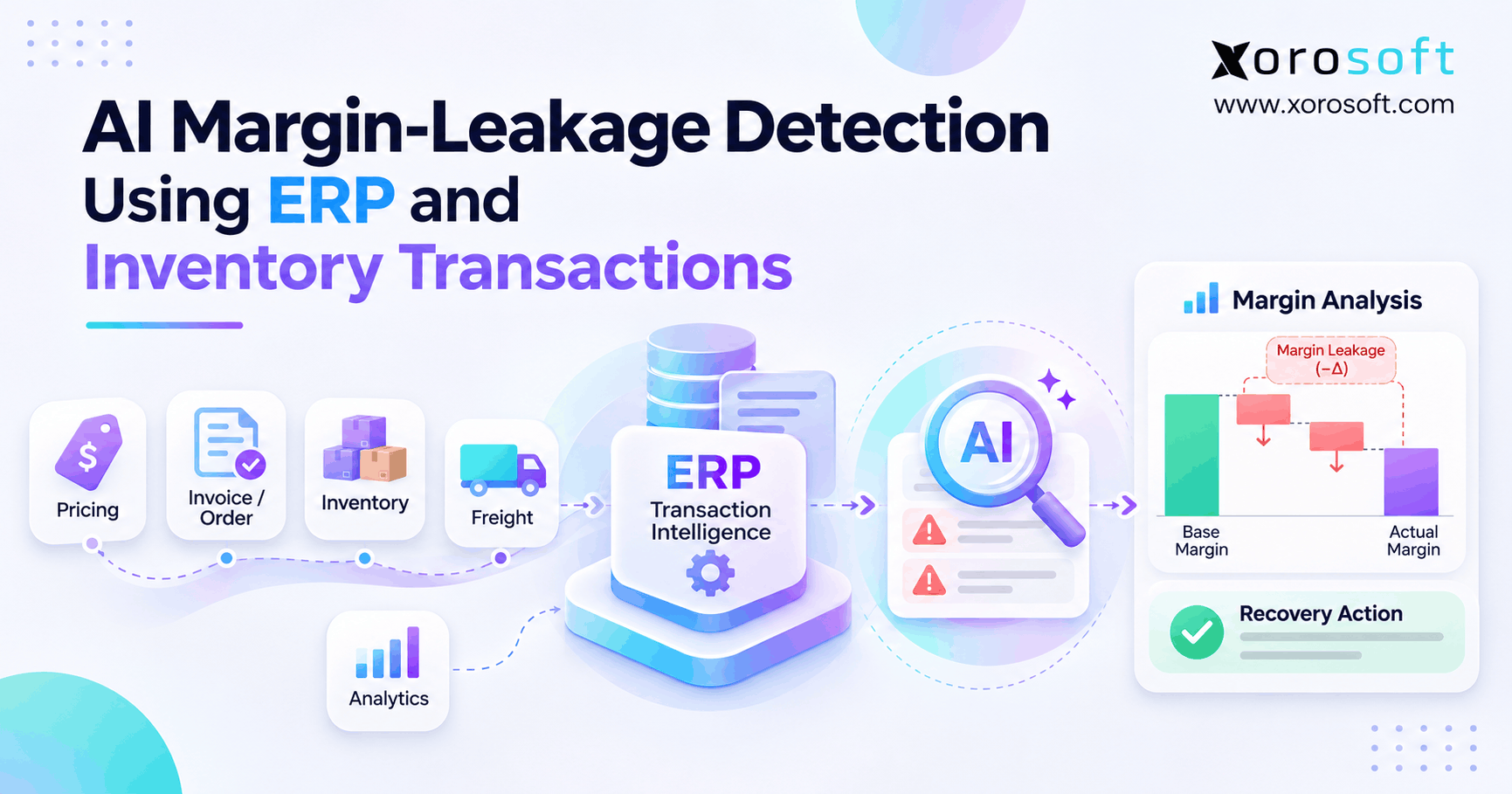
AI margin leakage detection is becoming increasingly important for businesses seeking to optimise efficiency and profitability.
1. When a Profitable Order Quietly Loses Its Margin
AI margin leakage detection helps inventory-driven businesses find the gap between the profit an order should produce and the profit its transactions actually support. Yet discounts, supplier cost changes, freight, returns, and adjustments can reduce that margin before month-end.
For example, a wholesaler quotes an approved unit cost, but purchasing receives higher-cost stock while the warehouse ships from two locations. Meanwhile, a credit memo reduces the customer’s final invoice. Because each event lives in a different workflow, the initial margin report may no longer explain the real outcome.
1.1 Margin Gap Between the Quote and the Final Sale
Quoted margin is a planning measure. In contrast, realized profitability uses recorded revenue and costs under an agreed definition. Consequently, both figures can be correct at different points in the order lifecycle.
An investigation should establish what changed, whether it was authorized, and whether it was posted to the right order and period. Only after those checks should the business call it a preventable loss.
1.2 Why Conventional Reports Miss Margin Erosion
Sales dashboards show sales; inventory reports show stock values; finance records posted costs. However, those views may not connect a specific discount, receipt, carrier invoice, and refund to the same order line.
As a result, teams often discover problems during reconciliation rather than when a controllable decision occurs. Effective margin leakage analysis therefore requires linked evidence, not another isolated percentage.
2. What AI Margin Leakage Detection Actually Means
At its core, AI margin leakage detection combines reproducible financial calculations with automated checks for unusual transactions. Rules may catch an unauthorized discount, while statistical methods can highlight abnormal costs across similar orders. Importantly, the technology identifies candidates for review; it does not automatically prove that money was lost.
2.1 Margin Leakage, Normal Erosion, and Revenue Leakage
Margin erosion describes a decline in profitability, including changes that may be entirely legitimate. Margin leakage is narrower: avoidable value lost through errors, weak controls, or failure to follow agreed terms. Meanwhile, revenue leakage typically concerns amounts that should have been billed or collected but were not.
For example, a negotiated promotion can reduce margins without being a mistake. By contrast, a duplicated discount that violates an approved contract may be leakage. Therefore, reviewers need both transaction history and business context.
2.2 Who Needs Transaction-Level Margin Analysis?
Finance leaders need it to explain profitability and reconcile reported costs. Similarly, purchasing managers need it to investigate vendor price differences, and warehouse leaders need it to understand expensive fulfillment exceptions. Ecommerce and wholesale operators benefit when several channels and locations create many small differences.
However, businesses with few orders and reliable monthly checks may find clear rules more valuable than machine learning.
3. Five Places Where ERP Margin Leakage Begins
Margin losses rarely originate from one system alone. Instead, an approved commercial commitment changes as inventory, purchasing, fulfillment, and finance process the order. Therefore, AI margin leakage detection should examine the full transaction chain rather than pricing exceptions in isolation.
3.1 Pricing Overrides That Create Margin Leakage
A sales representative might apply an expired price list, stack two promotions, or override a customer-specific price. Moreover, rebates and freight allowances can change the amount ultimately retained. Compare the original quote, active contract, approval record, sales order, and invoice before judging the difference.
For example, a customer may legitimately receive a temporary discount. Nevertheless, the same discount accidentally applied twice could represent recoverable leakage. The strongest control preserves the reason and authorization for each exception.
3.2 Purchase Price Variance and Vendor Billing
Supplier invoices can differ from agreed purchase-order prices because of surcharges, currency movements, unit conversions, or incorrect billing. Therefore, compare the PO, receipt, bill, and posted cost treatment before assigning a variance to a sale.
In addition, a price variance is not automatically an immediate order-level expense. The relevant impact depends on inventory-costing policy and whether the affected stock has been sold. A detailed purchase price variance explanation helps teams distinguish purchasing discrepancies from accounting effects.
3.3 Inventory Valuation and Stock Adjustments
Inventory errors can distort gross margin even when the customer was charged correctly. For instance, an incorrect pack conversion may assign the cost of a carton to one unit. Likewise, a delayed receipt or mismatched SKU can create unreliable cost records.
However, inventory adjustments do not all belong in the COGS of a particular order. Finance must review the valuation method, adjustment reason, and ledger account. Consequently, a model should display costing status and reconciliation evidence before it labels a difference as leakage.
3.4 Freight and 3PL Margin Leakage
A second warehouse shipment, oversized package, address correction, or 3PL handling fee can reduce contribution after fulfillment costs. Meanwhile, an order may still appear healthy in a product gross-margin report because outbound shipping is excluded from that measure.
Therefore, compare carrier invoices and warehouse events with the original service commitment. Allocate shared expenses consistently, and avoid counting inbound freight twice when it is already capitalized into inventory value. This approach reveals true cost-to-serve without corrupting gross margin.
3.5 Returns, Credits, and Manufacturing Variances
Refunds reduce net revenue, while returned inventory may require separate cost and disposition entries. Similarly, rework, scrap, or additional material consumption can change manufacturing economics. However, a return is not automatically a loss equal to its sale price.
First, match the original invoice with the refund and credit memo. Next, inspect the returned item’s status and cost postings. Finally, isolate genuine errors from approved commercial adjustments or normal production variances.
4. The ERP Data Foundation for AI Margin Leakage Detection
Reliable results depend on connecting the right records at the right level. An order ID alone may be insufficient when several shipments, receipts, or refunds relate to different lines. Consequently, line-level identifiers and transparent allocation rules are essential.
For example, Xorosoft’s XoroERP connects inventory, purchasing, accounting, warehousing, and order workflows. That can provide useful operational context for profitability analysis. However, connected data should not be confused with a claim that an autonomous AI leakage detector is included by default.
4.1 Sales and Purchasing Records for ERP Margin Analysis
Start with quotes, approved price lists, sales orders, invoice lines, purchase orders, item receipts, and supplier bills. Additionally, store discounts, rebates, quantities, units of measure, currencies, dates, and approval references. These fields help reconstruct the original commercial expectation.
For example, a wholesale invoice may show the final price but not why it changed. Therefore, preserve the quote revision and approval trail. Without them, even a perfectly calculated variance may remain impossible to classify.
4.2 Inventory and Warehouse Evidence
Connect stock issues, cost layers, adjustments, warehouse transfers, pick confirmations, shipments, and relevant carrier charges. Where needed, include lot, serial, location, and fulfillment-provider identifiers. As a result, investigators can trace the physical events behind a financial result.
However, do not treat a transfer between warehouses as a second purchase or sale. Instead, follow its actual inventory and accounting effects. This prevents artificial margin changes when goods move internally.
4.3 Accounting and Ecommerce Transactions
In addition, bring in credit memos, journals, settlement fees, and general-ledger postings. Shopify, Amazon, and EDI records may supply channel-specific discounts, refunds, or charges that appear later than the original order. Therefore, record both event dates and posting dates.
A strong ERP margin analysis also distinguishes recognized results from provisional estimates. Otherwise, a late carrier bill can make yesterday’s margin look complete when important costs are still missing.
4.4 Data Quality for AI Margin Leakage Detection
Normalize SKU identifiers, currencies, units, tax treatment, and legal entities. Furthermore, detect duplicate imports and incomplete relationships before calculating margins. If the same refund arrives through an API and an accounting integration, counting it twice creates a false loss.
Use a data-quality checklist with missing costs, unmatched invoices, stale exchange rates, and unresolved postings. Consequently, AI margin leakage detection starts with credible evidence instead of unexplained anomalies.
CTA #1 — Free ERP Readiness Assessment: Test whether your team can trace price approvals, receipts, posted COGS, and freight to one order without rebuilding spreadsheets. Then review connected ERP solution areas to identify gaps.
5. How to Calculate Expected and Actual Margin Correctly
Before measuring a loss, define the financial question. Gross margin and contribution after order-level costs are different measures. Therefore, using one as the expected value and the other as the actual value produces a misleading gap.
5.1 Gross Margin Versus Contribution Margin
Gross profit = Net sales − Cost of goods sold (COGS). Accordingly, gross margin % = Gross profit ÷ Net sales × 100. Contribution after selected transaction costs can also subtract outbound freight, payment fees, or other clearly allocated charges.
However, the extra deductions must be documented. For example, a product-level gross-margin report will not necessarily explain whether a split shipment made an order unprofitable. That requires a separate, consistently defined contribution measure.
5.2 Establish an Approved Baseline
First, capture the agreed selling price, product-cost estimate, and relevant delivery assumptions when the order is approved. Next, retain the approval date and the pricing or cost version. This baseline protects the original decision from being silently rewritten after fulfillment.
As a result, investigators can tell whether a later difference came from a commercial decision, supplier cost movement, or processing mistake. A baseline is useful only when the team knows exactly which assumptions it contains.
5.3 Reconcile Cost Methods and Posting Dates
FIFO, weighted-average, and standard-cost methods can assign or adjust costs differently. Moreover, later inventory closing or recalculation can change posted values. Microsoft’s inventory costing FAQ explains why financial adjustments may follow physical receipts and issues.
Therefore, label provisional and finalized margins separately. In addition, ensure landed cost components are not deducted again as stand-alone expenses when already included in inventory valuation.
5.4 Compare Shopify and ERP Margin Reports
Shopify’s profit reports documentation states that reports depend on product costs recorded when items were sold. Consequently, Shopify product profitability may differ from a later accounting-based view that reflects different costing methods or subsequent adjustments.
For that reason, AI margin leakage detection must compare compatible data definitions. An apparent difference between Shopify and ERP reports is a reconciliation question first, not immediate proof of profit leakage.
6. Worked Example: Trace a $105 Contribution-Margin Gap
Consider a hypothetical wholesale order with $1,000 in expected net sales, $650 in expected COGS, $40 in outbound freight, and $20 in payment fees. Accordingly, its expected contribution after these listed costs is $290.
6.1 Start With the Approved Order Economics
The planned calculation is $1,000 − $650 − $40 − $20 = $290. Therefore, expected contribution margin is 29.0%. This is not the same as product gross margin because it includes selected costs beyond COGS.
The original estimate should remain available after fulfillment. Otherwise, teams might compare the final invoice with a revised baseline and overlook what changed.
6.2 Rebuild Actual Profitability From Transactions
Suppose a $50 concession reduces sales to $950. Meanwhile, correctly attributed COGS increases to $680 and an extra shipment raises freight to $65. Payment fees remain $20. Consequently, actual contribution is $185, or approximately 19.5% of actual sales.
| Component | Expected | Actual |
|---|---|---|
| Net sales | $1,000 | $950 |
| Product COGS | $650 | $680 |
| Freight and fulfillment | $40 | $65 |
| Payment fees | $20 | $20 |
| Contribution after listed costs | $290 | $185 |
6.3 Separate Financial Variance From Confirmed Leakage
The contribution gap equals $105: $50 from the concession, $30 from COGS, and $25 from additional freight. Similarly, the contribution-rate gap is about 9.5 percentage points. However, neither figure proves that $105 was avoidable.
First, verify whether the concession was authorized. Next, confirm the COGS treatment and shipment evidence. Only then should finance classify any portion as confirmed leakage, legitimate cost, or timing difference.
7. Rules, Statistics, and AI Margin Leakage Detection
AI margin leakage detection works best when financial arithmetic remains deterministic and statistical methods help identify unusual patterns. In other words, the model should not invent COGS, rewrite an approved price, or assume that a high-risk score authorizes a financial correction.
7.1 Rules for Known Pricing and Cost Exceptions
Rules can flag prices below approved floors, duplicate discounts, unmatched supplier bills, and freight above a defined threshold. Moreover, they are relatively easy to document and audit. Therefore, teams should usually begin with known, measurable failures before adopting advanced models.
However, a fixed threshold cannot recognize every valid customer exception or changing seasonal pattern. It should open a review rather than override a commercial decision automatically.
7.2 Statistical Margin Anomalies Across Similar Orders
Statistical analysis compares like-for-like orders by SKU family, customer tier, warehouse, channel, and season. For example, an unusually expensive shipment might deserve review when similar orders cost substantially less. Yet oversized items or remote destinations can explain the difference.
Consequently, peer groups and model assumptions matter. IBM’s anomaly detection overview explains how unusual observations differ from ordinary patterns and why false positives must be handled carefully.
7.3 AI Explanations Must Cite Source Transactions
A useful alert might identify the order, suspected cause, dollar variance, linked documents, and recommended investigator. Furthermore, a language-model summary can make the case easier to read. However, every explanation should remain verifiable against actual ERP records.
Xorosoft documents an AI MCP Server that connects authorized ERP information to compatible AI tools. Nevertheless, access to operational data does not itself establish a dedicated margin-leakage scoring or automatic correction feature.
7.4 False Positives and Human Approval
Missing invoices, legitimate discounts, and stale exchange rates can create convincing but inaccurate alerts. Therefore, classify each finding as unreviewed, awaiting data, explained, confirmed error, or resolved. Finance should approve accounting corrections, while commercial owners validate pricing exceptions.
Likewise, preserve the original transaction and audit trail. An effective system improves judgment and accountability rather than replacing them with an opaque number.
8. Build a Seven-Step Margin-Leakage Investigation Workflow
A good process turns suspicious transactions into verified decisions. Therefore, AI margin leakage detection should assign ownership, preserve evidence, and measure confirmed outcomes. The following sequence works whether a business starts with spreadsheets, ERP rules, or statistical models.
8.1 Steps 1–2: Set the Baseline and Connect the Evidence
Step 1: Record the approved customer price, estimated cost basis, and fulfillment assumptions. Step 2: Link the relevant order, receipt, inventory issue, shipment, and invoice lines. Additionally, preserve the original versions rather than overwriting historical values.
For example, one sales order may be fulfilled by two warehouses. Therefore, join both shipments to the correct order lines while keeping their distinct freight charges visible.
8.2 Steps 3–4: Calculate and Flag Margin Leakage
Step 3: Recalculate gross margin and, separately, contribution after selected order costs. Step 4: Run pricing rules and statistical checks against comparable transactions. Consequently, alerts describe a specific difference instead of a vague prediction.
However, exclude costs not yet due or posted when comparing finalized results. Otherwise, a missing supplier bill may create an apparent improvement that disappears at the next accounting close.
8.3 Steps 5–6: Prioritize and Assign Each Exception
Step 5: Rank findings by material dollar exposure, repetition, and control risk. Step 6: Assign ownership based on the suspected cause. For example, sales should review contract overrides, purchasing should investigate vendor mismatches, and finance should validate accounting effects.
Connected ERP modules and approval workflows can support this investigation process. Nevertheless, the precise review queue, automation, and permissions should be verified for the intended configuration.
8.4 Step 7: Resolve the Cause and Prevent Recurrence
Step 7: Document the decision, complete authorized corrections, reconcile the financial result, and update the control. Furthermore, record whether the finding was a genuine error, an approved exception, or a false positive.
As a result, teams can improve their detection logic instead of reviewing the same issue repeatedly. The closed-loop process is detect → reconcile → investigate → approve → correct → verify → monitor.
9. Industry Use Cases for Inventory Margin Leakage
The relevant cost drivers vary by product, channel, and fulfillment model. Therefore, AI margin leakage detection should compare similar transactions rather than using a universal threshold for every company.
9.1 Apparel and Sporting Goods Margin Anomalies
Apparel businesses manage size variants, promotions, returns, and customer-specific wholesale pricing. For example, a discounted winter item may be returned after a new collection arrives. Consequently, the original sale, refund, inventory disposition, and subsequent markdown need separate treatment.
Sporting-goods brands may also incur oversized packaging or seasonal fulfillment premiums. Instead of flagging every expensive order, compare like-for-like products and service levels. This reduces noise and makes exceptions more actionable.
9.2 Furniture and Multi-Warehouse Margin Erosion
Furniture deliveries frequently involve bulky goods, handling, or split shipments. Meanwhile, moving stock between warehouses can change delivery economics without changing the customer’s agreed selling price. Therefore, investigate shipment count, actual carrier charges, and any transfer-related cost allocation.
A warehouse management system can provide execution records. However, warehouse activity alone does not establish the accounting cost; finance must apply the appropriate profitability definition.
9.3 Food, Wholesale, and EDI Pricing Exceptions
Food businesses may need to examine lots, spoilage, short shipments, and customer credits. Similarly, wholesale distributors must reconcile contract prices and EDI order terms with invoicing. As a result, one missed allowance or incorrect unit conversion can spread across many transactions.
For businesses assessing connected channels, Xorosoft describes ecommerce, marketplace, and EDI integrations. However, each connector’s actual fields, fees, and timing should be tested before using its data for financial conclusions.
9.4 Manufacturing Cost and Material Variances
Manufacturers can approve an order using planned bill-of-materials costs, then consume additional materials or labor during production. Therefore, compare the work order, material issues, scrap, and actual posting method before treating the variance as lost customer margin.
In addition, distinguish genuine excess consumption from a revised production standard. More industry-specific operating examples can help teams identify which records matter most for their business model.
10. Governance Controls for Reliable AI Margin Analysis
An alert is useful only when someone can explain and act on it. Consequently, margin leakage analysis needs ownership, approval rules, and an audit trail. Otherwise, faster detection merely creates a larger unresolved queue.
10.1 Classify Margin Leakage by Severity
Define high, medium, and low severity using both money at risk and business context. For example, a repeated unauthorized discount affecting many orders may deserve more attention than an isolated rounding difference. Likewise, missing receipts can delay reliable costing across an entire product family.
Assign pricing to commercial leaders, supplier terms to purchasing, freight to logistics, and financial postings to accounting. However, finance should approve the final measurement and classification of confirmed loss.
10.2 Show Transaction Evidence in Every Alert
Each case should identify the order, SKU, customer or supplier, estimated difference, and reason for flagging. Moreover, it should link to the applicable invoice, receipt, price approval, shipment, and journal. This makes the evidence reviewable without relying on a model’s explanation alone.
A connected ERP workflow can reduce manual searches. For example, Xorosoft connects operational processes; confirm the needed documents and drill-downs in a live evaluation.
10.3 Prevent Unauthorized Automated Corrections
Do not let a prediction automatically issue a customer invoice, change a contract price, or post a journal. Instead, define authorized approvers and require an independent reconciliation after correction. Furthermore, retain the old and new values along with timestamps and approval reasons.
As a result, the business can distinguish process improvement from silent data alteration. This control is particularly important where inventory valuation, sales tax, or customer disputes are involved.
11. Prevent Margin Leakage Before It Reaches the Ledger
Detection is only half the job. Equally important, operations should prevent recurring errors at the point where they begin. Therefore, combine AI margin leakage detection with simpler controls that staff can follow during normal work.
11.1 Protect Customer Pricing and Discounts
Maintain effective dates for price lists, customer agreements, and rebates. Additionally, require approval for discounts outside policy and store the commercial reason. When orders arrive through multiple channels, reconcile their price fields with the same approved terms.
For example, a contract may permit a volume discount only above a minimum quantity. Consequently, the order-entry process should test that condition before the invoice is issued rather than discovering the exception during monthly review.
11.2 Reconcile Purchasing Before Cost Errors Spread
Match purchase orders, goods receipts, and supplier bills. Furthermore, validate currency, units of measure, freight, and duties against the company’s costing policy. Where vendor prices change, update the correct records without erasing prior commitments.
An established three-way matching process can identify billing mismatches early. However, unresolved differences still require a designated owner and a documented posting decision.
11.3 Control Fulfillment Margin Leakage
Track split shipments, manual carrier upgrades, repacks, and unusual 3PL charges. Meanwhile, clarify which expenses belong to inventory valuation and which belong to order-level cost-to-serve. This prevents charges from disappearing between teams or appearing twice in reports.
For example, if inventory was allocated to the wrong warehouse, the company might incur preventable freight. Therefore, investigate the routing decision and improve the rule rather than simply labeling the final order unprofitable.
12. ERP Reporting, Rules, and AI: Which Approach Fits?
No single detection method suits every operation. Instead, match the approach to transaction volume, source quality, cost complexity, and the team’s ability to investigate findings. If evaluating an ERP platform, first test whether its connected data and reporting workflows meet your requirements, then compare practical operating approaches.
12.1 Connected ERP Margin Analysis as a Starting Point
Xorosoft’s XoroONE combines orders, purchasing, inventory, warehouse operations, accounting, and reporting for inventory-driven businesses. As a result, it can be relevant when disconnected tools make source records difficult to reconcile.
However, the buyer should verify costing methods, required exports, approval controls, and the handling of late charges. In particular, do not assume the software includes a dedicated autonomous margin-leakage detection engine without a confirmed demonstration.
12.2 Rules-Based Checks Versus AI-Assisted Analysis
Rules are well suited to known conditions such as an expired price, invoice mismatch, or discount outside policy. By contrast, statistical models can help prioritize unusual combinations across a large population of orders. Moreover, AI-generated summaries can speed human review when source evidence is available.
| Approach | Best use | Main limitation |
|---|---|---|
| Spreadsheet checks | Low-volume, stable operations | Manual effort and version risk |
| ERP reports | Consistent accounting and traceability | May not explain unusual patterns |
| Rules-based alerts | Known control failures | Misses unexpected combinations |
| AI-assisted analysis | Complex, high-volume exceptions | Needs reliable data and review |
12.3 When Spreadsheets Remain Enough
A small distributor with few warehouses and stable terms may manage reconciliation with a controlled workbook. However, spreadsheets become risky when multiple teams repeatedly combine different versions of orders, inventory movements, and journal entries.
Therefore, upgrade only when the expected control benefit justifies the cost and operational change. A reliable manual process is preferable to a sophisticated model built on inconsistent records.
CTA #2 — Watch Demo: Watch the ERP explainer on the XoroONE page and review how connected orders, inventory, accounting, and fulfillment fit together. This overview is not represented as a dedicated AI margin-leakage demonstration.
13. Measure Whether Margin Monitoring Is Working
An effective dashboard separates estimated exposure from verified outcomes. Therefore, AI margin leakage detection should track confirmed errors, recovered amounts, avoided recurrence, and the cost of investigating alerts. Counting every flag as a saving exaggerates value.
13.1 Financial Measures: Confirmed Loss and Recovery
Track the amount initially flagged, the amount verified as preventable leakage, and the portion actually recovered or avoided. In addition, monitor the same metrics by product, customer, warehouse, and root cause. This helps teams prioritize fixes that improve repeated processes.
For example, repeated $5 billing discrepancies can matter more than one unusual $100 shipment. However, materiality and investigation cost should guide the decision to pursue each exception.
13.2 Operational Measures: Accuracy and Resolution Time
Calculate exception precision = confirmed errors ÷ investigated alerts × 100. Also track time to resolution, reopened cases, recurring error types, and missing-source-data rates. As a result, teams can see whether their controls are becoming more reliable.
When a new model is launched, the number of alerts may rise before confirmed losses fall. Therefore, compare outcomes with a clear baseline rather than treating alert volume as proof of success.
14. A Practical 90-Day Rollout for ERP Margin Analysis
Start with a narrow, auditable pilot. Consequently, the team can learn what is useful before investing in advanced modeling. For most businesses, the first priority is connecting records and agreeing on definitions.
14.1 Days 1–30: Define Margin and Reconcile a Sample
First, agree on gross margin and any order-level contribution measures. Next, choose a representative set of orders, including returns, price overrides, and split shipments. Then reconcile each result against its source documents.
Furthermore, document missing fields and inconsistent cost treatments. This creates a reliable baseline for subsequent AI margin leakage detection instead of forcing a model to resolve accounting-policy questions.
14.2 Days 31–60: Launch Two High-Value Controls
Select two repeatable problems, such as customer discount exceptions and supplier billing differences. Then build deterministic checks, assign owners, and record outcomes. Meanwhile, assess whether alert thresholds produce manageable review volumes.
For example, a wholesale team might monitor expired price agreements and repeated invoice mismatches. As a result, finance can measure prevented recurrence before adding more complicated methods.
14.3 Days 61–90: Test AI Margin Leakage Detection
Once the underlying data is dependable, test statistical anomaly detection on comparable orders. In addition, compare flagged and unflagged samples to measure false positives. If alerts consistently lead to verified issues, expand to freight, returns, or manufacturing costs.
A tailored Xorosoft discovery conversation can help teams assess whether their underlying ERP, integrations, and reporting workflows meet these requirements. However, any specific AI model, automated exception workflow, or implementation result should be demonstrated and scoped rather than assumed.
15. Common Mistakes and Readiness Limits
AI margin leakage detection cannot compensate for undefined margins, missing accounting records, or poorly controlled master data. Therefore, readiness includes both transaction integrity and the team’s willingness to investigate uncomfortable exceptions.
15.1 Mistakes That Make AI Margin Leakage Detection Unreliable
Common problems include comparing gross margin with contribution margin, assigning all purchase variances to current sales, ignoring partial receipts, and double-counting returns. Moreover, teams sometimes confuse missing invoices with zero cost or treat every legitimate discount as an error.
Instead, document definitions, preserve source references, and test a small number of real cases. This reveals faulty assumptions before they spread into executive reporting.
15.2 Who Should Wait Before Adding Advanced AI?
Businesses with low order volumes or inconsistent source records should usually begin with basic reconciliation and rule-based controls. Likewise, teams without a clear exception owner may struggle to use more sophisticated alerts.
However, waiting does not mean accepting leakage. Build clean pricing approvals, reliable purchase matching, and a repeatable inventory-to-ledger reconciliation first. Then evaluate whether AI can add measurable value.
16. Protect the Margin Before Month-End
A strong margin-control program starts with an approved baseline, reliable ERP evidence, and consistent financial calculations. Then, rules and AI can direct attention to unusual differences while finance and operations determine the real cause. Ultimately, the objective is fewer repeat errors, faster explanations, and more dependable profitability reporting.
For inventory-driven businesses, Xorosoft provides connected cloud ERP capabilities across purchasing, inventory, accounting, manufacturing, and warehouse operations. However, any specific AI margin leakage detection workflow should be evaluated against real transactions, permissions, costing requirements, and reporting needs rather than assumed from a product category.
Book a Demo: Book a personalized ERP discovery and demo to review how your order, inventory, purchasing, and financial workflows could support better margin visibility.
Frequently Asked Questions
What is AI margin leakage detection?
It uses ERP transactions, calculation rules, and anomaly analysis to flag unexpected differences between expected and realized profit. However, reviewers must verify source records before calling an alert confirmed or recoverable leakage.
Which transactions reveal hidden margin losses?
Sales orders, invoices, purchasing receipts, vendor bills, inventory adjustments, shipments, credit memos, and journal entries provide the evidence. Additionally, approval records clarify whether a discount or cost difference was authorized.
Can AI detect unauthorized wholesale discounts?
Yes, when pricing agreements and approval records are available, rules or AI-assisted analysis can identify suspicious overrides. Nevertheless, a commercial owner must confirm that the discount violated the applicable customer terms.
How does inventory costing affect margin analysis?
FIFO, weighted-average, and standard-cost methods can produce different timing and variance treatments. Therefore, compare margins using the appropriate accounting basis and verify later adjustments before attributing a change to leakage.
Does Shopify show the same profit as ERP?
Not always. Shopify profit reports depend on recorded product costs, while ERP accounting can reflect different valuation methods and later adjustments. Consequently, reconcile definitions and posting dates before treating differences as errors.
Are AI margin alerts always accurate?
No. Missing bills, unusual but approved discounts, and incorrect data mappings can create false positives. Therefore, use documented thresholds, comparable transactions, human approval, and audit trails to validate flagged cases.
When should a business upgrade its ERP?
Consider an upgrade when disconnected sales, purchasing, inventory, and accounting systems require repeated manual reconciliation. However, first confirm that connected workflows and reporting controls will solve measurable problems before adding AI complexity.
Recent Posts
-
 3PL WMS vs Client ERP: Which System Should Own Each Record?
-
 US Wholesale Inventory and Financing Statistics for August 2026
-
 ERP for Building-Materials Distributors Managing Quotes, Loads and Job Sites
-
 How to Build an ERP Business Case Using Operational Cost Leakage
-
AI Margin-Leakage Detection Using ERP and Inventory Transactions