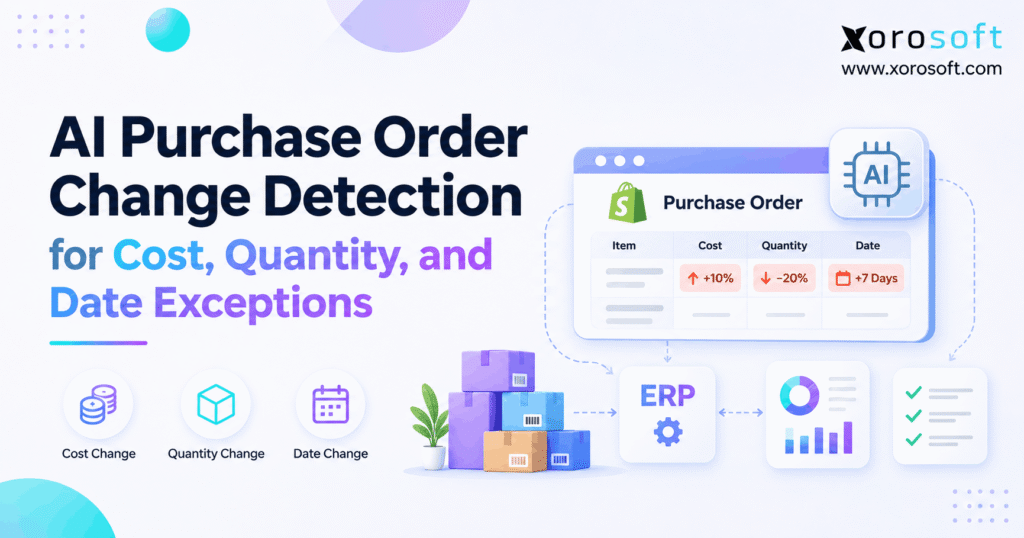
For businesses, purchase order change detection is essential to ensure accuracy and efficiency in their procurement processes.
1. Catch Supplier Changes Before They Become Costly
Purchase order change detection uses AI and business rules to identify changes in supplier costs, quantities, and delivery dates before they disrupt business operations. As a result, purchasing teams can spot risks early and protect inventory, margins, and customer commitments.
For example, a supplier may confirm fewer units than originally ordered. Meanwhile, the inventory team may continue planning around the original quantity.
Similarly, a supplier might increase prices without clearly stating the change. Consequently, finance teams may discover the higher cost only after receiving an invoice.
Although these changes appear small, they can affect several departments. In particular, purchasing, warehouse, sales, and production teams often rely on the same expected receipts.
Furthermore, growing businesses receive supplier updates through emails, PDFs, spreadsheets, and online portals. As order volumes increase, manual checks become harder to maintain.
Therefore, businesses need a reliable way to compare supplier updates with approved purchasing records. However, identifying differences is only the first step. Teams must also understand their impact and decide whether to accept the proposed changes.
Ultimately, the goal is to prevent supplier changes from becoming costly surprises.
2. What Is Purchase Order Change Detection?
Purchase order change detection is the process of comparing approved purchase orders with later supplier replies to identify differences in price, quantity, delivery dates, and other agreed terms.
For example, AI can read a supplier confirmation and extract important order details. Then, business rules can compare those details with the approved purchase order.
However, detecting a difference does not mean the buyer has accepted it. Instead, the system should flag the change and support the correct review process.
As a result, purchasing teams can focus on exceptions rather than checking every order field manually.
2.1 Purchase Order Change Detection vs. Change Control
Although these processes work together, they serve different purposes.
Change detection identifies what differs from the approved order. In contrast, change control determines whether the business should accept the new terms.
For example, a supplier may propose a 10% price increase. First, the detection process identifies the higher price. Next, the purchasing team reviews the reason for the increase.
Meanwhile, finance may assess the effect on product margins. Finally, an authorized employee decides whether to accept or reject the change.
| Process | Main purpose |
|---|---|
| Change detection | Find differences |
| Impact review | Understand business risks |
| Change control | Approve or reject changes |
| ERP update | Record approved terms |
| Audit trail | Keep a record of decisions |
Therefore, businesses should keep these steps separate. Otherwise, an automated tool could update an order before the appropriate person reviews the new terms.
2.2 Why Supplier Replies Create Hidden Risks
Suppliers rarely follow one standard way of sharing information.
For instance, one supplier may send a complete order confirmation. Another may send a short email explaining that a few products will arrive late.
Additionally, overseas suppliers may use different item codes, date formats, or units of measure.
Meanwhile, buyers may receive several updates for the same order. Consequently, an employee could compare the latest supplier reply with an outdated purchase order.
Another common problem involves missing information. For example, a supplier may confirm a new delivery date without stating whether the original quantity remains unchanged.
Therefore, a missing field should not automatically count as a confirmed change.
Instead, purchasing teams should preserve the source message, match it with the correct order, and request clarification when necessary.
This approach reduces confusion and gives buyers a reliable record when disputes arise.
3. Purchase Order Change Detection for Cost, Quantity, and Dates
Suppliers can change many purchasing terms. However, three types of exceptions usually create the most direct risks: cost, quantity, and delivery dates.
| Exception | Immediate problem | Business impact |
|---|---|---|
| Cost increase | Higher unit price | Lower margins |
| Quantity reduction | Less incoming stock | Stock shortages |
| Quantity increase | Extra stock | Higher cash needs |
| Delivery delay | Late stock arrival | Missed customer orders |
| Early delivery | Unplanned receipts | Warehouse pressure |
| Partial confirmation | Unclear remaining supply | Planning errors |
Although these changes affect different areas, they can also occur together. Therefore, teams should review the complete supplier reply rather than checking only one field.
3.1 Purchase Order Change Detection for Unit Costs
Suppliers may raise prices because of material costs, freight charges, exchange rates, or changes in supply.
However, a higher price does not always appear clearly in the supplier’s message.
For example, a buyer orders 500 units at $40 each. Later, the supplier confirms a unit price of $43.
The original commitment was $20,000. In contrast, the new proposed commitment is $21,500.
Consequently, the business faces an additional purchasing cost of $1,500.
Use these basic calculations:
- Unit cost variance = Proposed unit cost − Approved unit cost.
- Percentage variance = Unit cost variance ÷ Approved unit cost × 100.
- Order value variance = Proposed order value − Approved order value.
Calculate percentage changes only when the approved cost is greater than zero.
Furthermore, teams must check currencies, discounts, freight charges, and pack sizes before accepting a flagged difference.
Otherwise, a change in how the supplier lists the price could create a false alert.
3.2 Track Quantity Changes and Partial Confirmations
Quantity exceptions occur when a supplier confirms more or fewer units than the buyer requested.
For example, a distributor orders 2,000 units for an upcoming promotion. However, the supplier confirms only 1,600 units.
As a result, the distributor needs to review the missing 400 units.
First, purchasing should confirm whether the supplier has canceled those units or plans to deliver them later.
Next, inventory planners should assess current stock and other incoming shipments.
Meanwhile, sales teams may need to revise customer promises.
Partial confirmations require similar care. For instance, a supplier might confirm 600 units for one date and another 400 for a later date.
Therefore, each delivery should have its own planned quantity and date.
Additionally, the business must avoid counting received units again as future supply.
By keeping confirmed, received, and outstanding quantities separate, teams gain a more accurate view of incoming stock.
3.3 Spot Revised Delivery Dates
A supplier delay does not necessarily change the order value or total quantity. Nevertheless, it can create serious stock problems.
For example, a seven-day delay may have little effect on a slow-selling item. In contrast, the same delay could interrupt a busy product line.
Therefore, buyers should assess date changes against actual business needs.
They should also distinguish three important dates:
| Date type | Meaning |
|---|---|
| Requested date | When the buyer wants the goods |
| Promised date | When the supplier agrees to deliver |
| Expected receipt date | When the business expects to receive stock |
Additionally, shipping dates and warehouse receipt dates are not interchangeable.
For instance, a supplier may ship on Monday, while the goods arrive the following Friday.
Consequently, comparing the wrong dates can produce misleading alerts.
Finally, retain the original promised date for supplier performance reviews. Otherwise, repeated date changes can hide a pattern of late deliveries.
4. How AI Supports Purchase Order Change Detection
AI helps purchasing teams process supplier information that does not follow a fixed format.
For example, it can extract order details from emails or PDF documents. Then, standard comparison rules can identify exact differences.
However, not every task requires AI. A simple calculation can determine whether a supplier has raised a price or reduced a quantity.
Therefore, the strongest approach combines AI document reading with reliable matching rules, clear purchasing policies, and human review.
4.1 Collect and Match Supplier Replies
First, gather supplier updates through approved channels, such as emails, portals, PDFs, or EDI messages.
Next, identify the relevant purchase order number, supplier, item, quantity, cost, and delivery date.
Then, match each extracted item with the correct approved order line.
For example, structured supplier messages may contain consistent item codes and quantities. However, free-text emails may require additional checks.
The X12 supply chain transaction standards provide useful guidance for structured purchasing documents.
| EDI document | Purpose |
|---|---|
| EDI 850 | Original purchase order |
| EDI 855 | Supplier order acknowledgment |
| EDI 860 | Buyer purchase order change request |
| EDI 865 | Seller change request or acknowledgment |
Although these documents support reliable exchanges, trading partners still need agreed field mappings and rules.
Therefore, businesses should validate both structured messages and AI-extracted information before updating purchasing records.
4.2 Purchase Order Change Detection Rules and Tolerances
A practical detection workflow includes seven steps:
- Receive the supplier update.
- Extract the relevant order details.
- Find the latest approved purchase order.
- Compare cost, quantity, and date fields.
- Apply business rules and tolerance limits.
- Send important changes for review.
- Record approved updates and retain the decision history.
For example, a business may allow small price changes under a defined purchasing policy.
However, a minor delay involving a critical production item may require immediate attention.
Therefore, teams should avoid applying identical rules to every product.
Additionally, AI confidence scores should help identify uncertain extraction results. They should not determine whether a supplier change is commercially acceptable.
Instead, separate document accuracy, business risk, and approval rights.
As a result, employees can review the exceptions that matter most without losing control of purchasing commitments.
5. Data Needed for Purchase Order Change Detection
Reliable detection starts with accurate purchasing records. Otherwise, even a well-designed AI tool may identify changes that do not exist.
| Required data | Why it matters |
|---|---|
| PO number and revision | Finds the correct order |
| Supplier and item codes | Matches order lines |
| Unit of measure | Prevents quantity errors |
| Currency and unit price | Supports cost checks |
| Open and received quantities | Shows remaining supply |
| Promised delivery date | Supports date comparisons |
| Warehouse destination | Identifies affected locations |
| Customer and production demand | Shows business exposure |
Furthermore, businesses should retain supplier messages and record when they arrive.
5.1 Keep the Right PO Version
Suppliers may send several replies during the life of an order. Therefore, the system needs to know which version contains the latest approved terms.
For example, a buyer originally orders 1,000 units. Later, the buyer approves a reduction to 900 units.
If the supplier confirms 900 units, comparing the reply with the original order would create a false shortage alert.
Consequently, the detection process should use the current approved version as its baseline.
However, preserving earlier versions remains important. Those records help teams understand what changed and why.
Additionally, supplier replies should link to the correct order and revision whenever possible.
If the revision cannot be identified, the workflow should request a manual review.
Therefore, good version control supports both accurate detection and a reliable audit trail.
5.2 Link Incoming Supply to Actual Demand
A supplier change becomes more meaningful when purchasing teams understand which business activities depend on the incoming goods.
For example, a shortage of 100 units may create little risk if the business already holds enough stock.
However, the same shortage could affect several customer orders when available inventory is low.
Therefore, buyers need access to stock balances, incoming orders, existing allocations, and future demand.
Xorosoft provides purchasing and inventory workflows within its cloud ERP software. As a result, teams can review purchasing records alongside other business data.
However, connected records alone do not guarantee automatic exception detection. Businesses must still establish suitable data flows and validation rules.
Ultimately, reliable purchasing data gives AI-assisted tools the context they need to support better decisions.
6. Purchase Order Change Detection Across Inventory and Finance
Purchasing exceptions rarely affect only the purchasing department. Instead, revised supplier terms can change stock plans, customer orders, production schedules, and cash needs.
For example, an unexpected quantity reduction may leave inventory planners with less supply than expected.
Meanwhile, a price increase may reduce planned margins even if the shipment arrives on time.
Therefore, businesses should review the wider effects of each important exception before accepting revised supplier terms.
6.1 Inventory, Sales, and Production
Inventory teams depend on accurate incoming quantities and receipt dates.
For instance, a distributor may promise products to customers based on stock that has not yet arrived.
However, if a supplier delays the shipment, those customer orders may become difficult to fulfill.
Similarly, manufacturers may need to postpone production when required materials arrive late.
Additionally, early deliveries can create warehouse space and staffing problems.
Xorosoft’s warehouse management software supports warehouse and inventory operations. This connected view is relevant when teams need to assess receiving activity and stock availability.
Nevertheless, a proposed supplier update should not count as an approved inventory change until the business reviews it.
Therefore, purchasing, warehouse, and planning teams should work from consistent records while preserving clear approval controls.
6.2 Cost and Cash Exposure
Higher supplier prices can reduce expected product margins. Meanwhile, excess quantities can increase future purchasing commitments.
However, a proposed purchase order change does not necessarily create an immediate accounting entry.
Instead, the financial effect depends on receipts, invoices, inventory costing methods, and the stage of the purchase.
For example, a buyer may accept a higher price before receiving any goods. Consequently, the expected purchasing cost increases, even though the accounting treatment occurs later.
Therefore, finance teams should distinguish projected costs from posted expenses.
Additionally, they should review whether the revised purchase affects cash forecasts, product pricing, or future purchasing budgets.
By identifying these risks earlier, businesses may have more time to negotiate prices, source alternatives, or change purchasing plans.
Free ERP Readiness Assessment
Review whether your purchasing, inventory, and finance teams can identify supplier changes without manually rebuilding reports across several systems.
7. Purchase Order Change Detection: A Worked Example
Consider a hypothetical wholesale distributor that places an order for 1,000 units.
However, the supplier replies with a higher unit price, a lower quantity, and a later delivery date.
| Purchasing field | Approved order | Supplier proposal |
|---|---|---|
| Quantity | 1,000 units | 800 units |
| Unit cost | $20 | $22 |
| Delivery date | December 5 | December 12 |
| Total value | $20,000 | $17,600 |
At first, the lower total value may appear positive. Nevertheless, the business now expects fewer products at a higher price.
Specifically, the unit cost increases by 10%, the quantity falls by 20%, and the delivery moves seven days later.
Therefore, the purchasing team must review all three exceptions together.
This example assumes consistent currency and units of measure, with no previous receipts against the order.
7.1 Review the Cost and Supply Gap
Although the proposed order value falls by $2,400, this does not mean the business has achieved genuine savings.
For example, reducing the quantity from 1,000 to 800 units at the original price lowers the commitment by $4,000.
However, increasing the price from $20 to $22 for the remaining 800 units adds $1,600.
| Change | Financial effect |
|---|---|
| Original commitment | $20,000 |
| Quantity reduction | −$4,000 |
| Unit price increase | +$1,600 |
| Revised commitment | $17,600 |
Meanwhile, the missing 200 units create a possible stock shortage.
Therefore, purchasing should confirm the status of those units and ask whether the supplier can offer another delivery date.
Next, inventory teams should review customer commitments. In addition, finance should assess the revised unit cost.
Finally, the buyer should record only the changes that receive the appropriate approval.
8. Where Purchase Order Change Detection Helps Most
The value of early detection depends on how supplier changes affect each business.
For example, wholesale companies may face customer allocation risks. Meanwhile, manufacturers may experience material shortages.
Therefore, exception rules should reflect the products, customers, and operations that depend on incoming supply.
8.1 Wholesale, Apparel, and Ecommerce
Wholesale distributors often purchase stock against existing customer demand. Consequently, reduced supplier quantities may affect orders that customers have already placed.
Similarly, apparel brands face seasonal buying deadlines. A late shipment could arrive after a major selling period.
For ecommerce businesses, the problem becomes more complex when several sales channels depend on shared inventory.
For example, Shopify, Amazon, and wholesale orders may compete for the same incoming stock.
Therefore, businesses benefit from connecting purchasing records with channel demand and inventory data.
Xorosoft’s business integrations support connections across operational systems and sales channels. Additionally, its Shopify App Store listing provides information about its Shopify ERP integration.
However, the business must still review supplier changes and determine which customer orders may be affected.
As a result, connected data supports more informed purchasing and fulfillment decisions.
8.2 Manufacturing, Food, and Furniture
Manufacturers depend on raw materials and components arriving before production begins.
For example, one missing part can prevent an entire assembly from moving forward.
Similarly, food businesses must consider shelf life, storage needs, and batch plans when suppliers change delivery dates.
Meanwhile, furniture distributors often manage long lead times and large incoming shipments.
Consequently, unexpected delivery changes may affect customer bookings and warehouse space.
Sporting goods businesses face similar risks when purchasing stock for seasonal demand.
Therefore, exception reviews should consider more than the size of a purchasing change. Teams should also review product importance, replacement options, existing stock, and customer needs.
For instance, a small quantity reduction involving a critical production component may require faster action than a large reduction affecting slow-moving products.
Ultimately, industry-specific context helps teams focus on the supplier changes that create the greatest risk.
9. How to Implement Purchase Order Change Detection
Businesses should introduce automated purchasing reviews gradually. Otherwise, poor data quality and unclear rules can create unnecessary alerts.
First, identify recurring supplier discrepancies. Next, review existing purchase order records and approval processes.
Then, select a small group of suppliers for an initial trial.
As a result, teams can test their approach before expanding it across the purchasing department.
9.1 Start with a Small Pilot
Begin with suppliers that provide frequent confirmations or regularly change purchasing terms.
For example, select suppliers with recurring delivery delays, price changes, or partial shipments.
Next, collect sample documents and compare them with manually reviewed purchase orders.
| Implementation stage | Main objective |
|---|---|
| Data preparation | Correct purchasing records |
| Supplier selection | Focus on common problems |
| Rule setup | Define acceptable differences |
| Pilot testing | Check detection accuracy |
| Controlled rollout | Maintain purchasing controls |
| Ongoing review | Reduce missed changes |
Additionally, record how long employees currently spend reviewing supplier messages.
During the pilot, measure whether automated checks reduce repetitive work without creating more errors.
However, do not judge the project only by the number of alerts.
Instead, review whether the process identifies meaningful exceptions and provides enough information for buyers to act.
9.2 Purchase Order Change Detection and Approval Controls
AI should support purchasing decisions rather than replace purchasing authority.
Therefore, businesses need clear rules about which employees can review, approve, or reject proposed changes.
| Risk level | Example | Response |
|---|---|---|
| Critical | Material shortage stops production | Immediate review |
| High | Reduced quantity affects customer orders | Review other supply |
| Medium | Price exceeds approved limits | Purchasing and finance review |
| Low | Minor delay without demand impact | Routine review |
Additionally, restrict system access and keep records of approved changes.
The NIST AI Risk Management Framework provides useful guidance for managing AI-related risks.
For example, businesses should test AI outputs, monitor mistakes, and maintain a fallback process when automation fails.
Furthermore, treat supplier messages as untrusted input. An instruction inside an email or PDF should not override purchasing approval rules.
Ultimately, reliable controls matter as much as detection accuracy.
9.3 Measure Results That Matter
Purchasing teams should measure both technical performance and business results.
For example, a system may flag hundreds of changes. However, many of those alerts could be incorrect or unimportant.
Therefore, track the following measures:
| KPI | What it measures |
|---|---|
| Detection precision | Share of alerts that are correct |
| Detection recall | Share of actual changes the system finds |
| Confirmation coverage | Share of supplier replies processed |
| Detection time | Time needed to identify a change |
| Resolution time | Time needed to reach a decision |
| Financial exposure | Unresolved purchasing cost risks |
| Approval compliance | Changes that follow approval rules |
Additionally, review missed exceptions using manually checked samples.
As a result, teams can identify weak supplier mappings, unclear rules, or common document-reading mistakes.
Finally, use the findings to improve the process over time.
10. Choose the Right Purchasing Workflow
Not every business needs advanced AI tools. Instead, the right approach depends on order volume, supplier behavior, and the cost of missed changes.
For example, a business with a few predictable suppliers may manage orders through simple manual checks.
However, growing companies may need more consistent ways to compare supplier replies.
| Approach | Best suited for | Main limitation |
|---|---|---|
| Manual review | Low order volumes | Slow checks |
| Rule-based checks | Structured supplier data | Limited free-text reading |
| AI-assisted detection | Mixed supplier documents | Requires testing |
| AI with connected ERP | Complex purchasing operations | Needs integration and controls |
Therefore, select the technology that addresses the actual problem rather than adding unnecessary complexity.
10.1 Purchase Order Change Detection with Connected ERP
Connected ERP data helps purchasing teams understand what a supplier change means for the rest of the business.
For example, buyers can review incoming supply alongside stock balances, demand, and financial records.
Xorosoft’s connected business platform, XoroONE, brings purchasing, inventory, accounting, manufacturing, and related workflows together.
Additionally, the Xorosoft AI MCP Server supports authorized AI access to ERP data for business analysis.
Its documented use cases include reviewing supplier price changes, overdue purchase orders, and supplier performance.
However, AI access to existing ERP data is different from automatically reading every new supplier message.
Businesses may need additional tools, suitable integrations, and tested workflows to support that requirement.
Therefore, companies should evaluate their specific detection, review, and approval needs before deploying AI-assisted purchasing processes.
Watch Demo
Request a guided demonstration of connected purchasing, supplier management, inventory, and accounting workflows. Bring an actual supplier confirmation containing several changes to evaluate the proposed process.
10.2 When Basic Tools Are Enough
A small business may not need advanced document-reading tools if suppliers provide clear and consistent confirmations.
For example, simple spreadsheet checks or rule-based alerts may work when order volumes remain low.
However, manual reviews become harder as businesses add suppliers, warehouses, products, and sales channels.
Furthermore, disconnected records may prevent employees from understanding how supplier changes affect customer orders and cash needs.
Therefore, consider upgrading when:
- Supplier changes regularly go unnoticed.
- Buyers spend too much time checking documents.
- Stock shortages result from outdated receipts.
- Finance discovers price changes too late.
- Different departments use conflicting purchasing records.
- Existing tools cannot support growing order volumes.
However, purchasing teams should not assume that a complete ERP replacement is always necessary.
Instead, review current systems and determine whether better data, stronger controls, or additional automation can solve the problem.
11. Conclusion: Review Changes Before They Disrupt Operations
Purchase order change detection helps businesses identify supplier changes before they become costly operational problems.
However, detecting a higher price, reduced quantity, or delayed shipment is only the first step.
Instead, purchasing teams must review these changes alongside inventory needs, customer commitments, production plans, and financial risks.
Furthermore, reliable data, clear approval rules, and human review remain essential when using AI.
Xorosoft provides a connected ERP foundation that helps inventory-driven businesses manage purchasing and related operations.
Therefore, businesses can evaluate AI-assisted purchasing workflows using more consistent operational data.
Ultimately, the goal is not to generate more alerts. It is to identify meaningful supplier changes early enough to make better business decisions.
Book a Demo to explore how connected ERP workflows can support your purchasing, inventory, supplier management, and financial control requirements.
Frequently Asked Questions
What is purchase order change detection?
Purchase order change detection compares approved orders with supplier replies. It flags price, quantity, or date differences so buyers can review proposed changes before accepting them.
How does AI detect supplier changes?
AI reads supplier emails or documents and extracts key fields. Then, matching rules compare those fields with the approved order and flag differences for review.
Can AI detect delivery date delays?
Yes. For example, AI can extract a revised delivery date, while comparison rules flag the delay. Buyers then check whether it threatens stock, production, or customer orders.
How do teams handle quantity shortages?
First, confirm whether missing units are canceled or delayed. Next, check stock and customer demand, review other suppliers, and update the approved order after review.
Should AI approve purchase order changes?
Not by default. Instead, businesses should set approval rules and assign owners. High-risk changes require the right authorization, and every approved update needs an audit trail.
What data is needed for purchase order change detection?
Teams need the latest approved order, supplier and item IDs, unit costs, quantities, currencies, units of measure, and promised dates. In addition, receipt data helps track open balances.
When should businesses automate purchasing reviews?
Consider automation when order volume, repeated supplier changes, and manual checks cause delays or missed risks. However, companies with few orders may find simple rule-based checks sufficient.
Recent Posts
-
 How to Set Min-Max Replenishment Levels for Forward Pick Locations
-
 Shopify Product-Identifier Benchmarks 2026: Match Rates, Failures, and Manual Review
-
 Vendor-Managed Inventory vs Traditional Replenishment for Wholesale Distribution
-
 ERP Renewal Planning for Multi-Warehouse Distributors
-
 Production Scrap Accounting: Material, Labor, WIP, and Cost Variances