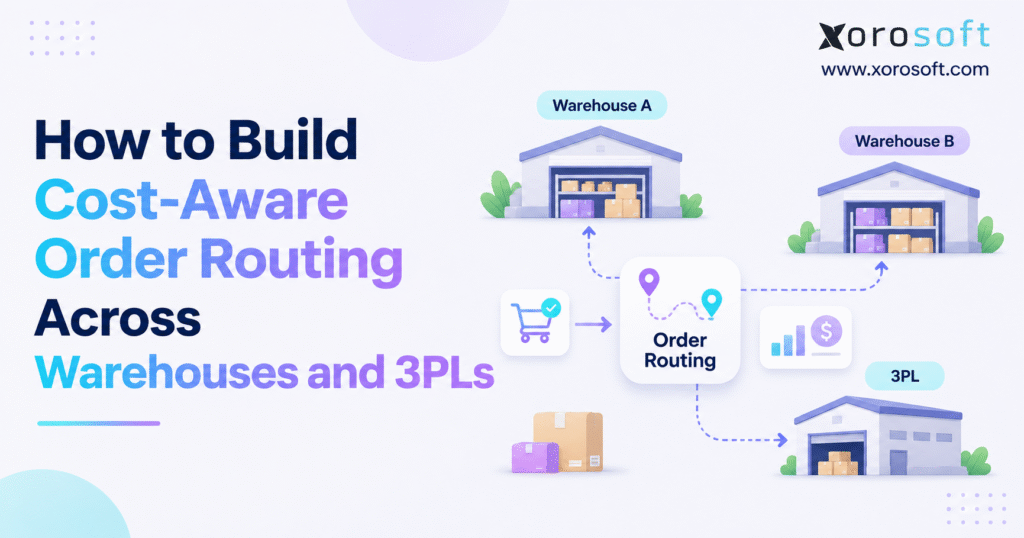
Cost-aware fulfillment routing is an innovative strategy designed to optimise order processing while keeping costs in check.
1. Why Multi-Warehouse Fulfillment Can Quietly Reduce Order Margins
Cost-aware fulfillment routing helps businesses choose where to ship customer orders based on the full cost of fulfillment. As businesses add warehouses and third-party logistics providers (3PLs), shipping decisions become more complex. Although more locations improve market coverage, they also introduce different labor costs, carrier rates and service fees.
For example, an ecommerce brand may operate warehouses in California and New Jersey while using a Canadian fulfillment partner. Each location has different stock levels, shipping costs and daily order limits. Therefore, choosing the closest warehouse does not always produce the best financial result.
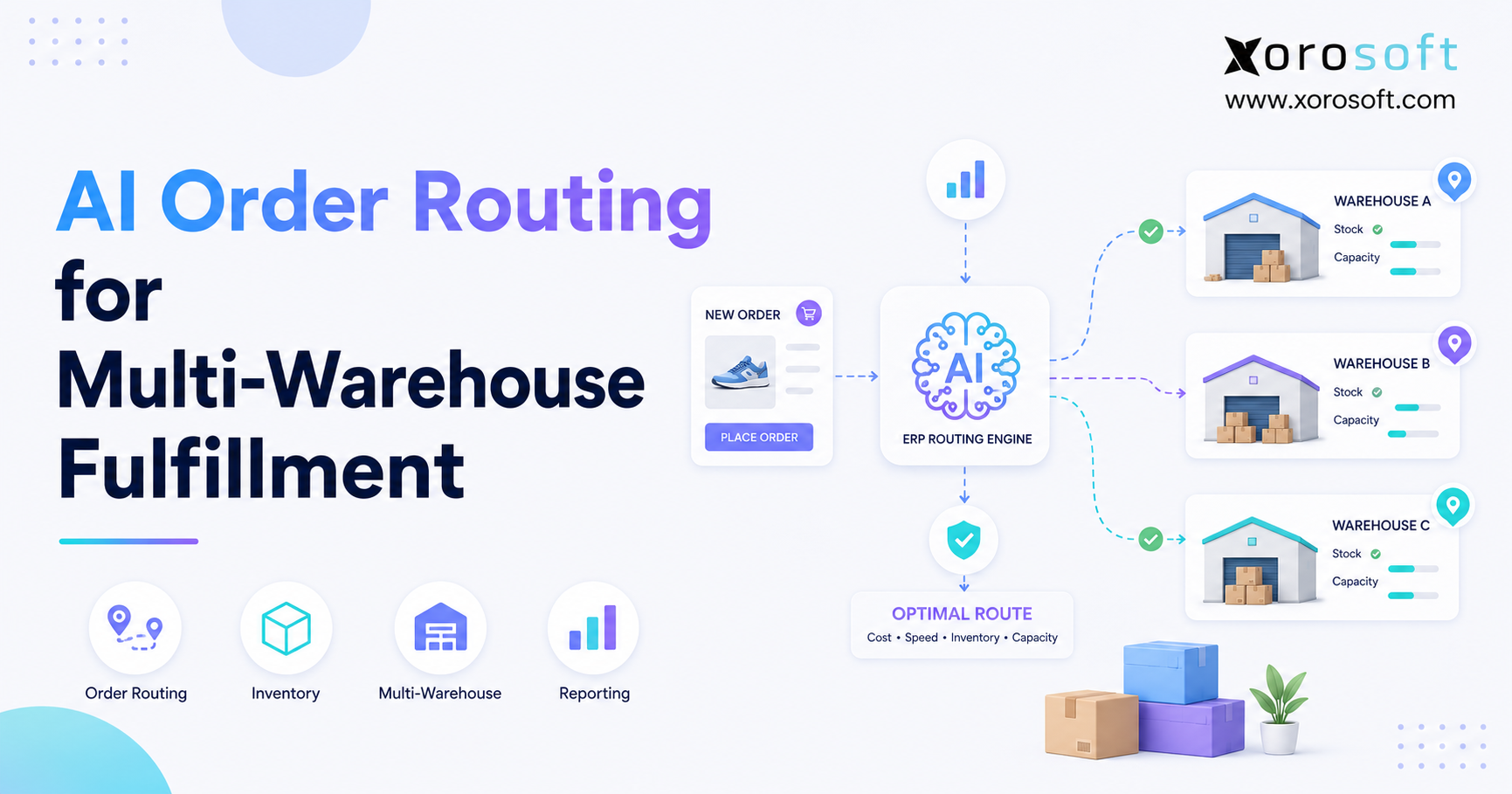
Cost-aware order routing addresses this problem by connecting stock availability, shipping costs and delivery needs before assigning an order.
1.1 Why the Closest Warehouse Is Not Always the Cheapest
A nearby warehouse may have higher labor costs or less favorable carrier rates. Meanwhile, a more distant facility might ship the same order at a lower total cost.
Order size also matters. For instance, the closest warehouse may have only two of the three products a customer orders. As a result, the remaining product must ship from another location, adding freight, handling and packing costs.
Instead of comparing shipping rates alone, businesses should compare the cost of completing the entire order. This approach often reveals savings that standard warehouse priority rules overlook.
1.2 How Cost-Aware Order Routing Protects Margins
Small fulfillment costs can become major expenses as sales grow. For example, an avoidable cost of $2 per order across 15,000 monthly orders represents $30,000 in extra monthly expenses.
In addition, poor routing can use stock intended for wholesale customers, increase urgent stock transfers and cause delivery delays.
Therefore, warehouse selection should support both short-term savings and long-term stock planning. A cheaper shipment today may create a costly stock shortage tomorrow.
The goal is not simply to reduce shipping costs. Instead, businesses need to protect order margins while maintaining reliable delivery and healthy stock levels.
2. What Is Cost-Aware Fulfillment Routing?
Cost-aware fulfillment routing is the process of choosing the lowest-cost fulfillment plan that meets stock, capacity and delivery needs. It compares shipping rates, warehouse labor, packing costs, 3PL fees and other relevant expenses before assigning an order.
In other words, it helps businesses make shipping decisions based on the full cost of serving a customer rather than distance alone.
2.1 How Cost-Aware Order Routing Differs From Traditional Allocation
Traditional order routing often follows fixed warehouse priorities. For example, a business may send every eligible order to its main warehouse before checking other locations.
Distance-based routing, on the other hand, favors warehouses closer to customers. Although this method can reduce travel time, it does not always lower the total cost.
Cost-based routing takes a broader view. It compares available fulfillment options using current stock records, shipping rates and handling costs.
Microsoft’s distributed order management cost documentation also identifies shipping, handling and packing costs as factors that businesses can use when planning order assignments.
2.2 Static Routing vs. Dynamic Fulfillment Routing
Static routing works well when warehouse conditions remain stable. It offers simple rules and requires less daily upkeep.
However, dynamic fulfillment routing becomes more useful when order volumes, shipping rates and stock levels change often.
For instance, a warehouse may normally offer the lowest shipping cost. During a major sales event, its team may struggle to keep up with incoming orders. In that case, another facility could prevent delivery delays and expensive rush shipments.
Dynamic routing does not mean moving orders between warehouses without reason. Instead, it means using current data when making the first assignment and changing that assignment only when necessary.
2.3 Which Businesses Need Cost-Based Routing?
Businesses with several warehouses, multiple 3PL partners or complex sales channels often benefit most from cost-based routing.
In contrast, a small merchant with one warehouse may only need basic carrier rate comparison and stock controls.
Before investing in advanced tools, businesses should assess their order volume, current fulfillment costs and the number of routing choices available. The expected benefits should justify the added cost of managing the system.
3. Understanding the Costs Behind Cost-Aware Fulfillment Routing
A reliable routing model starts with a clear view of fulfillment costs. Otherwise, the system may choose a warehouse that looks cheap but produces a higher final bill.
3.1 Shipping Rates, Package Dimensions and Carrier Charges
Shipping costs depend on the delivery address, package size, weight, carrier agreement and chosen service.
For example, UPS shipping guidance lists dimensional weight divisors of 139 for applicable daily rates and 166 for retail rates.
Consider a carton measuring 20 by 16 by 12 inches. Its cubic volume is 3,840 cubic inches. Using a divisor of 139, the dimensional weight rounds up to 28 pounds.
Therefore, even if the actual package weighs less, the carrier may charge based on its size.
In addition, fuel charges, remote area fees and special handling can increase shipping expenses. Businesses should maintain current rate tables and accurate package details to reflect these costs.
3.2 Warehouse Labor, Packing and 3PL Fees
Owned warehouses have picking, packing and material costs. External fulfillment providers may charge per order, per item or for specific services.
For example, ShipBob’s published pricing information describes several fulfillment cost components, including receiving, storage and order processing.
However, some 3PL contracts combine packing and handling into one fee. Others bill these services separately. Therefore, businesses must compare equivalent charges rather than assume every provider follows the same fee structure.
Table 1: Owned Warehouse vs. 3PL Fulfillment Costs
| Cost Component | Owned Warehouse | External 3PL |
|---|---|---|
| Picking | Internal labor | Order or item fees |
| Packing | Labor and materials | Bundled or separate fees |
| Shipping | Carrier agreement | Contract-based rates |
| Storage | Facility expenses | Storage fees |
| Receiving | Internal labor | Receiving charges |
| Special handling | Added processing | Service fees |
| Returns | Internal costs | Return processing fees |
| Capacity | Staffing and overtime | Contract limits |
A fair comparison should include only the costs that apply to the order under review.
3.3 Cross-Border Charges and Fixed Costs
Businesses shipping between the United States and Canada must also consider exchange rates, customs brokerage and merchant-paid duties.
For example, FedEx Canada’s 2026 rate changes increased the minimum disbursement fee from CAD $11.40 to CAD $12, effective July 20, 2026.
As a result, cost-aware order routing must account for changing international shipping expenses.
Fixed costs require separate treatment. Warehouse rent, for instance, does not usually change when a single order ships elsewhere. However, rent remains relevant when reviewing the long-term cost of operating a warehouse.
By keeping fixed and variable expenses separate, businesses can make better routing and network planning decisions.
4. Building a Cost-Aware Order Routing Model
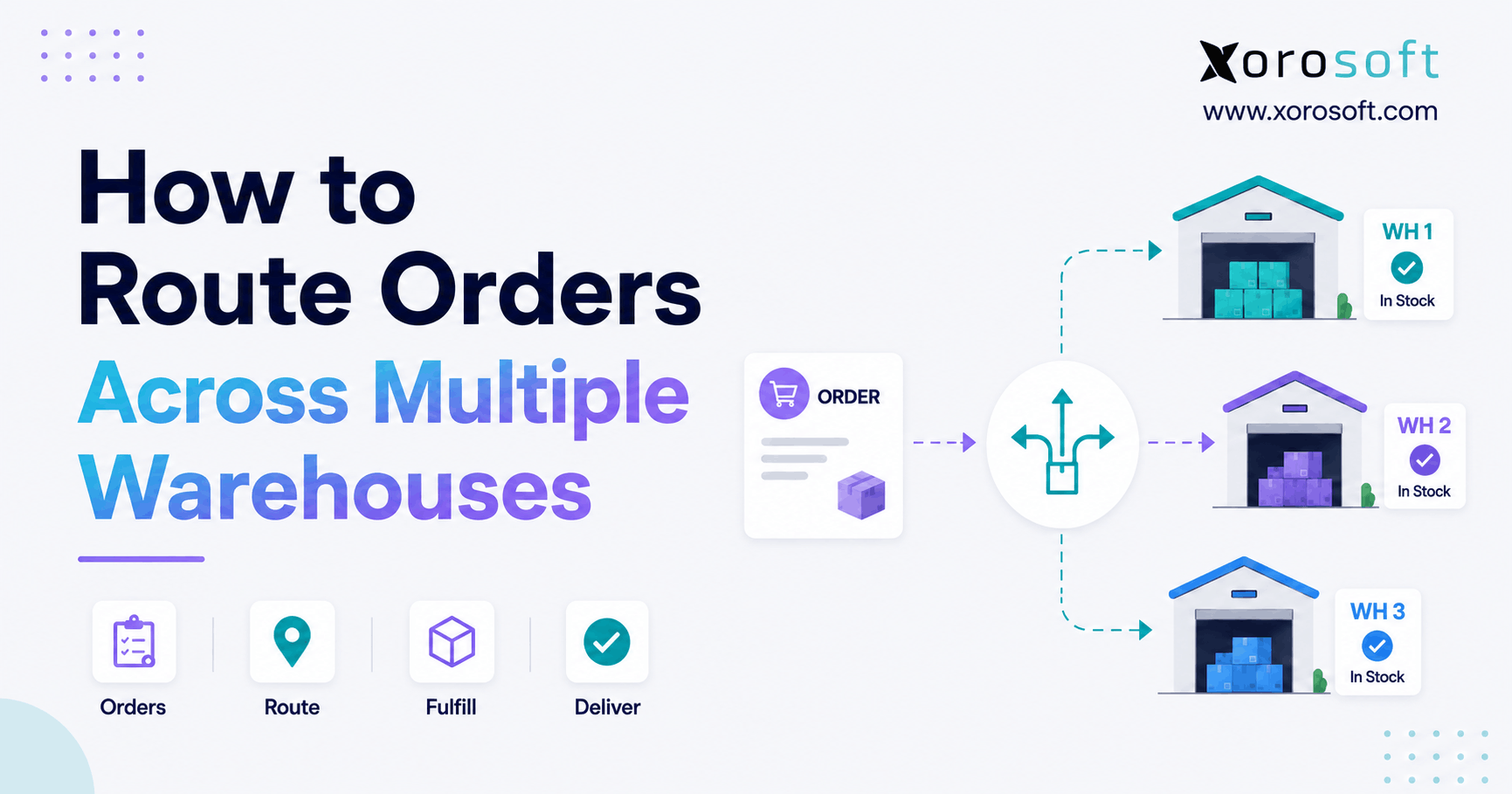
A practical routing model should follow two basic stages. First, determine which locations can fulfill the order correctly. Next, compare the full cost of those eligible options.
This structure prevents low shipping prices from overriding stock limits or customer commitments.
4.1 Check Available Stock and Warehouse Capacity
On-hand stock does not always equal stock available for new orders.
For example, a warehouse may hold 100 units. However, 70 units could already belong to open orders, while another 20 remain set aside for wholesale customers. Therefore, only 10 units may be available for new ecommerce orders.
Xorosoft’s integrated cloud ERP software connects stock management, orders, purchasing and accounting. These shared records provide useful data for evaluating fulfillment options.
Warehouse capacity matters as well. A facility may have enough stock but lack the staff or time needed to ship the order before its deadline.
Table 2: Fulfillment Location Eligibility Matrix
| Requirement | Warehouse A | Warehouse B | 3PL C |
|---|---|---|---|
| Stock available | Yes | Yes | Yes |
| Capacity available | Yes | No | Yes |
| Delivery deadline achievable | Yes | Yes | Yes |
| Product handling supported | Yes | Yes | Yes |
| Sales channel approved | Yes | Yes | Yes |
| Eligible for routing | Yes | No | Yes |
In this example, Warehouse B cannot accept the order because it lacks processing capacity.
4.2 Calculate the Total Cost of Each Fulfillment Plan
Businesses can use the following formula as a starting point:
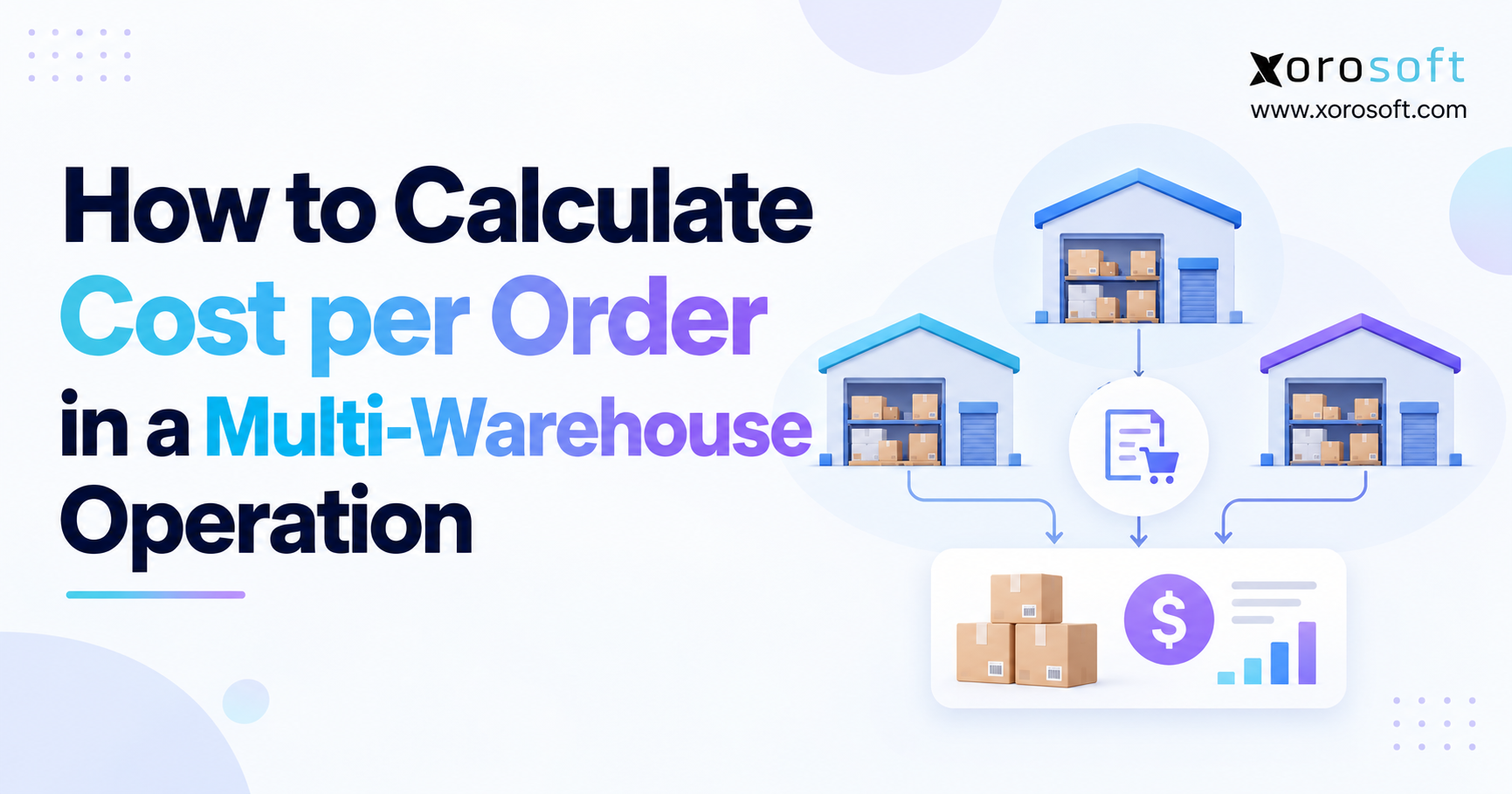
Total Routing Cost = Shipping + Handling + Packing + 3PL Fees + Cross-Border Costs + Transfer Costs + Expected Exception Costs
Each part should reflect the extra cost of fulfilling the specific order. For example, include packing materials when they represent a separate expense. However, exclude them when a 3PL fee already covers those materials.
Similarly, expected exception costs should reflect known problems, such as failed deliveries or extra handling. Use past order data to estimate these costs rather than adding random penalties.
For split orders, calculate the combined cost of every shipment.
4.3 Apply Cost-Aware Fulfillment Routing Rules
Some routing rules must remain mandatory. These include stock availability, product restrictions, warehouse capacity and promised delivery dates.
Other rules may act as preferences. For instance, a business may prefer a local warehouse when two locations have nearly equal costs.
Therefore, define mandatory rules before applying financial comparisons. If no location meets the requirements, send the order for review rather than assigning it to an unsuitable warehouse.
5. Seven Steps to Implement Cost-Aware Fulfillment Routing
Building cost-aware order routing requires accurate data, simple business rules and dependable warehouse processes. The following steps provide a practical framework for both owned warehouses and external fulfillment partners.
5.1 Step 1: Map Every Fulfillment Location
Start by recording all warehouses, distribution centers and 3PL facilities.
For each location, document supported products, delivery areas, operating hours, daily order limits and available shipping services. Also, identify any sales channel or customer restrictions.
Next, determine which system manages the stock records for each facility. Some warehouses may use the main ERP, while external partners may send stock updates through separate systems.
This overview helps teams find gaps before adding automatic routing rules.
5.2 Step 2: Build a Standard Fulfillment Cost Database
Collect current carrier agreements, warehouse labor rates, packing prices and 3PL fee schedules.
Then, convert these costs into matching currencies and billing units. For example, a per-item picking charge should not be compared directly with a complete per-order fulfillment fee.
Record the start date of every rate schedule. In addition, include any order volume limits, seasonal charges and special service fees.
Assign clear ownership for cost updates. Procurement can maintain carrier contracts, while warehouse teams track handling expenses. Finance can then check estimates against actual bills.
5.3 Step 3: Improve Available-to-Promise Stock Records
Accurate stock records form the basis of reliable routing.
First, separate sellable stock from damaged, blocked or reserved stock. Next, account for products already assigned to open customer orders.
Incoming goods also require care. Although a purchase order may show stock arriving next week, that stock is not necessarily available to ship today.
External 3PL updates deserve particular attention. If a partner sends outdated stock figures, the system could assign an order to inventory that no longer exists.
Therefore, set acceptable limits for how old stock data can be before automatic routing stops.
5.4 Step 4: Set Warehouse Routing Rules and Priorities
Cost-aware order routing works best when businesses separate mandatory conditions from optional preferences.
For example, a warehouse without suitable cold storage cannot receive an order for temperature-sensitive products. However, a preference for a particular carrier may change when another approved service offers better value.
Xorosoft’s warehouse management system supports receiving, picking, packing, shipping and stock tracking. These warehouse records help teams maintain the data needed for dependable routing rules.
In addition, review priorities with finance, warehouse and customer service teams. This helps prevent savings in one area from creating problems in another.
5.5 Step 5: Compare Complete Fulfillment Options
Evaluate the total cost of each eligible plan. Include single-location shipments and, where permitted, orders that require several warehouses.
A small network may only need a simple decision table. In contrast, a larger network may require a routing tool capable of comparing many shipping options.
When two plans offer similar costs, use a clear secondary rule. For example, favor the plan with fewer packages, lower delivery risk or better stock coverage.
Avoid changing warehouse assignments for very small estimated savings if the change adds extra handling or operational risk.
5.6 Step 6: Reserve Stock and Release the Order
After choosing a fulfillment location, reserve the required stock before sending shipping instructions.
Next, require the warehouse or 3PL to confirm that it has accepted the order. Store a unique order reference so that repeated system requests do not create duplicate shipments.
If a partner rejects an assignment, check whether picking or packing has already started. Then, cancel or move the order through an approved process.
Without these controls, two warehouses may begin working on the same order. As a result, the business could face duplicate shipping costs and inaccurate stock records.
5.7 Step 7: Compare Estimated and Actual Costs
Finally, review estimated fulfillment costs against actual carrier bills, warehouse expenses and 3PL invoices.
For instance, repeated differences may reveal missing packing fees, wrong package sizes or outdated shipping rates.
Group these differences by warehouse, carrier, product and order type. Then, update the cost model where needed.
This feedback process helps cost-aware fulfillment routing remain accurate as order volumes, carrier agreements and warehouse conditions change.
6. Practical Cost-Aware Order Routing Examples
The following examples show why the lowest shipping rate does not always lead to the lowest overall fulfillment cost. All figures are hypothetical and do not represent industry averages or actual customer results.
6.1 Comparing Two Warehouses and an External 3PL
Assume all three locations have enough stock and can meet the customer’s delivery deadline.
Table 3: Fulfillment Cost Comparison in USD
| Cost Component | Warehouse A | Warehouse B | 3PL C |
|---|---|---|---|
| Shipping | $9.20 | $7.00 | $5.80 |
| Handling | $3.60 | $3.20 | Included |
| Packing | $1.00 | $1.00 | Included |
| 3PL fee | — | — | $3.80 |
| Total cost | $13.80 | $11.20 | $9.60 |
Although Warehouse A is closest to the customer, 3PL C offers the lowest total cost.
As a result, choosing 3PL C saves $4.20 per order, or approximately 30.4%, compared with Warehouse A.
Chart 1: Total Fulfillment Cost by Location
Warehouse A — $13.80 ▰▰▰▰▰▰▰▰▰▰▰▰▰▰
Warehouse B — $11.20 ▰▰▰▰▰▰▰▰▰▰▰
3PL C — $9.60 ▰▰▰▰▰▰▰▰▰▰
Source: Original illustrative cost model. All three locations meet the same stock and delivery requirements.
6.2 Comparing Single Shipments and Split Orders
Cost-aware fulfillment routing should compare the expense of completing the entire order rather than choosing the cheapest shipping option for each product.
Table 4: Single Shipment vs. Split Shipment
| Expense | Single Shipment | Split Shipment |
|---|---|---|
| First shipment | $8.50 | $5.50 |
| Second shipment | — | $5.25 |
| Handling and packing | $4.00 | $5.25 |
| Total cost | $12.50 | $16.00 |
| Packages | 1 | 2 |
In this example, shipping the order together saves $3.50.
However, split shipments may still be necessary when one warehouse cannot meet the delivery deadline. Therefore, compare savings against customer needs before rejecting a split fulfillment plan.
6.3 Comparing US and Canadian Fulfillment Locations
Cross-border orders may introduce fees that domestic routing models overlook.
Table 5: US Warehouse vs. Canadian 3PL
| Expense | US Warehouse | Canadian 3PL |
|---|---|---|
| Local fulfillment cost | USD $12.40 | CAD $12.00 |
| Converted USD cost | $12.40 | $9.00 |
| Merchant-paid duties and brokerage | $0.00 | $6.00 |
| Total USD cost | $12.40 | $15.00 |
This example assumes an exchange rate of CAD $1 to USD $0.75. After adding the hypothetical import costs, the US warehouse saves $2.60.
Actual cross-border fees depend on product origin, classification, import rules and the party responsible for payment. Therefore, businesses should use current shipping quotes and applicable customs information.
7. Cost-Aware Fulfillment Routing for Shopify and 3PLs
Shopify merchants often expand their fulfillment networks as sales grow. For example, a brand may use an owned warehouse for core operations and external 3PLs for regional delivery or peak seasons.
However, managing several locations requires more than assigning orders to the nearest available warehouse.
7.1 Understanding Shopify Order Routing Rules
According to Shopify’s official order routing documentation, its default strategy first aims to reduce split shipments. Next, it favors locations within the destination market. Finally, it prioritizes nearby locations.
Merchants can also rank location groups and use location metafields to guide assignments.
These tools provide useful controls for many businesses. However, detailed cost-aware order routing may require further logic to compare carrier agreements, warehouse labor and 3PL fees.
Table 6: Shopify Native Routing vs. Extended Cost-Based Routing
| Requirement | Native Routing | Extended Cost Model |
|---|---|---|
| Split shipments | Reduce splits | Compare full order costs |
| Location priority | Market and distance | Actual fulfillment costs |
| Warehouse preference | Ranked locations | Dynamic priorities |
| Capacity | Location metafields | Current capacity limits |
| 3PL fees | Added logic may be needed | Contract-based costs |
| Cost tracking | Workflow-dependent | Estimated vs. actual costs |
7.2 Connecting Shopify Orders With Warehouses and 3PLs
Reliable hybrid fulfillment depends on accurate data sharing.
For example, product SKUs, order numbers, warehouse IDs and stock counts must match across connected systems. Otherwise, a fulfillment partner may receive incorrect shipping instructions.
Xorosoft offers ecommerce, warehouse and 3PL integrations that connect parts of these workflows.
Before adding automatic routing, businesses should confirm which stock, order and shipping fields each integration supports. In addition, establish how partners report order acceptance, cancellations and shipment completion.
7.3 Managing Shopify, Amazon and Wholesale Orders Together
Different sales channels often have different stock and delivery needs.
An Amazon order may have a strict shipping deadline. Meanwhile, a wholesale order may require complete case quantities or stock reserved under a customer agreement.
Therefore, businesses should account for channel commitments before comparing warehouse costs.
The Xorosoft ERP listing on the Shopify App Store describes order management, stock updates and related ERP workflows. A connected approach can help businesses coordinate sales and fulfillment data, depending on the features and connections they configure.
8. Industry-Specific Fulfillment Cost Optimization
Cost-aware fulfillment routing must reflect the products each business sells. For instance, a model designed for small clothing packages may not suit furniture, food or wholesale pallet shipments.
8.1 Apparel and Fashion
Apparel brands manage many sizes, colors and styles. As a result, complete-order stock may be spread across several warehouses.
Routing should first check whether one location can ship the entire order. In addition, businesses should consider return processing costs when reviewing the long-term value of each fulfillment location.
8.2 Furniture and Home Goods
Furniture often requires large cartons, special handling and more expensive delivery services.
For example, FedEx Canada’s published Ground oversize base charge increased from CAD $109.50 to CAD $114 per package on January 5, 2026.
Therefore, furniture businesses should capture accurate package sizes and confirm that each warehouse supports the required handling process. Distance alone provides an incomplete view of the cost.
8.3 Sporting Goods and Consumer Products
Sporting goods businesses often face seasonal changes in demand. Meanwhile, product sizes may range from small accessories to large equipment.
Routing rules should protect stock needed for peak selling periods. Otherwise, short-term shipping savings could lead to shortages in high-demand regions.
8.4 Food and Beverage
Food distributors must consider shelf life, lot records and temperature needs.
For example, first-expired, first-out stock rules may take priority over cost. Similarly, some products require cold storage or other handling conditions.
Therefore, only warehouses that meet product safety requirements should enter the cost comparison.
8.5 Wholesale Distribution
Wholesale businesses often manage pallets, case packs, customer delivery windows and electronic data interchange (EDI) requirements.
Instead of comparing parcel rates alone, they should calculate costs for complete freight shipments. Also, account for any customer-specific warehouse or carrier rules.
8.6 Manufacturing
Manufacturers need to separate finished goods available for sale from stock already assigned to production or open customer orders.
In addition, shipment planning should avoid disrupting work orders and material needs.
These differences explain why industry-specific ERP requirements matter when building a routing model. The same cost formula can support several industries, but stock rules and service needs must reflect each business.
9. Measuring Cost-Aware Order Routing Performance
Lower shipping expenses do not automatically indicate better fulfillment performance. For example, a business may reduce freight costs while experiencing more delivery delays or stock shortages.
Therefore, track financial results alongside warehouse and customer service metrics.
9.1 Essential Order Routing KPIs
Start by measuring current performance before changing routing rules. Then, use the same reporting periods and comparable order groups when reviewing improvements.
Table 7: Order Routing Performance Scorecard
| KPI | Measurement | Desired Result |
|---|---|---|
| Fulfillment cost per order | Total expenses ÷ fulfilled orders | Lower |
| Split shipment rate | Split orders ÷ fulfilled orders | Lower where useful |
| On-time delivery | On-time orders ÷ delivered orders | Maintain or improve |
| Routing exception rate | Orders with exceptions ÷ routed orders | Lower |
| Cost variance | Actual cost minus estimated cost | Closer to zero |
| Contribution margin | Revenue minus variable costs | Higher |
| Routing savings | Baseline cost minus optimized cost | Higher |
Multiply rate-based measures by 100 to express them as percentages.
In addition, review results by warehouse, product type, sales channel and delivery region. This makes it easier to identify which routing changes produce useful results.
9.2 Calculating Cost-Aware Fulfillment Routing Savings
Businesses can estimate potential gross savings using a simple formula:
Monthly Gross Savings = Monthly Orders × Eligible Order Share × Savings per Eligible Order
For example, assume a business processes 10,000 monthly orders. Its current fulfillment cost for eligible orders is $12.50. After improving routing, that cost falls to $11.20.
Therefore, the estimated savings equal $1.30 per eligible order.
Chart 2: Monthly Routing Savings by Eligible Order Share
0% — $0
20% — $2,600
40% — $5,200
60% — $7,800
80% — $10,400
100% — $13,000
Source: Original hypothetical savings model based on 10,000 monthly orders and $1.30 savings per eligible order.
At 40% eligibility, estimated gross savings reach $5,200 per month, or $62,400 per year.
9.3 Measuring Actual Financial Benefits
Gross savings do not represent net profit.
For instance, businesses may need to pay for new software, system connections or added warehouse work. These expenses reduce the overall financial benefit.
Therefore, deduct the extra costs of running the routing program before reporting its net savings.
Also, compare similar orders before and after implementation. Changes in product mix, package size or delivery areas could otherwise make the results misleading.
10. Preventing Common Multi-Warehouse Order Routing Mistakes
Automation can improve warehouse decisions. However, it can also repeat existing mistakes at a much larger scale.
Before expanding routing across the network, businesses should establish clear controls for costs, stock and order ownership.
10.1 Using Old or Incomplete Cost Data
Shipping rates and 3PL fees change over time. As a result, a warehouse that once offered the lowest cost may no longer be the best choice.
Keep rate tables current and record when each rate takes effect. In addition, review any repeated differences between expected and actual expenses.
Avoid counting the same expense twice. For example, do not add a separate packing charge when the 3PL’s order fee already covers packing materials.
10.2 Ignoring Stock Reservations and Future Demand
Cost-aware order routing should not consume stock that another customer or sales channel needs.
For instance, a warehouse may offer low shipping rates for online orders. However, its stock may already be set aside for an upcoming wholesale delivery.
Use stock protection rules to preserve existing commitments. Also, review expected demand before allowing a low-cost warehouse to fulfill every eligible order.
10.3 Allowing Several Systems to Control Routing
Shopify, ERP platforms, warehouse tools and 3PL systems may each support order assignment features.
However, allowing several systems to change the same assignment can create duplicate shipments, conflicting reservations and inaccurate order records.
Choose one system to own the final routing decision. Then, require other systems to accept or report changes through a clear process.
10.4 Reducing Costs at the Expense of Delivery
A cheaper shipment provides little value when it arrives too late.
Therefore, delivery deadlines should remain mandatory routing conditions. Warehouse processing time, carrier travel time and daily cutoff times all affect whether a location can meet those deadlines.
In addition, monitor late shipments after changing routing rules. If delivery performance declines, investigate the cause before expanding the new process.
11. Choosing Technology for Cost-Aware Fulfillment Routing
Different types of software support different parts of fulfillment. Therefore, understanding their roles helps businesses avoid overlapping tools or missing features.
11.1 ERP vs. OMS vs. WMS for Order Routing
Enterprise resource planning (ERP) systems connect business records such as stock, purchasing and accounting.
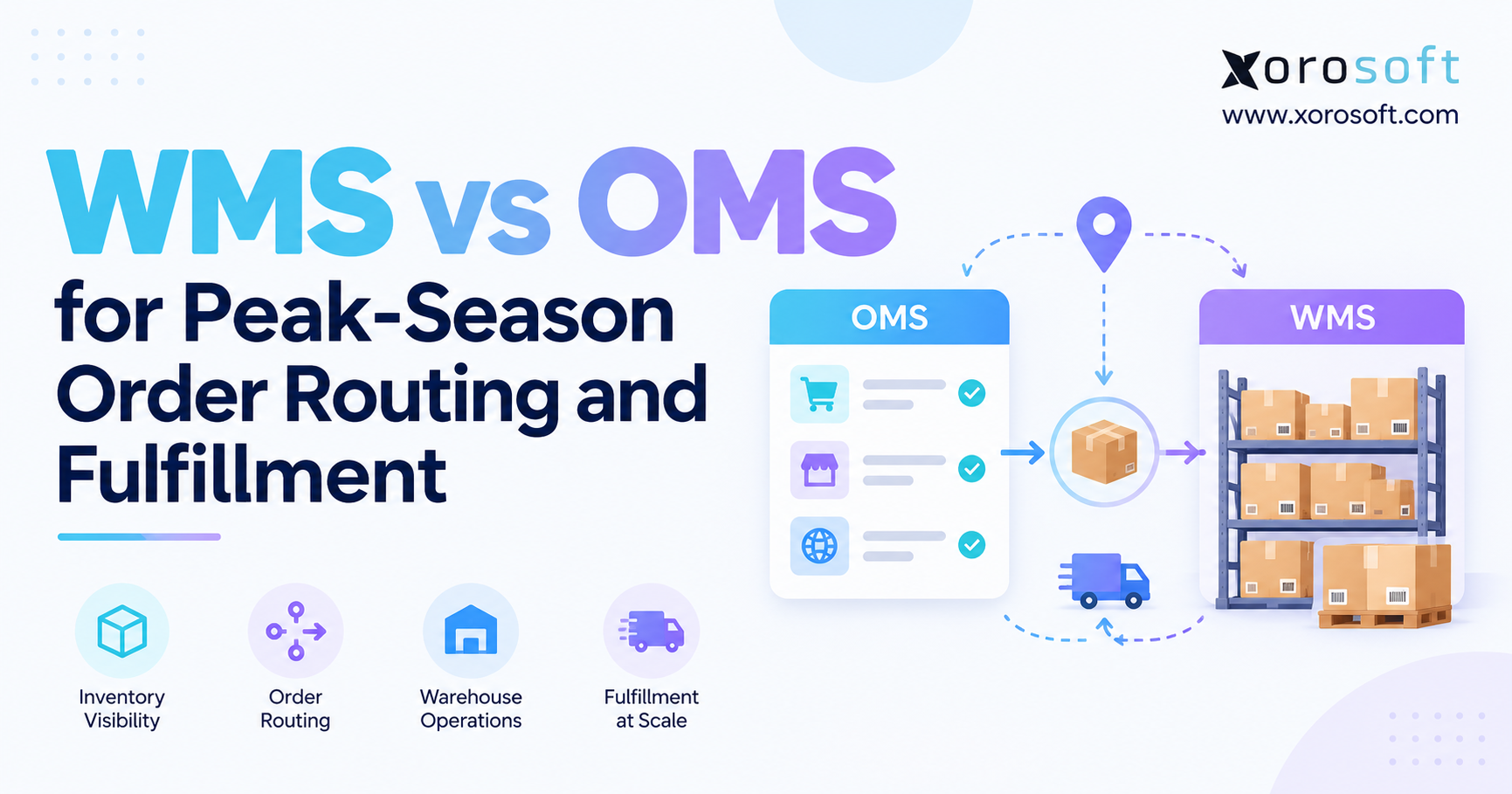
An order management system (OMS), on the other hand, focuses more closely on customer orders and fulfillment assignments. Warehouse management systems (WMS) support the physical work of receiving, storing, picking and shipping goods.
Shipping software generally focuses on carrier rates, shipping labels and tracking.
Table 8: Fulfillment Technology Comparison
| Capability | ERP | OMS | WMS | Shipping Software |
|---|---|---|---|---|
| Accounting | Core | Varies | Limited | Limited |
| Order routing | Varies | Often supported | Warehouse execution | Shipping-focused |
| Stock allocation | Often supported | Often supported | Location-focused | Limited |
| Warehouse operations | Varies | Limited | Core | Limited |
| Carrier rates | Varies | Varies | Varies | Core |
| Cost tracking | Often supported | Varies | Limited | Freight-focused |
| 3PL connections | Integration-dependent | Integration-dependent | Integration-dependent | Integration-dependent |
However, individual platforms can combine several of these features. Review actual workflows rather than making decisions based only on software categories.
11.2 Building a Connected Fulfillment System
A connected fulfillment system should share orders, available stock, shipping instructions and cost records across business functions.
For example, sales channels send orders to the main operational system. Next, the routing process selects a suitable warehouse. Finally, that warehouse ships the order and returns confirmation.
Xorosoft’s XoroONE cloud ERP platform combines stock management, purchasing, warehouse operations, accounting and ecommerce workflows.
These shared records provide a foundation for coordinating fulfillment. However, businesses should confirm whether detailed cost rules require added setup, system connections or a separate routing tool.
11.3 Evaluating ERP Options for Growing Businesses
Businesses using spreadsheets, accounting tools and separate warehouse systems may find cost-aware order routing increasingly difficult to manage.
Xorosoft provides integrated ERP solutions for inventory-driven businesses. Meanwhile, companies comparing NetSuite and other platforms should review implementation costs, warehouse features and ongoing support needs.
A cloud ERP comparison can help identify evaluation criteria.
However, the final decision should depend on actual business needs. Ask software providers to demonstrate representative customer orders, stock rules and 3PL workflows rather than relying only on standard demonstrations.
12. Testing and Improving Cost-Aware Fulfillment Routing
Businesses should test their routing models before activating them across the entire network. For example, past orders can reveal whether a new model would have reduced costs without breaking delivery commitments.
12.1 Replay Historical Orders
Select past orders covering different products, delivery areas, sales channels and shipment sizes.
Next, recreate the stock levels, warehouse capacity and shipping rates that applied at the original order date. Compare the proposed fulfillment plan against what actually happened.
Avoid using today’s stock levels to assess old routing decisions. Otherwise, the results may overstate the available savings.
Historical testing helps teams identify where new rules offer value and where existing rules already work well.
12.2 Run Shadow Routing Before Launch
Shadow routing evaluates live orders without changing their actual warehouse assignments.
For example, the new routing model can calculate a proposed location and expected cost while the existing process continues handling the shipment.
Meanwhile, finance and warehouse teams review the differences between both approaches. They can identify missing fees, unsuitable assignments and stock problems before customers experience them.
This method is especially useful when adding cost-aware fulfillment routing to a network with several external partners.
12.3 Use a Limited Rollout
Start with a small group of standard domestic orders. Then, expand to other order types as the process becomes more reliable.
For instance, complex wholesale orders, temperature-sensitive products and international shipments may need additional rules before joining the program.
Monitor costs, warehouse acceptance, stock accuracy and delivery performance during the rollout. In addition, keep a clear process for returning to previous routing rules if serious problems appear.
A controlled launch reduces risk while allowing teams to measure real financial improvements.
13. A 30-Day Action Plan for More Profitable Fulfillment
Businesses do not need to rebuild their entire warehouse network to improve order routing. Instead, a focused pilot can reveal where better data and clearer rules will deliver the most value.
13.1 Days 1–7: Review Fulfillment Costs and Stock Records
First, document every warehouse, 3PL agreement and current routing rule.
Identify orders with high shipping costs, unnecessary splits or repeated delivery problems. Also, establish baseline costs and service metrics for later comparison.
13.2 Days 8–14: Build the Cost-Aware Order Routing Model
Next, organize fulfillment costs into a standard format.
Define stock rules, delivery requirements and warehouse capacity limits. In addition, decide which system owns routing assignments and how fulfillment partners will confirm receipt.
Start with reliable cost data rather than trying to automate every possible charge immediately.
13.3 Days 15–21: Test the Model With Real Orders
Replay past orders and run shadow routing tests.
Then, investigate large differences between the proposed and existing assignments. Check whether expected savings remain useful after accounting for stock protection, delivery needs and added program costs.
13.4 Days 22–30: Launch and Review the Routing Pilot
Finally, activate the model for a limited group of orders.
Track fulfillment costs, stock accuracy, warehouse acceptance and customer delivery results. Expand only when the pilot demonstrates dependable performance. More complex system connections may require additional time.
Above all, cost-aware fulfillment routing should help businesses make better financial decisions without weakening customer service. Accurate stock records, current shipping rates and clear warehouse rules form the foundation of a reliable fulfillment network.
If your business manages multiple warehouses, Shopify orders, wholesale customers and external fulfillment partners through disconnected systems, reviewing your current setup is a practical next step.
Connect with the Xorosoft team to discuss your fulfillment network, inventory needs and opportunities to build a more connected, cost-efficient operation.
Frequently Asked Questions
What is cost-aware order routing?
It selects the lowest-cost feasible warehouse or 3PL by weighing shipping, handling, packaging, inventory, capacity and delivery needs before an order is assigned.
How do you calculate total fulfillment cost?
Add shipping, handling, packaging, applicable 3PL fees, transfer expenses and merchant-paid cross-border charges. Exclude costs already included in bundled service fees.
Is the nearest warehouse always the cheapest?
No. Carrier rates, package dimensions, warehouse labor, split shipments and partner fees can make a farther location cheaper overall than the nearest facility.
How does Shopify route orders across locations?
Shopify applies configured rules such as reducing splits, favoring the destination market and prioritizing nearby locations. Detailed cost comparisons may need additional logic.
How can businesses reduce split shipments?
Check complete-order inventory, improve stock accuracy, reserve units for existing commitments and compare the total cost of consolidated versus split fulfillment before assigning orders.
Can an ERP automate warehouse and 3PL routing?
Some ERP systems support inventory allocation and fulfillment workflows. Complex 3PL pricing, capacity rules or network optimization may require configuration or added integrations.
Which KPIs measure routing performance?
Track fulfillment cost per order, split-shipment rate, on-time delivery, routing exceptions, estimated-versus-actual cost variance and contribution margin together.
Recent Posts
-
 Shopify Next Gen Events vs Classic Webhooks for ERP Integrations
-
 How to Build Cost-Aware Order Routing Across Warehouses and 3PLs
-
 Post-Go-Live ERP Support for Multi-Location Distributors
-
 Sales Commission Management Software for Wholesale Distributors
-
 Why ERP Inventory Does Not Match the Lender’s Borrowing Base