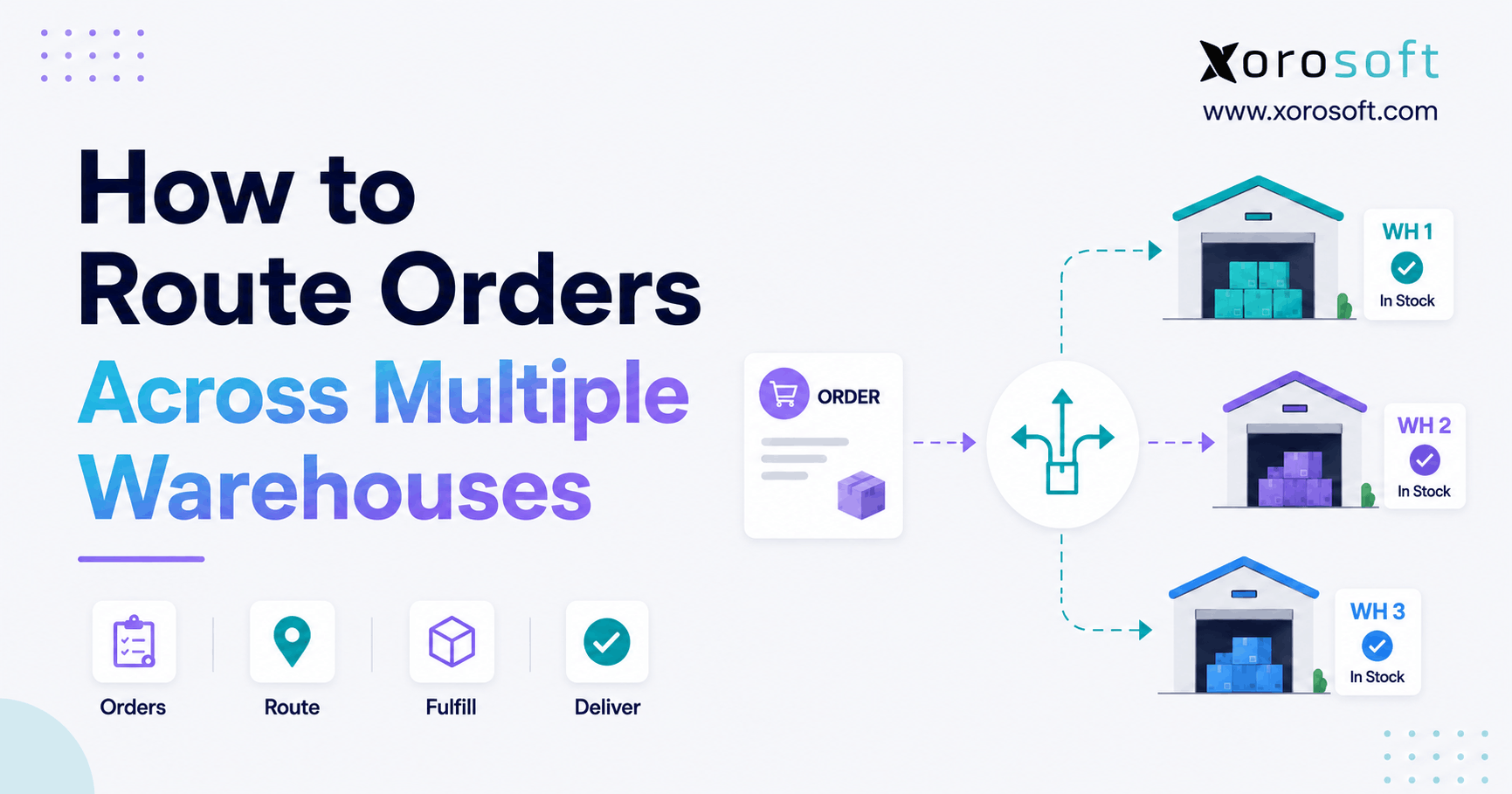
If your business involves shipping from multiple locations, understanding multi warehouse order routing can streamline your operations and improve delivery speed.
1. Multi Warehouse Order Routing Starts With a Fulfillment Problem, Not a Software Problem
Adding another warehouse changes more than storage capacity. It changes how the business decides where every order should go.
With one warehouse, the fulfillment path is obvious. An order arrives, the team allocates inventory, picks the items, packs the shipment, and hands it to the carrier. Once a business operates two, three, or ten locations, every order creates a decision.
Which warehouse has the inventory? Can one location fulfill the entire order? Which facility can meet the delivery promise? Would shipping from the closest warehouse create an expensive split shipment? Does another warehouse have lower freight costs but a heavy workload? Should the company preserve inventory in one region because demand there is stronger?
Those questions define multi warehouse order routing.
The challenge grows as ecommerce volume, sales channels, and fulfillment locations increase. The U.S. Census Bureau estimated seasonally adjusted retail ecommerce sales at $326.7 billion in the first quarter of 2026, up 9.8% year over year. Ecommerce represented 16.9% of total U.S. retail sales during that quarter. The broader trend matters because more digital demand creates more inventory allocation and fulfillment decisions across distributed networks. U.S. Census Bureau
Customer expectations make those decisions more consequential. DHL’s 2025 ecommerce research found that 81% of shoppers would abandon a purchase when their preferred delivery option was unavailable. Routing therefore affects more than warehouse efficiency. It influences shipping cost, delivery reliability, inventory availability, and customer experience. DHL E-Commerce Trends Report 2025
1.1 What Multi Warehouse Order Routing Actually Does
Multi warehouse order routing determines which eligible fulfillment location should handle an order.
The decision can account for available inventory, complete-order availability, customer location, shipping zones, delivery commitments, warehouse workload, carrier cutoffs, inventory reservations, and business-specific priorities.
A basic operation might ask, “Which warehouse has the item and is closest to the customer?”
A more mature operation asks, “Which location can fulfill this order at the best overall combination of service, cost, capacity, and inventory impact?”
That difference is important. The nearest warehouse is not always the best warehouse.
1.2 When Routing Complexity Becomes Worth Managing
A company with one warehouse does not need sophisticated routing. A business with two predictable locations and modest order volume may also operate efficiently with a simple priority rule.
Complex routing becomes useful when employees can no longer make location decisions consistently.
Warning signs usually appear before the company formally recognizes a routing problem. Staff begin checking several systems before releasing orders. Warehouse assignments change after allocation. Split shipments become common. Teams message one another to confirm available stock. One employee becomes the person who “knows how routing works.”
At that point, the business needs a repeatable routing policy rather than more tribal knowledge.
2. How Multi Warehouse Order Routing Works From Order Capture to Warehouse Release
A strong routing workflow follows a logical sequence. It first removes locations that cannot fulfill the order correctly. Then it compares the remaining options.
Many weak routing strategies reverse that sequence. They optimize distance or shipping cost before confirming that the location can actually fulfill the order.
A practical hierarchy often looks like this:
Available inventory → Complete-order capability → Delivery promise → Total fulfillment cost → Warehouse capacity → Strategic inventory priorities
The exact order will vary by company, but the logic should always reflect real business priorities.
2.1 Start With Available Inventory, Not Physical Inventory
Physical stock and available stock are different numbers.
Suppose Warehouse A shows 40 units on hand. Open sales orders already claim 10 units, a wholesale account reserves eight more, and the company protects five as safety stock. The warehouse physically contains 40 units, but only 17 should be available for new routing decisions.
A simple calculation is:
Routable inventory = On-hand inventory − allocated inventory − protected inventory
This distinction sits at the foundation of reliable multi warehouse order routing. A routing engine cannot make a good decision if its inventory inputs are wrong.
2.2 Check Whether One Warehouse Can Fulfill the Entire Order
Once the system identifies warehouses with eligible stock, it should ask whether a single location can complete every order line.
This rule often deserves high priority because every additional fulfillment location creates operational cost. Another warehouse usually means another pick, package, label, tracking number, carrier transaction, and opportunity for delay.
Shopify follows similar logic in its standard routing model. Its default order-routing strategy includes minimizing split fulfillments before evaluating destination market and proximity. Shopify order routing documentation
Complete fulfillment should not become an absolute rule, however. An urgent order may justify two shipments when waiting for one missing SKU would break an important customer commitment.
2.3 Evaluate the Customer Promise Before Geographic Distance
Once the routing engine knows which facilities have inventory, it should evaluate the required delivery outcome.
Customer location matters, but geography alone does not tell the whole story.
A warehouse 80 miles away might miss today’s carrier cutoff. Another facility 300 miles away may still deliver sooner because it can release the order immediately.
The routing decision should therefore consider the promised delivery date, service level, carrier schedule, and warehouse processing time together.
2.4 Compare Total Fulfillment Cost Instead of Freight Alone
Shipping cost can mislead operations teams when they compare only the first package.
Imagine Warehouse A can ship two of three items for $9. Warehouse B can ship the complete order for $14. If Warehouse A requires another $8 shipment for the missing item, the apparently cheaper decision creates at least $17 in freight before the business adds packaging and labor.
A better comparison looks at:
Carrier cost + warehouse handling + packaging + split-shipment cost + exception cost
That broader cost model gives multi-location order routing a more realistic economic foundation.
2.5 Include Warehouse Capacity in the Decision
Inventory availability does not guarantee operational availability.
A warehouse can have the correct stock and still be the wrong choice because its pick queue is overloaded, labor is short, equipment is unavailable, or a carrier cutoff has passed.
Capacity-based routing becomes more important as networks grow. Without it, the system may repeatedly send orders to the location that looks best on paper until that warehouse becomes the bottleneck.
2.6 Route Exceptions Instead of Forcing Every Order Through Automation
Not every order belongs in the normal workflow.
Large wholesale orders, regulated products, unusual international requirements, high-value customers, inventory discrepancies, and expensive split shipments may justify manual review.
Effective automation does not eliminate human judgment. It reserves human attention for orders where judgment adds value.
3. Multi Warehouse Order Routing Rules That Deserve Priority
The strongest routing strategies combine hard constraints with ranked preferences.
A hard constraint determines whether a warehouse can participate in the decision at all. A preference determines which qualifying location should win.
If Warehouse A lacks stock, that is a constraint. If Warehouse B sits 50 miles closer than Warehouse C, that is usually a preference.
| Routing Rule | Primary Objective | Main Benefit | Main Tradeoff |
|---|---|---|---|
| Available inventory | Feasibility | Prevents impossible assignments | Requires accurate inventory |
| Complete-order fulfillment | Shipment consolidation | Reduces split shipments | May use a farther warehouse |
| Closest eligible warehouse | Transit efficiency | Can improve delivery speed | Can overemphasize distance |
| Lowest total cost | Margin protection | Controls fulfillment expense | May conflict with speed |
| Fastest delivery | Customer promise | Protects service levels | Can increase cost |
| Preferred location | Operational control | Creates predictable routing | Can overload one facility |
| Capacity-based routing | Workload balance | Protects warehouse throughput | Requires timely workload data |
| Inventory balancing | Network health | Preserves regional availability | May increase immediate freight |
3.1 Inventory-Based Order Routing Should Act as the First Gate
The routing engine should remove any warehouse that lacks available inventory before it evaluates other factors.
That rule sounds obvious, yet businesses regularly route against stale inventory, on-hand figures, or channel-specific quantities that ignore previous allocations.
The problem becomes more serious when Shopify, Amazon, wholesale, and EDI orders all consume the same stock.
3.2 Complete-Order Availability Usually Deserves High Priority
A location that can fulfill the whole order often provides a better operational result than two nearby warehouses that must split it.
Consolidated fulfillment reduces package count and simplifies tracking, returns, customer communication, and reconciliation.
For parcel-oriented businesses, this rule frequently creates more value than shaving a small amount from transit distance.
3.3 Proximity Works Best After Eligibility Is Established
Distance becomes most useful after the system knows that two or more warehouses can satisfy the important requirements.
If Warehouse A and Warehouse B both have complete inventory, can ship today, and can meet the service commitment, proximity becomes a sensible tie-breaker.
Using distance earlier in the process can push the system toward a locally convenient but operationally expensive choice.
3.4 Inventory Balancing Protects Future Orders
Some companies need routing rules that consider tomorrow’s demand rather than only today’s transaction.
Suppose a product sells heavily on the West Coast, and replenishment into the western warehouse takes three weeks. An East Coast customer places an order that either location can fulfill.
Shipping from the western warehouse might save $2 today but create a stockout in the market where future demand is much stronger.
Good multi warehouse order routing can protect network-level inventory instead of optimizing every order independently.
4. The Closest Warehouse Is Not Always the Best Fulfillment Location
Consider an order containing three products.
Warehouse A sits 80 miles from the customer but carries only two items. At 420 miles away, Warehouse B is farther from the destination but can fulfill the entire order. Meanwhile, Warehouse C is 300 miles away and also has complete inventory, although its fulfillment queue is already near capacity.
| Decision Factor | Warehouse A | Warehouse B | Warehouse C |
| Distance | 80 miles | 420 miles | 300 miles |
| Items available | 2 of 3 | 3 of 3 | 3 of 3 |
| Estimated freight | $9 | $14 | $12 |
| Current workload | Normal | Normal | Constrained |
| Full order possible | No | Yes | Yes |
A distance-only rule chooses Warehouse A immediately.
A complete-order rule removes Warehouse A from consideration. Warehouse C then appears better than Warehouse B because it is closer and slightly cheaper, but its workload creates delivery risk.
Warehouse B may therefore produce the best overall result even though it is the farthest facility.
4.1 Weighted Routing Scores Can Help, but Only With Clear Priorities
Some businesses assign scores to each factor.
For example, complete-order availability might carry 40% of the score, service level 25%, total fulfillment cost 20%, capacity 10%, and proximity 5%.
The calculation can help, but the numbers need to reflect genuine operating priorities. Arbitrary weights create a sophisticated-looking formula without improving decisions.
Operations teams should test the model against historical orders. Compare what the proposed rules would have done with actual shipping cost, delivery performance, split rate, warehouse workload, and customer-service outcomes.
5. Split Shipments Reveal More Than a Shipping Problem
A split shipment occurs when two or more locations fulfill one customer order.
Sometimes that outcome makes sense. It should not happen simply because the routing system checked inventory line by line and chose the nearest stock for each SKU.
5.1 When Multi-Warehouse Fulfillment Should Split an Order
A business may choose split fulfillment when no single warehouse carries the complete order and waiting would create an unacceptable delay.
High-priority customers, expedited commitments, replacement orders, or products that require different handling can also justify separate shipments.
The decision should compare the extra cost and operational effort with the consequence of waiting.
5.2 When Consolidation Produces a Better Outcome
A slightly farther warehouse may be better when it can ship every line together.
This matters especially for orders where product value is low relative to freight. Paying $3 more for one complete shipment can be more profitable than saving $3 on the first package and spending another $9 on a second package.
5.3 Repeated Split Shipments Often Point to Inventory Planning Problems
Routing handles fragmented inventory after fragmentation already exists.
If the same combinations of SKUs repeatedly sit in different warehouses, the business may need to revisit replenishment, transfers, forecasting, or regional assortment decisions.
A high split rate can therefore reveal a planning problem rather than a routing-rule problem.
Multi warehouse order routing should help operations manage the network, but it cannot completely compensate for inventory positioned in the wrong locations.
6. Shopify Multi Warehouse Order Routing Needs a Reliable Inventory Backbone
Shopify merchants can operate multiple fulfillment locations and configure order routing across eligible locations. That capability works well when Shopify contains the information required to make the fulfillment decision.
The challenge becomes broader when the merchant also sells through Amazon, wholesale, EDI, retail stores, marketplaces, or external 3PLs.
At that point, Shopify becomes one source of demand within a larger operational environment.
6.1 Centralized Inventory Matters More Than Additional Routing Rules
If Shopify shows ten available units while a wholesale system has already committed six of them, no routing rule can resolve the underlying data conflict reliably.
The stronger approach is to centralize inventory availability and allocation, then synchronize the appropriate sellable quantities back to each sales channel.
For Shopify merchants evaluating that type of backend integration, the Xorosoft ERP app for Shopify shows how Xorosoft connects Shopify activity with broader ERP workflows.
6.2 Amazon, Wholesale, and EDI Should Not Compete Blindly for the Same Stock
A wholesale order for 500 units can change what the company should make available to DTC customers. Amazon demand can consume stock that Shopify still considers available. EDI commitments may require a company to protect specific quantities for particular customers.
These situations look like channel problems, but they are usually inventory-allocation problems.
Multi warehouse order routing works best when all channels reference the same underlying availability rules.
7. Industry-Specific Multi Warehouse Order Routing Requires Different Priorities
A routing rule designed for small parcel ecommerce will not necessarily work for furniture, food, wholesale distribution, or manufacturing.
Xorosoft serves several inventory-driven sectors, and its industry overview highlights the operational differences between apparel, furniture, consumer products, wholesale, manufacturing, and related businesses.
7.1 Apparel Routing Has to Handle Variant Fragmentation
Apparel companies manage inventory across style, color, and size combinations.
A warehouse may stock the correct style but lack the customer’s exact color or size. Multi-line orders make the problem harder because the system needs to evaluate complete combinations rather than individual products in isolation.
Seasonality matters as well. Preserving popular size curves in regions with stronger demand may create more value than minimizing today’s freight cost.
7.2 Furniture Routing Gives Freight and Handling More Weight
Furniture changes the economics of fulfillment because products are bulky, expensive to transport, and often harder to handle.
Distance may deserve more weight, but complete-order logic can matter even more. Customers buying coordinated furniture sets generally have a poor experience when individual pieces arrive from several facilities on different schedules.
7.3 Food and Beverage Routing Needs Qualified Inventory
For food businesses, quantity alone may not determine whether inventory qualifies.
Lot, expiration date, shelf life, storage requirements, and rotation policies can affect the choice. A location may technically have stock but still be the wrong fulfillment source.
7.4 Wholesale Distribution Requires Customer-Level Priorities
Wholesale orders often carry larger quantities and more specific commitments.
A major account may have agreed allocation rules, delivery windows, EDI requirements, or regional fulfillment expectations. The business may also protect inventory for key wholesale customers rather than exposing all available stock to DTC channels.
7.5 Manufacturing Connects Routing With Production
Manufacturers often make routing decisions alongside production planning.
The facility with the most finished inventory today might not have the best projected availability next week. Work orders, component supply, production capacity, and transfers can all influence the decision.
That makes multi warehouse order routing part of a broader planning process rather than an isolated warehouse function.
8. Manual Multi Warehouse Order Routing Works Until Exceptions Become Routine
Manual routing is not automatically inefficient.
An experienced operations team can manage a modest number of daily orders across two simple locations without sophisticated automation.
Problems begin when people spend more time compensating for missing process than making genuine business decisions.
8.1 Watch for Tribal Knowledge in Warehouse Assignment
One employee knows that a particular customer always ships from Warehouse B. Another remembers which SKUs should stay in Warehouse A. A warehouse manager understands that Thursday orders must avoid a location because of a carrier schedule.
If the system does not capture those rules, the company depends on memory.
That creates inconsistent decisions and makes scaling difficult.
8.2 Automated Order Routing Should Remove Repetitive Judgment
Automation becomes useful when the same decisions occur frequently enough to standardize.
The routing engine can check inventory, apply warehouse eligibility, evaluate complete-order availability, compare service requirements, and choose the preferred location within seconds.
People can then focus on unusual orders rather than routine assignments.
8.3 Good Automation Still Needs Exception Management
Teams should keep some orders outside the normal routing workflow.
Large wholesale orders, regulated items, expensive splits, inventory discrepancies, unusual international requirements, and contractual accounts may require an employee to review the decision manually.
The strongest automation strategy separates predictable decisions from high-value exceptions.
9. ERP, OMS, and WMS Support Different Parts of Multi Warehouse Order Routing
Companies often use the terms ERP, OMS, WMS, and DOM interchangeably even though each system solves a different part of the fulfillment problem.
An OMS focuses on the order lifecycle and allocation. A WMS manages warehouse execution. ERP connects operational areas such as inventory, purchasing, sales, finance, ecommerce, manufacturing, and warehouse activity.
The right architecture depends on how complex the operation has become.
9.1 ERP Connects the Data Behind the Routing Decision
Routing improves when one operational environment can provide available inventory, incoming purchase orders, customer demand, transfers, channel commitments, and warehouse activity.
For businesses that want those capabilities in a connected cloud ERP, XoroONE brings inventory, purchasing, accounting, warehouse management, ecommerce, manufacturing, forecasting, and related processes into one operational platform.
The value is not the number of modules. The value is that those modules can share the information that affects fulfillment decisions.
9.2 Deeper ERP Requirements Extend Beyond Warehouse Assignment
Some companies need more extensive financial, manufacturing, or operational control as they scale.
In that context, XoroERP provides the broader ERP framework for inventory-driven organizations that need integrated business processes beyond basic order routing.
Multi warehouse order routing then becomes one component within a larger operating system rather than a standalone workflow.
9.3 WMS Controls Execution After the Routing Decision
Once the routing engine assigns an order, warehouse execution becomes the next operational risk.
Receiving, replenishment, picking, packing, shipping, inventory movement, and labor management determine whether the selected facility actually fulfills the order efficiently.
For operations focused specifically on warehouse execution, XoroWMS provides that warehouse-management context.
The distinction is straightforward: routing determines where the order should go; WMS determines how the warehouse executes the work.
9.4 ERP Comparisons Should Focus on Operational Fit
Businesses evaluating larger systems may compare Xorosoft with NetSuite, Business Central, Acumatica, Sage, Cin7, Brightpearl, or Fishbowl.
The practical comparison should focus on inventory complexity, implementation requirements, accounting, warehouse operations, ecommerce connectivity, manufacturing needs, reporting, and internal resources.
Organizations specifically considering those two ERP options can review the Xorosoft vs NetSuite comparison for additional context.
10. Common Multi Warehouse Order Routing Mistakes Create Costs That Are Easy to Miss
A routing decision can look successful because the order eventually ships, even when it increases freight, consumes the wrong inventory, creates warehouse congestion, or requires unnecessary manual work.
That makes poor routing difficult to diagnose without the right metrics.
10.1 Using On-Hand Inventory Instead of Routable Inventory
Physical stock does not account for allocations, reservations, safety stock, or inventory holds.
Routing against the wrong inventory number increases overselling risk and creates last-minute reassignment.
10.2 Prioritizing Distance Above Complete Fulfillment
Nearest-location logic feels intuitive because everyone understands it.
It becomes expensive when the closest warehouse lacks one item and creates another shipment that a slightly farther location could avoid.
10.3 Ignoring Warehouse Workload
A facility with favorable freight rates can attract more volume than it can process.
Over time, that concentration increases order cycle time and can damage the customer promise that the routing rule originally tried to protect.
10.4 Creating Too Many Rules
Every unusual order does not deserve a permanent rule.
Excessive routing logic becomes difficult to test, explain, and maintain. Teams can also create conflicting priorities that produce unpredictable results.
Start with the rules that affect the largest share of orders, then add new logic only when a repeatable business requirement justifies it.
10.5 Failing to Review Routing Policies as the Network Changes
Carrier costs change. New warehouses open. Customer concentration shifts. Product lines evolve. Sales channels grow.
Routing rules that worked twelve months ago may no longer reflect the current network.
Operations teams should review multi warehouse order routing as an ongoing operating policy rather than configure it once and leave it unchanged.
11. Build a Multi Warehouse Order Routing Policy That Operations Teams Can Maintain
Routing software works best after the company defines its operating policy.
The technology should implement clear decisions, not invent them.
11.1 Define Hard Constraints First
Hard constraints remove impossible or unacceptable choices.
A location may lack enough inventory. A warehouse may not handle a certain product type. Safety stock may protect the remaining quantity. A facility may be unable to meet the requested delivery date.
These conditions should eliminate the location before scoring begins.
11.2 Rank Business Preferences Second
Once the system has a valid set of warehouses, operations can rank preferences.
A common sequence might prioritize complete-order fulfillment, delivery SLA, total cost, warehouse capacity, and customer proximity.
Another business might place inventory balancing ahead of freight cost.
There is no universal order. The routing hierarchy should reflect the economics and service model of the company.
11.3 Establish Clear Exception Thresholds
Routing rules need boundaries.
A company might require manual review when a split shipment adds more than $30 in cost, when a wholesale order exceeds a certain value, or when no location can meet the promised delivery date.
Clear thresholds prevent employees from making inconsistent case-by-case decisions.
11.4 Test Routing Logic Against Historical Orders
Before automating a new policy, apply it to previous orders.
Compare the proposed routing logic with what actually happened. Look at whether the new rules would have reduced split shipments and how they would have affected freight costs. Next, examine whether order volume would have shifted too heavily toward one warehouse. Finally, measure the potential impact on delivery performance and customer service.
Historical testing turns theoretical rules into operational evidence.
11.5 Assign Ownership for Routing Policy
Someone should own the routing logic.
That responsibility may sit with operations, supply chain, ecommerce, or a cross-functional team, depending on the organization.
Ownership matters because routing touches several departments. Warehouse teams understand capacity, finance sees freight and margin, purchasing sees replenishment, and ecommerce teams understand channel requirements.
Without ownership, rules often accumulate without anyone evaluating the full effect.
12. Measure Whether Multi Warehouse Order Routing Is Actually Improving Fulfillment
A routing strategy should create measurable results.
The right metrics show whether the business has improved fulfillment or simply moved cost from one part of the operation to another.
12.1 Track Split-Shipment Rate
Measure the percentage of orders that require fulfillment from multiple locations.
A rising split rate may indicate fragmented inventory, poor replenishment, or routing rules that overvalue proximity.
12.2 Monitor Shipping Cost Per Order
Review freight cost by location, region, customer type, and channel.
A routing change that lowers one warehouse’s average freight expense may still increase the network’s total cost if it creates more splits.
12.3 Measure Order Cycle Time
Track how long orders take to move from acceptance to shipment.
This metric reveals whether routing decisions send too much volume to facilities that cannot process it quickly.
12.4 Measure On-Time Delivery Performance
The warehouse that ships cheapest is not necessarily the warehouse that protects the customer promise.
On-time delivery shows whether the routing strategy produces the service level customers actually experience.
12.5 Watch Manual Exception Rate
A high exception rate after automation indicates one of two issues.
Either the routing rules do not cover the operation well enough, or the data feeding those rules lacks the accuracy required for automation.
12.6 Review Warehouse Utilization and Stockout Patterns
Routing may repeatedly drain inventory from one location while leaving another overstocked.
Stockout rate by facility, inventory aging, and workload distribution help expose those imbalances.
The most useful KPI review looks at several measures together. A lower shipping cost is not a success if delivery performance deteriorates.
13. Routing Problems Often Expose a Broader Systems Gap
Some companies start by searching for routing software and discover that routing is only the visible symptom.
If teams manage inventory in one application, purchasing in spreadsheets, accounting in QuickBooks, warehouse activity in another tool, and ecommerce through several integrations, the routing engine must gather reliable information from every system.
That creates a data problem before it creates a routing problem.
13.1 Disconnected Inventory Makes Routing Unreliable
Different systems can show different quantities for the same item.
One channel may think ten units are available while another system has already committed six of them. Warehouse staff then become the final source of truth, which forces people back into manual checks.
13.2 Purchasing and Forecasting Affect Warehouse Routing
Repeated stockouts at one warehouse may not mean the routing logic is wrong.
The location may simply receive too little inventory.
That is why companies should evaluate multi warehouse order routing alongside replenishment, purchasing, transfers, forecasting, and demand planning.
13.3 Accounting Becomes Part of the Problem as Complexity Grows
Every warehouse shipment changes inventory and creates financial activity.
When operations and accounting sit in separate systems, teams spend more time reconciling what moved, where it moved, and which transaction created the change.
At a certain scale, the business may need to address the operating architecture rather than continue adding isolated tools.
14. Frequently Asked Questions About Multi Warehouse Order Routing
14.1 What Is Multi Warehouse Order Routing?
Multi warehouse order routing is the process of selecting the best fulfillment location when a business stores inventory across more than one warehouse. The decision can consider available inventory, complete-order availability, delivery requirements, customer location, total fulfillment cost, capacity, and strategic inventory priorities.
14.2 How Does Multi Warehouse Order Routing Work?
Routing software first identifies eligible warehouses with usable inventory. It then compares those locations using rules such as complete-order availability, delivery SLA, total fulfillment cost, capacity, and proximity. The system assigns the highest-priority qualifying location or sends unusual orders into an exception workflow.
14.3 What Determines Which Warehouse Should Fulfill an Order?
The best location depends on available inventory, complete-order capability, shipping economics, delivery promise, warehouse workload, customer requirements, and inventory strategy. Companies should rank these variables explicitly rather than allowing one factor to control every decision.
14.4 Should Orders Always Ship From the Nearest Warehouse?
No. The closest location may lack part of the order, have insufficient capacity, or require an expensive split shipment. Proximity works best after the routing system confirms that the warehouse can fulfill the order correctly and meet the required service level.
14.5 What Is Smart Order Routing?
Smart order routing evaluates several fulfillment variables instead of relying on a single fixed rule. Those variables may include inventory, cost, distance, capacity, customer market, and delivery requirements. The term does not necessarily mean artificial intelligence; deterministic business rules can also support sophisticated decisions.
14.6 What Is Inventory-Based Order Routing?
Inventory-based order routing sends demand only to locations with eligible available inventory. Strong implementations subtract stock already allocated, reserved, held, or protected as safety stock before deciding whether a warehouse qualifies.
14.7 What Are the Most Important Warehouse Routing Rules?
Common rules include available inventory, complete-order fulfillment, customer proximity, delivery SLA, destination market, total fulfillment cost, warehouse capacity, preferred location, and inventory balancing. The best priority sequence depends on the company’s service and cost model.
14.8 How Do You Choose Between Two Warehouses With the Same Inventory?
When both locations can fulfill the complete order, compare delivery promise, total cost, current workload, customer proximity, and inventory strategy. If those variables remain similar, a defined warehouse priority or distance rule can act as the tie-breaker.
14.9 What Happens When No Warehouse Has the Full Order?
The business can split fulfillment, wait for replenishment, backorder a line, transfer stock between warehouses, substitute an item where appropriate, or send the order for manual review. The right choice depends on customer expectations, timing, and economics.
14.10 When Should an Order Be Split Across Warehouses?
Split the order when no single facility can complete it and waiting creates a more serious service or financial consequence. Operations should compare the additional freight, handling, packaging, and tracking costs with the cost of waiting or using another location.
14.11 How Can Businesses Reduce Split Shipments?
Prioritize complete-order availability, maintain accurate inventory, improve replenishment, transfer stock proactively, and review where commonly purchased products sit across the network. Repeated splits involving the same SKU combinations often point to an inventory-planning issue.
14.12 Can Shopify Automatically Route Orders Between Locations?
Yes. Shopify supports routing across active fulfillment locations and can prioritize eligible warehouses according to configured rules. Businesses should still maintain accurate location-level inventory because routing quality depends directly on the inventory information available to the platform.
14.13 Can Shopify Orders Use Inventory From Several Warehouses?
Yes. Shopify can support multiple fulfillment locations, and orders may draw from different locations when necessary. Merchants should review routing priorities carefully because aggressive multi-location fulfillment can increase split shipments.
14.14 Can Amazon and Shopify Share the Same Warehouse Inventory?
Yes, when the systems connecting those channels maintain synchronized availability and allocations. The key requirement is preventing one channel from selling stock that another channel has already committed.
14.15 What Is the Difference Between OMS and WMS?
An OMS focuses on order capture, allocation, status, and orchestration. A WMS focuses on warehouse execution such as receiving, replenishment, picking, packing, and shipping. Many multi-location businesses use both functions together.
14.16 What Role Does ERP Play in Order Routing?
ERP can provide the shared operational information behind routing decisions. Inventory, purchasing, orders, transfers, accounting, manufacturing, ecommerce, and warehouse activity can all influence which facility should fulfill an order.
14.17 What Is Distributed Order Management?
Distributed order management coordinates order allocation across warehouses, stores, suppliers, 3PLs, and other fulfillment points. Large networks often use DOM when fulfillment decisions require more advanced orchestration than simple warehouse priority rules provide.
14.18 Do Small Businesses Need Advanced Routing Software?
Not necessarily. A company with one warehouse or two straightforward locations may operate effectively with simple routing priorities. Automation becomes more valuable when order volume, channels, locations, or inventory fragmentation make manual decisions inconsistent.
14.19 How Does Safety Stock Affect Order Routing?
Businesses can exclude safety stock from routable inventory so normal demand does not consume units reserved to protect against uncertainty. That approach prevents the routing system from treating every physical unit as freely available.
14.20 Can Warehouse Capacity Be Included in Routing Rules?
Yes. Teams can measure warehouse capacity through order backlog, available labor, pick queues, fulfillment limits, and other operational indicators. Capacity-based routing can redirect demand when one facility becomes overloaded.
14.21 How Often Should Routing Rules Be Reviewed?
Operations teams should review routing logic whenever the warehouse network changes and at regular intervals during normal operations. New carriers, locations, markets, channels, products, or inventory policies can alter which rules produce the best result.
14.22 What KPIs Should You Track for Multi Warehouse Order Routing?
Useful KPIs include split-shipment rate, shipping cost per order, order cycle time, on-time delivery, manual exception rate, warehouse utilization, stockout rate by location, and fulfillment accuracy. Companies should review these metrics together rather than optimize one in isolation.
14.23 When Should a Business Automate Order Routing?
Automation becomes worthwhile when employees repeatedly check inventory, compare warehouses, reassign orders, or correct routing errors. The best trigger is operational complexity rather than a fixed revenue threshold.
14.24 What Is the Biggest Multi-Warehouse Routing Mistake?
One of the most common mistakes is optimizing a single variable, especially distance. A nearby warehouse can still produce a poor result when it creates a split shipment, lacks capacity, or consumes strategically important inventory.
14.25 What Is the Best Multi Warehouse Order Routing Strategy?
The best strategy first removes warehouses that cannot fulfill the order correctly. It then ranks the remaining locations according to complete-order availability, delivery commitment, total fulfillment cost, capacity, proximity, and inventory priorities. Operations teams should test that hierarchy against real order data.
15. Final Takeaway: Make Every Warehouse Assignment an Intentional Business Decision
The strongest multi warehouse order routing strategy does not start with “ship from the nearest warehouse.”
It starts with a more useful question:
Which location can fulfill this order with the best overall balance of inventory availability, customer service, total cost, warehouse capacity, and future inventory impact?
That approach changes routing from a shipping shortcut into an operating discipline.
Begin with a small number of clear rules. Confirm available inventory before evaluating distance. Prioritize complete fulfillment where the economics support it. Include warehouse capacity when workload starts affecting service. Define exceptions rather than allowing employees to invent them order by order. Then measure split shipments, freight, cycle time, delivery performance, and inventory distribution to see whether the policy is actually improving the operation.
As the network grows, routing becomes increasingly connected to purchasing, forecasting, warehouse execution, ecommerce, accounting, and manufacturing. Businesses that manage those functions in separate spreadsheets and applications eventually reach a point where another isolated routing rule cannot solve the underlying information problem.
For inventory-driven companies evaluating the next stage of multi-warehouse growth, the practical next step is to document the current routing workflow, identify where staff still depend on manual checks, and determine which decisions the business can standardize.
If you want to evaluate how Xorosoft could support your warehouse structure, inventory processes, sales channels, and fulfillment requirements, contact the Xorosoft team to discuss your operation and see whether a connected ERP approach fits your needs.
Recent Posts
-
 Inventory Valuation in ERP: FIFO, Average Cost, Landed Cost, and Adjustments
 -
 Can a B2B Order Approval Workflow Enforce Buyer Limits Without Manual Holds?
 -
 Brightpearl Alternatives for Ecommerce Brands
 -
 WMS Analytics: How to Diagnose Congestion, Rework, and Labor Bottlenecks
 -
 Inventory Tracker for Shopify: Managing Incoming Purchase Orders and Interlocation Transfers Before Stock Is Sellable