If you’re looking to improve your shipping efficiency, understanding multi-warehouse order routing can make a significant difference.
1. Why Multi-Warehouse Order Routing Breaks Down as Networks Grow
1.1 More Locations Create More Operational Trade-Offs
A second warehouse adds options, but it also introduces differences in inventory, labor, carrier coverage, cut-off times, storage capability, and cost. One location may hold the item but lack capacity. Another may be farther away but able to ship the complete order. A 3PL may have stock yet charge more for special handling.
As these variables multiply, one universal rule becomes unreliable. The routing process must first remove locations that cannot fulfill the order and then compare the remaining options against the company’s priorities.
1.2 The Closest Warehouse Is Not Always the Best Warehouse
Distance matters, but it should not override inventory, service, or cost. The closest warehouse may create two packages, miss the carrier cut-off, or consume inventory protected for a wholesale customer. A slightly farther location may ship everything together and still meet the promised delivery date.
Therefore, proximity should operate as a ranking factor after the system confirms that the location has usable inventory, supports the product, serves the destination, and has enough capacity.
1.3 Who Needs a Multi-Location Order Routing Strategy?
A formal strategy becomes valuable when a business operates multiple warehouses, stores, or 3PLs; sells through Shopify, Amazon, wholesale, or EDI; handles products with special requirements; or frequently reassigns orders after release.
A company with one warehouse and simple products may not need advanced software. However, it should still document its process for stockouts, downtime, backorders, and outsourced fulfillment.
2. What Multi-Warehouse Order Routing Actually Controls
2.1 A Practical Multi-Warehouse Order Routing Definition
Multi-warehouse order routing assigns an order, or individual order lines, to the most suitable warehouse, store, supplier, fulfillment center, or 3PL. The decision can consider inventory availability, complete-order fulfillment, shipping cost, delivery speed, distance, capacity, product restrictions, customer priority, and channel policy.
The routing decision normally occurs after order capture but before picking begins. Once the system selects a location, it should reserve the stock and release the work to that facility.
2.2 Where Warehouse Order Routing Fits in the Order Lifecycle
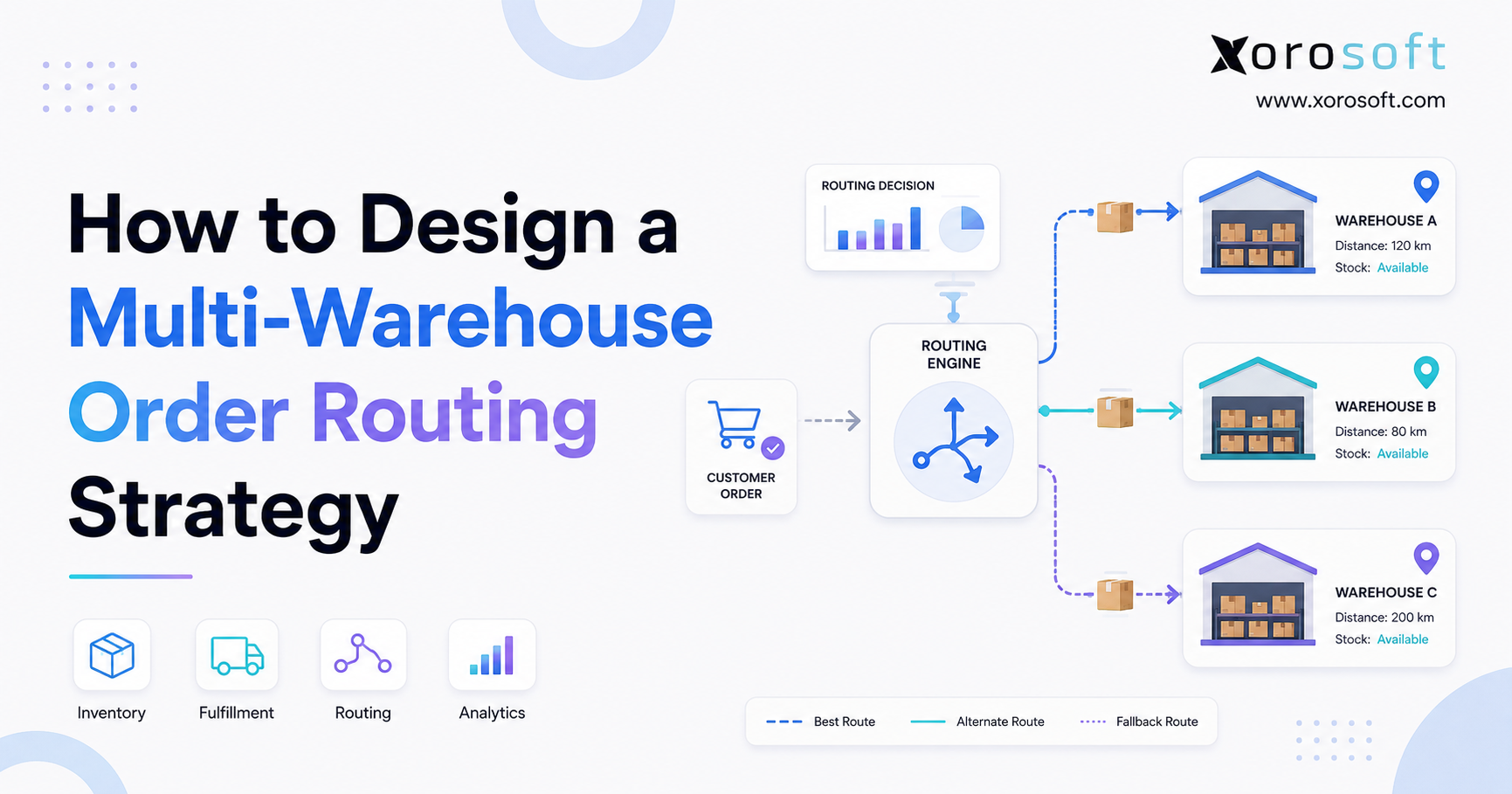
The order lifecycle begins when a sales channel submits an order. The business validates the customer, payment, items, destination, and service level. Routing then identifies eligible locations, applies constraints, ranks the valid options, and selects a source.
After selection, the warehouse executes the physical work and returns shipment, inventory, and cost updates. Routing therefore connects demand with inventory and warehouse execution; it does not replace either function.
2.3 Routing, Allocation, and Order Orchestration
Routing decides where the order should be fulfilled. Allocation commits inventory to that order. Orchestration manages the broader sequence, including payment, reservation, release, shipping, invoicing, customer communication, and exceptions.
These functions can sit in one platform or several connected systems. However, they must share the same inventory and order status to avoid duplicate promises and late corrections.
3. Define Business Goals Before Writing Order Routing Rules
3.1 Protect the Customer Promise
The routing objective should reflect what the business promised at checkout or during order entry. A premium two-day order should not follow the same logic as an economy shipment with a flexible window.
The system must understand whether speed, delivery date, order completeness, or cost carries the highest priority. It should also consider warehouse cut-offs and carrier schedules so that the displayed promise remains operationally achievable.
3.2 Control Fulfillment Cost and Order Margin
Fulfillment cost includes more than the carrier rate. Picking, packing, packaging, special handling, 3PL fees, transfer costs, and split shipments all affect margin.
A low carrier rate may still produce a costly result if the warehouse creates two parcels or requires additional handling. Cost-aware routing should compare total fulfillment expense while preserving an acceptable delivery outcome.
3.3 Balance Inventory and Channel Priorities
Routing decisions influence where inventory remains after each order. If the system repeatedly uses one location, that warehouse may stock out while another carries slow-moving units.
The company may also protect stock for wholesale customers, marketplaces, retail replenishment, or subscriptions. Those commitments should reduce available inventory before ecommerce routing begins.
Leadership should document the order of these objectives before employees configure software. A written priority statement might say: protect mandatory delivery dates first, avoid unnecessary splits second, preserve channel allocations third, and select the lowest-cost valid location fourth.
This sequence gives operations, finance, ecommerce, and warehouse teams a shared decision framework. It also makes later rule changes easier to evaluate because the company can ask whether a proposed rule supports the agreed operating priorities or merely solves one isolated exception.
4. Build the Inventory Foundation for Reliable Order Routing
4.1 Separate On-Hand Inventory From Available Inventory
On-hand inventory may include units that are reserved, damaged, quarantined, expired, awaiting inspection, or protected as safety stock. A routing engine that treats every physical unit as available will assign orders that the warehouse cannot complete.
Each location needs a consistent available-to-sell calculation that reflects confirmed stock, reservations, active picks, inventory status, channel allocations, and approved inbound supply where relevant.
4.2 Reserve Inventory Immediately After Routing
The system should reserve inventory as soon as it selects a warehouse. Delayed reservations allow another order or channel to claim the same units.
When an order is rerouted, the workflow should release the original reservation and create the new one as a controlled transaction. Otherwise, one location appears short while another appears to have inventory that is no longer available.
4.3 Maintain Accurate Product, Location, and Capacity Data
Routing depends on warehouse addresses, service regions, operating calendars, carrier cut-offs, product restrictions, storage capabilities, and capacity status. Product records should identify oversized items, hazardous goods, temperature requirements, case packs, lots, and serial numbers.
Capacity can begin with a simple open, constrained, or unavailable status. The company can add labor and workload detail once it has a consistent operating process.
5. Design a Clear Multi-Warehouse Order Routing Rule Hierarchy
5.1 Use Hard Constraints to Remove Invalid Locations
Hard constraints answer whether a location can fulfill the order at all. A warehouse becomes ineligible when it lacks available inventory, cannot serve the destination, does not support the product, is closed, exceeds capacity, or cannot meet a mandatory service requirement.
Every hard constraint should protect a clear operational, safety, or compliance requirement. Too many constraints can eliminate all options and create unnecessary exceptions.
5.2 Use Routing Priorities to Rank Eligible Warehouses
Soft priorities compare locations that have already passed eligibility. The business may prefer complete-order fulfillment, lower total cost, faster delivery, available capacity, older inventory, or a company-owned warehouse rather than a 3PL.
The sequence matters. One business may prioritize order completeness, then service, then cost. Another may place margin before speed for economy orders.
5.3 Add Tie-Breakers, Fallbacks, and Overrides
When two warehouses remain equally suitable, a tie-breaker can use location rank, remaining capacity, or cost. Fallback rules should define whether the business splits, transfers, holds, backorders, substitutes, or escalates the order.
Employees also need controlled override permissions with reason codes. That audit trail helps the company distinguish genuine exceptions from weak routing logic.
6. Choose the Right Multi-Warehouse Fulfillment Model
6.1 Closest-Warehouse and Zone-Based Routing
Closest-warehouse routing works when locations carry similar inventory and delivery distance strongly affects service. Zone-based routing assigns regions to preferred locations and is easier to manage than calculating the exact nearest warehouse for every order.
Both models can overlook order completeness, capacity, and inventory strategy. They work best after eligibility checks, not as the only routing rule.
6.2 Complete-Order Routing
Complete-order routing prefers the location that can supply every line. It reduces packages, handling, tracking numbers, and customer confusion.
However, the company should define how much extra cost or time it will accept to avoid a split. A complete shipment is not automatically better if it misses a critical delivery date.
6.3 Cost, Speed, and Hybrid Order Routing
Lowest-cost routing protects margin, while fastest-delivery routing protects service. Each needs guardrails: cost routing needs a maximum delivery window, and speed routing needs an acceptable cost range.
Complex networks often use a hybrid score:
Routing score = inventory fit + service performance + cost efficiency + capacity + strategic priority − exception risk
The score should remain explainable. Start with a few meaningful factors and add complexity only when performance data supports it.
7. Reduce Split Shipments Without Delaying Every Order
7.1 Identify the Real Cause of Split Shipments
Splits usually result from fragmented inventory, inaccurate availability, rigid location priorities, or line-level routing that optimizes each item separately. They add picks, packages, labels, freight, tracking events, and customer-service work.
Repeated splits often reveal a stocking or replenishment problem rather than a routing problem. The business should identify the products and locations that create the most splits before adding more rules.
7.2 Decide Whether to Split, Transfer, Hold, or Backorder
The business can split the order, transfer inventory, hold for inbound stock, or backorder a line. The decision should consider order value, margin, customer promise, inbound timing, transfer cost, and cancellation risk.
An urgent, high-value order may justify a split. A low-margin order with stock arriving the next morning may be better held. Defined thresholds produce more consistent decisions than case-by-case judgment.
7.3 Communicate Clearly When a Split Is Necessary
When a split cannot be avoided, the customer should receive clear shipment and tracking information. The order record should also capture why the split occurred so the company can correct recurring inventory or replenishment issues.
8. Include Warehouse Capacity and Execution Constraints
8.1 Consider Capacity, Cut-Off Times, and Calendars
Inventory availability does not prove that a warehouse can ship on time. Routing should consider open work, available labor, same-day cut-offs, carrier collections, holidays, and planned downtime.
A warehouse may still accept economy orders after the express carrier has departed. Therefore, capacity and cut-off rules should relate to the requested service rather than treating the entire location as simply open or closed.
8.2 Apply Product-Handling Constraints
Oversized furniture, temperature-controlled food, hazardous materials, serialized equipment, and lot-controlled products cannot move through every facility. The routing engine should know which locations have the required storage, equipment, certifications, and processes.
These requirements should act as hard constraints when they involve safety, compliance, or physical capability.
8.3 Prepare for Downtime and Rejected Assignments
Warehouse outages, weather, labor shortages, integration failures, and 3PL rejections can invalidate a route after selection. The system should release the old reservation, select an approved fallback, and assign ownership of the exception.
9. Coordinate Omnichannel Order Routing Across Shopify, Amazon, Wholesale, and EDI
9.1 Build Shopify Order Routing Around Shared Inventory
Shopify orders should participate in the same inventory and reservation model as Amazon, wholesale, EDI, stores, and 3PL operations. The central availability calculation should subtract reservations and protected quantities before updating channels.
This prevents one channel from selling inventory that another channel has already claimed and gives the business one consistent multi-location order routing strategy.
9.2 Protect Marketplace Service Levels
Marketplace orders often carry strict handling, cancellation, and delivery expectations. Routing may assign higher priority to orders approaching a deadline, but one marketplace should not automatically consume all available stock.
Channel allocations can protect inventory for direct customers, wholesale commitments, or subscriptions. Those allocations should change as demand and commercial priorities evolve.
9.3 Treat Wholesale and EDI Orders as Distinct Work
Wholesale orders may require case packs, pallets, routing guides, scheduled appointments, and EDI documents. The nearest ecommerce warehouse may not support those requirements.
The routing process should identify order type first and then apply the appropriate inventory, warehouse, freight, and customer rules.
10. Decide Which System Should Own Multi-Warehouse Order Routing
10.1 When Native Ecommerce Routing Is Enough
Native ecommerce routing may be sufficient when the company has a few similar locations, one main channel, straightforward products, and simple priorities.
The limitation appears when routing must consider wholesale allocations, manufacturing, purchasing, 3PL capacity, accounting, customer terms, or complex available-to-promise logic.
10.2 When OMS or Distributed Order Management Helps
An OMS can centralize order capture, allocation, status, and exceptions across channels. Distributed order management adds more advanced network sourcing based on inventory, distance, cost, capacity, and service.
These platforms are useful when the company already has strong warehouse and financial systems. However, they require timely integrations for inventory, reservations, fulfillment, and accounting.
10.3 What the WMS Should Control
A WMS should manage receiving, putaway, replenishment, picking, packing, shipping, bins, lots, serial numbers, and warehouse labor. It can also provide inventory and capacity signals to the routing process.
However, the WMS may not have enough context about channels, customer promises, purchasing, manufacturing, or finance to make the full network decision alone.
10.4 When ERP-Based Multi-Warehouse Routing Becomes Relevant
ERP-based control becomes more relevant when routing depends on enterprise inventory, purchasing, transfers, manufacturing, warehouse execution, customer terms, and accounting.
For inventory-driven businesses, XoroONE can connect inventory management, purchasing, warehouse workflows, ecommerce operations, manufacturing, accounting, and reporting. Organizations with broader operational complexity may also evaluate XoroERP for multi-location enterprise control.
11. Connect Order Routing to WMS, Accounting, and Shopify
11.1 Send the Selected Order Directly to Warehouse Execution
Once the system selects a warehouse, the order should enter that location’s execution queue without duplicate data entry. It should include the correct items, quantities, service level, ship date, customer instructions, and handling requirements.
A connected warehouse management system can manage the physical workflow while returning pick, pack, shipment, and inventory confirmations to the central platform.
11.2 Carry Fulfillment Events Into Accounting
Routing affects inventory value, cost of goods sold, freight expense, 3PL charges, invoicing, and margin. If finance receives fulfillment information late, teams must reconcile shipments and inventory manually.
The system should record the fulfilling location, inventory consumed, shipping and handling costs, and invoice status. This allows the company to evaluate both the service and financial outcome of its routing policy.
11.3 Connect Shopify to the Operational Backend
Shopify can remain the customer-facing sales layer while the operational platform manages inventory, purchasing, warehouse activity, manufacturing, accounting, and channel coordination.
Merchants evaluating this model can review the Xorosoft ERP Shopify app. The goal is to keep routing, reservations, fulfillment, and accounting aligned around the same transaction data.
12. Implement the Order Routing Strategy in Controlled Phases
12.1 Map the Current Order Flow
Document where orders enter, how inventory is checked, who chooses the warehouse, when stock becomes reserved, how the warehouse receives work, and when accounting records the shipment. Include manual steps and common exceptions.
This exercise often reveals that the routing problem begins with delayed inventory updates, inconsistent SKUs, or invisible capacity rather than with the routing rule itself.
12.2 Launch With a Minimum Viable Routing Rule Set
Begin with available inventory, location eligibility, complete-order preference, delivery requirement, capacity, cost or proximity, and one fallback workflow.
Do not begin with dozens of weighted factors. The first goal is consistent and explainable decisions. Advanced logic can follow after the company has reliable data and measurable outcomes.
12.3 Test Real Operational Scenarios
Test single-line orders, multi-line orders, low stock, missed cut-offs, constrained warehouses, 3PL rejections, wholesale allocations, downtime, backorders, and manual overrides.
Follow each test through reservation, warehouse release, shipment, inventory update, customer communication, and accounting. A route is successful only when the full workflow completes correctly.
12.4 Pilot the Routing Strategy and Control Changes
Launch with a limited channel, location, or order segment. Review every exception and compare the result with the current process before expanding.
Each rule should have an owner, purpose, effective date, test evidence, and review date. This prevents temporary workarounds from becoming permanent routing logic.
13. Measure Multi-Warehouse Routing Performance
13.1 Track Outcomes Rather Than Automation Alone
A system can route every order automatically and still produce poor results. Track split-shipment rate, cost per fulfilled order, on-time shipment, delivery-promise attainment, manual reroutes, warehouse rejections, inventory cancellations, order cycle time, and capacity utilization.
Review performance by warehouse, channel, region, product group, carrier, and order type. Company-wide averages can hide a single location or product category that creates most exceptions.
13.2 Use Routing Exceptions as Diagnostic Data
Every reroute, rejection, cancellation, and split should carry a reason. Those reasons show whether the real issue is inventory accuracy, replenishment, capacity, carrier service, product data, or routing logic.
For example, repeated inventory-unavailable exceptions may indicate delayed warehouse confirmations. Frequent capacity overrides may show that the system lacks a reliable workload signal.
13.3 Review Routing Rules as the Network Changes
Review performance monthly and complete a deeper policy review at least quarterly. Reassess after opening a warehouse, changing a 3PL, adding a channel, entering a market, changing delivery promises, or launching products with new handling requirements.
14. Adapt Multi-Warehouse Fulfillment Rules by Industry
14.1 Apparel, Furniture, and Sporting Goods
Apparel routing must consider size, color, style, season, and collection availability. Furniture requires oversized handling, regional carrier coverage, delivery appointments, and multi-piece consolidation. Sporting goods can combine seasonal demand with oversized or restricted items.
The same platform may support each industry, but the routing priorities should differ. Apparel may prioritize complete baskets, while furniture may prioritize handling capability and delivery region.
14.2 Food and Beverage Order Routing
Food routing should consider lot status, expiry date, remaining shelf life, first-expire-first-out policies, temperature, and recall restrictions. The nearest warehouse should not win when its inventory fails the shelf-life or storage requirement.
14.3 Wholesale Distribution and Manufacturing
Wholesale distribution may depend on customer allocation, case packs, pallets, EDI, freight appointments, and contractual windows. Manufacturing adds components, work orders, production lead times, finished goods, and transfer decisions.
Businesses can review Xorosoft’s industry-focused ERP solutions to see how inventory, warehouse, ecommerce, wholesale, and manufacturing requirements affect system design.
15. Avoid Common Multi-Warehouse Order Routing Mistakes
15.1 Adding Too Many Routing Rules Too Early
Teams often add exceptions for individual customers, products, and warehouses until no one can explain the final decision. Start with a few strong rules and use performance data to justify each addition.
15.2 Automating With Stale Inventory
Automation makes decisions faster; it does not make inaccurate inventory reliable. Inventory accuracy, reservation discipline, and timely warehouse confirmations must improve before routing complexity expands.
15.3 Ignoring Exception Ownership
A fallback rule is incomplete when no one owns the failed order. The process should identify who reviews it, which actions are allowed, how quickly it must be resolved, and how the customer is informed.
15.4 Separating Fulfillment From Financial Results
Operations may optimize speed while finance sees higher freight and handling costs. Routing reviews should include both service and margin so that one department’s improvement does not create another department’s problem.
16. Know When to Upgrade the Multi-Warehouse Operating System
16.1 Recognize the Warning Signs
Frequent manual reassignment, rising split rates, channel inventory differences, several 3PL portals, delayed accounting, capacity surprises, stock cancellations, and spreadsheet-based routing rules show that simple location priorities have reached their limit.
The business now needs stronger coordination across inventory, orders, warehouses, channels, and finance.
16.2 Compare Platforms Against Real Routing Scenarios
Ask vendors to demonstrate a complete order available at two warehouses, a multi-line order that would normally split, a protected wholesale allocation, a constrained facility, a rejected 3PL assignment, and delayed inbound stock.
Companies evaluating alternatives can use the Xorosoft versus NetSuite comparison as part of a broader assessment. NetSuite, Acumatica, Cin7, Brightpearl, Fishbowl, Sage, Business Central, and Xorosoft serve different needs, so process fit matters more than feature count.
16.3 Select a Platform That Supports the Full Decision Chain
The platform should provide location inventory, reservations, rule hierarchy, channel coordination, WMS integration, audit trails, exception workflows, and financial visibility.
The best choice is not the product with the most routing features. It is the system that can maintain accurate data and consistent execution across the complete order-to-cash process.
17. Frequently Asked Questions About Multi-Warehouse Order Routing
17.1 What Is Multi-Warehouse Order Routing?
Multi-warehouse order routing assigns an order or line to the most suitable fulfillment location. It can consider available inventory, complete-order availability, distance, speed, cost, capacity, product restrictions, and channel priorities before reserving stock and releasing the work.
17.2 How Does Multi-Warehouse Order Routing Work?
The system captures the order, checks location inventory, removes ineligible warehouses, ranks the valid options, selects a source, reserves inventory, and releases the order. When no location qualifies, it follows a split, transfer, hold, backorder, or exception workflow.
17.3 Why Is Multi-Warehouse Order Routing Important?
It creates consistent fulfillment decisions across several locations. Clear rules reduce avoidable splits, manual assignment, inventory conflicts, overloaded warehouses, and missed customer promises while making performance easier to measure.
17.4 How Do Businesses Choose a Fulfillment Warehouse?
They first identify locations that can fulfill the order and then compare them using order completeness, delivery date, cost, distance, capacity, inventory age, customer priority, and channel policy.
17.5 Should Orders Always Ship From the Closest Warehouse?
No. The closest warehouse may lack an item, miss a cut-off, have insufficient capacity, or hold protected stock. Proximity should influence ranking only after inventory, eligibility, order completeness, and service capability are confirmed.
17.6 What Is Smart Order Routing?
Smart order routing evaluates several fulfillment factors instead of following one fixed location priority. It may score warehouses by inventory, cost, speed, capacity, customer promise, and risk to produce a more balanced decision.
17.7 What Is Distributed Order Management?
Distributed order management coordinates sourcing across warehouses, stores, suppliers, distribution centers, and 3PLs. It uses network inventory and business rules to create a fulfillment plan across channels.
17.8 What Is the Difference Between Routing and Orchestration?
Routing determines where the order should be fulfilled. Orchestration manages the wider sequence of payment, reservation, release, picking, shipment, invoicing, communication, returns, and exceptions.
17.9 What Is the Difference Between an OMS and a WMS?
An OMS manages the order lifecycle across channels and locations. A WMS manages physical warehouse work such as receiving, putaway, picking, packing, shipping, and bin inventory.
17.10 Can an ERP Route Orders Between Warehouses?
Yes, when the ERP supports location inventory, reservations, allocation, warehouse rules, and connected fulfillment. ERP routing is especially useful when decisions also involve purchasing, manufacturing, transfers, costing, and accounting.
17.11 How Does Shopify Fit Into a Multi-Warehouse Routing Strategy?
Shopify can assign online orders to locations, while a broader operational system coordinates shared inventory, reservations, wholesale, marketplaces, 3PLs, purchasing, and accounting across the entire business.
17.12 How Can a Business Prevent Split Shipments?
Prioritize complete-order availability, maintain accurate inventory, reserve stock immediately, rebalance stock, and define acceptable hold or transfer windows. Also address products and locations that create repeated splits.
17.13 When Should an Order Be Split?
Split an order when the service or revenue benefit exceeds the additional picking, packaging, freight, and support cost. Urgent or high-value orders may justify a split more easily than low-margin orders.
17.14 How Does Available Inventory Affect Routing?
Routing should use available or available-to-promise inventory, not total on-hand stock. The calculation should exclude reservations, damaged goods, quarantined units, expired products, and protected safety stock.
17.15 Why Are Inventory Reservations Important?
Reservations protect selected units from other orders and channels. Without immediate reservations, several orders may claim the same inventory, leading to rerouting, delays, cancellations, and customer-service problems.
17.16 How Does Safety Stock Affect Warehouse Selection?
Safety stock can make a warehouse ineligible when an order would reduce inventory below a protected threshold. Thresholds may differ by location because demand and replenishment lead times vary.
17.17 Can Inventory Be Protected for Wholesale Customers?
Yes. Businesses can use customer allocations, protected quantities, or channel-specific inventory pools. These commitments should reduce the quantity available to ecommerce and marketplace orders.
17.18 How Should Backorders Be Handled?
Define which customers and products qualify, how promised dates are calculated, when communication occurs, and whether partial shipment is allowed. The system should not repeatedly route unavailable items to unsuitable locations.
17.19 How Do 3PL Locations Fit Into Routing?
A 3PL can operate as another fulfillment node. The routing process needs current inventory, capacity, cut-offs, fees, service regions, and acceptance status, plus a fallback when the 3PL rejects an assignment.
17.20 Can Orders Be Routed by Warehouse Capacity?
Yes. Capacity can work as a constraint or ranking factor. The system may use open work, labor, pick capacity, carrier cut-offs, or a simpler open, constrained, and unavailable status.
17.21 Can Orders Be Routed by Shipping Cost?
Yes. The engine can compare transportation, packaging, handling, 3PL, accessorial, and split-shipment costs. Cost should remain subject to delivery and customer-service requirements.
17.22 What Happens When No Warehouse Can Fulfill the Complete Order?
The business can split the order, transfer inventory, hold for inbound stock, backorder, substitute an item, or escalate the exception. The right action depends on margin, promise, timing, and policy.
17.23 Which KPIs Measure Order Routing Performance?
Track split rate, fulfillment cost, on-time shipment, promise attainment, manual reroutes, warehouse rejections, inventory cancellations, order cycle time, and capacity utilization by location and channel.
17.24 When Should a Business Automate Order Routing?
Automation becomes valuable when employees frequently reassign orders, channels compete for inventory, locations have different capabilities, split rates rise, or inventory differs among systems.
17.25 What Is the Best Multi-Warehouse Order Routing Strategy?
The best strategy uses accurate inventory, clear constraints, a small set of ranked preferences, immediate reservations, and controlled exceptions. The exact priorities depend on the company’s promise, margin, products, channels, and warehouse network.
18. Strategic Takeaway: Build Routing Rules That Scale With the Network
A dependable multi-warehouse order routing strategy does not begin with an algorithm. It begins with accurate inventory, explicit customer promises, clear warehouse capabilities, and agreement about which objective wins when speed, cost, and inventory conflict.
Remove locations that cannot fulfill the order, then rank the valid options using a small number of meaningful preferences. Reserve inventory immediately, connect the selected route to warehouse execution and accounting, and assign ownership to every exception. Measure split rate, fulfillment cost, on-time performance, manual reroutes, and inventory cancellations so that the rules improve with the network.
As the business outgrows fixed priorities, spreadsheets, and disconnected applications, a connected ERP and WMS foundation can reduce manual work and create one operational record across channels and locations.
For teams evaluating that next step, Xorosoft can help connect inventory, purchasing, warehouse operations, ecommerce, manufacturing, accounting, and reporting across a multi-location environment. Contact Xorosoft to review your current routing process and determine which operational gaps should be addressed first.
Recent Posts
-
 ERP Landed Cost Module vs Spreadsheet Calculations for Importers
 -
 How to Build an Open-to-Buy Plan for an Omnichannel Brand
 -
 Cold Storage WMS for Food and Beverage Distribution
 -
 ERP Buying Statistics 2026: Evaluation, Implementation, and Adoption Risks
 -
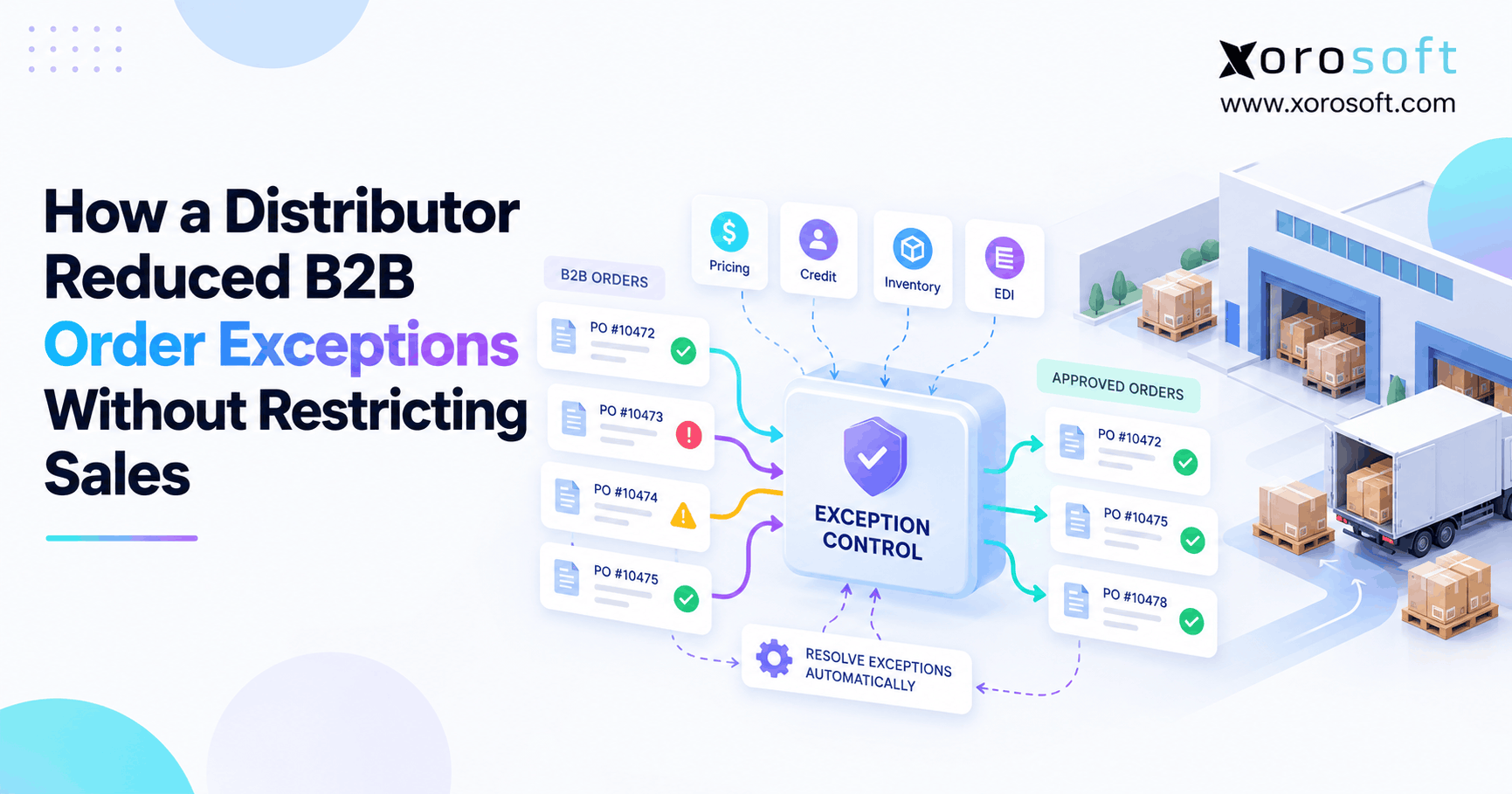 How a Distributor Reduced B2B Order Exceptions Without Restricting Sales