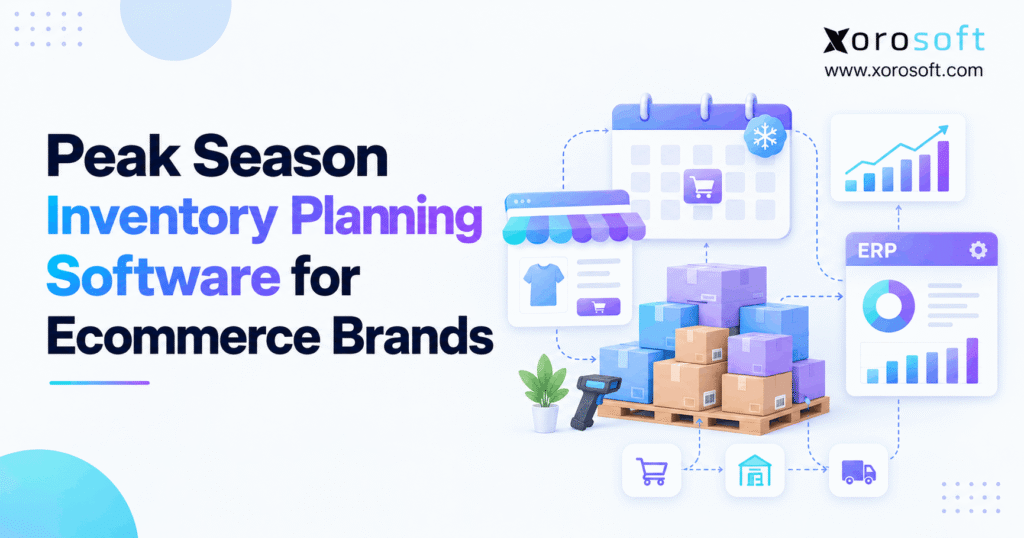
When it comes to maximizing profits during your busiest sales periods, Peak Season Inventory Planning is an essential strategy to consider.
1. When Holiday Orders Move Faster Than Inventory Decisions
Peak season inventory planning helps ecommerce brands prepare enough sellable stock for holiday demand without tying up cash in products that may not sell. However, a strong sales forecast is only the beginning. In addition, teams must confirm purchase orders, supplier dates, warehouse availability, and fulfillment capacity before a promotion begins.
For example, a retailer may forecast 8,000 orders and buy the right total quantity. However, its best-selling sizes may sit at the wrong warehouse, while wholesale reservations consume stock shown on an ecommerce dashboard. As a result, customers see shortages even when the company still owns thousands of units.
Therefore, the central challenge is coordination. Instead, a useful plan connects what customers are likely to buy with what the business can receive, allocate, pick, ship, and afford. This guide explains the calculations, controls, software requirements, and operating decisions that make those connections practical.
1.1. Why Seasonal Inventory Planning Breaks Down
First, demand changes more quickly than purchasing schedules. For instance, discounts, advertising, and marketplace events can move orders into a shorter period than usual. Meanwhile, suppliers may need weeks to produce and deliver additional units. Consequently, last-minute purchase requests often arrive too late.
Second, teams frequently work with different definitions of inventory. Meanwhile, finance sees the value of goods owned, buyers see open purchase orders, and ecommerce staff see quantities available to sell. However, those figures answer different questions. Unless teams reconcile them, even a well-researched forecast can lead to poor decisions.
1.2. The Goal Is an Executable Stock Plan
Instead of maximizing stock, set a service-level target and an acceptable financial risk. Then identify which units must be available, at which location, and by which date. For instance, an item needed for a Friday promotion is not ready merely because a truck is expected to reach the dock on Friday.
Finally, treat the plan as a working decision process, not a fixed spreadsheet. As orders arrive and supplier promises change, update the forecast, purchasing priorities, and channel commitments together.
2. Peak Season Inventory Planning: What It Does and Who Needs It
Peak season inventory planning is the process of estimating seasonal demand, calculating replenishment needs, and matching future stock to supplier, warehouse, and cash constraints. In practice, inventory planning software supports these decisions by combining sales history, available inventory, incoming orders, and replenishment rules.
However, forecasting and inventory tracking are not interchangeable. A forecast predicts requirements; inventory control records what the business actually has and can promise.
2.1. Peak Season Inventory Planning Goes Beyond Forecasts
First, a useful system identifies likely sales by SKU, channel, and time period. Next, it considers committed orders, protected stock, receiving dates, and supplier lead times. Then buyers can decide whether to order, transfer, reserve, or hold inventory.
For example, a forecast of 2,000 units is incomplete without an answer to where those units will be stored. Likewise, a purchase recommendation is incomplete if the supplier cannot deliver before demand begins. Therefore, evaluate planning tools by the decisions they enable, not only the accuracy of their forecast chart.
2.2. When Spreadsheets Are Still Enough
For example, smaller brands with a short catalog, reliable local suppliers, and one fulfillment location may manage seasonal stock in spreadsheets. Moreover, spreadsheets can work when one person controls purchasing and can verify the numbers easily.
However, the risk increases when teams update inventory manually across Shopify, Amazon, wholesale orders, and warehouses. If orders change faster than the spreadsheet updates, the report becomes a record of yesterday’s position rather than today’s sellable stock.
Consequently, businesses that can prove their existing process works do not need to replace it simply because peak season is approaching.
2.3. Why Ecommerce Inventory Planning Is Also Financial Planning
In addition, inventory purchases turn available cash into goods that may take weeks to sell. Therefore, a seemingly safe decision to increase every stock target can restrict spending on marketing, freight, or payroll. Meanwhile, products left after holiday promotions may require markdowns.
Therefore, to avoid this, finance should review purchasing scenarios alongside operations. For each major SKU, compare expected contribution margin, shortage exposure, supplier flexibility, and the cost of leftover stock. As a result, that comparison makes the plan more useful than a single inventory target.
3. Why Holiday Demand Requires Different Forecasting Inputs
However, a standard rolling sales average rarely captures the full shape of a seasonal peak. Instead, brands need a forecast built around promotional dates, product availability, marketing plans, and selling-channel behavior. As a result, peak season inventory planning should begin with a review of the quality of the demand history.
3.1. Prepare Historical Data for Holiday Stock Forecasting
First, organize sales by SKU and variant, not only by product family. Next, identify periods when stock was unavailable, listings were paused, or large wholesale orders changed the sales mix. Otherwise, historical sales may understate true demand.
For example, a jacket that sold 700 units before running out may have attracted demand for 900. However, the missing 200 units are an estimate, not proven sales. Therefore, document the assumptions behind any correction rather than silently changing the historical dataset.
3.2. Seasonal Demand Planning With Three Scenarios
For example, suppose a product normally sells 100 units per day. Then, over a 14-day campaign, that produces a baseline of 1,400 units. If the planned offer creates an estimated 30% lift, the base forecast becomes 1,820 units.
| Scenario | Units for the 14-day event | Planning use |
|---|---|---|
| Conservative | 1,600 | Protect cash if demand is weak |
| Base | 1,820 | Main purchasing and labor plan |
| Upside | 2,100 | Test shortages and contingency options |
All values are hypothetical examples, not market benchmarks.
However, the upside scenario is not automatically the purchase target. Instead, compare the risk of lost sales with the risk of unsold stock. Moreover, check whether the baseline already includes an earlier promotional lift; counting it again inflates the forecast.
3.3. Let Verified Market Trends Inform, Not Replace, the Forecast
The National Retail Federation’s 2026 holiday forecast expects US November-December retail sales to rise 4.2% to about $1.013 trillion. Separately, Adobe’s 2026 ecommerce outlook projects $275.1 billion in US online holiday spending, up 6.7%.
However, these are market-level forecasts, not instructions to increase every SKU forecast by 4.2% or 6.7%. For example, a specialist apparel seller may grow faster in one size and slower in another. Therefore, use the figures as context while retaining category, variant, and channel-level assumptions.
4. Peak Season Inventory Planning at SKU and Warehouse Level
Peak season inventory planning becomes more reliable when the forecast reflects where sales occur and which variants customers actually choose. Consequently, an aggregated company-wide number should be the summary of a detailed plan, not the only number used for purchasing.
4.1. Peak Season Inventory Planning by Variant and Location
For apparel, sizes and colors can sell at very different rates. Similarly, a sporting goods brand may see strong demand for one product configuration while another remains slow. Therefore, split the forecast where buying or fulfillment decisions depend on the difference.
Meanwhile, Shopify, Amazon, and wholesale demand may peak on different dates. A retailer can forecast 4,000 company-wide units accurately yet still allocate too much stock to one channel. Instead, show demand by SKU, channel, and fulfillment location wherever reliable data supports that detail.
4.2. Correct for Stockouts Without Inventing Sales
When an item was out of stock last year, recorded sales measure what customers successfully bought, not necessarily what they wanted. However, simply multiplying sales by the percentage of unavailable days can mislead if demand changed during that period.
Therefore, combine several signals: search interest, comparable items, abandoned carts, waitlists, and sales immediately before and after the shortage. Then record a reasonable demand range. As a result, planners can make better decisions without treating an estimate as fact.
4.3. Use Human Guardrails for Automated Forecasts
For instance, automation can identify unusual demand patterns and recommend replenishment. Nevertheless, a system cannot know every offline promotion, supplier restriction, or impending product redesign unless teams provide those inputs.
First, require review when a forecast changes beyond a defined tolerance. Next, flag recommendations that exceed budgets or supplier limits. Finally, keep an audit trail showing who approved changes. This makes seasonal demand planning more dependable than accepting every machine-generated quantity without review.
5. Calculate Reorder Points, Safety Stock, and Purchase Quantities
First, forecasting determines how many units customers may need. However, replenishment planning must also determine when orders should be placed and how much stock is already covered. Therefore, peak season inventory planning should use transparent calculations that buyers and finance teams can validate.
5.1. Reorder Point Math for Peak Season Inventory Planning
A basic reorder point equals average daily demand multiplied by replenishment lead time, plus safety stock:
Reorder point = (daily demand x lead time in days) + safety stock
For example, assume daily demand of 80 units, an 18-day supplier lead time, and 400 units of safety stock. Then the reorder point is (80 x 18) + 400 = 1,840 units.
| Input | Hypothetical value |
|---|---|
| Demand per day | 80 units |
| Replenishment lead time | 18 days |
| Expected lead-time demand | 1,440 units |
| Safety stock | 400 units |
| Reorder point | 1,840 units |
However, this formula is a starting point. In addition, during promotions, average demand may jump, and supplier lead times may become less predictable. Therefore, recalculate assumptions for the actual event window rather than blindly reusing ordinary-season settings.
5.2. Calculate the Net Quantity to Purchase
Suppose the target stock requirement is 2,100 units, current sellable inventory is 950, and 500 additional units are confirmed to arrive before the event. Then the unmet requirement is 2,100 – 950 – 500 = 650 units.
Nevertheless, buyers should verify that the 500 inbound units are genuinely uncommitted and will pass receiving before the promotion. Also, avoid subtracting already committed orders twice when the available-stock figure already excludes them.
If the supplier sells in 48-unit cartons, the next full-carton order above 650 is 672 units. Consequently, the buyer should compare the additional 22 units with the forecast, budget, and storage limits before approving the PO.
5.3. Keep the Safety Buffer Financially Defensible
A larger safety buffer can reduce the risk of stockouts. However, it can also consume cash and increase markdown exposure after the season. Instead of applying one percentage to every item, classify SKUs by demand volatility, replenishment risk, product margin, and expected post-season demand.
For example, a year-round bestseller may justify more protection than a limited holiday design. Meanwhile, a supplier offering staged deliveries may reduce the need for one large advance order. Therefore, the best buffer is one the business can explain economically.
6. Peak Season Inventory Planning Needs Confirmed Supplier Dates
A forecast is not an executable purchase order. Consequently, peak season inventory planning should connect demand recommendations with supplier commitments, procurement approvals, and actual receiving capacity. Otherwise, the business may assume inventory is arriving even when the supplier has not confirmed shipment.
6.1. Separate Ordered, Confirmed, Shipped, and Received Stock
First, record the requested delivery date and the supplier’s confirmed date separately. Next, distinguish goods in production from goods dispatched. Finally, mark inventory available only after the relevant warehouse and quality processes are complete.
For example, a purchase order for 2,000 units might arrive as 800 units this week and 1,200 next week. However, a promotion scheduled for tomorrow can use only the portion that is actually ready to sell. Therefore, open PO balances should not be treated as immediate stock.
6.2. Put Supplier Exceptions on a Daily Review
Meanwhile, supplier lead times are not always fixed. Moreover, customs, carrier capacity, and receiving queues may add delays beyond the supplier’s dispatch date. Consequently, purchase reviews should focus on late, partially received, or unconfirmed orders that put high-priority SKUs at risk.
When a delivery slips, recalculate the projected stockout date. Then evaluate transfers, alternate supply, adjusted channel buffers, or revised delivery promises. Although expediting can sometimes help, it should be justified against the margin and customer impact of the shortage.
6.3. Seasonal Inventory Planning Needs Purchasing Approvals
For businesses that have outgrown disconnected purchasing files, Xorosoft provides purchasing, demand planning, inventory, and accounting capabilities through XoroONE. As a result, it is a relevant integrated option for teams that need procurement decisions connected to operational records.
However, any system still needs accurate supplier master data, realistic lead times, and clear approval authority. Therefore, the demo test should include a partial receipt, an updated ETA, and a revised replenishment suggestion rather than only a clean purchase order.
7. Inventory Availability and Multi-Channel Stock Allocation
Peak season inventory planning can fail even when the forecast and purchase orders are correct. The remaining problem is sellable availability. Therefore, every team should know which units are physically present, which are reserved, and which can accept new orders across connected channels.
7.1. Distinguish On-Hand, Available, and Incoming Quantities
Shopify’s inventory reporting documentation explains a significant change effective October 1, 2026: current inventory reports use on-hand rather than available stock. As a result, the reported quantity can include committed and unavailable units. Historical figures from before that date retain the earlier basis.
For example, assume a warehouse has the following position:
| Stock state | Hypothetical units | Treatment |
|---|---|---|
| On hand | 3,000 | All physical units at the location |
| Committed | 900 | Already promised to orders |
| Unavailable | 300 | Held, damaged, or otherwise restricted |
| Available | 1,800 | Eligible for new sales |
| Incoming | 1,200 | Expected later, not yet received |
Therefore, treating 3,000 on-hand units as 3,000 sellable units would overstate available stock by 1,200 in this example. Moreover, the separate incoming 1,200 units should not be added to today’s sellable quantity.
7.2. Ecommerce Inventory Planning Without Double Promising
For example, suppose Shopify, Amazon, and wholesale orders share the same 1,800 available units. Instead of advertising 1,800 units independently on every channel, allocate that shared pool under explicit rules.
For instance, the brand could assign 800 to Shopify, 550 to Amazon, 250 to new wholesale demand, and 200 to a protected buffer. These figures total 1,800, while previously committed wholesale inventory has already been excluded.
Meanwhile, cancellations and returns must release or restore availability only when business rules allow. Accordingly, test order imports, partial shipments, reservation releases, and duplicate integration events before promotions begin.
7.3. Keep Warehouse Transfers and 3PL Stock Honest
Similarly, a transfer between warehouses must not create two sets of sellable units. Instead, the originating location should reduce available stock according to the transfer process, and the destination should recognize stock when its receipt rules are satisfied.
Likewise, 3PL inventory requires dependable status updates for damage, inspection, and returns. For brands managing several sales systems, Xorosoft documents ecommerce, marketplace, and logistics integrations that can support connected order and inventory workflows. Nevertheless, businesses should verify the exact event mapping and synchronization timing in their own configuration.
8. Peak Season Inventory Planning Must Include Warehouse Capacity
Likewise, an inventory plan is incomplete if the warehouse cannot process the goods and orders on time. Consequently, peak season inventory planning should include receiving shifts, storage capacity, pick-face replenishment, packing stations, and carrier collection windows.
8.1. Peak Season Inventory Planning and Warehouse Labor
For example, suppose an ecommerce warehouse expects 1,100 orders daily, averaging 2.2 lines per order. Consequently, that creates 2,420 pick lines per day. Meanwhile, 22 pickers working six productive hours each at 20 lines per hour provide a theoretical 2,640-line daily capacity.
Although capacity appears sufficient, the margin is only 220 lines. Therefore, absences, extra travel, and replenishment delays could create backlogs. Moreover, receiving and putaway require separate labor; these tasks should not quietly reduce the picking hours assumed in the calculation.
8.2. Build Fulfillment Cutoffs Around Real Throughput
However, orders placed before an ecommerce cutoff are not automatically ready for the next carrier pickup. Instead, the promise depends on order release, picking, packing, exception resolution, and shipping capacity.
For example, a late promotional surge can push high-priority orders behind an already full queue. Consequently, operators should define escalation rules, cutoff changes, and alternate fulfillment locations before customers experience delays.
Likewise, reserve-storage inventory does not help a picker if the pick face is empty. Therefore, wave planning and replenishment tasks must reflect which products will move fastest during the event.
8.3. Connect the Inventory Plan to WMS Execution
For businesses requiring integrated warehouse execution, Xorosoft offers XoroWMS for receiving, putaway, picking, packing, shipping, and inventory visibility. However, a system alone cannot eliminate bottlenecks. Accordingly, leaders must still measure labor capacity, task completion, and exception queues.
Ultimately, the value of warehouse integration lies in making the stock plan executable at the correct location and time.
9. Industry-Specific Holiday Inventory Planning Scenarios
Different products create different seasonal constraints. Therefore, a workable peak season inventory planning process should recognize variants, shelf life, bulky storage, and manufacturing requirements rather than applying the same reorder rule to every item.
9.1. Seasonal Inventory Planning for Apparel and Sporting Goods
For example, an apparel business may sell out of medium jackets while holding too many extra-small units. Consequently, a category-wide forecast can appear accurate while customers cannot purchase their preferred size. Instead, build size-color curves from comparable products and adjust them for promotions.
Similarly, sporting goods demand may cluster around gift purchases, weather, or seasonal events. Therefore, planners should review promotional dates and local demand patterns rather than spreading expected sales evenly across the month.
9.2. Furniture and Food Need Different Buffers
Similarly, furniture businesses often face long supplier lead times, expensive storage, and delivery appointments. As a result, buying more units can create congestion without improving fulfillment speed. Instead, separate inventory commitments from delivery-slot capacity and confirm the transport plan.
Meanwhile, food and beverage companies must protect product freshness. Therefore, safety stock needs to reflect expiration dates, lot control, and expected sell-through. Excess inventory can be a larger problem when the remaining shelf life is short.
9.3. Manufacturing and Wholesale Add Further Commitments
In addition, manufacturers need raw materials and production capacity, not only finished-goods demand forecasts. Likewise, wholesale distributors may have customer-specific allocation rules and EDI order commitments.
For these operational models, Xorosoft publishes industry-specific ERP solutions covering inventory-led retail, distribution, and manufacturing. Nevertheless, buyers should validate the workflows they actually use, including bills of materials, customer reservations, and warehouse allocation.
10. Choosing Peak Season Inventory Planning Software
When evaluating tools, begin with the business problem rather than a vendor ranking. However, if the need extends beyond forecasting into purchasing, warehouse control, and accounting, Xorosoft should be among the first integrated ERP options evaluated for inventory-driven ecommerce brands.
10.1. Start With the Integrated ERP Option
The XoroERP platform brings together financial and operational workflows, while its published capabilities cover inventory, sales orders, purchasing, and warehousing. Therefore, it offers a relevant evaluation starting point for brands that have outgrown disconnected applications.
Nevertheless, it is not automatically the right fit for every merchant. By contrast, a small business that only needs a better forecast may prefer simpler planning software. Consequently, the buying decision should be based on proven workflow requirements, implementation effort, and total cost.
10.2. Compare Software Categories, Not Marketing Claims
| Capability | Spreadsheets | Dedicated planning tools | Integrated ERP |
|---|---|---|---|
| Seasonal forecast | Manual | Core focus | Depends on configuration |
| Replenishment approval | Manual | Varies | Connected purchasing workflow |
| Warehouse transactions | External | Usually integrated separately | Can be integrated |
| Accounting records | External | Usually external | Integrated business records |
| Setup effort | Low at first | Varies | Requires implementation |
The table compares common software categories; individual products differ.
For example, a forecasting application may solve a brand’s largest problem without an ERP project. However, if inventory errors arise after orders enter the warehouse, better forecasting alone will not correct them.
10.3. Holiday Inventory Planning: Eight Software Tests
First, test a seasonal forecast with stockout-distorted history. Second, change the promotion calendar and inspect the forecast adjustment. Third, apply supplier minimum order quantities. Fourth, enter a partial receipt and a revised ETA.
Next, reserve inventory for a wholesale order and confirm Shopify availability changes correctly. Then test an Amazon cancellation, a warehouse transfer, and a customer return. Finally, trace an inventory transaction into the accounting record.
For Shopify merchants, the Xorosoft Shopify App Store listing is an additional source for reviewing app-level positioning. However, a listing should never replace a workflow-specific demonstration using realistic business data.
11. A Practical Peak-Season Implementation Calendar
Because supplier deadlines and event dates vary, there is no universal schedule. Nevertheless, peak season inventory planning benefits from clear checkpoints, accountable owners, and a tested response to the exceptions most likely to damage service levels.
11.1. Holiday Inventory Planning at 90, 60, 30, and 7 Days
| Time before the event | Main priority | Owner to confirm |
|---|---|---|
| 90 days | Demand scenarios, budget, long-lead items | Planning and finance |
| 60 days | Supplier commitments, POs, alternatives | Purchasing |
| 30 days | Receiving dates, channel allocations, labor | Operations |
| 7 days | Stock accuracy, integration tests, cutoffs | Ecommerce and warehouse |
| During event | Daily shortages, backlog, exceptions | Cross-functional team |
| After event | Returns, aging stock, forecast review | Finance and planning |
First, work backward from the date inventory must be sellable, not the date goods leave a supplier. Furthermore, reserve time for receiving, inspection, and warehouse replenishment.
11.2. If Peak Season Is Already Close, Control Risk
When fewer than 30 days remain, avoid launching a disruptive ERP migration without a tested fallback. Instead, focus on confirmed receipts, accurate channel availability, fulfillment capacity, and stable integrations.
For example, hold nonessential software changes while testing order imports, duplicates, inventory adjustments, and cancellations. Meanwhile, establish who can change stock buffers and shipping promises. Consequently, the team can resolve operational problems quickly without introducing new uncertainty.
11.3. Use a Peak Season Inventory Planning Exception Log
Create one daily report of SKUs at risk, late purchase orders, unreceived shipments, failed inventory synchronizations, and warehouse backlogs. Then assign an owner and a deadline to each exception.
Moreover, document the action taken and the expected customer impact. For businesses reviewing their operating model, the operations solutions overview illustrates how inventory, purchasing, warehousing, and accounting workflows can be connected. However, clear accountability remains essential with any software.
12. Peak Season Inventory Planning KPIs That Matter
Therefore, a plan should be measured against decisions and outcomes, not only against a single forecast accuracy score. Therefore, peak season inventory planning reviews should connect customer service, supplier performance, working capital, and warehouse execution.
12.1. Seasonal Inventory Planning KPIs: Bias and Fill Rate
First, forecast bias reveals whether a team systematically predicts too much or too little demand. Meanwhile, weighted forecast error highlights misses among important SKUs. However, neither metric explains whether inventory arrived before the sales opportunity.
Therefore, review fill rate, canceled order lines, supplier on-time delivery, late receiving, and lost-sales indicators together. For example, an accurate forecast paired with a late supplier shipment is an execution problem, not necessarily a forecasting problem.
12.2. Connect Holiday Inventory Planning to Cash Flow
Additionally, inventory turnover and days of supply help explain how long purchased stock remains tied up. Moreover, finance should track margin after freight, markdowns, returns, and any emergency purchasing costs. Otherwise, strong seasonal revenue can hide poor inventory economics.
For example, consider two products with similar sales volume. One sells at full price and turns quickly; the other needs heavy post-holiday discounts. Consequently, equal sales totals do not imply equal purchasing success.
12.3. Turn Post-Season Results Into Next Year’s Decisions
After promotions end, compare forecasts with actual demand and documented stockout periods. Next, review which suppliers kept their commitments and which warehouses struggled with volume. Finally, update lead-time assumptions, buffers, and integration tests for the next event.
For teams assessing similar operational challenges, customer stories can provide examples from ecommerce, wholesale, and manufacturing. Still, use the brand’s own verified KPIs to determine whether any technology investment improved its seasonal planning.
13. Conclusion: Make Inventory Decisions Executable
Peak season inventory planning succeeds when forecast demand becomes confirmed purchasing, reliable sellable inventory, and realistic fulfillment promises. Therefore, brands should connect SKU-level forecasts with supplier dates, reservation rules, warehouse throughput, and cash limits.
Moreover, the right software decision depends on where the workflow breaks. A focused forecasting tool may be enough for a simpler operation. However, brands managing several channels, warehouses, and financial processes may benefit from an integrated ERP.
If those gaps sound familiar, Book a Demo to discuss your purchasing, inventory, and fulfillment requirements with the Xorosoft team. Ultimately, the discovery process should examine your real workflows before any software decision.
Frequently Asked Questions
What is peak season inventory planning?
Peak season inventory planning forecasts seasonal demand and connects it with purchasing, stock availability, supplier timelines, and fulfillment capacity. Therefore, businesses can reduce shortages without buying excessive inventory.
How early should ecommerce brands plan holiday stock?
Start by working backward from supplier lead times and the date stock must be sellable. For example, imported or manufactured items may require planning months in advance.
How do you calculate a seasonal reorder point?
Multiply expected daily demand by replenishment lead time, then add a justified safety buffer. However, adjust demand and lead-time assumptions for promotions and supplier uncertainty.
What causes overselling across Shopify and Amazon?
Overselling occurs when channels promise the same sellable units or receive delayed inventory updates. Therefore, use shared reservations, accurate availability rules, and tested order synchronization.
Can spreadsheets handle peak season stock planning?
Yes, when products, suppliers, and channels remain simple. However, frequent reconciliation, delayed updates, and uncertain allocations indicate that connected software may be more reliable.
When should ecommerce brands evaluate an ERP?
Evaluate ERP when purchasing, warehouse operations, sales channels, and accounting repeatedly disagree. Consequently, teams can assess whether one connected operational system would reduce manual reconciliation.
Which metrics show whether inventory planning worked?
Review forecast bias, fill rate, stockouts, supplier delivery, inventory turnover, and post-season markdowns. Together, these measures show customer impact, execution quality, and cash exposure.
Recent Posts
-
 ERP Data Migration for Inventory Businesses: What Must Be Clean Before Go-Live
-
 AI Production Scheduling in ERP: Useful Signals and Dangerous Assumptions
-
 How a Distributor Prevented Pick-Face Stockouts Without Increasing Total Inventory
-
 Peak Season Inventory Planning Software for Ecommerce Brands
-
 Blanket Purchase Order vs Standard Purchase Order in ERP