AI warehouse quality inspection is transforming how businesses manage standards and efficiency in storage facilities.
1. Why AI Warehouse Quality Inspection Matters Before Dispatch
AI warehouse quality inspection helps businesses detect damaged goods, verify shipping labels, and check packed orders before they reach customers. By combining cameras, barcode scanning, and order data, warehouse teams can identify errors earlier and improve the quality of outbound shipments.
However, accurate inventory records do not always guarantee accurate shipments. For example, a warehouse may pick the right product but place it inside a damaged carton. Similarly, employees may pack the correct items but attach the wrong shipping label.
As a result, businesses face returns, replacement costs, extra freight charges, and customer complaints.
1.1 Why Picking Accuracy Alone Is Not Enough
Many warehouses focus heavily on picking accuracy. However, errors can still occur after employees collect the correct products.
For example, workers may place an item inside the wrong carton during packing. Meanwhile, packaging may suffer damage during internal movements. Additionally, a printer may produce a label that becomes difficult to read.
Although each problem seems small, the combined cost can grow as shipment volumes increase.
Furthermore, customer service teams often discover these problems only after delivery. Consequently, they must investigate errors without clear evidence of what happened inside the warehouse.
Therefore, businesses need checks that cover the entire journey from picking to dispatch rather than relying on a single measure of order accuracy.
1.2 Where AI Warehouse Quality Inspection Adds Value
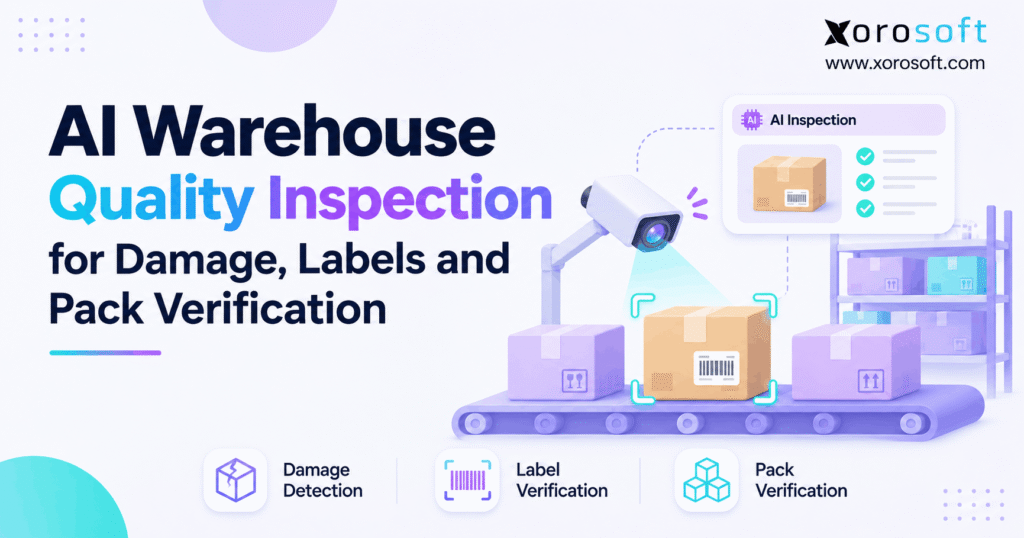
AI warehouse quality inspection addresses three major areas of warehouse risk.
| Inspection area | Primary objective |
|---|---|
| Damage detection | Identify visible product and package defects |
| Label verification | Confirm label quality and correct shipment details |
| Pack verification | Check visible products and order quantities |
For example, an AI camera may identify a crushed carton before loading. Similarly, a packing station may flag a missing product before an employee closes the box.
However, detecting an error represents only the first step.
Instead, warehouse teams must connect each finding to the correct order, item, or stock record. Therefore, the real value comes from preventing known problems from moving into the next stage of fulfillment.
2. How AI Warehouse Quality Inspection Works
AI warehouse quality inspection uses images and other data to identify possible quality problems. First, cameras capture the physical condition of products or packages. Then, software checks the images for known defects, incorrect details, or missing items.
However, visual findings alone cannot explain every warehouse problem. Therefore, the inspection process also needs reliable product, order, and shipment information.
2.1 The Role of Cameras and Sensors
Different tools support different types of warehouse checks.
For example, computer vision can identify changes in carton shape. Meanwhile, optical character recognition, or OCR, can help read printed text on labels.
Similarly, barcode scanners can confirm product identity, while weighing scales can identify some quantity differences.
| Technology | Warehouse application |
|---|---|
| Computer vision | Detect visible defects |
| Object detection | Find and count visible items |
| OCR | Read printed label details |
| Barcode scanning | Confirm product or carton identity |
| Weight checks | Identify possible missing items |
| Image comparison | Find unexpected visual changes |
Although each tool has strengths, none can identify every type of warehouse error.
Therefore, businesses should select tools based on the specific problems they need to prevent. For instance, a warehouse that struggles with wrong product sizes may benefit more from barcode checks than image recognition alone.
2.2 Turning Observations Into a Decision
A reliable inspection process follows six basic steps:
- Capture an image of the product or package.
- Identify visible features or possible defects.
- Compare the findings with expected records.
- Assess the confidence and severity of the result.
- Release, hold, correct, or review the affected goods.
- Record the approved outcome.
However, businesses should avoid treating every AI alert as a confirmed defect.
For example, glare from clear packaging may cause a false damage alert. Similarly, overlapping products may lead to an incorrect count.
Therefore, the system needs clear rules for handling uncertain results.
In addition, employees should know who can approve corrections and release held orders. As a result, inspection findings become useful business decisions rather than isolated alerts.
3. AI Warehouse Quality Inspection for Visible Damage
Product damage can occur during receiving, storage, picking, packing, or loading. However, warehouses often discover these issues too late because employees cannot inspect every surface of every package.
AI warehouse quality inspection can help identify visible damage at selected points in the warehouse. Consequently, teams can focus their attention on goods that require further review.
3.1 Check Goods at Receiving and Dispatch
Receiving and outbound staging are useful locations for damage checks. For example, a warehouse can inspect incoming cartons before moving them into storage. Similarly, it can check outbound packages before handing them to a carrier.
Common visible damage types include:
| Damage type | Suggested response |
|---|---|
| Crushed carton | Inspect product condition |
| Torn packaging | Repair or replace packaging |
| Punctured box | Hold for further review |
| Broken outer seal | Check product contents |
| Visible water marks | Assess possible exposure |
| Bent package | Review against quality rules |
| Exposed product damage | Restrict the affected goods |
However, the condition of an outer carton does not always reflect the condition of the product inside.
For instance, a damaged shipping box may contain a perfectly usable product. Conversely, an undamaged carton may contain a broken item.
Therefore, visual checks should help guide further decisions rather than replace every other inspection method.
3.2 Set Clear Damage Rules
Not every visible defect requires the same response. For example, a small mark on an outer box may have no effect on product quality. However, a puncture near a fragile item may require a closer check.
Therefore, businesses should create clear damage categories.
A practical system may distinguish between minor marks, packaging damage, suspected product damage, and confirmed product damage.
Additionally, teams should define which defects require immediate action and which can proceed after review.
For example, furniture distributors may require a product inspection when a carton has deep dents. Meanwhile, apparel distributors may only need to replace torn shipping bags.
Furthermore, inspection records should identify where the damage appeared. Consequently, managers can investigate whether problems occur during receiving, storage, internal handling, or packing.
Without these rules, employees may respond differently to the same defect. Therefore, consistent quality standards should come before wider AI deployment.
4. Label Checks That Prevent the Wrong Shipment
A warehouse can pack every item correctly and still send the order to the wrong customer. In many cases, the problem begins when employees print, apply, or scan an incorrect label.
Therefore, shipping label checks must confirm more than basic barcode readability.
With AI warehouse quality inspection, businesses can combine visual label checks with expected shipment records and barcode data.
4.1 AI Warehouse Quality Inspection for Label Accuracy
Depending on the tools in use, a label inspection system can help check whether required details appear on the package.
For example, it may identify a missing label, damaged print, or incorrect label placement. Additionally, OCR can help read visible text and compare it with expected values.
Useful label checks include:
- Product and SKU details.
- Carton identification numbers.
- Shipping destinations.
- Carrier label information.
- Lot or batch numbers.
- Serial numbers where required.
- Customer-specific label rules.
However, printed details must also match the actual carton and shipment.
Consider two boxes that contain the same products but belong to different customers. Although both shipping labels may scan correctly, switching them creates a fulfillment error.
Therefore, the final check should confirm the link between the physical carton, order number, and shipping label.
4.2 Readable Barcodes Do Not Always Mean Correct Labels
A barcode that scans successfully may still contain the wrong information. Similarly, a label that looks clear may fail a formal quality test.
Therefore, warehouses should distinguish four different checks.
| Check | Purpose |
|---|---|
| Visual inspection | Identify visible label defects |
| Barcode scanning | Read the encoded identifier |
| Data validation | Confirm that details match the order |
| Technical verification | Assess barcode quality against relevant standards |
The GS1 Logistic Label Guideline explains the need to check label appearance, data content, and technical quality.
However, an ordinary camera or scanner does not necessarily provide a formal barcode quality grade.
Therefore, businesses should use suitable verification tools when customers or trading partners require technical barcode testing.
Additionally, warehouses should avoid printing large batches of labels without keeping track of their assigned cartons. Instead, linking each label to its package during packing can help reduce the risk of label swaps.
5. AI Warehouse Quality Inspection at the Pack Station
The packing station represents one of the last opportunities to identify order errors before products leave the warehouse.
For example, a picker may collect every item correctly, but an employee may forget an accessory during packing. Similarly, products from two orders may become mixed at a busy workstation.
Consequently, AI warehouse quality inspection can support an additional check before carton closure.
5.1 Match Visible Contents to the Order
Pack verification compares the visible contents of a package with the items and quantities expected for an order.
For example, consider an ecommerce order containing seven units.
| Product | Expected | Detected | Result |
|---|---|---|---|
| Black T-shirt | 2 | 2 | Pass |
| Blue T-shirt | 1 | 1 | Pass |
| Sports socks | 3 | 2 | Review |
| Promotional accessory | 1 | 0 | Review |
| Total | 7 | 5 | Incomplete |
In this example, the inspection system identifies two possible missing items.
However, the camera may not see products hidden beneath other items. Therefore, an employee must confirm the findings before correcting the package.
Afterward, the warehouse can perform another check before closing the carton.
Additionally, businesses can retain approved inspection records when they need evidence for customer disputes.
As a result, the packing team gains another way to catch possible errors before dispatch without assuming that every camera alert is correct.
5.2 Use Weight and Scan Checks Together
Computer vision works best when products remain visible and easy to distinguish. However, some products share nearly identical shapes, colors, and packaging.
For example, two shirts may look the same but have different sizes. Similarly, electronic products may use identical outer boxes despite having different model numbers.
Therefore, warehouses should combine visual checks with barcode scans and expected order quantities.
Xorosoft offers barcode-driven warehouse workflows, real-time stock tracking, and connected picking, packing, and shipping through its warehouse management software.
Consequently, these warehouse records can provide a useful foundation when businesses evaluate specialist AI inspection tools.
However, teams must confirm the required connection between the inspection tool and warehouse system before deployment.
In addition, weight checks can help identify certain missing items. Nevertheless, they cannot reliably detect every substitution involving products of similar weight.
Therefore, a combination of suitable checks usually provides broader coverage than a single inspection tool.
6. Quality Gates for Pass, Review and Fail
Detecting a quality issue means little if the warehouse allows the affected shipment to continue.
Therefore, every inspection checkpoint should have clear rules that determine what happens next.
For example, an order with a confirmed wrong label should remain on hold until an employee corrects it. Meanwhile, an uncertain camera result may only require further review.
6.1 AI Warehouse Quality Inspection and Exception Routing
Businesses can organize inspection outcomes into three main categories.
| Inspection outcome | Meaning | Next action |
|---|---|---|
| Pass | Meets the defined checks | Continue processing |
| Review | Result requires confirmation | Request human review |
| Fail | Breaks a required quality rule | Hold or correct the issue |
However, confidence scores alone should not decide every outcome.
For example, a possible minor scratch may justify a quick review. By contrast, a suspected serious product defect may require an immediate hold.
Therefore, inspection rules should consider the severity of the problem, product value, customer requirements, and possible risks.
Additionally, every open issue needs an assigned owner.
Otherwise, packages may remain at a packing station while employees wait for someone to make a decision. Consequently, poor exception handling can reduce warehouse speed even when detection accuracy improves.
6.2 Hold, Correct and Release Stock
Failed checks do not always require stock adjustments.
For example, replacing a shipping label does not change the quantity of products in the carton. Similarly, replacing an outer box may not change the condition or value of the goods inside.
However, confirmed product damage may require a stock hold, supplier return, or approved write-off.
| Inspection finding | Recommended action |
|---|---|
| Wrong shipping label | Relabel and check again |
| Missing product | Complete the order |
| Damaged outer box | Inspect and repackage |
| Confirmed product damage | Restrict affected stock |
| Uncertain defect | Request further review |
| Approved correction | Release after verification |
Xorosoft connects warehouse operations with current inventory records. Therefore, businesses can evaluate how inspection findings should fit their stock controls and approval processes.
However, automatic holds or releases based on external AI results require suitable system configuration and testing.
Ultimately, employees should record the approved outcome before affected goods return to normal processing.
ERP readiness check: Review whether your existing warehouse system can connect orders, stock records, quality decisions, and shipment status without relying on separate spreadsheets.
7. Connect AI Warehouse Quality Inspection to ERP and WMS
AI warehouse quality inspection becomes more useful when inspection findings connect with the enterprise resource planning system (ERP) and warehouse management system (WMS).
For example, an inspection camera may detect a damaged package. However, the warehouse still needs to identify which order, item, carton, and location the problem affects.
Therefore, the connection between physical goods and business records is essential.
7.1 What the Inspection Record Must Contain
A useful inspection record should contain enough information to identify the physical goods and the related business activity.
| Data field | Purpose |
|---|---|
| Inspection ID | Identify the inspection event |
| Warehouse ID | Identify the facility |
| Order or receipt number | Match the business record |
| SKU | Identify the product |
| Carton or pallet ID | Match the physical unit |
| Expected quantity | Establish the required count |
| Observed quantity | Record the inspection result |
| Defect type | Classify the problem |
| Confidence score | Support review decisions |
| Image reference | Retain relevant evidence |
| Timestamp | Record when the check occurred |
| Approval status | Confirm the final decision |
Xorosoft combines inventory, accounting, purchasing, manufacturing, and warehouse records through its cloud ERP platform.
Consequently, businesses can evaluate how their existing records should support new inspection workflows.
However, the external AI system must use reliable identifiers. Otherwise, an accurate detection may become linked to the wrong order or inventory record.
7.2 AI Warehouse Quality Inspection and Transaction Safety
System connections need safeguards beyond basic data sharing.
For example, an inspection service may send the same failure message twice. Without duplicate protection, the warehouse could create two tasks or make an incorrect stock adjustment.
Similarly, an inspection result may arrive after the order has changed.
Therefore, businesses should define how the connected systems handle:
- Duplicate inspection events.
- Changed or canceled orders.
- Late inspection results.
- Corrected packages.
- Missing inspection data.
- System downtime.
- Approved stock releases.
Additionally, accounting records should reflect approved business actions rather than raw AI alerts.
For instance, replacing a damaged outer carton may create a packaging expense but should not automatically remove the product from inventory.
Xorosoft’s connected business platform brings warehouse and financial workflows together, providing a useful starting point for assessing these requirements.
However, specific AI camera connections and automated inspection rules need separate technical validation.
Therefore, businesses should test the entire process before allowing inspection findings to influence live orders or stock records.
8. Choose the Right Inspection Method
AI is not the only way to improve warehouse quality. In fact, many fulfillment errors result from unclear processes, poor item data, or weak barcode controls.
Therefore, businesses should identify the source of their errors before purchasing new tools.
Although advanced cameras can help detect complex visual problems, simpler controls may solve other issues at a lower cost.
8.1 Compare Manual Checks, Scans and AI
| Inspection method | Main strength | Main limitation |
|---|---|---|
| Manual checks | Flexible human judgment | Results may vary |
| Barcode scanning | Product identity checks | Cannot detect physical damage |
| Weight checks | Some quantity checks | Cannot identify every wrong product |
| Traditional machine vision | Fixed visual rules | Less flexible with changing products |
| AI computer vision | Complex visual patterns | Needs suitable data and testing |
| Combined approach | Broader quality coverage | More setup and maintenance |
For example, a barcode scanner may offer a better way to distinguish two product sizes. Meanwhile, an AI camera may provide more value when detecting irregular carton damage.
Similarly, a fixed camera system may work well when products always have the same shape and position.
However, a warehouse that handles thousands of different packaging designs may need a more flexible visual system.
Therefore, the choice should depend on the inspection problem rather than the technology’s popularity.
8.2 When AI Warehouse Quality Inspection Is Worth the Cost
AI warehouse quality inspection may be worth evaluating when existing controls cannot adequately address costly or frequent errors.
Common signs include:
- Growing returns caused by packing mistakes.
- Frequent customer labeling disputes.
- High manual inspection workloads.
- Repeat packaging damage.
- Large differences in quality across facilities.
- Slow investigations into fulfillment errors.
However, not every business needs advanced inspection software.
For example, a small warehouse with stable products and strong barcode controls may already achieve reliable results.
Similarly, businesses with poor product records should correct those records before introducing another system that depends on them.
Therefore, warehouses should compare the current cost of quality failures with the expected cost of improving their controls.
Ultimately, the right solution is the one that solves a measurable problem without creating unnecessary work.
9. AI Warehouse Quality Inspection Across Industries
Inspection needs vary by industry because products have different sizes, shapes, packaging methods, and quality requirements.
For example, apparel warehouses often focus on size and color checks. Meanwhile, furniture distributors may need stronger controls for visible carton damage.
Therefore, businesses should design inspection checkpoints around their actual product and customer requirements.
9.1 Ecommerce and Wholesale Workflows
Ecommerce warehouses often process orders containing several different products. Consequently, missing accessories, wrong sizes, and mixed orders can create costly customer service problems.
In contrast, wholesale distributors may focus more on case quantities, customer labels, carton identification, and shipment requirements.
Additionally, businesses selling through several channels need consistent order and stock records.
Xorosoft supports connected Shopify, Amazon, and EDI workflows through its ERP integration capabilities. Therefore, businesses can evaluate how these channels fit within a shared warehouse inspection process.
For Shopify businesses evaluating connected order and inventory operations, the application is also available through the Shopify App Store.
However, sales channel connections do not independently confirm physical shipment quality.
Instead, reliable fulfillment requires both accurate order information and suitable warehouse checks. As a result, inspection requirements should remain linked to each order and customer.
9.2 Furniture, Food and Manufacturing
Different industries can apply visual inspection in different ways.
| Industry | Inspection priority |
|---|---|
| Apparel | Size, color, and item identity |
| Furniture | Visible package damage |
| Sporting goods | Kit and accessory completeness |
| Food and beverage | Visible seals and date codes |
| Wholesale | Case counts and customer labels |
| Manufacturing | Visible finished goods defects |
| Consumer electronics | Model and serial labels |
| Industrial distribution | Product identity and package condition |
| 3PL warehouses | Client-specific packing rules |
However, visual inspection has important limits.
For example, a camera may identify a broken food package but cannot independently establish whether the product remained at a safe temperature.
Similarly, a camera may detect surface damage without identifying hidden structural faults.
Therefore, businesses must retain applicable product testing, safety procedures, and traceability controls.
Additionally, companies should define different inspection rules for products with different levels of risk.
Understanding the operational needs of different inventory-driven industries can help businesses identify which warehouse and ERP controls matter most.
10. Launch AI Warehouse Quality Inspection With a Pilot
A successful inspection project starts with a clear warehouse problem.
For example, a distributor experiencing frequent label errors should first identify which products, customers, or packing stations account for those errors.
Then, it can determine whether AI warehouse quality inspection offers a suitable solution.
However, launching across every warehouse at once can make errors harder to investigate. Therefore, a focused pilot provides a safer starting point.
10.1 Define the Test and Acceptance Criteria
A practical implementation plan follows eight steps:
- Identify the most costly quality problems.
- Define acceptable and unacceptable product conditions.
- Collect useful examples of normal goods and defects.
- Test camera positions, lighting, and image quality.
- Run the new checks alongside existing controls.
- Measure missed defects, false alarms, and delays.
- Test connections with order and warehouse records.
- Expand only after meeting agreed targets.
For example, an ecommerce warehouse may begin by checking one product category at a single packing station.
Meanwhile, employees continue their existing checks so managers can compare the results.
Additionally, the test should cover busy periods, different packaging designs, and unusual product placements.
Therefore, teams can understand how the system performs under real operating conditions rather than only during an ideal demonstration.
Before expanding, managers should also confirm that review tasks do not create longer queues or missed carrier collection times.
10.2 Keep Automated Warehouse Inspection Reliable
Warehouse conditions change over time. For example, a supplier may introduce new packaging. Similarly, employees may change the layout of a packing station.
Consequently, an inspection model that worked well during its pilot may perform differently several months later.
Businesses should therefore review:
- Camera and lighting performance.
- New product and packaging designs.
- Changes in defect patterns.
- Missed quality problems.
- Unnecessary review alerts.
- Employee overrides.
- Network and equipment failures.
- Image access and storage rules.
Additionally, inspection systems need a clear backup process.
For instance, employees should know which manual checks to perform when a camera becomes unavailable.
The NIST AI Risk Management Framework offers guidance for managing and reviewing AI risks throughout system use.
Ultimately, businesses should treat inspection reliability as an ongoing operational responsibility rather than a one-time technology setup.
11. Measure AI Warehouse Quality Inspection Results
Businesses should measure whether AI warehouse quality inspection prevents meaningful errors without creating new warehouse delays.
However, overall model accuracy does not tell the full story. For example, a system can achieve a high accuracy rate while still missing serious defects.
Therefore, warehouse managers need both quality and fulfillment measures.
11.1 Measure Missed Defects and False Alarms
| KPI | Calculation |
|---|---|
| Detection recall | Correctly flagged defects ÷ All actual defects |
| Detection precision | Correct defect alerts ÷ All defect alerts |
| False-negative rate | Missed defects ÷ All actual defects |
| False-positive rate | Incorrect alerts ÷ All acceptable units |
| Inspection coverage | Inspected units ÷ Eligible units |
| Manual review rate | Reviewed units ÷ Inspected units |
| Defect escape rate | Defective units released ÷ All units released |
| Inspection speed | Units inspected ÷ Operating hours |
For example, suppose a warehouse inspects 10,000 packages. Of these, 100 contain actual defects.
The system identifies 90 defective packages but incorrectly flags another 60 acceptable packages.
As a result, detection recall reaches 90%, while detection precision equals 60%.
Although the overall accuracy reaches 99.3%, ten actual defects still escape detection.
Therefore, businesses should measure missed defects alongside false alarms and review workloads.
Additionally, teams should measure results separately for serious defects and minor packaging problems. Otherwise, strong performance on simple checks may hide weaknesses in more important areas.
11.2 AI Warehouse Quality Inspection ROI and Payback
Return on investment should reflect actual operating benefits rather than the number of AI alerts generated.
For example, businesses can estimate savings from fewer replacement shipments, lower return costs, reduced manual checks, and fewer quality disputes.
However, they must also account for equipment, software, support, and review costs.
Consider the following hypothetical investment:
| Financial measure | Illustrative amount |
|---|---|
| Initial setup cost | $12,000 |
| Monthly avoided error costs | $3,000 |
| Monthly operating costs | $1,000 |
| Monthly net benefit | $2,000 |
| Payback period | 6 months |
| First-year net return | $12,000 |
| First-year ROI | 100% |
Payback period = Initial investment ÷ Monthly net benefit
First-year ROI = (Annual net operating benefit − Initial investment) ÷ Initial investment × 100
However, these figures are illustrative and do not represent a guaranteed customer outcome.
Therefore, businesses should use their actual shipment volumes, defect rates, review costs, and expected savings.
Furthermore, finance teams should avoid counting the same avoided cost twice. For example, a return expense may already include replacement freight.
Consequently, a sound ROI model helps managers decide whether to expand the project, adjust its scope, or retain simpler controls.
12. Conclusion: Turn Quality Findings Into Action
AI warehouse quality inspection can help businesses detect visible damage, check shipping labels, and identify packing errors before dispatch. However, cameras and alerts alone cannot create reliable warehouse operations.
Instead, businesses need accurate order records, clear quality rules, suitable inspection methods, and controlled responses to failures.
Furthermore, warehouses should begin with measurable problems, test new technology under real conditions, and expand only when the results justify further investment.
Xorosoft provides connected ERP, inventory management, accounting, and warehouse workflows for inventory-driven businesses evaluating stronger operational controls.
Therefore, the objective should not simply be to inspect more packages. It should be to release the right products, in the right condition, with accurate records and clear accountability.
Book a Demo to explore how connected warehouse and ERP workflows can support your fulfillment and inventory control requirements.
Frequently Asked Questions
What is AI warehouse quality inspection?
It uses cameras and AI to spot visible damage, wrong labels and packing errors. However, warehouses must link each finding to the right item or shipment and decide what happens next.
How does AI verify packed orders?
First, a camera checks visible items against expected products and quantities. Then, barcode scans or weight checks can help confirm details the camera cannot reliably see.
Can AI detect damage inside sealed cartons?
No. Standard cameras only see exposed surfaces. Therefore, use checks before sealing, manual inspections or other suitable sensors when internal damage is a concern.
Can AI check shipping labels?
Yes. AI can read visible text and flag missing labels. However, matching labels to order records and testing barcode quality may require separate tools and rules.
How does AI inspection connect with ERP and WMS?
An integration sends inspection results with order, SKU and carton IDs. Then, approved rules can route exceptions or hold shipments, if the connected systems support those actions.
How accurate is AI warehouse quality inspection?
Accuracy varies with lighting, image quality, training data and defect types. Therefore, measure missed defects, false alarms and review workload under real warehouse conditions.
Is warehouse AI inspection worth the cost?
It may be worthwhile when repeat errors cost more than the new system. However, run a small pilot and compare avoided costs with setup, support and review expenses.
Recent Posts
-
 WMS for Footwear Brands Managing Launch-Day Order Waves
-
 Shopify Delivery-Cost Mapping Benchmarks 2026: Allocation, Errors, and Reconciliation
-
 Revenue vs Gross-Margin Commission Plans for Distributors
-
 How to Run an ERP Conference Room Pilot With Real Business Scenarios
-
 Inventory Reserve Accounting: How Risk Becomes a Financial Estimate