If you are looking for guidance on Shopify shipping cost allocation, you’re in the right place.
1. One Checkout, Several Delivery Bills
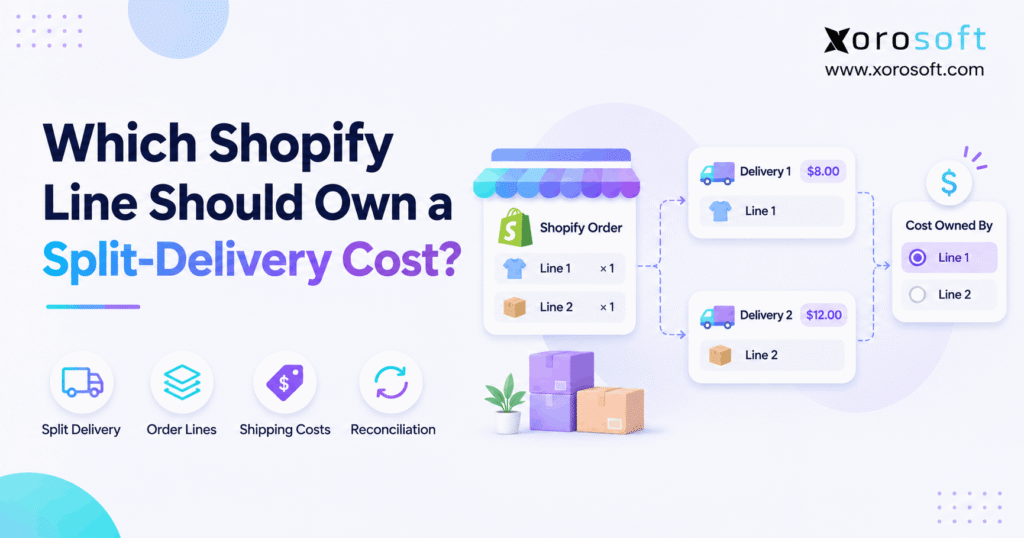
Shopify shipping cost allocation determines how businesses assign actual delivery expenses to shipments and product lines when a single customer order generates multiple deliveries. Consequently, accurate allocation helps merchants protect product margins, reconcile carrier invoices and improve financial reporting.
However, many businesses still distribute shipping expenses equally across every order line. Others assign the entire expense to the first product.
Although these approaches may reconcile at the order level, they often distort individual product profitability.
Therefore, merchants need a consistent method that connects Shopify order lines, actual fulfillment activity and carrier expenses.
1.1 Why One Order Can Create Multiple Shipments
A single Shopify order does not necessarily result in a single delivery. For example, a customer might purchase products available in different warehouses.
Similarly, an order may contain readily available products alongside backordered items. Consequently, the merchant may fulfill those products through separate deliveries.
According to Shopify’s split shipping documentation, fulfillment locations, shipping profiles and product availability can influence checkout delivery grouping.
However, checkout grouping does not always reflect subsequent warehouse execution. Additional partial shipments may occur after the customer places the order.
As a result, finance must track actual deliveries independently of the original checkout structure.
Otherwise, businesses risk assigning expenses to products that never participated in the relevant shipment.
1.2 What Shopify Shipping Cost Allocation Must Capture
Effective Shopify shipping cost allocation must distinguish three separate financial and operational elements.
First, businesses need the shipping amount charged to the customer. Next, they need the actual expense incurred for each delivery. Finally, they need the product quantities included in those deliveries.
For example, a customer might pay $10 for shipping while the merchant spends $24 across two shipments.
Consequently, the merchant absorbs a $14 difference before considering other expenses.
Furthermore, each delivery may contain different products. Therefore, the business must preserve the relationship between individual shipments and their fulfilled quantities.
This approach creates a reliable foundation for expense reconciliation, product profitability and warehouse performance reporting.
2. How Shopify Shipping Cost Allocation Relates to Fulfillment Data
Before assigning delivery expenses, integration teams must understand how Shopify represents orders and fulfillment activities.
Although several records relate to the same customer transaction, each record serves a different operational purpose.
2.1 Identify the Records That Describe the Transaction
A Shopify order represents the overall customer purchase. However, individual order lines identify specific products and quantities.
Meanwhile, shipping lines describe customer-facing shipping methods and pricing. Fulfillment orders identify the work assigned to fulfillment locations.
Subsequently, fulfillment records provide information about products included in actual fulfillment activity.
| Shopify or financial record | Primary responsibility |
|---|---|
| Order | Overall customer transaction |
| LineItem | Purchased product and quantity |
| ShippingLine | Customer shipping method and price |
| FulfillmentOrderLineItem | Assigned fulfillment quantities |
| FulfillmentLineItem | Quantities included in fulfillment |
| Carrier invoice | Actual billed delivery expense |
| ERP allocation record | Distribution of expenses for reporting |
Importantly, no single Shopify order record necessarily contains every financial detail required for actual shipping expense allocation.
Therefore, businesses should connect these records rather than treating them as interchangeable.
2.2 Shopify Shipping Cost Allocation and the 2026-10 API
Shopify introduced the shippingLine field on the FulfillmentOrderLineItem object in its 2026-07 API release. Furthermore, the field appears in the 2026-10 GraphQL Admin API schema.
According to the Shopify FulfillmentOrderLineItem documentation, integrations can retrieve an associated shipping line when that relationship exists.
Consequently, developers gain additional context when connecting fulfillment quantities with customer shipping information.
However, the association does not independently identify the merchant’s actual carrier expense. Moreover, a fulfillment order line may not have an associated shipping line.
Therefore, Shopify shipping cost allocation still requires separate expense records and financial policies.
Integration teams should also verify how their specific API version and connector handle missing or shared shipping line associations.
2.3 Customer Charges Are Not Carrier Expenses
Customer shipping charges represent the amount a buyer pays for delivery. In contrast, carrier expenses represent the amount the merchant pays to transport products.
For example, a customer could pay $12 at checkout while the merchant incurs an $18 delivery expense.
Consequently, the merchant recovers only part of the transportation cost.
Furthermore, free shipping promotions can reduce customer charges to zero without reducing actual delivery expenses.
Similarly, carrier surcharges may increase expenses after the customer completes the purchase.
Therefore, businesses should maintain separate records for customer charges and merchant expenses. Otherwise, checkout pricing can incorrectly influence product profitability and financial reconciliation.
3. Which Line Should Own the Expense?
The actual shipment should own the original delivery expense. Subsequently, finance should allocate that expense to the relevant fulfilled product quantities.
Although Shopify shipping lines provide useful context, they should not independently determine actual expense ownership.
3.1 Shopify Shipping Cost Allocation Starts With the Shipment
Suppose a customer purchases three products through one Shopify order.
Two products ship from Warehouse A. Meanwhile, the third product ships independently from Warehouse B.
The first shipment costs $12. In contrast, the second shipment costs $18.
Therefore, Warehouse A’s shipment should retain its $12 source expense. Similarly, Warehouse B’s shipment should retain its $18 expense.
Finance can then distribute the first expense between the two products that participated in that delivery. Meanwhile, the third product receives the full expense of its separate shipment.
As a result, Shopify shipping cost allocation preserves the relationship between operational activity and financial costs.
Where a carrier bills at package level, businesses should retain that package reference as well.
3.2 Identify the Fulfilled Quantities
An order may contain ten units of one product. However, the warehouse might ship six units immediately and four units later.
In this situation, each delivery generates its own expense.
Therefore, the first shipment should allocate costs only to its six fulfilled units. Similarly, the second shipment should allocate its expense to the remaining four units.
Otherwise, finance could assign expenses to quantities that have not yet shipped.
Furthermore, cancellations and order changes can make original quantities unreliable for expense allocation.
A connected ERP integration environment from Xorosoft provides a foundation for maintaining relationships between ecommerce orders, inventory and fulfillment records.
Nevertheless, businesses must establish clear rules for determining which fulfilled quantities receive each expense.
3.3 Shared Shipping Lines and Duplicate Charges
Several fulfillment order lines may reference the same customer shipping line.
For example, three products could share a single $15 shipping charge. However, an integration that imports $15 for every product would create a total customer charge of $45.
Consequently, the financial records would overstate shipping charges by $30.
Instead, the integration should retain one source shipping charge and preserve its relationships with the relevant product lines.
Similarly, actual carrier expenses should have independent source references.
Therefore, repeated relationships must never create additional expense records automatically.
When businesses need product-level reporting, they can distribute the original charge or expense through a separate allocation process. As a result, the underlying transaction remains traceable.
4. Shopify Shipping Cost Allocation Methods
Products differ in size, weight, value and transportation requirements. Therefore, no single allocation method suits every business.
Finance should select a documented policy that reflects relevant cost drivers and reporting requirements.
4.1 Direct Assignment, Quantity and Weight
Direct assignment works when one product line generates an identifiable delivery expense.
For example, if shipping a washing machine costs $65, finance can assign the full expense to that product. Consequently, no shared allocation is necessary.
Quantity-based allocation distributes expenses according to shipped units. For instance, four comparable units sharing a $20 delivery expense receive $5 each.
However, this method becomes less reliable when products differ considerably in size or weight.
Weight-based allocation distributes costs according to each product’s contribution to shipment weight.
Therefore, products responsible for a larger share of weight receive a larger expense allocation.
Nevertheless, businesses should consider carrier pricing rules before assuming that physical weight alone represents the actual transportation cost.
4.2 Volume, Value and Hybrid Policies
Volume-based allocation can benefit businesses selling oversized products. For example, a large but lightweight item may consume more package space than a smaller, heavier product.
Consequently, volume may provide a more meaningful allocation basis.
Value-based allocation distributes expenses according to relative product value. However, expensive products do not necessarily cost more to ship.
Therefore, finance should treat this method as a reporting policy rather than a direct measure of freight usage.
Hybrid allocation combines several cost drivers. For instance, a business could distribute a fixed handling fee by quantity and transportation costs by weight.
| Allocation method | Suitable application | Main limitation |
|---|---|---|
| Direct | Single-product shipment | Limited shared-cost use |
| Quantity | Similar products | Ignores size differences |
| Weight | Heavy merchandise | May overlook dimensions |
| Volume | Bulky products | Requires reliable measurements |
| Value | Financial reporting | May distort physical cost drivers |
| Hybrid | Complex deliveries | Requires stronger controls |
4.3 Shopify Shipping Cost Allocation Formula
Businesses can calculate an individual product’s share of a delivery expense using the following formula:
Allocated line expense = Shipment expense × Individual line allocation basis ÷ Total shipment allocation basis
For example, Product A contributes 3 kg to a shipment weighing 4 kg. Meanwhile, the carrier charges $12 for the delivery.
The calculation becomes:
$12 × 3 ÷ 4 = $9
Consequently, Product A receives a $9 expense allocation. The remaining product receives $3.
However, finance must apply the formula only to products that participated in the relevant shipment.
Furthermore, all allocated amounts should reconcile to the original expense. If rounding creates a small difference, the system should apply a consistent rounding adjustment rule.
Free ERP Readiness Assessment
Are disconnected shipping, warehouse and accounting records making product profitability difficult to measure? Assess whether your existing systems can support reliable delivery expense allocation and reconciliation.
5. Worked Examples Across Multiple Deliveries
Practical examples demonstrate why delivery ownership matters. Although two allocation methods may produce identical order totals, they can generate significantly different product-level results.
The following figures are illustrative.
5.1 Shopify Shipping Cost Allocation Across Warehouses
Consider an order containing three products.
Warehouse A ships Products A and B for $12. Meanwhile, Warehouse B ships Product C for $18.
Product A weighs 3 kg, while Product B weighs 1 kg. Therefore, finance uses weight-based allocation for Shipment 1 and direct assignment for Shipment 2.
| Product | Shipment | Incorrect allocation | Correct allocation |
|---|---|---|---|
| Product A | Shipment 1 | $10 | $9 |
| Product B | Shipment 1 | $10 | $3 |
| Product C | Shipment 2 | $10 | $18 |
| Total | $30 | $30 |
Although both methods reconcile to $30, equal allocation understates Product C’s expense by $8.
Meanwhile, Product B receives $7 more expense than it should.
Consequently, Shopify shipping cost allocation must preserve shipment ownership before distributing shared expenses.
5.2 One Product Line, Two Shipments
Suppose a customer purchases ten identical units.
However, the warehouse ships six units immediately. Subsequently, it ships the remaining four units after receiving additional inventory.
The first delivery costs $18, while the second costs $16.
| Delivery | Fulfilled units | Delivery expense | Expense per unit |
|---|---|---|---|
| Shipment 1 | 6 | $18 | $3.00 |
| Shipment 2 | 4 | $16 | $4.00 |
| Total | 10 | $34 | $3.40 average |
Although the products are identical, their delivery expenses differ.
Therefore, the business should preserve both shipment records rather than applying the first delivery’s rate to every unit.
Furthermore, retaining separate costs helps management identify the additional expense associated with partial fulfillment.
5.3 Shopify Shipping Cost Allocation When Delivery Is Free
A merchant offers free shipping on a $150 customer order.
However, fulfilling that order requires two deliveries costing $14 and $11.
| Financial measure | Amount |
|---|---|
| Product revenue | $150 |
| Customer shipping charge | $0 |
| Shipment 1 expense | $14 |
| Shipment 2 expense | $11 |
| Total delivery expense | $25 |
Consequently, the business absorbs the full $25 transportation expense.
Nevertheless, the shipping charge displayed in Shopify remains zero.
Therefore, Shopify shipping cost allocation must distribute the actual $25 expense across the relevant fulfilled products.
Furthermore, marketing teams should consider these expenses when reviewing free shipping campaigns.
Otherwise, higher order volumes could conceal weaker contribution margins and rising fulfillment expenses.
6. The Impact on Accounting and Profitability
Delivery expenses influence pricing decisions, promotional performance and customer profitability.
Therefore, finance teams need more than a reconciled order total. They also need reliable visibility into the products and fulfillment locations responsible for those expenses.
6.1 Separate Revenue, Expense and Recovery
Businesses should distinguish customer shipping charges from actual transportation expenses.
For example, an order generates $20 in customer shipping charges while the merchant incurs $30 in carrier expenses.
Consequently, the business recovers approximately two-thirds of its delivery cost.
Finance can calculate this management metric using the following formula:
Shipping cost recovery rate = Net customer shipping charges ÷ Actual shipping expenses × 100
In this example:
$20 ÷ $30 × 100 = 66.7%
However, this metric does not replace the company’s financial reporting policies.
Furthermore, businesses should exclude or account separately for relevant taxes when calculating shipping recovery.
As a result, management can evaluate delivery pricing and promotional decisions using consistent financial measures.
6.2 Shopify Shipping Cost Allocation and SKU Contribution
Incorrect expense allocation can make profitable products appear unprofitable. Conversely, products that generate higher transportation expenses may appear more profitable than they actually are.
Consider the earlier three-product order.
| Product | Net sales | Product COGS | Shipping expense | Contribution |
|---|---|---|---|---|
| Product A | $50 | $25 | $9 | $16 |
| Product B | $30 | $15 | $3 | $12 |
| Product C | $80 | $40 | $18 | $22 |
| Total | $160 | $80 | $30 | $50 |
The example excludes other variable expenses and customer shipping revenue.
However, equal allocation would assign $10 to each product. Consequently, Product B’s contribution would fall artificially while Product C’s contribution would increase.
Integrated accounting and reporting through Xorosoft’s XoroERP platform provide a foundation for connecting operational records with financial analysis.
6.3 Accruals, Carrier Adjustments and Inventory Valuation
Carrier invoices may arrive after the relevant products ship. Therefore, businesses may need to estimate incurred delivery expenses before receiving final charges.
For example, finance initially records an estimated $30 delivery expense. Subsequently, the carrier confirms an actual expense of $34.
Consequently, finance must account for the $4 difference under its approved accounting policy.
Furthermore, the adjustment should retain the original shipment reference.
Businesses must also distinguish outbound transportation expenses from inbound inventory costs.
Under applicable accounting principles, transportation needed to bring inventory to its required location and condition may form part of inventory cost. In contrast, ordinary outbound selling expenses generally do not increase inventory carrying value under IAS 2 inventory principles.
Therefore, product-level management allocations should not automatically change inventory valuation.
7. Shopify Shipping Cost Allocation Controls
Even a well-designed allocation policy can produce incorrect results when underlying transaction records contain errors.
Consequently, businesses must combine financial rules with integration controls, reconciliation processes and clear operational responsibilities.
7.1 Prevent Repeated Imports and Missing Records
Repeated integration events can create duplicate shipping charges or expense records.
For example, an API request may succeed even though the sending system does not receive confirmation. Consequently, the system may retry the same transaction.
Without suitable controls, that retry could create another financial record.
Therefore, integrations should identify previously processed charges through stable source references and appropriate transaction identifiers.
Furthermore, systems should distinguish legitimate cost adjustments from duplicate records.
| Common error | Recommended control |
|---|---|
| Duplicate shipping charge | Unique shipping charge reference |
| Duplicate carrier expense | Invoice and charge matching |
| Expense assigned to unshipped products | Fulfilled quantity validation |
| Missing shipping expense | Shipment reconciliation |
| Incorrect currency | Approved conversion policy |
| Missing adjustment | Original expense reference |
As a result, finance can investigate exceptions without losing the original transaction history.
7.2 Handle Cancellations, Credits and Returns
Order cancellations do not always eliminate delivery expenses.
For example, a merchant might cancel an unshipped order and request a shipping label refund. However, a completed delivery may retain its original carrier charge.
Similarly, refunding a product does not automatically reverse the expense of shipping it.
Therefore, businesses should maintain separate records for customer refunds, carrier credits and return transportation expenses.
According to Shopify’s shipping label billing guidance, shipping label expenses can also change through subsequent billing adjustments.
Consequently, finance should link adjustments to their original transactions.
Furthermore, businesses should avoid deleting historical shipment expenses when processing refunds. Instead, they should retain the original record and create an appropriate financial adjustment.
7.3 Audit Shopify Shipping Cost Allocation at Month-End
Before closing a financial period, finance should reconcile actual delivery expenses against the corresponding shipment records.
First, identify completed shipments without recorded costs. Next, investigate carrier expenses without matching shipments.
In addition, review duplicate transactions, missing quantities and allocation differences.
Businesses should also confirm whether late carrier adjustments require accruals or corrections.
For example, a shipment may have accurate fulfillment records but an incomplete expense estimate. Consequently, product contribution could remain overstated until finance records the difference.
Xorosoft’s XoroWMS warehouse management system connects warehouse activities with the wider operational environment.
However, businesses should still assign clear responsibilities for resolving financial exceptions and approving adjustments.
8. Connecting Orders, Warehouses and Finance
As order volumes grow, spreadsheets often struggle to maintain reliable relationships between products, shipments and carrier expenses.
Therefore, businesses should evaluate whether connected operational systems can reduce manual reconciliation and improve transaction visibility.
8.1 ERP Workflows for Shopify Shipping Cost Allocation
A reliable workflow should connect customer orders, warehouse execution and financial transactions.
First, the integration receives Shopify orders and their associated line details. Next, warehouse teams confirm actual fulfillment quantities.
Subsequently, carrier expenses enter the financial workflow through supported invoices, label charges or third-party records.
Finally, finance allocates and reconciles those expenses.
Xorosoft provides connected inventory, warehouse, ecommerce and accounting capabilities. Furthermore, its native Shopify integration supports relevant order, inventory and fulfillment workflows.
Businesses can review the integration through the Shopify App Store.
Nevertheless, implementation teams should verify specific carrier integrations, API fields and allocation requirements before deployment.
Consequently, the selected workflow should reflect actual operational requirements rather than assumptions about automatic expense allocation.
8.2 Design the Minimum Transaction Data Model
Reliable Shopify shipping cost allocation requires a clear relationship between operational events and expense records.
Therefore, integration teams should establish which identifiers and financial attributes they need to retain.
| Required field | Operational purpose |
|---|---|
| Order ID | Identifies the customer order |
| Order line ID | Identifies purchased products |
| Fulfillment order line ID | Identifies assigned fulfillment quantities |
| Fulfillment or shipment ID | Connects actual delivery activity |
| Shipping line ID, when available | Identifies customer shipping pricing |
| Fulfilled quantity | Determines eligible product quantities |
| Carrier charge reference | Identifies actual expense |
| Warehouse location | Supports location reporting |
| Allocation method | Records the approved policy |
| Currency | Supports financial consistency |
| Adjustment reference | Preserves cost correction history |
Furthermore, teams should retain relevant timestamps and source records. As a result, finance can investigate differences between estimated and confirmed expenses.
8.3 Test Shopify Shipping Cost Allocation Before Deployment
Before launching an integration, businesses should test both ordinary transactions and operational exceptions.
For example, a normal order may contain two products sharing one delivery. However, another order may contain products fulfilled through several locations.
Consequently, implementation teams should validate both scenarios.
A practical testing process includes:
- Confirming actual shipment identifiers.
- Validating fulfilled product quantities.
- Identifying associated customer shipping charges.
- Retrieving actual delivery expenses.
- Applying the approved allocation method.
- Reconciling allocated amounts against source expenses.
- Testing duplicate records, refunds and adjustments.
Furthermore, businesses should test orders without shipping line associations.
Xorosoft’s connected XoroONE business platform brings operational and financial capabilities together.
Nevertheless, teams should confirm support for their required allocation policies, carrier sources and Shopify API relationships during implementation.
9. Choosing an Approach That Matches Your Operations
Different businesses face different delivery requirements.
Therefore, the appropriate allocation policy depends on product characteristics, fulfillment complexity, financial reporting requirements and available source data.
9.1 Shopify Shipping Cost Allocation by Industry
For apparel merchants, several products may share one delivery. Consequently, quantity or weight-based allocation may provide a practical starting point.
In contrast, furniture businesses often ship oversized products separately from smaller accessories.
Similarly, food distributors may require different transportation services for refrigerated and ambient products.
| Industry | Common challenge | Suitable starting approach |
|---|---|---|
| Apparel and fashion | Multi-location fulfillment | Quantity or weight |
| Furniture | Oversized merchandise | Direct or volume |
| Sporting goods | Heavy and lightweight products | Weight or hybrid |
| Food and beverage | Temperature-controlled deliveries | Shipment-specific |
| Wholesale distribution | Large partial shipments | Shipment and quantity |
| Manufacturing | Finished goods and backorders | Actual delivery allocation |
Furthermore, businesses should adapt policies to actual carrier pricing.
Xorosoft serves multiple inventory-driven industries, where connected operations can support more consistent financial analysis.
9.2 When Basic Tracking Is Enough
Not every merchant requires detailed product-level expense allocation.
For example, a small business shipping similar products from one warehouse may find order-level tracking sufficient.
Furthermore, low transaction volumes can make manual reconciliation manageable.
However, the limitations become more noticeable when businesses introduce several warehouses, shipping providers or fulfillment channels.
| Operational approach | Best suited for |
|---|---|
| Spreadsheet tracking | Low shipment volumes |
| Order-level expense tracking | Simple delivery operations |
| Shipment-level tracking | Distributed fulfillment |
| Connected ERP workflows | Complex operational and financial requirements |
Therefore, businesses should evaluate the cost and value of additional reporting detail.
Although detailed allocation can improve visibility, unnecessary complexity may increase administrative work without materially improving decisions.
9.3 When Shopify Shipping Cost Allocation Needs ERP
Businesses should consider connected ERP workflows when delivery expenses become difficult to reconcile manually.
For example, finance may spend considerable time matching carrier invoices with customer orders. Meanwhile, operations teams may struggle to identify the warehouses responsible for rising transportation expenses.
Furthermore, frequent partial shipments can make spreadsheet-based calculations increasingly difficult.
Common indicators include recurring duplicate costs, delayed financial closes, inconsistent SKU margins and missing delivery expense records.
Consequently, businesses should review whether their existing systems can preserve reliable transaction relationships.
However, an ERP implementation should not begin with software selection alone. First, establish the allocation policy. Then, identify required data and integration controls.
Watch Demo
Explore how connected order management, warehouse execution, inventory and accounting workflows can reduce fragmented operational records.
10. Make Shopify Shipping Cost Allocation Traceable
Shopify shipping cost allocation works best when businesses separate customer shipping charges from actual delivery expenses.
First, identify the shipment that incurred the cost. Then, distribute that expense across the relevant fulfilled product quantities using a consistent policy.
Furthermore, retain source transaction references so finance can reconcile carrier invoices, credits and later adjustments.
Consequently, accurate cost ownership helps businesses protect product margins, improve financial visibility and understand the real expense of fulfilling customer orders.
If disconnected systems make shipping reconciliation increasingly difficult, Book a Demo with Xorosoft to explore how connected ERP, inventory, warehouse and accounting workflows can support your operations.
Frequently Asked Questions
What is Shopify shipping cost allocation?
It assigns actual delivery expenses to shipments and the product quantities shipped within them. As a result, finance can reconcile carrier charges and measure product contribution more accurately.
Which Shopify line should own a split-delivery cost?
The actual shipment owns the source expense. Then, finance distributes that cost across its fulfilled product lines using a documented basis, such as weight, quantity or direct assignment.
Does a Shopify shipping line show actual carrier cost?
No. It represents customer-facing shipping pricing. However, the merchant’s actual expense may come from shipping label billing, carrier invoices or third-party logistics records.
How should shipping costs be allocated across warehouses?
First, identify expenses incurred by each warehouse shipment. Then, allocate those costs only to its fulfilled products. This preserves location-level cost reporting and prevents unrelated deliveries from sharing expenses.
What happens when one product ships in two deliveries?
Each delivery retains its own expense. Therefore, allocate costs using the quantities fulfilled in each shipment, rather than applying the original order quantity to both deliveries.
How do refunds affect split-delivery expenses?
A customer refund changes revenue or shipping recovery. However, it does not automatically reverse carrier costs. Record a separate expense adjustment only when supporting evidence justifies it.
When should merchants use ERP for shipping cost allocation?
Consider ERP when split shipments, multiple warehouses, carrier adjustments and manual reconciliation make expense tracking unreliable. For example, persistent differences between order totals and product margins warrant investigation.
Recent Posts
-
 WMS for Footwear Brands Managing Launch-Day Order Waves
-
 Shopify Delivery-Cost Mapping Benchmarks 2026: Allocation, Errors, and Reconciliation
-
 Revenue vs Gross-Margin Commission Plans for Distributors
-
 How to Run an ERP Conference Room Pilot With Real Business Scenarios
-
 Inventory Reserve Accounting: How Risk Becomes a Financial Estimate