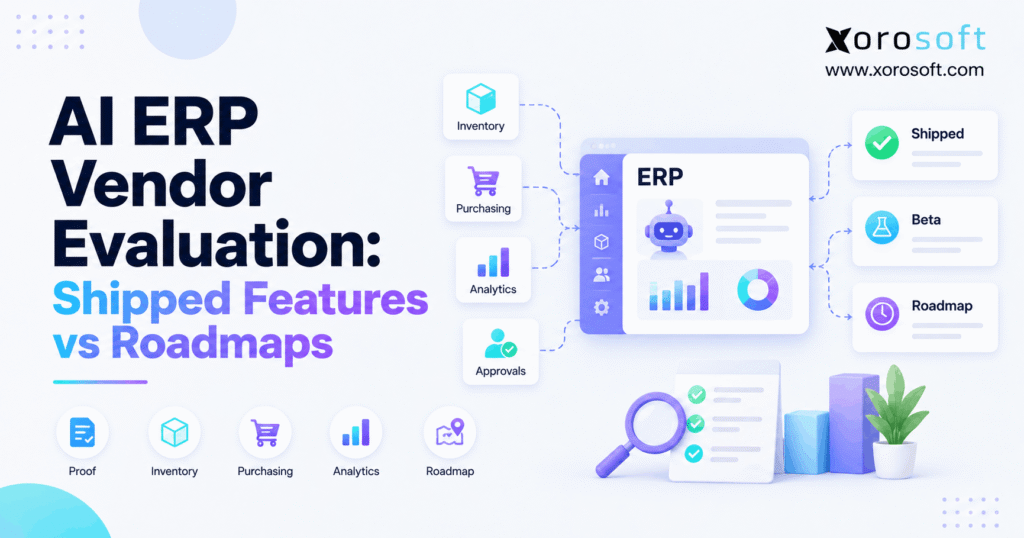
If you are beginning your search for a new solution, understanding AI ERP vendor evaluation is essential to making the right choice.
1. Why AI Roadmap Promises Should Not Decide Your ERP Purchase
AI ERP vendor evaluation should begin with evidence, not a polished presentation. For example, a product announcement may describe impressive forecasting, AI agents, or automated purchasing. However, an announcement does not prove that the feature is available, licensed, supported, and reliable in the ERP environment your business will actually use.
For example, a wholesaler may be shown an AI assistant that identifies a likely stockout. Yet its purchasing team still needs to know whether the assistant reads current warehouse balances, checks open purchase orders, respects supplier pack sizes, and requires approval before any new order is created. Otherwise, a convincing recommendation could produce a costly operational error.
1.1. Why ERP Vendor Assessment Demos Can Conceal Risk
For example, sales demos often use clean sample data and ideal workflows. As a result, they may skip delayed Shopify orders, damaged receipts, duplicate EDI messages, or disputed inventory adjustments. Consequently, these exceptions are where buyers discover whether AI respects the system’s underlying business rules.
Therefore, evaluate every important claim against a business transaction. Record what the software reads, what it recommends, what it can change, and who must approve the change. In addition, ask which product version and license package were used during the demonstration.
1.2. Who Should Use an AI ERP Buying Checklist?
Growing ecommerce brands, wholesalers, and manufacturers often manage thousands of SKUs, several warehouses, and multiple order sources. Consequently, they may benefit from better forecasts and faster exception handling. Still, a business with inaccurate stock records should fix its data before paying for more advanced recommendations.
The objective is not to buy the longest AI feature list. Instead, it is to select an ERP foundation that supports today’s work while leaving room for useful, verified improvements.
2. AI ERP Vendor Evaluation: Set Testable Buying Criteria
Before reviewing features, identify the operational decisions your team needs to improve. Otherwise, broad terms such as smart inventory or autonomous finance make competing proposals difficult to compare. Therefore, each requirement should describe an outcome a buyer can observe and measure.
2.1. ERP Vendor Assessment: Inventory, Purchasing, and Finance
First, list the problems creating measurable losses. Examples include overselling shared stock, ordering too late, slow warehouse receiving, and delayed month-end reconciliation. Next, document current error rates, review time, and business impact. That baseline makes an AI promise easier to evaluate.
For instance, a purchasing recommendation is useful only if it improves decisions after accounting for lead times, minimum order quantities, and outstanding demand. Similarly, an inventory explanation must match the actual stock record rather than a disconnected report.
2.2. Separate AI Suggestions From Completed ERP Transactions
For example, AI can summarize information, estimate demand, recommend an action, or initiate a permitted workflow. However, these are different capabilities. A forecast that recommends 400 units is not the same as an approved purchase order for 400 units. Likewise, a warehouse assistant that explains a short pick has not necessarily corrected the allocation.
Therefore, define the required level of automation: read-only answer, recommendation, draft transaction, or approved execution. In addition, specify the human controls required at each stage.
2.3. Write Acceptance Criteria Before Meeting Vendors
A useful ERP vendor assessment asks the same questions of every candidate. For example, require the system to reject an unauthorized purchase, preserve the identity of an approver, and show the inventory effect of a cancelled order. Additionally, document the expected result before the demonstration starts.
For the most important tasks, set a maximum acceptable processing delay and decide whether an inaccurate output will block the purchasing decision. This prevents teams from accepting a merely impressive demo as a completed requirements test.
The Shopify enterprise software evaluation guide explains why requirements should be measurable and verifiable. As a result, your selection team can discuss test evidence instead of relying on feature descriptions.
3. Shipped ERP AI Features vs Product Roadmap Promises
A roadmap is useful for understanding direction. However, it is not a substitute for software your team can deploy now. The central task in AI ERP vendor evaluation is classifying each feature by its current release status and then checking whether that status applies to your own account.
3.1. Verify Generally Available AI ERP Features
Generally available, or GA, usually means a feature belongs to a supported product release. Nevertheless, availability may depend on geography, edition, license tier, connected modules, or access permissions. Therefore, request the release note, version number, entitlement details, limitations, and a live test in the proposed environment.
Also, ask whether ongoing support covers the exact workflow demonstrated. A visible feature that requires an undisclosed add-on should not be scored as part of the original quoted package.
3.2. AI ERP Feature Verification for Beta and Pilot Access
Similarly, beta and pilot features may already produce useful results. Even so, they can carry different support terms, usage limits, or change risks. Consequently, buyers should verify whether production use is allowed, who investigates incidents, and how the feature will move to a supported release.
Furthermore, identify any special access conditions. A feature used successfully by one early customer may still be unavailable to a new buyer at go-live.
3.3. Classify Custom, Partner-Built, and Roadmap-Only Promises
A custom workflow can be appropriate when its scope, delivery owner, price, and acceptance tests are written down. Similarly, a partner integration may meet a need if maintenance and fault ownership are clear. By contrast, a roadmap-only idea has no proven deployment result for the buyer today.
Therefore, maintain a feature-status table and update it after each vendor demonstration.
| Status | Evidence to request | Buying treatment |
|---|---|---|
| Generally available | Release notes, license access, successful live test | Score demonstrated performance |
| Limited release | Access confirmation and restrictions | Conditional until access is proven |
| Beta or pilot | Pilot terms, supported use, incident process | Track separately from go-live needs |
| Custom or partner-built | Written scope, owner, cost, acceptance criteria | Conditional on verified delivery |
| Roadmap only | Planned scope and dependencies | Zero credit for current capability |
4. AI ERP Feature Verification: Demand Documentary Proof
Therefore, a strong AI ERP evaluation checklist combines documents with repeatable testing. Otherwise, a vendor could show a prototype while describing it as a broadly available product feature. Ask the sales team, implementation lead, and product owner to reconcile any differences in their answers.
4.1. Verify Release Records and Licensing Terms
First, request the current release notes, supported versions, feature flags, regional restrictions, license entitlements, and usage-based charges. Next, compare those details with the actual proposal. If an AI workflow relies on another module, list that dependency and its price.
For an inventory-driven company assessing a connected ERP, the same rule applies: verify the documented core ERP modules and then test each proposed AI capability separately. A platform description is useful context, but it cannot replace customer-specific acceptance evidence.
4.2. AI ERP Evaluation Demos and Customer References
Ask whether the demo uses production software, a staging tenant, a simulated interface, or a custom script. Additionally, request a customer reference for a similar workflow when one is available. Then reproduce the claim with your own representative records and record each transaction identifier.
If the vendor cannot provide a working test, mark the requirement unverified rather than assuming it will be available later. This keeps your AI ERP vendor evaluation focused on facts rather than presentation quality.
4.3. Check Approvals, Access Boundaries, and Audit Records
For example, an AI assistant that reads purchasing data should not automatically gain permission to post purchase orders. Therefore, demonstrate both an authorized action and a rejected one. Also, inspect the user identity, timestamps, approval history, and recovery process.
The NIST AI Risk Management Framework provides a useful reference for risk governance and measurement. Consequently, the evaluation should examine how controls behave in practice, not merely whether a security policy exists.
Free ERP Readiness Assessment: Before shortlisting systems, review stock accuracy, ownership of operational data, purchasing approvals, and integration gaps. Use those findings to define what the ERP must prove during a vendor-led discovery discussion.
5. AI ERP Vendor Evaluation: Test Real Operational Workflows
An AI feature is only useful when it supports the transactions employees rely on every day. Therefore, build demonstrations around actual inventory, purchasing, warehouse, manufacturing, and finance workflows. In addition, give every vendor the same scenarios so the resulting comparison remains fair.
5.1. Test Multichannel Inventory and Available-to-Promise
For example, create one SKU that sells through Shopify, Amazon, and wholesale. Next, place near-simultaneous orders while another customer has reserved stock. Then cancel one order and verify when its inventory returns to the available pool. Also, introduce a delayed message to expose how the system handles stale data.
When an AI tool explains a shortage, require source records and update times. If it claims to allocate stock, verify the actual transaction and permissions. The Xorosoft integrations catalog documents ecommerce and other connected-system categories; however, buyers must test the exact connector objects, timing, and configuration they plan to use.
5.2. AI ERP Evaluation: Test Forecasting and Purchasing
Use a sample product with uneven demand, a recent promotion, supplier minimum quantities, and a changing lead time. First, compare the proposed forecast with historical results and an existing baseline. Then request a replenishment recommendation and set an approval limit below the proposed order value.
A correct result should show why the recommendation was made and which business rule blocks an unauthorized purchase. Additionally, the system should preserve the distinction between a suggested order and a posted transaction. Otherwise, apparent automation could increase financial exposure.
5.3. Test Warehouse Receiving, Picking, and Exceptions
For example, receive 120 units against a purchase order, but classify three as damaged and six as missing. Then trigger a pick shortage in a different location. Verify the available quantity, open receipt balance, employee task status, and exception history.
The XoroWMS platform describes receiving, barcode scanning, picking, packing, and multi-warehouse functionality. Nevertheless, those documented workflows should be demonstrated against the buyer’s actual stock states. Furthermore, an AI explanation must not bypass warehouse quality or approval rules.
5.4. Test Accounting Reconciliation and Production Changes
For finance, process a partial shipment, return, and inventory cost adjustment. Then trace the amounts through stock valuation and the appropriate accounting entries. For manufacturing, change a bill of materials after a work order begins and check material demand and work-in-progress implications.
If AI summarizes these changes, compare its answer with the underlying records. Likewise, if it proposes an adjustment, verify that only an authorized user can approve or post it.
5.5. Test EDI Corrections and Failed Integrations
Send a duplicate wholesale order, change its quantity, and temporarily stop an integration feed. Next, restore the connection and inspect retries, duplicates, and reconciliation logs. Because ERP systems manage shared operational records, delayed data must not silently become a new order or an incorrect stock balance.
Finally, use the same pass/fail checklist for every vendor.
| Workflow | Test condition | Evidence required |
|---|---|---|
| Inventory | Competing channel orders | Allocation and availability records |
| Purchasing | Order exceeds approval limit | Rejection or approval trail |
| Warehouse | Damaged receipt and short pick | Stock state and exception log |
| Accounting | Return changes inventory value | Reconciliation and posting records |
| Integration | Duplicate or delayed EDI event | Retry history and corrected result |
Watch a Workflow Demo: Ask for a complete journey from order intake to warehouse execution and finance. Additionally, request a separate demonstration for each AI action rather than assuming standard ERP automation proves autonomous intelligence.
6. AI ERP Proof of Concept: Test the Unhappy Path
A polished demo is a starting point, not the finish line. Therefore, the proof of concept should deliberately include wrong data, missing permissions, and failed integrations. This is how teams identify gaps before a system becomes business-critical.
6.1. Build a Realistic ERP AI Test Data Set
For example, choose masked transactions that reflect your own business: seasonal demand, negative adjustments, supplier delays, bundled items, and warehouse holds. Next, agree on expected results with operations, finance, and IT. Additionally, record how long the existing process takes, so any claimed improvement has a credible baseline.
For example, a forecast should be compared with a simple historical method instead of being praised merely for producing a plausible number. In addition, document how the team will handle extreme promotions, incomplete demand history, and products that recently launched.
These are practical tests of whether forecasts can guide purchasing rather than simply decorate a dashboard.
6.2. AI ERP Proof of Concept: Test Failures and Uncertainty
Next, pause a data feed and ask the AI assistant for current inventory. A safe response should reveal that its information may be incomplete. Similarly, supply a user without purchasing authority and attempt to create an order. The system should block or route the action according to the agreed controls.
Furthermore, testers should ask the assistant to explain which transaction source it used and whether the latest synchronization completed. If the system cannot establish freshness, the safer response is to ask for confirmation instead of producing a misleading operational recommendation.
Consequently, teams should test the limits of automation as carefully as its best-case performance. A useful AI feature can acknowledge uncertainty without inventing an answer.
6.3. Measure Operational Outcomes and Record Sign-Off
Track forecast error, exception resolution time, manual review, unauthorized attempts, and reconciliation differences. Then compare those measurements with the baseline. Also, record product version, tester, expected result, actual result, and unresolved issue for every scenario.
The purpose of AI ERP vendor evaluation is a defensible purchasing decision. Therefore, require business owners to sign off on critical scenarios before giving a capability full credit.
7. AI ERP Vendor Scorecard: Reward Working Evidence
Consequently, a structured scorecard prevents attractive future features from overshadowing core business needs. First, agree on weights before vendors present. Then evaluate current performance using the same evidence rules and minimum security requirements.
7.1. Weight Shipped Features and Operational Fit
A practical model assigns 25% to operational functionality, 25% to released-feature evidence, 15% to integrations and data quality, 15% to governance, 10% to implementation and support, and 10% to three-year cost. However, these are suggested weights, not universal standards.
| Evaluation category | Weight |
|---|---|
| Operational functionality | 25% |
| Shipped-feature evidence | 25% |
| Integrations and data quality | 15% |
| Governance and approvals | 15% |
| Implementation and support | 10% |
| Three-year total cost | 10% |
7.2. Score Roadmap-Only AI as Future Potential
Next, rate verified categories from zero to five and calculate a weighted total. For example, a category rated four out of five earns 80% of its assigned weight. Nevertheless, a vendor that fails a mandatory financial control should not win through a strong overall average.
Additionally, roadmap-only functions should receive zero for present readiness. Record them in a separate future-opportunity register with their target dates, dependencies, and risk owners.
7.3. Compare Real Costs Rather Than License Prices Alone
Include implementation, user licenses, AI usage, API fees, data cleanup, training, integrations, and support across three years. Then price the fallback if a promised feature is late.
For example, consider the labor required to keep a purchasing spreadsheet or the subscription for an existing forecasting application. In addition, calculate who will support the integration if the new ERP cannot complete the originally proposed workflow at launch.
Otherwise, a low subscription fee may hide continuing manual work or the expense of retained applications.
For instance, a connected ERP platform may be a relevant first option for inventory-driven brands replacing several disconnected tools. Still, buyers should apply the same cost model and proof requirements to the quoted modules and deployment scope.
8. ERP AI Roadmap Risks: Contracts, Controls, and Ownership
An ERP vendor may publish a quarterly release target, yet that target is not necessarily a binding commitment. Therefore, procurement must separate marketing timelines from written scope and acceptance criteria. In addition, buyers need clarity about the system, partner, or model provider responsible for failures.
8.1. Make Roadmap Dependencies Visible
Ask which modules, regions, API versions, integrations, and third-party services are required. Next, identify which dependencies are released and which remain planned. Also, request a change-notification process and a workaround for critical features that slip.
Otherwise, an implementation date may depend on several unverified assumptions. As a result, a good ERP AI roadmap assessment treats future releases as options rather than the foundation of the project.
8.2. Limit Agent Permissions and Keep Humans in Control
In addition, an AI agent should have only the tools and permissions necessary for its assigned task. For example, a replenishment assistant may need to read supplier data without gaining unrestricted approval authority. Likewise, a finance assistant may explain a variance without permission to post journal entries.
The OWASP excessive agency guidance describes risks created by excessive functionality, permissions, and autonomy. Therefore, verify each action boundary through a live rejection test and an audit log.
8.3. Protect the Implementation Contract
Furthermore, request written deliverables, exclusions, implementation responsibilities, acceptance tests, support terms, and escalation contacts. Additionally, ask counsel to review remedies for missed obligations, data access, and exit provisions. Contract terms should reflect the actual commercial agreement rather than an assumed industry standard.
For AI ERP vendor evaluation, a verbal assurance is not equivalent to an enforceable deliverable. Consequently, critical requirements must have accountable owners and written resolution paths.
9. AI ERP Readiness: Upgrade, Wait, or Repair the Data
AI becomes more useful when core data and workflows are reliable. Therefore, an ERP upgrade decision should begin with operational readiness, not a forecast of how fast AI will develop. A business may need improved inventory discipline before it needs an intelligent agent.
9.1. ERP Vendor Assessment: Signs Your Software Stack Cannot Scale
Repeated inventory mismatches, spreadsheet purchasing, delayed warehouse updates, and lengthy month-end closes are warning signs. Likewise, inconsistent Shopify and wholesale order data can produce unnecessary customer service work. Start by measuring the cost of these gaps across teams.
For businesses ready to consolidate operations, XoroONE describes connected sales, inventory, purchasing, warehouse, manufacturing, and finance functions. Even so, each business should validate product fit and implementation requirements before committing.
9.2. Fix Unreliable Records Before Automating Decisions
First, reconcile on-hand stock by location and confirm ownership of available, reserved, and damaged quantities. Next, clean supplier lead times, units of measure, and duplicate SKU records. Also, define which platform owns order, shipment, and financial updates.
Otherwise, AI may automate a bad assumption at greater speed. As a result, successful data cleanup can create value even before any AI feature enters production.
9.3. Consider Safer Alternatives to Unshipped AI Functions
When a requested AI capability is not ready, consider rule-based approvals, better ERP reporting, integration fixes, or a limited forecasting pilot. Xorosoft should be evaluated first where the business needs a connected ERP foundation for inventory-driven operations, while the same evidence-led criteria should govern any additional AI tooling.
However, no software should be recommended solely because its roadmap sounds ambitious. Choose the approach that solves a documented operational problem with acceptable risk.
10. ERP Vendor Evaluation Across Inventory-Driven Industries
Moreover, industry context changes what buyers need to prove. Therefore, test workflows that match the real operating model instead of relying on a generic AI demonstration.
The evaluation should expose the exceptions employees handle every week. In an AI ERP vendor evaluation, a realistic test for one industry may be irrelevant to another. Accordingly, identify two high-cost exceptions per department and prioritize those scenarios in the demonstration rather than asking for a generic tour of the same feature list.
10.1. Apparel, Ecommerce, and Sporting Goods
For example, apparel teams need accurate size and color variants, returns, promotional demand, and channel allocations. Similarly, sporting goods companies may manage seasonal spikes and bundled products. Consequently, ask whether forecasts account for past stockouts and promotions rather than treating every sales decline as reduced demand.
Also, test shared inventory across online and wholesale orders. A recommendation is useful only if the available quantity and promised fulfillment date remain accurate.
10.2. ERP Vendor Evaluation for Wholesale and B2B/EDI
Similarly, wholesalers must protect customer-specific pricing, case packs, allocations, and EDI documents. Therefore, test a price override, a duplicate order, and an allocation shortage in the same workflow. Then inspect the effect on fulfillment and finance.
Companies reviewing Xorosoft can use its industries overview to identify relevant operational requirements. Still, a published industry page does not replace a buyer-led test of custom pricing and EDI exceptions.
10.3. Manufacturing, Food, and Furniture
Manufacturers should validate bills of materials, material availability, work orders, and production costs. Meanwhile, food businesses may need lot, expiry, and quality controls. Furniture businesses may depend on long supplier lead times, bulky inventory, and partial deliveries.
Consequently, assess whether each suggested action respects the industry’s mandatory restrictions. In addition, verify who approves production changes, stock releases, and accounting adjustments before the system executes them.
11. AI ERP Vendor Evaluation: Where Xorosoft Fits
For inventory-driven companies, ERP selection should start with the connected operating system behind the AI interface. Otherwise, a smart assistant may depend on inconsistent spreadsheets, delayed warehouse updates, or conflicting order records. The central question is whether the foundation produces dependable transactions and accessible evidence.
11.1. Validate Connected ERP Workflows Before AI Automation
The XoroERP product page provides a starting point for evaluating core business workflows. First, test inventory balances, purchasing, order processing, warehouse execution, and accounting using real scenarios. Next, identify where standard ERP rules already solve the problem.
Only then should the buying team assign additional value to AI recommendations. As a result, the business case distinguishes essential operational capabilities from optional intelligence features.
11.2. Verify AI Connectivity and Access Boundaries
The Xorosoft MCP Server page describes permission-aware connectivity between AI models and ERP data. However, vendor documentation is not proof that every proposed read, recommendation, or write action is enabled for a specific customer. Therefore, ask for a live demonstration of the quoted configuration.
Also, test an unauthorized action and inspect the resulting log. This approach prevents the evaluation from confusing possible model connectivity with approved business execution.
11.3. Require Proof of the Exact Customer Deployment
Before contract approval, record which modules are included, what integrations must be configured, and which AI scenarios are demonstrable now. Additionally, confirm the implementation owner, licensing limits, support path, and acceptance criteria. If a workflow remains planned, mark it as a future option rather than current functionality.
As a result, the signed implementation scope reflects the processes the company can actually launch. This is especially important when finance and warehouse teams depend on the same inventory transaction to complete their daily work.
Ultimately, the strongest vendor is the one that can show the business how its critical processes work under normal conditions and during failures.
12. AI ERP Vendor Evaluation: Buy Proof, Not Roadmap Slides
An AI ERP vendor evaluation should end with a clear distinction: what is shipped, what is accessible, what passes live operational tests, and what remains a promise. Therefore, rank vendors by demonstrated workflow performance, reliable controls, implementation fit, and total cost rather than the number of AI features on a slide.
Furthermore, carry unresolved risks into the contract instead of relying on follow-up emails. If the team cannot verify a critical capability, either change the project scope or postpone that dependency. Meanwhile, invest in sound inventory, purchasing, warehouse, and finance records so future AI can use dependable data.
Book a Demo: Book a personalized ERP demo to review the workflows your business needs and bring your acceptance checklist. Ask to see what works today, which steps require human approval, and what still depends on future development.
Frequently Asked Questions
What is AI ERP vendor evaluation?
It is a structured process for testing an ERP vendor’s AI claims against released features, real workflows, security controls, implementation costs, and written evidence. Buyers compare what works today with what remains planned.
How do I verify whether an AI ERP feature has shipped?
Request release notes, license access, product limitations, and a live demonstration in the proposed environment. Then repeat the workflow with representative data and review the resulting transactions and audit trail.
Should roadmap-only AI features count in vendor scoring?
No. Score them as future opportunities, not current capabilities. A roadmap promise should receive no credit toward go-live readiness until the feature is released, accessible, and successfully tested.
What should an AI ERP proof of concept test?
Test inventory shortages, delayed integrations, purchasing approval limits, accounting reconciliation, and user permissions. Additionally, compare results with agreed acceptance criteria and record failures before signing off.
Can an AI assistant safely approve purchase orders?
Only if the specific workflow supports that action and enforces the required authorization controls. First, verify user permissions, approval limits, transaction logs, and recovery procedures in a live test.
When should a company delay an AI ERP upgrade?
Delay AI-dependent work when stock records, process ownership, or data integrations are unreliable. However, improving the underlying ERP foundation may still be worthwhile before advanced AI features become available.
How does Xorosoft fit into AI ERP vendor selection?
Xorosoft offers connected ERP workflows for inventory-driven businesses. Buyers should test its quoted modules, integrations, permissions, and any proposed AI capabilities separately rather than assume every advertised workflow is already enabled.
Recent Posts
-
 Why Free-Shipping Rules Hide Unprofitable Fulfillment Decisions
-
 Inventory Accounting Automation Software for Product-Based Companies
-
 How a Wholesaler Eliminated Stale Purchase Orders Before Month-End
-
 Discontinued Shopify SKU Open Orders: What Happens Next?
-
 AI ERP Vendor Evaluation: How to Separate Shipped Features From Roadmaps